Showing posts with label media. Show all posts

Wednesday, April 13, 2011

Memory of the Future: Joan Grossman’s Video and David McIntire’s Music

H   istory is marked by catastrophic events that defy meaning and understanding. The 20th century was a century of prosperity and progress; it was also history’s bloodiest. The death toll from war and genocide reached 140 million people. Trauma of this magnitude poses grave challenges to memory and thought. This work explores failures of memory and cognition—The Blackout—as a condition that plagues history, and is particularly problematic in an era of mass media, in which memory is increasingly disembodied and virtualized, undermined by [what might be called] a ‘Generalized Media Disorder’. Technologies of media and war are creating a condition in which the virtual world is displacing the ethical world. The Blackout is a space of memory and thinking that collapses with Catastrophe and falls into a stupor. Humanity has been nearly extinguished by the tremendous violence it has enacted, pushing philosophy, language and ethics to their limits.”
  — BLACKOUT, jacket blurb.
A nd music can be both a political act and powerful antidote to the collapse of social memory and the erosion of community... the withdrawal into passive, vegetative isolation, each at home, continually surfing Netflix, surfing the web.
  • McIntire – ‘Revenants’ (electroacoustic recording, live percussion, 20-min)
  • McIntire & Grossman – ‘Singing Bowl’ (video, electroacoustic, live percussion, 47-min)
T he combination of the video imagery and the live and the electroacoustic music was imaginative and highly listenable and watchable. Joan Grossman’s video was elegant... with a simple beauty that leveraged symmetries across the vertical and/or horizontal axes in the center of the 8 x 6-meter projection screen in Epperson Auditorium. The video involved replication and reflection of imagery in kaleidoscope fashion, at times with superimposed additional imagery blended into the central part of the visual field.

Joan Grossman
U nlike certain computer music / media compositions where the composer-artists ‘try too hard’ or succumb to temptation and use too many of the diverse array of techniques and patches available to them (resulting in sensory overload for the audience, hindering our grasping a memorable meaning or narrative arc), McIntire and Grossman achieved a satisfying, deliciously cohesive, coherent effect.

David McIntire
P ercussionists Jennifer Wagner and Christopher Howard performed at percussion tables on the right- and left-hand sides of the auditorium, while the recorded electroacoustic tracks were played through Mackie SRS 450® powered monitors and SRS 1500® subwoofer at the front of house. Seated as I was front-and-center, the antiphonal bells and gongs and cymbals, and glass wine goblets bowed across their rims with violin bows, and hammered and brushed brass bowls, and Equilibrium® tuned-box slit-drums, and Daisy® BBs rolling on the underside of a tom-tom drum head—all of this was wonderfully ‘immersive’ with the house lights dimmed. Great sibilance of the live percussion sounds, creating a rich contrast to the electronically-filtered and distorted sampled-voice and other sound content in the digital-recording tracks. [The ‘live’ elements might be better still if yet another pair of percussionists were added, positioning them toward the rear of the auditorium/performancespace so that the entire audience could experience the intense immersive effects that we did at the front.]

Memory of the Future
T he electroacoustic recording and reproduction/sound-reinforcement EQ was expertly done by McIntire. Both of the pieces have a low-pitch ‘red-spectrum’ rumble—almost boilerroom-like, or intrauterine—that imparts a subtle but pervasive ‘interiority’ to the music, very chesty, very warm.

G etting the pre-recorded digital tracks to ‘sit’ well amongst live performers relies on the tracks having an even level, a congenial tonal and level balance, and the right reverberant ambience. McIntire does this superbly, gracefully executing minor adjustments at the workstation control-surface in response to moment-to-moment performance decisions made by Wagner and Howard. Compressor and gain automation settings were spot-on, so that the percussion sounds sat happily in-track, with none of the live percussion effects sounding too loud or too quiet or clashing with the pre-recorded sonic material and synthesizer tracks.

F or some of the voice content (e.g., DECtalk Hawking-esque recitations of NOAA National Weather Service Marine Forecasts; alpha-bravo-charlie...romeo-sierra-tango...zulu), McIntire adds density to the voice sample by upping the compression ratio to maybe around 6:1 or 8:1 and then adjusts the threshold to a couple of dB on average-level parts. This means quieter sections are left alone and anything louder is jumped-on hard, bringing it closer to the average level. The coherence or cohesiveness of these two compositions, each with its volume level and acoustic complexity ascending to a climax about two-thirds of the way through and then tapering to a quiet conclusion, is nicely enhanced by this approach.

M cIntire’s EQ and engineering are commendable as noted above, and he does not go overboard on special effects. His EQ cuts are made over quite narrow bands, and his boosting is gentle and wide. McIntire gently applies boosts in the 50-300Hz band to add warmth. He applies cuts in the 1 KHz band, to deemphasize nasal vocal sounds, and adds generous ‘presence’ with boosts between 4 KHz and 8 KHz. The magical sense of Nature and air and space involves a wide boost applied between 12 KHz and 20 KHz, and that was really beautiful up-front, seated in Row #1. With these two compositions that explore the interplay between Nature and Technology, between humankind and other species—between inanimate noisy things like water (sometimes seemingly talking to us, almost alive, almost human), and supposedly-sentient creatures (humans) who often act in hostile, destructive and uncaring ways as though they were inanimate—the musical and artistic success absolutely depends upon making these EQ choices right.

I n summary, a fantastic, powerful experience—beautifully composed, engineered, filmed, edited, and performed. Very happy!

T he ArtSounds series, of which the McIntire-Grossman ‘Memory of the Future’ program was a part, is co-sponsored by UMKC Conservatory and Kansas City Art Institute.

J oan Grossman is a Brooklyn, New York-based independent media artist and producer. Her work has been screened in more than 20 countries and won numerous awards. She is currently Visiting Professor in Film & Media Arts at UMKC. Grossman was formerly a producer for NPR and Voice of America on a variety of programs, including All Things Considered, Afropop Worldwide, Kids America, and The Territory of Art. She has worked in Africa, China, Russia, and throughout Europe, has produced media for public interest organizations and NGOs, and has also worked as producer on European documentaries and feature films. Joan has a Ph.D. in Media and Philosophy from the European Graduate School and has taught film production and theory. She has worked with leading theorists and filmmakers such as Agnes Varda, Claude Lanzmann, Chantal Akerman, Jean Baudrillard, and Jacques Derrida. Her book, ‘Blackout: On Memory & Catastrophe’, was published in 2009 (link below).

D avid McIntire is a Kansas City, Missouri-based composer who, with composer-musicologist Kyle Gann, co-directed the 2009 Second International Conference on Minimalist Music at UMKC Conservatory. In 2010, he launched Irritable Hedgehog Music, a record label focusing on minimalist and soundscape compositions. McIntire has performed with Colorblind James Experience. With pianist R. Andrew Lee he has produced a recording of Tom Johnson’s ‘Hour for Piano’ (link below).

Memory of the Future


Sunday, March 30, 2008

Few Chamber Orchestras Are Too Big to Fail: Market Size, Scale and Sustainability

 Saint Paul Chamber Orchestra
The culture of electronic media and the internet and the culture of social interaction continue to erode classical music and chamber music concert attendance. In the U.S., possibly some of this erosion is augmented by the economic downturn, but the trend has been relentlessly underway for many years now. Lifestyle and arts consumption choices of shifting generations continue to thwart traditional concert attendance, despite the fact that there are today more high-quality concert events and more diverse programming than ever before.

How long can this go on? Which organizations are likely to survive? How much does size (assets; revenue; financial strength) insure sustainability? Are there norms that are embodied by the strongest and best of the current contenders in this nonprofit chamber music marketplace, that other organizations in the field ought to aim for? Do the treasury management decisions of such leading organizations constitute norms that others should emulate? As weaker organizations begin to fail, will we see some of them get aggregated by joint-ventures or M&A into other larger ‘survivor’ organizations in the same geographic vicinity? And, if so, what are the financial ratios that potential acquirers should look for in due-diligence?

These are questions that are not readily answerable. But it does seem that tough, Darwinian survival-of-the-fittest times are ahead.

Just as you would do if you were evaluating companies and stocks, it’s helpful to consider the competitive landscape for chamber music ensembles by applying some financial-ratio analysis, to characterize the field quantitatively and monitor the players and the outcomes.

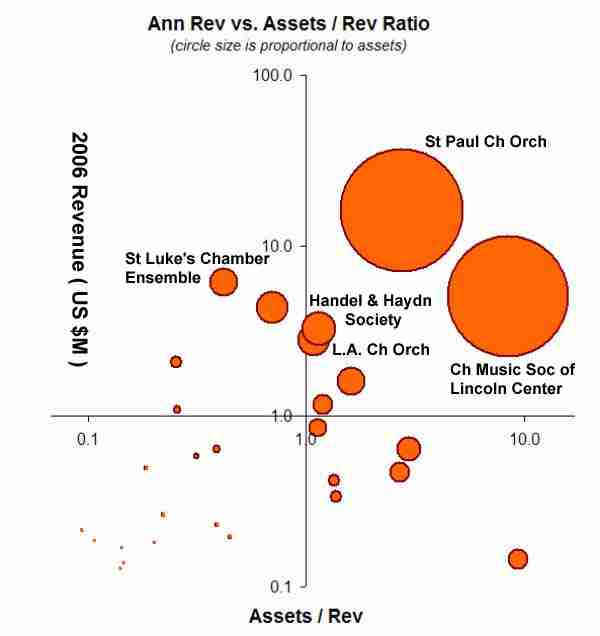
 Form 990 data for 501(c)(3) U.S. chamber orchestras
The log-log plot of the revenue vs. assets-to-revenue ratio shown above is for 35 nonprofit standing chamber orchestra organizations in the U.S. for the most recent year for which data are available, 2006. It provides at-a-glance comparison of top-line revenue and capital-output efficiency. I extracted the data from the federal IRS Form 990 tax documents that are publicly available via Guidestar and other sources. It’s easy to do—took me less than one hour. You may like to do this for your own organization, or for organizations that you make contributions to, to see how they are doing amongst their peers.

The upper-right quadrant contains ensembles that are both highly productive (in terms of revenue generation and free cashflow) and well-endowed. The upper-left quadrant contains ensembles that are very active but are relatively under-capitalized. The lower-right quadrant contains ensembles that are relatively well-endowed but are perhaps under-utilizing their available assets. And the lower-left quadrant contains organizations that are financially at-risk. Although this plot is strictly for standing chamber orchestras, the same sort of statistical distribution and scatter-plot could be done for 501(c)(3) chamber music presenter organizations and other groups. Robert Higgins’s and Richard Bull’s and Murray Dropkin’s books (links below) are particularly good, with regard to understanding and acting upon financial-ratio analysis for nonprofit organizations.

 eMarketer projected social networking annual ad spend
Possibly the most promising strategy for selling to the evolving chamber music market—of all ages—is social networking and Web 2.0 apps. Besides those environments, there are email affinity-marketing services, such as Emma.com, which are significantly more effective and flexible than services that were available several years ago.

When being chased by a bear, your survival first requires that you are not the slowest runner in the woods and that you are running in the best direction for getting away. I seriously doubt that the Federal Reserve will come to the rescue of any chamber music organizations ...

In this regard, the concept of sustainable growth was originally developed by Robert Higgins, Professor of Finance at the School of Business Administration, University of Washington. The sustainable growth rate (SGR) of any enterprise is the maximum rate of growth in sales that can be achieved, given the enterprise’s profitability, asset utilization, and debt (financial leverage) ratios. The variables in the SGR equation are the following:

  1. the net profit margin on new and existing revenues (P);
  2. the asset turnover ratio, which is the ratio of sales revenues to total assets (A);
  3. the retention rate, which is defined as the fraction of earnings retained in the business (R);
  4. the assets to beginning-of-period equity ratio (T).
To compute an orchestra’s SGR, multiply the four variables together, or, in other words, the SGR = P x A x R x T. Alternatively, the SGR equals the retention ratio, times the return on beginning-of-period equity.

The SGR increases when the operating margin increases, the assets to beginning-of-period equity increases, the asset turnover increases, or the retention rate increases. The sustainable growth model assumes that the firm wants to: (a) maintain a target capital structure without issuing new equity; and (b) increase sales as rapidly as market conditions allow.

Since the orchestras we are discussing are not-for-profits, the profit-margin term is a bit tricky. But the net income in the operating fund is a suitable proxy for what profit-margin would be in a for-profit enterprise, so the SGR equation can in fact be used for nonprofits.

The concept of sustainable growth can be helpful for planning healthy nonprofit growth. This concept forces managers to consider the financial consequences of sales increases and to set sales growth goals that are consistent with the operating and financial policies of the enterprise. Often, a conflict can arise if growth objectives are not consistent with the value of the organization's sustainable growth. If an orchestra’s sales expand at a rate that exceeds the sustainable rate, one or some combination of the four ratios must change. If an orchestra’s actual revenue growth rate temporarily exceeds the SGR, the required cash can usually be borrowed, against the orchestra’s line-of-credit. When actual growth exceeds the SGR for longer periods, management must formulate a financial strategy from among the following options: (1) permanently increase financial leverage (the issuance of debt); or (2) decrease the total assets to sales ratio. In practice, orchestras may be reluctant to undertake these steps. Orchestras are reluctant to issue debt because of high issue costs, and the unreliable nature of debt funding on terms favorable to the issuer. An orchestra can increase financial leverage only if it has unused debt capacity with assets that can be pledged and its debt-to-fund equity ratio is reasonable in relation to other nonprofits. Orchestras can attempt to liquidate marginal programs or intellectual property (such as trademarked broadcast programs or record labels, or branded educational/outreach content), increase ticket prices, or enhance production efficiencies to improve the financial ratios.

In summary, it is possible for an orchestra to grow too aggressively and rapidly, resulting in reduced liquidity and the need to deplete assets. Shrinking attendance and ticket sales is a worse problem, but it is not the only problem that can happen.

 Joseph Horowitz book


Thursday, March 15, 2007

Fontijn’s ‘Desperate Measures’: Confabulating a Plausible Bembo

 La Donna Musicale and Claire Fontijn
It may come as something of a surprise to learn that at least four of the Venetian students of Francesco Cavalli were women: the singer-composer Barbara Strozzi; Betta Mocenigo; Fiorenza Grimani; and the young singer Antonia Padoani.”

  —  Claire Fontijn

CMT: It’s a popular thing in publishing and in movies these days: fan fiction, speculative extension of what’s known. Star Trek’s James T. Kirk when he was at the Academy, in a way that Roddenberry would never have conceived. Taking liberties with Conan Doyle’s Sherlock Holmes. The wildly speculative Da Vinci Code. Buffy the Vampire Slayer, extended ad infinitum; episodes addressed to a seemingly endless demand.

DSM: The sequel-prequel approach is natural, I suppose—for authors and for publishers and marketers. You have a ‘brand’ or ‘franchise’—a ready-made, existing market; people already familiar with the subjects and themes; who find them appealing; who identify with them, and who buy them—and you just continue it.

CMT: The last ten years has seen an explosion of this because of the Web. Anybody who wants to write fan fiction can now do it, with almost zero investment other than their time. And, increasingly, some originators of the intellectual property are relinquishing certain rights to their characters or works—at least in idioms that they themselves do not intend to pursue. That was the subject of one of the pieces on the NPR Morning Edition program this morning . . .

DSM: It’s surprising, though, to see instances of this when the phenomenon touches some of the more arcane dimensions of classical music and early music. We are not astonished to see a film like Amadeus appear, but would we be astonished to see Claire Fontijn’s biography of Antonia Padoani Bembo made into a feature film?

CMT: Well, it would be exotic, I admit. But Fontijn’s book and the accompanying CD are juicy. Bembo was a larger-than-life figure. She was blocked by the church from divorcing her abusive husband and fled from Venice to Paris, where she worked as a composer at the court of Louis XIV. There are a number of aspects that would resonate with feminists in North America, Europe, and elsewhere. ‘Desperate Measures’ is bona fide biography—fastidiously respecting historical details and the preserved correspondence of Antonia Padoani Bembo; all the extant details—as befits Fontijn’s role as Associate Professor and Chairperson of the Department of Music at Wellesley College in Boston. But the book is a page-turner! It reads like an A.S. Byatt book. I can see that ‘Desperate Measures’ could readily be turned into a successful screenplay. This book is not the mere publication of Fontijn’s 1994 doctoral thesis!

Claire Fontijn, Venice
DSM: Antonia Padoani Bembo fled the abusive situation and had to leave her children in Venice, is that right? Her rapport with Louis XIV, according to Fontijn, caused Louis XIV to change his views of women generally—not just women as composers, but women as equals of men in all respects?

CMT: She lived with Louis XIV’s sponsorship in a flat near the church of Notre Dame de Bonne Nouvelle. But her situation was still precarious and highly dependent upon Louis XIV—both financially and socially. So don’t get carried away with your notions of ‘equal’ or Louis XIV’s progressiveness. Bembo continued to worry about people revealing where she lived. The scanty correspondence that Bembo left gives us few factual clues as to why this concern persisted, years after her departure from Venice.

DSM: But there is no evidence of paranoia or other psychiatric issues. ‘Desperate Measures’ is perfect—very Byatt-like in its portraying the backstory of Fontijn’s own sleuthing to deduce the motives and causes behind Bembo’s life!

CMT: So Fontijn takes her thesis and wants to write a story, wants to make it accessible to a large audience. Perhaps more to the point, she gets further and further into researching Antonia and discovers a story so rich and multi-faceted that it’s just begging for her to write it. It’s been nibbling at her ankles for ten years now, keeping her up at night with promises of great literature yet to be, and distracting her when she has all sorts of other commitments at Wellesley and with La Donna Musicale and other groups she performs with. She already knows the characters—Louis XIV and many others of them are canon. She embellishes with a few of her own, given that they’ve probably been talking in her head since she began her doctoral program. And she’s got a Creativity Demon. Good for her! The story has legs! It practically writes itself!

DSM: So she writes it down. Fontijn writes what she knows about Bembo’s story, and she writes the way that works for her. She writes best when she does each scene in order, rather than skipping ahead and back and forth—although the Byattish historian in Fontijn does do some chapters that provide character background and context. Some of my writing friends work well when they write the dialogue first, then go back and add descriptions. Some people write the last paragraph or last page, then go to the beginning and see if they get to that point. Some people—my friend Teresa, for example, writes an outline and religiously works from that.

CMT: Plots are very important to this process, and that is something that Fontijn does very well. It must amaze her editor at Oxford University Press! While you can write an academic monograph without a plot (PWP = Plot? What Plot?), if you’re addressing a broad audience and you aspire to selling a screenplay, then you probably want to start with a good plot! In fact, that’s probably the nature of Fontijn’s Creativity Demon: a plot that just won’t go away.

DSM: Or maybe she just had a scenario. What’s the difference? A scenario is “Bembo, displaced from her kids, composes her heart out.” A plot is, “Bembo goes to Paris where she is transformed into a prominent social and political figure, threatening in many ways to elements of the Ancien Regime, and has to adjust to her new lifestyle in the middle of negotiating a trade agreement.” Maybe ten years ago she couldn't tell someone else what the rising and falling action is, or what the goal is that the character Antonia Bembo is seeking. But incubate it awhile! Maybe Fontijn needed to take ten years before she could figure it out for herself.

CMT: No, I think that, given Fontijn’s careful scholarly publications and journal articles, she clearly knew what she had from the start. But what did it mean to her, in 2001, when her story was already over 1 megabyte of juicy story and still wasn’t anywhere near finished? Well, she clearly wasn’t spending too much time going over the same ground. And she wasn’t struggling to stitch fragments together. She realized that this wasn’t just a static ‘plight of baroque woman’ scenario! She had an honest-to-god Plot! She had Antonia and Louis. Are they spending a lot of time thinking long paragraphs about their feelings for each other? She breaks away from the lead characters for a bit and works on a subplot. No, not just one! A second, a third, a fourth plot, related to the main plot. All of these plots may come together at the end (in many good stories, they do, and in many, they remain separate like in real life).

DSM: And in fact this helps to focus her main plot once she’s distanced herself, even if just for a scene or two. Claire Fontijn teaches courses on Early Music, Opera, Women Composers, and German Lieder. She has appeared as a singer and baroque flutist with La Donna Musicale of Boston, the Washington DC Bach Consort, and Le Concert Spirituel of Paris, among other ensembles. Her students must count themselves very lucky!

D   esperate Measures stands midway between scholarly work and novel—with the rigor of the former and the readability of the latter.”

  —  Giovanni Zanovello, Padua, Italy


Desperate Measures


Saturday, December 16, 2006

SpotDJ plus iTunes: Webradio for and by the Chamber Music Community

SpotDJ client app
DSM: I looked on iTunes the other day and there are more than 6,000 string quartet tracks there.

CMT: Did you know there’s a new service called SpotDJ that works with iTunes and plays short MP3 clips (‘spots’) about the track and artist you just listened to in iTunes? At the end of a track, if the SpotDJ database has a spot associated with that track or artist, then the SpotDJ server pushes the spot to your PC, the SpotDJ client app on your PC plays it, and then your iTunes moves on to the next track in your playlist as usual. If SpotDJ doesn't find a spot to play (or if you have more info about an already-spotted track), you can record your own commentary about the track and share it with everyone else who has SpotDJ. It basically makes your private iTunes emulate webradio. The spots that you hear in between tracks are generally interesting—diverting or intellectually engaging—as they should be to have value. The remarks are expansive, encouraging the listener to reflect or stimulating the listener’s thoughts to head off in whatever direction the listener pleases. The spots are not heavy-handed or gavel-slamming. The result is that, instead of your solitary listening to your iTunes playlist, you get a ‘radio-like’ experience of hearing other human beings telling you things, telling you little micro-stories. This imparts a sense of community, a connection with other thoughtful people. It’s virtual radio. True story!

DSM: Is there any curation of the spots by SpotDJ’s webmaster? Are you ever subjected to idiotic or profane spots? Can you skip or kill a spot that you don’t like without having to listen to the whole thing? Does the SpotDJ webmaster do surveillance to make sure that the amateur SpotDJs submitting spots aren’t inserting bootlegged copyrighted material through their PCs, spoofing as ‘spots’? Is there any checking to make sure that somebody reciting something into their mic isn’t reciting some other author’s copyrighted text, misrepresenting the copy of the spot as the SpotDJ user’s own work?

CMT: Not so far as I can tell, to any of the above. But the identity of the submitting SpotDJ user is traceable. So I imagine it’s caveat orator —if a copyright-holder claims violation of copyright then the submitting SpotDJ user would be liable, and Spot DJ would have to remove the offending item.

DSM: Who or what is SpotDJ? Or should I say what is a SpotDJ?

CMT: Any person able to talk into a microphone can be a SpotDJ user/announcer. But besides human SpotDJ users/announcers, SpotDJ is a service that adds commentary to your music listening experience. It detects what track you’re listening to on your PC, communicates with the SpotDJ server so that the server can search its spotlibrary to find previously recorded spots that pertain to that track and select and queue up a spot that you haven’t heard before, and push that spot to the SpotDJ client app on your PC. You listen to your music in iTunes just like normal, but periodically, with a frequency that you specify in your SpotDJ client app preferences, SpotDJ plays a spot between your iTunes tracks. It’s an improvement over the spots you hear on the classical channels on XMradio or Sirius or Last.fm. A spot is simply a few seconds of recorded speech about the track you were listening to. It typically consists of information about the track, a story about the artist, a criticism, news, gossip, or recommendations about recordings or performances—other recordings of the artist just heard, or recordings by other artists who have ‘covered’ the same piece! All of the spots on SpotDJ are created by amateur SpotDJ user-members. So if you’re listening to a track and have something to say about it, just launch SpotDJ, click the “Spot this Song” button and record your spot. Other SpotDJs who later listen to that track in their iTunes environment will hear the spot you recorded.

DSM: What is a Spot, exactly?

CMT: A spot is a short audio clip that you hear between tracks you listen to in iTunes. While you’re listening to your music, SpotDJ checks to see if there are spots that are relevant to the track you’re listening to. When the track is over, you hear one of these 20-second to 1-minute spots! A spot can be just about anything. A spot might tell you something interesting that you didn’t know about one of your favorite tracks. Other spots contain artist updates, concert announcements, trivia, interpretations of tracks, etc.

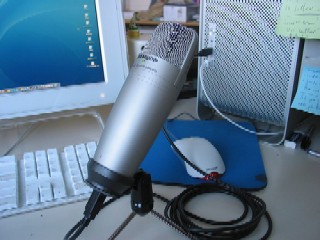
DSM: You know, I do some podcasting already. I’ve got my podcasting microphone and preamp and mixer connected to my PC. I assume SpotDJ works with the equipment I’ve already got, right? How do I record a spot?

CMT: Here’s how to record a SpotDJ spot:
  • Launch SpotDJ, by double-clicking the SpotDJ icon:
  • In iTunes, start playing the track you’d like to spot.
  • When SpotDJ shows the correct track info, click the “Spot this Song!” button:
  • Click the “Record” button:
  • Start talking!
  • Click the “Stop” button to finish:
  • Click the “Play” button to listen to your spot. If you don’t like it, you can record it again:
  • Click “Upload” to send your spot to SpotDJ. It’ll take a few seconds, and then iTunes will go on to the next playlist track.
DSM: How does SpotDJ decide which spots to play when I’m in iTunes and playing the tracks in one of my playlists?

CMT: The spots you hear are determined based on a number of factors. SpotDJ’s server has scripts that construct a list of potential spots to queue up for you based on the title and artist of the track you’re listening to and the log of spots that the SpotDJ has previously served up to your userid. They refine the list based on what you’ve already heard, your list of Faves, the ratings of the spots, and other of the preferences that you’ve set up in your SpotDJ profile.

DSM: Can I record a spot for a track that’s already been ‘spotted’ by somebody else? How about a track that I’ve previously spotted myself?

CMT: Even if a spot already exists for your track, you can go ahead and add your own new spot. Or if you hear a spot that you disagree with, or you want to expand on, add a new spot. You can record multiple spots yourself for the same track.

DSM: What are these ‘Fans and Faves’ things that are showing up in my SpotDJ client app GUI here?

CMT: A Fave is a SpotDJ user who’s recorded a spot, and you have favorably regarded that spot and marked its author as a Fave. Besides when you’re listening to a spot, when your just browsing a DJ’s page you can add that DJ as one of your Faves without necessarily having listened to their spots—if you see from that DJ’s profile that the genres that they do spots on coincide with things that interest you. So Faves are a way to connect with other people while using SpotDJ. Your list of Faves shows up on your DJ page (when other users look at your profile), and the SpotDJ server factors your list of Faves into account when deciding which spots to push to your PC (you’ll tend to get more spots from your Fave DJs). If you record spots yourself and then someone adds you as a Fave, they become one of your Fans. The more Fans you have, the more people tend to hear your spots, and the more popular you look when people view your profile. When you invite a friend to join SpotDJ, they automatically become one of your Fans. This is pretty much like friending in LinkedIn, MySpace, Facebook, and other social networking services.

DSM: Are the principles of doing a good ‘spot’ the same as those that make for a good podcast?

CMT: Well, the short ‘spot’ format—less than 1 minute or so—does make for some differences. Some of the best SpotDJs do seem to be following these practices:
  • Keep it Short! The length of your spot shouldn’t be more than about 20% of the length of the track itself, or people might start to tune out and they’ll just skip the spot. The best spots are less than 30 seconds long. That’s about 100 to 150 words at most. A good spot begins by announcing the track (composer, performer, date recorded, venue, other descriptive information) that you just heard and then gives the listener a brief nugget of info or a micro-vignette about the performer or composition or composer.
  • Emulate a Professional Announcer. Forget that you’re in front of a computer and pretend you’re in a studio sound booth—same as you do with your podcasts. You’ve got a mic in front of you and you just played a track. There are people out there listening, depending on you for interesting commentary and context.
  • Make it Personal. It’s most interesting to hear a DJ talk about their personal experience with an artist or composition.
Most of the spots I’ve heard in SpotDJ so far do tend to be journalistic or reportorial. Wouldn’t necessarily have to be that way, though. I imagine that some classical music SpotDJs in the future might start doing short clips about music theory or performance pedagogy—as long as they’re short and punchy and interesting and don’t go off the deep end with fancy technical language. That might be useful as part of music education classes. But for regular listeners probably the journalistic DJ style/format is what’d attract the most ‘listens’ and lead to other SpotDJ users’ Faving you.

DSM: Why don’t I hear the spot I just recorded here?

CMT: As soon as you uploaded your new spot, the SpotDJ server starts distributing it to people listening to the track you spotted. If you yourself listen to the track after you record your spot, SpotDJ (generally) plays your new spot so you get to hear it first. But I’ve noticed that there are still a few bugs in the current version. If you’re not hearing your own spot, here are some things to keep in mind: In general, SpotDJ’s queueing and dispatching algorithm to plays you spots recorded by other DJ’s because you probably know what you sound like. So after they’ve played your new spot once, you probably won’t get it again from the normal queueing and dispatching algorithm. Also, Spots take some time to download. It depends on the size of the spot you recorded, the bandwidth of your internet connection, how much of that bandwidth is being consumed by other stuff going on on your PC, the amount of traffic that the SpotDJ server is handling at that time, and so on. So if you’re near the end of the track and you recorded a longish spot, SpotDJ might not have enough time to retrieve it and push it to your PC before the track has finished playing on your PC.

DSM: So SpotDJ’s spot-matching algorithm logs the spots that’ve been pushed to each SpotDJ user and won’t play the same spot twice in a row. And if you heard your spot once and then you bring me over to hear it, I probably won’t hear it until at least one other spot has played first—or more typically three or more intervening spots? I see here that spots only play at the end of a track, so if you’re trying to replay it a few times to get the spot to play right away, you can skip to 5-10 seconds before the end to make sure SpotDJ has enough time to download the spot and detect that the track has changed. And you can always view/edit/listen to all your spots from your SpotDJ page, which you can access at your SpotDJ login page.

iTunes track pushing to SpotDJ
DSM: This is cool! I’m listening to spots recorded by other people—the spots that get pushed to my PC when I’m listening to the tracks on my iTunes playlists—and the effect is very much like listening to Karl Haas or other thoughtful classical music commentators. To me, the impression is very much like listening to late-night radio programs. No longer do I feel so solitary listening to my iTunes playlists! Here are these other like-minded human beings talking to me, volunteers telling me things about the tracks that, evidently, we both care about! Suddenly, a new virtual community! I feel connected, not isolated. This is a great new type of social media!

CMT: Yes, the late-night radio effect is something I noticed right away, too. It fosters an intimate, one-on-one relationship between a listener and a voice on the radio—or, in this case, on the SpotDJ-iTunes lash-up emulation of a radio experience. More details are left to the listener’s imagination. Oh, there’s a potential for these kinds of shows to become heavy-handed—or for a dog’s breakfast effect (that is, of various different DJs with very divergent perspectives and attitudes and ‘spot’ production values) to be excessively ‘uneven’ in spot mood or content. And if you don’t have someone on who knows what they’re talking about, or if the DJ is florid or romanticizes the issues, then they’ll do a real disservice to the listening public. The more sensational the spots try to be, or the more egotistical or full of himself/herself a SpotDJ user is, the worse they’ll be. But, thankfully, most of the spots that have been uploaded to SpotDJ so far are pretty good—certainly on a par with professional radio commentators.

DSM: You know, radio and memory are, for many people, very closely linked—a stitching together musical cultures with personal psychologies. The speech of an announcer who we listen to regularly—a Fave now in SpotDJ—becomes like a dear friend over time. The listener develops an internal notion of what the announcer looks like, what sort of a person the announcer is. And that announcer’s voice is coupled very tightly to our memory of the music that that announcer’s voice was associated with, and to our memory of what we were doing or experiencing in our lives around the time when we heard that music and that announcer. The dynamic of sound, ephemeral but powerful, finds a parallel in the dynamic of memory—fluid, complex, deeply ingrained. To grab hold of the certainty of our experience, knowledge, or sensation is often difficult when confronting both sound and memory. Both inscribe us deeply, but each is diffuse and malleable.

CMT: As Steven Connor says, ‘the self that is defined in terms of hearing rather than sight is a self that is imaged not as a point, but as a membrane; not as a picture, but as a channel through which voices and music travels’ (Connor2004, p. 57). Connor says that sound and memory are associated by being always already present, while at the same time oscillating between the ephemeral and the concrete, the diffuse and the certain. Because of this binding and cognitive flux, we get the evolving construction of the self, our identity as persons.

DSM: Radio has ever and always insinuated itself into the human imagination. Radio is a medium of the disembodied voice, and it therefore compels a ‘re-conceptualizing’ of the human body, of the self—broadcast audio media inherently leaves the speaker’s body behind while at the same time powerfully rendering the body in the listener’s mind.

CMT: Whereas ‘live’ performances bind us to the materiality of the immediate and local—the person(s) in front of us—broadcast technology offers the body its own escape, propelling flights of fantasy through the listeners’ imagination. Imaginary flights of fancy!

DSM: By adopting listening as a general attitudinal relation to philosophical inquiry, Fiumara seeks to move beyond the predominance of logo-centric models, which for her situates a particular form of ‘arrogance’ onto the field of knowledge. ‘An aversion towards listening to the rich multiplicity of “reality” seems to be linked with a background of profound fears and to the resulting defensive postures that express themselves in a tendency to reduce knowledge in general to a set of principles from which nothing can escape’. Listening thus provides a link or passage toward a renewed sense of inquiry by allowing us to remain susceptible and receptive, and impassioned less by our own thinking than by what it may converse with.

CMT: The ‘discourse of listening’ continually drives us into a productive ambiguity. This causes us to create new symbols. The thinking radio-listening body—a body that remains bound to listening—is engaged in memory-generating processes, increasing our understanding and feeling and expanding our knowledge. I think this is what makes a radio experience—like what we’re getting from this SpotDJ-iTunes lash-up—so seductive. We crave this otherness, this connectedness with other human beings, this expansive ambiguity, this boundness-to-generate-new-memories and new thoughts and new feelings.

DSM: Beyond that, I think this late-night radio effect is something where the self finds points of reference and security. It’s a ‘bath of community,’ more or less. And with radio memory, replaying is a prominent and typical feature. It’s part of the user’s behavioral paradigm, part of the psychology. Idiomatically, I wait for the DJ to play a track that I like again—or, in iTunes, I cause it to replay whenever I want, simply because I can. And I crave these SpotDJ spots’ evoking new ideas, extending my imaginary flights.

CMT: ‘Radio memory’—and the ways in which this kind of memory fixes itself onto the field of auditory constitution—can be understood as part of the allied musical partnership. For if music is understood as a means for ‘world-making activities’ and for realizing ‘subjectivity and self’, then ‘radio memory’ is a special type of musical understanding—relevant to all genres, not just classical or chamber music. And speech clips or ‘spots’ rendering descriptions of these memories is a powerful instantiation of that. In contrast to an ordinary iPod user, the radiophonic SpotDJ user does not predetermine or control the experience beyond selecting the playlist. Rather, there is a tremendous amount of runtime indirection. The SpotDJ radiophonic listener abdicates control to the SpotDJ server and its inventory of recorded spots. The user’s Faveslist and profile-preferences only moderately influence what will be served up in any given radiophonic SpotDJ-iTunes session. The playlist and accompanying spots are always only heard at the moment of memory-making. They’re served up by the medium of the event itself.

DSM: What radio memory also reveals are how noise contributes—and how indirection and surprise (surprise at the unpredictable spots served up) contribute—on an emotional and psychological level. A communication link through which negotiation and sharing takes place; how ‘location’ gets defined and remembered. Hidden just under the surface, these memories are a tapestry of individual experience; it’s a tapestry that tells the story of my individual negotiation with outside influences—the other SpotDJ DJs and the SpotDJ algorithms—as ‘locational conditions’.

CMT: More than anything, radio is a form of stylized sociality through which ‘location’ is rife with the unexpected. Inevitably, it brings with it new encounters. Think about the ontology of radio itself, interrupting our social reality with stimuli of ‘others’, impressing upon me that I am not an island unto myself despite the fact that I may be alone as I listen—it’s virtual life!

DSM: You’re emphasizing what happens when you do this when you’re alone. But what I want to emphasize is how your individual experience is related to communal sharing and how this ‘synthetic’ SpotDJ-iTunes-based form of amateur webradio provides an unexpected kind of community and sociality.

CMT: That viral, communitarian ‘swarm’ idea runs counter to sociological and musicological viewpoints that posit music as either inherently relational among social groups, or territorialized by the techniques of compositional method and the evolutionary jumps marked out from composer to composer, artist to artist. In any case, it’s very cool!


PodCasting and SpotDJ set-up