Showing posts with label social networking. Show all posts

Friday, March 20, 2009

網絡空間: 個人空間的延展 Cyberspace: China, The Extension of Personal Space & Future of Everything

 Zhou Long
T    hinking about what we could do to share different cultures in our new society, I have been composing music seriously to achieve my goal of improving the understanding between peoples from various backgrounds. My conceptions have often come from ancient Chinese poetry. There are musical traits directly reminiscent of ancient China: sensitive melodies, expressive glissandi in various statements, and, in particular, a peculiarly Chinese undercurrent of tranquility and meditation. The cross-fertilization of color, material, and technique, and on a deeper level, cultural heritage, makes for challenging work. But there is more than this... more than reminiscence.”
  —  Zhou Long.
T he members of UMKC Wind Ensemble and Choir gave a nice performance last night at White Recital Hall (Steven Davis and Joseph Parisi conducting). The program included:

  • Chen Yi: Fanfare [premiere]
  • Zhou Long: The Future of Fire (for orchestra and choir; new transcription) [premiere]
  • Paul Rudy & Bobby Watson: Finally... (Bobby Watson, saxophone) [premiere]
  • James Mobberley: Words of Love (Rebecca Sherburn, soprano)
  • Alban Berg: Kammerkonzert (Benny Kim, violin; Robert Weirich, piano)
E ach work was admirably executed; and it was my intention to post some comments about the Berg piece, since, with 15 parts, it is the only one that’s totally consistent with the focus of CMT exclusively on ‘chamber music’. But limited time prevents me from putting up remarks about more than one piece right now, and ‘Future of Fire’ was the work that most captured my imagination.

P reviously, Zhou’s ‘Future of Fire’ was scored for orchestra and children’s choir—with the timbres and social implications that children singing to a predominantly adult audience can have. It has been performed, though, by adult choirs as well, including Chanticleer.


    [50-sec clip, Chanticleer, Zhou Long, ‘Words of the Sun’, 1.2MB MP3]


    [50-sec clip, Singapore Symphony Orchestra, Zhou Long, ‘Future of Fire’, 1.2MB MP3]

I n his new transcription, the orchestra is smaller, with textures that are more ‘chamber-like’. The 11 female voices were positioned on the left side of the stage, and the 7 men were on the right. The new transcription has the genders trading volleys—some of them lilting and lyrical, others punchy, punctate. There are no ‘extra’ notes, but there is an intense urgency ... a feeling of up-to-the-last-moment ‘indeterminacy’, about which notes the women’s parts will take next, and which notes will form the men’s parts’ response.

S o, ‘Notes Uncle’, which note? 五声阿叔, 孰徵? [wǔ-shēng-à-shú, shú-zhǐ?]

I  was reminded of the infamous YouTube video about ‘Bus Uncle’ [巴士阿叔, bā-shì-à-shú].

T he stream-of-consciousness mode that characterizes much of Zhou’s writing is present in ‘Future of Fire’, but now with a more assertive ‘mash-up’ quality and extemporaneity than it had in the children’s choir version. The volleys of disconnected gestures between the voices, the sound masses where vocal parts are doubled by instruments (women by woodwinds; men by brass)—these are clearly of Chinese origin and they are pure Zhou. But last night in the premiere of the new transcription, the atmospherics expressed (in Zhou’s abstract, modernist manner)... the future, not so much of Fire per se, but of Everything... The future of our world and our relationships with each other and with Authority.

F ire might, I think, be Zhou’s place-holder for ‘technology’ and our evolving array of social practices involving technology. In Web 2.0 social networking, what personal information may today be disclosed without the individual’s consent? 究竟在網絡這個「新世界」中,甚麼資訊是可以透露?

U nder what conditions or circumstances may it be disclosed? 在甚麼條件/情況下透露?

W hat musical expressions are strictly intimate, private, chamber-music-like, such that others have no right to mess with it or interfere with it? 又有甚麼資訊是嚴格屬於私人保有,別人無權干涉的呢?

T hese issues, to me, are what the new transcription of Zhou’s ‘Future of Fire’ assays. Truly wonderful, both in its beauty and in its political/social statement!

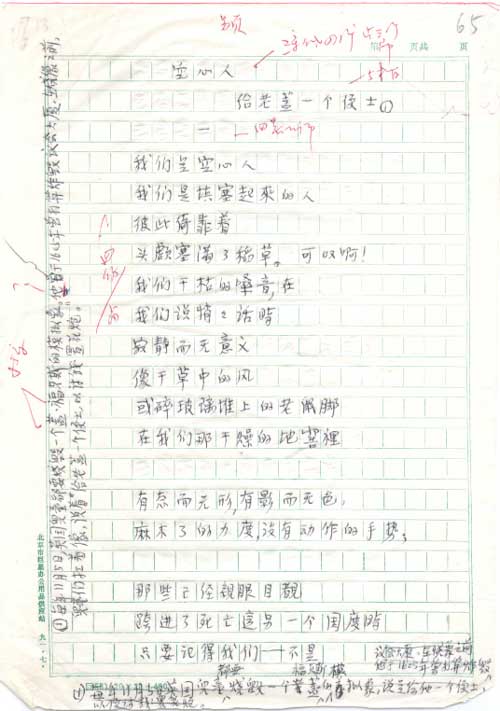
 Lucy Zhao, tr. of Walt Whitman ‘Leaves of Grass: Out of the Cradle, Endlessly Rocking’
I  , the singer of painful and joyous songs, the uniter
         of this life and the next,
Receiving all silent signs, using them all,
         but then, leaping across them at full speed,
Sing of the Past.

[Borne hither, ere all eludes me—hurriedly,
A man, yet by these tears a little boy again,
Throwing myself on the sand, confronting the waves—
I—chanter of pains and joys, uniter
         of here and hereafter,
Taking all hints to use them,
         but swiftly leaping beyond them,
A reminiscence sing.]”
  —  Lucy Zhao, tr. of Walt Whitman ‘Leaves of Grass: Out of the Cradle, Endlessly Rocking’; Peter Hessler, English back-translation from Zhao, in ‘Oracle Bones’, p. 458 ; [Whitman original].


Thursday, March 12, 2009

Matthew Fields: Composer. Humanist. Just-in-Time-Activist. Computer Scientist.

 Matthew Fields
A    ctually, business isn’t always ‘purely Darwinian’. (Please allow me this term because we all know what I mean even if it isn’t what Darwin meant—sorry!)
  Wed, 11-MAR-2009, P. SanGregory / S. Chien
--------
Nope, stop right there. The English language provides ‘cut-throat’, ‘ruthless’, ‘merciless’, ‘relentless’, ‘callous’, ‘cold-blooded’, ‘dog-eat-dog’, ‘inexorable’, ‘iron-fisted’, and many other terms closer to your probable meaning. In contrast, 'Darwinian' selection includes selection for those who are particularly merciful towards kin and whose genes thus survive more frequently than the selfish. ‘Darwinian biology’, i.e. real biology, observes and explains patterns in nature and does not judge them. Let us stop this misuse of the term [‘Darwinian’]. It’s part of the propaganda of the worldwide anti-science [anti-intellectual] movement ... and it undermines the very civilization which affords us [musicians] our roles.”
  —  Matthew H. Fields, Society of Composers listserve, 11-MAR-2009, commenting on draconian MTSU funding cuts, eliminating ~40 non-tenured faculty positions, including ones in Music.
I t’s been some years since I met Matthew Fields, in Winter of 1996 I think, in connection with one of my visits to the Medical Center Information Technology Dept at the University of Michigan Health System in Ann Arbor. His fiery temperament was (and is) propelled by a passionate wish for the world to be a better place. I had not known back then of Matthew’s accomplishments as a composer.

B orn in 1961, Matthew was trained at Oberlin and Stanford, and received his 1991 DMA/PhD at Univ of Michigan. Among other things, he was involved with the [now-defunct] ‘Just In Time Composers of Boston’. He received first prize in the 1991 composition contest of the Ferruccio Busoni Memorial Society, honorable mention in the Harvey Gaul Composition Competition of Pittsburg New Music Ensemble (2000), second place in the composition competition of the Utah Composers Guild (2002), and was co-winner of the League-ISCM Composer’s Competition (2006). There are a couple of CD recordings of his music that have appeared.

H is chamber music compositions are pretty diverse, but I especially enjoy Matthew’s writing for cello.

 Matthew Fields: ‘Rollerchant’ for cello, 2002

    [50-sec clip, Matthew Fields, ‘Rollerchant’, 1.2MB MP3]


 Matthew Fields: ‘Progeny of Memory’ for cello and harp, 2006, Mvt. 1

    [50-sec clip, Matthew Fields, ‘Progeny of Memory’, 1.2MB MP3]

A nd I particularly enjoy his frequent interactions on SCI and other composers’ websites. His remarks are always forthright, incisive, and, in general, address these issues:

  • Where is composing heading? What is being written and why?
  • How is the the art of composing approached today?
  • What obstacles are professional and amateur composers facing in today’s society, in North America and elsewhere?
I n case you are unfamiliar with Matthew’s work, I thought I’d put up this little post with a couple of clips and links. M.H. Fields: thoughtful humanist, innovative computer scientist, progressive activist, pragmatic advocate for peace and community, committed composer-artist ... with a day-job and family.

P    erfect is the Enemy of Good.”
  —  Voltaire.


Tuesday, March 10, 2009

Canonical Form as Social Networking (Reply re: Canonical Form as Epidemic Contagion)

 James Tenney
Y    our infectious/epidemiology model may be the first theory of canonical form that says that voices engaged in canon are passive ... coerced, so to say. As though the neighboring parts had some sort of apraxia until infected. But they are not at a loss for words. They are not passive [respondents]. And you obviously do not have anything like the release of tension, which is the conclusion of normal classical music composition structure.”
  —  Anonymous email to CMT.
I  agree with some of the emailer’s observations about the earlier CMT post: the players are not ‘passive’ or ‘inert’. Each is receptive to stimulation and, after being stimulated/infected by those around them, engages in ‘speculative’ or ‘expansive’ elaboration upon what they’ve received.

B ut I disagree about the ‘tension’ point. There’s no ‘law’ that says that all musical events must be deliberative or rational or intended. Individual players may emit sounds that have unintended [but wonderful—] consequences or inadvertent meanings. Players have a possibility for automatic or pre-conscious improvisational sonic production, which the composer can call upon if she/he wishes (think Stockhausen or Nancarrow or Tenney). There may be hyper-structural or obsessive features that are far from ‘rational’ (think Feldman or Babbitt or Cage). Stochastic/random elements don't mean that a piece defies analysis—only that the analytical approach has to change to address the content. It’s not a music theory dead-end.

I n fact, I think that the indeterminacy/stochastic elements tend to make the music more ‘listener-centric’ rather than ‘performer-centric’ or ‘text/composer-centric’. We are on ‘edge’ in part because of the greater indeterminacy/unpredictability that it has, compared to conventional forms. The indeterminacy itself is a kind of ‘structure’ or ‘form’. And, so long as the player or listener understands the relationships of the structures and mechanics of the thing—how the stochastic events and mechanisms fulfill the roles of themes and modulations in traditional music—then the thing can be comprehensible and emotionally accessible, just as any other piece of music is.

I  suggest that Ferneyhough’s ‘Chûte d’Icare’ and other recent compositions that employ canonical structures actually do permit significant run-time indirection. Furthermore, I suggest that such compositions are analogous to social networking and micro-blogging service. Canonical-form compositions like these are neither more nor less coercive than contemporary Web 2.0 apps and the canonical exchanges that arise in those.

Y es, canonical forms are inherently replicative. This cuts out a lot of the ‘me-too’ chatter and dilatory utterances among the parts, by definition. But there is nonetheless a lot of within- and between-channel complexity. The entropy of the signals is high, even though the signals are canonically structured! And in the Ferneyhough—or in, say, James Tenney’s ‘Postal Pieces’—the parts have to decide whether to ‘resist’ or instead ‘give in’/’succumb’ to the neighboring canonical utterances/viruses. There is the text of the score, and then there is each performer’s free-will...

C  learspace uses an unconventional, passive ‘friending’ model. Other users can assert themselves as your friends with or without requiring or permitting your active assent or declining. Your only choice is to remove them (socially awkward), when all you maybe want to do is clear up your “activity feeds” so that you don’t have to drink from such a big fire-hose of information when all those people who friended you generate activity that doesn’t interest you. Facebook and other social networking apps have active/consensual assent-or-decline friending—so filtering/throttling the fire-hose is easier. In the Facebook and other active-friending apps, reciprocal friending is expected, and friend relationships are hard to break. By contrast, in Twitter the ‘following’ relationship comes without connotations of friendship (and less hesitation about unfollowing to control your attention).

W hat would be useful would be if canonical-form compositions were written like Twitter—and offered the notion of ‘following’ a part as an alternative to ‘friending’ or passively ‘subscribing’ as in conventional canonical-form compositions. That way each performer could retain some autonomous control of her/his social filter without having to ignoring feeds or corrupting the composer’s text with individual expressions/interpretations or out-of-band [a-canonical] irruptions.

Y ou can get around this by subscribing separately to each person’s activity RSS feed, but I have found no way to easily aggregate those into a single ‘river of activity’ stream other than creating a combined folder in my feed reader. By contrast, the ‘broadcast’ nature of sound means that we automatically aggregate the acoustic feeds of the other parts around us. (With my chronic hearing loss, I just have a hard time hearing the harpsichord...)

I  suppose a non-broadcast canon could be composed and performed. Actually, tape loops and other electroacoustic media are in that vein. Or we could update Tenney’s postcards, and compose a canon where each performer goes into the studio alone and lays down a single track: each person/part is entirely at liberty to listen or not listen to a headphone ‘mix’ of one or some or all of the tracks that have been recorded by other performers. Then the engineer/producer/composer do the edit and post-production. Still canonical form—only off-line!

T witter itself is a great social filter. It has ‘lower friction’ than blogging, and the 140-character limit per tweet makes it less cognitively intrusive/absorptive than blogging or RSS feeds. It’s a shared party-line, and users tend to tweet things that preserve the signal-to-noise ratio for everybody on the party-line. (If they don’t, they can be un-followed without any concern.) Like blogging, Twitter allows you to time-shift your participation (something you can’t do with IM). And like ‘Chûte d’Icare’ or ‘Postal Pieces’, it permits stochastic run-time indirection.

A bout 20% of my Twitter followers are people I know. For better and worse, the rest are a wonderfully-varied ... canonical, stochastic ... Fire-Hose...

H ow does it feel to perform ‘Chûte d’Icare’ or ‘Postal Pieces’, I wonder?

T hank you for the email, and for the privilege of exchanging ideas about these things here!

I    think of ‘form’ on a larger temporal scale—as what’s called ‘content’ on a smaller scale. That old ‘form-content’ dichotomy is, to me, a spurious one, because they involve the same thing at different hierarchical levels of perception. What we take to be substance or content—say, a string quartet—is really the result of forms—formal shapes and structures at a microscopic level: particular envelopes, waveforms, and sequences of these—detailsin the signal. All ‘form’ is just the same thing at a larger level,involving spans of time over, say, five minutes or more.”
  —  James Tenney, interview with composer Gayle Young, 1978.
 Stravinsky, ‘Threni’, virulent tenor infector and susceptible bass, minor 6th below, canonically making and breaking the score’s rules


Wednesday, October 1, 2008

Chamber Music for Rome Burning: Brass Band and Pacifism

Foden’s Richardson Band
T he earth died screaming,
While I lay dreaming—
Dreaming of you.”
  —  Tom Waits, ‘Earth Died Screaming’.
I f you’re standing ‘outside’ [the community of brass-band players] looking in, [brass band] music could be misread as being aesthetically naïve. But those composers are fulfilling a function by providing well-crafted scores for a community that really wants them.”
  — Philip Clark, Review of Foden’s Brass Band ‘New Music for Brass Band’ CD, Gramophone, OCT-2008.
You may wonder what exactly Nero played while Rome burned. You may equally well wonder why he played it and what he was thinking and feeling as he did so. Sometimes there’s nothing that one can do. Never mind Nero and his nonfeasance. As the financial markets continue on their incendiary way, may I suggest that you will enjoy the unusual collection of ‘new music’ on the CD just released on NMC Records, by the Foden’s Richardson Brass Band, conducted by Bramwell Tovey? The 30-member ensemble explores fascinating territory that goes far beyond the idioms normally associated with ‘brass band’. And, in a way that I can only regard as ironic or clairvoyant or both, the music is perfectly matched to the ‘tropes’ that are in-play in the world of financial markets and central banking. Here on this superb CD is a kind of emotional catharsis that can only be found in brass band repertoire.

Bramwell Tovey
  • ‘While Rome Burns’ trope
    Something awful is happening. The world is ending, there’s an earthquake, there’re people leaping from buildings, there’s rioting in the streets. The ‘While Rome Burns’ person couldn’t care less. You’re still reading a book, playing or listening to music, posting and looking at blogs, whatever. Not that you approve of what’s going on—far from it; you just see the situation as futile. ‘While Rome Burns’ is the supertrope of ‘Dissonant Serenity’. Compare with ‘Holding Out For A Hero’ trope.
  • ‘Dissonant Serenity’ trope
    There’s maiming and killing afoot. Screaming and cursing, clatter of swords, bang of guns. Faces distorted with pain and hate, collective despair, fear and loathing. It’s terrifying, but it is to be expected. But you see peace in the middle of horror. You are smiling; not vicious, not insane, not stoic—but calm, gentle—almost enlightened. As the throats are slit left and right, you are in the eye of the storm, the calm center of destruction, and your serenity is so ‘off’ that it’s more terrifying than any fury. Villains and heroes can be dissonantly serene in battle mode, but it’s rarely the main character who does that. A closely related state of mind: the uncomprehending ‘Psychopathic Man-child’. The ‘Tranquil Fury’ trope seems similar but is very different in practice.
The Foden Motor Works Band was founded in 1902 and, phoenix-like, it has endured over the years under various and changing sponsorships, including Morris Motors, Overseas Technical Services Ltd., Britannia Building Society, Antoine Courtois Company, and Richardson Developments of Oldbury. To date, the illustrious Foden’s band has won the U.K. National Brass Band Championships twelve times.

This new CD has 14 wonderful tracks, with compositions by Richard Bennett, Kenneth Hesketh, and George Benjamin, Philip Wilby, Elgar Howarth, Michael Ball, Edward Gregson, plus Judith Bingham’s character pieces on Prague (St. Wenceslas Chapel, Wenceslas Square, Charles Bridge, Rabbi Low Creates the Golem). Righteous antidotes to our present societal terror.

Foden’s Richardson Band: New Music for Brass Band
Most interesting to me are the 6 variations on a theme by Michael Tippett—pieces composed by Philip Wilby, Elgar Howarth, Michael Ball, Edward Gregson, and Bramwell Tovey. These meditations reveal the astonishingly wide range of timbres and expressions of which brass band is capable. They reveal a surprising variety of communitarian and pacifistic views, for which Tippett was famous and which the composers of these variations/meditations here have honored. They additionally reveal a phlegmatic, unflappable attitude toward adverse events and toward authorities and elites that resonates deeply with the current state of affairs in the world. Having played in a brass band many years ago, I feel this is characteristic of idiomatic brass band literature—and of brass band members’ sociology and musicianship in-ensemble. Foden’s display this to the nth degree.

N o one could have guessed from looking at the score—and thinking of the thing [dismissively] as a ‘toccata’ for brass band—how beautiful and serious this work is, as abstract music.”
  — George Bernard Shaw, remark to Edward Elgar, upon hearing Elgar’s Severn Suite in competition on 27-SEP-1930.
So turn off the sound on your CNBC or BBC or whatever, and put on this disc at high-volume as you watch the financial catastrophe ‘crawl’ across the bottom of your television screen. Foden’s Richardson Brass Band is just the thing to ‘buck up’ your spirits.

Rome, Burning
During his lifetime Sir Michael Tippett (1905–1998) composed 5 string quartets, 4 piano sonatas, a sonata for 4 horns, and several other chamber works. He also composed a number of oratorios and cantatas. As a composer, Tippett was a late bloomer; he completed his compositions slowly. At age 30, he studied composition with Reginald Owen Morris at the Royal College of Music (after Morris’s return to London from his stint at Curtis Institute in Philadelphia).

Tippett was imprisoned as a conscientious objector/pacifist in WWII. Tippett’s mother was a charity-worker; her influence led him to have a lifelong identification with oppressed people and suffering. Tippett’s gayness probably figured in there as well...

Melismas—ones more ornate than are reasonable or practicable for voice, but entirely feasible for brass—plus rapid mensural/rhythmic changes where the metre is continually cast and recast—outside the norms that are set up in the rest of the work: these are here in abundance.

Mikhail Bakhtin’s dialogical conception of language—conceits like a ‘polyphonic novel’ and ‘double-voiced discourse’? In this wonderful Foden’s Richardson Brass Band CD we find that all of our utterances must be polyglot—syncretisms of every language that we’ve assimilated since birth. Just as the least stable kind of tonality has the strongest anti-tonal tendencies, so the least stable atonality is the kind that’s most inclined to abandon sound-mass totality in favor of a lyrical, neo-tonal individualism. Redefinition, deconstruction, and reconstruction of language out of its ashes. Bingham’s apocalyptic ‘Prague - St Wenceslas Chapel’; Wilby’s elegiac ‘Shadow Songs’.

Brass band repertoire is, I have felt, frequently conflictual—at the boundary of ‘us’ and ‘the other’; the music often explicitly points out this boundary. But brass band music is also frequently pacifistic or communitarian—displaying the emblems of class identity and ‘tutti’ solidarity with community. (Frank Bridge; Benjamin Britten; other pacifists? Granville Bantock; Harrison Birtwistle; Arthur Bliss; Derek Bourgeois; Arthur Butterworth; Simon Dobson; Edward Elgar; Edward Gregson; Hans Werner Henze; Gustav Holst; Herbert Howells; George Lloyd; William Mathias; John McCabe; Edmund Rubbra; Robert Simpson; Phyllis Tate; Ralph Vaughan Williams?) The ensemble may be ‘instrumental’, but its gestures and social behaviors are essentially ‘choral’…

T ippett has everyday words ‘Let’s go!’, sung by the disenfranchised Man and Woman characters, interrupting the madrigalian setting of lines borrowed from Milton’s Paradise Lost (‘This was the everlasting place of dreams.’). [And Tippett’s compositions for brass came from the same pen and they manifest this same world view. dsm].”
  — David Clarke, Music and Thought of Michael Tippett, p. 162.
As Julian Johnson has written, the Enlightenment, which conferred autonomy on humans, also produced a “model of man that was cut-off from the world around him,” alienated “by the mechanistic and atomistic implications of Enlightenment theory.” Was Tippett cut off? (Am I feeling [financially] ‘cut off’? Is brass band repertoire necessarily the language of aesthetically capable phlegmatic stalwarts?)

David Clarke (see book links below) holds that Michael Tippett was composing in a post-Enlightenment mode, embracing a ‘romantic, humanistic agenda’ not unlike that of Kant, Hegel, and other philosophers who aimed to restore a oneness with Nature. But Tippett, according to Clarke, also engaged in life-long relentless self-criticism and, in his operas and other compositions, created parts that enabled ‘post-humanist’ voices to speak—uniquely highlighting the limitations and failures of romanticism. Tippett repeatedly collides classical ideals with materialist realities.

Music historian Arnold Whittall once referred to Tippett as a ‘post-romantic modern’ (‘Is there a choice at all?: King Priam and motives for analysis,’ in Tippett Studies, Cambridge Univ, 2006, p. 77). But, in this Foden’s-Bramwell Tovey outing, maybe Tippett is closer to a ‘post-modern anti-romantic’. Yes, that is why this music feels so compelling, so poignant and timely right now.

W   hile we would need to be cautious about positing a postmodern dimension to Tippett’s thinking, the kind of connections I have been exploring [in this book] suggest that the aesthetic mutations of his late works are not unrelated to certain of the more radical and fruitful avenues of that problematic cultural paradigm.”
  —  David Clarke, Music and Thought of Michael Tippett, p. 269.
What especially pleases me in listening to this CD during this awful, catastrophic week are these works’ expression of an ineffable soundworld that is simultaneously tonal and post-tonal—full of melodic tonal writing, but with fragmentation, textural strata, and purpose-built melodic disjunctions that match my dark mood—miraculously healing it. There are ruptures with the premises of tonality, but the departures from tonality turn out not to be permanent—they eventually return us to orderly, diatonic lyricism. So, by implication, we sense that, regardless what happens to our collieries in one decade, our motor works in another decade, our financial institutions and markets in this decade, our cities, our governments, our environment, and so on in future decades—human beings (and brass bands, and the arts, and civilized culture in general) will somehow survive.

Up-coming performances by Foden’s Richardson Brass Band include:
David Clarke, Tippett book

Emperor Nero (U.S. Treasury Secretary Henry Paulson, after The Fall?)


Thursday, June 5, 2008

Stalking: An Occupational Hazard for Chamber Musicians?

 Pathé book
I  am not absolutely certain that I’m being stalked. But I’m pretty sure somebody was following me after our quartet’s last performance. What should I be doing about this? I don’t know who to talk to or call about this.”
  —  Anonymous.
This is outside the scope of things I have any personal expertise in. The links below may be helpful to you, though.

Current U.S. statistics on stalking are here. More than one million women and almost 400,000 men are stalked annually in the United States. Eight percent of women and two percent of men in the United States have been stalked in their lifetime. Although stalking is a gender-neutral crime, most victims (78 percent) are female and most perpetrators (87 percent) are male. In the course of managing a stalking episode, 28 percent of female stalking victims and 10 percent of male victims obtained a court protective order. Sixty-nine percent of female victims and 81 percent of male victims had the protection order violated. Eighty-one percent of women who were stalked by a current or former husband or cohabiting partner were also physically assaulted, and 31 percent were also sexually assaulted by that partner.

The average duration of stalking is 1.3 years. Most stalking, however, lasts about one month. Statistically, the median (31 days) is way lower than the mean (470 days in the U.S.). The statistical distribution has a long tail toward the right (longer durations). Two-thirds of stalkers pursue their victims at least once per week. Seventy-eight percent of stalkers use more than one means of pursuing, contacting or interfering with the victim. Have a look at this article by Mullen’s group in Australia for more information. (The stats are qualitatively similar in other countries, although duration distributions by stalking type, comparative prevalence by stalking type, and other details differ quantitatively from country to country, or even by region within each country.)

Stalking, Table.1 from Mullen et al., 1999
There are no statistics maintained on epidemiology of classical musicians as targets of stalking or as stalker perpetrators, although undergraduate musicians or conservatory students probably experience stalking rates comparable to other university students (about 20%). Possibly members of small chamber music ensembles might be more vulnerable on account of the small number of members in the group, and the absence of budget such as a large orchestra may have for security and other services.

Stalking behavior is not motivated by any one thing, and therefore no one strategy is effective protection against all the various types of stalking and types of stalkers. Effective strategies are ones that take into account the particular circumstances and identity, if these are known (that is, the history of any prior relationship with the pursuer; the chronology of events; the methods the pursuer is using).

R  isk assessment in stalking situations is currently limited by a lack of prospective studies of representative samples. Clinicians and the legal decision-makers do not, however, have the luxury of deferring action until such evidence emerges. They must, for the present, depend on integrating knowledge from stalking research, borrowing from the systematic studies of risk in other areas, and drawing on clinical experience... The longer stalking has lasted, the longer it is likely to persist. Nearly 50 percent of stalking situations amount to a short burst of intrusive behavior lasting only a few days and not extending beyond two weeks. This form of harassment is typically perpetrated by a stranger. In contrast, stalkers who persist for longer than two weeks usually continue for many months.”
  —  Paul Mullen et al., 2006.
Even if no physical violence has occurred, the anxiety and fear and implied threats are a form of harm. You do not know what the stalker might do next.

B  eing stalked can induce depression, anxiety, and chronic stress. Post-traumatic stress disorder (PTSD) describes the psychological sequelae of stalking... To our knowledge, however, the utility of [PTSD] treatments in the management of stalking victims has yet to receive empirical support.”
  —  Paul Mullen, Michele Pathé, and Rosemary Purcell, Stalkers, p. 221.
Don’t assume that there is just one pursuer. Some celebrities attract multiple pursuers, either serially or concurrently. Classical musicians may not have as great a likelihood of this as other celebrities, but the risk of it is surely not zero.

Do inform others about what is happening and what you are concerned about. Neighbors, co-workers, friends, and other ‘proxies’ who are not aware of the victim’s situation and who think they are being helpful can unwittingly disclose the information that a stalker wants to know.

If you have children who could be potential secondary targets for the pursuer, do have a calm, serious discussion with the children about the subject and instruct them how to be safe. In the U.S., you can contact VictimServices.org’s 7x24 hotline at 1-866-689-HELP (4357) for advice.

The Mullen-Pathé-Purcell book is especially good. It covers strategies to defend against and manage stalking behaviors; protecting personal information; declining and terminating contact; classifying different types of stalking and stalkers and risks associated with each; false stalking and delusions of being stalked; stalking-by-proxy, such as ordering/cancelling goods and services. Proxies utilized by stalkers may include your current or past employers, doctors, lawyers, pharmacists, hairdressers/cosmetologists, gyms/fitness clubs, banks, schools, churches/synagogues, and other intermediaries.

The book provides comprehensive discussion of morbid infatuations and other psychopathologies; incompetent suitors and intimacy seekers; acquaintances and friends. It counsels us to avoid any further discussions or correspondence with the pursuer—do not indulge them in argument or negotiation; do not deliver your termination message incrementally, in ‘let them down slowly’ instalments. The imperative is to be decisive, be firm.

The 12-page 2006 paper by Mullen and co-workers is excellent. The pdf is downloadable free here.

Recognizing possessiveness, hypersensitivity, dependence, jealousy, and mood swings in friends or business acquaintances can help to identify the potential for stalking and may be instrumental in your decision to terminate contact with the person, as a means of preventing stalking by someone who is known to you. According to Mullen and Pathé, ex-intimates are the stalking victims most likely to be threatened and assaulted. A history of domestic violence and/or jealousy before separation have been reported to increase the risk of violence in this group. Statistically speaking, and despite some famous examples to the contrary, stranger stalkers present the lowest risk of assaulting their victims.

Do be selective about disclosing personal details, including home address or phone numbers or email addresses. A post-office box provides security to prevent theft of confidential materials from a private letterbox at your home.

Do get an electric shredder for your home and be careful to shred all of your mail before placing it in the recycling or rubbish bins. Don’t take the same route to work or concert hall or other destinations; don’t do anything that’s readily monitored, in which your routine daily patterns can become known in a manner that may make it easier for a pursuer to harrass or attack you.

Do get a whistle. Get a small mace or pepper spray if legal in your area.

Do avail yourself of some musician-specific guidance for your use of MySpace, FaceBook, and other social networking sites, available on pages 206-208 of Frances Vincent’s book. Her blog is here.

Do consider hiring under-cover security services, such as Bo Dietl & Associates, for at least a few days or for covering your next several performances. They can discreetly monitor the performance venues and monitor your comings and goings, to ascertain whether there is or is not suspicious stalking-type activity. On a short-term or intermittent engagement basis such services are not tremendously expensive, and the reassurance that can come from their expert observations (esp. if they find no evidence of stalking) is huge. And, if in fact there is someone stalking you, they are expert in engaging law enforcement, the courts, forensic healthcare, and other appropriate authorities to deal with it in an expeditious, definitive way. With far more flexibility than the authorities can muster, an under-cover security service can devise counter-measures to stop the person, or to precipitate circumstances and evidence that will make the pursuer chargeable under the anti-stalking laws. Tremendously good value. Here are some more suggestions:

  • If you are arriving or departing from a performance in separate vehicles, make sure each person is accompanied/escorted between the performance venue and the transportation.
  • If you are not accompanied while en route, be sure and phone someone to let them know when you are departing and when you expect to arrive.
  • Leave your mobile phone turned on. If it has a GPS feature, leave that turned on as well.
  • If no one will be home when you get there, arrange to go to someone else’s house/apartment and stay with them, instead of going directly home to an empty house.
  • Let doctors, lawyers, hairdressers, dentists, etc., know the importance of maintaining your security. They may be able to arrange off-street parking so that you are less visible. Ask them to instruct the receptionist not to allow any information about you to be leaked out.
  • Check to be sure the library, gym, video shop, etc., will not give out information about you.
  • Sell your car and buy a different one if feasible, so that the stalker will not recognize you (for awhile).
  • Make sure you check the car before you get in, to make sure no one is in it.
  • If you are being followed drive directly to the nearest police station.
  • Don’t always drive the same way home. Don’t always take the same subway or bus home.
  • Put the car away immediately when you arrive home, out of sight if possible.
  • If you believe someone is stalking you, call the police.
  • Arrange for your mail to be redirected to a post office box. You will need to fill in a Mail Redirection form from the Post Office.
  • Call ‘fire’ instead of ‘rape’ or ‘help’.
  • Put 911 into your mobile phone directory so that it can be speed-dialed. Note that, when contacting 911 from a cellular phone, you must identify where you are (i.e., tell the dispatcher your exact address or location). From a hardwired landline phone, the address pops up on the dispatcher’s computer automatically. But with cell phones, the computer doesn’t know where the phone is. 911 calls placed from cell phones are routed to the closest 911 operations center based on cell tower site location that’s closest to where you are calling from. And although technology has made advances in getting cellular phone calls to the appropriate police/fire agency, the process is not 100-percent accurate. If you call 911 on a cell phone, it will be associated with the nearest mobile phone repeater cell antenna tower, which may be miles away from where you are. The software will not route to the correct 911 center closest to you but instead will route to the 911 center that is closest to that cell tower. Then, if you are not able to speak freely or if you hang up or an attacker damages your phone, the dispatcher will not have your address information available, and it may take many minutes to locate the approximate address where your cell phone transmissions came from to send you help. Help would be dispatched from a 911 center needlessly further away from you, possibly some miles beyond that cell tower, to a destination that is so vague as to offer minimal chance of locating and assisting you in a timely way. Uggh.
  • For the reasons noted in the previous point, put other emergency numbers into your mobile phone, for each of the cities where you perform.
Please be safe. Don’t ignore or discount what’s going on or pretend that it’s not happening or that it will go away. Contact one of the social services agencies in your area who have responsibility for sexual harassment prevention and management, or one of the national services whose URLs appear in the list below. Bo Dietl & Asociates provide a number of security and investigative services to performing musicians. Thank you for your CMT comments and questions!

Categorizing Stalking, Fig.1 from Mullen et al., 2006

 Glass book