I am not absolutely certain that I’m being stalked. But I’m pretty sure somebody was following me after our quartet’s last performance. What should I be doing about this? I don’t know who to talk to or call about this.”
— Anonymous.
This is outside the scope of things I have any personal expertise in. The links below may be helpful to you, though.
Current U.S. statistics on stalking are
here. More than one million women and almost 400,000 men are stalked annually in the United States. Eight percent of women and two percent of men in the United States have been stalked in their lifetime. Although stalking is a gender-neutral crime, most victims (78 percent) are female and most perpetrators (87 percent) are male. In the course of managing a stalking episode, 28 percent of female stalking victims and 10 percent of male victims obtained a court protective order. Sixty-nine percent of female victims and 81 percent of male victims had the protection order violated. Eighty-one percent of women who were stalked by a current or former husband or cohabiting partner were also physically assaulted, and 31 percent were also sexually assaulted by that partner.
The average duration of stalking is 1.3 years. Most stalking, however, lasts about one month. Statistically, the median (31 days) is way lower than the mean (470 days in the U.S.). The statistical distribution has a long tail toward the right (longer durations). Two-thirds of stalkers pursue their victims at least once per week. Seventy-eight percent of stalkers use more than one means of pursuing, contacting or interfering with the victim. Have a look at
this article by Mullen’s group in Australia for more information. (The stats are qualitatively similar in other countries, although duration distributions by stalking type, comparative prevalence by stalking type, and other details differ quantitatively from country to country, or even by region within each country.)
 T
There are no statistics maintained on epidemiology of classical musicians as targets of stalking or as stalker perpetrators, although undergraduate musicians or conservatory students probably experience stalking rates comparable to other university students (about 20%). Possibly members of small chamber music ensembles might be more vulnerable on account of the small number of members in the group, and the absence of budget such as a large orchestra may have for security and other services.
Stalking behavior is not motivated by any one thing, and therefore no one strategy is effective protection against all the various types of stalking and types of stalkers. Effective strategies are ones that take into account the particular circumstances and identity, if these are known (that is, the history of any prior relationship with the pursuer; the chronology of events; the methods the pursuer is using).
R isk assessment in stalking situations is currently limited by a lack of prospective studies of representative samples. Clinicians and the legal decision-makers do not, however, have the luxury of deferring action until such evidence emerges. They must, for the present, depend on integrating knowledge from stalking research, borrowing from the systematic studies of risk in other areas, and drawing on clinical experience... The longer stalking has lasted, the longer it is likely to persist. Nearly 50 percent of stalking situations amount to a short burst of intrusive behavior lasting only a few days and not extending beyond two weeks. This form of harassment is typically perpetrated by a stranger. In contrast, stalkers who persist for longer than two weeks usually continue for many months.”
— Paul Mullen et al., 2006.
Even if no physical violence has occurred, the anxiety and fear and implied threats are a form of harm. You do not know what the stalker might do next.
B eing stalked can induce depression, anxiety, and chronic stress. Post-traumatic stress disorder (PTSD) describes the psychological sequelae of stalking... To our knowledge, however, the utility of [PTSD] treatments in the management of stalking victims has yet to receive empirical support.”
— Paul Mullen, Michele Pathé, and Rosemary Purcell, Stalkers, p. 221.
Don’t assume that there is just one pursuer. Some celebrities attract multiple pursuers, either serially or concurrently. Classical musicians may not have as great a likelihood of this as other celebrities, but the risk of it is surely not zero.
Do inform others about what is happening and what you are concerned about. Neighbors, co-workers, friends, and other ‘proxies’ who are not aware of the victim’s situation and who think they are being helpful can unwittingly disclose the information that a stalker wants to know.
If you have children who could be potential secondary targets for the pursuer, do have a calm, serious discussion with the children about the subject and instruct them how to be safe. In the U.S., you can contact VictimServices.org’s 7x24 hotline at 1-866-689-HELP (4357) for advice.
The
Mullen-Pathé-Purcell book is especially good. It covers strategies to defend against and manage stalking behaviors; protecting personal information; declining and terminating contact; classifying different types of stalking and stalkers and risks associated with each; false stalking and delusions of being stalked; stalking-by-proxy, such as ordering/cancelling goods and services. Proxies utilized by stalkers may include your current or past employers, doctors, lawyers, pharmacists, hairdressers/cosmetologists, gyms/fitness clubs, banks, schools, churches/synagogues, and other intermediaries.
The book provides comprehensive discussion of morbid infatuations and other psychopathologies; incompetent suitors and intimacy seekers; acquaintances and friends. It counsels us to avoid any further discussions or correspondence with the pursuer—do not indulge them in argument or negotiation; do not deliver your termination message incrementally, in ‘let them down slowly’ instalments. The imperative is to be decisive, be firm.
The 12-page 2006 paper by Mullen and co-workers is excellent. The pdf is downloadable free
here.
Recognizing possessiveness, hypersensitivity, dependence, jealousy, and mood swings in friends or business acquaintances can help to identify the potential for stalking and may be instrumental in your decision to terminate contact with the person, as a means of preventing stalking by someone who is known to you. According to Mullen and Pathé, ex-intimates are the stalking victims most likely to be threatened and assaulted. A history of domestic violence and/or jealousy before separation have been reported to increase the risk of violence in this group. Statistically speaking, and despite some
famous examples to the contrary, stranger stalkers present the lowest risk of assaulting their victims.
Do be selective about disclosing personal details, including home address or phone numbers or email addresses. A post-office box provides security to prevent theft of confidential materials from a private letterbox at your home.
Do get an electric shredder for your home and be careful to shred all of your mail before placing it in the recycling or rubbish bins. Don’t take the same route to work or concert hall or other destinations; don’t do anything that’s readily monitored, in which your routine daily patterns can become known in a manner that may make it easier for a pursuer to harrass or attack you.
Do get a whistle. Get a small mace or pepper spray if legal in your area.
Do avail yourself of some musician-specific guidance for your use of MySpace, FaceBook, and other social networking sites, available on pages 206-208 of
Frances Vincent’s book. Her blog is
here.
Do consider hiring under-cover security services, such as
Bo Dietl & Associates, for at least a few days or for covering your next several performances. They can discreetly monitor the performance venues and monitor your comings and goings, to ascertain whether there is or is not suspicious stalking-type activity. On a short-term or intermittent engagement basis such services are not tremendously expensive, and the reassurance that can come from their expert observations (esp. if they find no evidence of stalking) is huge. And, if in fact there is someone stalking you, they are expert in engaging law enforcement, the courts, forensic healthcare, and other appropriate authorities to deal with it in an expeditious, definitive way. With far more flexibility than the authorities can muster, an under-cover security service can devise counter-measures to stop the person, or to precipitate circumstances and evidence that will make the pursuer chargeable under the anti-stalking laws. Tremendously good value. Here are some more suggestions:
- If you are arriving or departing from a performance in separate vehicles, make sure each person is accompanied/escorted between the performance venue and the transportation.
- If you are not accompanied while en route, be sure and phone someone to let them know when you are departing and when you expect to arrive.
- Leave your mobile phone turned on. If it has a GPS feature, leave that turned on as well.
- If no one will be home when you get there, arrange to go to someone else’s house/apartment and stay with them, instead of going directly home to an empty house.
- Let doctors, lawyers, hairdressers, dentists, etc., know the importance of maintaining your security. They may be able to arrange off-street parking so that you are less visible. Ask them to instruct the receptionist not to allow any information about you to be leaked out.
- Check to be sure the library, gym, video shop, etc., will not give out information about you.
- Sell your car and buy a different one if feasible, so that the stalker will not recognize you (for awhile).
- Make sure you check the car before you get in, to make sure no one is in it.
- If you are being followed drive directly to the nearest police station.
- Don’t always drive the same way home. Don’t always take the same subway or bus home.
- Put the car away immediately when you arrive home, out of sight if possible.
- If you believe someone is stalking you, call the police.
- Arrange for your mail to be redirected to a post office box. You will need to fill in a Mail Redirection form from the Post Office.
- Call ‘fire’ instead of ‘rape’ or ‘help’.
- Put 911 into your mobile phone directory so that it can be speed-dialed. Note that, when contacting 911 from a cellular phone, you must identify where you are (i.e., tell the dispatcher your exact address or location). From a hardwired landline phone, the address pops up on the dispatcher’s computer automatically. But with cell phones, the computer doesn’t know where the phone is. 911 calls placed from cell phones are routed to the closest 911 operations center based on cell tower site location that’s closest to where you are calling from. And although technology has made advances in getting cellular phone calls to the appropriate police/fire agency, the process is not 100-percent accurate. If you call 911 on a cell phone, it will be associated with the nearest mobile phone repeater cell antenna tower, which may be miles away from where you are. The software will not route to the correct 911 center closest to you but instead will route to the 911 center that is closest to that cell tower. Then, if you are not able to speak freely or if you hang up or an attacker damages your phone, the dispatcher will not have your address information available, and it may take many minutes to locate the approximate address where your cell phone transmissions came from to send you help. Help would be dispatched from a 911 center needlessly further away from you, possibly some miles beyond that cell tower, to a destination that is so vague as to offer minimal chance of locating and assisting you in a timely way. Uggh.
- For the reasons noted in the previous point, put other emergency numbers into your mobile phone, for each of the cities where you perform.
Please be safe. Don’t ignore or discount what’s going on or pretend that it’s not happening or that it will go away. Contact one of the social services agencies in your area who have responsibility for sexual harassment prevention and management, or one of the national services whose URLs appear in the list below.
Bo Dietl & Asociates provide a number of security and investigative services to performing musicians. Thank you for your CMT comments and questions!

- Beau Dietl & Asociates webpage
- U.S. National Center for Victims of Crime, Stalking Resource Center
- SafeHorizon (VictimsServices.org) Stalking page.
- U.S. DoJ Office of Violence Against Women
- Bates L. Safety for Stalking Victims: How to Save Your Privacy, Your Sanity, and Your Life. Writers' Showcase, 2001.

- Davis J, ed. Stalking Crimes and Victim Protection: Prevention, Intervention, Threat Assessment, and Case Management. CRC, 2001.
- Glass D. Stalking the Stalker: Fighting Back with High-tech Gadgets and Low-tech Know-how. iUniverse, 2006.
- Meloy J, ed. The Psychology of Stalking: Clinical and Forensic Perspectives. Academic, 2001.
- Mullen P, Mackenzie R, Ogloff J, Pathe M, McEwan T, Purcell R. Assessing and managing risks in the stalking situation. J Am Acad Psych Law 2006; 34:439-50. [1MB pdf]
- Paul Mullen page at Monash Univ
- Centre for Forensic Behavioural Science, Forensicare, Fairfield, Victoria, Australia
- Mullen P, Pathe M, Purcell R. Stalkers and Their Victims. Cambridge Univ, 2000.
- Mullen P, Pathe M, Purcell R, Stuart G. Study of stalkers. Am J Psych 1999; 156:1244-9. [500KB pdf]
- Pathe M. Surving Stalking. Cambridge Univ, 2002.
- Proctor M. How to Stop a Stalker. Prometheus, 2003.
- Snow R. Stopping A Stalker: A Cop's Guide To Making The System Work For You. daCapo, 2001.


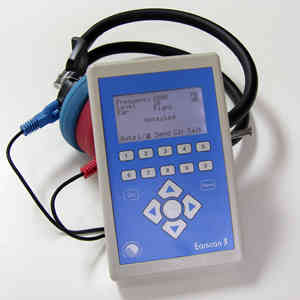
 I think: how big is the dynamic range in decibels of the music in this recording, to which the safety warning label refers? The quietest room on Earth (the old Sound 80 studio in Minneapolis) has an ambient sound pressure level (SPL) of -9.4 dB. And the latent SPL of the top-of-the-line audio signal path (microphones, cables, connectors, pre-amps, amps, EQ, digital recording media, audio workstations/mixing consoles, audio CD media, playback amplifier and EQ, monitors/headphones, tympanic membranes and ossicles in the ears, cochlea, Organ of Corti, spiral ganglion, and acoustic nerve, cranial nerve VIII) is about 3.1 dB RMS, at 2 KHz and 20 years of age.