Showing posts with label hearing. Show all posts

Tuesday, December 6, 2011

Tallis Scholars’ sound, or why 176 KHz/192 KHz HD sampling for choral chamber music is important

Tallis Scholars
I   t is known that energy in the 5-20 KHz range can be perceived even when it is 50 dB or more below the main voice spectrum peak. Also, these upper frequencies are conventionally emphasized in the production of popular vocal music. Yet very few studies of the acoustic content of this range have been made. High fidelity recordings were made of singers sustaining vowels at varying levels of vocal effort. A general characterization of the two highest octaves 5-20 KHz was sought. The prevalence of high-frequency energy, the variation of harmonics signal-to-noise ratio as a function of frequency, and the covariation with overall SPL were all highly variable, but several landmark features were identified... [including] clusters of resonances in the regions 7-10 KHz and 13-16 KHz. Harmonic energy was observed to over 16 KHz in strong female voices.”
  —  Sten Ternström, KTH Stockholm, 2008.
T he Tallis Scholars’ performance in Kansas City tonight was gorgeous. The concert was performed in the Cathedral of the Immaculate Conception, which has a central altar and a wide chancel such that there are myriad acoustic reflections that arrive at one’s ears from multiple directions. Unlike many performance venues where reflected sound for people seated in most locations is predominantly from one or two general directions, Immaculate Conception has quite high reflective efficiency from many of its interior surfaces.

I f you are seated close to the ensemble—not more than, say, 10 meters away from the sound source—the sound projects exaggerated cues of ‘spatiality’, accentuating the atmospheric qualities that are there in the music and the text. This was especially true tonight during the pieces by Arvo Pärt, which have considerable dissonance and frisson amongst the parts, with long sustained notes during which the spatial effects from the direct and indirect sounds arriving at our ears can be fully appreciated.

T    aking into account the speed of sound, we can convert energy defocusing in the time domain to “smear” in distance estimation by the ears. Energy spread over ±500 ms is the same as a distance smear of ±15 cm. 96 KS/s keeps almost all the energy within about ±50 ms, or ±1.5 cm. One of the observations people make about 96 KS/s material is that the spatial localisation of everything is very much better than 44.1 KS/s. 192 KS/s is better than this, although very dependent on amp and speaker performance to demonstrate it.”
  —  Mike Story, 1997.
Tallis Scholars
T he spectrum of frequencies and harmonics returning to your ears in this marble-and-plaster, highly-reflective cathedral has a surprising, pleasing amount of power in the range 4 KHz and up. In an age when noise and unpleasant/irrational/blurred stimuli bombard us every day, the Tallis Scholars’ sound in this sort of brightly reverberant performance space restores our belief in clarity—restores our belief in the fidelity of human communication across large distances in space and time. It is as though high signal-to-noise ratio becomes an aesthetic and cultural emblem of Civilization itself.

W hat I mean is, the sound (with its high S/N and high-end harmonics) not only embodies the enduring and transcendent meaning of the sacred music that Tallis performs and the human spirituality that caused this music to be written so long ago, but it asserts the very possibility of transcendence and persistence—of meaning that lasts beyond one’s own lifetime. After the concert, I go to Gimell Records’ website and download a couple of their 24-bit 176 KHz-sampled Studio Master high-def recordings, to get more of this. What I hear is truly thrilling—as good as the live performance.

C onventional wisdom doubts that humans can hear frequencies much higher than 20 KHz—frequencies higher than that are only perceptible to dogs and other animals. That is foolish—misinformation propagated uncritically since 50 years ago. In recent years, the misconception persists as a reflection of the fact that otolaryngologists’ and audiologists’ primary focus has been on “basic,” “practical” functions such as a person’s ability to hear and accurately understand speech. By contrast, research concerned with aesthetic and musical functioning has received much less attention or funding. [Measurement equipment for studying acoustics of bats in the 20 to 100 KHz part of the spectrum has existed for quite awhile—bat and bird and other animal communication is the subject of scholarly articles in acoustics society journals—but not many researchers studying humans have utilized it. Part of the reason why the freqency spectrum above 4 KHz for vocalizations has been under-studied is that high-speed video strobolaryngoscopy has been unable to detect the very small-amplitude (~0.1mm) vibrations in the larynx. Not surprisingly, if you can’t detect something, then you tend not to study what you can’t detect.]

T here is a common, mistaken notion that frequency response above 10 KHz is only relevant to sibilant “S” or fricative “F” type consonants in speech or singing. Well, that is most definitely not true, as evidenced by tonight’s Tallis Scholars performance! Recent research by Brian Monson, Andrew Lotto, and colleagues at the University of Arizona in Tucson (link below) shows that the frequency spectrum above 8 KHz figures prominently in singers’ sustained-vowel sound imaging—and figures also in listeners’ perception of open vowel sounds. The Pärt works in tonight’s program—and the effects of reverberation in these, in Immaculate’s chancel—especially emphasize intervallic and spatial relationships and transformations, and remind me of a workshop led by John Roeder at the 2003 Mannes Institute. That workshop examined expressive transformational representations for music by Pärt and others, and addressed how transformational representations relate to musical form, and to how musical forms are experienced. Varied repetition as in Pärt amounts to retracing similar transformational pathways among different sets of musical objects, and plumbing the extent and meaning of their similarities. Canon and contrapuntal cyclical spaces are frequent vehicles for enacting or showing transformations, of course, and—to the degree that each of these enactments is individually convincing—uncovering these unexpected connections becomes our primary mode of understanding and enjoying the music.

T onight’s performance and these HD Gimell/Tallis recordings reveal why it’s desirable to have a sampling frequency that is at least 4 times the desired system bandwidth, a process that is known as oversampling. If your goal is to maintain a “flat” response with 6 dB or less roll-off at the upper limit of the band, then a sampling frequency that is more than four times the desired bandwidth is needed—hence, the 176.4 KHz or 192 KHz sampling rates on these Gimell HD Studio Master files.

Tallis Scholars
A  problem (for me, at least) with off-the-shelf HD audio equipment is that the sound reproduction chain (player, preamps, EQ, power amps, speakers) can sometimes have too much high-frequency power. It can sound too sibilant—even for vowel sounds—somewhere between 12 KHz and 20 KHz. The spectrum EQ sliders on your playback equipment may not have center frequencies that correspond to wherever that objectionable tweeter “break-up frequency” peak is—so the adjustments you make to cope with it end up impairing the quality of the sound around that peak, essentially leaving you with a sound that's far less than HD. But Bowers & Wilkins speakers are one example of a product that doesn’t have this issue. They’re clear above 8 KHz, and give smooth mid-range and ample bass. Put two 800 Diamonds in front of you, two 802s behind you, plus a couple of DB1s somewhere in the room to cover the bottom bass frequencies. HD music recordings—such as those produced by Tallis and Gimell—have frequencies that exceed 20 KHz and we need speakers (and other components in the reproduction chain) that can accurately render these. The response of the 800Ds is essentially flat between 25 Hz and 33 KHz. Their tweeter “break-up” frequency is way, way out of harm’s way—at about 70 KHz.

R eproducing high frequencies has everything to do with recreating the sensation of sharpness and immediacy—the experience of being near the sound-source, in or near the front row (see Beranek, p. 511). There is not just the issue of rapid attenuation of high-frequency portions of the spectrum as a function of distance, but also the matter of inter-aural time-difference cues.

W    e found that robust pitch perception can be elicited by harmonic complex tones with fundamental frequencies below 2 KHz, even when all of the individual harmonics are above 6 KHz—well above the currently-accepted ‘existence region’ of pitch and above the currently-accepted limits of neural phase-locking. The results suggest that perception of musical pitch at high frequencies is not constrained by temporal phase-locking in the auditory nerve but may instead stem from higher-level constraints shaped by [immediately] prior exposure to harmonic sounds.”
  —  Andrew Oxenham, Christophe Micheyl, Michael Keebler, Adam Loper & Sébastien Santurette, Dept of Psychology, Univ Minnesota, 2011.
I n other words, our ability to perceive (a) spatial relationships—relative locations of different singers or depth and breadth of other sound-sources—and (b) overtones/harmonics generated by the blending of all of the lower frequencies in ensemble (Fourier spectra of mixed signals) ... depends primarily on the high-frequency (short-wavelength) components and on phase-angle relationships between the frequencies as they mingle with each other in the performance space (or the playback environment, for a recording). If the sound-sources are moving (as in an opera; or even for singers who are shifting or rotating slightly on-stage), then the high-frequency components contribute most to our ability to perceive that motion. It’s part of how our brain sorts out “signal” from “noise” in noisy environments.

A nd we get special pleasure from successfully doing this. Clarity that facilitates the listener’s own brain’s processing—which is what the HD 176 KHz/192 KHz-sampled media does for us (see Vorländer, pp. 222ff).
  • Jan Pieterszoon Sweelinck - Hodie Christus Natus Est
  • John Taverner - Magnificat (A5)
  • Robert White - Tota Pulchra Es
  • Arvo Pärt - Magnificat
  • Arvo Pärt - Nunc Dimittis
  • Hieronymous Praetorius - Magnificat IV
  • Robert White - Regina Caeli
  • Morales - Regina Caeli
  • Benjamin Britten: Hymn to the Virgin
  • Giovanni Pierluigi Da Palestrina - Magnificat for Double Choir
  • Giovanni Pierluigi Da Palestrina - Nunc Dimittis for Double Choir
I  very much hope that Phillips and colleagues continue to add aggressively to their HD DVD-Audio recording downloads. There are many of us out here who crave the immersive psychoacoustic experience that only very high sample-rate HD can deliver. The Tallis Scholars’ recordings are [one of the types of—] music that powerfully motivates and intensely satisfies the “immersive HD” desire.

B efore you place an order, Gimell recommmends to try the Test Files they provide for free download, to insure compatibility with your system.

T allis and Gimell recommend using an audiophile-quality Network Music Player to listen to the HD download files. If you own a DVD-Audio player and your PC has a DVD burner, then you can create your own DVD-Audio discs by importing the HD download files into Cirlinca’s DVD-Audio Solo® or other similar software apps. The files are 15 to 18 times larger than the equivalent track with MP3 compression. The Gimell offerings also include multichannel Quadraphonic/Surround Sound formats. Cirlinca’s HD-Audio Solo Ultra® v4.1 software costs just USD$75 for a single-user license— HD-Audio Solo Ultra® is the product that I use. Cirlinca has relationships with record labels including Gimmel, Deutsche Grammophon, and Hyperion, plus orchestras and ensembles including Boston Symphony Orchestra, Philadelphia Orchestra, and many others.

M arketing-wise, when HD recordings such as these from Tallis/Gimell are coupled with correspondingly good playback chain equipment it opens up a promising (and to-date under-developed) market segment for serious music: tech-avid audiences and software developers and gamers whose primary passion is virtual reality (VR) and who have a strong but decidedly secondary interest in music. Many in this segment or niche market may not be musicians per se, and they may not be people who regularly attend ‘conventional’ live concerts. But they crave excellent VR and immersive “worlds” that can capture the heart and mind—as good music can do so effectively. And such people spend quite a lot of money each year on personal “world-building”. Their sort of passionate “sonic-experience-first-music-second” amateurism is, I suppose, not unlike serious HiFi audiophiles of the 1960s or late 50s.

I n summary, Tallis Scholars and Gimell are creating the right kinds of HD content to grow a VR audio market. Maybe more and different marketing, including social media, will be needed to really drive its growth. For now, I’m delighted to have experienced these wonderful recordings that prove once and for all that very high sampling-rates of 176.4 KHz and 192 KHz are actually necessary, to accurately reproduce the nuances that we hear up-close in live performance. The freshness and lightness and clarity of the sound invite the listener “inside” the world that the music conjures—the Studio Master HD files enable listeners to inhabit that world via interactive replay evoking “live” sensations and realism, most vividly when the listener/file-downloader can freely explore and re-explore again and again ad lib. We avid listeners want to rehearse our neurons—not only to re-experience the shivers up our spines, but (through practice) to train our bodies to optimally respond to the aural cues that are in these beautiful HD recordings, and in the next live performance we’re able to attend. Bravo!

Tallis Scholars

Sunday, March 13, 2011

Meditating on Ken Ueno, Musical Seismology, Japan

Ken Ueno
U   eno’s concert music, writing for a variety of ensembles from chamber groups to orchestra, has been informed in significant ways by his experiences as a performer... Cultural resonances abound in his music; for example, the biwa and shakahuachi concerto Kaze-no-Oka (‘Hill of the Winds’) has an architectural basis, being inspired by buildings designed by Fumihiko Maki... [Japanese] ideograms are used as musical formants, the details of which can be extrapolated and recontexualized to create an organic, but continually changing, whole. Subjecting an acoustical object or objects to scrutiny using computer-based tools of timbral analysis, Ueno extracts details of its musical makeup, such as its prevailing frequencies and how that profile might change over time... What are the limits of perception? ... In Kaze-no-Oka, in addition to the architectural origin, the conceptual-musical idea is of the orchestral body as a reflection and amplification of the biwa (orchestral strings as ‘super-biwa’) and shakuhachi (bass sax and contrabass clarinet as ‘super-shakuhachi’).”
  —  Robert Kirzinger, liner notes, Ken Ueno - BMOP ‘Talus’ CD.
I was relieved to hear that composer Ken Ueno’s parents, grandma, and other family members in Japan are okay following the quake and tsunami.

T hinking of them and others affected by Friday’s magnitude 8.9 temblor and hundreds of aftershocks, I put Ken’s CD ‘Talus’ on to play. I look at its CD jewelcase. It still bears this orange warning label:

Ken Ueno, Talus CD warning I  think: how big is the dynamic range in decibels of the music in this recording, to which the safety warning label refers? The quietest room on Earth (the old Sound 80 studio in Minneapolis) has an ambient sound pressure level (SPL) of -9.4 dB. And the latent SPL of the top-of-the-line audio signal path (microphones, cables, connectors, pre-amps, amps, EQ, digital recording media, audio workstations/mixing consoles, audio CD media, playback amplifier and EQ, monitors/headphones, tympanic membranes and ossicles in the ears, cochlea, Organ of Corti, spiral ganglion, and acoustic nerve, cranial nerve VIII) is about 3.1 dB RMS, at 2 KHz and 20 years of age.

T he corresponding minimum perceptible ambient vibration in the Earth is about -0.7 Richter, according to Thouvenot and Bouchon (see link, below).

T he biggest recorded earthquake was the Great Chilean Earthquake of 22-MAY-1960, which had a magnitude of 9.5 Richter. So, 10 times [9.5 minus -0.7] equals a perceptible dynamic range of 102 dB for maximum earthshaking ever, and 96 dB for Friday’s Japanese earthquake.

A nd the approximate maximum of dynamic range for playing this BMOP CD of Ken’s is about 96 dB on standard digital audio at 16-bit resolution and 44.1 KHz sampling rate, given the limits of CDs and available amplifier chains and monitors/headphones.

K en’s ‘Talus’ CD jewelcase orange warning label alerts us to acoustic SPL differences in his compositions that are basically comparable to the SPL differences of what people experienced in Japan on Friday, just in different ranges of frequency spectrum. [...Heeding orange warning label, turns volume down.]


    [30-sec clip, BMOP, Ken Ueno, ‘Kaze-no-Oka’, 1.1MB MP3]

K en’s music is like koans... not a progression from pain to realization, or pain and loss as a reminder of realization. It is the lean-ness of the mind focusing on the present, consciously exerting energy in the face of difficult odds and adversity. Yamada Roshi: “When you stand up, there is only that standing-up in the whole world, with nothing sticking to it.” Ueno’s music is, like, “This! Just this!” ... something of a ‘last word,’ a rhetoric of pure experience. His compositions’ expression is without judgment, sort of a Zen-like “letting the Shodo calligraphy brush write whatever it wants,” but that does not mean that it is ‘acquiescing’ or accepting of the reality, the suffering that Nature dishes out, nor is it free from worry.

O ur thoughts go out to those in Japan and their families.

Video #1
Video #2
Video #3

D   o not say
that the deepest meaning
comes only from one’s mouth!

Day and night,
eighty thousand poems
arise one after the other—

and in fact
not one audible utterance
has ever been spoken.”
  —  Musō Soseki (夢窓 疎石, 1275 – 1351).

Tokyo, 11-MAR-2011


Sunday, April 12, 2009

Beglarian’s Chamber Music: Magic through Risk-Sharing, Intimacy through Obligate FM

 Eve Beglarian
J    esus said, ‘I have cast fire upon the world and, see, I am guarding it until it blazes.’ ”
  —  Gospel of Thomas, v. 10, quoted by Eve Beglarian, ‘Until It Blazes’.
I    am (you are) the light that shines over all things. I am (you are) everywhere. From me (you) all came forth, and to me (you) all return. Split a piece of wood, and I am there. Lift a stone, and you will find me there. Tend a sick sheep, and you will find me there.”
  —  Gospel of Thomas, v. 77.
E    very atom belonging to me as good belongs to you.”
  —  Walt Whitman, ‘Leaves of Grass’.
L    istening for the magic, as if our lives depended on it.”
  —  Eve Beglarian, quoted in Hinkle, p. 148.
T he music and writings of Eve Beglarian are terse, capable of having radical impact for those who are amenable to attending to them.


    [50-sec clip, Eve Beglarian, ‘Until It Blazes’, Segment 1, 1.6MB MP3]


    [50-sec clip, Eve Beglarian, ‘Until It Blazes’, Segment 2, 1.6MB MP3]


    [50-sec clip, Eve Beglarian, Messiah Remix, ‘Be/Hold’, Segment 1, 1.6MB MP3]


    [50-sec clip, Eve Beglarian, Messiah Remix, ‘Be/Hold’, Segment 2, 1.6MB MP3]

E ve’s iconoclastic tendencies are endearing. Only phonies/fogies would consider them seriously threatening. And her compositional methods are wonderfully diverse—pushing envelopes that we didn’t know were there. I listen to some of the synth ‘chirps’ and tone-pips in several of her pieces...


    [50-sec clip, Ray Lynch, Deep Breakfast, ‘Tiny Geometries’, 1.6MB MP3]

E ve’s use of ambient chirps and tone-pips is not like, say, Ray Lynch’s use of them. Many communication sounds, including those of primates such as New World monkey twitter calls, contain frequency-modulated (FM) swept-spectrum signals or tone-pips. Others have rhythmic pulses that are FM swept click-trains. Complex natural sounds (e.g., vocalizations or speech) can be characterized by specific spectro-temporal patterns the components of which change in both frequency (FM) and amplitude (AM).

B ut the timing and properties of Eve’s tone-pips are measurably, statistically different from Lynch’s—Eve’s are more like natural primates and birds—and therein lies, I think, a source of the radical, profound effects that Eve’s compositions have. She is ‘wired’ into a part of our innate neurophysiology—a part that is engaged in our reflexively apprehending patterns in our surroundings, and disambiguating and prioritizing the profusion of patterns. Upon a first hearing Eve’s music confronts us with and makes us aware of details of our own inner workings that we may not have known existed; upon subsequent hearings, we revisit what we learned about those details, and reflect upon what it means and how it matters.

I t’s interesting to find what the probability density function and statistical kurtosis of a music signal are, as a means to figure out why the music works or has the effects on us that it does. In a mixture of a Gaussian signal with a sub-Gaussian signal, the Gaussian signal will be significantly attenuated or suppressed, in terms of the pulse-train intensity and auditory evoked potentials in the brain [see links below].

T he probability densities of Beglarian’s music that I’ve examined with my signal-processing set-up tend to be super-Gaussian (kurtosis > 3.0). This generally occurs because there is a substantial amount of low-amplitude time in her compositions (tracks). By concentrating the energy near zero during these times, the probability density function (PD) becomes more peaked, and therefore becomes more super-Gaussian.

 Super-Gaussian passage, Eve Beglarian, ‘Until It Blazes’
I f the raw, super-Gaussian music signals are admixed with others, they will have less ‘gain’ (in human auditory processing) than, say, a competing sub-Gaussian signal. One might want, therefore, to alter the probability density function of the music signals from super-Gaussian to sub-Gaussian. A frequency-modulated (FM) signal is always sub-Gaussian.

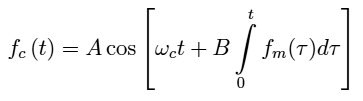
A n FM signal, fc(t), is mathematically defined by the function [see Dunlop & Smith]:

 Eq.1
where A is the carrier-frequency amplitude, ωc is the carrier frequency, fm(t) is the modulating signal, and B is proportional to the modulation depth. This equation shows that the amplitude of the carrier never is changed, but the frequency varies according to the modulation signal. As a result, the probability density function is exactly the same as the probability density function of the carrier itself:

 Eq.2
T his particular probability density function is the probability density function of a sinusoidal, and has a kurtosis of 1.5 (or an excess kurtosis of -1.5).

B ut there is no ‘law’ that says that the carrier has to be of a single pitch or frequency, that it has to be sinusoidal. Likewise, there is no ‘law’ that says that the carrier has to be many orders of magnitude different in frequency from the modulating signal. In FM radio it is true that the frequencies in the audio signal are many tens of thousands of times lower than the FM radio carrier frequency, but that is because of the radio broadcast use-case, which is not applicable in Eve’s musical-soundscape use-case.

S o all signals, whether super-Gaussian, Gaussian, or sub-Gaussian, are necessarily, obligatorily converted to a sub-Gaussian signal if they are frequency-modulated—and that is part of the physics that Eve’s compositions take advantage of, to achieve the effects and impact that they do. Gaussian and super-Gaussian signals do not give way to themes that are conveyed by sub-Gaussian signals; they are ‘taken over’ by the sub-Gaussians. Quasi-vivisectionist/neuroanatomist, Eve takes us apart: her pieces are fascinating lessons, revealing to us how we work, deep down inside. Different interpretation of chamber music as ‘intimacy’.

I n ‘Until It Blazes’, the latter part of the piece is overwhelmed by a high-frequency noise spectrum that, essentially, becomes an FM ‘carrier’ for the other musical signals with which it’s admixed and which it takes over. It’s not that the other signals are buried; no, the amplitudes stay the same. Rather, the admixture/modulation causes new processing by our hearing and auditory cortex—processing by which are able to detect and respond to FM acoustic signals. The musical result—and the gnostic text that inspired it—compel us to reprioritize what we believe, what we believe we know; re-think the evidence that is the basis for our knowing... This isn’t merely ‘edginess’ or gratuitous excitement. It’s politically interventional, potentially life-changing—features that are characteristic of Eve’s work. It’s an invitation to a self-styled, radically self-examining intimate community.

T he ‘gnostic’ gospels reference the Greek word ‘gnosis’, meaning ‘knowledge’. Arguably, Gnostic philosophy—finding answers to spiritual questions within oneself, without reliance on a church or priests; individuals learning to free themselves from the material world by way of meditation and enlightenment—did begin in pre-Christian times; either that, or it was a Jewish reaction to Judaism reacting to early Christianity. Some introductory comments about the apocrypha, gnostic Gospel of Thomas and the 114 ‘sayings’ it contains are here. A fine provocation for meditation, I think, on the occasion of Easter.

E    ve started out as an Uptowner with a Princeton-Columbia education, but then jumped ship and began composing music her professors couldn’t countenance. Her approach to musical sources is omnivorous. She’s made collages of disco music, updated the 14th-century composer Guillaume de Machaut, made theater pieces out of Kurt Schwitters’ nonsensical ‘Ur-Sonata’, and quoted Gregorian chants along with the sounds of a couple having orgasms. One of her best pieces is ‘No Man’s Land’, a gritty poem to New York whose thoughtful text is accompanied by sampled sounds as grating as the city itself. Beglarian is an amazingly high-tech sampling artist, and much of her music—even orchestra pieces like ‘FlamingO’—uses brilliantly manipulated prerecorded noises.”
  —  Kyle Gann.


Thursday, December 11, 2008

Before We Go: Luigi Nono, Omissions, Silence, & The Rhetoric of Wee Hours

 Arditti Quartet
Y    ou know, you are mistaken in the translation of this Khlebnikov poem. ‘When they are dying, horses feel profoundly relieved / When they are dying, shrubberies become sad / When they are dying, suns cease to shine / When they are dying, men sing’ is a more apt rendering of the sense of the Russian. Your ‘When horses die, they breathe / When grasses die, they wither / When suns die, they go out / When people die, songs are sung’ is badly wrong. Seriously in error. Every line. You should fix it. Otherwise, schmexy.”
  —  M. Vladov, email to CMT.
A  very interesting point. The CMT post that M. Vladov was commenting on was actually an essay I wrote last year while stuck in an airport with a long flight delay. It was on the Kronos Quartet performance of Henryk Górecki’s ‘and songs are sung…’ and how its meaning, for me, is closely tied to progressive disability and terminal decline to the end of life, as fundamental/inescapable parts of the human condition. The epigram at the top of that CMT post was actually someone else’s (Górecki’s?) rendering of the Khlebnikov poem into English, not my own.

And yet I very much like and appreciate M. Vladov’s clarification/correction. He/she says it’s not the survivors who sing on the occasion of the loved-one’s death. That comes later. It’s instead the one who is dying who, if lucky enough to have time and lucid moments so late in the game, “sings” an intimate, extemporized ‘epilogue’ of his/her life’s story, to anyone—anyone—who is nearby. Having worked for years in palliative medicine and hospice, I can say that that is true: the poignant, urgent need to create meaning by saying and singing to other members of our species—it is almost as strong as the need the heart has to beat and beat, or our hunger for air until, finally, the need collapses and we let go of that beating, breathing hunger and depart the planet. That is what Khlebnikov’s poem is about—or at least that’s what M. Vladov’s email makes me think, and what I believe he/she meant by ‘every line wrong’.

And the stars/suns don’t ‘fade out’ in the way that some English translations have it. This, in M. Vladov’s view, is just as outrageously wrong, same as the one in the liner of the Kronos CD. Instead, the stars/suns utterly cease! The light stops, they implode never to shine again—whatever. No dwindling, no dimming and fading, just sudden nuclear darkness.

Когда умирают кони - дышат,
Когда умирают травы - сохнут,
Когда умирают солнца - они гаснут,
Когда умирают люди - поют песни...
  —  Хлебников, 1912.
Further, it isn’t trivial grasses that wither and rot, prosaically, soullessly … in a manner that merits only passing regard from untouched humankind. Instead, the entire biosphere, vegetables and shrubberies and all, is ensouled and its members of all species have moral standing and have a capacity for sorrow, albeit implemented with very different nervous systems than we mammals have. And, oh, by the way, you will not get out unscathed by the death of the plants…

And horses, M. Vladov says, are relieved at the end—which I first-hand also know to be true, as I once owned horses and have seen them euthanized. The death rattle and last exhalation of a horse is louder than that of a human being. It’s a large animal with large lungs and big vital capacity and a tidal volume that is 10 to 15 mL/kg, or 6 liters compared to an adult human’s 750 mL. Horses are obligate nose-breathers. For those reasons, it is more likely that you will hear their dying breath and, if you hear it, more likely that you will hear it in enough detail that you will be able to grasp its several musical stages, millisecond by millisecond, until it is gone. You will not then doubt (if you ever did—) that the animal has a soul. It is not a stupid, empty moment. You can sense the animal’s relief as it lets go of the mortal body and flies away.

It is enough to, maybe, make you nostalgic for the time before you were born. No. Scratch that. For the time before you were conceived. [goes away from PC, listens to owls in moonlight, returns to desk, looks at a humorous photo of Luigi Nono]

 Luigi Nono, if a trombonist falls in a woodwind forest and there are only not-hearing musicians there, does it make a sound?
I    believe that more than ever before humankind has the opportunity and the ability to study; to open up new routes; to reach for peaks; to discover peaks that are beyond the heavens—different spaces, different worlds! Different abysses! Different fantasies!”
  —  Luigi Nono.
Da capo… There is besides the Górecki, of course, another composition that referenced the same famous Khlebnikov poem and took it as an inspiration and point of departure: Luigi Nono’s ‘Quando stanno morendo’—the Italian for ‘When they are dying’. I’m not sure what M. Vladov will make of the Nono piece. Nono composed it for the Warsaw Music Festival of 1985, but the festival was cancelled. Some of Nono’s friends were in exile, some were in prison, and some were resisting the Russian ‘invasion that never happened’. Written in 1985 in Baden-Baden; ‘Quando stanno morendo No. 2’ is a chamber work that is scored for four female voices, plus flute, cello and live electronics. There are some analysts and historians who insist that this is a ‘political’ piece, but I think a valid personal, individualistic reading is also possible—in the same vein as the Gorecki. Anyone, I think, who has worked with the dying would think so…

L    isten to this moment: a weak power thinking bringing to a [mortal] halt.”
  —  Luigi Nono, Chorus, Prometeo.
Pure anxiety and beauty coexist in the vocal intervals that incarnate them. Nono was in those days experimenting with what one might call ‘timbral particle physics’, splitting the acoustic ‘atom’, combining different sonorities of instruments and instrumentalists’ breathing… anatomical sound-art of the human body, with instruments as prosthetic devices, crutches. For B-flat clarinet and C flute, dozens of tones are familiar to us; the contrabass flute, and contrabass clarinet ones, less so. The amplified flute here sounds like Khlebnikov’s expiring horse … my expiring cancer patient … evolving into gentle breath sounds and harmonics/gasps, followed by solo voices accompanied by low-pitched electroacoustics.

The finale has the singers again in restrained Khlebnikovian agony.

La Lontananza Nostalgica Utopica Futura’ takes us on a path that Nono suspects leads to a utopia—or at least something different than what we have now. Change we can believe in, not because we have any desire for or knowledge of the destination, but rather because we realize that our present location is no longer habitable. Our air is exhausted, our position here no longer tenable. It is patently obvious that it is untenable now; we have no choice but to depart this planet.

    Luigi Nono
  • Arrived: 29-JAN-1924, Venice, Italy
  • Departed: 8-MAY-1990, age 66, Venice, Italy
  • Cause of death: undisclosed
  • Politics: Socialist
  • Nationality: Italy
  • Precis: Composer of serialist, electronic, and aleatoric music.
  • Education: B.Mus, Venice Conservatoire (1941); JD, University of Padua (1946); studied composition under Gian Francesco Malipiero, Bruno Maderna, Hermann Scherchen
  • Father: Mario Nono (civil engineer)
  • Mother: Maria Manetti
  • Significant other: at age 31 married Nuria Schoenberg, daughter of Arnold Schoenberg
  • Daughters: Silvia Nono (b. 1959), Serena Bastiana (b. 1964)

    [50-sec clip, Schreck Ensemble, Luigi Nono, ‘Fabbrica Illuminata’, 1.2MB MP3]
 La Lontananza Nostalgica Utopica Futura
    [50-sec clip, Schreck Ensemble, Luigi Nono, ‘La Lontananza Nostalgica Utopica Futura’, 1.2MB MP3]

 Józef Simmler, 1855: Diotima
L    uigi Nono’s only score for string quartet, ‘Fragmente-Stille, an Diotima’ [Hushed Fragments for Diotima] already expresses at the very beginning of the 1980s, with its ample phrases made up of fragments mingled with long-held notes and drawn-our silences, that ‘tragedy of listening’ that haunts the composer’s last works—a world both crepuscular and ethereal, shot through with shadows and fleeting sensations, and a meditation on the ‘eternal, silent brightness’ of the poet Friedrich Hölderlin.”
  —  Arditti CD case blurb.
But beyond what must be said and beyond what we are so hungry to say at the end—beyond what occurs to us to sing just before we finally go—is that which is unsaid or unsayable, or unsung, unsingable. Luigi Nono’s composition for orchestra and electronics, ‘Prometeo’, is the epitome of that. John Wollaston gives a fine essay on the London Sinfonietta performance of ‘Prometeo’ earlier this year here. Prometheus was the Greek mythical figure who is symbolic of the belief in progress, and symbolic of unconditional love and hubris at the same time. [Hell, the idea of ‘unconditional love’ is hubristic all by itself, progress or no progress.] Prometheus also culminates Luigi Nono’s composerly thinking: extreme sound-art, predictable and unpredictable panning of sound fields within the performance space, and aleatoric compositional and performance processes—disembodied, spectral.

Prometeo’ as Luigi Nono’s answer to Schoenberg’s ‘Moses und Aron’? Nono’s ‘Quando stanno morendo’ is his answer to Schoenberg’s ‘A Survivor from Warsaw’? Well, no. To me, Nono seems more particular, more highly personal—more specific about the plight of the individual, rather than about the political plight of a class of people…

 Rehearsal before first performance of Prometeo in the Church of San Lorenzo, Venice; photo: Graziano Arici)
The estrangement of this body from its soul and the fragmentation of the sense of sight from the sense of sound that Nono achieves in ‘Prometeo’—especially if it is performed or recorded in a spacious performance hall—are remarkable. As Wollaston notes, “At this stage in Nono’s later musical theatre, sight no longer has a purpose. As he considered the visual realm a site for the most dangerous sorts of dictatorial manipulations, of both audience and source material, Nono aimed to rescue his musical theatre from visual elements. This anti-visual syndrome was developed in order that the fusion of the point of view might be a delicate one taking place within a craft of intricate networks upon magnified sonic elements.” Reflecting on the immediately prior CMT post on macular degeneration, I am led to wonder how low-visioned or blind people experience ‘Prometeo’. The uncertainties in ‘Prometeo’ are unnerving for us who still have good vision…

It’s an aleatoric-antiphonal chamber piece with four instrumental ensembles scattered to the four winds, with a choral ensemble on-stage, plus five solo singers deployed up on high platforms and scaffolding. Also distributed high in upper balcony/box locations on both sides of the auditorium are smaller groups of musicians and two narrators, along with tubas, a contrabass clarinet, and custom-made glass instruments. Electroacoustic parts are done via a speaker array that is deployed overhead and around the walls of the room. Wollaston says that this geometry “inscribe[s] several horizons, artificial or electronically produced, and actual. Each space has its chant; all together constitute the sky. And in these skies we might ‘rediscover the possible’.”

A    mplified echoes play explicit formal roles in the present sound, the electronics enable precisely defined constructions in the course of the now-time of hearing with shapes and resources of a previously articulated event. This re-enunciated remnant is made mobile to such extent in a multiplicity of movement that the listener becomes lost in a kind of unitary perception. … A tension exists between a sense of circling the ultimate fragmentation, not the highest but the last, as sound director André Richard said at a pre-concert discussion, ‘the last before dying’, between this ultimate finality and an open possibility is compassable, the realm of infinitely variable potentialities where we ought ‘rediscover the possible’. Nono’s sound unravels a paradoxical seamlessness between the collapse into silence and extreme fragments of sonic event, pregnant and intensive. In this way, silence becomes a principle motivating force within the music.”
  —  John Wollaston, review of London Sinfonietta performance of ‘Prometeo’.
W achtel’s nice book talks about the ‘transfiguration’ elements in Khlebnikov poems and others’ experiments with wordless ululations and ‘Zaum Gedichte’ (‘sound-poetry’; ‘beyond-sense-poetry’)—the organic, alinguistic simplicity of it; the association-free vocality of words sung, detached from human minds and intentions; emblems of Hölderlin’s tragedy as ‘the understanding in misfortune, the dreaming naive... to depict man’s understanding as wandering below the unthinkable.’

 Vledimir Khlebnikov manifesto, quoted in Michael Wachtel, p.42
Semi-comprehending what they sing, we hear the experiences of the about-to-depart and imagine our own, sometime in the indefinite future. Long, sustained notes: a fragile, tenuous thread on which the spirit is suspended—in several different layers in musical space and in several layers of register/pitch. Fitting that I should happen to listen to this in the wee hours, on the basis of thoughts triggered by an email from an M. Vladov somewhere halfway around the planet…

Comments and emails are a delight when you send them to me here at CMT. I invariably learn something and often make new friends. If I make mistakes, please forgive me. Thank you! [goes back to listening to Arditti Quartet recording of Nono, Great Horned owls outside in the trees still howling aleatorically]

 Nono, ‘Quando Stanno Morendo’
M    usically, the work is luminous. Nono is a serialist, but one who knows how to make music sing and make music dramatic. The piece is full of powerful moments. Much was made of the inclusion of worker's songs including the Internationale when the piece was premiered. The use of such straightforward tonal material in an avant-garde piece was against the grain at the time. After 25 years, this doesn’t shock anymore. What does stay with you is how well integrated the tonal material is with the serial material. Nono uses similar procedures on the workers’ songs as he uses on his tone rows. The result gells nicely. It does not have the pastische quality that quotations in Berio’s Sinfonia have. Rather, it packs emotional punch. Nono was always considered to be the most politically committed of the Darmstadt set of the 50s and 60s. (Though Xenakis certainly was as well.) This may explain why his music retains such a powerful impact. Where Boulez was looking for an almost mathematical approach to composition, and Stockhausen was alternatively a musical explorer and a mystic, Nono was motivated by deep love for people. As a result his music retains a humanity that is more readily apparent than in other Darmstadters.”
  — Christopher Forbes, Brooklyn.

 Allwardt book