Showing posts with label disability. Show all posts

Sunday, February 12, 2012

John Bischoff: Audio Combine, Modal/Bispectral Discoveries, Post-Human Futures

John Bischoff, Audio Combine
L   ocal color’ features synthetic bell-like tones, sustained tonal clusters, and computer-triggered acoustic bells struck in complementary patterns that are sometimes random, sometimes human-triggered, and combinations of both... It is enough to reference the idea of a tactus, but not enough to be [understood as] an organizing [meaning-generating/insuring] element.”
  — Audio Combine, liner notes, Ed Osborn, Brown Univ, 2011.
T he music comprising John Bischoff’s new CD ‘Audio Combine’, just released on New World Records, is beautiful, fascinating, thoroughly enjoyable. Philip Perkins’s engineering and production values are superb.

T he five tracks on the disc are diverse, representing Bischoff compositions from 2004 to mid-2011. The third track ‘Local Color’ evokes traditional chinese zhong bells, but also especially calls into question the ‘who’ of music performance [in asmuch as some of the bells are computer-triggered, randomly and deterministically, while others are played by Bischoff from his score] and other limits of performance identity [insofar as the bell modes and timbres evolve after the bell is struck—on the rim; on the bosses/nipples; on the wall; etc.—in aleatoric/random ways that the musician-computer can neither predict nor control]. Of course, all music emerges in less-than-predictable/controllable ways—just less obviously so than bells.


    [50-sec clip, John Bischoff, ‘Local Color’; (track 3), 2012, 1.4MB MP3]
T   he pieces were all recorded in live performance with minimal editing and no over-dubs. Philip Perkins recorded direct from Bischoff’s setup and also from three pairs of microphones placed at various points in the concert hall. The mix heard here switches between these four perspectives as the pieces are played. The distance and pace incorporated into the recordings from various mic positions give a clear sense of the space of the performance, and of the object-ness of the sounds. That space and our place within it become the final part of the ‘material’: when the listener has no fixed point of perspective, then the position from which the listening/understanding is done becomes one of the elements of counterpoint.”
  —  Audio Combine, liner notes, Ed Osborn, Brown Univ, 2011.
T here are a few excellent books that empirically measure the modal vibrations of bells... He & Fu, for example. And some books on bispectral analysis—mainly used today in aerospace engineering and vibration-management engineering of turbines and other structures. Useful to explore if you are a composer/performer wanting to know more about how to more reliably utilize distinctive bell harmonics in your work. Links to some of these at the bottom of this post.
Fu-He book, p. 276
[Modal Analysis, Fu & He, 2001, p. 276]

    [50-sec clip, Wang Yuanping & Hubei Chime Bells Orchestra, ‘竹枝词 (Zhu-zhi-ci) Bamboo-pole Love Poem’; (track 1), 1989, 1.5MB MP3]

T he substantial rhythmic independence of the parts in the ‘Local Color’ bell quartet is part of its distinctive Asian beauty. Because each bell projects its sound clearly, each individual bell can easily be heard over the rest of the bell ensemble, and yet the ensemble—the ‘community’ of bells—remains the primary subject. This is dissimilar from other voiced percussion like a timpani choir, performing a ‘programmatic’ role, where the effect of four or more timpani playing together is treated more as an ‘effect’ than as harmony. It is instead quartet ‘orchestration with Chinese characteristics’!

W ith computer-triggered sticking, the timing of the ring-down and the pitch-bend are the same, but the kinematic nuances of human left-hand/right-hand mallet or sticking patterns are gone. But the electromechanical linear actuators for the computer-controlled bells have their own kinematic constraints, in terms of speed of resetting for the next stroke, and so on. They have their own unique, finite kind of ‘embodiment’ just as we humans have ours, and we can hear this in these wonderful Bischoff compositions and this excellent recording of them being performed ‘live’.

A nd so the most amazing thing that we get from Bischoff’s mechatronic compositions like ‘Local Color’ is a vivid glimpse of robotic humanity and machine consciousness, revealed by the beater mechanics and linear actuators... something like an inversion of the ‘human-becoming-machine’ perspective of Ambrazevičius and Balsienė (link below): ‘machine-becoming-human’... a brilliant future of new expressive possibilities, including bionic accomodations for musicians with disabilities. Musical prosthetics? Sonnez les matines! / Din, dan, don!


J ohn Bischoff (b. 1949) is an early pioneer of live computer music. He is known for his solo constructions in real-time synthesis as well as his seminal work in computer network ensembles. Bischoff studied composition with Robert Moran, James Tenney, and Robert Ashley. He has been active in the experimental music scene in the San Francisco Bay Area for over 25 year as a composer, performer, teacher, and grassroots activist. His performances around the US include NEW MUSIC AMERICA festivals in 1981 (SF) and 1989 (NYC), Experimental Intermedia (NYC), Roulette Intermedium (NYC), and the Beyond Music Festival (LA). He has performed in Europe at the Festival d'Automne in Paris, Akademie der Künst in Berlin, Fylkingen in Stockholm, and TUBE in Munich. He was a founding member of the League of Automatic Music Composers (1978), considered to be the world's first Computer Network Band, and he co-authored an article on the League's music that appears in "Foundations of Computer Music" (MIT Press 1985). He was also a founding member of the network band The Hub with whom he performed and recorded from 1985 to 1996.
John Bischoff, Audio Combine


Tuesday, May 19, 2009

One-on-One ‘Chamber Music’ with Mom: Music Therapy for Sensory-Sensitive Kids

 Kranowitz book
A    ny suggestions on how to deal with a toddler who is terrified of certain sounds? Just the mere mention of the word ‘vacuum’ has her falling on the floor, face in her hands, yelling ‘No!’ Not only is she freaked-out by the vacuum but also by certain toys, by the opening song for the ‘Barney’ TV program, the hairdryer, the blender—and also, just recently, by thunder. Any advice would be appreciated.”
  —  Anonymous#1.
I    had the same problem with my kid, starting around 2 and still somewhat an issue at 5. Not sure if being ‘overly sensitive’ is a possibility with your daughter, but my son kept getting his feelings hurt and would cry at the drop of a hat... not like throwing a fit, but instead like someone had broken his heart. A slow process waiting for this phase to pass!”
  —  Anonymous#2.
P    lease don’t make me go hear that sad, sad music again,’ my son said. He was so frightened about it that we eventually said, ‘Okay, you don’t have to go.’ After that, my husband and I took turns going to Mass vs. staying home with our son.”
  —  Laura Heneghan, quoted in Miller & Fuller, p. 15.
I  was just such a kid myself, and I still have some features of it even today as an adult. I am oversensitive to certain sounds; I cannot maintain a pace to tell a joke; I have lapses in tactfulness when I am inordinately ‘jumpy’; I over-react to certain sonic stimuli. Can’t seem to help it.

F  or example, music played very quietly—what the people who are playing it say is ‘just background music’—just makes me go ballistic. And their dismissiveness: their saying that such tiny, innocuous sounds as they are making with their soothing, nondescript, scarcely-audible ‘background music’ can’t possibly be annoying to anyone at all—‘It’s inconceivable!’—aggressively asserting that I have no legitimate basis whatever for complaint: this naturally makes me even more angry. My sonic defensiveness must be ‘all in my head’, ‘not real’, ‘invalid’—is what their denials mean. Only ‘loud’ music could possibly be objectionable—is what their refusals imply.

W  ell, in the immortal words of Mandy Patinkin to Wallace Shawn, “I do not think that word [‘inconceivable’] means what you think it means.”

I  n fact, any monotonous background sound pattern that is too quiet to be heard in detail infuriates me, drives me mad. And yet sitar music and traditional Chinese music and ‘minimalist’ compositions that have just the merest, subtlest hints of variations in notes’ attacks and releases—and which go on and on, for 30 minutes at a time or more—all of these are pleasantly, peculiarly fascinating to me. Maybe it is this way, too, for others who have SPD-type symptoms?

A  t any rate, these are the sole remaining remnants of what was, for me, undoubtedly SPD. Except that SPD did not exist as a diagnosis back when I was a kid, and nobody knew to do anything about it. Except immerse the kid in music, methodically, gradually...

I  just recently received the two SPD-related emails (2 blockquotes) above. I do intermittently browse the research literature, just out of curiosity in light of my own history and situation, to see what the current status of SPD and its clinical treatments may be—and, I thought it might be helpful to post some links (below).

T    apping tunes:
‘I’m going to tap out the rhythm of a song that you know... Listen and tell me what the song is.’ [When the child guesses correctly, sing/tap/play the song together.]
Benefits: Listening to rhythms improves auditory discrimination and aural awareness. Connecting rhythmic patterns with words promotes auditory association and memory. Using hands to tap or beat a rhythm provides tactile and proprioceptive stimuli to associate with sound and to diminish the degree to which acoustic input is 'dissociated' or frightening.”
  —  Kranowitz, OOS, p. 159.
M    atching sounds:
‘Ten identical containers, such as small opaque plastic bottles; five different kinds of small familiar objects, such as rice, paperclips, pennies, buttons, toothpicks. Shake a container and guess what's inside. Then find the other one of the other 9 containers that has the same thing in it. Shake the two containers at the same time, to be sure they match.’
Benefits: Listening to and differentiating the sounds of containers’ contents improves auditory discrimination, auditory memory, and integration of sonic expectations.”
  —  Kranowitz, OOS, p. 161.
S    cale songs:
‘Franz Joseph Haydn’s mom used to play seven tones of scale to get him up in the morning. She would play 7 notes of scale but not play the octave. Franz Joseph couldn’t stand it. He had to run downstairs and play the top ‘C’ to finish the scale. I will do that now. You cover your eyes while I play some notes, and then when I tell you, uncover your eyes and come and play the note that will finish the scale, just like little Franz Joseph and his mom Maria used to do.’
Benefits: ‘Scale songs’ reinforce rhythmic and sonic awareness. Moving while seeking to find the note that will complete the octave that mom didn't finish helps to integrate muscular/motor/vestibular systems. Pitch training makes sounds less disorienting and frightening. Pre-attentive preparatory efforts improve skills in attending to sounds and lower the threshhold for awareness of sounds.”
  —  Kranowitz, OOS, p. 162.
F  irst identified in the 1960’s by the late A. Jean Ayres (1920-1988), ‘sensory processing disorder’ (SPD) is a developmental disorder in:
  • neurological processing and cognitive organizing of sensory information;
  • assigning meaning to what is experienced;
  • acting or responding to situations in an adaptive, purposeful manner;
  • also known as Sensory Integrative Dysfunction (DSI).
S  ensory Processing Disorder does not ‘go away over time’ without therapeutic intervention. Kids don’t ‘out-grow’ it. And, in many cases, SPD doesn’t ‘go away’ even with the best available interventions and treatments. The child simply learns to cope with it, practices ways to make the symptoms less frequent and less severe, and structures her/his activities (and eventual career/profession) to take advantage of the sensory-cognitive gifts and sensory-cognitive deficits that she/he has.

T  LP listening sessions—which have been pursued with some success by a couple of the nurse-moms who I interact with at work and have known professionally for 6 to 20 years, for their own SPD kids—are typically fifteen minutes in length, done once or twice a day, five days a week, using stereo headphones that cover the ears. The efficacy of TLP, Tomatis, and other sensory-stimulation occupational therapy/music therapy programs has not been proven in clinical trials yet (see systematic-review articles and meta-analyses published by Sinha and others, for current status of scientific evidence), but neither have these therapies been shown to be ineffective.

Y  et, qualitatively and anecdotally, I do know from the two nurse-mom-friends that these therapies yielded noticeable improvements in their kids’ behaviors and level of stress.

T  he triggers of the symptoms or sensitivity leading to fright or acting-out seem to be multi-factorial and idiosyncratic: the child’s level of fatigue or stress, the time of day, the situation or social setting where the sonic stimuli occur. The interventions that can blunt or extinguish an over-sensitive episode are just as idiosyncratic.

F  or me, Sarabandes and Courantes are the best medicine—and other calming dance music, preferably Baroque… Sitting in a backyard swing on a sunny summer day and auto-stimulating my differently-abled vestibular system by twisting the swing clockwise, holding still there for a few seconds, and then reversing the swing to un-twist it, anti-clockwise... listening to Bach medium-loud, watching clouds overhead!

Note: CMT blog should not be considered as medical advice, and the remarks in these blog posts are not a substitute for professional medical advice, diagnosis, or treatment. Never delay or disregard seeking professional medical advice from your physician, pharmacist, or other qualified healthcare provider because of something you have read on CMT. You should always speak with your doctor before you start, stop, or change any prescribed part of your care plan or treatment.


Thursday, December 11, 2008

Before We Go: Luigi Nono, Omissions, Silence, & The Rhetoric of Wee Hours

 Arditti Quartet
Y    ou know, you are mistaken in the translation of this Khlebnikov poem. ‘When they are dying, horses feel profoundly relieved / When they are dying, shrubberies become sad / When they are dying, suns cease to shine / When they are dying, men sing’ is a more apt rendering of the sense of the Russian. Your ‘When horses die, they breathe / When grasses die, they wither / When suns die, they go out / When people die, songs are sung’ is badly wrong. Seriously in error. Every line. You should fix it. Otherwise, schmexy.”
  —  M. Vladov, email to CMT.
A  very interesting point. The CMT post that M. Vladov was commenting on was actually an essay I wrote last year while stuck in an airport with a long flight delay. It was on the Kronos Quartet performance of Henryk Górecki’s ‘and songs are sung…’ and how its meaning, for me, is closely tied to progressive disability and terminal decline to the end of life, as fundamental/inescapable parts of the human condition. The epigram at the top of that CMT post was actually someone else’s (Górecki’s?) rendering of the Khlebnikov poem into English, not my own.

And yet I very much like and appreciate M. Vladov’s clarification/correction. He/she says it’s not the survivors who sing on the occasion of the loved-one’s death. That comes later. It’s instead the one who is dying who, if lucky enough to have time and lucid moments so late in the game, “sings” an intimate, extemporized ‘epilogue’ of his/her life’s story, to anyone—anyone—who is nearby. Having worked for years in palliative medicine and hospice, I can say that that is true: the poignant, urgent need to create meaning by saying and singing to other members of our species—it is almost as strong as the need the heart has to beat and beat, or our hunger for air until, finally, the need collapses and we let go of that beating, breathing hunger and depart the planet. That is what Khlebnikov’s poem is about—or at least that’s what M. Vladov’s email makes me think, and what I believe he/she meant by ‘every line wrong’.

And the stars/suns don’t ‘fade out’ in the way that some English translations have it. This, in M. Vladov’s view, is just as outrageously wrong, same as the one in the liner of the Kronos CD. Instead, the stars/suns utterly cease! The light stops, they implode never to shine again—whatever. No dwindling, no dimming and fading, just sudden nuclear darkness.

Когда умирают кони - дышат,
Когда умирают травы - сохнут,
Когда умирают солнца - они гаснут,
Когда умирают люди - поют песни...
  —  Хлебников, 1912.
Further, it isn’t trivial grasses that wither and rot, prosaically, soullessly … in a manner that merits only passing regard from untouched humankind. Instead, the entire biosphere, vegetables and shrubberies and all, is ensouled and its members of all species have moral standing and have a capacity for sorrow, albeit implemented with very different nervous systems than we mammals have. And, oh, by the way, you will not get out unscathed by the death of the plants…

And horses, M. Vladov says, are relieved at the end—which I first-hand also know to be true, as I once owned horses and have seen them euthanized. The death rattle and last exhalation of a horse is louder than that of a human being. It’s a large animal with large lungs and big vital capacity and a tidal volume that is 10 to 15 mL/kg, or 6 liters compared to an adult human’s 750 mL. Horses are obligate nose-breathers. For those reasons, it is more likely that you will hear their dying breath and, if you hear it, more likely that you will hear it in enough detail that you will be able to grasp its several musical stages, millisecond by millisecond, until it is gone. You will not then doubt (if you ever did—) that the animal has a soul. It is not a stupid, empty moment. You can sense the animal’s relief as it lets go of the mortal body and flies away.

It is enough to, maybe, make you nostalgic for the time before you were born. No. Scratch that. For the time before you were conceived. [goes away from PC, listens to owls in moonlight, returns to desk, looks at a humorous photo of Luigi Nono]

 Luigi Nono, if a trombonist falls in a woodwind forest and there are only not-hearing musicians there, does it make a sound?
I    believe that more than ever before humankind has the opportunity and the ability to study; to open up new routes; to reach for peaks; to discover peaks that are beyond the heavens—different spaces, different worlds! Different abysses! Different fantasies!”
  —  Luigi Nono.
Da capo… There is besides the Górecki, of course, another composition that referenced the same famous Khlebnikov poem and took it as an inspiration and point of departure: Luigi Nono’s ‘Quando stanno morendo’—the Italian for ‘When they are dying’. I’m not sure what M. Vladov will make of the Nono piece. Nono composed it for the Warsaw Music Festival of 1985, but the festival was cancelled. Some of Nono’s friends were in exile, some were in prison, and some were resisting the Russian ‘invasion that never happened’. Written in 1985 in Baden-Baden; ‘Quando stanno morendo No. 2’ is a chamber work that is scored for four female voices, plus flute, cello and live electronics. There are some analysts and historians who insist that this is a ‘political’ piece, but I think a valid personal, individualistic reading is also possible—in the same vein as the Gorecki. Anyone, I think, who has worked with the dying would think so…

L    isten to this moment: a weak power thinking bringing to a [mortal] halt.”
  —  Luigi Nono, Chorus, Prometeo.
Pure anxiety and beauty coexist in the vocal intervals that incarnate them. Nono was in those days experimenting with what one might call ‘timbral particle physics’, splitting the acoustic ‘atom’, combining different sonorities of instruments and instrumentalists’ breathing… anatomical sound-art of the human body, with instruments as prosthetic devices, crutches. For B-flat clarinet and C flute, dozens of tones are familiar to us; the contrabass flute, and contrabass clarinet ones, less so. The amplified flute here sounds like Khlebnikov’s expiring horse … my expiring cancer patient … evolving into gentle breath sounds and harmonics/gasps, followed by solo voices accompanied by low-pitched electroacoustics.

The finale has the singers again in restrained Khlebnikovian agony.

La Lontananza Nostalgica Utopica Futura’ takes us on a path that Nono suspects leads to a utopia—or at least something different than what we have now. Change we can believe in, not because we have any desire for or knowledge of the destination, but rather because we realize that our present location is no longer habitable. Our air is exhausted, our position here no longer tenable. It is patently obvious that it is untenable now; we have no choice but to depart this planet.

    Luigi Nono
  • Arrived: 29-JAN-1924, Venice, Italy
  • Departed: 8-MAY-1990, age 66, Venice, Italy
  • Cause of death: undisclosed
  • Politics: Socialist
  • Nationality: Italy
  • Precis: Composer of serialist, electronic, and aleatoric music.
  • Education: B.Mus, Venice Conservatoire (1941); JD, University of Padua (1946); studied composition under Gian Francesco Malipiero, Bruno Maderna, Hermann Scherchen
  • Father: Mario Nono (civil engineer)
  • Mother: Maria Manetti
  • Significant other: at age 31 married Nuria Schoenberg, daughter of Arnold Schoenberg
  • Daughters: Silvia Nono (b. 1959), Serena Bastiana (b. 1964)

    [50-sec clip, Schreck Ensemble, Luigi Nono, ‘Fabbrica Illuminata’, 1.2MB MP3]
 La Lontananza Nostalgica Utopica Futura
    [50-sec clip, Schreck Ensemble, Luigi Nono, ‘La Lontananza Nostalgica Utopica Futura’, 1.2MB MP3]

 Józef Simmler, 1855: Diotima
L    uigi Nono’s only score for string quartet, ‘Fragmente-Stille, an Diotima’ [Hushed Fragments for Diotima] already expresses at the very beginning of the 1980s, with its ample phrases made up of fragments mingled with long-held notes and drawn-our silences, that ‘tragedy of listening’ that haunts the composer’s last works—a world both crepuscular and ethereal, shot through with shadows and fleeting sensations, and a meditation on the ‘eternal, silent brightness’ of the poet Friedrich Hölderlin.”
  —  Arditti CD case blurb.
But beyond what must be said and beyond what we are so hungry to say at the end—beyond what occurs to us to sing just before we finally go—is that which is unsaid or unsayable, or unsung, unsingable. Luigi Nono’s composition for orchestra and electronics, ‘Prometeo’, is the epitome of that. John Wollaston gives a fine essay on the London Sinfonietta performance of ‘Prometeo’ earlier this year here. Prometheus was the Greek mythical figure who is symbolic of the belief in progress, and symbolic of unconditional love and hubris at the same time. [Hell, the idea of ‘unconditional love’ is hubristic all by itself, progress or no progress.] Prometheus also culminates Luigi Nono’s composerly thinking: extreme sound-art, predictable and unpredictable panning of sound fields within the performance space, and aleatoric compositional and performance processes—disembodied, spectral.

Prometeo’ as Luigi Nono’s answer to Schoenberg’s ‘Moses und Aron’? Nono’s ‘Quando stanno morendo’ is his answer to Schoenberg’s ‘A Survivor from Warsaw’? Well, no. To me, Nono seems more particular, more highly personal—more specific about the plight of the individual, rather than about the political plight of a class of people…

 Rehearsal before first performance of Prometeo in the Church of San Lorenzo, Venice; photo: Graziano Arici)
The estrangement of this body from its soul and the fragmentation of the sense of sight from the sense of sound that Nono achieves in ‘Prometeo’—especially if it is performed or recorded in a spacious performance hall—are remarkable. As Wollaston notes, “At this stage in Nono’s later musical theatre, sight no longer has a purpose. As he considered the visual realm a site for the most dangerous sorts of dictatorial manipulations, of both audience and source material, Nono aimed to rescue his musical theatre from visual elements. This anti-visual syndrome was developed in order that the fusion of the point of view might be a delicate one taking place within a craft of intricate networks upon magnified sonic elements.” Reflecting on the immediately prior CMT post on macular degeneration, I am led to wonder how low-visioned or blind people experience ‘Prometeo’. The uncertainties in ‘Prometeo’ are unnerving for us who still have good vision…

It’s an aleatoric-antiphonal chamber piece with four instrumental ensembles scattered to the four winds, with a choral ensemble on-stage, plus five solo singers deployed up on high platforms and scaffolding. Also distributed high in upper balcony/box locations on both sides of the auditorium are smaller groups of musicians and two narrators, along with tubas, a contrabass clarinet, and custom-made glass instruments. Electroacoustic parts are done via a speaker array that is deployed overhead and around the walls of the room. Wollaston says that this geometry “inscribe[s] several horizons, artificial or electronically produced, and actual. Each space has its chant; all together constitute the sky. And in these skies we might ‘rediscover the possible’.”

A    mplified echoes play explicit formal roles in the present sound, the electronics enable precisely defined constructions in the course of the now-time of hearing with shapes and resources of a previously articulated event. This re-enunciated remnant is made mobile to such extent in a multiplicity of movement that the listener becomes lost in a kind of unitary perception. … A tension exists between a sense of circling the ultimate fragmentation, not the highest but the last, as sound director André Richard said at a pre-concert discussion, ‘the last before dying’, between this ultimate finality and an open possibility is compassable, the realm of infinitely variable potentialities where we ought ‘rediscover the possible’. Nono’s sound unravels a paradoxical seamlessness between the collapse into silence and extreme fragments of sonic event, pregnant and intensive. In this way, silence becomes a principle motivating force within the music.”
  —  John Wollaston, review of London Sinfonietta performance of ‘Prometeo’.
W achtel’s nice book talks about the ‘transfiguration’ elements in Khlebnikov poems and others’ experiments with wordless ululations and ‘Zaum Gedichte’ (‘sound-poetry’; ‘beyond-sense-poetry’)—the organic, alinguistic simplicity of it; the association-free vocality of words sung, detached from human minds and intentions; emblems of Hölderlin’s tragedy as ‘the understanding in misfortune, the dreaming naive... to depict man’s understanding as wandering below the unthinkable.’

 Vledimir Khlebnikov manifesto, quoted in Michael Wachtel, p.42
Semi-comprehending what they sing, we hear the experiences of the about-to-depart and imagine our own, sometime in the indefinite future. Long, sustained notes: a fragile, tenuous thread on which the spirit is suspended—in several different layers in musical space and in several layers of register/pitch. Fitting that I should happen to listen to this in the wee hours, on the basis of thoughts triggered by an email from an M. Vladov somewhere halfway around the planet…

Comments and emails are a delight when you send them to me here at CMT. I invariably learn something and often make new friends. If I make mistakes, please forgive me. Thank you! [goes back to listening to Arditti Quartet recording of Nono, Great Horned owls outside in the trees still howling aleatorically]

 Nono, ‘Quando Stanno Morendo’
M    usically, the work is luminous. Nono is a serialist, but one who knows how to make music sing and make music dramatic. The piece is full of powerful moments. Much was made of the inclusion of worker's songs including the Internationale when the piece was premiered. The use of such straightforward tonal material in an avant-garde piece was against the grain at the time. After 25 years, this doesn’t shock anymore. What does stay with you is how well integrated the tonal material is with the serial material. Nono uses similar procedures on the workers’ songs as he uses on his tone rows. The result gells nicely. It does not have the pastische quality that quotations in Berio’s Sinfonia have. Rather, it packs emotional punch. Nono was always considered to be the most politically committed of the Darmstadt set of the 50s and 60s. (Though Xenakis certainly was as well.) This may explain why his music retains such a powerful impact. Where Boulez was looking for an almost mathematical approach to composition, and Stockhausen was alternatively a musical explorer and a mystic, Nono was motivated by deep love for people. As a result his music retains a humanity that is more readily apparent than in other Darmstadters.”
  — Christopher Forbes, Brooklyn.

 Allwardt book


Wednesday, December 3, 2008

Pianoteq: Virtual Instrument with Many Uses

Philippe Guillaume
P   iano voicing consists in giving the piano a ‘nice’ sound. What ‘nice’ means depends of course on the pianist or the listener. This task is done by the piano technician who acts on the hammers by filing (shaping), softening or hardening them, in order to obtain a mellow sound when playing softly, and a bright sound when playing strongly. The technician also acts on the piano action, adjusting it in order to obtain even touch and sound from one note to another. Finally, the technician acts on the piano tuning itself, because the way each [three-string] unison is tuned has a great influence on how the sound develops and decays—that is, on how the piano ‘sings’.”
  —  Philippe Guillaume, INSA-Toulouse.
I   n general, Pianoteq sounds more like you are sitting in front of a real piano soundboard than any sample library does. There is that ‘It’ factor that is missing in many waveform sample libraries that helps create dynamic, believable piano sounds. And I would be lying if I didn’t say I was impressed at just how closely MODARTT has gotten to the pianos I grew up loving to play.”
  —  Brent Randall, ProRec, JUN-2008.
I   started learning the piano at school when I was eleven years old. I remember how fascinated I was the first time I heard somebody playing the Etudes of Chopin—and of course I wanted to play them too. After years of practice, there are some that I could play, but not the one I always wanted to play: Etude No. 23 in A minor. But, anyway, I loved the piano so much that I wanted to work with pianos, and that’s why I became a piano tuner. As a piano tuner, I worked for numerous piano shops in Toulouse and then I had my own repair workshop where I restored many old pianos. I have also worked for numerous concerts and music festivals in Toulouse and the surrounding region, preparing concert grands for great artists. I was always a bit frustrated not having full control of the sound to satisfy their requests. For example, when voicing a real acoustic grand, you have some control of the timbre, but cannot decide to simply increase the 6th overtone by 6 dB. ‘How could I accomplish this?’ I asked myself. I started dreaming of a device that could allow such manipulations of the sound... But it was too early to develop such a device as there were no computers available with the required processing power and speed. Twenty years later, Pianoteq was created with the aim of providing full control over the piano sound.”
  —  Philippe Guillaume, interview with IMSTA, 2007.
Virtual instruments (VIs) and soundfonts keep getting dramatically better each year. After reading several favorable reviews of MODARTT’s Pianoteq virtual piano earlier this year, I picked up a copy of Pianoteq. This CMT post aims (a) to express my very positive feelings about the product, (b) to provide a suggestion about some valuable uses for Pianoteq that are not covered in the product manual or in the reviews that have been published to-date, and (c) to offer advice on the minimum system configuration that will enable Pianoteq to deliver satisfying results.

Have a listen to a couple of MP3 clips of the Prelude No. 1 from Well-tempered Clavier Book 1 that illustrate what you can do:
Bach, WTC Book 1, Prelude No. 1 in C major, BWV 846, mm. 1 to 5

    [50-sec clip, J.S. Bach, ‘Prelude No. 1 in C major’, Pianoteq2, Equal temperament, 1.2MB MP3]

    [50-sec clip, J.S. Bach, ‘Prelude No. 1 in C major’, Pianoteq2, Kellner Baroque temperament, 1.2MB MP3]

    [50-sec clip, J.S. Bach, ‘Prelude No. 1 in C major’, Pianoteq2, Werckmeister III 12-of-19 TET temperament, 1.2MB MP3]

    [50-sec clip, J.S. Bach, ‘Prelude No. 1 in C major’, Pianoteq2, Shang Dynasty bells FXP settings, 11-TET scale, 1.2MB MP3]

    [50-sec clip, J.S. Bach, ‘Prelude No. 1 in C major’, Pianoteq2, Shruti 22-TET temperament, 1.2MB MP3]

Each of these was created by driving the same .MID file, with the velocity and pedaling and other commands.

In the case of the 11-TET Chinese bells, I created a .FXP effects-profile file that has properties mimicking the spectral analysis of the actual 433 B.C.E. bells that were found in the tomb of Marquis Yi of Zeng some 30 years ago. Using Scala software, I created a .SCL scale file with 110 cents per equal-tempered step in an 11-step-per-octave scale resembling the Chinese bell array. If you like, you can download those files here and here and upload them into your copy of Pianoteq.

The overall GUI user-interface design of Pianoteq is straightforward and uncluttered. The layout is sensible, and the controls are intuitive, entailing at most one level of drop-down/cascading menu selections. On the right-hand side there is a ‘Design’ panel that allows you to adjust the acoustical physics parameters of the soundboard (including the impedance of it, altering its sitka spruce or other materials, its thickness, its tapering at the edges, the sharpness or ‘Q’ of its resonance, and cut-off frequency) and the strings. The sympathetic resonance among the undamped strings is adjustable (à la ‘microcosmos’ by Béla Bartók)—the mathematical model accurately allows you to quantitatively vary the amount of acoustical coupling between the strings, not only with respect to their different pitches but also their physical distance from each other within the physical piano that is modeled. The dimensions of the virtual piano can be changed from less than 2 meters to as much as 10 meters, which enables you to precisely mimic actual keyboard instruments, plus instruments that are far larger or smaller than any that presently exist. The ‘Quadratic Effect’ control permits you to tweak the nonlinear strike-velocity part of the string response, generating frequencies with twice the values of the normal ones with hard strikes. Cranking this up can give you realistic higher overtones of fortississimo playing without having to physically beat your piano to death.

Incidentally, some of these settings may enable handicapped persons to achieve effects that they were once able to do on a conventional piano but are no longer able to do on account of an acquired disability. To my knowledge, none of the Pianoteq reviews or product literature has mentioned the use of Pianoteq as an ‘assistive’ technology before—i.e., the tremendous value that the Pianoteq VI would have for pianists who are disabled to a degree that impairs or prevents performance, but who are nonetheless able enough to operate a MIDI keyboard and sequencer and click on the controls of the Pianoteq GUI. It is absolutely wonderful for this, better than any other VI that I know of.

Design
The upper-middle portion of the Pianoteq GUI is ‘Voicing’, where you adjust the hardness of the hammers across the different loudness/dynamics levels and use the little vertical EQ-slider controls to change the frequency spectrum for the fundamentals and harmonics/overtones 2 through 8 for all of the strings. The ‘Character’ slider lets you control the statistical variance of the overtones’ intensities—so that the irregularity varies randomly within either narrow or wider bounds as you prefer, mimicking the gradations of color in a real piano through the various registers. You also get to adjust the amount of hammer noise and pedal noise that you want Pianoteq to add. The ‘Soft pedal’ slider controls the amount of smoothing that is activated by depressing the una corda pedal.

Voicing
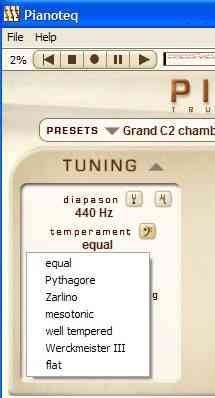
The upper left-hand section lets you choose from several dozen ‘presets’ with all of the modeled parameters for Steinway concert grands and Fazioli and other instruments built-in. You can set the frequency of A4 to be something other than A440 if you wish, and the mathematics automatically takes care of modeling the implications that that has on other of the acoustical physics governed by the other settings. From a drop-down menu you can choose from a range of historic temperaments.

Temperament controls
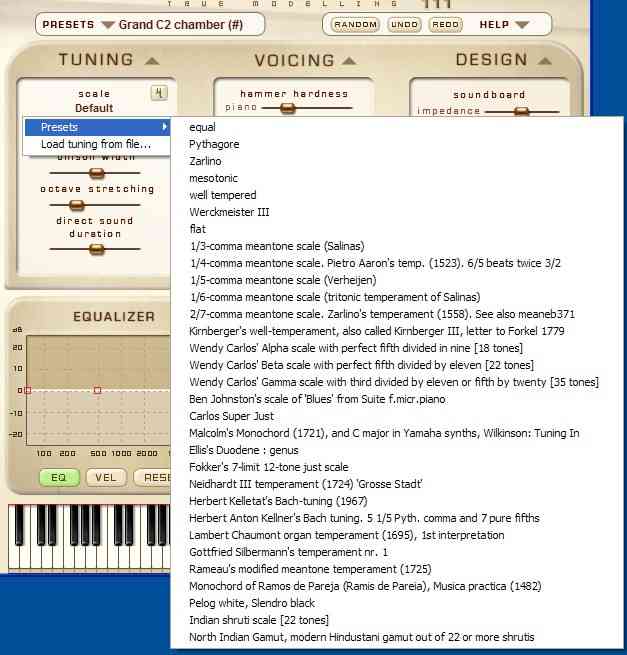
Click on the Greek letter ‘mu’ symbol, and you are able to select a variety of built-in microtonal scales and temperaments—or, alternatively, you can load custom microtonal scales and tunings that you have built yourself as .SCL files, using Scala or a similar app.

Microtonal controls
You can also import .KBM keyboard-mapping files, to remap your keyboard’s keys to different pitches if you wish.

Microtonal controls
I particularly enjoy exploring the coloristic/textural effects of longitudinal vibrational modes in very long strings—say in a surreal piano that is 3 times as long as the longest concert grand—way bigger than anyone could afford, way bigger than anyone has a hall big enough to hold, way bigger than any manufacturer would ever make. Maybe such a piano would have to be on a concrete floor because it would be so heavy. Maybe such a piano would have to have robotic electro-hydraulically actuated hammers because the string caliber would be so much bigger than normal and the distances to where the hammers would need to hit the strings… Maybe you will have as much fun as I have been having, doing your own ‘What if?’ explorations at the margin of what is possible in the real world.

Microtonal controls
The ‘quadratic effect’ to alter the harmonic overtones spectrum as a function of key velocity is very cool, perhaps most dramatically so when you have loaded some microtonal scale and tuning scheme that has lots of unusual dissonances and sympathetic resonances…

Microtonal controls
W hat’s more, you get to adjust the amount of damper noise, the amount of pedal noise, the amount of noise generated by your key-releases, and so on. You can’t do that on any other VI that I know of. The amount of realism (or over-the-top dramatic effects) that’s achievable is mind-blowing. Yes, you have to have the patience to actually try out all of these controls. This console has many, many things you can tweak. But, unlike sampled libraries where you are forced to index into a combinatoric explosion of discrete selections, here you are moving analog sliders to change the coefficients’ values that drive Pianoteq’s models’ equations.

Microtonal controls
The full set of pedals—plus the possibility for doing fractional-pedal MIDI commands—is wonderful. You can do half-pedaling, quarter-pedaling, ‘10%-pedalling’ or even more detail if you wish. You can do re-pedaling. If you edit your MIDI file, you can create pedaling that your feet can’t physically do, if there is some really exotic pedaling effect that you’re after.

Pedals controls
You can click on the ‘Vel’ velocity display and click-and-drag the spline knots-nodes (or add more of them) to adjust the action of the piano—the relation of the dynamics of the sound produced to the velocity of the key strokes. Play a passage or load a MIDI file and see the vertical red lines show the velocity information for each note that is played. Drag the knots to change how steep or shallow the middle part of the curve is. Of course, there is nothing to prevent you from doing something other than ‘left-right-monotonic-increasing’ curves. For some paradoxical interpretations, try making it high at the left and downward-sloping to the right. Pianissimo becomes fortissimo and vice versa. Okay, don’t do that. But the point is, there is tremendous flexibility here. In fact, two of the major uses that I perceive for a professional traditional acoustic pianist to have a copy of Pianoteq are (a) to better communicate with piano technicians, both when you are at home and when you are a guest performer far away, and (b) to be able to quantitatively discover the parameters of the real-world instrument you are after, and show those (or email the .FXP settings) to the agents who are trying to find your next instrument for you. The Pianoteq FXP settings become an objective ‘specification’ for what you want—the strings, the action, the soundboard’s timbre and resonances, everything.

Velocity
For those of us who are obsessed and delighted with all things microtonal, or with early music historical temperaments, the Pianoteq VI is perfect for quickly and cheaply trying different temperaments out. Before you request that your piano technician spend hours retuning an instrument to some temperament that you have never tried before, try it out on Pianoteq.

If you have ordered a piano technician to tune an instrument to Rameau’s 1725 meantone tuning, then when he/she is done you can check the job by putting your laptop next to the instrument, putting on your headphones, launch Pianoteq set to Rameau and confirm whether the real-world instrument is as it should be or not.

For that matter, if you are a piano technician who responds to esoteric requests like this, then having Pianoteq on your laptop when you do the job will make the work tremendously faster and less tedious.

Again, these ‘composer’ and ‘musician-services’ use-cases are not described in any of the Pianoteq product materials or reviews, but they are among the most valuable things that I would imagine doing with it. In other words, performance and recording using Pianoteq may be the flashy and ‘obvious’ use-cases. But the composer-helper and pianist-instrument-hunting and disabled-pianist and pianist-pianotuner-specifier-quality-assurance use-cases are, in my opinion, likely to have far greater impact overall.

The Pianoteq dynamic mechanical and acoustics mathematical models use data issued from several recorded music sources and from a Steinway D, recorded at Studio Le Graal, 31600 Muret, France. Fazioli and Bosendorfer and other instruments have also been modeled. And a good number of harpsichords and other keyboards are available as free .FXP downloads from Pianoteq’s website.

Pianoteq’s design is by Philippe Guillaume and Julien Pommier, who are on the faculty in the Dept. of Mathematics at INSA Toulouse (links below).

You can run Pianoteq under VST or Sonar or Cubase hosts or standalone. The resonance between notes is better than any impulse response generated with any of the piano libraries I own, like Garritan and Native Instruments and Vienna Symphonic. Unlike the dynamics transitions you get with libraries, the transitions with Pianoteq are smooth, with no ‘stepping’ between layers. There should be no surprise at this, since the Pianoteq’s waveforms are governed by linear and nonlinear differential equations. You can go from pianississimo to fortississimo without any ‘edge’ of a velocity layer (velocity dynamics represented with 7-bit 127-levels quantization, far finer resolution than the ear can hear).

To edit a MIDI you record with Pianoteq, you open it in your favorite sequencer. Next, Pianoteq lets you export your piece as a .WAV audio file, which you can easily convert to .MP3 (as I did for the examples above) or other formats.

Octave-stretching. It is normal to ‘stretch’ octaves a few cents beyond 1200—especially in the upper registers in a piano, but how much should they be stretched? You decide! Pianoteq lets you tweak an octave-stretching parameter. The setting is physically modeled after real pianos, though, so the strongest effect of octave-stretching will be observed in the upper treble range. If you want to do wider octave-stretching, just get out Scala and make yourself some custom .SCLs with however many cents-per-octave you want, and that octave-stretching or octave-compression will be pan-register ‘global’ in its effect, not just in the upper registers.

Unison-tuning of three-string and two-string notes. The three strings of each piano ‘unison’ (the strings hit by a particular hammer) are not tuned to precisely the same frequency. For prober timbre and color, a piano technician introduces small tuning differences between the three strings. You can discover interesting effects by adjusting the unison width, the difference between the lowest and the highest frequency produced by the three strings of a single note. Moving the slider to the left tunes the strings closer to perfect unison. Moving the slider to the right increases the degree to which the strings are slightly out of tune. Far to the right = ‘honky tonk’.

Pianoteq’s diversity of mathematical model-generated timbres is wonderful. If you are not satisfied with what you are getting with the out-of-the-box presets, then just be patient and make some adjustments. Save your preferred tweaks as your own .FXP file. If you’re especially finicky, then capture some samples from a real-world piano that you admire—play a few passages in a location that you admire acoustically and record them with good equipment; or rip some representative patches off an SACD that has the sound you are looking for—and do spectrum analysis on it. Use that as a ‘gold standard’ to guide your Pianoteq tweaking. I swear that the few people who have posted “Oh, Pianoteq is not quite there yet” comments have either (a) simply not bothered to exert themselves to adequately tailor the Pianoteq settings to match their own preferences, (b) do not have a digital audio system in their laptop/workstation that is able to do justice to the Pianoteq output, or (c) are poseurs who play deceptive games of one-upsmanship.

In short, Pianoteq has easily become my favorite VI, on the basis of its acoustic realism, feature-function flexibility, and ease-of-use. Based on my own experience so far, (on Dell Latitude D830 and Dell Precision M6400C) I strongly recommend not trying to run on a machine that is less than 2.0 GHz. Preferably, you will want a machine that is 2.5 GHz or higher, with 2GB (or more if 64-bit) of main memory not already consumed by other apps.

If you get ‘computer overload’ messages, then set the polyphony down. ‘Polyphony’ is the number of individual sounds that Pianoteq renders simultaneously in its equation-synthesized output. The lower the clock-rate of your CPU, the lower you should set the polyphony. Or you can choose ‘Automatic’ (either ‘Auto-pessimistic’ or ‘Auto-optimistic’) to let Pianoteq automatically adjust the polyphony setting based on the CPU bandwidth that it finds available on your machine. Polyphony lower than about 24 may disappoint you acoustically, which is the reason for the suggestion above for a substantially-unused 2.5 GHz or more. If you’ve got a 3.0 GHz Intel Core 2 Duo Extreme chipset that TaskManager shows to be under 20% average CPU utilization before you start playing on Pianoteq, you’ll be fine.

Fast passages generate large amounts of polyphony, which causes CPU consumption to go way up. So does holding the sustain pedal down, obviously. Global resonance and sympathetic resonance are also CPU consuming. If you slide the global resonance and sympathetic resonance sliders all the way to the left, the resonance computations are by-passed, and the CPU load is far smaller. But you really don’t want to do that. You want to put Pianoteq on a fast machine that will give you the realism that Pianoteq’s internals are capable of delivering. [Multi-core processor resources are supported (feature is accessible in the Options pull-down menu) for high-performance acoustic rendering in Pianoteq 2.3. Dual-core and quad-core CPUs (like Intel Core 2 Duo and Extreme, AMD Phenom, etc.) are fine, although massively multiprocessor parallel systems (such as NVIDIA Tesla and similar) are currently not supported.]

One especially good thing is that, with Pianoteq, you will not need to worry about needing dozens and dozens of gigabytes of fast SATA disk to store piano sampling libraries, nor will you need to meticulously slave over carefully selecting effects from those libraries bar-by-bar, note-by-note in order to achieve realistic sound and phrasing.

MODARTT’s Pianoteq: possibly a good holiday ‘gift’ for yourself—or put it under your Tannenbaum/Weihnachtsbaum for the techie-pianist family member in your house.


Philippe Guillaume book