Showing posts with label temperament. Show all posts

Thursday, December 13, 2012

Beiser/Harrison/YPC: Joyous Time Loops, Just Intonation

YPC with Beiser and Harrison
T   his is the basic premise of the Transient Glory® project: that a child’s voice is a unique instrument during that fleeting time between childhood and after-childhood... and that this instrument can tackle the most challenging and uncompromising music written for them. Children leave something behind [as they grow up and leave childhood]. I don’t know what it is, but children are able to communicate in a way we adults have forgotten how to do.”
  — Francisco Núñez, YPC, 09-MAY-2011.
T   he entirety of ‘Time Loops’ is performed using ‘just intonation’ tuning, based on whole number proportions. With ‘Time Loops’ I am demonstrating the simpler and more harmonious aspects of just intonation. As a result the tunings on the CD don’t push boundaries per se, but rather they sound clearer and more direct than the normal equal-tempered scale that is used in most Western music.”
  — Michael Harrison, 23-AUG-2012.

T he new recording ‘Time Loops’ is a superb stimulus to joy and reflection. Meditation to bring peace at this or any time of year.

I n concert performances, cellist Maya Beiser plays the lead part live accompanied by pre-recorded, digitally-processed tracks forming an auto-ensemble of many sonic layers. Multi-media artist Bill Morrison created a film for ‘Time Loops’ that incorporates archival footage and CGI images that illustrate the movement of the planets, celestial mechanics mathematically conforming to the integer ratios of the music’s just intonation. Composer Michael Harrison performs the piano part with sensitivity and feeling. Even amidst the complexity and conflict of everyday life, we rediscover here the beauty and solace that are immanent in the natural world—the patterns and harmonics of a clockwork Universe whose physics was first formalized mathematically by Kepler, Galileo, Newton, and others—and rediscover that our own homo sapiens processes are as real and natural and immutable as those.

T he last and largest-scale work on the CD, ‘Hijaz,’ was composed by Harrison for Beiser and the Young People’s Chorus of New York City under the direction of Francisco Nuñez, as well as composer and percussionist Payton MacDonald on tabla and shaker. The text combines a prayer written by Harrison with spoken South Indian rhythmic syllables, which merge with the choral textures to evoke a sense of joy and unity and transcendence—deeply fitting for this holiday season.

E specially vivid and poignant are the perspectives of the school-age voices in the choir (see blockquote above). Wise beyond their years; empowered and uplifted by the music. To me, joy is mainly what music is for, and people should, through writing and performing music, feel joyous and acquire a better ability to create more joy. This CD—the compositions and performances—is first-class evidence supporting this idea. Evidence, too, of how crucially important opportunities are for kids to learn and perform music—before adulthood overtakes them as it does us all. Not a nostalgia for a childlike simplicity, but instead a meditation on clarity, on earnestness, on wonder, on the youthful drive to penetrate the truth of things, on receptiveness to joy.


    [50-sec clip, Beiser/Harrison/YPC, ‘Hijaz’; (track 8), 2012, 1.4MB MP3]
M   y intention was to invoke a sense of pilgrimage, either to a wondrous or holy place, or, metaphorically, to a sacred place within each of us. The chorus is the soul of the journeyer... The pulsing rhythms trace our footsteps, and those of our camels, as we make our way on the path of self-discovery.”
  — Michael Harrison, 23-AUG-2012.

T he recent release of ‘Time Loops’ coincided with the first productions of Maya Beiser’s ‘ELSEWHERE: A CelloOpera,’ created by Maya with director Robert Woodruff, composers Missy Mazzoli and Eve Beglarian and writer Erin Cressida Wilson. For more information, visit www.elsewherecelloopera.com.


Sunday, May 20, 2012

Terry Riley’s Aleph (א): Music to Code By

Terry Riley
A  leph in Jewish mysticism represents the oneness of the Divine. The letter can been seen as being composed of an upper yud, a lower yud, and a vav leaning on a diagonal. The upper yud represents the hidden and ineffible aspects of God while the lower yud represents God’s revelation and presence in the world. The vav connects the two realms.”
  — Wikipedia.

T he 1-hour 53-min recording of Terry Riley’s solo synth performance of his composition, ‘א’, is beautiful—and precisely the sort of experience you would expect from Riley.

B ut, apart from whatever else it may be and apart from its merits as a composition and as a performance, I have found it to be especially conducive to my own productivity when working on complex math problems and coding software to solve them. For me, silence works only up to a point, after which I need minimalist music.

B ut not just any minimalist music. For example, Michael Nyman’s music interferes with concentration. La Monte Young’s music contains, for me, too many distractions. I do find Ellen Fullman’s recent work conducive, though, in the same way that Terry Riley’s ‘Aleph’ is conducive.

T he timbre of the Korg Triton Studio 88 Synth is bright like a Chinese single-reed or double-reed, but with a lot of spectral flux like a car horn... or a choir of Chinese tenor and bass suonas. Spectral flux and spectral irregularity are distinguishing features in car horns (see Lemaitre 2003, link below).

T he two-hour performance is filled with dense, organic, continually-changing textures—nimble car horns, if car horns can ever be nimble, and these are supernaturally nimble. The automaticity of preschool kids’ trying out their fingers on a keyboard, enjoying the raw pleasure of making notes and reproducing patterns and sequences... reflexive movements of their fingers and arms, yielding arpeggiation that involves just those notes that are within easy reach without stretching.

T he effect, some minutes into listening to it, evokes a freedom from intention and planning that is unknown to sober adults, and this is what facilitates my problem-solving and coding mind. The uncertain continuation of woodwind-like fingering patterns without aim, as long as they last, until superceded by some new motif... the stochastic, aleatoric innovations... Riley discounts the creative value of mind and deliberation and discounts it again, and again... the dollar-store of intellect... until the passion of meat is all that’s left, and animal instinct is restored...

O  nly connect the prose and the passion, and both will be exalted, and human love will be seen at its height. Live in fragments no longer. Only connect...”
  — E.M. Forster, ‘Howard’s End’, Ch. 22, 1910.

H ere’s a short MP3 clip.

T here is a ceremonial, magisterial, quasi-liturgical quality of ‘Aleph’ that reminds me of requiem forms. Or of chant, which can be heard as both archaic and contemporary. It is a mystical piece that unfolds at an implacable, glacial pace. The tone is largely meditative and serene, which provides space for contemplation and veneration. There are dozens-of-voices atmospheric Ligeti-like sound-fogs... fields of dissonance that convey an inhuman, infinite, primeval power—this surely is part of the Hebrew significance of Aleph; as is true also of the meaning of ‘א’ in mathematics—fitting as well in the context of requiem-writing.

I  t has been said that my ‘Requiem’ does not express the fear of death and someone has called it a lullaby of death. But it is thus that I see death: as a happy deliverance, an aspiration towards happiness above, rather than as a painful experience. The music of Gounod has been criticized for its over-inclination towards human tenderness. But his nature predisposed him to feel this way: religious emotion took this form inside him. Is it not necessary to accept the artist’s nature? As to my ‘Requiem’, perhaps I have also instinctively sought to escape from what is thought right and proper...”
  — Gabriel Fauré, 1902.

T hroughout, the piece is prodigiously inventive, with prolific layers upon layers of rhythmic and harmonic complexity, yet all presented with what appears on the surface to be minimalistic... it embodies the best of what minimalism can be: full of latent variety that captures and nourishes the listener’s awareness. (Which is why I find it helpful to listen to when I am tackling a hard problem, and why I am writing this blogpost you are reading. If you are interested in reading more about quantitative evidence concerning music listening and work productivity, have a look at the links below, esp. the book by Vikram Kiran.)

T he seamless, cluster-like blends fan out like a spilled liquid on a flat surface—part of the organic quality of just intonation, providing a support structure for the synth suona-like parts, a Toop-style “rawness” of intonation that sustains the emotional intensity of the piece.

M ost a cappella ensembles naturally gravitate to just intonation because its ‘stability’ or ‘target-pitch predictability’ is comfortable. In that regard, maybe the spectral flux and on-again-off-again frisson of this Terry Riley recording will be of special interest to people of a vocal bent, both amateur and professional singers alike.

T his sound of synth suonas keening, synth voices keening, choir of synth car horns keening... bears some resemblance to the György Ligeti piece in ‘2001 A Space Odyssey’, ‘Lux aeterna’... A friend who was overhearing my repeated playing of the 2 Riley ‘Aleph’ CDs wondered aloud “How can you stand that!? It’s driving me nuts!” So, to be truthful I should say that this is an acquired taste, or reveals a patience borne of equanimity. It is like being transported by William Kraft’s music in the walkway between terminals underneath Chicago’s O’Hare airport. It is like listening to a choir of chainsaws in the forest at a great and comfortable distance. Or like the persistent-but-beautiful bleating and tintinnabulation of sheep in a high alpine meadow in the Swiss alps, below the Jung Frau Joch in the late mornings of mid-summer. In other words, the bleating and tintinnabulation signify tolerant, salutary, and humane qualities that are implicit in our planet’s troubled story. Children of the Universe, you (every living creature) are here, hurray. Have a good life.

I  n short, these are qualities which make humans, the sum of which could be seen in love (esp. agape, which in turn can be seen as an embodiment of the ‘idea of One’). The musical gaze cast from this sphere upon the story world is distanced, more or less withdrawn, non-judgemental, calm, quiet, and slightly melancholic, yet non-sentimental. As film music, tintinnabuli music often qualifies as an ‘against all odds’ score capable of making the complicated plot-level matters more poignant.”
  — Kaire Maimets-Volt, p. 172.

I f you were in a foreign country and experiencing the local people performing on their native instruments, a long raga, for example—you would exhibit a tolerance toward such bleatings and tintinnabulations. But if instead, like my friend, you regard it as a choir of annoying car horns—multiple car alarms being set off repeatedly by marauding kids on a street a couple of blocks away—you just want it to stop.

I n summary, playing these 2 CDs consecutively without a break induces an awareness that can facilitate productive concentration at work and lift you into a realm beyond human understanding or hearing. The music requires an audience who must be willing to accept the spirit of the work and suspend their disbelief in order to receive its many rewards.


Friday, March 6, 2009

Chugach Brass: Chamber Music for Sugpiaq (‘Real Persons’)

 Chugach Mountains, view from Anchorage, AK, in 1930/32, photo: Walter Hodge, Elmer E. Rasmuson Library, University of Alaska Fairbanks
T he Chugach Brass Ensemble delivered a wonderful performance at University of Alaska Anchorage on Thursday evening to an enthusiastic audience. About 120 people braved the cold, the thick snowfall, and the icy roads to attend.

 Chugach Brass: Sweeney, Weeda, Pierce, Epperson
  • Christopher Sweeney, trombone
  • Linn Weeda, trumpet
  • Cheryl Pierce, french horn
  • Dean Epperson, piano (guest)
T he program was widely-varied, including early music, Weeda’s arrangement of Bach’s Contrapunctus 16, a romantic piece by Debussy’s colleague Paul Dukas, and several new compositions.
  • A Philharmonic Fanfare (2003)….Eric Ewazen
  • Be My Love, A Suite of 16th Century French Chansons (2000)…. arr. Linn Weeda
         Tru, tru, tru avant il fault boire!....Jean Richafort
         Au joly boys je rencontray m’amye….Clemens (non Papa)
         Jouyssance vous donneray….Antonine Gardane
         Baises moy tant, tant….Adrian Willaert
  • Folksong (1972)….Bruce Broughton
  • Trio for Brass (1961)….Robert Sanders
  • Villanelle (1906)….Paul Dukas
  • Recreation for Trumpet, Horn, Trombone and Piano (1958)…. Pierre Gabaye
  • Contrapunctus XVI (inversus), Art of the Fugue, BWV 1080 (1745)….J.S. Bach (arr. Weeda)
  • Sonata for Trombone and Piano (1951)….George Frederick McKay
  • Fumeux fume (ca. 1380)……..Solage (arr. Weeda)
  • Trio for Brass (1996)….Anthony Plog
T he Ewazen ‘Fanfare’ is predominantly consonant triads interspersed with more dissonant harmonies (Copland-esque). The overall quality is assertive, gregarious, and extroverted—not frivolous, but intensely convivial. Very ‘brass-like’ in idiom.

W eeda’s beautiful 5-minute-long arrangement of French chansons illustrated the diversity of brass orchestration and textures. Also, a wide range in composerly ‘stance’—from the ribald ‘Tru, tru, trut’, to the tender ‘Au joly boys’ with Weeda’s mellow flugelhorn, to the exuberant horn-trombone duet ‘Jouyssance’, to the high-tessitura ‘Baises moy tant’ with Weeda’s brilliant piccolo trumpet. The brightness of the ensemble timbre is made even more dramatic by adding the piccolo trumpet on the top end. It lends a paradoxical impression of yet-wider harmonies—the as-written intervals do not have such wide spreads.

T he Broughton ‘Folksong’ was rendered with great empathy—lyrical and legato articulation without sentimental excess. Copland-esque. Sharp staccato trumpet stabs moderate the dark tones of the piano part. Weeda’s control of extended diminuendos was masterful and delicious.

O ne of the other salient musical features of this work include the frequent inclusions of slurred passages. Slurs throughout the work are used in two ways: 1) to move from one clear chord/pitch to another or 2) to move to indeterminate pitches as a gesture. In the simplest sense, slurs and legato playing provide a kinesthetic indication of fluidity within the work.

T he several Weeda arrangements showed off Weeda’s skill in orchestrating nuances that differ between the instruments. Low fifths thicken the sound.When the trumpet could otherwise be too strident, he softens the effect with the horn and trombone. Very nicely written and performed.

T hemes in much brass literature tend to maintain consistent relationships between pitches, often arranged in ascending or descending patterns. Both linear and vertical dimensions exist, of course, but can have different functions in brass works, compared to string ensemble lit. In the linear dimension, a theme is repeated, and the melodic contour varies according to the registral placements. Sometimes it is presented as an ostinato figure with a consistently repeated ascending contour and a recurring rhythmic pattern. This theme can also be combined with other elements to form a longer melodic line. Weeda handles these aspects with great skill.

T he other pieces were also new to me and interesting as a ‘casebook’ of recent writing for small chamber brass ensemble. Harmonies that are, in many places, ‘choral’ in texture.

I n the Sanders piece, the cadential formulae arise mostly from modern added-tone extensions beyond the tonic scale. Some modal intervals of fourths and fifths. By placing the “chorale material”, Sanders creates a sense of latent energy, even during the Adagio. Since we are expecting 8th note groupings in 4 (and the quarter-note pulse), the irregular feel of the rhythm in this movement gives a disruptive energy.

I n all, it was a wonderful evening—an intriguing sampling of recent chamber compositions for brass, and a fine introduction to Weeda’s abilities as an arranger. Wonderful, too, to experience such cultural diversity in the depths of winter in Anchorage.

T he ensemble takes its name from the Chugach (‘sugpiaq’) tribe that is indigenous to the Prince William sound area. Besides their roles teaching at University of Alaska Anchorage and playing with the Anchorage Symphony Orchestra, each of the performers is involved with local outreach and community music education efforts.

B esides his position as Principal Trumpet with ASO, Weeda is Music Director of the Anchorage Youth Symphony. His M.M. was from Boston University. Pierce received her M.M. from Temple University and performed French horn for 15 years in the U.S. Air Force prior to her current role in the horn section with ASO. Sweeney has M.M. and Ph.D. Mus. Ed. degrees from University of Miami and is currently Asst. Prof. of Music at UAA. Epperson was honored in 2005 as an MTNA Foundation Fellow, in recognition of distinguished service to music teaching. He has performed with Anchorage Chamber Symphony and Kenai Peninsula Orchestra.

T    he incisiveness [of the bright timbre] must be used advisedly. However, this property can be used to make a theme salient. The attack can have an equally pointed, even dissonant, effect. One sees the extent to which the problem of balance is complex and difficult...”
  —  Charles Koechlin, ‘The balance of sonorities’, in Mathews, ed., Orchestration, p.142.

T    he following five values operate through and with texts:
  • Will-to-Image: includes, at a minimum, images of past events and selves, as well as the inclination to move between several disparate worlds, what exists and what does not exist; what is real and what is not real... ;
  • Will-to-Improvise: includes not only how to invent in connection to the kairotic moment, but also how to confront failure and play within the dark spaces of the unknown, the unuttered, the ineffable;
  • Will-to-Intuit: the ability to disregard Reason, encouraging the role of emotions and feeling; the basis for inquiry and investigation; the curiosity-maker; the hunter; the willful accident;
  • Will-to-Juxtapose: the ability to contrast images and thoughts with one another, let them interact, cause them to conflict; the Bakhtininan 'centripetal force of language’; the power of metaphor;
  • Will-to-Integrate: includes synthesis, connection, parallelism, coherence; the beginning of transition to discourse; the Bakhtinian ‘centrifugal force of language’.”
  —  Joddy Murray, Non-Discursive Rhetoric, p. 140 [viz., the ‘assertiveness’ of brass players].
 ANLC map


Wednesday, December 3, 2008

Pianoteq: Virtual Instrument with Many Uses

Philippe Guillaume
P   iano voicing consists in giving the piano a ‘nice’ sound. What ‘nice’ means depends of course on the pianist or the listener. This task is done by the piano technician who acts on the hammers by filing (shaping), softening or hardening them, in order to obtain a mellow sound when playing softly, and a bright sound when playing strongly. The technician also acts on the piano action, adjusting it in order to obtain even touch and sound from one note to another. Finally, the technician acts on the piano tuning itself, because the way each [three-string] unison is tuned has a great influence on how the sound develops and decays—that is, on how the piano ‘sings’.”
  —  Philippe Guillaume, INSA-Toulouse.
I   n general, Pianoteq sounds more like you are sitting in front of a real piano soundboard than any sample library does. There is that ‘It’ factor that is missing in many waveform sample libraries that helps create dynamic, believable piano sounds. And I would be lying if I didn’t say I was impressed at just how closely MODARTT has gotten to the pianos I grew up loving to play.”
  —  Brent Randall, ProRec, JUN-2008.
I   started learning the piano at school when I was eleven years old. I remember how fascinated I was the first time I heard somebody playing the Etudes of Chopin—and of course I wanted to play them too. After years of practice, there are some that I could play, but not the one I always wanted to play: Etude No. 23 in A minor. But, anyway, I loved the piano so much that I wanted to work with pianos, and that’s why I became a piano tuner. As a piano tuner, I worked for numerous piano shops in Toulouse and then I had my own repair workshop where I restored many old pianos. I have also worked for numerous concerts and music festivals in Toulouse and the surrounding region, preparing concert grands for great artists. I was always a bit frustrated not having full control of the sound to satisfy their requests. For example, when voicing a real acoustic grand, you have some control of the timbre, but cannot decide to simply increase the 6th overtone by 6 dB. ‘How could I accomplish this?’ I asked myself. I started dreaming of a device that could allow such manipulations of the sound... But it was too early to develop such a device as there were no computers available with the required processing power and speed. Twenty years later, Pianoteq was created with the aim of providing full control over the piano sound.”
  —  Philippe Guillaume, interview with IMSTA, 2007.
Virtual instruments (VIs) and soundfonts keep getting dramatically better each year. After reading several favorable reviews of MODARTT’s Pianoteq virtual piano earlier this year, I picked up a copy of Pianoteq. This CMT post aims (a) to express my very positive feelings about the product, (b) to provide a suggestion about some valuable uses for Pianoteq that are not covered in the product manual or in the reviews that have been published to-date, and (c) to offer advice on the minimum system configuration that will enable Pianoteq to deliver satisfying results.

Have a listen to a couple of MP3 clips of the Prelude No. 1 from Well-tempered Clavier Book 1 that illustrate what you can do:
Bach, WTC Book 1, Prelude No. 1 in C major, BWV 846, mm. 1 to 5

    [50-sec clip, J.S. Bach, ‘Prelude No. 1 in C major’, Pianoteq2, Equal temperament, 1.2MB MP3]

    [50-sec clip, J.S. Bach, ‘Prelude No. 1 in C major’, Pianoteq2, Kellner Baroque temperament, 1.2MB MP3]

    [50-sec clip, J.S. Bach, ‘Prelude No. 1 in C major’, Pianoteq2, Werckmeister III 12-of-19 TET temperament, 1.2MB MP3]

    [50-sec clip, J.S. Bach, ‘Prelude No. 1 in C major’, Pianoteq2, Shang Dynasty bells FXP settings, 11-TET scale, 1.2MB MP3]

    [50-sec clip, J.S. Bach, ‘Prelude No. 1 in C major’, Pianoteq2, Shruti 22-TET temperament, 1.2MB MP3]

Each of these was created by driving the same .MID file, with the velocity and pedaling and other commands.

In the case of the 11-TET Chinese bells, I created a .FXP effects-profile file that has properties mimicking the spectral analysis of the actual 433 B.C.E. bells that were found in the tomb of Marquis Yi of Zeng some 30 years ago. Using Scala software, I created a .SCL scale file with 110 cents per equal-tempered step in an 11-step-per-octave scale resembling the Chinese bell array. If you like, you can download those files here and here and upload them into your copy of Pianoteq.

The overall GUI user-interface design of Pianoteq is straightforward and uncluttered. The layout is sensible, and the controls are intuitive, entailing at most one level of drop-down/cascading menu selections. On the right-hand side there is a ‘Design’ panel that allows you to adjust the acoustical physics parameters of the soundboard (including the impedance of it, altering its sitka spruce or other materials, its thickness, its tapering at the edges, the sharpness or ‘Q’ of its resonance, and cut-off frequency) and the strings. The sympathetic resonance among the undamped strings is adjustable (à la ‘microcosmos’ by Béla Bartók)—the mathematical model accurately allows you to quantitatively vary the amount of acoustical coupling between the strings, not only with respect to their different pitches but also their physical distance from each other within the physical piano that is modeled. The dimensions of the virtual piano can be changed from less than 2 meters to as much as 10 meters, which enables you to precisely mimic actual keyboard instruments, plus instruments that are far larger or smaller than any that presently exist. The ‘Quadratic Effect’ control permits you to tweak the nonlinear strike-velocity part of the string response, generating frequencies with twice the values of the normal ones with hard strikes. Cranking this up can give you realistic higher overtones of fortississimo playing without having to physically beat your piano to death.

Incidentally, some of these settings may enable handicapped persons to achieve effects that they were once able to do on a conventional piano but are no longer able to do on account of an acquired disability. To my knowledge, none of the Pianoteq reviews or product literature has mentioned the use of Pianoteq as an ‘assistive’ technology before—i.e., the tremendous value that the Pianoteq VI would have for pianists who are disabled to a degree that impairs or prevents performance, but who are nonetheless able enough to operate a MIDI keyboard and sequencer and click on the controls of the Pianoteq GUI. It is absolutely wonderful for this, better than any other VI that I know of.

Design
The upper-middle portion of the Pianoteq GUI is ‘Voicing’, where you adjust the hardness of the hammers across the different loudness/dynamics levels and use the little vertical EQ-slider controls to change the frequency spectrum for the fundamentals and harmonics/overtones 2 through 8 for all of the strings. The ‘Character’ slider lets you control the statistical variance of the overtones’ intensities—so that the irregularity varies randomly within either narrow or wider bounds as you prefer, mimicking the gradations of color in a real piano through the various registers. You also get to adjust the amount of hammer noise and pedal noise that you want Pianoteq to add. The ‘Soft pedal’ slider controls the amount of smoothing that is activated by depressing the una corda pedal.

Voicing
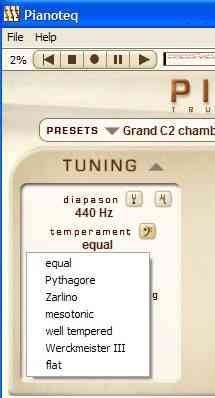
The upper left-hand section lets you choose from several dozen ‘presets’ with all of the modeled parameters for Steinway concert grands and Fazioli and other instruments built-in. You can set the frequency of A4 to be something other than A440 if you wish, and the mathematics automatically takes care of modeling the implications that that has on other of the acoustical physics governed by the other settings. From a drop-down menu you can choose from a range of historic temperaments.

Temperament controls
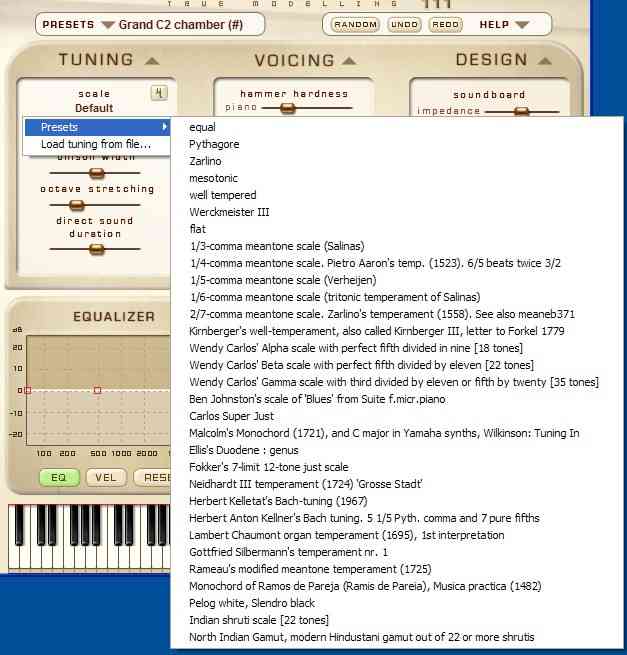
Click on the Greek letter ‘mu’ symbol, and you are able to select a variety of built-in microtonal scales and temperaments—or, alternatively, you can load custom microtonal scales and tunings that you have built yourself as .SCL files, using Scala or a similar app.

Microtonal controls
You can also import .KBM keyboard-mapping files, to remap your keyboard’s keys to different pitches if you wish.

Microtonal controls
I particularly enjoy exploring the coloristic/textural effects of longitudinal vibrational modes in very long strings—say in a surreal piano that is 3 times as long as the longest concert grand—way bigger than anyone could afford, way bigger than anyone has a hall big enough to hold, way bigger than any manufacturer would ever make. Maybe such a piano would have to be on a concrete floor because it would be so heavy. Maybe such a piano would have to have robotic electro-hydraulically actuated hammers because the string caliber would be so much bigger than normal and the distances to where the hammers would need to hit the strings… Maybe you will have as much fun as I have been having, doing your own ‘What if?’ explorations at the margin of what is possible in the real world.

Microtonal controls
The ‘quadratic effect’ to alter the harmonic overtones spectrum as a function of key velocity is very cool, perhaps most dramatically so when you have loaded some microtonal scale and tuning scheme that has lots of unusual dissonances and sympathetic resonances…

Microtonal controls
W hat’s more, you get to adjust the amount of damper noise, the amount of pedal noise, the amount of noise generated by your key-releases, and so on. You can’t do that on any other VI that I know of. The amount of realism (or over-the-top dramatic effects) that’s achievable is mind-blowing. Yes, you have to have the patience to actually try out all of these controls. This console has many, many things you can tweak. But, unlike sampled libraries where you are forced to index into a combinatoric explosion of discrete selections, here you are moving analog sliders to change the coefficients’ values that drive Pianoteq’s models’ equations.

Microtonal controls
The full set of pedals—plus the possibility for doing fractional-pedal MIDI commands—is wonderful. You can do half-pedaling, quarter-pedaling, ‘10%-pedalling’ or even more detail if you wish. You can do re-pedaling. If you edit your MIDI file, you can create pedaling that your feet can’t physically do, if there is some really exotic pedaling effect that you’re after.

Pedals controls
You can click on the ‘Vel’ velocity display and click-and-drag the spline knots-nodes (or add more of them) to adjust the action of the piano—the relation of the dynamics of the sound produced to the velocity of the key strokes. Play a passage or load a MIDI file and see the vertical red lines show the velocity information for each note that is played. Drag the knots to change how steep or shallow the middle part of the curve is. Of course, there is nothing to prevent you from doing something other than ‘left-right-monotonic-increasing’ curves. For some paradoxical interpretations, try making it high at the left and downward-sloping to the right. Pianissimo becomes fortissimo and vice versa. Okay, don’t do that. But the point is, there is tremendous flexibility here. In fact, two of the major uses that I perceive for a professional traditional acoustic pianist to have a copy of Pianoteq are (a) to better communicate with piano technicians, both when you are at home and when you are a guest performer far away, and (b) to be able to quantitatively discover the parameters of the real-world instrument you are after, and show those (or email the .FXP settings) to the agents who are trying to find your next instrument for you. The Pianoteq FXP settings become an objective ‘specification’ for what you want—the strings, the action, the soundboard’s timbre and resonances, everything.

Velocity
For those of us who are obsessed and delighted with all things microtonal, or with early music historical temperaments, the Pianoteq VI is perfect for quickly and cheaply trying different temperaments out. Before you request that your piano technician spend hours retuning an instrument to some temperament that you have never tried before, try it out on Pianoteq.

If you have ordered a piano technician to tune an instrument to Rameau’s 1725 meantone tuning, then when he/she is done you can check the job by putting your laptop next to the instrument, putting on your headphones, launch Pianoteq set to Rameau and confirm whether the real-world instrument is as it should be or not.

For that matter, if you are a piano technician who responds to esoteric requests like this, then having Pianoteq on your laptop when you do the job will make the work tremendously faster and less tedious.

Again, these ‘composer’ and ‘musician-services’ use-cases are not described in any of the Pianoteq product materials or reviews, but they are among the most valuable things that I would imagine doing with it. In other words, performance and recording using Pianoteq may be the flashy and ‘obvious’ use-cases. But the composer-helper and pianist-instrument-hunting and disabled-pianist and pianist-pianotuner-specifier-quality-assurance use-cases are, in my opinion, likely to have far greater impact overall.

The Pianoteq dynamic mechanical and acoustics mathematical models use data issued from several recorded music sources and from a Steinway D, recorded at Studio Le Graal, 31600 Muret, France. Fazioli and Bosendorfer and other instruments have also been modeled. And a good number of harpsichords and other keyboards are available as free .FXP downloads from Pianoteq’s website.

Pianoteq’s design is by Philippe Guillaume and Julien Pommier, who are on the faculty in the Dept. of Mathematics at INSA Toulouse (links below).

You can run Pianoteq under VST or Sonar or Cubase hosts or standalone. The resonance between notes is better than any impulse response generated with any of the piano libraries I own, like Garritan and Native Instruments and Vienna Symphonic. Unlike the dynamics transitions you get with libraries, the transitions with Pianoteq are smooth, with no ‘stepping’ between layers. There should be no surprise at this, since the Pianoteq’s waveforms are governed by linear and nonlinear differential equations. You can go from pianississimo to fortississimo without any ‘edge’ of a velocity layer (velocity dynamics represented with 7-bit 127-levels quantization, far finer resolution than the ear can hear).

To edit a MIDI you record with Pianoteq, you open it in your favorite sequencer. Next, Pianoteq lets you export your piece as a .WAV audio file, which you can easily convert to .MP3 (as I did for the examples above) or other formats.

Octave-stretching. It is normal to ‘stretch’ octaves a few cents beyond 1200—especially in the upper registers in a piano, but how much should they be stretched? You decide! Pianoteq lets you tweak an octave-stretching parameter. The setting is physically modeled after real pianos, though, so the strongest effect of octave-stretching will be observed in the upper treble range. If you want to do wider octave-stretching, just get out Scala and make yourself some custom .SCLs with however many cents-per-octave you want, and that octave-stretching or octave-compression will be pan-register ‘global’ in its effect, not just in the upper registers.

Unison-tuning of three-string and two-string notes. The three strings of each piano ‘unison’ (the strings hit by a particular hammer) are not tuned to precisely the same frequency. For prober timbre and color, a piano technician introduces small tuning differences between the three strings. You can discover interesting effects by adjusting the unison width, the difference between the lowest and the highest frequency produced by the three strings of a single note. Moving the slider to the left tunes the strings closer to perfect unison. Moving the slider to the right increases the degree to which the strings are slightly out of tune. Far to the right = ‘honky tonk’.

Pianoteq’s diversity of mathematical model-generated timbres is wonderful. If you are not satisfied with what you are getting with the out-of-the-box presets, then just be patient and make some adjustments. Save your preferred tweaks as your own .FXP file. If you’re especially finicky, then capture some samples from a real-world piano that you admire—play a few passages in a location that you admire acoustically and record them with good equipment; or rip some representative patches off an SACD that has the sound you are looking for—and do spectrum analysis on it. Use that as a ‘gold standard’ to guide your Pianoteq tweaking. I swear that the few people who have posted “Oh, Pianoteq is not quite there yet” comments have either (a) simply not bothered to exert themselves to adequately tailor the Pianoteq settings to match their own preferences, (b) do not have a digital audio system in their laptop/workstation that is able to do justice to the Pianoteq output, or (c) are poseurs who play deceptive games of one-upsmanship.

In short, Pianoteq has easily become my favorite VI, on the basis of its acoustic realism, feature-function flexibility, and ease-of-use. Based on my own experience so far, (on Dell Latitude D830 and Dell Precision M6400C) I strongly recommend not trying to run on a machine that is less than 2.0 GHz. Preferably, you will want a machine that is 2.5 GHz or higher, with 2GB (or more if 64-bit) of main memory not already consumed by other apps.

If you get ‘computer overload’ messages, then set the polyphony down. ‘Polyphony’ is the number of individual sounds that Pianoteq renders simultaneously in its equation-synthesized output. The lower the clock-rate of your CPU, the lower you should set the polyphony. Or you can choose ‘Automatic’ (either ‘Auto-pessimistic’ or ‘Auto-optimistic’) to let Pianoteq automatically adjust the polyphony setting based on the CPU bandwidth that it finds available on your machine. Polyphony lower than about 24 may disappoint you acoustically, which is the reason for the suggestion above for a substantially-unused 2.5 GHz or more. If you’ve got a 3.0 GHz Intel Core 2 Duo Extreme chipset that TaskManager shows to be under 20% average CPU utilization before you start playing on Pianoteq, you’ll be fine.

Fast passages generate large amounts of polyphony, which causes CPU consumption to go way up. So does holding the sustain pedal down, obviously. Global resonance and sympathetic resonance are also CPU consuming. If you slide the global resonance and sympathetic resonance sliders all the way to the left, the resonance computations are by-passed, and the CPU load is far smaller. But you really don’t want to do that. You want to put Pianoteq on a fast machine that will give you the realism that Pianoteq’s internals are capable of delivering. [Multi-core processor resources are supported (feature is accessible in the Options pull-down menu) for high-performance acoustic rendering in Pianoteq 2.3. Dual-core and quad-core CPUs (like Intel Core 2 Duo and Extreme, AMD Phenom, etc.) are fine, although massively multiprocessor parallel systems (such as NVIDIA Tesla and similar) are currently not supported.]

One especially good thing is that, with Pianoteq, you will not need to worry about needing dozens and dozens of gigabytes of fast SATA disk to store piano sampling libraries, nor will you need to meticulously slave over carefully selecting effects from those libraries bar-by-bar, note-by-note in order to achieve realistic sound and phrasing.

MODARTT’s Pianoteq: possibly a good holiday ‘gift’ for yourself—or put it under your Tannenbaum/Weihnachtsbaum for the techie-pianist family member in your house.


Philippe Guillaume book


Wednesday, April 2, 2008

Was Dallapiccola’s Piano Microtonal or Just-Tuned?

 Dallapiccola, Simbolo, mm. 1-4
W  hy are D-sharp, F-sharp, and G-sharp so horrible?”
  —  Anonymous.
M  any recent composers have come to feel that the compromise of Equal Temperament was a mistake. They feel that the musical logic of moving from any key to any other key became a priority at the expense of music’s sonic sensuousness. Equal temperament chords do have a kind of active ‘buzz’ to them—a level of harmonic excitement and intensity. Equal Temperament could be described as the musical equivalent to eating a lot of red meat and watching violent action films. By contrast, Just intonation intervals are much calmer, more passive. You literally have to slow down to listen to them.”
  —  Kyle Gann.
After my recent CMT blog post on Dallapiccola’s ‘Quaderno di Annalibera’ I have continued to explore these pieces, especially ‘Simbolo’. The dissonances in them are peculiar, unsettling. And the consonances in them are also peculiar—unsettling in their ‘tentativeness’, a quality that’s hard to put your finger on.

I revisited the late David Lewin’s excellent analysis of Quaderno, in hopes of finding a persuasive explanation of these pieces’ effects on me. But, rather than feeling convinced or reassured, I instead began to feel that Lewin’s erudite analysis may manifest certain ‘assumptions’ that were not acknowledged, namely, the assumption that Dallapiccola’s piano was tuned in the standard, modern way—with Equal Temperament (ET). Lewin’s analysis presumes that the piano was equal-tempered. It’s a natural assumption to make, but is it necessarily true? After all, Quaderno was composed during a period that was for Dallapiccola full of intensive exploring and discovery.

How would the tensions and dramatic consonances and dissonances in Quaderno work if the instrument had been tuned in Just Intonation (JI), I wondered? To find out, I downloaded a script to my MIDI keyboard / synthesizer, to change it to JI tuning.

The result was fascinating. The effective tonal dissonance is markedly different when Simbolo is played in JI tension structure instead of ET. In fact, Dallapiccola’s choice of register for the several lines or voices seems especially congenial in JI. The consonances in JI generally fall in Dallapiccola’s relatively long passages and very often dwell on long, now only mildly dissonant stases. In ET, the consonances are transient, and the stases are pretty strongly dissonant. ‘Violent’, to use Gann’s phrase. In my opinion, the contemplative quality of Dallapiccola’s Quadernos di Annalibera is far better in Just Intonation than in Equal Temperament. The JI has a primitive, crunchy-but-laconic, ‘communitarian’ feel. By contrast, the spectra and timbre of the ET—for the intervals in Simbolo, say—are, to my ear, too urgent.

In ET, it’s hard to keep Simbolo from sounding hurried, judgmental, aspiring, and self-referential. In JI, however, Simbolo exhorts the listener (and the pianist) to a zen-like composure, a stop-and-smell-the-roses alertness, a non-judgmental satisfaction with what one has. The former matches what we know of Dallapiccola’s politics; the latter matches what a father (Luigi) might reasonably express to his young daughter (Annalibera).

Modern composers using Just Temperament include Carola Anderson, Bill Alves, David Canright, Jon Catler, John Chalmers, David Doty, Tom Doughterty, Dean Drummond, Dudley Duncan, Adriaan Fokker, Glenn Frantz, Kyle Gann, Denny Genovese, Philip Glass, Eivind Groven, Lou Harrison and Michael Harrison, Norman Henry, Ralph Hill, Jim Horton, Ben Johnston, Joan LaBarbara, Anne LeBaron, Janis Mattox, David Mitros, Norbert Oldani, Harry Partch, P.Q. Phan, Larry Polansky, James Pugiliese, Robert Rich, Eric Ridgway, Terry Riley, Gino Robair, Daniel Schmidt, Carter Scholz, Bill Sethares, Jules Siegel, James Tenney, Toby Twining, Erling Wold, and La Monte Young.

But, so far as I can tell, there’s no documentation that Luigi Dallapiccola used JI when composing Quaderno. Nonetheless, the emotionally coherent effect that JI imparts to these pieces makes the JI conjecture at least plausible.

We have no way of knowing in mm. 2-3 whether the G-flat—A-flat—D is an order-segment of an emerging tone-row. We don’t know in ET, and we don’t know in JI. So we don’t hear the trichord { G-flat, A-flat, D } in mm. 2-3 as yet bound to an intervallic ‘context’ when we hear { G, D-flat, F } in m. 4. We are only ‘situated’ in-context later on. And yet… and yet in JI the ‘context’ looms in a more immediate, more rapidly apprehended, more hospitable and inviting way.

The sense of tension in this music is, I suggest, fundamentally linked to the temperament (and its timbre and spectrum, to use Sethares’s language) in which the music is played. The JI tuning is far less tense overall. Most of the tritones in Simbolo are less disturbing in JI than they are in ET. Often these JI tritones are more consonant than the thirds and the sixths—because of the particular positions of the intervals [see spreadsheet, below] used in Simbolo. (But, conversely, in JI some of the Major sixths are off by a whopping 32 cents. Even some of the Perfect fifths are as much as 24 cents out of tune.)

In other words, JI neutralizes some of the tensions that were present when the pieces that comprise Quaderno are performed in ET and simultaneously gives wolfish dissonances in intervals that would otherwise be warm and consonant. Rather than feeling disoriented, we are oriented in new and dramatically different ways. It is as though I am hearing Simbolo for the first time—and maybe understanding it for the first time? Did David Lewin ever think about this?

Dallapiccola, Simbolo, mm. 31-35
Lewin once wrote that the marking ‘oscuro’ in m. 33 is a hint that ‘something large’ should happen in mm. 34-36: a tone-row might appear; a new configuration may appear, or a new variation; or the piece may just end (which it does, soon afterward). Lewin maintained that the enigmatic effect of the writing here is not just due to a ‘stimmung’ but rather is due to an ‘incompleteness’—a withdrawing or withholding of the hoped-for tone-row.

Instead, I now think it plausible that Simbolo may have been intended to be played on a JI-tuned piano. Why? In part, I think this because then nothing ‘large’ is expected and frustrated in mm. 34-36; nothing so red-meatlike happens earlier in the piece as occurs in ET. Some of the gestural ‘questions’ and ‘problems’ that Lewin worries about are, in JI, not so puzzling or enigmatic. Instead, in JI we get the calm equanimity that Kyle Gann alludes to. It is a seductive conceit. It may be right or it may be wrong. But based on these little MIDI keyboard experiments it is now intriguing enough to make me want to look for evidence, talk to Annalibera.

And, while JI may be the best possibility, it is not necessarily the only alternative. For example, I think I will also try the temperament put forward by Giuseppe Zarlino, the Maetre de Chapelle of San Marco in Venice. In 1560 Zarlino proposed inverting the Major and Minor tones of the upper group in Aristoxenus’s classical scale. This gave him these intervals:

CDEFGABC 
0  20438649870288410881200 cents

He then reduced every fifth by 2/7ths of a comma to minimize the comma between the rest of the intervals. This was basically a Meantone (MT) temperament. The MT scheme redistributes the intervals such that the principal ones, such as fourths and fifths are uniformly near-perfect in most keys and other intervals are re-tuned so that they still fulfill their traditional intervallic role within the scale. The most common way of doing this involves flatting the first four fifths (C-G, G-D, D-A, and A-E), reducing them enough to give a true third.

This also eliminates the difference between the Major and Minor tones, producing a ‘Mean’ whole tone between the two, hence, the MT name. The major thirds and the minor sixths are then true, but most of the fifths are slightly flat. It enabled safe modulation from key to key but it left problematic intervals like the fifth G#-D# (viz, the Anonymous remark at the top of this post). The interval’s way too sharp, and its inversion (the perfect fourth) is severely flat.

This is known historically as a wolf tone, so called because the effect is like howling of wolves. There are other wolf tones, but this one is the worst. Apart from readability, the wolf tones are one reason why composers historically have tended to avoid using keys with a large number of sharps or flats.

Here is a spreadsheet you can download by clicking on the screenshot. The spreadsheet enables you to see the sensitivity of deviations from ET to scale position, for JI and for a variety of other historical temperaments, including Zarlino.


Spreadsheet with Temperaments and Intervals calculated

Interestingly, Mozart avoided C# (D-flat), F# (G-flat), G# (A-flat), and B Major. Correspondingly, he also avoided A# (D-flat) minor, D# (E-flat) minor, F minor, and G# (A-flat) minor, respectively. These keys display prominent wolf tones. Mozart also avoided F# (G-flat) minor and B minor. The latter is odd when you consider that one of his favorite keys was the relative D Major. And if you totalize across the various historical temperaments, both D Major and B minor are about as ‘wolfish’ as the more famously wolfish keys.

MajorMinor
C-sharp (D-flat)A-sharp (B-flat)
D-sharp (E-flat)C
F-sharp (G-flat)D-sharp (E-flat)
G-sharp (A-flat)F
A-sharp (B-flat)G
BG-sharp (A-flat)

Here is a spreadsheet you can download by clicking on the screenshot.


Spreadsheet tabulating Mozart keyboards works’ keys

I think I should take an inventory of Dallapiccola’s works, to see what patterns appear and to see whether any of it sheds light on the Quaderno, either corroborating or discorroborating the ideas about JI vs. ET. I’d be very grateful for comments from any of you Dallapiccola scholars out there ...


Saturday, January 26, 2008

Neurodiversity: Borromeo Quartet Brings Beethoven’s Op. 130 + Op. 133 Temperament to Life

Borromeo Quartet, photo Steiner
I n but one extraordinary passage, marked ‘beklemmt’, does the first violin break into a kind of anguished recitative whose obstreperous rhythm challenges the solemn gait of the lower instruments and threatens to rupture the music asunder. The emotion is purged, however, and the violin rejoins its companions to murmur once again the theme of the opening. Beethoven left the question of the Quartet’s finale unsettled, so that the work may be performed with either the Große Fuge of the original version or the substitute Rondo movement that he provided for it shortly before his death. This latter movement, a splendid piece of music, was written in the manner of continuous thematic expansion and development that was central to the style of his last years. With its thrusting rhythms and brief returns of its Gypsy-tinged opening theme, the movement has about it a … stubborn unwillingness to be bent into the tonic key of B-flat major.”
  —  Richard Rodda, 2005.
I ts official title is really a misnomer, for the movement incorporates an introduction, a double fugue, a slower and only mildly contrapuntal section brought about with an abrupt modulation from B-flat to G-flat, a scherzo that is soon overwhelmed by a resumption of the fiercest fugal developments, followed by a stream of afterthoughts and retrospects.”
  —  Denis Matthews.
G reat wits are sure to madness near allied—
And thin partitions do their bounds divide.”
  —  John Dryden, 1662.
W ell, if you ask writers and artists who have depression, severe depression or manic depression, what they feel is important to them about their illness and their moods in their work, what they almost always focus upon is the intensity and the range of emotional expressiveness. Learning from the pain and from the suffering, they experience the sorrow, they experience the despair of the nihilism and so forth. And on the other hand, very ecstatic and visionary states. So that’s what artists and writers focus upon. I think it’s a lot more complicated than that. I think it’s also that people with manic depressive illness who have a particular temperament live a life of almost seemingly irreconcilable differences and opposite states that they somehow, on a day to day basis, have to reconcile. So people who have very disciplined and interesting and strong and creative minds, who also have this temperament, spend their lives having to make some order out of chaos and reconcile these opposite states. I think that a lot of what we ask from artists really is to experience extreme mood states, experience the extremes of human nature and experience, and put some new meaning and redemptive value in their work.”
  —  Kay Redfield Jamison, Live from Lincoln Center.
In late 1822, Prince Nikolas Galitzin of Russia commissioned several string quartets from Beethoven. Beethoven was preoccupied with work on the Missa Solemnis, Op. 123; the Diabelli Variations, Op. 120; and the Ninth Symphony, Op. 125, and delayed delivering the B-flat quartet and Große Fugue until 1825. Galitzin was understandably annoyed by the delays. He wasn’t chopped liver.

What’s more, in this third installment on the commission Galitzin got these six movements, including the two strange slow movements and the giant, fierce 16-minute Fuge. The two fugue subjects here are not playing nicey-nicey. They’re rhetorical adversaries, struggling with each other in musical armed conflict, taking no prisoners. There are winners and there’re losers.

The unhappy public reception of Op. 130 with the Fuge attached as-written led to the substitution of the alternate finale to Op. 130, the Rondo, which turned out to be Beethoven’s last finished composition. The deal was, Beethoven would provide the substitute Rondo on condition that the withdrawn Große Fuge would be issued separately, and Beethoven would get an additional fee. Right. The fugue was published posthumously as Op. 133. Why was the final release as Op. 133 delayed until after Beethoven had died? Who was the cause of the delays, and what were their motives? And how many composers today could engage their patrons in this way? The recklessness and extravagance of it are mind-boggling! Crazy!

In December, I did a post on bipolar (manic-depressive) illness and musical creativity. The occasion of last night’s performance by the Borromeo Quartet made me wonder once more about the diversity of varieties of depression that give rise to composers’ output. Several varieties are, I think, manifested in this Beethoven Quartet. Have a look at Larkin’s nice chapter in Cooper’s book on Beethoven for some extended analysis of signs and symptoms in Beethoven’s later life and works.

The Borromeo Quartet outdid themselves in last night’s incarnation of this wonderful, emotional work. The deep perplexity of the human condition was “in there”, in their performance of Op. 130 + Op. 133. The Rondo in place of the amputated Große Fuge? Somehow, it just doesn’t seem right. It’s a shame that Beethoven suffered so that we might have this work. And it’s possible that, back in his time, nothing could’ve been done to treat his condition or mitigate his suffering. But today the question is, ought such symptoms to be under-treated, so that we might have more works like this? Ought such symptoms to be medically induced, as a form of composer performance-enhancement?

P revailing conceptions of creativity in psychology and psychiatry derive from romanticist ideas about the creative imagination—they differ considerably from notions that are central in modernism and postmodernism. Whereas romanticism views creative inspiration as a highly emotional, Dionysian, or primitive state, modernism and postmodernism emphasize processes involving hyper-selfconsciousness and alienation (hyperreflexivity). Although manic-depressive or cyclothymic tendencies seem especially suited to creativity of the romantic sort, schizoid, schizotypal, schizophreniform, and schizophrenic tendencies have more in common with the anti-romantic sensibilities of modernism and postmodernism. I criticize the book by Kay Redfield Jamison, ‘Touched With Fire: Manic-Depressive Illness and the Artistic Temperament’, for treating romantic concepts of creativity as if they defined creativity in general. I argue that Jamison’s denial or neglect of the creative potential of persons in the schizophrenia spectrum relies on certain diagnostic oversimplifications: an overly broad conception of affective illness and an excessively narrow conception of schizophrenia that ignores the creative potential of the schizophrenia spectrum.”
  —  L Sass, Creativity Research J 2000; 13: 55-74.
T  aking the new antidepressants, some of my patients said they found themselves more ‘confident’ and ‘decisive’. Is this, I wonder, a categorically ‘good’ thing? I used these claims as a jumping-off point for speculation: what if future medications had the potential to modify personality traits in people who had never experienced mood disorder? [Drugs like MK-801, for example.] If doctors were given access to such drugs, how should they prescribe them? The inquiry moved from medical ethics to social criticism: what does our culture demand of us, in the way of assertiveness? What is the price of conformity?”
  —  Peter Kramer, There’s Nothing ‘Deep’ about Depression, 2005.

    Nine Temperament Characteristics
  • Activity level refers to the amount of physical energy in the child. Does the child have to be constantly moving or do they have a relaxing approach?
  • Regularity / Rhythmicity refers to the level of predictability in a child’s biological functions such as waking, becoming tired, feeding.
  • Approach / Withdrawal refers to how the child responds to new people or environments either positive or negative. Does the child check out people or things in their environment without hesitation or do they shy away?
  • Adaptability refers to how long it takes the child to adjust to change. Does the child adjust to the changes in their environment easily or are they resistant to what is happening around them?
  • Intensity refers to the energy level of a positive or negative response. Does the child react intensely to a situation or do they respond in a calm and quiet manner?
  • Mood refers to the child’s general tendency towards a happy or unhappy demeanor.
  • Distractibility refers to the child’s tendency to be sidetracked by other things going on around them. Does the child get easily distracted by what is happening in the environment around them or can they concentrate despite the interruptions?
  • Persistence & Attention Span refers to the child’s ability to stay with a task through frustrations and length of time on the task. Can the child stay with an activity for a long period of time or do they just give up when they become frustrated?
  • Sensitivity refers to how easily a child is disturbed by changes in their environment. Does the child get bothered by external stimuli in their environment such as noises, textures, lights, etc. or do they just seem not to be bothered by them at all?

Kagan & Snidman, Long Shadow of Temperament

 Borromeo Quartet, photo Linder