Showing posts with label education. Show all posts

Friday, March 6, 2009

Chugach Brass: Chamber Music for Sugpiaq (‘Real Persons’)

 Chugach Mountains, view from Anchorage, AK, in 1930/32, photo: Walter Hodge, Elmer E. Rasmuson Library, University of Alaska Fairbanks
T he Chugach Brass Ensemble delivered a wonderful performance at University of Alaska Anchorage on Thursday evening to an enthusiastic audience. About 120 people braved the cold, the thick snowfall, and the icy roads to attend.

 Chugach Brass: Sweeney, Weeda, Pierce, Epperson
  • Christopher Sweeney, trombone
  • Linn Weeda, trumpet
  • Cheryl Pierce, french horn
  • Dean Epperson, piano (guest)
T he program was widely-varied, including early music, Weeda’s arrangement of Bach’s Contrapunctus 16, a romantic piece by Debussy’s colleague Paul Dukas, and several new compositions.
  • A Philharmonic Fanfare (2003)….Eric Ewazen
  • Be My Love, A Suite of 16th Century French Chansons (2000)…. arr. Linn Weeda
         Tru, tru, tru avant il fault boire!....Jean Richafort
         Au joly boys je rencontray m’amye….Clemens (non Papa)
         Jouyssance vous donneray….Antonine Gardane
         Baises moy tant, tant….Adrian Willaert
  • Folksong (1972)….Bruce Broughton
  • Trio for Brass (1961)….Robert Sanders
  • Villanelle (1906)….Paul Dukas
  • Recreation for Trumpet, Horn, Trombone and Piano (1958)…. Pierre Gabaye
  • Contrapunctus XVI (inversus), Art of the Fugue, BWV 1080 (1745)….J.S. Bach (arr. Weeda)
  • Sonata for Trombone and Piano (1951)….George Frederick McKay
  • Fumeux fume (ca. 1380)……..Solage (arr. Weeda)
  • Trio for Brass (1996)….Anthony Plog
T he Ewazen ‘Fanfare’ is predominantly consonant triads interspersed with more dissonant harmonies (Copland-esque). The overall quality is assertive, gregarious, and extroverted—not frivolous, but intensely convivial. Very ‘brass-like’ in idiom.

W eeda’s beautiful 5-minute-long arrangement of French chansons illustrated the diversity of brass orchestration and textures. Also, a wide range in composerly ‘stance’—from the ribald ‘Tru, tru, trut’, to the tender ‘Au joly boys’ with Weeda’s mellow flugelhorn, to the exuberant horn-trombone duet ‘Jouyssance’, to the high-tessitura ‘Baises moy tant’ with Weeda’s brilliant piccolo trumpet. The brightness of the ensemble timbre is made even more dramatic by adding the piccolo trumpet on the top end. It lends a paradoxical impression of yet-wider harmonies—the as-written intervals do not have such wide spreads.

T he Broughton ‘Folksong’ was rendered with great empathy—lyrical and legato articulation without sentimental excess. Copland-esque. Sharp staccato trumpet stabs moderate the dark tones of the piano part. Weeda’s control of extended diminuendos was masterful and delicious.

O ne of the other salient musical features of this work include the frequent inclusions of slurred passages. Slurs throughout the work are used in two ways: 1) to move from one clear chord/pitch to another or 2) to move to indeterminate pitches as a gesture. In the simplest sense, slurs and legato playing provide a kinesthetic indication of fluidity within the work.

T he several Weeda arrangements showed off Weeda’s skill in orchestrating nuances that differ between the instruments. Low fifths thicken the sound.When the trumpet could otherwise be too strident, he softens the effect with the horn and trombone. Very nicely written and performed.

T hemes in much brass literature tend to maintain consistent relationships between pitches, often arranged in ascending or descending patterns. Both linear and vertical dimensions exist, of course, but can have different functions in brass works, compared to string ensemble lit. In the linear dimension, a theme is repeated, and the melodic contour varies according to the registral placements. Sometimes it is presented as an ostinato figure with a consistently repeated ascending contour and a recurring rhythmic pattern. This theme can also be combined with other elements to form a longer melodic line. Weeda handles these aspects with great skill.

T he other pieces were also new to me and interesting as a ‘casebook’ of recent writing for small chamber brass ensemble. Harmonies that are, in many places, ‘choral’ in texture.

I n the Sanders piece, the cadential formulae arise mostly from modern added-tone extensions beyond the tonic scale. Some modal intervals of fourths and fifths. By placing the “chorale material”, Sanders creates a sense of latent energy, even during the Adagio. Since we are expecting 8th note groupings in 4 (and the quarter-note pulse), the irregular feel of the rhythm in this movement gives a disruptive energy.

I n all, it was a wonderful evening—an intriguing sampling of recent chamber compositions for brass, and a fine introduction to Weeda’s abilities as an arranger. Wonderful, too, to experience such cultural diversity in the depths of winter in Anchorage.

T he ensemble takes its name from the Chugach (‘sugpiaq’) tribe that is indigenous to the Prince William sound area. Besides their roles teaching at University of Alaska Anchorage and playing with the Anchorage Symphony Orchestra, each of the performers is involved with local outreach and community music education efforts.

B esides his position as Principal Trumpet with ASO, Weeda is Music Director of the Anchorage Youth Symphony. His M.M. was from Boston University. Pierce received her M.M. from Temple University and performed French horn for 15 years in the U.S. Air Force prior to her current role in the horn section with ASO. Sweeney has M.M. and Ph.D. Mus. Ed. degrees from University of Miami and is currently Asst. Prof. of Music at UAA. Epperson was honored in 2005 as an MTNA Foundation Fellow, in recognition of distinguished service to music teaching. He has performed with Anchorage Chamber Symphony and Kenai Peninsula Orchestra.

T    he incisiveness [of the bright timbre] must be used advisedly. However, this property can be used to make a theme salient. The attack can have an equally pointed, even dissonant, effect. One sees the extent to which the problem of balance is complex and difficult...”
  —  Charles Koechlin, ‘The balance of sonorities’, in Mathews, ed., Orchestration, p.142.

T    he following five values operate through and with texts:
  • Will-to-Image: includes, at a minimum, images of past events and selves, as well as the inclination to move between several disparate worlds, what exists and what does not exist; what is real and what is not real... ;
  • Will-to-Improvise: includes not only how to invent in connection to the kairotic moment, but also how to confront failure and play within the dark spaces of the unknown, the unuttered, the ineffable;
  • Will-to-Intuit: the ability to disregard Reason, encouraging the role of emotions and feeling; the basis for inquiry and investigation; the curiosity-maker; the hunter; the willful accident;
  • Will-to-Juxtapose: the ability to contrast images and thoughts with one another, let them interact, cause them to conflict; the Bakhtininan 'centripetal force of language’; the power of metaphor;
  • Will-to-Integrate: includes synthesis, connection, parallelism, coherence; the beginning of transition to discourse; the Bakhtinian ‘centrifugal force of language’.”
  —  Joddy Murray, Non-Discursive Rhetoric, p. 140 [viz., the ‘assertiveness’ of brass players].
 ANLC map


Tuesday, November 25, 2008

Imani Quintet: Synthetic Homelands, Statecraft & Hierarchies of Belonging

Imani Winds
S   tandpoint theory’ … asks: could you do science [, or computing, or music or other of the arts] differently if you did not ‘erase’ [disenfranchise] those people outside the [conventionally-enforced] institutional representation? ... Women in science can more sharply expose [science’s] assumptions because they are not party to the prior agreements [of the prevailing Establishment authorities]. And precisely because they are not part of the prior agreements, they may freely prioritize other agreements, including agreements about strategies for dealing with the actual world that are different from those used by institutional science [or institutional music, etc.]; strategies with a different understanding about power relations between the observer and the observed and generating different kinds of knowledge.”
  —  Lynette Hunter, Situated Textualities, p. 163.
E   verybody thinks that classical music is the music of the European canon. But when you go to children [in public schools in the U.S.] now, they don’t know what ‘classical music’ is, period.”
  —  Toyin Spellman-Diaz, Imani Winds oboist, quoted in Vivien Schweitzer NYT 14-NOV-2008.
A  nd so those kids are growing up not imagining that these musical ‘homelands’ exist. They are growing up not knowing that they ‘belong’ and have the possibility of a home within the many communities of classical music including chamber music. Community outreach programs to address that problem are tremendously important, to the kids and to each society as a whole. The Imanis are wonderful ambassadors—Secretaries of State from what, to those kids, are unknown (and what, once they discover them, are revealed to be exciting and congenial—) ‘lands’. Thank you, Imani Winds, for all of your efforts to de-mystify chamber music through your community outreach programs!”
  —  DSM.
The ‘Thanksgiving’ U.S. holiday seems to me a perfect occasion to point out the recent, festive performances and recordings of the wind quintet, Imani.

  • Valerie Coleman, flute
  • Mariam Adam, clarinet
  • Toyin Spellman-Diaz, oboe
  • Jeff Scott, French horn
  • Monica Ellis, bassoon
M embers of the Imani Winds ensemble all have graduate degrees from conservatories like the Juilliard School and the Manhattan School of Music. But, prior to their illustrious achievements in those settings and subsequently, each of them attended public schools in the U.S., and experienced the limitations that that generally entails. With that as prologue, the ensemble and its members do now perform pro bono and ‘community outreach’ work as a focus of many of their programs. Their own personal experiences in this way inform and propel their natural, generous response to the still-unmet, ever-more-unmet needs, especially for music education opportunities for underserved inner-city kids. This aspect was covered in Vivien Schweitzer’s article on the Imanis in the NYT a couple of weeks ago. It is inspiring and truly wonderful to see the Imanis ‘giving back’ in this way. Please be sure to thank them and acknowledge their efforts. (And, of course, one way of tangibly doing that is to attend their performances and buy their CDs.)

Have a listen to a couple of MP3 clips from two of their recent recordings:

    [50-sec clip, Imani Quintet, Ástor Piazzolla, ‘Fuga e Misterio’, 1.2MB MP3]

    [50-sec clip, Imani Quintet, ‘The Holly and The Ivy’ traditional carol, 1.2MB MP3]

The Piazzolla is especially characteristic, I think, of the Imanis’ chamber music ‘fusion’ interpretive approach. In his chamber compositions Piazzolla notoriously ‘borrowed’ elements of jazz (esp, its harmonies and dissonances)—plus elements of tango, baroque counterpoint, and a variety of other idioms. Essentially, he created a ethnomusicological ‘country’ or ‘territory’ in which to ground his own individualism. The Imanis make a ‘home’ out of it. In fact, they make every sonic-space they enter their ‘home’.

Piazzolla’s—and the Imanis’—style transcends all of the borrowed influences: they don’t merely ‘appropriate’ the influences or ‘reference’ them. For example, the passacaglia form with its circulating continuo line entraining/entrained-in a recursive harmonic sequence was idiomatic for 17th and 18th Century baroque music, but it’s also fundamental to jazz progressions. Another example from baroque composition idioms is the complex and often virtuosic counterpoint that epitomizes formal, collectivistic fugal gestures but which in Piazzolla/Imani Winds incarnations becomes a vehicle for individualistic discourse by each chamber artist in turn.

M ore obviously ‘democratic’ and autonomy-related are the improvisational elements. Improvisation might nominally be borrowed from jazz, but in practice it entails different tonal and rhythmic palettes that, despite how extensible and varied they are, do stay within the boundaries of the ‘homesteaded’ sonic territory.

  • Property rights;
  • Autonomy and equality;
  • Enfranchisement;
  • Social justice;
  • Decolonizing the colonized;
  • Becoming anti-colonial musical activists.
Yeah, all of that. Thankful are we, for these beautiful and interesting real worlds and virtual worlds.

Our notions of ‘belonging’ and nation-ness may have mutated in these recent years of globalization, but the issue of belonging is no less important than it ever was—and the Imani Winds sound reminds us of that fact. Thanksgiving is a holiday (in the U.S., Canada, and other places) that is associated, perhaps more than any other holiday, with concepts of nation and family and unity and equality. But it’s also an occasion for remembering and celebrating difference—for affirming the stories that we hold in common with each other, and for remembering and meditating upon the narratives that make us diverse or that, for better and worse, still separate us or colonize us. The Imanis cross genre boundaries as though they weren’t there—one big borderless E.U. as far as the performing arts are concerned.

Shall I put one of the Imani CDs on to play when my own family assembles to celebrate this Thursday? In think yes. The group or family forms a focus for our sense of belonging—and how we move our sense of attachments and identity from place to place. Members of my own family live far apart and travel abroad frequently; we don’t have opportunities to see each other very often. Our processes of ‘identification’ aren’t constant, and they surely aren’t frozen in-time as they once seemed when we were not all so far-flung. The processes are renewed and altered at times of holiday celebrations; they are contingent and fleeting, expressed in relation to our group and its customary holiday foods, and music, and other cultural genres and artifacts. We ‘transcend’ whatever our identities may have been in the past, as we create new experiences together. In a way, Imani Winds is ‘trans-national’ and ‘contingent’ as much as it is transcendent in its repertoire and interpretations. And it is so in much the same way, I think, as what I believe families do, including my own.

All of us are, in the process, avoiding artistic ‘essentialism’ and artistic ‘determinism’ or passivity—and instead actively migrating into or creating new areas. Or at least that is what listening to the Imanis makes me feel.

Their warmth and exciting virtuosity are captivating. To hear Imani Winds perform is to want to be(come) a member of their family...

Upcoming Imani Winds performances include the following:
  • 01-DEC-2008 19:00 at Borders Bookstore, 461 Park Av, New York NY
  • 02-DEC-2008 20:00 at Carnegie Hall Stern Auditorium, New York
  • 09-DEC-2008 19:00 at Borders Bookstore, 3700 Torrance Blvd, L.A.
  • 10-DEC-2008 20:00 at Walt Disney Concert Hall in Los Angeles CA
  • 12-DEC-2008 20:00 at the Performing Arts Center in South Orange NJ
Imani Woodwind Quintet


Friday, October 10, 2008

Halloween: Spooky String Quartets, Scary Piety

Violinist, skeletonized
T    he basic purpose of story-telling ... is not just to entertain but to illuminate life. It doesn’t matter if we deal in the symbolism of supernatural beings such as vampires, zombies, ghosts, werecreatures, and unknowable cosmic entities. If horror is done right—and we have only to look at the stories withstanding the test of time to identify which ones are done right—then it provides a psychological roadmap through the trials of life.”
  —  Matthew Warner, Horror Isn’t a 4-Letter Word, p. 14.
To many, Halloween is a perfect ‘holiday’, relatively free of the social stresses that burden other celebrations during the year. And, to celebrate Halloween, it’s always good to have some appropriate atmospheric music to mark the occasion. If you and your string quartet friends are looking for something new to put you and your Halloween audiences in the spirit, you can surely do no better than Stacy Garrop’s String Quartet No. 2, ‘Demons & Angels’.


    [50-sec clip, Stacy Garrop, String Quartet No. 2 ‘Demons & Angels’, Mvt. 3, ‘Inner Demons’, 1.2MB MP3]

Music in the Loft commissioned the first two movements of ‘Demons and Angels’ for performance by the Biava Quartet on its 2004/2005 concert series. The Loft subsequently commissioned the rest of the piece, premiered by the Biava Quartet at Yale University in November 2005. The 4-movment complete work received its premiere at Music in the Loft in October, 2006.

An assemblage of unrelenting demons, unreliable angels, and gothic humanity, String Quartet No. 2 tells the story of a devout man who confidently and self-righteously thought his actions were guided by God, only to discover that he was mistaken—he has in fact heinously murdered five people. The first two movements elucidate the deluded personality of this character. The first, ‘Demonic Spirits’, addresses the darkness that’s inherent in his pious self-deception. The movement begins with a jarring chord played five times, each one representing a murder. These chords return as violent interruptions throughout the piece. This movement has two main themes: the first theme is martial/militaristic; the second theme is sinister in its arrogant impishness. The second movement, ‘Song of the Angels’, contemplates the goodness in the protagonist before his personality is transformed by delusional piety. The cello has a long solo created by blending elements of the first movement’s themes, representing how evil is spawned from good intentions that are oblivious to reality.

The third movement, ‘Inner Demons’, is a vivid account of this character as he descends into psychosis. This movement contains four themes: a tarantella, a demented waltz, a scherzo, and the Kentucky pentecostal folk hymn ‘The Wayfaring Stranger.’ Finally, the eerie hymn asserts itself above all, and we hear the man commit the five murders that opened the first movement. The piece concludes with IV. ‘Broken Spirit.’ This movement explores his realization of what he has done. The man is caught and sentenced to life in prison. With a festinating four-note motive, the man paces in his cell while his mental state alternates between psychotic violence and spasms of remorseful hope that, through contrition, he can be saved by angels.

I    am a poor Wayfaring Stranger,
A-trav’lin’ [you betcha!] through this land of woe.
And there’s no sickness, toil or danger
In that bright world to which I go.
I know dark clouds will gather ‘round me;
I know my way is [darn] rough and steep.
But beauteous fields lie just beyond me [my friends],
Where souls redeemed their vigil keep.
I want to wear a crown of glory
When I get home to that bright land;
I want to shout Salvation’s story
In concert with that blood-washed band.”
  — Appalachian Folk Hymn.
Scary jack-o-lantern
Of course, a composer’s decision to write a string quartet is fateful in its own right, linking one to the great European tradition, including veneration of glorious, deceased masters. At the outset the composer always believes in her/his own mind that the quartet-writing enterprise is a just and righteous one. Mindful of the risk of self-deception, however, Garrop dissects her corpses carefully and finds her own funereal path. ‘Demons & Angels’ is a pestilential object lesson in terror—for listeners, performers, and maybe other composers. She discovers her quartetly ‘path’ both musically and theatrically, incorporating diverse elements and exploiting the dimly-lit concert environment in suspenseful bubonic ways. Musically, Garrop’s works are distinguished by the mordant quality of their realization. The Second Quartet embodies a well-(de)composed ‘working out’ of the implications of these various morbidly-contrasting motivic ideas and Ichabodleian gestures with a traditional arch form, galloping repeated psycho-rhythms, and a cadaveric approach to thematic development. ;)

Stacy Garrop has won several orchestra competitions resulting in performances by the Civic Orchestra, Omaha Symphony, New England Philharmonic, the Women’s Philharmonic, and readings by the Minnesota Orchestra and the American Composers Orchestra. She was also selected for the Dale Warland Singers 2000-2001 New Choral Music Program. She was a finalist for the 2001 Rome Prize, and received a 2001 Barlow Endowment commission, as well as a 2002 Artists Fellowship Award from the Illinois Arts Council.

Her works have been recently performed by the Charleston Symphony Orchestra, San Francisco Chamber Singers, EARPLAY. Other performances includes ones given by the National Repertory Orchestra and the new music ensembles Third Angle and SoundsNew.

She has held fellowships/residencies at the Banff Centre for the Arts, MacDowell Colony, Millay Colony, Atlantic Center for the Arts, Yaddo, and Wellesley Composers Conference.

Garrop completed her Doctorate in Music at Indiana University in 2000; she also holds an M.A. from the University of Chicago (1995) and a B.M. from University of Michigan (1992).

Stacy is currently an Assistant Professor in Composition at the Chicago College of the Performing Arts at Roosevelt University.

Other Halloween-ish pieces you might consider include these:
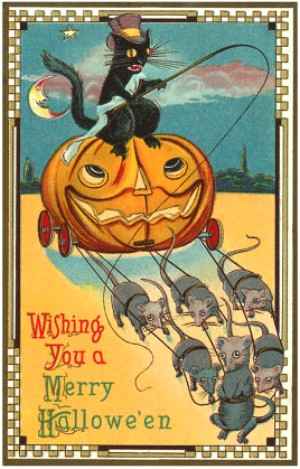
Cat pumpkin coach
Z   ig et zig et zag, la mort crie cadence
Frappant une tombe avec son talon,
La mort à minuit joue un air de danse,

Zig et zig et zag, sur son violon.
Le vent d'hiver souffle, et la nuit est sombre,
Des gémissements sortent des tilleuls ;
Les squelettes blancs vont à travers l'ombre
Courant et sautant sous leurs grands linceuls,

Zig et zig et zag, chacun se trémousse,
On entend claquer les os des danseurs,
Un couple lascif s'asseoit sur la mousse
Comme pour goûter d'anciennes douceurs.

Zig et zig et zag, la mort continue
De racler sans fin son aigre instrument.
Un voile est tombé ! La danseuse est nue!
Son danseur la serre amoureusement.
La dame est, dit-on, marquise ou baronne.
Et le vert galant un pauvre charron - Horreur!
Et voilà qu'elle s'abandonne
Comme si le rustre était un baron!

Zig et zig et zig, quelle sarabande!
Quels cercles de morts se donnant la main!

Zig et zig et zag, on voit dans la bande
Le roi gambader auprès du vilain!
Mais psit ! tout à coup on quitte la ronde,
On se pousse, on fuit, le coq a chanté
Oh! La belle nuit pour le pauvre monde!
Et vive la mort et l'égalité!

[Zig … zig … zag, Death in cadence
Striking a tomb with his heel,
Death on the stroke of midnight plays a dance-tune,

Zig … zig … zag, on his violin.
The winter wind blows, and the night is dark,
Groans are heard in the lindens;
Through the gloom, white skeletons pass,
Running and leaping in their shrouds.

Zig … zig … zag: each one is frisking,
The bones of the dancers are heard to crack—
A lustful couple sits on pillows
As if to relish a remembrance of softness that they knew in life.

Zig … zig … zag, Death continues
to scrape endlessly his sour instrument.
A shroud fell! The dancer is nude!
The dancers embrace, squeezing each other in withered love.
The lady was, says one, a marquise or baroness.
And the gallant lover was but a poor cartwright – Horror!
Look how wantonly she bonily abandons herself
As if the uncouth one was a baron!

Zig … zig … zig, which sarabande!
Circles of deaths giving each other the hand!

Zig … zig … zag, one sees in the band
The beauteous gambol with the ugly!
But psit! all of a sudden they quit the round ,
They push forward, they fly; the cock has crowed.
Oh! How exquisite is this night for the poor world!
And how lively Death and Equality!]

  —  Henri Cazalis (1840-1909), ‘Danse Macabre’.
The archetype for the Halloween spooky trope is no doubt the grotesque poem by Henri Cazalis that Saint-Saëns set for his ‘Danse Macabre’: ‘Zig et zig et zig, la Mort in cadence.’ Death, the violinist: summoning skeletons from their graves at midnight for a dance. Ghastly merriment, with interruptions. The poem’s two themes—one: osseous, clacking; the other: benighted, desolate.

If your quartet’s cellist is game, you might find Kaija Saariaho’s ‘Petals’ especially fitting as an addition to your play list. The tremendous abjection of it is deeply scary [click on the link to hear a YouTube clip of it]; very different from Danse Macabre.

It’s a challenge for composer and performers alike to achieve the grotesque without devolving into cheap pastiche. Garrop’s quartet orchestration is robust, balanced in a way that does not present excessive risks in performance. Kingston’s arrangement of the Saint-Saëns is vivid and serviceable. And Saariaho’s cello solo will leave everyone hesitant to shake the scary cellist’s hand after the performance. Bwwaah-ha-ha-ha-ha.

P   etals für Violoncello solo wurde in wenigen Tagen komponiert; eine lange, unbewußte Vorbereitung war diesem Stück jedoch vorangegangen. Das Material stammt direkt von meinem Stück Nymphea für Streichquartett und Elektronik. Der Name Petals (Blumenblätter) ist ebenfalls aus dieser Beziehung abgeleitet. Die gegensätzlichen Elemente darin sind sehr zerbrechlich, es sind farbenprächtige Passagen, die energischere Ereignisse mit klarem rhythmischen und melodischen Charakter hervorbringen. Diese scharf umrissenen Figuren werden verschiedenen Veränderungen unterworfen und versinken schließlich in einem dynamisch reduzierten, aber nicht weniger intensiven Filigranmuster. Mit der Kombination dieser beiden gegensätzlichen Ausdrucksarten wollte ich den Interpreten zu einer Ausweitung seiner körperlichen Sensibilität zwingen.
[‘Petals’ was composed in just a few days; a long, unconscious incubation preceded this, however. The material comes directly from my piece ‘Nymphea’ for string quartet and electronics. The name ‘Petals’ is derived also out of this relation—the Nymphs; the string/electronics orchestration. The moribund frailty of it all, of the petals! The opposing elements: passages that are very fragile with ambiguous character and rhythm oppose colorful passages evoking vigorous events with clear rhythmic and melodic character. These sharply outlined figures are subjected to different variations; they sink, and are dynamically reduced in the end to just one, but with still-intensive filigreed patterns. With the combination of opposing expression types, I wanted to force the performer to expand her/his sensitivity to the corporeal limits.
  —  Kaija Saariaho.
Botting book

Decrepit violin


Sunday, July 27, 2008

Chamber Music & Norman Dello Joio

 Norman Dello Joio
I  n the cool of the night time
The clocks pick off the points
And the mainsprings loosen.
They will need winding
One of these days.
Rabelais, in red boards—
Walt Whitman in green,
Hugo in ten-cent paper covers:
Here they stand on shelves
In the cool of the night time
And there is nothing
To be said against them...”
  —  Carl Sandburg, ‘Cornhuskers’, 1918 (one of the texts/epigrams for Dello Joio’s 1940 ‘Suite for Piano’, premiered at Carnegie Hall on 09-MAR-1941).
The lyricism of Norman Dello Joio, who died last week at age 95 on 24-JUL, is treasured by all who have performed or listened to his works.

In 1939, he received a scholarship to Juilliard, where he studied composition with Bernard Wagenaar. And in 1941 he began studying with Paul Hindemith, who encouraged him to follow his own lyrical inclinations, instead of pursuing atonal or 12-tone systems. By the late 40s, he was highly-regarded among American composers and prolific in a variety of genres, especially choral music. He served on the faculty at Sarah Lawrence College in the late 40s, and later at Mannes College of Music. He was professor and dean at Boston University until retiring in 1978, when he moved to Long Island. Throughout his career he was devoted to music education, and his ‘Comprehensive Musicianship’ pedagogical materials and advocacy helped to guide and calibrate subsequent generations of authors/composers of curricula, method books and etudes.

Here are some of his chamber music pieces.
  • Piano Trio, 1937
  • Suite for Piano (Sandburg’s Phrases), 1940
  • Sextet for Three Recorders & String Trio, 1944
  • Duo Concertato for Cello & Piano, 1945
  • Sonata No. 1 for Piano, 1947
  • Sonata No. 2 for Piano, 1948
  • Sonata No. 3 for Piano, 1948
  • Trio for Flute, Cello & Piano, 1948
  • Fantasia on a Gregorian Theme for Violin & Piano, 1949
  • Variations and Capriccio for Violin & Piano, 1949
  • Nocturne in E for Piano, 1950
  • Nocturne in F-sharp for Piano, 1950
  • Aria and Toccata for Two Pianos, 1955
  • Colloquies for Violin & Piano, 1964
  • Bagatelles for Harp, 1969
  • Capriccio on the Interval of a Second for piano, 1969
  • Three Essays for Clarinet & Piano, 1974
  • Lyric Fantasies for Viola and String Quintet, 1975
  • Sonata for Trumpet and Piano, 1980
  • Concert Variants for Piano, 1983


[Dello Joio, ‘Trio for Flute, Cello & Piano’, 1948]

 Dello Joio, Concert Variants for Piano, 1983, mm. 6 - 11
Norman’s open harmonies and engaging writing style somehow fit well with the often-weighty subject matter of his compositions. It’s unfortunate that in recent years many of these pieces have not been more frequently performed and recorded. Although not warhorses for sheer technical virtuosic display, they present the performer with challenges of a different sort—conveying depth/complexity of emotion through phrasing and thoughtful gesture. These pieces have great expressive potential, and deserve to be included more often in the chamber music repertoire.


[Dello Joio, ‘Piano Sonata No. 3’, 1948]

 Dello Joio, Piano Sonata No. 3, 1948, mm. 8 - 15
Although sight-singing, keyboard harmony, theory, and so on, are part of development of musicianship, Dello Joio’s emphasis and major concern focused on those skills that are mainly cognitive—that is, music concepts and interpretive and analytical skills that are not predominantly developed through psychomotor (performance) drill. By nature he was opposed to performance-practice ‘tricks’, and he was impervious to the seductions of celebrity and technical virtuosity that have attained such popular cachet in recent years. Dello Joio’s traditional artistic values and teaching—and his compositions—are and will remain important guides for us going forward.

N  orman Dello Joio is outstanding for an outgoing directness of expression and simplicity of manner ... which have an intentionally broad appeal. A strong melodic vein; a rhythmic vitality; a relatively restrained harmonic vocabulary; an infectious brio and freshness of invention—these are among the earmarks of his style. Inseparable from this style is Dello Joio’s conviction—resembling almost an ethical attitude—that his music should communicate with a broad, contemporary public——not merely with an alert avant garde, not with a few fellow composers, not with some hypothetical future public.”
  —  Edward Downes, The music of Norman Dello Joio. The Musical Quarterly 1962; 48:149-72.


 Norman Dello Joio