Showing posts with label chicago. Show all posts

Thursday, June 4, 2009

Knowledge Unspoken: How Much of Xenakis’s ‘Morsima-Amorsima’ Was Really Computer-Generated?

 IBM 7090, circa 1960
B    ut of what essence are these materials made? This essence is the intelligence of man solidified in a way: intelligence that seeks, questions, infers, reveals, and foresees at all levels. Music and the arts in general seem necessarily to be a solidification—a ‘materialization’—of intelligence. Naturally, this intelligence, though humanly universal, is diversified by the individual: by talent that distances one individual from the others. Talent is therefore a kind of qualification—a gradation of the vigor and richness of intelligence. For intelligence is, fundamentally, the result—the expression of billions of exchanges, of reactions, of transformations of energy in the cells of the brain and the body. One could, taking astrophysics as a visual aid, say that intelligence is the form taken by the minimal acts of cells in their condensations and their movement—as happens with the particles of the suns, planets, galaxies, and clusters of galaxies born of or turned back into cold interstellar dust... To think up music as composer, craftsman, and creator, it is first necessary to study solfège, notation, music theory, and even an instrument over a long time. And since, in addition, musical creation is considered superfluous, very few people are able to attain it. Thus the individual and the society are deprived of the formidable power of free imagination that musical composition offers them. We are able to tear down this ‘iron curtain’, thanks to the technology of computers and their peripherals. The system that has succeeded at this ‘tour de force’ is the UPIC (Unité Polyagogique Informatique du CEMAMu)...”
  —  Iannis Xenakis in a typically ‘expansive’ moment in the 1970s, quoted in ‘The Art of Music: Tradition and Change’ by William Christ and Richard DeLone.
T  he performance by International Contemporary Ensemble and Steve Schick of five major works—‘Psappha’, ‘Echange’, ‘Akanthos’, ‘Palimpseste’, and Xenakis’s final composition, ‘O-Mega’—is an opportunity not to be missed. It’s at Chicago’s Museum of Contemporary Art, tonight at 19:30. Anticipating this ICE performance got me to listening to the recordings I have of Xenakis’s music. I have never been lucky enough to hear a ‘live’ performance like this...

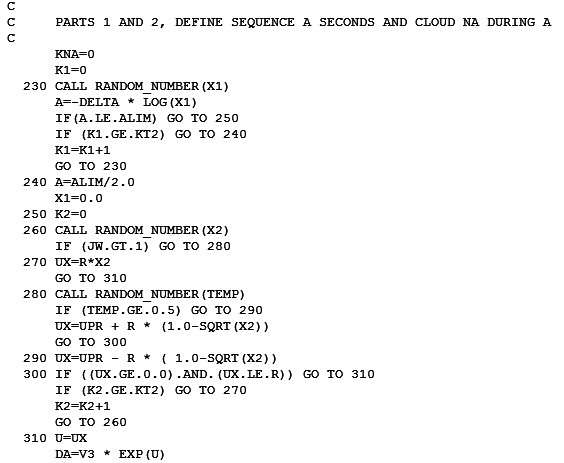
Source-code:
 Xenakis FORTRAN code
Output:
 FORTRAN code output
X  enakis’s ‘Morsima/Amorsima’ score says that ‘moros’ = ‘fate’ and ‘amorsima’ = ‘that which does not come from fate’. It was composed on an IBM 7090 in Paris, in increments/revisions between 1956 and 1962, and it was, like Xenakis’s ‘Achorripsis’, supposedly entirely stochastic (random, computer-generated). To me, this beggars belief.

F  ew have ever performed a deep-dive source-code review of what Xenakis programmed, nor compared what the 7090 generated to what Xenakis actually wrote down as a published score. Oh, yes, there are people who have ported the FORTRAN code in Xenakis’s book to FTN95, and, yes, the code does run—it does produce things. It has calls to the built-in FORTRAN random-number function; it modifies global variables and accesses the system clock to accomplish a modest degree of runtime indirection and aleatorics, in the limited ways that the FORTRAN language was (and is) able to support.

B  ut these source-codes do not produce things that have any close resemblance to any composition that Xenakis actually published. And the in-line commenting of the source code is terrible. The rats' nests of GOTO statements upon GOTO statements are nearly impenetrable-incomprehensible, even by the not-so-great software engineering standards of his day. A static analyzer would be the thing to use with this wild-hare code, not manual ‘desk analysis’! PRQA used to sell an analyzer called QAfortran™. I don’t know whether this is still available. I don’t see it on their website...

W  e have lots of software things today that serve as composition-aids... PWGL, Vielklang, Max/MSP, Jitter, harmonization plug-ins in Finale® and other notation applications… all sorts of things. And in the 2000s [almost] nobody goes around touting their use of composition software in the way that Xenakis did. By the same token, [almost] nobody is embarrassed to say that they do use them, or to forthrightly confess the methods by which the tools contribute to the compositional process.

X  enakis’s code supposedly causes the [specifications for the scored—] sounds to be generated as a directed-graph (digraph). First the [random] sequence of pitches is generated, with each note’s time of specified onset—it’s time coordinate. Then its timbre is generated (the instrument that is to play it; and its articulation: arco, pizzicato, glissando, and so on). Then the velocity of attack. Then the gradients in loudness (dynamic changes in loudness during the time interval the note is sounded... legato, accent, marcato ^, staccato, slur, portato/martelé ... sforzando, subito whatever) and in pitch (vibrato or not, glissando beginning and ending, shakes’ frequency and pitch-width). Then the duration. Not sure whether the program had anything in it to specify the (random) mode of releasing each note.


    [50-sec clip, austraLYSIS, Iannis Xenakis, ‘Morsima/Amorsima’, 1.6MB MP3]


    [50-sec clip, austraLYSIS, Iannis Xenakis, ‘Morsima/Amorsima’, 1.6MB MP3]

T  he 7090 was a room-sized $3M, 36-bit single-CPU machine, with 32K words of magnetic-core RAM (144 KB) and a clock cycle of 2.18 μs (459 KHz). It computed at about 0.2 MIPs, 0.03 MFLOPs. [The little laptop on which I am now writing this blog, is 64-bit, 8 GB, over-clocked 3.06 GHz dual-CPU, 46.7 MIPS (Dhrystone ALU), 35.2 MFLOPS (Whetstone iSSE3).]

B  ut the probabilities in ‘Morsima-Amorsima’ fate-vs-nonfate are highly unlikely. And this piece and others are too, too beautiful to be ‘lightly edited’ output from any of Xenakis’s FORTRAN source-codes that are available. Instead, there are the hallmarks of the human ear, the human hand, the Xenakisian mind. I am betting that this ‘Morsima/Amorsima’ is maybe 80% Xenakis traditional compositional method-produced and only 20% Xenakis algorithms on IBM 7090-produced—20% Fate and 80% Non-Fate, by one way of thinking about random events and chance. The score only costs €50. We should take a detailed statistical look and see!

 IBM 7090, circa 1960
I  am not saying that Iannis Xenakis deceived anyone, exactly, regarding how his compositions were produced. He was a brilliant, flamboyant character and a wonderful and entertaining speaker, and I experienced these qualities of his, first-hand. I attended a lecture series he gave in 1972… I had been taking Computer Science courses at University of Minnesota at the time. The exuberance and expansiveness he exhibited when speaking were fabulous.

B  ut I think that not enough detailed consideration has been given to the stories he told about his compositional methods—comparing his writings and interviews and software source-codes against his finished scores, to see how well (or not) Xenakis’s remarks about his methods are supported by the evidence.

X  enakis’s famous book ‘Formalized Music’ and the FORTRAN source-code fragments that have been published obfuscate more than they reveal. Was he unsatisfied with the musicality of the results of his algorithms? Did he feel that he needed to extensively rewrite the computer-produced compositions to achieve a more aesthetically appealing, defensible work? What motives would lead him to withhold so many of the details? Did he have a sense of obligation to IBM Paris, who had provided resources and upon whom he depended? Was it pride? The François Bernard Mâche and the James Harley biographies are well worth studying! But none of the biographers to-date have been software engineers capable of performing detailed code-reviews, to ascertain whether or not Xenakis actually did things in the ways he claimed that he did.

I  f you have views about these things—about the roles of computational composition and interactions between algorithms and human composers; and about Xenakis’s evasiveness about his actual methods—please add a comment below or send me an email. If you knew Xenakis personally and think my speculation is a bunch of hooey, please write and tell me so. If you yourself delegate to Vielklang or PWGL or other software tools part of your composerly work, I’d be delighted to hear from you, too, to learn how you use these tools to generate ideas and edit them.

O  f course, if you’re able to attend the Steven Schick—ICE performance tonight in Chicago, please put a comment here, too! Thanks!

 Temperley book

 Smith-Dean book


Friday, October 10, 2008

Halloween: Spooky String Quartets, Scary Piety

Violinist, skeletonized
T    he basic purpose of story-telling ... is not just to entertain but to illuminate life. It doesn’t matter if we deal in the symbolism of supernatural beings such as vampires, zombies, ghosts, werecreatures, and unknowable cosmic entities. If horror is done right—and we have only to look at the stories withstanding the test of time to identify which ones are done right—then it provides a psychological roadmap through the trials of life.”
  —  Matthew Warner, Horror Isn’t a 4-Letter Word, p. 14.
To many, Halloween is a perfect ‘holiday’, relatively free of the social stresses that burden other celebrations during the year. And, to celebrate Halloween, it’s always good to have some appropriate atmospheric music to mark the occasion. If you and your string quartet friends are looking for something new to put you and your Halloween audiences in the spirit, you can surely do no better than Stacy Garrop’s String Quartet No. 2, ‘Demons & Angels’.


    [50-sec clip, Stacy Garrop, String Quartet No. 2 ‘Demons & Angels’, Mvt. 3, ‘Inner Demons’, 1.2MB MP3]

Music in the Loft commissioned the first two movements of ‘Demons and Angels’ for performance by the Biava Quartet on its 2004/2005 concert series. The Loft subsequently commissioned the rest of the piece, premiered by the Biava Quartet at Yale University in November 2005. The 4-movment complete work received its premiere at Music in the Loft in October, 2006.

An assemblage of unrelenting demons, unreliable angels, and gothic humanity, String Quartet No. 2 tells the story of a devout man who confidently and self-righteously thought his actions were guided by God, only to discover that he was mistaken—he has in fact heinously murdered five people. The first two movements elucidate the deluded personality of this character. The first, ‘Demonic Spirits’, addresses the darkness that’s inherent in his pious self-deception. The movement begins with a jarring chord played five times, each one representing a murder. These chords return as violent interruptions throughout the piece. This movement has two main themes: the first theme is martial/militaristic; the second theme is sinister in its arrogant impishness. The second movement, ‘Song of the Angels’, contemplates the goodness in the protagonist before his personality is transformed by delusional piety. The cello has a long solo created by blending elements of the first movement’s themes, representing how evil is spawned from good intentions that are oblivious to reality.

The third movement, ‘Inner Demons’, is a vivid account of this character as he descends into psychosis. This movement contains four themes: a tarantella, a demented waltz, a scherzo, and the Kentucky pentecostal folk hymn ‘The Wayfaring Stranger.’ Finally, the eerie hymn asserts itself above all, and we hear the man commit the five murders that opened the first movement. The piece concludes with IV. ‘Broken Spirit.’ This movement explores his realization of what he has done. The man is caught and sentenced to life in prison. With a festinating four-note motive, the man paces in his cell while his mental state alternates between psychotic violence and spasms of remorseful hope that, through contrition, he can be saved by angels.

I    am a poor Wayfaring Stranger,
A-trav’lin’ [you betcha!] through this land of woe.
And there’s no sickness, toil or danger
In that bright world to which I go.
I know dark clouds will gather ‘round me;
I know my way is [darn] rough and steep.
But beauteous fields lie just beyond me [my friends],
Where souls redeemed their vigil keep.
I want to wear a crown of glory
When I get home to that bright land;
I want to shout Salvation’s story
In concert with that blood-washed band.”
  — Appalachian Folk Hymn.
Scary jack-o-lantern
Of course, a composer’s decision to write a string quartet is fateful in its own right, linking one to the great European tradition, including veneration of glorious, deceased masters. At the outset the composer always believes in her/his own mind that the quartet-writing enterprise is a just and righteous one. Mindful of the risk of self-deception, however, Garrop dissects her corpses carefully and finds her own funereal path. ‘Demons & Angels’ is a pestilential object lesson in terror—for listeners, performers, and maybe other composers. She discovers her quartetly ‘path’ both musically and theatrically, incorporating diverse elements and exploiting the dimly-lit concert environment in suspenseful bubonic ways. Musically, Garrop’s works are distinguished by the mordant quality of their realization. The Second Quartet embodies a well-(de)composed ‘working out’ of the implications of these various morbidly-contrasting motivic ideas and Ichabodleian gestures with a traditional arch form, galloping repeated psycho-rhythms, and a cadaveric approach to thematic development. ;)

Stacy Garrop has won several orchestra competitions resulting in performances by the Civic Orchestra, Omaha Symphony, New England Philharmonic, the Women’s Philharmonic, and readings by the Minnesota Orchestra and the American Composers Orchestra. She was also selected for the Dale Warland Singers 2000-2001 New Choral Music Program. She was a finalist for the 2001 Rome Prize, and received a 2001 Barlow Endowment commission, as well as a 2002 Artists Fellowship Award from the Illinois Arts Council.

Her works have been recently performed by the Charleston Symphony Orchestra, San Francisco Chamber Singers, EARPLAY. Other performances includes ones given by the National Repertory Orchestra and the new music ensembles Third Angle and SoundsNew.

She has held fellowships/residencies at the Banff Centre for the Arts, MacDowell Colony, Millay Colony, Atlantic Center for the Arts, Yaddo, and Wellesley Composers Conference.

Garrop completed her Doctorate in Music at Indiana University in 2000; she also holds an M.A. from the University of Chicago (1995) and a B.M. from University of Michigan (1992).

Stacy is currently an Assistant Professor in Composition at the Chicago College of the Performing Arts at Roosevelt University.

Other Halloween-ish pieces you might consider include these:
Cat pumpkin coach
Z   ig et zig et zag, la mort crie cadence
Frappant une tombe avec son talon,
La mort à minuit joue un air de danse,

Zig et zig et zag, sur son violon.
Le vent d'hiver souffle, et la nuit est sombre,
Des gémissements sortent des tilleuls ;
Les squelettes blancs vont à travers l'ombre
Courant et sautant sous leurs grands linceuls,

Zig et zig et zag, chacun se trémousse,
On entend claquer les os des danseurs,
Un couple lascif s'asseoit sur la mousse
Comme pour goûter d'anciennes douceurs.

Zig et zig et zag, la mort continue
De racler sans fin son aigre instrument.
Un voile est tombé ! La danseuse est nue!
Son danseur la serre amoureusement.
La dame est, dit-on, marquise ou baronne.
Et le vert galant un pauvre charron - Horreur!
Et voilà qu'elle s'abandonne
Comme si le rustre était un baron!

Zig et zig et zig, quelle sarabande!
Quels cercles de morts se donnant la main!

Zig et zig et zag, on voit dans la bande
Le roi gambader auprès du vilain!
Mais psit ! tout à coup on quitte la ronde,
On se pousse, on fuit, le coq a chanté
Oh! La belle nuit pour le pauvre monde!
Et vive la mort et l'égalité!

[Zig … zig … zag, Death in cadence
Striking a tomb with his heel,
Death on the stroke of midnight plays a dance-tune,

Zig … zig … zag, on his violin.
The winter wind blows, and the night is dark,
Groans are heard in the lindens;
Through the gloom, white skeletons pass,
Running and leaping in their shrouds.

Zig … zig … zag: each one is frisking,
The bones of the dancers are heard to crack—
A lustful couple sits on pillows
As if to relish a remembrance of softness that they knew in life.

Zig … zig … zag, Death continues
to scrape endlessly his sour instrument.
A shroud fell! The dancer is nude!
The dancers embrace, squeezing each other in withered love.
The lady was, says one, a marquise or baroness.
And the gallant lover was but a poor cartwright – Horror!
Look how wantonly she bonily abandons herself
As if the uncouth one was a baron!

Zig … zig … zig, which sarabande!
Circles of deaths giving each other the hand!

Zig … zig … zag, one sees in the band
The beauteous gambol with the ugly!
But psit! all of a sudden they quit the round ,
They push forward, they fly; the cock has crowed.
Oh! How exquisite is this night for the poor world!
And how lively Death and Equality!]

  —  Henri Cazalis (1840-1909), ‘Danse Macabre’.
The archetype for the Halloween spooky trope is no doubt the grotesque poem by Henri Cazalis that Saint-Saëns set for his ‘Danse Macabre’: ‘Zig et zig et zig, la Mort in cadence.’ Death, the violinist: summoning skeletons from their graves at midnight for a dance. Ghastly merriment, with interruptions. The poem’s two themes—one: osseous, clacking; the other: benighted, desolate.

If your quartet’s cellist is game, you might find Kaija Saariaho’s ‘Petals’ especially fitting as an addition to your play list. The tremendous abjection of it is deeply scary [click on the link to hear a YouTube clip of it]; very different from Danse Macabre.

It’s a challenge for composer and performers alike to achieve the grotesque without devolving into cheap pastiche. Garrop’s quartet orchestration is robust, balanced in a way that does not present excessive risks in performance. Kingston’s arrangement of the Saint-Saëns is vivid and serviceable. And Saariaho’s cello solo will leave everyone hesitant to shake the scary cellist’s hand after the performance. Bwwaah-ha-ha-ha-ha.

P   etals für Violoncello solo wurde in wenigen Tagen komponiert; eine lange, unbewußte Vorbereitung war diesem Stück jedoch vorangegangen. Das Material stammt direkt von meinem Stück Nymphea für Streichquartett und Elektronik. Der Name Petals (Blumenblätter) ist ebenfalls aus dieser Beziehung abgeleitet. Die gegensätzlichen Elemente darin sind sehr zerbrechlich, es sind farbenprächtige Passagen, die energischere Ereignisse mit klarem rhythmischen und melodischen Charakter hervorbringen. Diese scharf umrissenen Figuren werden verschiedenen Veränderungen unterworfen und versinken schließlich in einem dynamisch reduzierten, aber nicht weniger intensiven Filigranmuster. Mit der Kombination dieser beiden gegensätzlichen Ausdrucksarten wollte ich den Interpreten zu einer Ausweitung seiner körperlichen Sensibilität zwingen.
[‘Petals’ was composed in just a few days; a long, unconscious incubation preceded this, however. The material comes directly from my piece ‘Nymphea’ for string quartet and electronics. The name ‘Petals’ is derived also out of this relation—the Nymphs; the string/electronics orchestration. The moribund frailty of it all, of the petals! The opposing elements: passages that are very fragile with ambiguous character and rhythm oppose colorful passages evoking vigorous events with clear rhythmic and melodic character. These sharply outlined figures are subjected to different variations; they sink, and are dynamically reduced in the end to just one, but with still-intensive filigreed patterns. With the combination of opposing expression types, I wanted to force the performer to expand her/his sensitivity to the corporeal limits.”
  —  Kaija Saariaho.
Botting book

Decrepit violin


Monday, October 6, 2008

William Coble’s ‘Autumn Elegy’: Parentheticals and Implicature

Cherry leaves
I recently had occasion to hear a recording of William Coble’s beautiful 1983 chamber composition, ‘Autumn Elegy for solo guitar’. Coble is a two-time winner of the Davenport Orchestral Composition competition (1990, 2002) at SUNY New Paltz and has received commissions from eighth blackbird and Pacifica Quartet, among others. His chamber music works have been performed at Merkin Hall, Weill Hall, CAMI Hall, Harvard Musical Association, Northwestern University’s Music Marathon, Society for New Music, Cincinnati’s Music-2004 Festival, and the BSO at Tanglewood.

Coble trained initially at Boston University School of Music, with graduate work at Harvard University and Curtis Institute of Music. His teachers have included Ned Rorem, David DelTredici, Mario Davidovsky, Gunther Schuller, Steve Albert, John Eaton, Kotoka Suzuki, and Howard Sandroff.

W hile a fellow at the Macdowell Colony, he recently completed a setting of sacred music for baritone, violin, cello, and piano. He also worked on vocal chamber music for an upcoming festival in Austria and on Variations for the Richmond Symphony. Coble is currently a graduate student in composition at the University of Chicago.

Coble’s music is honest and free of pretension. It is intent on creating coloristic effects from a wide palette. Its performance does call for ‘repose’, reserve, and great subtlety of phrasing. ‘Autumn Elegy’ is characteristic in that regard...

In fact, in view of Coble’s output to date, including his ‘Parenthetical Phrases for Flute, Oboe, and Bassoon’, he seems especially interested in inter-part adverbial constructions and parentheticals. Various of his compositions have to do with encapsulating one passage within a constrasting ‘wrapper’ structure. The enclosed passage is generally a sort of ‘aside’ or reminder——not so much subordinate to the surrounding material as expressing a rebuttal or rejoinder to it.

Musical parenthetical expressions correspond to a sense of suspending and resuming——a change of gesture, confiding or revealing some intimate detail. Parentheticals are not ‘incidental’ or ‘accessory’; instead they are often where the most important dramatic things are said.

W hat I notice in Coble’s ‘Autumn Elegy’ is these variations’ demand for spontaneity. Too often, at chamber music master classes and lessons, when the teacher addresses interpretation and the timing of transitions (‘No, wait a little longer here. Try to end this up in the air,’ etc.) it seems to focus too much on the superficial ‘syntactic’ features of the piece and too little on how to make each performance fresh.

Now, I don’t find ‘Autumn Elegy’ sad as such–—its overall emotional mien is wonderfully abstract—–but the phrase to which the low B in measure 5 leads is desolate. You feel a kind of inner call towards contemplation rather than playing and engagement. A few bars of minor are absorbed within the larger arc; a bubble of minor floating in the major.

William Coble, Autumn Elegy for guitar
The low notes have their distinctive ‘litoral’ colors: they are dark, forsaking and forsaken; uncertain what they will do now——now that they, and we, have fallen to the ground.

Coble controls his materials well, including his clauses that Diane Blakemore and others might call ‘adverbial parentheticals’. But he does so with a deliberate aim to allow/demand improvisatory interpretive ‘implicature’ by the performer(s). Implicature does not succeed if it’s an over-rehearsed ‘talking-point’, ‘too smooth’. Implicature only works if it’s spontaneous and real. Coble clearly has the mechanics of implicature ‘nailed’.

The term ‘parenthetical’ covers a disparate range of phenomena only some of which have been regarded as falling within the domain of syntax—which is possibly why master classes and lessons seldom to justice to parenthetical idioms. It’s been argued by Haegeman that adverbial parenthetical clauses, which have been treated by other writers as syntactic phenomena, must be analyzed as syntactic ‘orphan’ that are integrated into the utterance at the level of utterance interpretation. If this approach is right, then it would raise the question of how we could justify a distinction between grammatical parentheticals and pragmatic or discourse parentheticals.

But recently research linguist Christopher Potts at UMass Amherst has argued against this approach in favor of an integrated syntactical analysis. In Potts’s analysis, the ‘otherness’ of parentheticals is best characterized semantically by treating them as inserting ‘implicatures’. The difference between these approaches to adverbial parenthetical clauses basically concerns what relationship the parentheticals have with the material that encloses them.

Have a look at the linguistics references below to see how compositions like William Coble’s (and, say, Beethoven’s Opp. 109 and 111) are supported by these two very different conceptions of the distinction between grammar (syntax) and pragmatics (performance practice; rhetoric). I myself favor the Potts-Blakemore view, which emphasizes pragmatics, spontaneity, and implicature. Their linguistics analytical methods have much to offer, I think, to music theory and to composers who find analysis helpful during the process of composing/orchestrating…

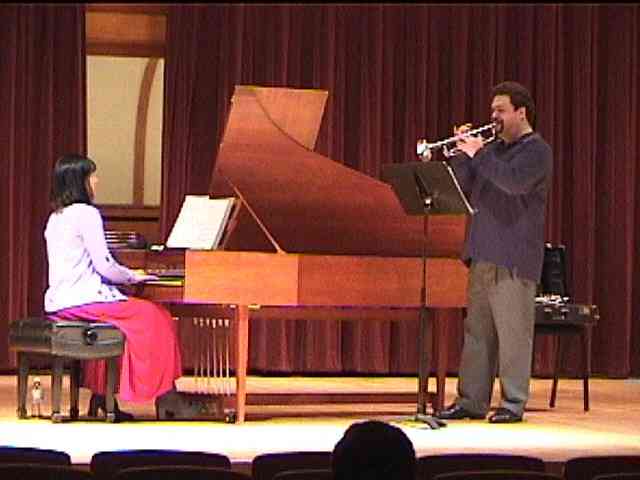
William Coble, trumpet recital