Showing posts with label atonal. Show all posts

Thursday, June 4, 2009

Knowledge Unspoken: How Much of Xenakis’s ‘Morsima-Amorsima’ Was Really Computer-Generated?

 IBM 7090, circa 1960
B    ut of what essence are these materials made? This essence is the intelligence of man solidified in a way: intelligence that seeks, questions, infers, reveals, and foresees at all levels. Music and the arts in general seem necessarily to be a solidification—a ‘materialization’—of intelligence. Naturally, this intelligence, though humanly universal, is diversified by the individual: by talent that distances one individual from the others. Talent is therefore a kind of qualification—a gradation of the vigor and richness of intelligence. For intelligence is, fundamentally, the result—the expression of billions of exchanges, of reactions, of transformations of energy in the cells of the brain and the body. One could, taking astrophysics as a visual aid, say that intelligence is the form taken by the minimal acts of cells in their condensations and their movement—as happens with the particles of the suns, planets, galaxies, and clusters of galaxies born of or turned back into cold interstellar dust... To think up music as composer, craftsman, and creator, it is first necessary to study solfège, notation, music theory, and even an instrument over a long time. And since, in addition, musical creation is considered superfluous, very few people are able to attain it. Thus the individual and the society are deprived of the formidable power of free imagination that musical composition offers them. We are able to tear down this ‘iron curtain’, thanks to the technology of computers and their peripherals. The system that has succeeded at this ‘tour de force’ is the UPIC (Unité Polyagogique Informatique du CEMAMu)...”
  —  Iannis Xenakis in a typically ‘expansive’ moment in the 1970s, quoted in ‘The Art of Music: Tradition and Change’ by William Christ and Richard DeLone.
T  he performance by International Contemporary Ensemble and Steve Schick of five major works—‘Psappha’, ‘Echange’, ‘Akanthos’, ‘Palimpseste’, and Xenakis’s final composition, ‘O-Mega’—is an opportunity not to be missed. It’s at Chicago’s Museum of Contemporary Art, tonight at 19:30. Anticipating this ICE performance got me to listening to the recordings I have of Xenakis’s music. I have never been lucky enough to hear a ‘live’ performance like this...

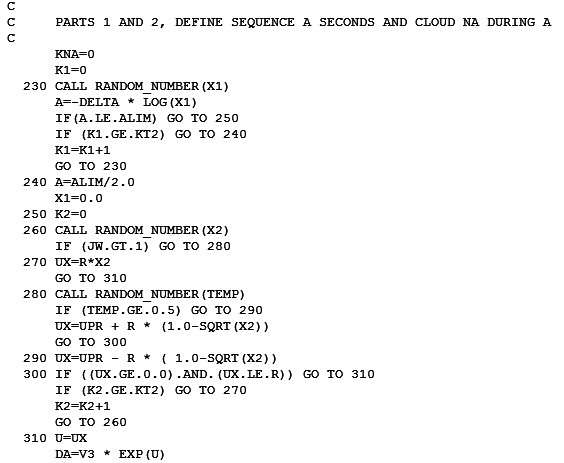
Source-code:
 Xenakis FORTRAN code
Output:
 FORTRAN code output
X  enakis’s ‘Morsima/Amorsima’ score says that ‘moros’ = ‘fate’ and ‘amorsima’ = ‘that which does not come from fate’. It was composed on an IBM 7090 in Paris, in increments/revisions between 1956 and 1962, and it was, like Xenakis’s ‘Achorripsis’, supposedly entirely stochastic (random, computer-generated). To me, this beggars belief.

F  ew have ever performed a deep-dive source-code review of what Xenakis programmed, nor compared what the 7090 generated to what Xenakis actually wrote down as a published score. Oh, yes, there are people who have ported the FORTRAN code in Xenakis’s book to FTN95, and, yes, the code does run—it does produce things. It has calls to the built-in FORTRAN random-number function; it modifies global variables and accesses the system clock to accomplish a modest degree of runtime indirection and aleatorics, in the limited ways that the FORTRAN language was (and is) able to support.

B  ut these source-codes do not produce things that have any close resemblance to any composition that Xenakis actually published. And the in-line commenting of the source code is terrible. The rats' nests of GOTO statements upon GOTO statements are nearly impenetrable-incomprehensible, even by the not-so-great software engineering standards of his day. A static analyzer would be the thing to use with this wild-hare code, not manual ‘desk analysis’! PRQA used to sell an analyzer called QAfortran™. I don’t know whether this is still available. I don’t see it on their website...

W  e have lots of software things today that serve as composition-aids... PWGL, Vielklang, Max/MSP, Jitter, harmonization plug-ins in Finale® and other notation applications… all sorts of things. And in the 2000s [almost] nobody goes around touting their use of composition software in the way that Xenakis did. By the same token, [almost] nobody is embarrassed to say that they do use them, or to forthrightly confess the methods by which the tools contribute to the compositional process.

X  enakis’s code supposedly causes the [specifications for the scored—] sounds to be generated as a directed-graph (digraph). First the [random] sequence of pitches is generated, with each note’s time of specified onset—it’s time coordinate. Then its timbre is generated (the instrument that is to play it; and its articulation: arco, pizzicato, glissando, and so on). Then the velocity of attack. Then the gradients in loudness (dynamic changes in loudness during the time interval the note is sounded... legato, accent, marcato ^, staccato, slur, portato/martelé ... sforzando, subito whatever) and in pitch (vibrato or not, glissando beginning and ending, shakes’ frequency and pitch-width). Then the duration. Not sure whether the program had anything in it to specify the (random) mode of releasing each note.


    [50-sec clip, austraLYSIS, Iannis Xenakis, ‘Morsima/Amorsima’, 1.6MB MP3]


    [50-sec clip, austraLYSIS, Iannis Xenakis, ‘Morsima/Amorsima’, 1.6MB MP3]

T  he 7090 was a room-sized $3M, 36-bit single-CPU machine, with 32K words of magnetic-core RAM (144 KB) and a clock cycle of 2.18 μs (459 KHz). It computed at about 0.2 MIPs, 0.03 MFLOPs. [The little laptop on which I am now writing this blog, is 64-bit, 8 GB, over-clocked 3.06 GHz dual-CPU, 46.7 MIPS (Dhrystone ALU), 35.2 MFLOPS (Whetstone iSSE3).]

B  ut the probabilities in ‘Morsima-Amorsima’ fate-vs-nonfate are highly unlikely. And this piece and others are too, too beautiful to be ‘lightly edited’ output from any of Xenakis’s FORTRAN source-codes that are available. Instead, there are the hallmarks of the human ear, the human hand, the Xenakisian mind. I am betting that this ‘Morsima/Amorsima’ is maybe 80% Xenakis traditional compositional method-produced and only 20% Xenakis algorithms on IBM 7090-produced—20% Fate and 80% Non-Fate, by one way of thinking about random events and chance. The score only costs €50. We should take a detailed statistical look and see!

 IBM 7090, circa 1960
I  am not saying that Iannis Xenakis deceived anyone, exactly, regarding how his compositions were produced. He was a brilliant, flamboyant character and a wonderful and entertaining speaker, and I experienced these qualities of his, first-hand. I attended a lecture series he gave in 1972… I had been taking Computer Science courses at University of Minnesota at the time. The exuberance and expansiveness he exhibited when speaking were fabulous.

B  ut I think that not enough detailed consideration has been given to the stories he told about his compositional methods—comparing his writings and interviews and software source-codes against his finished scores, to see how well (or not) Xenakis’s remarks about his methods are supported by the evidence.

X  enakis’s famous book ‘Formalized Music’ and the FORTRAN source-code fragments that have been published obfuscate more than they reveal. Was he unsatisfied with the musicality of the results of his algorithms? Did he feel that he needed to extensively rewrite the computer-produced compositions to achieve a more aesthetically appealing, defensible work? What motives would lead him to withhold so many of the details? Did he have a sense of obligation to IBM Paris, who had provided resources and upon whom he depended? Was it pride? The François Bernard Mâche and the James Harley biographies are well worth studying! But none of the biographers to-date have been software engineers capable of performing detailed code-reviews, to ascertain whether or not Xenakis actually did things in the ways he claimed that he did.

I  f you have views about these things—about the roles of computational composition and interactions between algorithms and human composers; and about Xenakis’s evasiveness about his actual methods—please add a comment below or send me an email. If you knew Xenakis personally and think my speculation is a bunch of hooey, please write and tell me so. If you yourself delegate to Vielklang or PWGL or other software tools part of your composerly work, I’d be delighted to hear from you, too, to learn how you use these tools to generate ideas and edit them.

O  f course, if you’re able to attend the Steven Schick—ICE performance tonight in Chicago, please put a comment here, too! Thanks!

 Temperley book

 Smith-Dean book


Friday, May 15, 2009

Piano and Combinatorial Inspiration: Fred Rzewski

 Frederic Rzewski
B    esides his composerly skill, Rzewski is—] a granitically overpowering piano technician, capable of depositing huge boulders of sonoristic material across the keyboard without actually wrecking the instrument.”
  —  Nicolas Slonimsky, Baker’s Biographical Dictionary of Musicians.
T    hose who have been criticizing contemporary music for lacking true melodic lines, may be consoled to learn that some composers now are very much concerned with melody. I don’t mean that they are writing romantic melodies, or popular melodies, or any other familiar kind of melodies, but they are certainly writing melodies. I heard two very good new pieces of this sort last week. One was Frederic Rzewski’s ‘Coming Together’.”
  —  Tom Johnson, Village Voice, 13-APR-1972.
T  he piano music of Frederic Rzewski kept me company during the wee hours this morning.


    [50-sec clip, David Jalbert, Fred Rzewski, ‘North American Ballads, No. 2, Which Side Are You On’, 1.6MB MP3]

F  red’s music... often exhibits a chromatic background that intercalates with a diatonic contrapuntal background. Chromatic events are initiated by dyadic conflicts in the foreground—the interactions of chromatic and diatonic species. In his piano works he often manipulates a single pitch-class so as to bring about large-scale harmonic motions. Henry Burnett’s and Roy Nitzberg’s analyses resonate deeply, based on the evidence in Rzewski's writing. Which leads me to wonder whether Fred would feel that Henry’s and Roy's characterization of the compositional process rings true. My guess is yes.

I  do not have the score (yet), so I rock the MP3 of Jalbert’s recording back and forth and pick off the notes, transcribe some of the figures...

  H0 + Tt I H0 = A, for some t

where the hexachord H has a subscript denoting the order number associated with the hexachord’s first element, I is the inversion (permutation) operator, and T is the transposition operator with subscript t denoting the transposition number, any odd integer.

 (0 1 4 5 8 9) combinatorics
L  acking 2s and 6s (whole-tones and tritones), the ‘6-20’ hexachord has a high degree of symmetry—and Rzewski resorts to it, maybe in part because of its mathematical/structural beauty and diverse possibilities. It [‘6-20’] is paradoxically ‘malleable/slippery’ and ‘crystalline/interlocked/solid’ at the same time. According to John Rahn’s calculations, ‘6-20’ maps into itself 3 times under transposition and 3 times under inversion: the prime form (0 1 4 5 8 9) duplicates itself under transposition at 0, 4, and 8; under inversion at 1, 4, and 9. In pitch-class content, there are only 4 distinct forms of ‘6-20’; only the whole-tone hexachord ‘6-35’ is more redundant. Under transposition or inversion it yields sets that are either completely identical or nonidentical—whence comes the slippery crystallinity of it.

S  everal segments are F# minor, the Dominant of home key B minor. Patterns of transposition levels are generated either 2 semitones or multiples of 2 semitones apart—except for one, I think. The transposition levels convolve as modulo-2 multiples of semitones, in contrary motion within octaves. The distance between each transposition becomes smaller and smaller until it meets the middle of the octave, the tritone.

J  albert’s account of the ‘North American Ballads’ adheres nicely to the political agenda set forth by Fred—not ‘Leftist’ so much as ‘Ethical-Humanist-Concerned-with-Justice’.

W  hich side are you on’ is basically asking ‘Are you for war or against it?’ There are minimalist idioms in the middle section, with obsessive repetitions of the rhythms with slowly proliferating deviations/convergences, noted above. These reinforce the obstinacy of the political question, which demands to be answered. It won’t go away by ignoring it. But the majority of the piece is melodic, wry, playful, lyrical Rzewski.

O  f course, besides these ‘North American Ballads’ (1978-9) many of Rzewski’s works over the years have been inspired by social and political themes—for example, ‘The People United Will Never Be Defeated!’; ‘Coming Together’, a setting of the letters of an inmate who was murdered at the State Prison at Attica at the time of the riots in 1971; ‘The Price of Oil’ and its questions about the legitimacy of societies’ priorities; ‘Les Moutons de Panurge’, about aggression and mutual destruction; ‘Antigone-Legend’, a meditation on principled opposition to the policies of the State; ‘Struggle’, whose text is taken from a letter written by Frederic Douglass in 1849, about the constant struggle necessary to achieve social reforms.

S  tudied at Phillips Academy, Harvard and Princeton. Studied under Randall Thompson, Roger Sessions, Walter Piston, Milton Babbitt, and Luigi Dallapiccola. Professor of Composition at the Conservatoire Royal de Musique in Liège, Belgium, since 1977. Politically active always; honest as a matter of conscience and constitution. Belovèd in Boston and everywhere. Delightful sense of humor and irony, humane, wonderful teacher. I learn quite a lot before dawn, taking his music apart, putting it back together.


Tuesday, April 22, 2008

New Music ‘Expectations’ vs. ‘Expectancy’: George Perle

 George Perle
H  is [Perle’s] pieces also raise what has become a confusing question: What do classical composers writing music like this expect from listeners?”
  —  Bernard Holland, NYT, 20-MAY-2008.
W  hat do composers writing music like this expect from listeners? They expect nothing, except honesty and an open mind. They don’t expect charity or an unearned free ride. They expect no more ‘smarts’ than the curiosity one finds in cats watching ambient television in their owner’s house, for free. We self-select, those of us who are transfixed like cats, enthralled by Perle’s music. There is a contrary self-selection, too, by those who aren’t even mildly curious about what it is or how it works or what it might mean or what comes next. Honestly confessing to ‘not liking’ something is fine. And calling it a different language, as Holland does, is also fine. But choosing not to attend to a language, and impugning the comprehensibility of the language and those who speak and write it, and justifying one’s position by asserting the inevitable, righteous marginality/disenfranchisement of the shunned language—as Holland does—are indefensible, xenophobic choices. If we follow Holland’s lead, I guess we need not bother to learn Tlingit, or Monguor, or Southern Tiwa—because there are only a few hundred speakers of those, the languages are dying anyway, and the songs and the ideas they are about seem nasty or irrelevant to classical Euro-centric white metro consumption-crazed culture.”
  —  DSM.
I  t is true that in the natural course of things, languages, like everything else, sometimes die. People choose, for a variety of valid social reasons, not to teach their children their own mother tongue. In the case of American Indian languages, however, the language drop-off has been artificially induced and precipitous, and just as with the human-caused endangered species crisis, it is worth doing something about it. Amerindian languages were deliberately destroyed, particularly in North America. In the earlier days of European contact, Indians were separated from their linguistic kin and resettled hundreds of miles away with individuals from other tribes who couldn’t understand each other. Historically, this is the single most effective way to eliminate minority languages (for obvious imperialistic reasons).”
  —  Laura Redish, NativeLanguages.org.
Bernard Holland, one of the New York Times’s music critics, repeatedly bashes new music and composers of new music every few months or so. His piece on George Perle in Sunday’s NYT is another installment. Holland’s rants generally exhort composers to create audience-friendly works, works of ready-made ‘relevance’ for unprepared general audiences—as if doing so will somehow solve classical music’s sales and marketing problems in this era of mass-media consumerism. Holland, the staunch advocate for a Tyranny of Mass-Market Relevance.

I will continue to read Bernard, even though these anti-new music attitudes of his annoy me—and annoy Greg Sandow, Frank Oteri, David McMullin, and almost anyone who is composing or performing or attending or buying and experiencing new music.

But I think of these experiences differently from Holland. I think of them as explorations. An opportunity to hear, or perform, or write new music is a form of exploration, or art tourism, or musical anthropological adventure, into virtual cultures that are infrequently visited by ‘civilized’ consumeristic/capitalistic people. The ‘aboriginal’ musicians are spontaneously doing and creating what they do—not as though they have never encountered white men [of Bernard Holland’s imperial ilk] before, but as though they need to do it for their own real, honest, indigenous reasons.

In fact, they (we) are quite interested in trade with people from other ‘lands’. We welcome the visitors. But commercial trade with them is not what makes us most of us tick. And we are not about to allow ourselves to be subjugated by them. We don’t intend to end up making derivative ‘musical trinkets’ or commodities catering to the needs and mass-market aspirations of imperialists.

I  write music that I intend to be beautiful, and I hope that it will please listeners. My strange idea of beauty may not resonate as widely as Bach’s or Britney Spears’, but it’s what I have to offer, and it doesn’t mean I hate my audience. All I ask of listeners is an open mind.”
  —  David McMullin, American Composers’ Forum.
And, in general, we who do new music are not ‘defying’ anything, any more or less than any genuine indigenous culture is ‘defying’ a dominant-culture with which it comes into contact. We refuse to be tyrannized by the dominant out-culture’s traditions or expectations. Nor are we self-tyrannized by an obsession to always be ‘new’, in a way that deliberately, perversely races ahead of any audience’s ability to comprehend or enjoy, in the manner that Holland implies. We know that radical novelty in and of itself is no guarantee of meaningfulness or value.

Bernard Holland is right about one thing: we do create new languages—ones that he simply prefers not to learn and sees no possibility of enjoying and damns by faint praise.

I  can speak only the languages I was born to. Sometimes I feel guilty. Maybe I should work harder at [Perle’s] grammar and vocabulary. With age I feel guilty less and less [about my indolent attitude toward new music].”
  —  Bernard Holland, New York Times, 20-APR-2008.
We invent things. It’s what we do; it’s what we have to offer. And, to be worthy of the Patent Office’s term ‘invention’, by definition the things must be novel, non-obvious, and valuable—valuable to future societies, if not to the ones that exist right now. To be worthy of the term ‘invention’, by definition not everyone will have thought of it or immediately think it’s ‘fun’.

A  ‘language’ is a dialect with an army and a navy. [And anything lacking military force is merely a ‘dialect’ to be dismissed, not reckoned with.]”
  —  Max Weinreich, 1945.
Language extinctions:
  • 497 languages are projected to become extinct within 15 years;
  • ~3,000 will be lost within a generation [David W. Lightfoot, NSF data].
North America:
  • 700 languages in 1492 C.E.;
  • Now only 162 have living speakers;
  • 75 are now spoken only by a handful of elderly;
  • Only 12 languages are spoken by more than 10,000 people;
  • 100 languages spoken in the Arctic but dramatic changes over the last 40 years [e.g., Tlingit, Tsimshian, Haida].
George Perle himself gave the best answer, to Bernard Holland’s question as to what composers expect:
Y  ou should approach a new piece the same way in which you would any other new experience—with a sense of curiosity, and with the hope that it will be a challenging, interesting, and exciting experience ... When I first came to San Francisco to take up my post as composer-in-residence, I was introduced to the symphony’s board of governors. One of them asked me, ‘Is your music fun to listen to?’ When you see a new piece on the program, you have a right to hope that it will be fun to listen to. There is a very good chance that you will be disappointed. There must be ten times as many young composers around today as there were when I was a young composer. The only aim that I can discern in the music of some of them is not to offend anyone by offering him music that he might not find entirely obvious at a first hearing, so they give you second-hand versions of Debussy, or Mahler, or early Stravinsky, or even Vivaldi. Second-hand versions of anything are a bore, which is itself an offense, to my way of thinking, but the new piece is rarely allowed to last more than ten minutes, and so you put up with it, and both you and the management of the orchestra feel that they have done their part in furthering the cause of contemporary music. I ask you to expect much more from new music, and to be prepared to recognize the difference when the real thing comes along. And I think you will recognize the difference ... The older music that is an important part of your lives represents only a selected and very limited portion of the music of any particular period. It is music that has stood the test of time, which only means that it is music your predecessors have culled out of the music of the past. You should be intrigued and challenged by the notion that you, too, will be playing a similar role in the unfolding of music history. It seems to me that nothing can be more important for the future of that history than the relation that you establish to the music of your contemporaries.”
  —  George Perle, Commencement address, San Francisco Conservatory of Music, May, 1991.
Composers hope for open minds, for expectancy. We hope to be accorded the dignity and respect that anthropologists should give to any culture. Each of us is, after all, our own far-away ‘land’, lacking an army or navy.

 Grenoble & Whaley book


Tuesday, August 14, 2007

Celebration of Successes in Dealing with Failures: Bender, Joachim, and the Joy and Suffering of Amateurs

Wayne Booth: For the Love of It
I t was in 1961, at the summer session of CAMMAC (Canadian Amateur Musicians - Musiciens Amateurs du Canada), upon the occasion of butchering Beethoven’s first Razumovsky String Quartet, Op. 59, when Joachim said, ‘Fritz, you are really an awful violinist.’ Fritz, without missing a beat, replied coolly ‘Yes, Otto, but I am a much better violinist than you will ever be a chemist.’ ”
  —  Robert Bender, reminiscence regarding his father, Fritz Bender (1906-2005), inorganic and medicinal chemist, inventor of process for fabricating aircraft-grade plywood (initially for Mosquito bomber planes), fled Germany, interned in New Brunswick in 1941, served in Canadian government in various capacities thereafter; accomplished amateur violinist and acquaintance of Otto Joachim.

CMT: Otto’s implication was that Fritz ought to quit trying? He was implying that, because Fritz’s playing would never be virtuosic, he should simply stop?

DSM: No, not that. It was simply a genuine expression of frustration—the burden of being bound by the limitations of the other players, including Fritz, was, in that moment, too much for Otto. He lost his patience. It was regrettable, in that the four played together regularly.

Otto Joachim
CMT: Joachim had his symphony chair, and he had his McGill professorship, and he had The Montreal String Quartet (1955-63) - Le Quatuor à cordes de Montréal (1955-63). He had the Canadian government commissions. And yet he routinely played in amateur ensembles as well. That is really remarkable. The Montreal String Quartet was composed of illustrious musicians—Hyman Bress and Mildred Goodman, violins, Otto Joachim, viola, and Walter Joachim, cello. Its early performances were mainly devoted to works of Canadian composers: Vallerand, Papineau-Couture, Betts, Morel, Archer, Freedman, and Turner. It premiered Glenn Gould’s Quartet (1956), Otto Joachim’s Quartet (1957), and Clermont Pépin’s Quartet No. 2 (1956) and Quartet No. 4 (1960). When it disbanded in 1963, the quartet was considered one of the finest in Canada.

Fritz Bender at 99
DSM: Fritz was a little older than Otto. The picture above was taken when Fritz was almost 99 years old. Both of them had fled Nazi Germany in the 30s. Otto Joachim was born in Düsseldorf in 1910 and became a naturalized Canadian in 1957. He studied the violin 1916-28 at the Buths-Neitzel Conservatory. In 1934, a year after Hitler came to power, Joachim left Germany for the Far East, where he remained for 15 years, performing and teaching first in Singapore and later in Shanghai. He eventually decided to settle in Montreal, where he became principal viola of the Montreal Symphony Orchestra and of the McGill Chamber Orchestra. At the Conservatoire de musique du Québec à Montréal Joachim was in charge of chamber music, violin, and viola classes until 1977. He had a paradoxical interest in old instruments and modernist avant-garde electroacoustic music. As a modernist, Joachim wrote music in its various idioms: serial, aleatoric, and electroacoustic. In 1985, during a concert in Windsor, Ontario, to commemorate his 75th birthday, the Essex Winds premiered his Mobile für Johann Sebastian Bach, commissioned by the Windsor Symphony Orchestra, which he conducted. In 1990, his 80th birthday was marked by a concert of his works presented at the Chapelle historique du Bon-Pasteur in Montreal.

T  he terms ‘amateur’ and ‘professional’ are by no means opposites. Indeed, the distinction between them offers difficulties. E.T. Hiller (Social Relations & Structures, Harper, 1947) speaks of five variable attributes of professions:
  • long, systematic preparation;
  • the presence of norms of conduct;
  • an occupational conscience, that is, an emphasis on standards and services rather than material rewards;
  • recognition by the public of professional authority based on knowledge rather than mere credentials or powers delegated by the state; and
  • a kind of personal ‘bearing’ consistent with the value served by the vocation.
... The amateur, on the other hand, is ... free to choose, and can enter into his activity with the greatest of enthusiasm. He can be expected to contribute new ideas [but is not under a professional compulsion to do so]. In this sense, the problem of every professional musician is how to find a balance between freedom from his circle as an amateur in spirit, at the same time that he is supported by it as a professional in occupation.”
  — Max Kaplan, The social role of the amateur. Music Educators’ Journal 1954; 40:26-8.

CMT: Musicologist Robin Elliott has remarked that Joachim’s L’Éclosion and Concertante No. 1 and other pieces ‘exude a spirit of compromise. … [a trait that] has been one of the hallmarks of the Canadian psyche.’

M y deep-felt response to minor-third and minor-second dying falls ... Deryck Cooke rightly insists that our emotional responses to particular intervals and harmonies are partly cultural inventions and partly natural. Consider the half-dying falls Mendelssohn exploits so wonderfully in the quartet Op. 44 No. 2 (E minor) ... We were amateurs without—I suspect—even knowing the word.”
  —  Wayne Booth, For the Love of it: Amateuring & Its Rivals, p. 24.

DSM: According to Udo Kasemets, ‘Joachim’s treatment of the tone-row is at once quite conventional and undogmatic ... his rows are easily recognizable and tuneful.’

T he accidental blessing of the sense of total leisure—that precious freedom to go until ‘worn out,’ utterly drained, totally possessed: that freedom to be an amateur without qualification. How rarely in life do we stumble into anything like that!”
  —  Wayne Booth, For the Love of it: Amateuring & Its Rivals, p. 33.

CMT: Amazing to ears unprepared to believe that 12-tone music can be lyrical, he used tone-rows to achieve phenomenal lyrical and tragic effects. Joachim’s way of creating unusual sounds from traditional instruments also shows the influence of Varèse—the intersection of old instruments and new music.

A ll of this presupposes that you have available other players who are better than you are. It also assumes that you have no insatiable need to shine. Many professional cellists and violists don’t enjoy playing pieces that give them little to do beyond do-sol, sol-do. We don't need any testimony from them—the absence of compositions like that from professionals’ programs tells it all. When was the last time you heard a first-class group doing the early Haydn piano trio? The cellists have just backed off.”
  —  Wayne Booth, For the Love of it: Amateuring & Its Rivals, p. 45.

DSM: Joachim’s String Quartet presents an intricate and cleverly worked out balance between twelve-tone techniques and tonal procedures. Sensible, listenable textures—with ‘Webernesque frailties’ according to Kasemets.

CMT: Each of the instruments has important solo passages—you see, he was concerned with the balance of personalities and voices in ensemble playing. These are not compositions of a pianist but instead the creations of an inspired and knowledgeable string player.

I  s a [music] teacher teaching for the love of music and the teaching of it? It’s always hard to tell. A few of my teachers have taught, like my present one, as if even winning a fortune would not stop their teaching; more of them made it painfully clear that they were simply eking out a living. When Signora X spent several minutes complaining because I’d bought my cello without using her as a paid go-between, I felt that music had long since left the room. But when Kim Scholes moved over to the piano, began to play the piano part of the cello sonata I had just dragged out, and shouted, ‘Come on—dance it with me!’ he was a passionately engaged teacher.”
  —  Wayne Booth, For the Love of it: Amateuring & Its Rivals, p. 91.

DSM: Joachim’s String Quartet’s mixing of non-serial and serial techniques achieves a convincing synthesis of twelve-tone techniques and compositional techniques from earlier periods.

W e are scheduled, according to Phyllis’s calendar, to play the Schubert cello quintet this coming Sunday—a favorite—and perhaps one of the Boccherinis—with Mary and Zeke and two of their friends. So Phyllis and I practice our parts together on the wonderful Schubert—me on cello, as usual—and even run through the famous Boccherini, with me for the first time ever doing pretty well on the colorful solo of the fourth movement. But since the Boccherini is really a bit boring I decide to go to our university library and see if there are other two-cello quintets—I’ve been told that there is at least a Glazunov. Lo and behold, there’s a foot-high stack of them! I check them out and carry them home on my bicycle. She and I try out bits of each of them, and find that they’re either boring (the Borodin) or too difficult (the Milhaud). Then, late Saturday, we phone the Jacksons about time of arrival, but Mary begins by saying, ‘We’re looking forward to those sextets.’ ‘Sextets?’ So it’s the Brahms sextets; but we’ve spent hours working up the quintets!”
  —  Wayne Booth, For the Love of it: Amateuring & Its Rivals, p. 101.

S ince my musical life provides no coherent progression from Mozart to Bach to Bartok to Haydn, to follow mere chronological journal tracings won’t make sense. What will? Some sort of plot line is required. What can it be? The plot line of playing, of laboring at thumb position in your eighth decade, is unavoidably double. Considered as a struggle to get better all the time, it would inevitably trace, twenty years from now, a trajectory from rising to falling, from hope to failure—even if we leave death aside. The moment will finally arrive when I have not only failed to become a really good cellist but am getting worse and worse all the time. ... On the worst days the plot turns into something even more pathetic than the cello tragedy. Yet sometimes, writing after a blissful quartet session the night before, the undrawable plot line rises beyond tragicomedy to become almost a divine comedy: rising, falling, rising—though ever more slowly—to peaks never foreseen but at last coming into view. The always-poor cellist experiences unimaginable ecstasies, and, though he knows that no prosaic account can capture them, he also knows that the aspiration is quite different. It must become a celebration of success in dealing with failure, an account of why failure in climbing one mountain, whether in music or prose, may be success in climbing an unforeseen neighboring peak.”
  —  Wayne Booth, For the Love of it: Amateuring & Its Rivals, p. 119.

F ay ce que vouldras!” (Do what you like!)
  — Rabelais.

T radition of a different nature is the backbone of Otto Joachim’s work. Strict dodecaphony—that is, straightforward serial writing—underlies his String Quartet ... The extraordinary talent of this composer shows already in the basic tone rows. Compiled of a succession of intervals which enable the creation of sensitive melodic curves and intense harmonies, they establish an element of thematic power which never relaxes during the various manipulations of the total form ... Often he employs two-part counterpoint between outer voices while the inner parts articulate rhythmic pedal points or ostinati. Canons over fragmentary rhythmic punctuation in the Quartet ... are not mere mechanical constructions, but inspired formal complexities with enormous inner power. Webernesque frailties appear in contrast to multiple-stop rhythmic orgies ... A performing artist himself, Joachim makes no errors in scoring. Every detail is worked out with meticulous care and consideration for clarity and balance.”
  —  Udo Kasemets, New Music: Canadian Study Scores I, Canadian Music Journal 1960; 1: 65-7.

CMT: Kasemets’ analysis is a good starting point for looking at Joachim’s quartet. The label ‘strict dodecaphony’ is, I think, a misnomer—that’s not really what Joachim’s quartet is. The opening of the work establishes a tonal centre on D, and much of the harmonic and melodic center of mass of the quartet is without a doubt D. And the dramatic tension in the quartet is created by the contrast between the unfolding permutations of the row and the repetitions of the note D. D is also used in a pedal point in the second movement. But Joachim’s String Quartet isn’t truly ‘in D’ or even ‘on D,’ but this pitch is used to articulate several important structural moments. The choice of the pitch D as a stable reference point seems to result as much from considerations of string quartet scoring—the note resonates richly on string instruments, whether played as a stopped note or open string—as from any pre-compositional decisions about tonalaty and twelve-tone techniques. More melodic than strict, Joachim’s row is made up exclusively of minor and major seconds and thirds:

Joachim, String Quartet, 1956 “Row”
DSM: The structure of the row gives a homogeneous character to the melodic material of Joachim’s String Quartet—fourths and fifths are never used melodically except in a few places where the row is used vertically instead of horizontally. The oddity in Joachim’s String Quartet and Paean and other pieces is that he forces old and new together in uncomfortable arrangements. We get the impression that past and present have not been reconciled but are in constant tension and confrontation. This is what I feel when listening to this piece.

A lthough it seems beyond belief, there does not exist a single piece of music composed within the last forty years that is regarded by the learned as worth hearing.”
  —  Johannes Tinctoris, Liber de arte contrapuncti, 1477.

CMT: Like the tensions in the string quartets of Elliot Carter or Brian Ferneyhough … for as long as there has been an avant-garde in music, there has been a vociferous and at times vehement critical opinion in staunch opposition to it. I suppose Monteverdi was judged as harshly in his day by Artusi or other contemporaries, or as harshly as Boulez was judged by Ligeti.

DSM: Joachim’s chamber works include:

  • Music for Violin and Viola, 1953.
  • Sonata for cello and piano. 1954.
  • String Quartet. 1956.
  • Interlude ‘Quartet for Four Saxophones,’ 1960.
  • Nonet, 1960. (wind quartet, string quartet, piano)
  • Divertimento, 1962. (wind quintet)
  • Expansion, 1962. (flute, piano)
  • Dialogue. 1964. (viola, piano)
  • Illumination I, 1965. (speaker, chamber ensemble, projectors)
  • Kinderspiel, Aleatoric Music for Children, 1969. (narrators, violin, violoncello, piano)
  • Twelve 12-Tone Pieces for the Young, 1970. (violin, piano)
  • Six Pieces for Guitar, 1971.
  • Requiem, 1977. (violin, viola or cello)
  • Four Intermezzi, 1978. (flute, guitar)
  • Night Music, 1978. (flute, guitar)
  • Tribute to Saint Romanus, 1981. (organ, 4 horns, 4 percussion)
  • Paean, 1989. (violin, cello)
  • Stacheldraht. 1994. (speaker, solo flute, and chamber orchestra)
  • Trio, 1996. (guitar)
  • String Quartet, 1997.

M y recollection of my father, Fritz, as a violinist was that what he lacked in skill he made up for in both enthusiasm and knowledge: whenever he missed a passage or a page was dropped in turning, he was always able to ‘get back in’ and could in fact play most of the chamber repertoire from memory. As a chemist, he was well regarded by a fairly impressive group, as I came to appreciate late in my youth; even in his late 70s he attracted post-doctoral fellows from a number of international sources.”
  — Robert Bender, personal communication.