Showing posts with label stochastic. Show all posts

Saturday, November 10, 2012

Xenakis Matters

 Xenakis, photo (c)1999 Ulf Andersen/Getty Images
T   he Demiurge (1) creates from an intuition of Good; (2) takes disorder and friction and waste and makes it orderly and efficient, so far as is possible to do; (3) places Reason within the soul, and the cosmic soul within the cosmic body; (4) models the cosmos on the form of a generalized sentient lifeform, i.e., an animal with moral standing; (5) creates the cosmic body on principles of geometric proportionality; (6) creates the world soul out of population-level sameness and difference; (7) blends these into a durable alloy; and (8) divides the alloy into useful, value-generating harmonic intervals.”
  — Plato’s ‘Timaeus’, quoted by Eric Lewis in Kanach, p. 81.
U   nlike Schoenberg, who controls and organizes his music at the level of the individual note, Xenakis works at the level of the whole population [of all notes, taken together, as a sound-mass].”
  — Brian Kane, in Kanach, p. 97.

T he new book, ‘Xenakis Matters’, the latest in the multi-author, multi-volume series edited by Sharon Kanach and published by Pendragon, provides a superb and many-faceted view of the enduring impacts of composer-artist-architect-engineer Iannis Xenakis, who died in 2001. Sharon Kanach is Vice-President of Centre Iannis Xenakis in France and Founder and President of the Xenakis Project of the Americas of the Brook Center at CUNY. She served as Xenakis’s assistant for two decades prior to his death in 2001.

 Sharon Kanach

X enakis was an iconic, formative influence on me, even though I encountered him and his teaching only for a short while in 1972. Xenakis was then still on the faculty at Indiana University at Bloomington in 1972... IU with its beautiful-and-powerful-and-then-new Control Data 6600 computer, sylvan wooded paths of the campus, and its quiet, clear-flowing limestone creek so incongruous with the intensity of the University and the minds gathered there.

S pringtime 1972 was, I suppose, before many of us recognized that the Sixties were over. It was when students at the University of Minnesota were protesting the War and barricading Washington Avenue with piles of lumber set on fire, an incendiary deconstructionist action undertaken not far from the School of Architecture where I attended Xenakis’s lectures.

S pring 1972 was when my life still straddled music and engineering equally—and when Xenakis, his music, his cross-disciplinary, fusion-avid compositional methods and materials, and his talks and writings were the epitome of innovation—his compelling, unifying vision a convergence of nature, science, engineering, and art.

H is mathematical models as automatic generating functions—not only for making music but for representing it—where equations accomplished this in a manner so much more compact than mere notes on paper could ever do: so crystalline, the beauty of this.

T   he idea becomes the machine that makes the art .”
  — Sol Lewitt.

H is programmatic transformations of acoustic forms and found-sounds—embodying a mode of creativity beyond pitch and rhythm and traditional music pedagogy—a random and happenstantial process can nonetheless have statistical self-similar or fractal properties across the ensemble of parts/voices and across time, and can manifest and evoke specific, real meanings.

C   an order be established from noise? Well, your music was the first to discover this.”
  — philosopher Michel Serres, remark during Xenakis’s PhD thesis defense.

H is physicality and love of ‘immersive’ media and sonic productions—in which the raw and elemental and cranked-up challenged us to (re-)discover the boundaries between Nature and the human.

H is famous book, ‘Formalized Music’, wherein he referred to some of his work as the musical equivalent of the “phenomena of a political crowd... protesters forming a human ‘river’, and their shouted messages propagating from front to back, comprehensible to an observer situated at a distance from the crowd but often not coherent, as such, to individuals within the crowd”.

I ’ve spent the 40 years since then in very different ways than I would have imagined, most of them doing software engineering. But the maieutic* debt that I owe to Iannis Xenakis as an important teacher in my life is great. [*uncovering through analysis; eliciting knowledge by provoking or questioning; assisting-in-coming-into-being; midwifing]

I  suppose only as we get older do we really begin to appreciate/apprehend the entire cycle of Life. There is a sense of totality to life and its review, a summing-up. The emphasis is on the ‘examined life’, on how we assess our life and how we have lived it, and assess what truth we have synthesized from the events that have accumulated, from our own efforts and decisions, and from the acts of others and how they have filled and inhabited our lives.

A  powerful mixture of emotions—happy memories; regret; guilt; 40 years’ longing and loss—is part of what this book caused to well-up in me—part of what will lead me to read and re-read this volume in years to come. The poignancy of what is remembered so vividly across the decades is staggering. I become reattached to my past as it is reanimated by these authors on these pages.

S ignificant for many readers besides me, though, is how this book works as historiography—revealing how life crystallizes itself in the artifacts that remain in us, emblems of the impact that others have had on us.

I n hindsight, it’s impossible to exaggerate Iannis’s importance to my development, as a person and as an engineer. While insisting on holding students to high standards, he also took an active, personal interest in each one’s well-being. Puckish and provocative, but always seeming to accurately gauge the limits of each. Xenakis’s legendary generosity/hospitality/charity is part of his legacy and, no doubt, a major reason why he is remembered so vividly by so many people, even ones like me who only encountered him briefly.

R emembering now Iannis Xenakis’s smiling face, remembering his exuberance and enthusiasm—how he confided his uncertainties about what some of his music meant, while he simultaneously professed that each motive and pattern did have meaning(s), however ineffable those meanings may be; how he excitedly expressed his ideas and showed his students how to make them work, or, at a minimum, how to believe sufficiently in the possibility so that they fearlessly strived to make it happen—redeems me a bit from my long history of sinning by transience and forgetting.

G   enuine problems are... both necessary and impossible. Possibility arrives right when you no longer expect it. That is what an ‘event’ really is.”
  — Alain Badiou, quoted by Olga Touloumi in Kanach, p. 101.

I n summary, reminiscence can be dynamic and creative—it can be productive of new discoveries; reminiscence does not have to be reductionistic or static—and I thank Sharon Kanach and her co-authors for this gift.

A ll of the essays in ‘Xenakis Matters’ are engaging and a joy to read. Each essay advances the scholarship regarding the composer’s ideas and influence. And each conveys the kindness, humanity, and something of the humor and kindly nature that are what I remember of him. Robert Wannamaker’s chapter (pp. 127-141), especially, on math exhorts composers to emulate Xenakis’s use of ‘discretion’ in humanizing the combination of mechanical/programmatic musical elements with human ones, to achieve a synthesis that can touch the heart and move us in valuable or even life-changing ways.

M   usic is a mathematical exercise, disguised in such a way that the mind does not realize it is counting.”
  — Gottfried Wilhelm Leibniz.

I  love this book—for reasons noted above, universal as well as personal. Whether or not you have personal memories of Xenakis as an excellent human being, you will, I’m confident, love the book too.

Recording of Pianist Yuji Takahasi performance of Xenakis’s ‘Herma’
I   n 1963 I became [Xenakis’s] composition student. When I showed him my piano piece, he pointed to two sections in the piece and offered me a big eraser... I can still feel the notes of ‘Herma’ at my fingertips. Performing ‘Herma’, I discovered the gravity-free state of sound. It was the feeling of lightness, rather than the violent movement other people surmise from the pianistic virtuosity of the work... I hear through those hundreds of notes—and I sense from them at unexpected moments—something like a voice of the inexplicable.”
  —  pianist Yuji Takahashi, quoted by Roger & Karen Reynolds in Kanach, p. 13.
 Takahashi album cover

Monday, June 8, 2009

‘Empfindsamer Stil’ (Sensitive Style): Aleatory, Jouissance, and ‘Trance’ in the Music of C.P.E. Bach

 C.P.E. Bach, tantric adept
A    cadenza is meant to be improvised and should be performed as though it had just occurred to the performer. But, as it is risky for most players to improvise it on the spot, they ought to write it down or at least sketch it in advance... It is as little possible to prescribe good cadenzas… as it is to teach someone to memorize flashes of ‘wit’ beforehand.”
  —  Daniel Gottlob Türk, Klavierschule, 1789.
I    It is well known that Carl Philipp Emanuel Bach was connected to a wide circle of philosophers, theologians, poets and music critics—both in Berlin, where he worked as court harpsichordist to Frederick the Great, and in Hamburg, where he took up the post as director of music of the city’s churches from 1768. One of the central debates within these intellectual circles concerned the nature of artistic expression and its relationship to the self.”
  —  Rachel Baldock, Understanding [C.P.E.] Bach, 2008.
T  here have been lots of ‘hits’ on the CMT post that I put up a couple of days ago, on Mozart’s ‘Wurfelspiel’ minuet generator—oddly many. Also, a number of emails from readers asking whether I meant the post to be—or, alternately, whether Mozart meant K.516f to be—an attack on minuet form as ‘banal’. Hmmm!

W  ell, no! Neither is true! Nor were early aleatoric compositional methods intended as pranks or idle curiosities, probably. I bet the instances that we know of—Mozart’s, Haydn’s, C.P.E. Bach’s, others’—were bona fide musical experiments, meant to earnestly see where things could go… intended to ‘push the envelope’ of compositional techniques and musical experience.

I  n 1753 C.P.E. Bach wrote his ‘Versuch’ treatise, and he devoted the long last chapter entirely to how to improvise fantasias. He strongly recommended ‘free improvisation’ and thought that one effective way to encourage it was by [Sacrebleu!] eliminating the bar lines in the score.

B  asically, he used randomization to generate sudden emotional contrasts. In the spirit of the so-called ‘Empfindsamer Stil’ for which C.P.E. Bach was famous, the performer/listener was meant to ‘go with the flow’, suspend disbelief, and ‘submit’ to the rite... Allow the evolving and contrasting moods of the composition to carry himself/herself away.

T his was not a superficial pandering to prevailing ‘market’ mores; it was C.P.E. Bach’s experiment in navigating the emotions—and an experiment in discovering what musical gestures were (or were not) effective in rapidly eliciting genuine feelings. Pamela Fox wrote a famous article about C.P.E. Bach’s ‘stylistic non-constancy’ about 20 years ago. But she didn’t speculate much about C.P.E. Bach’s motivations or psychological intentions. Pamela did not write about trances or ecstatic, mystical states…

T    The public demands that practically every idea be constantly altered, sometimes without investigation whether the structure of the piece or the skill of the performer permits such alteration... One no longer has the patience to play the written notes [even] for the first time.”
  —  C.P.E. Bach, Essay on the True Art of Playing Keyboard.
F  or me, the process I experience is as though C.P.E. Bach were aiming at ‘startling’ us players or listeners with sudden changes in dynamics, with altered rhythmic patterns, with unexpected modulations.

T ake the ‘Concerto in F Major for Two Harpsichords’, Wq. 46 [H. 408], for example. There are some aleatoric elements in here, but these are only half-explicit... scored, but not entirely prescribed by C.P.E. And they are not the ‘frozen improvisations’ of the illustrious father, as Scheibe and Birnbaum once debated (see John Lutterman, Early Music America, Summer 2009, pp. 61-4).

I  n Wq. 46, the subject enters—the right hand leading the canon—which could have been continued ad infinitum. The momentum that comes from the initial rhythm is not just from the notes’ velocity but also from the accelerated pace of canonical imitation—in other words, speed of fingers begets contrapuntal speed, a kind of organic biomechanical-gestural-psychological cooperation.

A  s contrasted with the contrapuntal development of his father J.S., C.P.E.’s cadences are ‘loose’—ambiguous rests of indeterminate length, ambiguous rhythmic cues—suggestive of the physics of superconducting material, or of the physics of superfluidity. C.P.E. lets short-term ‘molecular physics’ of fast-moving harpsichordists’ fingers confront the larger contrapuntal designs and—Surprise!—call the larger designs into question.

I  s this Wq. 46 concerto not ultimately a ‘clinical’ piece: C.P.E. Bach, plumbing human neurocognitive pathways of music and emotion? It’s almost as though this C.P.E. Bach composition pre-sages Stockhausen’s controlled aleatory of the later Klavierstücke—a kind of ‘meta-Galant’ style—or maybe instead it reprises the (?) stochastic gestalt of Gregorian plainsong?

T  he 11 strings [3-3-2-2-1] and 2 horns have—a priestly role?

W  ith the latitude for improvisation afforded by Wq. 46, can we not regard this concerto as a kind of ‘emotional gymnasium’ for esoteric training or ‘tantric exercises’? C.P.E. Bach wants the performers and the audience members to find out how fast can you go from bemusement/humor to pathos, from excited anticipation to ecstatic relief!

I  n this connection, the usual sense of ‘frozen’ [scored] improvisations is that the composer was sketching what the performer might do—expecting that the performer would be able, technically, to do what was indicated or readily elaborate on the sketch.

B  ut here we have a composer who writes something so demanding that it’s impossible for all but the most elite performer to manage it. Nonetheless, mere mortal performers do attempt it—like firewalkers. Or like pole-vaulters, with stochastically varying degrees of success at vaulting: performing the motoric parts of the Allegro assai of Wq. 46 is like a series of death-defying chasm leaps. We are thrilled to safely land on the opposite side; we are vicariously thrilled when performers do it... the beauty of surviving intact... Is it ‘extreme sport’? Is it a rite?

 Firewalking
A  nd what about the [runtime] idiosyncrasies of the elite body; or of the musical text/score and its scansion by our human eyes; or of the mechanism of the instrument itself (the plectrum for harpsichord; the bow for strings; the valves/slide for brass; the keys on a woodwind instrument; the laryngeal muscles and flesh of vocal folds). In the case of the harpsichord, the rate of return of the plectrum has relatively high variability (compared to piano, say)… Newtonian physics, in service of transcendent spiritual/emotional experience!

I  acknowledge that these are emergent/microgranular sorts of aleatorics that’re not usually considered as ‘proper’ aleatoric forms. They may be either inadvertent (require the participant to ‘let go’ [become indifferent toward self] to enter the altered state of consciousness) or deliberate (require the participant to engage in ritual to induce ecstatic/high-arousal/transcendent state). They may not fit the ‘usual’ definitions, but they’re aleatoric just the same.

T  ake, for example, Mozart’s writing in ‘Apollo et Hyacinthus’, where Mozart writes for boy singers (with peri-pubertal changing voices) and creates monumental technical difficulties for them—perilously low ‘alto’ parts for Apollo and Zephyr, especially. Melia and Hyacinth, sopranos; Oebalus, the tenor, for example confronts a technically scary part... a chorus to “sacrifice” on a pyre, then: whose parts Mozart deviously writes so as to expressly conjure a particular emotional state, triggered by events that take place in the recitatives and ‘da capo’ arias. All that.

S o was C.P.E. Bach familiar with tantric and sufi practices? Was Mozart? Were some of their concerti and menuets tantric dance analogues? Were they using aleatoric methods as a way to achieve altered states of consciousness?

E ven if the evidence is too scanty to ever know for sure, ask yourself whether these are sublime incantations with small-scale aleatorics! Ask yourself whether this Wq. 46 union of two harpsichords is an ‘ecstasy of technical plenitude’.


[Musica Antiqua Koln, Andreas Staier, Double Concerto for 2 harpsichords, 2 horns, strings & continuo in F major, H. 408, Wq. 46, I, Allegro]


[Musica Antiqua Koln, Andreas Staier, Double Concerto for 2 harpsichords, 2 horns, strings & continuo in F major, H. 408, Wq. 46, II, Largo]


[Musica Antiqua Koln, Andreas Staier, Double Concerto for 2 harpsichords, 2 horns, strings & continuo in F major, H. 408, Wq. 46, III, Allegro assai]

M  y own taste runs more to Gustav Leonhardt’s and Alan Curtis’s or Ton Koopman’s and Tini Mathot’s more ‘over-the-top’ interpretations, I have to admit—compared to the conservative MAK performance. Or maybe the former recordings just happened on occasions of particularly auspicious baroque tantric good luck?

P  lenty to discuss with Pamela Fox should she happen to be at BEMF this week…

T    The harpsichord is my life... the organ is, in a way, a ‘luxurious extra’ to me.”
  —  Gustav Leonhardt.

 Kubota book
T   he work is the death mask of its [improvisational] conception.”
  —  Walter Benjamin.


Sunday, June 7, 2009

Early-Music Aleatorics: Mozart’s Macrogranular Minuet Generator

T    he piece starts with a recognizably Mozartean voice, but as different versions of the minuet are superimposed, the textures become complex and passingly dissonant. Soaring themes, too, and bits of poignancy, rise. There’s much to arrest the ear.”
  —  Scott Cantrell, Dallas Morning News, 21-APR-2006, review of Robert Rodriguez’s ‘Mozart Dice Game’.
A    nleitung:
Walzer oder Schleifer mit 2 Würfeln zu componieren,
ohne Musikalisch zu seyn,
noch von der Composition etwas zu verstehen.”

[Instruction:
To compose a waltz or a schleifer / landler with two dice,
without being musically gifted,
nor knowing anything about composition.]
  —  W.A. Mozart.
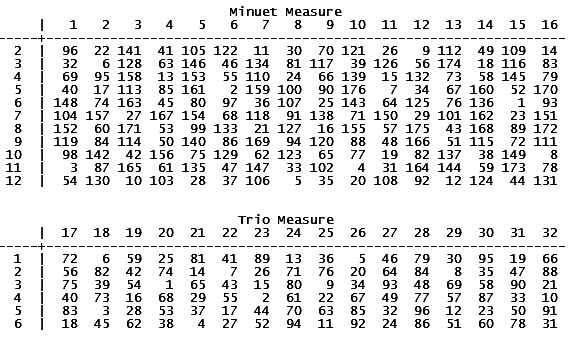
S ometime around 1775—when is not known with certainty—Mozart wrote the measures and instructions for a musical compositional method using dice, a table of numbers, and a set of cards. On each card was printed one measure of music and a number to identify that measure. You randomly select from these pre-written measures of music based on rolls of the dice. With each dice roll, you do a table look-up to find out what card (measure) you are to select from the deck. Then you put the cards together to create new Menuets. It was possibly the first [published] algorithmic stochastic composition.

T here are 176 possible Menuet measures and 96 possible Trio measures to choose from. The results of the 32 dice rolls and the pretty large set of pre-written measures give a quite large number of different compositions that could be generated by Mozart’s rules.

B ut there are not 1116 + 616 = 4.6 * 1016 possible compositions as some claim. [My god, there is an error on the internets!]

N or is it 272C32 (176 + 96 things, taken 32 at a time) = 4.6 * 1041 possible menuets.

I nstead, what you have with Mozart’s menuet generator are 1116 * 616 = 1.3 * 1029 possibilities. That’s because his rules specify a menuet as a segmented number (string-vector) comprised of 16 base-11 (undecimal [Babylon5 ‘minbari’]) digits concatenated with 16 base-6 (hexal) digits, where each digit indexes into a separate list of permitted measures. Only members of the specific subset of measures that Mozart enumerated in a given roll’s list are permitted (table column look-ups), not just any from the whole set of all 176 Menuet measures or all 96 Trio measures.

I    f you fail to preserve it [the sequence of 32 numbers from your dice rolls, or the sequence of measures you get], it will be a menuet that will [probabilistically speaking—] never be heard again.”
  —  Martin Gardner, Scientific American, 1970.
 Mozart K. 516f ‘Wurfelspiel’
  • The Menuet section is in the tonic key and the Trio section is in subdominant.
  • Measure numbers are indicated in the top row.
  • Outcome of each dice roll is indicated in the left-most column (2 to 12 for the Menuet roll with two dice; 1 to 6 for the Trio single-die roll).
  • For example, for the first measure (Menuet) if you rolled “snake-eyes” you would play measure #96 of the 176 possible Minuet measures. If in bar 17 (Trio) you rolled a “6” you would play measure #18 of the 96 possible Trio measures.
I n 2005, the Dallas Symphony Orchestra commissioned a ‘new version’ of K. 516f in honor of the 250th anniversary of Mozart’s birthday.

 Robert X. Rodriguez, photo (c) Schexnyder
M    usical Dice Game’ begins with the first solo quartet playing the first half of one minuet; both quartets then join to play all eleven versions of those bars at once; the second solo quartet continues with the second half of the minuet, followed by all eleven versions of those bars, again played by all forces simultaneously. Eleven continuous variations follow, based on the harmonies and principal melodic motifs of the original dice game. I most often used the game’s versions for throwing a five, six, eight, nine or, particularly, a seven. Since, by the laws of probability, those numbers are the most likely to be thrown, they have the most melodically distinctive variants. In the first few variations, the themes and harmonies are given in their simple, original forms; then, as the piece progresses, the minuets are disguised, and the music grows more and more chromatic, complex and rhythmically asymmetrical. In the final variation, a synthesis is reached between the Mozartean themes and their transformed versions, as the original minuets return, superimposed over the varied material in a festive musical layer cake.”
  —  Robert Xavier Rodriguez, score notes, 2005.
B eautiful! Having been persuaded/challenged by the DSO to go where angels fear to tread, Rodriguez created a composition guided by Mozart’s stochastic wurfelspiel rules that is notable for its novelty and sheer musicality. It does not have too much emphasis on ‘bar-lines’, despite the ‘measure-wise’ macro-granularity of the stochastic engine (dice-rolling selection of single measures by table look-up). It’s superbly constructed... a moving piece of music in its own right, and one that also invites us to critically rethink Mozart’s own compositional methods and computational composition in general.

I n light of the Schick/ICE Xenakis concert in Chicago earlier this week and my previous CMT post speculating about algorithmic composition methods’ begging for human editing/finishing, I thought I’d mention Mozart’s own experiments, as well as Robert Rodriguez and his Mozart Reloaded.

M    usic is meaningless noise unless it touches a receptive mind.”
  —  Paul Hindemith.
P    otential for banality, or beauty

What are avatars of impendingness?
After Verdi died in 1901 (January, in Milan, of complications from a single, deterministic stroke), Italy suffered a cardiac/cultural arrest of confidence.
After Xenakis died in 2001 (February, in Paris, of complications from multiple stochastic ailments he had been enduring), Greece suffered nothing, at least not right away.
But soon after each event, the protean exuberance of the respective century collapsed; emergent self-absorption papered over with frenzied ornamentation.
No such country as “Homeland”... non-existence hardly ameliorates its artistic self-glorification.
You know, things that happen according to Markovian rules can be changed without loss of overall meaning, and likewise without gain of overall meaning.

What are Markov melody engines?
Stochastic algorithms who have had a recurring, salacious role in western music composition for more than 200 years...
Who do not want the listener to be aware of their forms and metabolisms.
Mozart’s ‘Musikalisches Wurfelspiel’ K.516f is well-known. But other composers, including Haydn and C.P.E. Bach, fooled around here.
Recombining humanly-composed motifs in random orders, first for the novelty of it, but then as friends/accomplices, then as crutches/co-dependents, and finally as addictions.
Mozart wrote (or [at least] Peter Welcker published in 1775, in London) a ‘Tabular System Whereby Any Person without the Least Knowledge of Musick May Compose Ten Thousand Different Menuets in the Most Pleasing and Correct Manner’.
‘Pleasing’, maybe, sometimes. ‘Correct’, leave it for the first violin to say.”


Thursday, June 4, 2009

Knowledge Unspoken: How Much of Xenakis’s ‘Morsima-Amorsima’ Was Really Computer-Generated?

 IBM 7090, circa 1960
B    ut of what essence are these materials made? This essence is the intelligence of man solidified in a way: intelligence that seeks, questions, infers, reveals, and foresees at all levels. Music and the arts in general seem necessarily to be a solidification—a ‘materialization’—of intelligence. Naturally, this intelligence, though humanly universal, is diversified by the individual: by talent that distances one individual from the others. Talent is therefore a kind of qualification—a gradation of the vigor and richness of intelligence. For intelligence is, fundamentally, the result—the expression of billions of exchanges, of reactions, of transformations of energy in the cells of the brain and the body. One could, taking astrophysics as a visual aid, say that intelligence is the form taken by the minimal acts of cells in their condensations and their movement—as happens with the particles of the suns, planets, galaxies, and clusters of galaxies born of or turned back into cold interstellar dust... To think up music as composer, craftsman, and creator, it is first necessary to study solfège, notation, music theory, and even an instrument over a long time. And since, in addition, musical creation is considered superfluous, very few people are able to attain it. Thus the individual and the society are deprived of the formidable power of free imagination that musical composition offers them. We are able to tear down this ‘iron curtain’, thanks to the technology of computers and their peripherals. The system that has succeeded at this ‘tour de force’ is the UPIC (Unité Polyagogique Informatique du CEMAMu)...”
  —  Iannis Xenakis in a typically ‘expansive’ moment in the 1970s, quoted in ‘The Art of Music: Tradition and Change’ by William Christ and Richard DeLone.
T  he performance by International Contemporary Ensemble and Steve Schick of five major works—‘Psappha’, ‘Echange’, ‘Akanthos’, ‘Palimpseste’, and Xenakis’s final composition, ‘O-Mega’—is an opportunity not to be missed. It’s at Chicago’s Museum of Contemporary Art, tonight at 19:30. Anticipating this ICE performance got me to listening to the recordings I have of Xenakis’s music. I have never been lucky enough to hear a ‘live’ performance like this...

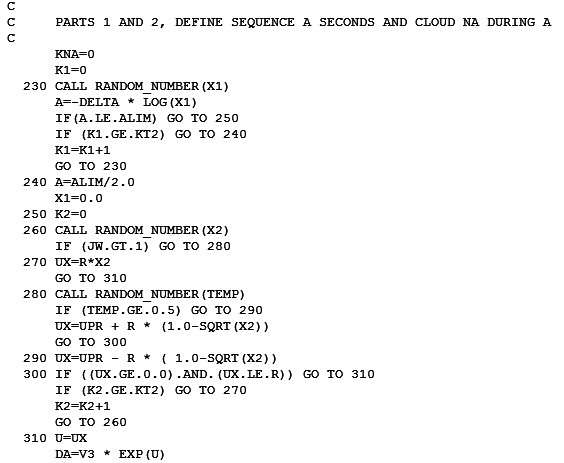
Source-code:
 Xenakis FORTRAN code
Output:
 FORTRAN code output
X  enakis’s ‘Morsima/Amorsima’ score says that ‘moros’ = ‘fate’ and ‘amorsima’ = ‘that which does not come from fate’. It was composed on an IBM 7090 in Paris, in increments/revisions between 1956 and 1962, and it was, like Xenakis’s ‘Achorripsis’, supposedly entirely stochastic (random, computer-generated). To me, this beggars belief.

F  ew have ever performed a deep-dive source-code review of what Xenakis programmed, nor compared what the 7090 generated to what Xenakis actually wrote down as a published score. Oh, yes, there are people who have ported the FORTRAN code in Xenakis’s book to FTN95, and, yes, the code does run—it does produce things. It has calls to the built-in FORTRAN random-number function; it modifies global variables and accesses the system clock to accomplish a modest degree of runtime indirection and aleatorics, in the limited ways that the FORTRAN language was (and is) able to support.

B  ut these source-codes do not produce things that have any close resemblance to any composition that Xenakis actually published. And the in-line commenting of the source code is terrible. The rats' nests of GOTO statements upon GOTO statements are nearly impenetrable-incomprehensible, even by the not-so-great software engineering standards of his day. A static analyzer would be the thing to use with this wild-hare code, not manual ‘desk analysis’! PRQA used to sell an analyzer called QAfortran™. I don’t know whether this is still available. I don’t see it on their website...

W  e have lots of software things today that serve as composition-aids... PWGL, Vielklang, Max/MSP, Jitter, harmonization plug-ins in Finale® and other notation applications… all sorts of things. And in the 2000s [almost] nobody goes around touting their use of composition software in the way that Xenakis did. By the same token, [almost] nobody is embarrassed to say that they do use them, or to forthrightly confess the methods by which the tools contribute to the compositional process.

X  enakis’s code supposedly causes the [specifications for the scored—] sounds to be generated as a directed-graph (digraph). First the [random] sequence of pitches is generated, with each note’s time of specified onset—it’s time coordinate. Then its timbre is generated (the instrument that is to play it; and its articulation: arco, pizzicato, glissando, and so on). Then the velocity of attack. Then the gradients in loudness (dynamic changes in loudness during the time interval the note is sounded... legato, accent, marcato ^, staccato, slur, portato/martelé ... sforzando, subito whatever) and in pitch (vibrato or not, glissando beginning and ending, shakes’ frequency and pitch-width). Then the duration. Not sure whether the program had anything in it to specify the (random) mode of releasing each note.


    [50-sec clip, austraLYSIS, Iannis Xenakis, ‘Morsima/Amorsima’, 1.6MB MP3]


    [50-sec clip, austraLYSIS, Iannis Xenakis, ‘Morsima/Amorsima’, 1.6MB MP3]

T  he 7090 was a room-sized $3M, 36-bit single-CPU machine, with 32K words of magnetic-core RAM (144 KB) and a clock cycle of 2.18 μs (459 KHz). It computed at about 0.2 MIPs, 0.03 MFLOPs. [The little laptop on which I am now writing this blog, is 64-bit, 8 GB, over-clocked 3.06 GHz dual-CPU, 46.7 MIPS (Dhrystone ALU), 35.2 MFLOPS (Whetstone iSSE3).]

B  ut the probabilities in ‘Morsima-Amorsima’ fate-vs-nonfate are highly unlikely. And this piece and others are too, too beautiful to be ‘lightly edited’ output from any of Xenakis’s FORTRAN source-codes that are available. Instead, there are the hallmarks of the human ear, the human hand, the Xenakisian mind. I am betting that this ‘Morsima/Amorsima’ is maybe 80% Xenakis traditional compositional method-produced and only 20% Xenakis algorithms on IBM 7090-produced—20% Fate and 80% Non-Fate, by one way of thinking about random events and chance. The score only costs €50. We should take a detailed statistical look and see!

 IBM 7090, circa 1960
I  am not saying that Iannis Xenakis deceived anyone, exactly, regarding how his compositions were produced. He was a brilliant, flamboyant character and a wonderful and entertaining speaker, and I experienced these qualities of his, first-hand. I attended a lecture series he gave in 1972… I had been taking Computer Science courses at University of Minnesota at the time. The exuberance and expansiveness he exhibited when speaking were fabulous.

B  ut I think that not enough detailed consideration has been given to the stories he told about his compositional methods—comparing his writings and interviews and software source-codes against his finished scores, to see how well (or not) Xenakis’s remarks about his methods are supported by the evidence.

X  enakis’s famous book ‘Formalized Music’ and the FORTRAN source-code fragments that have been published obfuscate more than they reveal. Was he unsatisfied with the musicality of the results of his algorithms? Did he feel that he needed to extensively rewrite the computer-produced compositions to achieve a more aesthetically appealing, defensible work? What motives would lead him to withhold so many of the details? Did he have a sense of obligation to IBM Paris, who had provided resources and upon whom he depended? Was it pride? The François Bernard Mâche and the James Harley biographies are well worth studying! But none of the biographers to-date have been software engineers capable of performing detailed code-reviews, to ascertain whether or not Xenakis actually did things in the ways he claimed that he did.

I  f you have views about these things—about the roles of computational composition and interactions between algorithms and human composers; and about Xenakis’s evasiveness about his actual methods—please add a comment below or send me an email. If you knew Xenakis personally and think my speculation is a bunch of hooey, please write and tell me so. If you yourself delegate to Vielklang or PWGL or other software tools part of your composerly work, I’d be delighted to hear from you, too, to learn how you use these tools to generate ideas and edit them.

O  f course, if you’re able to attend the Steven Schick—ICE performance tonight in Chicago, please put a comment here, too! Thanks!

 Temperley book

 Smith-Dean book


Friday, November 3, 2006

Pražák Fractal Vista Overlook

Pražák String Quartet
[I am] “always searching for the meaning of life, searching for truth. A system of uncertainty has entered our daily life. The pressures of mechanization and uniformity to which life is subject call for protest ... by music.” — Bohuslav Martinů.

DSM: Martinů’s String Quartet No. 3 (H. 183, 1929)—performed so beautifully by the Pražák String Quartet this evening—reminds me a lot of Iannis Xenakis’ music. In 1972 at the University of Minnesota I attended lectures given by Xenakis. It was astonishing to me at the time how organic and natural—How expressive!—the structures and textures in this music could be—pieces whose heritage was mathematical, that is. Martinů’s music has this same sort of formal beauty—it has a mathematical beauty.

CMT: Yes, that’s true! As though it were derived from the theory of fractals! Quantitative fractal mathematics analyses of heterophonic ‘webs’ of sound lilke Martinů’s and Shostakovich’s and Xenakis’ string quartets. In fact, there’s a vibrant research literature that addresses the ‘after-the-fact’ mathematical analytics and theory side of it. But, you’re right, the real surprise is that mathematics can guide or produce the composition itself—or major elements of it, the raw materials, or completing or correcting the orchestration. So the mathematics and software don’t just analyze it after the fact. They can generate it and build it. And the deeper surprise is also that wholly ‘stochastically-generated’ pieces can actually signify things to us and move us! At least some of them can. As if there were some Law of the Universe that should make such a thing heretical or cognitively impossible. As if! ‘Stochastic music’ is the name given to the mode of composing music developed by Xenakis and put forward in his classic book “Formalized Music,” first published in France in 1963. Music composed this way isn’t by any means ‘random’ music; instead, it’s musical phrases and textures by mathematical random-walk diffusion, martingales, discrete Brownian motions, mathematical Itô processes. The trajectory of each phrase is related to its immediate predecessor—a Markovian nearest-neighbor regime—which is probably why it does seem organic and cohesive. Each step is sensible and coherent in the context of what just preceded it. And the result exhibits the four musical textures that are recognized on conventional music theory: monophony, homophony, polyphony and heterophony:
  • Monophonic texture has a single melody or single line of sound;
  • Homophonic texture is is comprised of a succession of ‘block’ chords;
  • Polyphonic texture has two more concurrent, independent lines of sound;
  • Heterophonic texture consists of variant versions of the same musical line played concurrently—a musical ‘braid’.
Martinů’s and Xenakis’ music has such textures, every bit as much as the music of Mozart or Beethoven does!

DSM: As technology improved in the Sixties, computers were an ever more essential tool for Xenakis. Beginning with Achorripsis in 1956, he used software apps that linked musical parameters (timbre, duration, intensity, and so on) via mathematical game-theoretic algorithms. By separating non-temporal parameters (like pitch) from temporal ones (like rhythm) in his algorithms, Xenakis produced intricate constructions—pieces like Tetras (1983), which was dedicated to the Arditti String Quartet.

CMT: You know, I think he was in those days a lightning rod for criticism on this point, because many people misunderstood what he was doing with computers. Or they thought it was somehow reductionistic or devaluing of the human element—or a backhanded denial of transcendence in music. People’s misunderstandings then might be likened to a vehement but spurious objection to the ‘Turing Test’ in computer science or philosophy of Mind. Or Searle’s ‘Chinese Room’. Instead, Xenakis regarded composing as a structured kind of creativity—one governed by rules and variables and, for him, one that could be aided by technology—but still admitting of lots of flexibility with those rules. Xenakis once spoke of the distance separating expression and composition: “...that kind of traditional sentimental effusion of sadness, gaiety or joy—I don’t think that this is really admissible in my music.” Well, today far fewer people raise objections like the ones that Xenakis faced. If you’re a mechanical engineer designing complex systems, you use Parametric Technology Corp’s Pro/E™ software; if you’re a doctor you use things like ePocrates™; if you’re a graphic artist, you use Adobe’s InDesign™ and Illustrator™ and QuarkXpress™ and other things—giclee is not a dirty word—and if you’re a composer you use Coda’s Finale™ and myriad other software packages. You can still compose with rocks and sticks if you want to—nobody’s stopping you. But many today do use some level of technology as part of how they compose these days—and nobody disparages the use of tools per se. Yes, a ‘Fool with a Tool’ is still a Fool. But the tool itself doesn’t produce bad compositions. And the human composer isn’t abdicating or demoting herself/himself to the role of copy-editing what the tool generates. Mere use of machines and algorithms by no means denotes an acceptance of mechanization, or of a bland monoculture! In other words, the Luddites, I think, mostly faded out about twenty years ago or so. A Kuhnian paradigm shift happened somewhere along the line, and now there is pretty alacritous acceptance of what the previous generation had found very threatening. Use of algorithms in composition is no longer sacrilege.

DSM: But the irascibility was surely part of Xenakis’ lectures back in 1972. “Sentimental effusions not admissible in my music!” Or Martinů’s “Mám toho plné zuby!” (I’m fed up!) Basically, he implied that others’ work was excessively sentimental or overwrought or—Horrors!—bound by tradition. But, despite Xenakis’ rants, he wasn’t actually “anti-expressive” as such—not more than Martinů was anyhow. From his wartime experiences (“the agony of my youth, of the Resistance”), Xenakis declared his yearning for the transcendent: “For years I felt guilt at having left the country for which I’d fought. I left my friends. I felt I had a mission. So my thoughts were moving around more general, universal problems. I became convinced that one can achieve universality, not through religion, not through emotions or tradition, but through the sciences.” So, like Martinů, Xenakis’ attention to musical texture and form was not at all “cold”—despite his use of mathematics and despite the computers in his acts of composing. He was a warm, friendly, brilliant guy. Iconoclastic and irascible, yes, but deep-down he was warm.

CMT: What about other types of mathematics in music composition? Wavelet theory? Horizontal (longitudinal) cliques; vertical cliques; signals convolved with other signals! String Quartets Nos. 3, 4, and 5 are examples of Martinů’s mathematically convolving Czech folk music signals with the neo-Classical signals that radiated throughout Europe’s music scene in the pre-War years. These Quartets’re full of diverse sonorities and technical effects; they’ve got rich vertical texture and longitudinal texture. But—Look!—they’re also balancing passionate chromatics and harmonies with the crystalline form and independence of the voices—quintessential quartet writing. Very conversational! As you said, despite his use of formal mathematical techniques, Martinů wrote “[I am] always searching for the meaning of life, humankind's life and my own, searching for truth. I feel the pressure of the contradictory forces, I would like to find a ‘common denominator’ which would absorb these contradictions. [There is a] system of uncertainty that came to our daily life.The pressure of mechanization and uniformity which our life is subject to, [and this] evokes our protest ... in music.” The formalism—the way he composed—was in fact a part of this humanistic protest!

DSM: The No. 3 Quartet is witty—funny, even—this string quartet, written wryly in F major. Martinů was 33—he was young still when he moved from staid Prague to wild Paris in 1923. There is a jaunty, playfulness in the Vivo in this Martinů No. 3—it’s bohemian in the cultural sense of the word, as well as literally bohemian in respect of Martinů’s ethnicity. Yes, this quartet was clearly composed to please Martinů’s intended avant garde listener. But the Quartet’s disciplined part-writing gives each of the four voices a unique identity. This Quartet rewards the audience for a close listening. But if listeners aren’t attentive enough, they’ll merely be annoyed.

CMT: The independence of these lines makes for some major dissonant clashes with each other. In the outer movements these gestures produce effects that, to me, are humorous, but there’s a tragic quality in the middle movement. The violin seems to lift the whole texture into higher registers, and the music takes on a more driving character as the percussive effects become more prominent.

DSM: True. And these disturbed chords and low trills add a darkness that ascends to the climactic central section and resolves in a mood of resignation—and acceptance. Extravagant, prodigal, cavalier, epicurean.

CMT: The second quartet, with its direct impressionistic influence, is even more “profligate” in its tone and range of innovative textures and flavors. It implies a composer who is all-seeing, detached-but-interested—the perspective of an observer at a distance, one who has no immediate sense of his mortality—a young person’s view from a belltower or belfry, rather than from ground level. Martinů spent the first twelve years of his life looking at his village from this bird’s-eye perspective, you know. His father was the local carilloneur. The memory of this view of the world, experienced every week with his father, was inscribed upon the young Bohuslav’s mind—how could it not but influence his ideas of composition! As he wrote later in life, it was “not the small interests of people, the cares, the hurts, or the joys” that he saw from that great height, but “space, which I always have in front of me.”

DSM: At Martinů’s funeral, the eulogist characterized Martinů's work by saying, “His music is the music of our times, because it expresses profound basic problems; it bears the stamp of individuality, which enables it to ring out among all the rest, and guarantees that he will not be forgotten.”

CMT: During 2007, quite a few North American audiences will be fortunate to hear the Pražák String Quartet—including New York, Boston, Houston, San Francisco, Los Angeles, Detroit, New Orleans, Salt Lake City, Tucson, Vancouver, and Montreal. Pražák’s Kansas City performance tonight was just an appetizer!

Here are some tasty “morsels” for you:

and these too:
DSM: Šťastnou cestu! (Have a good trip!)

CMT: Děkuji! (Thank you!)

DSM: Prosím! (You’re welcome!)


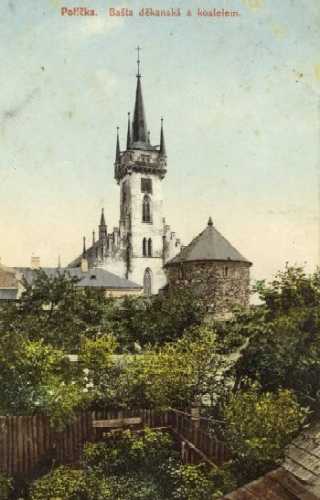
Martinů’s Boyhood Vista, Polička, 100 mi east of Prague