A remarkably accomplished string quartet, not simply for its high technical polish and refined tone, but more importantly for the searching musical insights it brings.”
— John von Rhein, Chicago Tribune, 23-AUG-2002.
T his piece was a great discovery for me. It helped me to realize that my piano playing style and my personality match well with chamber music. I believe the Franck was my finest performance during the [2001 Van Cliburn] Competition.”Looking forward to the Borromeo Quartet performance this Friday (25-JAN-2008) in Kansas City, I check out their program and revisit scores for the works they will play. One of them will be César Franck’s Piano Quintet in F minor, a “big”, atmospheric piece.
— Stanislav Ioudenitch.
- Nicholas Kitchen, Violin
- Kristopher Tong, Violin
- Mai Motobuchi, Viola
- Yeesun Kim, Cello
- Stanislav Ioudenitch, Piano (guest)
- Piano Quintet in F Minor
- I: Molto Moderato Quasi Lento, Allegro 16:00 – 17:00
- II: Lento, Con Molto Sentimento 10:30 – 12:00
- III: Allegro Non Troppo, Ma Con Fucco 9:20 – 10:00
T he instrumental work was seen [in the 19th Century] as a wordless oration, and its form was viewed not so much as a harmonic or thematic plan but as an ordered succession of thoughts.”The piano part in this Quintet is virtuosic, magisterial, symphonic. In fact, that may be the biggest risk—the fact that the piano part is so “big”. The quartet may play beautifully and cohesively, but the pianist must fully “belong”. This is a chamber music piece. It ought not to come off as a mini ensemble piano concerto. Nobody is ‘accompaniment’. And it’s not a ‘pianist vs. quartet’ duet.
— Mark Bonds, p. 53.
So the real unifying factor has got to be pianist Ioudenitch. Not ‘in charge’, but genuinely ‘unifying’. The opening Molto Moderato is simultaneously tender, muscular, edgy—moderato but almost anxiously hurried—with minimal good-natured geniality: urgent.
The Borromeos—known for their full tone—deliver phrasings that are abundant with feeling, and their sound production has a characteristic lyrical fullness. But, playing with Iodenitch, they are under-stated, more subdued as they merge their playing. There is a wonderfully hushed quality in this Molto Moderato.
And, true to the ma con fucco indication, the Allegro is brisk, lively and light, well-accented, almost hard-driven. Despite the fact that they do not regularly play together, the Borromeos and Ioudenitch manage to achieve what, to paraphrase David Rounds, is clearly ‘The Five and The One.’
Each movement in the Quintet evolves from a single idea, and these ideas clearly connect as a series of narrative episodes. Like a protagonist in a drama, each idea goes on its ‘journey’ through a series of contrasting psychological states hoping for resolution or fulfillment. Inter-connections and inter-movement references are beautifully rendered by the Borromeos. An extended passage, or even a single texture recalled from an earlier moment triggers our memory and builds up a multi-dimensional awareness. All this makes the work feel “Big”.
Ioudenitch’s interplay with the wonderful Borromeos is marvelous. How hard should the players try to minimize ‘inhomogeneity’ between the strings? In my view, not much. It’s routine to have a novel where each character is fully-developed and yet there are leading roles and supporting roles. And so, too, in a piece like this. It’s unreasonable to insist on absolute parity when the expressive/narrative content of the work doesn’t exhibit parity and when the composer didn’t intend it. The ‘characters’ in the 5 parts here are so disparate as to argue against attempting to enforce ‘equality’.
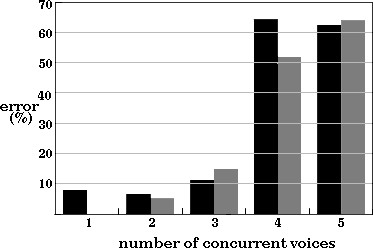
In other words, this is not the same inter-voice dynamic as in a Piano Trio or Piano Quartet. Obviously, the five voices have to cooperate. But the texture is more complex and could get muddy if they do not really, really cooperate and anticipate each other’s phrasing. There are thematic processes that operate on a larger scale. This is not a ‘subject/answer’ or ‘tell-and-ask’ rhetoric, as Peter Smith and others have explored in Brahms, say (Music Analysis 2001;20:193-236). There’s less predictability in individual voice-leading. There are more inter-voice constraints than in a quartet.
And the unfolding of the separate voices/characters is idiosyncratic—characteristic of Franck, even if not necessarily characteristic of the period or the quintet form or sonata form. We have ‘hybrid phrases’ where Franck creates ‘antecedent’ and ‘consequent’ phrases—creates the ‘consequent’ of one (sub-) phrase by transposing an initial tonic-oriented antecedent statement of a thematic idea into the dominant key. This is especially notable when the minor dominant is tonicised. In an alternative approach, Franck adjusts intervals within the repetition (consequent) so that the restatement centers on the dominant but remains within the tonic key. Material that unfolds within the tonespace of the 1-5 fifth is ‘answered’ by a repetition that falls within the 5-1 fourth. This alternative approach ‘recontextualizes’ the idea of an ‘answer’.
In fact, if Franck had used a formal ‘subject/answer’ or ‘tell-and-ask’ type of rhetoric, it would have lent a sort of ‘instability’ to the piece. It would have been somwhat of an anacrusis—an under-stressing or ambiguity of authority, before (and in between) the more forceful statements.
It’s a complex phenomenon and it involves the musical and social coordination of the group, an agreed sense of leadership, and the group members’ individual and collaborative construction of meaning through verbal discussions and shared reflections on the playing. Group identity is shaped by individual players’ self-identities and vice-versa (Rounds 1999; Stubley, 1992) and a piano quintet is no exception. We have both musical and social coordination between musicians here (Davidson & Good, 2002; Ginsborg, Chaffin, & Nicholson, 2006; Williamon & Davidson, 2002; Young & Colman, 1979).
Dahlhaus at Technische Universitat Berlin (1991, p. 255) discussed rhetorical coherence in terms of ‘architectonic form’—a balance between phrases, periods, and sets of periods—each rhetorical unit counterbalanced by one or more other metrical/rhetorical units at every level in the piece. He contrasted this with ‘logical form’ (form based soley on ‘motivic connections’) which holds a movement together ‘from within’. This Franck Quintet seems clearly ‘architectonic’ according to Dahlhaus’ definitions. Big and satisfying!
T his music is rich in atmosphere and tenderness. There are so many colors and such a wide range of emotions, it makes it hard to breathe! When all the proportions are right during the performance, it connects us with the composer’s soul. That’s an unbelievable experience for the performer and the audience.”
— Stanislav Ioudenitch.


[40-sec clip, César Franck, Piano Quintet, Molto Moderato, mm. 1-10, Schubert Ensemble, 1.1MB MP3]
[50-sec clip, César Franck, Piano Quintet, Molto Moderato, “A”, Schubert Ensemble, 1.6MB MP3]
[30-sec clip, César Franck, Piano Quintet, Molto Moderato, “B”, Schubert Ensemble, 0.9MB MP3]
[50-sec clip, César Franck, Piano Quintet, Molto Moderato, “C”, Schubert Ensemble, 1.3MB MP3]
- Borromeo String Quartet website
- Ysaye Quartet with Pascal Rogé. Franck Piano Quintet. (Ysaye, 2007.)
- Schubert Ensemble with Simon Blendis. Franck Piano Quintet. (ASV, 2006.)
- Spiegel Quartet with Jan Michiels. Franck Piano Quintet. (MD&G, 2006.)
- Quatuor Ludwig with Michael Levinas. Franck Piano Quintet. (Naxos, 1998.)
- Almen B, Pearsall E, eds. Approaches to Meaning in Music. Indiana Univ, 2006.
- Bonds M. Wordless Rhetoric: Musical Form and the Metaphor of Oration. Cambridge Univ, 1991.
- Dahlhaus C. Nineteenth-Century Music. Univ California, 1991, p. 255.
- Dahlhaus C. Between Romanticism and Modernism: Four Studies in the Music of the Later Nineteenth Century. Univ California, 1989.
- Davidson J, Good J. Social and musical co-ordination between members of a string quartet: An exploratory study. Psychol Music 2002;30:186-201.
- Dreyfus L. Bach and the Patterns of Invention. Harvard Univ, 1996.
- Eich K. Die Kammermusik Von Cesar Franck. Barenreiter, 2002.
- Ginsborg J, Chaffin R, Nicholson G. (2006). Shared performance cues in singing and conducting: A content analysis of talk during practice. Psychol Music 2006; 34:167-94.
- Gritten A. Music and Gesture. Ashgate, 2006.
- Hefling S, ed. Nineteenth-Century Chamber Music. Schirmer, 1998.
- Mazzola G. The Topos of Music. Birkhauser, 2003.
- McKenna P, Maister D. First Among Equals. Free Press, 2002.
- Reynolds C. Motives for Allusion: Context and Content in Nineteenth-Century Music. Harvard Univ, 2003.
- Rounds D. The Four and the One: In Praise of String Quartets. Lost Coast, 1999.
- Scher S, ed. Music and Text. Cambridge Univ, 1992.
- Schoenberg A. Fundamentals of Musical Composition. Faber & Faber, 1982, pp. 20-22.
- Spitzer M. Music As Philosophy: Adorno and Beethoven's Late Style. Indiana Univ, 2006.
- Stock K, ed. Philosophers on Music: Experience, Meaning, and Work. Oxford Univ, 2007.
- Tarasti E. Signs of Music: A Guide to Musical Semiotics. de Gruyter, 2003.
- Tarasti E. Musical Signification: Essays in the Semiotic Theory and Analysis of Music. de Gruyter, 1995.
- Williamon A, Davidson J. Exploring co-performer communication. Musicae Scientiae 2002; 6:53-72.
- Young V, Colman A. Some psychological processes in string quartets. Psychol Music 1979; 7:12-6.
- Zbikowski L. Conceptualizing Music: Cognitive Structure, Theory, and Analysis. Oxford, 2002.