A nthony Burton’s program notes for the London Phil’s ‘Chamber Contrasts’ series at Wigmore Hall emphasize how impressed Brahms was with the potential of clarinet, as a result of his hearing clarinettist Richard Mühlfeld perform in 1891. But Brahms composed this Op. 115 clarinet quintet within a few years of his death from cancer, a period when many of his friends and family died (his sister Elise, his brother Fritz, Elizabeth von Herzogenberg, Hermione Spies, Theodor Broth, Clara Schumann, etc.). This makes me think that the recursive, ‘re-considering’ structures in this quintet maybe derive more from the emotional impact of those events on Brahms—than from any scheme Brahms may have had, to create in Op. 115 a virtuosic clarinet showpiece for the great Mühlfeld.
L arge-scale variation comes from relationships between variations (the theme included) and how these relationships are united into a pervasive algorithm that encapsulates the entire set—that is, an operating system governing the entire set. In other words, these are not a mere series of independent objects and methods (scripts) that are expected derivatives of a parent object or class. They are a ‘network-based object-oriented OS’.
W hat I mean is, Brahms’s variations feel to me ‘network-based’, not ‘hierarchical’. It seems (to me) that Brahms was exposing larger-scale connections, and transforming his idea into a multi-domain network rather than a hierarchical structure with conventional ‘parent’ exposition classes and ‘child’ instantiations. The arrangement of variations involves pairs of diatonic pitch-class cells derived from the theme. But the textural differences that follow are like remote procedure-calls that cross-link the tension-producing structures within the variations’ designs. This gives the piece an attractive sort of ‘meta-complexity’.
I n other people’s analyses (links below), variation sets in Brahms’s multi-movement instrumental compositions are usually only moderately complex. Variation sets in interior movements often do not have full ‘closure’. In the variations in this Clarinet Quintet in B minor, Brahms suggests or ‘projects’ closure by recapitulating first-movement phrases. But the promised closure doesn’t come until the very end. It is as though there is a latent, suspended complexity that is irreducible until the very end.
T his gets me to thinking about how Brahms does this, and how we might devise similar structures and mechanics in new music. The ‘Kolmogorov complexity’ (links below) of a software program or script, or a piece of text or a musical composition, is a measure of the computational resources needed to specify the object. Kolmogorov complexity is also known as descriptive complexity, Kolmogorov-Chaitin complexity, stochastic complexity, algorithmic entropy, or program-size complexity.
O ne of the appealing, intuitively plausible qualities of Kolmogorov complexity as a metric to characterize what I was hearing last night in the account of the Brahms clarinet quintet given by Robert Hill and his colleagues has to do with how the aggregate complexity goes, for large composite or ‘compound’ or ‘network’ or ‘cloud’ objects that are constituted from multiple smaller objects. For example, consider a compound object built up from objects X and Y. The Kolmogorov complexity of the two of them together K(X,Y) is:
K(X,Y) = K(X) + K(Y|X) + O(ln(K(X,Y)))
T his says that the shortest program that reproduces X and Y is no more than a logarithmic term larger than a program to reproduce X and a program to reproduce Y given X. This basically puts a quantitative ‘bound’ on the amount of mutual information there is between X and Y in terms of the Kolmogorov complexity.
T he amount of unresolved tension we feel in the inner movements in this Brahms quintet—and the intensity of the desire we feel for the eventual resolution of these tensions at the end—feels, to me, logarithmic. Maybe some future music theory PhD candidate will explore this notion properly and critically. For now, it’s happy enough for me to give you a few interesting links below and the glimmer of a potential reason why the complexities and proportions of this quintet seem so ‘right’ and so beautiful.
R eligion...is a person’s total reaction upon life.” — William James, ‘Varieties of Religious Experience’, 1902.
A genuine first-hand religious experience like this is bound to be a heterodoxy to its witnesses, the prophet appearing as a mere lonely madman. If his doctrine prove contagious enough to spread to any others, it becomes a definite and labeled heresy. But if it then still prove contagious enough to triumph over persecution, it becomes itself an orthodoxy; and when a religion has become an orthodoxy, its day of inwardness is over.” — William James, ‘Varieties of Religious Experience’, 1902.
Y ou will enjoy and be inspired by the new recording by guitarist/composer Gene Pritsker and his ensemble, SoundLiberation.
Gene Pritsker, electric guitar
Greg Baker, electric guitar
David Gotay, cello
Mat Fieldes, double-bass and electric bass
Joe Abba, percussion
T he original chamber opera from which this VRE Suite derives was orchestrated for narrator, tenor, soprano, mezzo soprano, baritone, 2 guitars, cello, and double-bass.
[50-sec clip, SoundLiberation Ensemble, Gene Pritsker, Varieties of Religious Experience, ‘Everything Else Might Be a Dream’ (track 3), 2010, 1.6MB MP3]
T he Suite progresses in 8 tracks (64 min) from ‘Introduction’, a musical exposition of William James’ early views on psychology of religion, through James’ subsequent reconsiderations of his thought (‘Closer to Me than My Own Breath’, track 5), to an account of Tolstoy’s spirituality, to William James’ “conclusion” (track 8). There are myriad textures here that invite meditation. Accessible, stimulating chamber music throughout—although I do hope someday to experience the VRE opera. The theatrical gestures in here make me curious about the VRE libretto and staging. What texts did Pritsker choose, I wonder?
T he last peculiarity of consciousness to which attention is to be drawn in this first rough description of its stream is that it is always interested more in one part of its object than in another, and welcomes and rejects, or chooses, all the while it thinks.” — William James, ‘Principles of Psychology’, 1890.
M any of the published reviews of Pritsker’s work note that he challenges musical boundaries. Uh, yes he does. Exceptionally curious and inclusive rather than aggressive or confrontational, Pritsker and his collaborators explore passionate new expressions based on jazz, world rhythms, machine rhythms, lyricism, and the spirit.
W hat interest, zest, or excitement can there be in achieving the right way, unless we are enabled to feel that the wrong way is also a possible and a natural way?” — William James, ‘Dilemma of Determinism’, 1884.
T he VRE Suite is full of tasteful improvisation, sturdy melodies and voice-leading, strong ‘grooves’. Mystical it may be, but VRE Suite is far from ‘enigmatic’. It positively asserts that your cosmic, mystical experience is as genuine as my mystical experience; or as genuine as that of any organized religion.
R eligion, therefore, as I now ask you arbitrarily to take it, shall mean for us the feelings, acts, and experiences of individual men and women in their solitude, so far as they apprehend themselves to stand in relation to whatever they may consider the divine.” — William James, ‘Varieties of Religious Experience’, 1902.
A ccording to theists’ Argument from Religious Experience, people have “religious experiences” — mystical or supernatural experiences, like angels or ghosts. Theists say that, because we believe other experiential claims people make — that they ate spaghetti last night, or they have a pet cat — then we should believe these claims as well. Theists say that, when skeptics insist on different, more stringent standards for assessing the veracity of claims based on religious experiences than they do for claims based on other experiences, they are prejudiced against religious claims. This prevents them from understanding and believing. William James entertained this argument in his Varieties of Religious Experience. He proposed that all normal persons do have religious experience and, since empirical experience is the final arbiter of truth, then God—as one object of religious experiences—must be accepted as factually true. A problem, though, arises in the variety of religious experiences: if there were just one true God, why is there such wide variety in religious experiences? They are mutually inconsistent, so at least some experiences must be false. There are no independent criteria we can use to separate true experiences from false experiences — not only others’, but our own. There are no independent criteria; there can be no independent criteria; all criteria rely upon the validity of some religious system, a Bible or the Koran, or some other sacred text—some of them, or all of them, must be false.
R eligions have approved themselves; they have ministered to sundry vital needs which they found reigning. When they violated other needs too strongly, or when other faiths came which served the same needs better, the first religions were supplanted.” — William James, ‘Varieties of Religious Experience’, 1902.
F or any who are unfamiliar with William James (1842-1910), I should point out that James was not a Christian. He was religious in his own way, but he was hardly a monotheist. William James published his ‘Varieties of Religious Experience’ in 1902 and, subsequently, many theists have taken bits of his writings out of context to support their arguments. But at bottom James was a Rationalist, and he did not believe in a personal God who enters history or personally responds to people’s prayers. Gene Pritsker’s VRE Suite likewise evokes a diverse range of spirituality while broadly extending respect and tolerance to all forms.
A n act has no ethical quality whatever unless it be chosen out of several all equally possible.” — William James, ‘Principles of Psychology’, 1890.
P ritsker offers a unique look at trans-textual relationships between the poetic text and musical text; between the chamber music creative tradition and new ways of crossing boundaries of genres and orchestration; between the Western canon of chamber music thought and non-traditional, jazz-derived ways of intimacy; and between the ideology of chamber for chamber’s sake and the opposite: the ideology of chamber musicians’ active ethical engagement in, and attention to, social issues.
T he total possible consciousness may be split into parts which co-exist but may mutually ignore each other.” — William James, ‘Principles of Psychology’, 1890.
Chamber operas are a good example of new “ideological,” stylistic and technological approaches to composition. They are emblematic of a transition from musical thinking that was orthodox and conservative to more heterodox, multi-layered forms.
T he Hell to be endured hereafter, of which theology tells, is no worse than the hell we make for ourselves in this world by habitually fashioning our characters in the wrong way.” — William James, ‘Principles of Psychology’, 1890.
P ritsker uses isorhythmic patterns in the first several tracks, retrogrades in ‘The Less Real of the Two’, and allusions to the rondo form in ‘William James’ Conclusion’.
G enius, in truth, means little more than the faculty of perceiving in an unhabitual way.” — William James, ‘Principles of Psychology’, 1890.
T he predominant texture in the VRE Suite is ‘pointillistic’ and tense, but not in the acoustic sense of guitars or pizzicato passages in the cello or double-bass. VRE Suite is organized through a contrapuntal juxtaposition and alternation of single notes, short gestures, and gestural ‘units’ that are based on certain ‘privileged’ pitches and intervals and chosen beat-divisions. Complex linear constructs are mostly melismas—especially exposed in the guitars, but also in the cello part.
T he transition from tenseness, self-responsibility, and worry, to equanimity, receptivity, and peace, is the most wonderful of all those shiftings of inner equilibrium.” — William James, ‘Varieties of Religious Experience’, 1902.
I t is interesting that in the first parts of the Suite the individual notes and gestures are distributed across the whole available range in each instrument, with emphasis given to irregular, “nervous” rotations of leaps and step-wise motion. A kind of self-less, anonymous, transcendent texture emerges as a result. Such an approach has a lot to do with post-serialist compositional methods, even if Pritsker would be happier to disavow this.
I ntegrity—a unified/unifying collective voice that is robust against the ensemble members individuality and rhythmic complexity—is assured by a technique based on manipulations of similar timbral and gestural units (motives, minimalistic ones or otherwise). The groups of repeated units establish a sonic architectural continuum and create a durable terrain governed by intervals and timbres of desire between consenting adults.
R omeo wants Juliet as the filings want the magnet; and if no obstacles intervene he moves towards her by as straight a line as the filings. But Romeo and Juliet, if a wall be built between them, do not remain idiotically pressing their faces against its opposite sides like the magnet and the filings. Romeo soon finds a circuitous way, by scaling the wall or otherwise, of touching Juliet’s lips directly. With the filings the path is fixed; whether it reaches the end depends on accidents. With the lover it is the end which is fixed; the path may be modified indefinitely.” — William James, quoted by Mortimer Adler.
B eyond the ‘Introduction’, VRE Suite becomes more and moredialectical, but in a good way. Gestures of disparate provenance react against each other, animating each other not killing each other off, bringing passages to life (?reincarnating them). The gestures (revealed by guitars, cello, and drums) alternate against a double-bass ostinato. There is much joy and comfort to be had in this...
P ritsker’s use of unusual cello-electric guitar timbres should be considered from a psychological rather than a technological point of view. “Technical” in nature, these timbres intensify the poetic metaphor or enhance the emotional power the music exerts on us, inscribing us, carving us as it goes...
W e are spinning our own fates, good or evil, and never to be undone. Every smallest stroke of virtue or of vice leaves its never-so-little scar.” — William James, ‘Principles of Psychology’, 1890.
I n James’ writing, Pritsker has found a congenial source of conceptual and artistic inspiration. William James himself embodies the contradiction of a spiritual man and rationalist. There is something of the prophet as well as a “martyr” in him, despite his wealth and Harvard credentials and social standing... He was aware of the necessity to combine intellectual effort with social intervention and his own convictions. His writings are humorous, perhaps inadvertently so. His entirely serious meanings are embedded in an “innocent”, “childish, “naïve”, “life-is-short-so-what-the-hell” surface. His psychological writings amount to an exotic kind of poetry influenced by folk literature, supernatural beauty, pain of life, and religion.
T ake the happiest man or woman, the one most envied by the world, and in nine cases out of ten his/her inmost consciousness is one of failure. Either his/her ideals in the line of his/her achievements are pitched far higher than the achievements themselves, or else he/she has secret ideals of which the world knows nothing, and in regard to which he/she inwardly knows himself/herself to be found wanting.” — William James, ‘Varieties of Religious Experience’, 1902.
T he complexity of James’ poetic texture and his multi-spectral style must appeal deeply to Pritsker. It is amazing how masterfully Pritsker explored the opportunities offered by James’ poetic vocabulary.
P ritsker’s compositions (including chamber music, chamber operas, electroacoustic and orchestral works, rock, and hip-hop) have been performed widely (Berlin Philharmonic; Adelaide Symphony; Brooklyn Philharmonic; Athens Camerata; and others). He has also collaborated with Joe Zawinul on film scoring projects.
C reatures extremely low in the intellectual scale may have conception. All that is required is that they should recognize the same experience again. A polyp would be a conceptual thinker if a feeling of ‘Hello! Thing-um-a-bob again!’ ever flitted through its mind.” — William James, ‘Principles of Psychology’, 1890.
I believe that we stand in much the same relation to the whole of the Universe as our canine and feline pets do to the whole of human life. They inhabit our drawing rooms and libraries... They are tangent to curves of history the beginnings and ends and forms of which pass wholly beyond their ken. Just so, we are tangent to the wider life of things.” — William James, ‘Pragmatism: A New Name for Some Old Ways of Thinking’, 1907.
Michael Smetanin’s ‘Obsession’ for tenor saxophone, electric guitar, cello, double bass, piano, and drumkit (1995)
Irinel Anghel’s ‘El Enigmes II’ for electric guitar, cello (with processing), bass guitar, and tape (2001)
James Tenney’s ‘Septet’ for 6 electric guitars and bass guitar (1981)
Salvatore Macchia’s ‘Onde’ for double bass and guitar (2000)
Brian Ferneyhough’s ‘Trittico per G.S.’ for double bass (1989); Seven ‘Tableaux Vivants’ depicting the Angel of History as Melancholia; Stelæ for Failed Time)
S tandpoint theory’ … asks: could you do science [, or computing, or music or other of the arts] differently if you did not ‘erase’ [disenfranchise] those people outside the [conventionally-enforced] institutional representation? ... Women in science can more sharply expose [science’s] assumptions because they are not party to the prior agreements [of the prevailing Establishment authorities]. And precisely because they are not part of the prior agreements, they may freely prioritize other agreements, including agreements about strategies for dealing with the actual world that are different from those used by institutional science [or institutional music, etc.]; strategies with a different understanding about power relations between the observer and the observed and generating different kinds of knowledge.” — Lynette Hunter, Situated Textualities, p. 163.
E verybody thinks that classical music is the music of the European canon. But when you go to children [in public schools in the U.S.] now, they don’t know what ‘classical music’ is, period.” — Toyin Spellman-Diaz, Imani Winds oboist, quoted in Vivien Schweitzer NYT 14-NOV-2008.
A nd so those kids are growing up not imagining that these musical ‘homelands’ exist. They are growing up not knowing that they ‘belong’ and have the possibility of a home within the many communities of classical music including chamber music. Community outreach programs to address that problem are tremendously important, to the kids and to each society as a whole. The Imanis are wonderful ambassadors—Secretaries of State from what, to those kids, are unknown (and what, once they discover them, are revealed to be exciting and congenial—) ‘lands’. Thank you, Imani Winds, for all of your efforts to de-mystify chamber music through your community outreach programs!” — DSM.
The ‘Thanksgiving’ U.S. holiday seems to me a perfect occasion to point out the recent, festive performances and recordings of the wind quintet, Imani.
Valerie Coleman, flute
Mariam Adam, clarinet
Toyin Spellman-Diaz, oboe
Jeff Scott, French horn
Monica Ellis, bassoon
M embers of the Imani Winds ensemble all have graduate degrees from conservatories like the Juilliard School and the Manhattan School of Music. But, prior to their illustrious achievements in those settings and subsequently, each of them attended public schools in the U.S., and experienced the limitations that that generally entails. With that as prologue, the ensemble and its members do now perform pro bono and ‘community outreach’ work as a focus of many of their programs. Their own personal experiences in this way inform and propel their natural, generous response to the still-unmet, ever-more-unmet needs, especially for music education opportunities for underserved inner-city kids. This aspect was covered in Vivien Schweitzer’s article on the Imanis in the NYT a couple of weeks ago. It is inspiring and truly wonderful to see the Imanis ‘giving back’ in this way. Please be sure to thank them and acknowledge their efforts. (And, of course, one way of tangibly doing that is to attend their performances and buy their CDs.)
Have a listen to a couple of MP3 clips from two of their recent recordings:
[50-sec clip, Imani Quintet, Ástor Piazzolla, ‘Fuga e Misterio’, 1.2MB MP3]
[50-sec clip, Imani Quintet, ‘The Holly and The Ivy’ traditional carol, 1.2MB MP3]
The Piazzolla is especially characteristic, I think, of the Imanis’ chamber music ‘fusion’ interpretive approach. In his chamber compositions Piazzolla notoriously ‘borrowed’ elements of jazz (esp, its harmonies and dissonances)—plus elements of tango, baroque counterpoint, and a variety of other idioms. Essentially, he created a ethnomusicological ‘country’ or ‘territory’ in which to ground his own individualism. The Imanis make a ‘home’ out of it. In fact, they make every sonic-space they enter their ‘home’.
Piazzolla’s—and the Imanis’—style transcends all of the borrowed influences: they don’t merely ‘appropriate’ the influences or ‘reference’ them. For example, the passacaglia form with its circulating continuo line entraining/entrained-in a recursive harmonic sequence was idiomatic for 17th and 18th Century baroque music, but it’s also fundamental to jazz progressions. Another example from baroque composition idioms is the complex and often virtuosic counterpoint that epitomizes formal, collectivistic fugal gestures but which in Piazzolla/Imani Winds incarnations becomes a vehicle for individualistic discourse by each chamber artist in turn.
M ore obviously ‘democratic’ and autonomy-related are the improvisational elements. Improvisation might nominally be borrowed from jazz, but in practice it entails different tonal and rhythmic palettes that, despite how extensible and varied they are, do stay within the boundaries of the ‘homesteaded’ sonic territory.
Property rights;
Autonomy and equality;
Enfranchisement;
Social justice;
Decolonizing the colonized;
Becoming anti-colonial musical activists.
Yeah, all of that. Thankful are we, for these beautiful and interesting real worlds and virtual worlds.
Our notions of ‘belonging’ and nation-ness may have mutated in these recent years of globalization, but the issue of belonging is no less important than it ever was—and the Imani Winds sound reminds us of that fact. Thanksgiving is a holiday (in the U.S., Canada, and other places) that is associated, perhaps more than any other holiday, with concepts of nation and family and unity and equality. But it’s also an occasion for remembering and celebrating difference—for affirming the stories that we hold in common with each other, and for remembering and meditating upon the narratives that make us diverse or that, for better and worse, still separate us or colonize us. The Imanis cross genre boundaries as though they weren’t there—one big borderless E.U. as far as the performing arts are concerned.
Shall I put one of the Imani CDs on to play when my own family assembles to celebrate this Thursday? In think yes. The group or family forms a focus for our sense of belonging—and how we move our sense of attachments and identity from place to place. Members of my own family live far apart and travel abroad frequently; we don’t have opportunities to see each other very often. Our processes of ‘identification’ aren’t constant, and they surely aren’t frozen in-time as they once seemed when we were not all so far-flung. The processes are renewed and altered at times of holiday celebrations; they are contingent and fleeting, expressed in relation to our group and its customary holiday foods, and music, and other cultural genres and artifacts. We ‘transcend’ whatever our identities may have been in the past, as we create new experiences together. In a way, Imani Winds is ‘trans-national’ and ‘contingent’ as much as it is transcendent in its repertoire and interpretations. And it is so in much the same way, I think, as what I believe families do, including my own.
All of us are, in the process, avoiding artistic ‘essentialism’ and artistic ‘determinism’ or passivity—and instead actively migrating into or creating new areas. Or at least that is what listening to the Imanis makes me feel.
Their warmth and exciting virtuosity are captivating. To hear Imani Winds perform is to want to be(come) a member of their family...
Upcoming Imani Winds performances include the following:
01-DEC-2008 19:00 at Borders Bookstore, 461 Park Av, New York NY
02-DEC-2008 20:00 at Carnegie Hall Stern Auditorium, New York
09-DEC-2008 19:00 at Borders Bookstore, 3700 Torrance Blvd, L.A.
10-DEC-2008 20:00 at Walt Disney Concert Hall in Los Angeles CA
12-DEC-2008 20:00 at the Performing Arts Center in South Orange NJ
T he Second Quartet signifies for Carter a leap forward in terms of control of harmony (and, by extension, melody), register, and rhythm, from the smallest rhythm to the largest form, and including the way in which time passes in the piece—in each part, and in the whole.” — Robert Kirzinger, Program Notes, p. 67.
The BSO’s Festival of Contemporary Music at Tanglewood (Elliott Carter Centenary) on Wednesday had a wonderful performance by members of the New Fromm ensemble.
Quintet for Piano and Strings (1991) [Henry Ward (oboe), Raymond Santos (clarinet), Rose Vrbsky (bassoon), Lauren Moore (horn), Nolan Pearson (piano)]
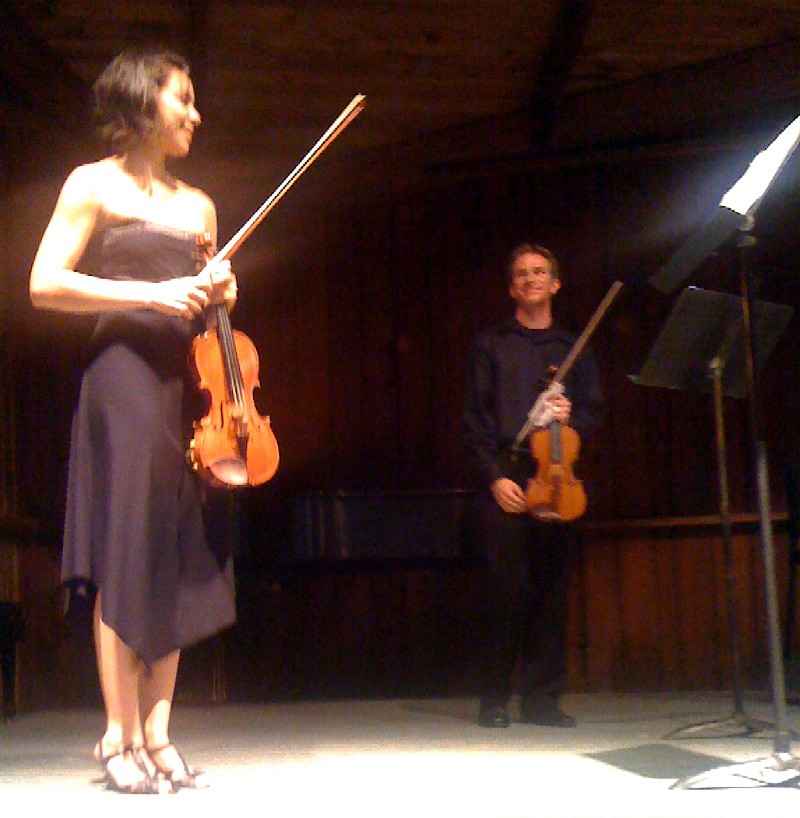
The rich textures and rhythmic complexity thoroughly diverted the appreciative SRO audience filling the 200-seat Chamber Music Hall. (The Chamber Music Hall is a weather-worn barn with wood plank walls, 2-by-10 rafters, and simple folding-chair seating in the west side of the Tanglewood campus in Lenox, Massachusetts.)
From the tiny scale of microsounds and fragments and motives, to the large scale of whole movements of a piece, to the yet-larger scales of multiple works by a composer, a pattern normally only attains a level of significance if it occurs more than once, in more than one setting. In Carter’s chamber music works we experience a wide and innovative range of evocative patterns. For those of you who are interested in the theory of such things, the recurrence of patterns is treated from a post-modern intertextuality and other perspectives in Steven Jan’s nice book, ‘The Memetics of Music’.
But it’s more than that, more than sequences and recurrences. In Wednesday afternoon’s performance: we experienced the ‘vascular’ or ‘hemodynamic’ propagation of musical motives and phrases, as though they were blood. Within a Carter piece, it as though the expression in one instrument’s part is like a contraction of the heart, sending a pulse of blood outward into the circulatory system—of the composition, of the performance. Depending on the distance traveled and the stretchiness or ‘compliance’ of the blood vessels (the channels of acoustic and visual communication that prevail amongst the performers and the neurophysiology of their attention), the pressure ‘wave’ that is ejected in each pulse propagates with a finite speed and has its effects on the other body systems some milliseconds to seconds later. In other words, the patterns propagate, not so much as intimate ‘conversations’, but as though they were blood pressure waves from successive heartbeats among the various organs (instruments/parts) that comprise this living organism of performers.
Furthermore, between and among compositions by a particular composer like Carter, I think the morphologically and dynamically similar expressions are like Richard Dawkins’s ‘selfish genes’, propagating down through generations of a species. The stylized Carterian naturalism to which conductor Oliver Knussen referred on Monday here arises in part through a kind of organic, self-replicating, mutually-reinforcing recursion. In the ‘refinements’ of Carter’s style, we see a cumulative evolutionary ‘selection’ among the best and most effective of these self-conserving compositional ‘genes’. (I suppose the idea can be over-done, pushed beyond the limits of its validity. All I am saying is that there is more to the human composer than intellect and ‘will’. There is an unconscious, organic element, too. And only by hearing several pieces in close succession—ones composed decades apart from each other—only by doing this is one likely to hear these possibilities and think these thoughts.)
Propagation of expressions in ‘waves’. The sensations of point, pulse (series of points), line (tone), and surface (texture) emerge as acoustic particle density increases. Sounds coalesce, evaporate, and mutate into other sounds—and they do so as though they had mass and viscosity. This Carter quintet and this Carter quartet feel as though they were made of living, flowing blood.
What do I deduce from this? Rather than looking at the performer as an ‘instrument’ of the analyst/composer—as an ‘executant’—we should remember that the performer’s interpretive choices are themselves inherently analytical. But (of course!) the performer’s ‘analysis’ is not 100% cerebral. The neurophysiology of pitch and rhythm kicks in, and—here, nicely illustrated by the Tanglewood New Fromm Players’ performance of these Carter pieces—we get these genuine, honest, primal, highly physical interpretive responses. Some of you Conservatory-based theorists may want to confer with your cardiologist and neurophysiologist colleagues over in the School of Medicine, to see whether the analytics that are used to study human circulatory and nervous systems can be brought to bear on better understanding some of this wonderful, exciting music by Elliott Carter. And have a look at some of the sources in the list of links below.
Thank you for this superb performance! Bravo, New Fromm artists!
I love Elliott, but I loved his music first. (I can’t do this in reverse; I can’t love the music just based on a rapport with the composer.)” — Conductor James Levine.