Showing posts with label woodwind. Show all posts

Friday, July 3, 2009

Native American Flute and How We Are As People Today

 R. Carlos Nakai
O    ur primary importance as musicians is trying to tell people that history can’t be changed, but the future can be. Personally, I feel I should try to contribute something that would encourage people to change, to become more positive about our situation, to reorganize and reorient ourselves together instead of continuing to build walls.”
  —  R. Carlos Nakai.
K  athleen DuVal had a piece in the New York Times yesterday, meditating on the U.S. July 4 holiday and the meaning of the American Revolution. In it she mentioned the diversity of Native American cultures and the fact that different American Indian tribes had participated in the War, with different motivations, on both the British and the American sides.

I  got to reminiscing about my own friendships with Indians... the several Ojibway (Chippewa, Ojibwe, or Anishinabe) and Cherokee and Abenaki who have been coworkers with me at various times in my professional life; my interactions with Tlingit people in 1991 and 1993. One Abenaki, Dr. John Flickinger, is an accomplished flutist. It was he who introduced me to the music of R. Carlos Nakai in 2001.

N  akai, a fine composer and performing artist, creates a pentatonicism that is alternately relaxed or taut—the acoustic ‘image’ that his music projects is “aesthetically naïve or minimalistic, but not technically naïve.” The melodies are restricted to a pentatonic collection, but the accompanying harmonies—while still overwhelmingly consonant—are quite sophisticated. Besides this, a simple pattern of repetition is seen in the sequence of phrases: a, a', b, a", c, etc.

 Pentatonic F# scale (iiim7)
A  Nakai phrase “A” occurs two or three times, while phrases “B” and “C”—although creating contrast—are still modeled very closely on phrase “A”. Every phrase contains a ‘reciting’ tone, and exhibits characteristic melodic figurations, such as ‘lower-neighbor motion’ that occurs at the beginning of a phrase. Nakai’s embellishments are also devised in ways such as will convey “aesthetic naïvete” or naturistic gestures, but are not in any way technically naïve.

T    he PF-Series Ken Light [Amon Olorin] ABS plastic flutes ... I have found these instruments to remain in-tune through extended playing and in varying environmental conditions that would limit the performance capability of the one-of-a-kind and more expensive wooden models. The PF-Series flute is well suited to double and triple tongueing passages and responds excellently to varying embouchure dynamics. The clarity of the pitches and the extended range of the PF-Series flute enables more varied performance and collaborative possibilities. Compositions for performance by more than one flute are now readily accomplished without the idiosyncratic eccentricity and tunings of similar hand-made flutes. Wood is a living and changing material whereas the PF-Series flutes are exact in many ways. The PF-Series flute marks another achievement in attaining the very best in reliability practicable without question. Now, I limit the hand-made flutes to special performances and use the PF's for extended work either in rehearsal, studio projects, or in long ensemble performances where time is of the essence. I highly recommend the PF-Series flute for beginners, students, teachers, and professionals alike and the enjoyment of working with a reliable, extremely versatile, affordable instrument will only add pleasure in expressing yourself in the language of music.”
  —  R. Carlos Nakai.
T  he quarter-tone and pitch-bent microtonal features of Native American offer a number of possibilities for new-music chamber works... Besides the interesting and varied timbres it has, Native American flute and its microtonal possibilities can add dramatic natural tension, stasis-free and open-ended, with emotionally-evocative, clearly-tenuous resolution. And compared to some other woodwinds, it’s relatively easy to reliably produce and control quarter-tones on Native American flutes.

 X
I  f you are composing for this instrument and prefer natural acoustic-only flute, that’s great. But if you do a thoughtful job of miking/pick-up and DSP processing a Native American flute as Nakai does, you can capture wonderful articulation and fingering and headjoint/totemic-aperture and breathing sounds from the instrument. Used judiciously, these can create textures conveying even greater chamber intimacy and accentuate the sense of you-me ‘duality’ that comes with the anhemitonic pentatonic scale.

W    hat makes a tune pentatonic? This is like asking ‘How long is the coastline of Great Britain?’... It is of no consequence that the pentatonic scale happens to contain five notes; what really matters is the degree of dissonance it permits or excludes. ‘Auld Lang Syne’ is pentatonic [technically], but not all pentatonic melodies are so obligingly regular. ‘Na more utushka’ include an extra-pentatonic tone [more than 5 notes] but is nonetheless pentatonic. Not all modal skeletons are equally pentatonic. So it is quite possible to have two tunes, each making full use of all seven notes of a heptatonic scale, that are in fact ‘pentatonic’ to different degrees.”
  —  Peter van der Merwe, p. 38.
 Improvisation on iiim7
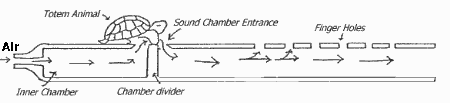
T  he non-well-tempered scale of Native American flute presents both challenges and opportunities to composers. Most Native American flutes are tuned close to a Phrygian (iiim7) pentatonic scale (F#-A-B-C#-E)—set { 0 (1) 3 5 7 (8) 10 }. In jazz, the iiim7 is often a substitute for Imaj7. The root, minor third, fifth, and minor seventh of iiim7 substitute as the third, fifth, seventh, and ninth of Imaj7. The perfect fourth of the Phrygian scale works as the sixth of Imaj7. Pitch-bending puts some extra-pentatonic options within practical reach, including dissonant counterpoint, multiple concurrent melodies, and deliberate confusion of chromatic-vs-pentatonic polarity and Bartokian ‘mikrocosmos’/Lou Harrison-type effects.


    [50-sec clip, R. Carlos Nakai, ‘Departure’ (Canyon Trilogy), 1.6MB MP3]


    [50-sec clip, R. Carlos Nakai, ‘Embracing Darkness’ (Migration), 1.6MB MP3]


    [50-sec clip, R. Carlos Nakai, ‘Obsidian Talisman’ (Talisman), 1.6MB MP3]

S  even-times Grammy-nominated R. Carlos Nakai is of Navajo-Ute descent. Originally a brass player, Nakai took up flute after an early-1980s car accident caused permanent injury to his embouchure. Composer James DeMars and others have written and dedicated compositions for him. Nakai, while cognizant of the traditional use of the flute as a solo instrument, has from time to time extended his repertoire to include jazz and classical and new music. Nakai’s appearances in chamber orchestral performances have included Promusica Chamber Orchestra (Ohio; Timothy Russell conducting), Chicago Sinfonietta (George Hanson, conductor), and Nouveau West Chamber Orchestra (Arizona; Terry Williams conducting). He founded the ethnic jazz ensemble, the R. Carlos Nakai Quartet, to explore the intersection of ethnic and jazz idioms. Over the past 25 years, Nakai has performed with over fifteen symphony orchestras. He was a featured soloist on the Philip Glass composition, ‘Piano Concerto No. 2: After Lewis & Clark’, premiered by the Omaha Symphony. Nakai has his Master’s Degree in American Indian Studies from the University of Arizona.

I    consider myself a traditional flutist.... Tradition is what people do now, rather than looking back at historic or romantic times. Our compositions deal with how we are as people today.”
  —  R. Carlos Nakai.
M  r. Nakai will be performing on 25-JUL-2009 at the Native American Flute Music (NAFM) event “Native Voices with Keola and Moana Beamer” in Mt. Peale, Old La Sal, Utah (more information call 888-687-3253 or 435-686-2284). Note, too, that the 2010 INAFA annual convention will be held next year at the University of Wisconsin - Eau Claire from 14-18-JUL-2010, and Nakai will be one of the artists there as well.


Wednesday, July 1, 2009

Margaret Marco & French Baroque Oboe: The Composer, The Performers, The Audience

 Margaret Marco
T    he change in the disposition of sonic objects in the acoustic space may alter the perspective of the listener. Where various sound-objects move in different directions... the listener may reasonably assume himself to be at a point of rest. If, however, a number of sound-objects are spaced at various points of the compass... might suggest to the listener that he himself is spinning whilst the frame of reference remains still... Depending on the type of material used, closeness may imply intimacy, distance a sense of eavesdropping or of detachment, and, at various stages in between, a sense of interpersonal communication or more formalised social communication... and aural ‘magnifying glass’, quite different from our experience of normal acoustic perspective.”
  —  Trevor Wishart, p. 148.
L ike good butler, a good Baroque composer does not ‘eavesdrop’... she/he ‘discreetly overhears’.

N ot in the sense of surveillance or espionage, of course. More in the sense of parent/guardian or journalist. This CD contains recordings of seldom-heard pieces, infrequently-performed composers.

 Margaret Marco – Hidden Gems: Oboe Sonatas of French Baroque
  1. Bouin-Cinquième Suitte: I. Le Prudent-La Prudente
  2. Cinquième Suitte: II. Tambourin
  3. Cinquième Suitte: III. Musette
  4. Cinquième Suitte: IV. Les Oiseaux
  5. Huguenet-Première Sonate, Op. 1: I. Grave
  6. Première Sonate, Op. 1: II. Gay-Grave
  7. Première Sonate, Op. 1: III. Sicilienne
  8. Première Sonate, Op. 1: IV. Gigue
  9. Chedeville-Sixième Sonate, Op. 3: I. La Rivièr d'hier
  10. Sixième Sonate, Op. 3: II. La Dificile
  11. Sixième Sonate, Op. 3: III. Rondeau
  12. Sixième Sonate, Op. 3: IV. Les Adieux de Brunoy
  13. Naudot-Sixième Sonate en Trio, Op. 7: I. Musette
  14. Sixième Sonate en Trio, Op. 7: II. Gavotte
  15. Sixième Sonate en Trio, Op. 7: III. Allemande
  16. Sixième Sonate en Trio, Op. 7: IV. Menuet
  17. Sixième Sonate en Trio, Op. 7: V. Sarabande
  18. Sixième Sonate en Trio, Op. 7: VI. Gigue
  19. Naudot-Caprice en Trio, Op. 7: I. Caprice
  20. Caprice en Trio, Op. 7: II. Tambourin
  21. Caprice en Trio, Op. 7: III. Menuet
  22. Caprice en Trio, Op. 7: IV. Chaconne

    [50-sec clip, Margaret Marco, Jacques-Christophe Huguenet, ‘Première Sonate – IV. Gigue’, 1.6MB MP3]


    [50-sec clip, Margaret Marco, Nicolas Chedeville, ‘Sixième Sonate – IV. Les Adieux de Brunoy’, 1.6MB MP3]


    [50-sec clip, Margaret Marco, Jacques-Christophe Naudot, ‘Sixième Sonate – VI. Gigue’, 1.6MB MP3]

  • Margaret Marco, oboe
  • Barbara Bishop, oboe
  • Matthew Herren, cello
  • Rebecca Bell, harpsichord
T hese sonatas are not merely ‘evocative’. They report on particular kinds of relationships—between performers and their audience; between composers and performers and patrons. There are hints in these 18th Century works, about the nature of such relationships that may have been distinctly French, plus elements that were widely-traveled... The rhythms and textures, the binary or rounded binary form with sectional repeats, the predominance of dance-inspired forms such as the courante, rigaudon, menuet, and gigue.

H idden Gems’ brings together works that share natural affinities characteristic of the time. But hearing them together illuminates some of their not-so-obvious ‘hidden’ qualities as well. Not only do the individual pieces seem to provide a [backhanded; unintended] commentary on each other, the pieces taken together embody who it was these composers were writing for. The pieces suggest how the performers conceived of their audiences. And the pieces contain clues about the aristocratic patrons and how they wished to be diverted and perceived by each other: a society that delighted in ‘overhearing’ juicy conversations. Even the music suggests ‘positioning’ in order to surreptitiously overhear things and repeat them to others, a rhetoric of reciprocal pleasure...

L    anger’s [Philosophy in a New Key: A Study in the Symbolism of Reason, Rite, and Art, 1957, p. 218] philosophy [portrays] ... music-making as a symptom of ... eavesdropping. If music were only a matter of releasing pent-up personal desire, music’s formal excellence would not matter the way it does. In fact, the more ‘self-expressive’ something is, the less musical it is likely to be. Music, Langer is convinced, is not about exposing, discharging, or expressing feeling; and yet, it is clearly related to feeling in some way. How might that be? Simply, music is a presentational symbol; and as such it is neither a stimulus nor a symptom of feeling: it is ‘not the cause or the cure of feelings, but their logical expression’.”
  —  Wayne Bowman, p.210.
V    arious performative strategies that ‘opera buffa’ adopts in the rhetoric of pleasure... [which] cannot exist without the eavesdropping presence of the audience.”
  —  Downing Thomas, p. 228.
W hile Chedeville and Huguenet and Naudot were part of the same tradition, culturally and musically, their backgrounds were very different. Nicolas Chedeville (1705-1782) was a prolific composer and instrument maker, a member of the Douze Grands Hautbois, a group of oboists and bassoonists who performed for state ceremonies during the reigns of Kings Louis XIV and XV. Jacques Christophe Huguenet (1680-1729) was a violinist and composer, appointed an ordinaire of the Royal Chamber in 1710 and a member of the Petits violons. Jacques-Christophe Naudot (1690-1762) was a self-taught Parisian flautist who had many aristocratic pupils and patrons. By contrast, not much is known about Jean-Francois Bouin; even his birth and death dates are not known. But from the title page of his compositions we know that he was a publisher and teacher of the ever-disparaged ‘vielle’ (hurdy-gurdy), about which he wrote a large, erudite, defensive tome. The righteous pique he develops in this book makes it a satisfying, if exotic, read—somewhat like reading transcripts of lawyers’ celebrated pleadings in courts of law, on behalf of hurdy-gurdies in the dock.

T hese works show sophisticated adults who as a salon game pretend to be children, amusing themselves with stylizations of fashionable dances. The differences in the composers’ approaches, and indeed, of their psychological make-up are evident enough. But the similarities of gesture and rhetoric are also evident. Marco’s and her colleagues’ musicianship is excellent, enabling us to hear and imagine these things (stylized ‘eavesdropping’ behaviors, relished and storied) beyond the musical texts themselves.

I  admit I bought this CD with the somewhat ‘detached’ intention of learning something about composers I’d never before heard and woodwind ensemble literature about which I was totally ignorant until now. But I am thrilled to have found not a pallid scholarly account but instead a rich provocation to Baroque dreaming and conjecture, in French. Cool!

M argaret Marco is principal oboe with the Kansas City Chamber Orchestra and has appeared with various orchestras including the Orquesta Sinfònica de Maracaibo, the Rome Festival Orchestra, the Dubuque (IA) Symphony and the St. Joseph (MO) Symphony. She is the Associate Professor of Oboe at the University of Kansas and holds degrees from Northwestern University, University of Iowa, and University of Illinois in Champaign-Urbana. She served as President of the Midwest Double Reed Society and performs frequently on Kansas Public Radio and with the flute, oboe, piano trio Allègresse. She currently serves on the Executive Committee of the International Double Reed Society as the coordinator of the Fernand Gillet-Hugo Fox International Oboe Competition.

R ebecca Bell, harpsichordist, studied at the Royal College of Music in London, where she won the prize for clavichord playing while studying with Ruth Dyson and Robert Woolley. She has concertized in the U.S., Canada, England, the Netherlands, Italy, Austria and Germany. She is a founding member of Summerfest Kansas City where she served as the Artistic Director from 1995-1999. She is the harpsichordist for the Kansas City Symphony and the Kansas City Chamber Orchestra.

M atthew Herren has performed at Alice Tully Hall at Lincoln Center and The National Gallery in Washington and has recorded orchestral and chamber music for the Deutsche Grammophon, Sony, Atlantic, Helicon and London Decca Labels with The Orchestra of St. Luke’s. His performances have been broadcast on NPR’s Performance Today. Herren performs regularly with The American Composers Orchestra, The New York Oratorio Society, and The New York Concert Singers, Trio Fedele, The Kansas City Symphony, Kansas City Chamber Orchestra and Chamber Music Society.

B arbara Bishop is Associate Principal Oboe with the Kansas City Symphony and co-principal of the Kansas City Chamber Orchestra and Assistant Professor of oboe at the University of Missouri-Kansas City Conservatory. She trained at the Eastman School and has a Master of Music degree from the University of Minnesota. She is a regular Guest Principal with the Saint Paul Chamber Orchestra.


Saturday, June 20, 2009

Pre-verbal Music: Duo Stump-Linshalm’s Recording of Pierluigi Billone's 1+1=1

 Duo Stump-Linshalm
I    s it possible to approach music in silent [wordless] comprehension, without falling prey to human psychological, intuitive, irrational, spontaneous influences—i.e., those forms of comprehension engendered by words, text, speaking?”
  —  Pierluigi Billone.
P ierluigi Billone’s aleatoric work reminds me a little of Peter Eötvös’s and Ensemble Modern’s performance of Helmut Lachenmann’s ‘Schwankungen am Rand’ [Fluctuations at the edge]. Pierluigi had in fact spent some time studying with Helmut some years ago...

A    final angst-ridden attempt to strike water out of the stone of the dead monument known as [modernist] ‘music’.”
  —  Helmut Lachenmann, commenting on the aims of new music.
P lumbing the outer-limits of timbral space with each instrument. Sudden, explosive dynamics changes. Overblowing, harmonic-clipping and distortion of bass-clarinet reeds... wonderful, naturalistic colors. The harmonic palette is maybe a little like the songs of whales singing to each other, whales’ courting rituals...

T    he title of the work, ‘1+1=1’, is a quotation from an Andrey Tarkovskij film which points to the special relation between the two instruments [achieving a transcendent union by their playing together]... One drop plus another drop makes one larger drop, not two.”
  —  Petra Stump & Heinz-Peter Linshalm.
I t is impossible to know whether it is a ‘proper’ language with subjects, predicates, etc. But it has harmonic and lyrical and rhythmic features that (a) invite interest, (b) reward whatever interest and patience are sent its way, and (c) propel the interested listener to various kinds of meditation.

 Petra Stump, photo (c) Petra Stump
T    he variations that become part of instrumental technique through each individual discovery are traces—some clearer than others—of the human and cultural experiences that produced them and led to them. And they ‘vibrate’ in the act of listening—as particularity, identity, origin. They are sonic ‘layers’—living matter, with an intelligence of its own...”
  —  Pierluigi Billone.
L ooking at some of his scores, I wonder whether Billone is striving to be an archtypically ‘difficult’ composer. But electroacoustic digital material or specially-designed analog instruments or ‘found’ instruments, including rumbling and crumpling metal, play no role in this 70-minute composition. And the graphical/aleatoric score annotations are reasonably straight-forward, compared, say, to Stockhausen or Xenakis.

S onic materials and structure. Think like a whale and use what’s at hand. Reed, glottis, keys smacking against clarinet-body tone-holes, lungs. From time to time, things grind to a halt while Petra Stump and Heinz-Peter Linshalm slowly and punctuatedly smash hell out of their two bass clarinets’ keys). Alternately, there are moments where subtle, whispered tones only hint at the note that would sound were more air flowing past the expectant reed. Intertwining of pitch-bent/quarter-tone and microtonal passages by Stump and Linshalm are beautiful and wonderfully discursive, on account of the excellent recording and engineering of this disc. The beat-frequencies from the microtonal interferences between the two parts add extra depth to the music—a feature that’s accentuated by the spatial specifications that Billone designed for the piece to be performed.

T he two performers are positioned as far apart as possible (about 15 meters) while still permitting mutual acoustic influence and line-of-sight gesture. Each soul is spatially isolated... The interior of the studio is then “like the interior of a big instrument,” says Billone. No synthesizers or exotic digital sound-processing software were used in the recording/engineering of this CD. So, except for the technically and aesthetically excellent miking and mixing by Alfred Reiter at Klangforum Wien, it is almost an anti-technological work. Marine mammal-esque.

T    he flow of energy and merging of performer and instrument... One finds archaic [pre-historical, paleological] images taking form. It seems as if they were musical incantations intended to counteract the commodifiability of which the world of ‘administrated listening’ rests.”
  —  CD liner notes, ‘1+1=1’.
B esides Pierluigi Billone and the ‘1+1=1’ piece, other composers including Beat Furrer, Bernhard Gander, Bernhard Gal, Erin Gee, Christoph Herndler, Jorge Sánchez-Chiong, and Judit Varga have dedicated pieces to Stump and Linshalm. The diversity of Petra’s and Heinz-Peter’s playing and repertoire is really remarkable.

 Heinz-Peter & Petra, photo (c) Jean-François Charles
Duo Stump-Linshalm’s upcoming performances are listed here.

P etra and Heinz-Peter reside (as is poetically fitting considering the rocky etymology of their given names) in Berg 31, Götzis, Austria—in the beautiful Alps foothills south of the Bodensee, between Zurich and Innsbruck. The photo gallery on their website shows images from a number of mountainous places they have trekked. Pierluigi is currently Gastdozent für Komposition at the Musikhochschule Frankfurt, having just completed a guest professorship in Graz. (Envious, I think I would like to adjust some life-priorities to be more like Pierluigi’s or like Petra’s and Heinz-Peter’s?)


    [50-sec clip, Duo Stump-Linshalm, Pierluigi Billone, ‘1+1=1’, track2, 1.6MB MP3]


    [50-sec clip, Duo Stump-Linshalm, Pierluigi Billone, ‘1+1=1’, track8, 1.6MB MP3]

T    hey [Petra and Heinz-Peter] elicit the most unusual sounds from their instruments. These range from ethereal arabesques to enraged shrieking...”
  —  Ursula Strubinsky.
 Pierluigi Billone


Tuesday, November 25, 2008

Imani Quintet: Synthetic Homelands, Statecraft & Hierarchies of Belonging

Imani Winds
S   tandpoint theory’ … asks: could you do science [, or computing, or music or other of the arts] differently if you did not ‘erase’ [disenfranchise] those people outside the [conventionally-enforced] institutional representation? ... Women in science can more sharply expose [science’s] assumptions because they are not party to the prior agreements [of the prevailing Establishment authorities]. And precisely because they are not part of the prior agreements, they may freely prioritize other agreements, including agreements about strategies for dealing with the actual world that are different from those used by institutional science [or institutional music, etc.]; strategies with a different understanding about power relations between the observer and the observed and generating different kinds of knowledge.”
  —  Lynette Hunter, Situated Textualities, p. 163.
E   verybody thinks that classical music is the music of the European canon. But when you go to children [in public schools in the U.S.] now, they don’t know what ‘classical music’ is, period.”
  —  Toyin Spellman-Diaz, Imani Winds oboist, quoted in Vivien Schweitzer NYT 14-NOV-2008.
A  nd so those kids are growing up not imagining that these musical ‘homelands’ exist. They are growing up not knowing that they ‘belong’ and have the possibility of a home within the many communities of classical music including chamber music. Community outreach programs to address that problem are tremendously important, to the kids and to each society as a whole. The Imanis are wonderful ambassadors—Secretaries of State from what, to those kids, are unknown (and what, once they discover them, are revealed to be exciting and congenial—) ‘lands’. Thank you, Imani Winds, for all of your efforts to de-mystify chamber music through your community outreach programs!”
  —  DSM.
The ‘Thanksgiving’ U.S. holiday seems to me a perfect occasion to point out the recent, festive performances and recordings of the wind quintet, Imani.

  • Valerie Coleman, flute
  • Mariam Adam, clarinet
  • Toyin Spellman-Diaz, oboe
  • Jeff Scott, French horn
  • Monica Ellis, bassoon
M embers of the Imani Winds ensemble all have graduate degrees from conservatories like the Juilliard School and the Manhattan School of Music. But, prior to their illustrious achievements in those settings and subsequently, each of them attended public schools in the U.S., and experienced the limitations that that generally entails. With that as prologue, the ensemble and its members do now perform pro bono and ‘community outreach’ work as a focus of many of their programs. Their own personal experiences in this way inform and propel their natural, generous response to the still-unmet, ever-more-unmet needs, especially for music education opportunities for underserved inner-city kids. This aspect was covered in Vivien Schweitzer’s article on the Imanis in the NYT a couple of weeks ago. It is inspiring and truly wonderful to see the Imanis ‘giving back’ in this way. Please be sure to thank them and acknowledge their efforts. (And, of course, one way of tangibly doing that is to attend their performances and buy their CDs.)

Have a listen to a couple of MP3 clips from two of their recent recordings:

    [50-sec clip, Imani Quintet, Ástor Piazzolla, ‘Fuga e Misterio’, 1.2MB MP3]

    [50-sec clip, Imani Quintet, ‘The Holly and The Ivy’ traditional carol, 1.2MB MP3]

The Piazzolla is especially characteristic, I think, of the Imanis’ chamber music ‘fusion’ interpretive approach. In his chamber compositions Piazzolla notoriously ‘borrowed’ elements of jazz (esp, its harmonies and dissonances)—plus elements of tango, baroque counterpoint, and a variety of other idioms. Essentially, he created a ethnomusicological ‘country’ or ‘territory’ in which to ground his own individualism. The Imanis make a ‘home’ out of it. In fact, they make every sonic-space they enter their ‘home’.

Piazzolla’s—and the Imanis’—style transcends all of the borrowed influences: they don’t merely ‘appropriate’ the influences or ‘reference’ them. For example, the passacaglia form with its circulating continuo line entraining/entrained-in a recursive harmonic sequence was idiomatic for 17th and 18th Century baroque music, but it’s also fundamental to jazz progressions. Another example from baroque composition idioms is the complex and often virtuosic counterpoint that epitomizes formal, collectivistic fugal gestures but which in Piazzolla/Imani Winds incarnations becomes a vehicle for individualistic discourse by each chamber artist in turn.

M ore obviously ‘democratic’ and autonomy-related are the improvisational elements. Improvisation might nominally be borrowed from jazz, but in practice it entails different tonal and rhythmic palettes that, despite how extensible and varied they are, do stay within the boundaries of the ‘homesteaded’ sonic territory.

  • Property rights;
  • Autonomy and equality;
  • Enfranchisement;
  • Social justice;
  • Decolonizing the colonized;
  • Becoming anti-colonial musical activists.
Yeah, all of that. Thankful are we, for these beautiful and interesting real worlds and virtual worlds.

Our notions of ‘belonging’ and nation-ness may have mutated in these recent years of globalization, but the issue of belonging is no less important than it ever was—and the Imani Winds sound reminds us of that fact. Thanksgiving is a holiday (in the U.S., Canada, and other places) that is associated, perhaps more than any other holiday, with concepts of nation and family and unity and equality. But it’s also an occasion for remembering and celebrating difference—for affirming the stories that we hold in common with each other, and for remembering and meditating upon the narratives that make us diverse or that, for better and worse, still separate us or colonize us. The Imanis cross genre boundaries as though they weren’t there—one big borderless E.U. as far as the performing arts are concerned.

Shall I put one of the Imani CDs on to play when my own family assembles to celebrate this Thursday? In think yes. The group or family forms a focus for our sense of belonging—and how we move our sense of attachments and identity from place to place. Members of my own family live far apart and travel abroad frequently; we don’t have opportunities to see each other very often. Our processes of ‘identification’ aren’t constant, and they surely aren’t frozen in-time as they once seemed when we were not all so far-flung. The processes are renewed and altered at times of holiday celebrations; they are contingent and fleeting, expressed in relation to our group and its customary holiday foods, and music, and other cultural genres and artifacts. We ‘transcend’ whatever our identities may have been in the past, as we create new experiences together. In a way, Imani Winds is ‘trans-national’ and ‘contingent’ as much as it is transcendent in its repertoire and interpretations. And it is so in much the same way, I think, as what I believe families do, including my own.

All of us are, in the process, avoiding artistic ‘essentialism’ and artistic ‘determinism’ or passivity—and instead actively migrating into or creating new areas. Or at least that is what listening to the Imanis makes me feel.

Their warmth and exciting virtuosity are captivating. To hear Imani Winds perform is to want to be(come) a member of their family...

Upcoming Imani Winds performances include the following:
  • 01-DEC-2008 19:00 at Borders Bookstore, 461 Park Av, New York NY
  • 02-DEC-2008 20:00 at Carnegie Hall Stern Auditorium, New York
  • 09-DEC-2008 19:00 at Borders Bookstore, 3700 Torrance Blvd, L.A.
  • 10-DEC-2008 20:00 at Walt Disney Concert Hall in Los Angeles CA
  • 12-DEC-2008 20:00 at the Performing Arts Center in South Orange NJ
Imani Woodwind Quintet