
O ur primary importance as musicians is trying to tell people that history can’t be changed, but the future can be. Personally, I feel I should try to contribute something that would encourage people to change, to become more positive about our situation, to reorganize and reorient ourselves together instead of continuing to build walls.”K athleen DuVal had a piece in the New York Times yesterday, meditating on the U.S. July 4 holiday and the meaning of the American Revolution. In it she mentioned the diversity of Native American cultures and the fact that different American Indian tribes had participated in the War, with different motivations, on both the British and the American sides.
— R. Carlos Nakai.
I got to reminiscing about my own friendships with Indians... the several Ojibway (Chippewa, Ojibwe, or Anishinabe) and Cherokee and Abenaki who have been coworkers with me at various times in my professional life; my interactions with Tlingit people in 1991 and 1993. One Abenaki, Dr. John Flickinger, is an accomplished flutist. It was he who introduced me to the music of R. Carlos Nakai in 2001.
N akai, a fine composer and performing artist, creates a pentatonicism that is alternately relaxed or taut—the acoustic ‘image’ that his music projects is “aesthetically naïve or minimalistic, but not technically naïve.” The melodies are restricted to a pentatonic collection, but the accompanying harmonies—while still overwhelmingly consonant—are quite sophisticated. Besides this, a simple pattern of repetition is seen in the sequence of phrases: a, a', b, a", c, etc.

A Nakai phrase “A” occurs two or three times, while phrases “B” and “C”—although creating contrast—are still modeled very closely on phrase “A”. Every phrase contains a ‘reciting’ tone, and exhibits characteristic melodic figurations, such as ‘lower-neighbor motion’ that occurs at the beginning of a phrase. Nakai’s embellishments are also devised in ways such as will convey “aesthetic naïvete” or naturistic gestures, but are not in any way technically naïve.
T he PF-Series Ken Light [Amon Olorin] ABS plastic flutes ... I have found these instruments to remain in-tune through extended playing and in varying environmental conditions that would limit the performance capability of the one-of-a-kind and more expensive wooden models. The PF-Series flute is well suited to double and triple tongueing passages and responds excellently to varying embouchure dynamics. The clarity of the pitches and the extended range of the PF-Series flute enables more varied performance and collaborative possibilities. Compositions for performance by more than one flute are now readily accomplished without the idiosyncratic eccentricity and tunings of similar hand-made flutes. Wood is a living and changing material whereas the PF-Series flutes are exact in many ways. The PF-Series flute marks another achievement in attaining the very best in reliability practicable without question. Now, I limit the hand-made flutes to special performances and use the PF's for extended work either in rehearsal, studio projects, or in long ensemble performances where time is of the essence. I highly recommend the PF-Series flute for beginners, students, teachers, and professionals alike and the enjoyment of working with a reliable, extremely versatile, affordable instrument will only add pleasure in expressing yourself in the language of music.”T he quarter-tone and pitch-bent microtonal features of Native American offer a number of possibilities for new-music chamber works... Besides the interesting and varied timbres it has, Native American flute and its microtonal possibilities can add dramatic natural tension, stasis-free and open-ended, with emotionally-evocative, clearly-tenuous resolution. And compared to some other woodwinds, it’s relatively easy to reliably produce and control quarter-tones on Native American flutes.
— R. Carlos Nakai.
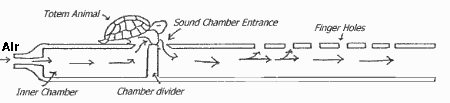
I f you are composing for this instrument and prefer natural acoustic-only flute, that’s great. But if you do a thoughtful job of miking/pick-up and DSP processing a Native American flute as Nakai does, you can capture wonderful articulation and fingering and headjoint/totemic-aperture and breathing sounds from the instrument. Used judiciously, these can create textures conveying even greater chamber intimacy and accentuate the sense of you-me ‘duality’ that comes with the anhemitonic pentatonic scale.
W hat makes a tune pentatonic? This is like asking ‘How long is the coastline of Great Britain?’... It is of no consequence that the pentatonic scale happens to contain five notes; what really matters is the degree of dissonance it permits or excludes. ‘Auld Lang Syne’ is pentatonic [technically], but not all pentatonic melodies are so obligingly regular. ‘Na more utushka’ include an extra-pentatonic tone [more than 5 notes] but is nonetheless pentatonic. Not all modal skeletons are equally pentatonic. So it is quite possible to have two tunes, each making full use of all seven notes of a heptatonic scale, that are in fact ‘pentatonic’ to different degrees.”
— Peter van der Merwe, p. 38.

T he non-well-tempered scale of Native American flute presents both challenges and opportunities to composers. Most Native American flutes are tuned close to a Phrygian (iiim7) pentatonic scale (F#-A-B-C#-E)—set { 0 (1) 3 5 7 (8) 10 }. In jazz, the iiim7 is often a substitute for Imaj7. The root, minor third, fifth, and minor seventh of iiim7 substitute as the third, fifth, seventh, and ninth of Imaj7. The perfect fourth of the Phrygian scale works as the sixth of Imaj7. Pitch-bending puts some extra-pentatonic options within practical reach, including dissonant counterpoint, multiple concurrent melodies, and deliberate confusion of chromatic-vs-pentatonic polarity and Bartokian ‘mikrocosmos’/Lou Harrison-type effects.
[50-sec clip, R. Carlos Nakai, ‘Departure’ (Canyon Trilogy), 1.6MB MP3]
[50-sec clip, R. Carlos Nakai, ‘Embracing Darkness’ (Migration), 1.6MB MP3]
[50-sec clip, R. Carlos Nakai, ‘Obsidian Talisman’ (Talisman), 1.6MB MP3]
S even-times Grammy-nominated R. Carlos Nakai is of Navajo-Ute descent. Originally a brass player, Nakai took up flute after an early-1980s car accident caused permanent injury to his embouchure. Composer James DeMars and others have written and dedicated compositions for him. Nakai, while cognizant of the traditional use of the flute as a solo instrument, has from time to time extended his repertoire to include jazz and classical and new music. Nakai’s appearances in chamber orchestral performances have included Promusica Chamber Orchestra (Ohio; Timothy Russell conducting), Chicago Sinfonietta (George Hanson, conductor), and Nouveau West Chamber Orchestra (Arizona; Terry Williams conducting). He founded the ethnic jazz ensemble, the R. Carlos Nakai Quartet, to explore the intersection of ethnic and jazz idioms. Over the past 25 years, Nakai has performed with over fifteen symphony orchestras. He was a featured soloist on the Philip Glass composition, ‘Piano Concerto No. 2: After Lewis & Clark’, premiered by the Omaha Symphony. Nakai has his Master’s Degree in American Indian Studies from the University of Arizona.
I consider myself a traditional flutist.... Tradition is what people do now, rather than looking back at historic or romantic times. Our compositions deal with how we are as people today.”M r. Nakai will be performing on 25-JUL-2009 at the Native American Flute Music (NAFM) event “Native Voices with Keola and Moana Beamer” in Mt. Peale, Old La Sal, Utah (more information call 888-687-3253 or 435-686-2284). Note, too, that the 2010 INAFA annual convention will be held next year at the University of Wisconsin - Eau Claire from 14-18-JUL-2010, and Nakai will be one of the artists there as well.
— R. Carlos Nakai.
- R. Carlos Nakai website
- Canyon Records website
- International Native American and World Flute Association
- First Nations Composer Initiative (ACF)
- Native-American_flutes.com
- List of native american flute makers
- Nakai R. Talisman. (Canyon, 2009.)
- Nakai R. Our Beloved Land. (Canyon, 2005.)
- Nakai R. Fourth World. (Canyon, 2002.)
- Nakai R. Mythic Dreamer. (Canyon, 1998.)
- Nakai R, Demars J, McAllester D, Light K. The Art of the Native American Flute. Canyon, 1997.
- Nakai R, Kater P. Migration. (Canyon, 1992.)
- Nakai R. Canyon Trilogy. (Canyon, 1989.)
- Diamond B. Native American Music in Eastern North America: Experiencing Music, Expressing Culture. Oxford Univ, 2007.
- Paquette D. Flute Dreams: Playing the Native American Flute. iUniverse, 2005.
- Vames J. The Native American Flute: Understanding the Gift. 3e. Molly Moon, 2007.
- van der Merwe P. Roots of the Classical. Oxford Univ, 2005.
- Nelson-Atkins Museum of Art (Kansas City), American Indian Art Collection (curator, Dr. Gaylord Torrence, Prof. Emeritus of Fine Arts, Drake Univ)
- DuVal K. Life, Liberty and Benign Monarcy? NY Times, 02-JUL-2009. [American Indians participated on both sides of American Revolutionary War]
- Wein G. Native American composers. NewMusicBox, 08-APR-2009.
- Wilford J. Flutes offer clues to stone-age music. NY Times 24-JUN-2009.


