Showing posts with label microtonal. Show all posts

Sunday, December 5, 2010

Prepared Piano: Subtle Effects by Hacking DIY Nocks with Sugru® Silicone Rubber

Nocking points and tube applied to piano strings
S ometimes ‘less’ is ‘more’. For ‘prepared piano’, you don't necessarily need to throw all sorts of heavy hardware, and car keys, bolts, screws, weatherstripping, and other violent junk into your piano and treat your piano like a percussionist’s rubbish bin.

F or one thing, the piano suffers. For another thing, the sonic consequences are just too extreme, and draw the audience’s attention to the performer and to the outrageous thing the performer has done to the piano, and detract from the audience’s actually listening to the music that the prepared instrument makes. Sometimes, instead of a visual ‘spectacle’ or sonically ‘provocative stunt’, the comparatively subtle acoustic effect you want can be gotten just by inserting some tiny objects that are gentle to the piano and that can be as easy to apply and remove as, say, a mute on a violin or other stringed instrument is easy to apply and remove.

T he do-it-yourself widgets below don’t ‘mute’ anything though. They dramatically change the pitch of each string they are applied to—from a few tens of ‘cents’, up to as much as a major sixth.

A nd you can’t create this sort of note-by-note harmonic effect with Pianoteq® or other synths; those establish harmonic attributes globally, applying them across the entire keyboard, not note-by-note.

F irst get yourself some Sugru®. It comes in a wide variety of colors, not just the orange that appears in the pictures here.

N ext, get yourself some 5 mm OD brass tubing and 5 mm OD brass archery nocking points (see links below). Also get yourself some 22 AWG copper wire, or whatever convenient gauge is slightly smaller than the diameters of the various piano wires where you intend to place the nocks.

T hen with your Dremel® handtool fitted with an abrasive saw (circle disc), cut your brass tubing to the lengths you want.

I  have used tubing lengths from 30 mm to 70 mm to create weights ranging from 3 gm to 7 gm. For strings in the bass register, obviously you can use larger-diameter brass tubing.

E ach Allen Co (Broomfield CO) nocking point (Part No. 540) weighs about 400 mg when its lumen is filled with Sugru® silicone rubber.

N ext, cut one lengthwise slit in the side of each segment of brass tube with the Dremel® handtool.

C ut pieces of copper wire with a wire cutter or snips, about 2 cm longer than the length of each brass tube or nock. Use a needlenose pliers to put a crook or loop in one end of each wire, so you will be able to easily grasp the wire between your thumb and index finger, and so you will also have a loop by which to hang each piece up in a safe place while the Sugru® cures. Alternatively, you can get a piece of florists’ foam or styro at a hobby shop and stick the straight end of the copper wire into it after the nocks have been penetrated by the wire.

L ay all of the brass bits and archery nocking points and copper wires out on your worktable on a piece of plastic or a plastic kitchen cutting board. This will faciliate clean-up and prevent the Sugru® from smudging any surface you care about.

O pen a 5 gm sachet of Sugru®. Roll it around in your fingers for a few seconds. It has the consistency of soft modeling clay at this point.

Y ou can press the Sugru® into the lumen of a brass bit with your fingers and trowel it nice and even with an artists’ spatula.

T hen take a copper wire of the length appropriate to that brass bit and gently push the straight end of the wire lengthwise through the Sugru® in the center of the lumen. The copper wire adheres to the fresh Sugru® a little, but you can easily poke the wire through, so that a centimeter or so of bare wire sticks out beyond the end of the nock/tube. Hang the wire with the Sugru® nock/tube (or insert the straight into florists’ foam) in a safe place where it can remain undisturbed for at least 24 hours.

C ontinue, filling each of the brass bits and penetrating their centers with the copper wires. Set your collection of Sugru® piano nocks aside in a cupboard—someplace at about 20°C (68°F) and away from sunlight.

F or your convenience, make a 5 mm ball of Sugru® and set it aside in the same location with the rest. Wait at least 24 hours for the Sugru® to cure. Pick up the 5 mm Sugru® ball and squeeze it. If it is firm, then you know that the curing process is complete and it is okay to proceed with the next step.

T ake a razor blade or X-acto® knife and cut radially, directly down to the copper wire. Mount each in turn in a PanaVise® or other suitable holder and slice the silicone in the lumen lengthwise, to enable the nock/tube to slide onto a piano string. Then gently rotate the copper wire loop clockwise and anticlockwise 45 degrees or so, to release the wire’s surface from its attachment to the Sugru® silicone. Pull lengthwise to extract the copper wire out of the silicone rubber hole it’s been embedded in. Use your X-Acto® knife to trim any excess Sugru® from the slit or the ends of each nock/tube.

Slicing silicone in nock core with X-Acto knife
H ere is how the Sugru®-filled brass tubes and bow-hunting archery nocking points look:

5 mm OD brass tube filled with silicone
Allen 540 nocking point filled with silicone
A nd the picture at the top of this post is how they look when you push the nocks and tubes on, their slits going over the piano wires so that each piano wire is seated in the center, in the cylindrical ‘cast’ made by the copper wire.

O n notes that have 2 or three strings, if you apply a tube or nock to one of the strings, you will create a sound where the weighted string is significantly lower in pitch than its companion string(s). In the upper register, my 3 gm to 7 gm tubes make the notes sound like Chinese bronze bells with the nipple-like bosses.

Zhou Dynasty bronze bell with bosses
Y ou can slide the weight close to the middle of the string and it will mainly lower the fundamental and second harmonic of the string. If you move it nearer to the end of the string, it will lower the third and higher harmonics much more strongly.

I ’ve created a little Excel spreadsheet (link below), which helps you to calculate how much detuning you can expect as a function of changing the average mass of a string by adding weight to it. Obviously, this simple spreadsheet does not tell you anything about how the higher-order harmonics change, given that the weight is localized in a particular position on the string, not spread over its entire length.

P lease add comments below or email me to comment on your experiences with these Sugru® prepared-piano kluges.


Saturday, October 2, 2010

Feltsman: Temperaments of Discovery

 Vladimir Feltsman V ladimir Feltsman’s performance in the concert that opened Friends’ of Chamber Music new season was powerful and moving. Besides this, he illuminated dimensions we hadn’t realized existed in these pieces.

  • Mozart - Fantasia in D Minor, K. 397
  • Schubert - 4 Impromptus, Op. 90, D. 899
  • Liszt - Sonata in B minor, S. 178
I  found the Liszt sonata especially engaging.

I  imagine what it might’ve been like to start with blank sheets of manuscript paper and compose this sonata... You have a thought, privately. You think about the idea; it seems interesting. It’s a new thought. At least, it’s an interesting one—interesting enough for you to write down. And it rapidly leads to other thoughts.

Y ou come back to the original thought a moment later, or several minutes later. It still is novel, interesting. You mull it over and see how it connects to other thoughts, in odd, ironical, happenstantial, stimulating ways. An oddly ‘self-referential’ thought—about you, and about your habit of thinking, privately, pianistically. A thought about a self having a thought and thinking about itself thinking, while connected to a piano.

B ut the thought calls into question who exactly is the self who is referring to itself. About how it is that we remember who we have been and are able to retrace the trajectories of how we felt about things an hour ago or yesterday or the month before. About how it is that we speak to ourselves and carry on these inner dialogues. And who is this piano I am connected to? Its personality is here, too!

A   h, it was the great Liszt who listened, listened to his inner voice. They said he was ‘inspired’. But he was simply listening to himself.”
  —  Vladimir de Pachmann, on pianistic originality.
A nd you are furiously writing your ideas down. It just happens to be music. The original thought was not that difficult or monumental a thought—not ‘heroic’ anyhow. If anything, it was kind of an ‘organic’ thought, like something you just happened to find and decided to keep, or something that sprouted as a ‘volunteer’ in your garden and you watered it and it happened to grow exuberantly.

T hat’s the sense I have of this Liszt sonata, S. 178. And it is how I experienced Vladimir Feltsman’s performance of it tonight.

H e has played this piece—for many years—and there was still more to discover in it, last night, in Kansas City.

T here’s a tremendous amount of experimentation and exploration in this sonata, trying different ideas on “for size” and testing them.

I t’s something. Some expressions in it are almost anticipating... Late Modernism? Complexities of, maybe Ferneyhough; maybe Rzewski; others? Sort of like reinventing virtuosity without the heroism. Or a hero who is inadvertently a hero, who denies being brave and says he/she just ‘lived’.

C learly, Vladimir Feltsman likes this piece. It is a piece of music that asserts that solo piano music is mostly individualistic performance art. The score feels like an improvisational essay, less prescriptive than previously taught; the composer’s narrative is not the putative narrative but instead—How could we doubt it?—the performer’s own. Vladimir likes this about it.

W    ith Liszt we have a bold navigator who throws himself into the sea with his boat and sail... who seeks his route in the stars of the sky, but if the sky gets cloudy... M. Thalberg, for his part, carries a compass.”
  —  Review of Liszt performance, Le Monde, 29-JAN-1837.
V ladimir Feltsman does carry a highly precise compass. And an old-school sextant; and his precise chronometer. But it is bad form to obsessively look at any damned compass, or watch, or sextant. It’s blue-water sailing; you came here to be away from the shore and to not see anything but water and sky for long stretches of time, and to see what happens. You will take your sights and do your celestial nav and re-plot your course at the appointed times. But you will not be ruled by your tools. You’re here to experiment, to take risks, to discover things.

I    have been continuing writing in proportion as ideas come to me, and I fancy I have arrived at last at that point where the style is adequate to the thought.”
  —  Franz Liszt, Letters (coll. & ed. La Mara, tr. Constance Bach), 1894, Vol. 1, p. 130.
I s his route exhaustively planned in advance? Or is each journey, each performance, one of deep discovery? Last night, Feltsman displayed no worries about “clouds” or uncertainties. They are part of the challenge, part of the expressive/interpretive attraction that a piece can have. Part of his native Russian mien...

L iszt’s chromatic gestures aggressively explore what the colors can do—to himself, to the performer, to the audience... And then I wonder: What tuning (temperament) was used on the piano Liszt composed this on?

A n augmented second—look at measures 740-744 of this sonata—enharmonically equivalent to a minor third in modern equal temperament, but it is not the same interval in other tunings. In any tuning close to quarter-comma meantone it will be close to the 7:6 ratio of the septimal minor third. What colors was Liszt listening to? And Vladimir: has he experimented with playing this sonata in a well-temperament instead of equal temperament?

 Liszt, Sonata in B minor, S. 178, measures 739-744, score at IMSLP S o, if twelve-tone equal temperament was just emerging in Liszt’s time and various well-temperments were still in-use, then maybe some of his pianistic ideas in this sonata may indicate his ongoing fascination with them, his explorations of them—what they allowed, what they mutated beyond recognition, what they (including equal temperament) ‘forbid’.

O    ne can confidently assert that, with the single exception of the harp, no modern instrument ... has been so radically altered in conception as the piano. The techniques presently applied to this instrument are poles removed from conventional keyboard methodology. It is not that the piano has become even more solidly entrenched as a percussive instrument, but rather that today’s experimental composers have a thorough awareness of its tone-color potential.”
  —  Hugh Davies, ‘Instrumentation & Orchestration’, New Grove Dictionary of Music and Musicians, Vol 12, p. 401 (2001).
W as this piece composed on a piano that had departed from the well-temperament of Liszt’s youth? (The late Owen Jorgensen [Jorgenson O. Tuning the Historical Temperaments by Ear. Northern Michigan Univ, 1977, p. xii] evidently thought so.)

O n some days—on some piano tunings; on some particular instruments—the harmonic “waters” of an augmented second could seem optimistic and azure-colored. And on other days the same interval was mysterious—glowing an ominous aquamarine, with flashes of nervous herring swimming fast just under the surface. And not for no reason. A toothy predator pursues them. S. 178: emphatic, violent passages interspersed with serene, azure ones...

E qual temperament is, as they say, like an architect’s drawing: prescriptive; precise; every detail laid-out explicitly. Well-temperament is... an impressionist artist’s painting. So much is implicit; liberties are being taken. Equal temperament is this singular “color” or “in-tuneness” for all like intervals; well-temperaments instead give you a shocking palette of diverse harmonic hues. The “character of the keys” and differences in modulation make for color changes that just don’t arise in equal temperament. Was S.178 part of Liszt’s experiments with voicing in well-temperaments on the eve of equal temperament?

W here is his lab notebook containing his results? Some pianists emphasize the ‘text’ they are performing and exercise their pianos’ notes, their tuning. By contrast, Feltsman explores the “voicing” of this piano, as though it is a witness to be interrogated. This one could be reliable and it could provide valuable evidence. Or it could be a perpetrator.

T he piano technician has made all the notes very even and the sound as clear as possible in each register. Feltsman finds out ‘whose’ voice it is that is in there. He knows whether or not they are lying or holding back. He makes the piano confess things. Beautiful, true things.

C harles Smith wrote a famous article on “extravagance” in composing. He said that chromaticism is a “convergence” of harmonic and contrapuntal motion. S. 178 is nothing if not extravagant. And wild, wild harmonies and counterpoint, converging and then diverging again.

T his sonata is so full of convergences—the measures 740-744 are among the tamest of them... enharmonic reincarnations of harmonic colors... The convergences make me wonder about the narrative ‘overload’ of the piece.

R ichard Bass at UConn (link below) examined how half-diminished sevenths unhinge us. Our minds expect them to be the product of sensible counterpoint, but then they do something out-of-character (in contexts other than viiϕ7 or iiϕ7). Their alibi is not really plausible; it’s too emphatic, too aggressively ‘testamental’ for its own good. It means something, but we can’t be sure what, exactly. We can’t entirely trust it.

I    f you transported a pianist from 30 years ago and had him/her play on one of the mellower-sounding pianos we’re voicing today, he wouldn’t like it because he wouldn’t think it sounded aggressive enough.”
  —  Sibin Zlatkovic, expert piano voicer.
T he #2 is a regular element in dominant sonorities and is not without its usual dramatic purposes and emotional tension (Smith, p. 124). But here in this measure, #2 is a perpetrator infiltrating an otherwise law-abiding chord, doing something nefarious probably, impersonating a minor third or even a diminshed third, depending on the way the piano is tuned—starting some kind of trouble or other, probably; covering its own vulnerability, certainly—and demanding that we have now a major-triad resolution, okay?

F eltsman has just the sort of temperament to love this kind of suspense and color and ‘lurking microtonality’, and he is just the experimental sort to reanimate it and show us how curious and lovable it is.

U ltimately, Liszt’s Sonata in B minor, S. 178, will forever be too difficult for my amateur fingers, but that doesn’t mean that I would be able to banish the piece from my dreams.

I n fact, if a piece is totally beyond my ability to attempt it, like this one is, I tend to become fascinated with studying the score, with playing the bits of it that I can manage—with playing and re-playing those bits to hear their voice. I try to see what they do and how they work. (My apologies to my wife for what this racket sounds like.) It leads me to questions and discoveries—to things that are new for me, at any rate. It amuses me to think that maybe even Liszt pottered about like this, in a microbial manner, on his way to discoveries that he then wrote down and fashioned into this epic, experimental piece.

 Augmented second in different tunings


Friday, July 3, 2009

Native American Flute and How We Are As People Today

 R. Carlos Nakai
O    ur primary importance as musicians is trying to tell people that history can’t be changed, but the future can be. Personally, I feel I should try to contribute something that would encourage people to change, to become more positive about our situation, to reorganize and reorient ourselves together instead of continuing to build walls.”
  —  R. Carlos Nakai.
K  athleen DuVal had a piece in the New York Times yesterday, meditating on the U.S. July 4 holiday and the meaning of the American Revolution. In it she mentioned the diversity of Native American cultures and the fact that different American Indian tribes had participated in the War, with different motivations, on both the British and the American sides.

I  got to reminiscing about my own friendships with Indians... the several Ojibway (Chippewa, Ojibwe, or Anishinabe) and Cherokee and Abenaki who have been coworkers with me at various times in my professional life; my interactions with Tlingit people in 1991 and 1993. One Abenaki, Dr. John Flickinger, is an accomplished flutist. It was he who introduced me to the music of R. Carlos Nakai in 2001.

N  akai, a fine composer and performing artist, creates a pentatonicism that is alternately relaxed or taut—the acoustic ‘image’ that his music projects is “aesthetically naïve or minimalistic, but not technically naïve.” The melodies are restricted to a pentatonic collection, but the accompanying harmonies—while still overwhelmingly consonant—are quite sophisticated. Besides this, a simple pattern of repetition is seen in the sequence of phrases: a, a', b, a", c, etc.

 Pentatonic F# scale (iiim7)
A  Nakai phrase “A” occurs two or three times, while phrases “B” and “C”—although creating contrast—are still modeled very closely on phrase “A”. Every phrase contains a ‘reciting’ tone, and exhibits characteristic melodic figurations, such as ‘lower-neighbor motion’ that occurs at the beginning of a phrase. Nakai’s embellishments are also devised in ways such as will convey “aesthetic naïvete” or naturistic gestures, but are not in any way technically naïve.

T    he PF-Series Ken Light [Amon Olorin] ABS plastic flutes ... I have found these instruments to remain in-tune through extended playing and in varying environmental conditions that would limit the performance capability of the one-of-a-kind and more expensive wooden models. The PF-Series flute is well suited to double and triple tongueing passages and responds excellently to varying embouchure dynamics. The clarity of the pitches and the extended range of the PF-Series flute enables more varied performance and collaborative possibilities. Compositions for performance by more than one flute are now readily accomplished without the idiosyncratic eccentricity and tunings of similar hand-made flutes. Wood is a living and changing material whereas the PF-Series flutes are exact in many ways. The PF-Series flute marks another achievement in attaining the very best in reliability practicable without question. Now, I limit the hand-made flutes to special performances and use the PF's for extended work either in rehearsal, studio projects, or in long ensemble performances where time is of the essence. I highly recommend the PF-Series flute for beginners, students, teachers, and professionals alike and the enjoyment of working with a reliable, extremely versatile, affordable instrument will only add pleasure in expressing yourself in the language of music.”
  —  R. Carlos Nakai.
T  he quarter-tone and pitch-bent microtonal features of Native American offer a number of possibilities for new-music chamber works... Besides the interesting and varied timbres it has, Native American flute and its microtonal possibilities can add dramatic natural tension, stasis-free and open-ended, with emotionally-evocative, clearly-tenuous resolution. And compared to some other woodwinds, it’s relatively easy to reliably produce and control quarter-tones on Native American flutes.

 X
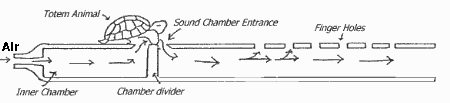
I  f you are composing for this instrument and prefer natural acoustic-only flute, that’s great. But if you do a thoughtful job of miking/pick-up and DSP processing a Native American flute as Nakai does, you can capture wonderful articulation and fingering and headjoint/totemic-aperture and breathing sounds from the instrument. Used judiciously, these can create textures conveying even greater chamber intimacy and accentuate the sense of you-me ‘duality’ that comes with the anhemitonic pentatonic scale.

W    hat makes a tune pentatonic? This is like asking ‘How long is the coastline of Great Britain?’... It is of no consequence that the pentatonic scale happens to contain five notes; what really matters is the degree of dissonance it permits or excludes. ‘Auld Lang Syne’ is pentatonic [technically], but not all pentatonic melodies are so obligingly regular. ‘Na more utushka’ include an extra-pentatonic tone [more than 5 notes] but is nonetheless pentatonic. Not all modal skeletons are equally pentatonic. So it is quite possible to have two tunes, each making full use of all seven notes of a heptatonic scale, that are in fact ‘pentatonic’ to different degrees.”
  —  Peter van der Merwe, p. 38.
 Improvisation on iiim7
T  he non-well-tempered scale of Native American flute presents both challenges and opportunities to composers. Most Native American flutes are tuned close to a Phrygian (iiim7) pentatonic scale (F#-A-B-C#-E)—set { 0 (1) 3 5 7 (8) 10 }. In jazz, the iiim7 is often a substitute for Imaj7. The root, minor third, fifth, and minor seventh of iiim7 substitute as the third, fifth, seventh, and ninth of Imaj7. The perfect fourth of the Phrygian scale works as the sixth of Imaj7. Pitch-bending puts some extra-pentatonic options within practical reach, including dissonant counterpoint, multiple concurrent melodies, and deliberate confusion of chromatic-vs-pentatonic polarity and Bartokian ‘mikrocosmos’/Lou Harrison-type effects.


    [50-sec clip, R. Carlos Nakai, ‘Departure’ (Canyon Trilogy), 1.6MB MP3]


    [50-sec clip, R. Carlos Nakai, ‘Embracing Darkness’ (Migration), 1.6MB MP3]


    [50-sec clip, R. Carlos Nakai, ‘Obsidian Talisman’ (Talisman), 1.6MB MP3]

S  even-times Grammy-nominated R. Carlos Nakai is of Navajo-Ute descent. Originally a brass player, Nakai took up flute after an early-1980s car accident caused permanent injury to his embouchure. Composer James DeMars and others have written and dedicated compositions for him. Nakai, while cognizant of the traditional use of the flute as a solo instrument, has from time to time extended his repertoire to include jazz and classical and new music. Nakai’s appearances in chamber orchestral performances have included Promusica Chamber Orchestra (Ohio; Timothy Russell conducting), Chicago Sinfonietta (George Hanson, conductor), and Nouveau West Chamber Orchestra (Arizona; Terry Williams conducting). He founded the ethnic jazz ensemble, the R. Carlos Nakai Quartet, to explore the intersection of ethnic and jazz idioms. Over the past 25 years, Nakai has performed with over fifteen symphony orchestras. He was a featured soloist on the Philip Glass composition, ‘Piano Concerto No. 2: After Lewis & Clark’, premiered by the Omaha Symphony. Nakai has his Master’s Degree in American Indian Studies from the University of Arizona.

I    consider myself a traditional flutist.... Tradition is what people do now, rather than looking back at historic or romantic times. Our compositions deal with how we are as people today.”
  —  R. Carlos Nakai.
M  r. Nakai will be performing on 25-JUL-2009 at the Native American Flute Music (NAFM) event “Native Voices with Keola and Moana Beamer” in Mt. Peale, Old La Sal, Utah (more information call 888-687-3253 or 435-686-2284). Note, too, that the 2010 INAFA annual convention will be held next year at the University of Wisconsin - Eau Claire from 14-18-JUL-2010, and Nakai will be one of the artists there as well.