Showing posts with label iconoclasm. Show all posts

Saturday, January 15, 2011

James Mulcro Drew and the Creation of Meaning

James Mulcro Drew, photo ©2005 by Kelly Drew Baskett
S   ome years, ago I addressed an audience at an International Webern Society Festival ... The point of my talk was that although Anton Webern was a renowned master, his influence created a ‘dead end’ for countless academic composers who didn’t really know earlier traditions very well, let alone understand Webern’s immense steps. The ability to count to 12 was of no value whatsoever. That was not where the Music was... I was designated a controversial speaker, but no one disagreed with my assessment, as far as I know. When I finished my talk, there was total silence—until George Rochberg yelled out, ‘I think they believe you, Jimmy.’ Organization alone is not a sufficient condition to create a symphony or a painting or any kind of Art work. Somewhere behind the resonating shapes, textures and temporal connections, exists the Music. The task of any artist is to find something that has personal meaning, something to Believe in—that’s the beginning. This has nothing to do with style. It has to do with flashes of light and with contemplation.”
  — James Mulcro Drew, Intention in the Arts, 2009.
A  fter God was assumed to be dead and no one any longer seemed to be in control, the new twentieth century, with the bang of World War I, was well on its way to what was soon to be a series of disastrous human errors. Certainly it is common for both individuals and nations to engage in competitive rhetoric of a political or artistic nature, but the breakdown, instead of the strengthening, of values that occurred in the nineteenth and twentieth centuries, an age of spiritual disinheritance, was a collapse characterized by a kind of tittering hysteria... But, to confuse matters even further, the same general philosophy somehow managed to be understood, by many, as representing a ‘modern’ point of view and, therefore, sowing the seeds that equate ‘modern’ with the idea of ‘meaningless.’ The modernness of Monteverdi was not based upon meaninglessness, nor are the black paintings of Ad Reinhardt ‘meaningless.’ Meaningless needs no explanation, but the term ‘modern’ is another matter. Modern is anything that makes us feel new or renewed... As Eliot pointed out, ‘I can make nothing with nothing.’ Art, however, is dangerous—dangerous because, if its subject matter is crucial, it will reflect a doctrine of moral values and therefore will pose a threat to other ideologies. The moral and ethical battle in Art continues. The existential crisis, to quote Lloyd Rodgers, is yours.”
  —  James Drew, liner notes for Mirecourt Commissions CD, 1978.
J ames Mulcro Drew, beloved contemporary composer, died on 23-DEC-2010, aged 81, following a brief illness. He studied with Wallingford Riegger and Edgard Varèse and subsequently taught at Northwestern University, Yale University, UCLA, Cal State, and other institutions. He performed with and co-founded several musical groups, including Crossfire Mission Orchestra in the 1960s in New Haven, Connecticut. Drew combined superb technique and earnestness with humor and insight, to create a variety of original works that will last.

D rew’s style included subtle tonality and voice-leading, along with innovative figures that are challenging and, at the same time, illuminating to play. His contributions and honesty are perhaps most vividly remembered by his students, who experienced Drew’s energetic pedagogy first-hand. His enthusiasm was absolutely remarkable. Music was not a ‘subject’ to be ‘taught’; teaching music was something you did, in an up-close participative way. Nowhere to hide, you must own who you are.

I n a way, Drew’s prescience—his gravitation toward unusual topics and his investment of tremendous personal energy in them, years before other of his colleagues could grasp the point of it and decades before the topics grew to be popular—and his deep interest in Nature and in physics were characteristic features of his personality, ones that propelled the fascination that he held for many of his friends. The compositions of ‘Animating Degree Zero’ (link below) were manifestations of those life-long tendencies.

I n this respect, Drew was not unlike one of my old teachers, Rufus Lumry, a physical chemist at University of Minnesota, who intuited the importance of ionic liquids back in the late 1970s, long before the subject changed from a small, academic curiosity into a vibrant and popular industry.

E ven in his later years, Drew kept pace with the fast-moving areas his innovations had helped to create. With such prodigious activity comes a lot of fatigue and a lot of hype. But with it too comes a peculiar, memorable, enviable brand of perpetual youth. He will be greatly missed.

I   nsisting that the meaningfulness of a work of art depends on its having been created exposes us to an objection: Surely, it may be suggested, the meaningfulness of a work of art can only depend on its having been created if what is there to be understood is the reason why it has been created as it is. That is, we will be driven to suppose that the meaning of a work of art is to be explained (1) by explaining the intentions of the artist or (2) by explaining the historical circumstances which gave rise to the work, and which the work may be understood to express. It may be very useful for understanding the life and mind of the artist to work out her intentions, and it may be important for understanding the history of a period to understand what is shown in a work about the circumstances of its production, but neither of these things—the objection goes—is understanding the work of art itself. As it happens, [to a degree] I agree with the objector... [but] the crucial point is that, at the time of the creation of any given work of art, there are properties of the medium which are there independently of the intentions and beliefs of the would-be creator.”
  — Michael Morris, Doing Justice to Musical Works, in Philosophers on Music, 2010, p. 67.

Mirecourt Trio CD


Wednesday, June 24, 2009

Adina Spire: Music of Universal Devotion, Protest, Ecstasy

 Adina Spire
D    ark brightness’... the music of a contemporary Romanian gypsy girl... Born in Romania in 1977, Adina Spire is a classical composer of sacred music for Catholic and Orthodox liturgies. An attempt to put any interpretation on her music has to make references to the mysterious Romanian old culture and the context of recent history... The context of Adina Spire’s compositions is the 1989 the revolution of Romania against the totalitarian government and the suffering of the people during the subsequent civil war—including the Adina’s own suffering as a little girl, suddenly orphaned and displaced to the orphanage associated with a monastery near Arad. Her music dwells on a complex of interrelated themes: grief, fear, solitude, vigil, memory, nostalgia, innocence, sensuality, intolerance, protest, violence—each piece approaching this view from a different angle, insistent upon perfecting a coded way of talking about something either unmentionable or impossible to express... This is ‘rebel’ music—the protest of the soul against soullessness, of the poor and defenseless against unfeeling poverty and aggression and intolerance.”
  —  Institutul Cultural Român, 2009.
A dina Spire’s music is brilliant—evocative, lyrical, and incisive. Intensely political. It is also ‘doctrinal’—expressing doctrines of the once-and-future displaced, disenfranchised, and disabused... each note now aspiring to live.


    [50-sec clip, Adina Spire, ‘Kontakion’, 1.6MB MP3]

M any of Adina’s compositions are calibrated by Romanian tradition and informed by Orthodox liturgy or explore notions of religious practice and the Divine. But her vision is delocalized from her native Romania and draws upon materials that are pan-European and span a period from Medieval times up to the present.

T he very old ‘borrowed’ elements and the instantaneous ‘ambient’ elements mingle and give rise to a fantastical sort of ‘bricolage’ that calls into question the very concepts of time and civilization. In a manner similar to Jorge Luis Borges stories, Adina’s compositions can make you wonder whether human history—any of it—is to be trusted. This disorienting effect can be both beautiful and moving.

A dina Spire is a teacher at the conservatory in Arad, Arader Musik Conservatorium. She is also an accomplished conductor and cellist.

T he example MP3 clip above is representative of her modus operandi—generating new expressions from materials that are simultaneously familiar and exotic, archaic and radically new: her compositions are, like Kontakion, invariably novel and surprising. The execution is passionate, with deeply-felt flourishes. Adina’s music suggests Renaissance or Baroque performance practices of elaborating from the written music, and it is hard to know where Adina’s score leaves off and the performers’ ‘improvvisaziones’ begin.

A    dina Spire’s ... harmonic and dynamic designs reflect a paradoxical vision of intense feeling behind a frozen and fearful facade. Thus, tempos are mostly so slow as to give the impression of motionlessness, an effect sustained, even when short note-values are in play, by the use of small and very simple progressions, tense pedal-points, and agonized suspensions.... In parallel to orthodox modulation, the composer cuts abruptly between keys or slowly dissolves one chord into another by accumulating their pitches into blurred clusters. Since the tonic at any given point in Adina Spire’s score is a disputed issue (often brusquely dictated by the orchestra, often completely absent), these arpeggio-clusters—which have their precedents in the cinematographic soundtrack genre of terror movies—also amount to significant polytonal ambiguities in themselves... At the level of general design, Adina Spire works repeatedly with extreme contrasts between moments of tonal delicacy and cataclysmic avalanches of atonal sound... Spire’s three-dimensional orchestration scores and interpretations are intrinsic to these gradual transitions, tone-colour in what amounts to a quasi-cinematographic conception of timbre as light and sound positioning as ‘viewpoint’.”
  —  Institutul Cultural Român, 2009.
I n the case of this example, ‘Kontakion’ (Greek: κοντάκιον) is a kind of hymn that has for many centuries been performed in the Eastern Orthodox Church. The Greek word is ‘kontax’ (κόνταξ), a ‘pole’—specifically the pole around which a sacred scroll text is coiled. The term describes the way in which the words on a scroll unfurl as the scroll is read in worship. The word ‘kontakion’ originally referred to a Byzantine poetic form, whose origins date back as far as the 6th century CE or probably earlier. Based in Syriac hymnographical traditions that underwent mutations in Greek-speaking Byzantium, it’s really a “sermon in verse accompanied by music”. The meter and music accentuate the rhetorical beauty of the speaker’s meditation.

A  Kontakion is fundamentally a ‘funerary’ form—usually comprised of 18 to 24 metrically identical stanzas called oikoi (“houses”), each preceded by a short prelude (in a different meter), called a koukoulion (“cowl”). If the ‘cowl’ is, say, in a duple meter, then the ‘house’ may be in triple meter. The first letters of each of the stanzas form an acrostic, which frequently includes the name of the poet... not unlike, say, J.S. Bach and his fascination with numerology and acrostics (e.g., incipits that spell out B-A-C-H). The last line of a Kontakion prelude introduces a refrain, which is repeated at the end of all the stanzas. The stanzas are not unlike Baroque chaconne or passacaglia or ‘folia’ forms, with their dozens of variations that obsess upon a theme until the point of ecstasy or emotional transcendence.

T his Kontakion by Adina Spire has reverential yet aggressive aspects to it. It is contemplative, brooding—as is fitting for a ‘Hymn for the Dead’ or requiem. But it’s also punctuated with explosive electroacoustic effects. Listen carefully. Are some of these recorded segments played backwards, reversed tracks? Maybe so. What we have is a delirious mix of ambient-aleatoric material with Baroque variations. (I pull my copy of Robin Stowell’s book from the shelf, look at p. 140.)

I n the midst of the ambient-aleatoric edifice that’s going up, we hear... the cello playing a version of ... ‘La Folia’? The ‘La Folia’ meter is either in 1 [4+2] or 3, depending on what era you're speaking of and depending on whether the ‘La Folia’ performance was a vernacular music of common people or was instead a co-opted, stately dance of the aristocracy. Its chord progression is the ubiquitous/eternal i-V-i-VII / III-VII-[i or VI]-V / i-V-i-VII / III-VII-[i or VI7]-IV[4-3sus]-i.

R encontre entre la tradition de la basse obstinée du 17e siècle et le jazz, sur fond d’improvisation et de plaisir pur?

F olia’ is pronounced “foh-LEE-ah,” conventionally thought to mean ‘crazy’ or ‘empty-headed’ or ‘revelrous’. But is this correct? Well, no, not really. It seems to have been uncritically repeated in the musicology literature, by non-Iberians who neither know Portuguese nor have any deep understanding of the politics of 16th-Century Iberians who likely were the originators of ‘La Folia’.

I t’s a sort of hemipedalian waltz that carries the feeling of lament with a slow, percussion-marked processional feeling—not a jolly dance, really; more like a reckless PTSD dance of refugees and casualties from a war—like Adina. Yes, the ‘folia’ was a musical framework used during the Baroque period for songs, dances and sets of variations. But the early versions embody, I think, a valedictory spirit ... of the Portuguese who were busy fighting and eventually defeating the Moors? It is an aesthetic that acknowledges the real possibility of premature, sudden death—the unpredictability of troubled times. It is ‘mannerist’ and ‘historical materialist’ in outlook.

I n other words, ‘La Folia’ bears the same aesthetic ‘marks’ as the epic and autumnal ‘Tarantella’—furious, ecstatic dancing in defiance of fate and death. Its rollicking is not orgiastic but reckless in its psychological regressiveness. I could die tomorrow, as could you... as did he.

I n 1611, Sebastiàn de Covarrubias (Tesoro de la lengua castellana) described the folia as a Portuguese dance, very noisy, performed with tambourines and other instruments by disguised street-porters carrying young men dressed in women’s clothing on their shoulder. He said nothing about moroseness... it is a defiantly celebratory requiem dance. Have a look at the books by Hauser and Maniates.

T he musical design of a 16th or an early 17th-century folia consists of an upper melodic framework (although the precise melody varies) and a lower staff that yields a simple continuo accompaniment. The opening two beats of anacrusis are sometimes omitted, but in any case the first accent always falls on the V chord. The stroke pattern continually emphasizes 3/4 meter, but both the melody and the harmonic changes often oscillate between 3/2 and 6/4—as seems to be the case in Adina Spire’s ‘Kontakion’.

T hen in the 1670s the ‘folia’ was co-opted by the aristocracy and was mutated into a slow and stately dance, akin to a sarabande. All second beats still were dotted... the prominent secondary ‘folia’-type accent.

W hat is so special about this tune? Why has it been borrowed so extensively, by many western composers over the past 500 years?
  1. Does its appeal derive from its satisfying human beings’ love of rhythmic ‘balance’ and harmonic ‘parity’ among multiple parts? The fact that ‘folia’ form has a high degree of symmetry and equitable harmonic layering suggests that this might be so.
  2. Does ‘folia’ embody some hard-wired pattern that our brains have evolved to prefer? It even sounds familiar when you have never heard the piece before.
  3. Is its perennial popularity a consequence of a peculiarly wide latitude that the ‘folia’ chord progression affords for textural adaptation and variations? La Folia form provides lots of freedom because there are no fixed numbers of variations to complete nor has there to be any structure between the variations. Vamp away!
  4. Is ‘folia’ popularity driven by politics? Consider the social phenomenon that the ‘folia’ had its roots in popular ‘rebel’ culture and developed into a stately court dance but, more than this, a vehicle for courtly flirtation. Consider, too, that in some cultures it was a funerary piece or requiem but in other cultures was primarily a fertility dance for the people. The ambiguities enable all sorts of interpretations, all sorts of transgressions.
  5. Is ‘folia’ popularity a Richard Dawkins-like ‘selfish gene’, popularity that begets more popularity and repetition/borrowing? A tune that we grow up with, and that each composer grows up with—strongly associated with culture and personal memories—and this is what invites yet more borrowing?
T he performer needs to be aware of the transformations of the basic four-note subject. Not only does the subject repeat almost relentlessly, but it’s restated and transformed in successive variations, in sixteenth and eighth notes. These segments divide the music into discrete sentences/statements. This approach generates ‘micro-pieces’ played one after the other. Kaleidoscopic!

L ike a chaconne or passacaglia or romanesca, the ‘folia’ form involves a short subject (usually four measures) that’s relentlessly repeated and varied... Symmetric thematic transformations of transposition, inversion, retrograde, and retrograde inversion. These are normally supplemented with diminution, augmentation, interpolation, fragmentation, octave displacements, and elision operations. The relentlessness of it is, I think, what lends the funereal aspect to what is otherwise (or can be) a pretty vigorous dance.

W hat we have here amounts to a kind of ‘multiple-encryption’. From the elements of a supposedly Orthodox liturgy, Adina Spire’s incorporation of symbolic components of secular origin enables her to protest recent political events and cultural trends. Conversely, from the notation of a supposedly ‘secular’ music Bach and other Renaissance and Baroque composers who ‘borrowed’ ‘La Folia’ encrypted texts of the Latin liturgy, we get [Bach's] customary incorporation of symbolically numbers of biblical origin that were significant in [Lutheran] doctrine (for example, Bach's multiform signatures, B-A-C-H, etc.). Hidden chorale citations embedded in the developing variations.

B    ach used antithesis, conceit and paradox to ‘instruct and familiarize the reader with basic concepts of faith in highly condensed form’. Also called paradoxa, a typical epigram included juxtapositions of passages such as ‘God wills that all men should be saved’ with ‘Few are chosen’ (1 Timothy 2:4 and Matthew 22:14)... With enigmatical notations such as ‘mi contra fa, concordia discors’, ‘cross/crown’, and ‘beginning/ending’, Bach associates his canons with a peculiarly Lutheran dialectic in which antithesis (what Augustine called ‘antinomy’) is a symbol for the cross of Christ.”
  —  Eric Chafe, Symbolum, p. 14.
D id ‘La Folia’ arise out of the valedictory spirit in Portugal, during and after the conflicts with the Moors in 1500s? Is this music a product of the same milieu that prompted Camões to write the epic ‘Os Lusíadas’? I find tidbits of evidence, for and against. I am unsatisfied with the facile accounts given and repeated uncritically in the musicology literature [which trivialize the history of ‘La Folia’ as ‘mad revelry’... as either a peasant dance or courtly dance], but I have not found (yet) anything definitive to support my conjecture of more serious origins of the tune--involving, say, political/aesthetic correspondences between ‘Os Lusíadas’ and ‘La Folia’.

 Camões, Os Lusíadas
T his beautiful ambient, aleatoric ‘Kontakion’ is wholly compatible with the epic, ecstatic, improvisatory, protestful, funerary idiom of ‘La Folia’. Adina’s decision to incorporate it here is, I think, brilliant.

T he compass of Adina Spire’s music cannot be adequately grasped in one reading. I have ‘read’ it and admire it and am excited about it to want to write about it here. I recognize that I have only so far scratched its surface, but I hope the ideas above may excite you to explore her work. Adina’s music is playful. It manages to be intensely political without being angry. Expect to read it with an attitude that questions the status quo—or even, say, the notion of ‘reverence.’ Discover ‘sacred’ music that respects reverential postures but asks you to critically reevaluate your reverential stance and the moral implication that reverence has for us as individuals and as societies. Very cool.

Therapeutic Tarantella: Bruegel the Elder, ‘Epileptic Women’
T    o prepare for [a friend’s funeral] service, I had been practicing the Chaconne every day — fussing over individual phrases, searching for better ways to string them together, and wondering about the very nature of the piece, at its core an old dance form that had been around for centuries. After the many times I had heard and played the Chaconne, I had hoped it would fall relatively easily into place by now, but it appeared to be taunting me. The more I worked, the more I saw; the more I saw, the further away it drifted from my grasp. Perhaps that is in the nature of every masterpiece. But more than that, the Chaconne seemed to exude shadows over its grandeur and artful design. Exactly what was hidden there I could not say, but I would lose myself for long stretches of time exploring the work’s repeating four-bar phrases, which rose and fell and marched solemnly forward in ever-changing patterns.”
  —  Arnold Steinhardt, Violin Dreams.


Saturday, June 20, 2009

Pre-verbal Music: Duo Stump-Linshalm’s Recording of Pierluigi Billone's 1+1=1

 Duo Stump-Linshalm
I    s it possible to approach music in silent [wordless] comprehension, without falling prey to human psychological, intuitive, irrational, spontaneous influences—i.e., those forms of comprehension engendered by words, text, speaking?”
  —  Pierluigi Billone.
P ierluigi Billone’s aleatoric work reminds me a little of Peter Eötvös’s and Ensemble Modern’s performance of Helmut Lachenmann’s ‘Schwankungen am Rand’ [Fluctuations at the edge]. Pierluigi had in fact spent some time studying with Helmut some years ago...

A    final angst-ridden attempt to strike water out of the stone of the dead monument known as [modernist] ‘music’.”
  —  Helmut Lachenmann, commenting on the aims of new music.
P lumbing the outer-limits of timbral space with each instrument. Sudden, explosive dynamics changes. Overblowing, harmonic-clipping and distortion of bass-clarinet reeds... wonderful, naturalistic colors. The harmonic palette is maybe a little like the songs of whales singing to each other, whales’ courting rituals...

T    he title of the work, ‘1+1=1’, is a quotation from an Andrey Tarkovskij film which points to the special relation between the two instruments [achieving a transcendent union by their playing together]... One drop plus another drop makes one larger drop, not two.”
  —  Petra Stump & Heinz-Peter Linshalm.
I t is impossible to know whether it is a ‘proper’ language with subjects, predicates, etc. But it has harmonic and lyrical and rhythmic features that (a) invite interest, (b) reward whatever interest and patience are sent its way, and (c) propel the interested listener to various kinds of meditation.

 Petra Stump, photo (c) Petra Stump
T    he variations that become part of instrumental technique through each individual discovery are traces—some clearer than others—of the human and cultural experiences that produced them and led to them. And they ‘vibrate’ in the act of listening—as particularity, identity, origin. They are sonic ‘layers’—living matter, with an intelligence of its own...”
  —  Pierluigi Billone.
L ooking at some of his scores, I wonder whether Billone is striving to be an archtypically ‘difficult’ composer. But electroacoustic digital material or specially-designed analog instruments or ‘found’ instruments, including rumbling and crumpling metal, play no role in this 70-minute composition. And the graphical/aleatoric score annotations are reasonably straight-forward, compared, say, to Stockhausen or Xenakis.

S onic materials and structure. Think like a whale and use what’s at hand. Reed, glottis, keys smacking against clarinet-body tone-holes, lungs. From time to time, things grind to a halt while Petra Stump and Heinz-Peter Linshalm slowly and punctuatedly smash hell out of their two bass clarinets’ keys). Alternately, there are moments where subtle, whispered tones only hint at the note that would sound were more air flowing past the expectant reed. Intertwining of pitch-bent/quarter-tone and microtonal passages by Stump and Linshalm are beautiful and wonderfully discursive, on account of the excellent recording and engineering of this disc. The beat-frequencies from the microtonal interferences between the two parts add extra depth to the music—a feature that’s accentuated by the spatial specifications that Billone designed for the piece to be performed.

T he two performers are positioned as far apart as possible (about 15 meters) while still permitting mutual acoustic influence and line-of-sight gesture. Each soul is spatially isolated... The interior of the studio is then “like the interior of a big instrument,” says Billone. No synthesizers or exotic digital sound-processing software were used in the recording/engineering of this CD. So, except for the technically and aesthetically excellent miking and mixing by Alfred Reiter at Klangforum Wien, it is almost an anti-technological work. Marine mammal-esque.

T    he flow of energy and merging of performer and instrument... One finds archaic [pre-historical, paleological] images taking form. It seems as if they were musical incantations intended to counteract the commodifiability of which the world of ‘administrated listening’ rests.”
  —  CD liner notes, ‘1+1=1’.
B esides Pierluigi Billone and the ‘1+1=1’ piece, other composers including Beat Furrer, Bernhard Gander, Bernhard Gal, Erin Gee, Christoph Herndler, Jorge Sánchez-Chiong, and Judit Varga have dedicated pieces to Stump and Linshalm. The diversity of Petra’s and Heinz-Peter’s playing and repertoire is really remarkable.

 Heinz-Peter & Petra, photo (c) Jean-François Charles
Duo Stump-Linshalm’s upcoming performances are listed here.

P etra and Heinz-Peter reside (as is poetically fitting considering the rocky etymology of their given names) in Berg 31, Götzis, Austria—in the beautiful Alps foothills south of the Bodensee, between Zurich and Innsbruck. The photo gallery on their website shows images from a number of mountainous places they have trekked. Pierluigi is currently Gastdozent für Komposition at the Musikhochschule Frankfurt, having just completed a guest professorship in Graz. (Envious, I think I would like to adjust some life-priorities to be more like Pierluigi’s or like Petra’s and Heinz-Peter’s?)


    [50-sec clip, Duo Stump-Linshalm, Pierluigi Billone, ‘1+1=1’, track2, 1.6MB MP3]


    [50-sec clip, Duo Stump-Linshalm, Pierluigi Billone, ‘1+1=1’, track8, 1.6MB MP3]

T    hey [Petra and Heinz-Peter] elicit the most unusual sounds from their instruments. These range from ethereal arabesques to enraged shrieking...”
  —  Ursula Strubinsky.
 Pierluigi Billone


Sunday, April 12, 2009

Beglarian’s Chamber Music: Magic through Risk-Sharing, Intimacy through Obligate FM

 Eve Beglarian
J    esus said, ‘I have cast fire upon the world and, see, I am guarding it until it blazes.’ ”
  —  Gospel of Thomas, v. 10, quoted by Eve Beglarian, ‘Until It Blazes’.
I    am (you are) the light that shines over all things. I am (you are) everywhere. From me (you) all came forth, and to me (you) all return. Split a piece of wood, and I am there. Lift a stone, and you will find me there. Tend a sick sheep, and you will find me there.”
  —  Gospel of Thomas, v. 77.
E    very atom belonging to me as good belongs to you.”
  —  Walt Whitman, ‘Leaves of Grass’.
L    istening for the magic, as if our lives depended on it.”
  —  Eve Beglarian, quoted in Hinkle, p. 148.
T he music and writings of Eve Beglarian are terse, capable of having radical impact for those who are amenable to attending to them.


    [50-sec clip, Eve Beglarian, ‘Until It Blazes’, Segment 1, 1.6MB MP3]


    [50-sec clip, Eve Beglarian, ‘Until It Blazes’, Segment 2, 1.6MB MP3]


    [50-sec clip, Eve Beglarian, Messiah Remix, ‘Be/Hold’, Segment 1, 1.6MB MP3]


    [50-sec clip, Eve Beglarian, Messiah Remix, ‘Be/Hold’, Segment 2, 1.6MB MP3]

E ve’s iconoclastic tendencies are endearing. Only phonies/fogies would consider them seriously threatening. And her compositional methods are wonderfully diverse—pushing envelopes that we didn’t know were there. I listen to some of the synth ‘chirps’ and tone-pips in several of her pieces...


    [50-sec clip, Ray Lynch, Deep Breakfast, ‘Tiny Geometries’, 1.6MB MP3]

E ve’s use of ambient chirps and tone-pips is not like, say, Ray Lynch’s use of them. Many communication sounds, including those of primates such as New World monkey twitter calls, contain frequency-modulated (FM) swept-spectrum signals or tone-pips. Others have rhythmic pulses that are FM swept click-trains. Complex natural sounds (e.g., vocalizations or speech) can be characterized by specific spectro-temporal patterns the components of which change in both frequency (FM) and amplitude (AM).

B ut the timing and properties of Eve’s tone-pips are measurably, statistically different from Lynch’s—Eve’s are more like natural primates and birds—and therein lies, I think, a source of the radical, profound effects that Eve’s compositions have. She is ‘wired’ into a part of our innate neurophysiology—a part that is engaged in our reflexively apprehending patterns in our surroundings, and disambiguating and prioritizing the profusion of patterns. Upon a first hearing Eve’s music confronts us with and makes us aware of details of our own inner workings that we may not have known existed; upon subsequent hearings, we revisit what we learned about those details, and reflect upon what it means and how it matters.

I t’s interesting to find what the probability density function and statistical kurtosis of a music signal are, as a means to figure out why the music works or has the effects on us that it does. In a mixture of a Gaussian signal with a sub-Gaussian signal, the Gaussian signal will be significantly attenuated or suppressed, in terms of the pulse-train intensity and auditory evoked potentials in the brain [see links below].

T he probability densities of Beglarian’s music that I’ve examined with my signal-processing set-up tend to be super-Gaussian (kurtosis > 3.0). This generally occurs because there is a substantial amount of low-amplitude time in her compositions (tracks). By concentrating the energy near zero during these times, the probability density function (PD) becomes more peaked, and therefore becomes more super-Gaussian.

 Super-Gaussian passage, Eve Beglarian, ‘Until It Blazes’
I f the raw, super-Gaussian music signals are admixed with others, they will have less ‘gain’ (in human auditory processing) than, say, a competing sub-Gaussian signal. One might want, therefore, to alter the probability density function of the music signals from super-Gaussian to sub-Gaussian. A frequency-modulated (FM) signal is always sub-Gaussian.

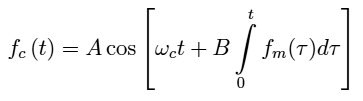
A n FM signal, fc(t), is mathematically defined by the function [see Dunlop & Smith]:

 Eq.1
where A is the carrier-frequency amplitude, ωc is the carrier frequency, fm(t) is the modulating signal, and B is proportional to the modulation depth. This equation shows that the amplitude of the carrier never is changed, but the frequency varies according to the modulation signal. As a result, the probability density function is exactly the same as the probability density function of the carrier itself:

 Eq.2
T his particular probability density function is the probability density function of a sinusoidal, and has a kurtosis of 1.5 (or an excess kurtosis of -1.5).

B ut there is no ‘law’ that says that the carrier has to be of a single pitch or frequency, that it has to be sinusoidal. Likewise, there is no ‘law’ that says that the carrier has to be many orders of magnitude different in frequency from the modulating signal. In FM radio it is true that the frequencies in the audio signal are many tens of thousands of times lower than the FM radio carrier frequency, but that is because of the radio broadcast use-case, which is not applicable in Eve’s musical-soundscape use-case.

S o all signals, whether super-Gaussian, Gaussian, or sub-Gaussian, are necessarily, obligatorily converted to a sub-Gaussian signal if they are frequency-modulated—and that is part of the physics that Eve’s compositions take advantage of, to achieve the effects and impact that they do. Gaussian and super-Gaussian signals do not give way to themes that are conveyed by sub-Gaussian signals; they are ‘taken over’ by the sub-Gaussians. Quasi-vivisectionist/neuroanatomist, Eve takes us apart: her pieces are fascinating lessons, revealing to us how we work, deep down inside. Different interpretation of chamber music as ‘intimacy’.

I n ‘Until It Blazes’, the latter part of the piece is overwhelmed by a high-frequency noise spectrum that, essentially, becomes an FM ‘carrier’ for the other musical signals with which it’s admixed and which it takes over. It’s not that the other signals are buried; no, the amplitudes stay the same. Rather, the admixture/modulation causes new processing by our hearing and auditory cortex—processing by which are able to detect and respond to FM acoustic signals. The musical result—and the gnostic text that inspired it—compel us to reprioritize what we believe, what we believe we know; re-think the evidence that is the basis for our knowing... This isn’t merely ‘edginess’ or gratuitous excitement. It’s politically interventional, potentially life-changing—features that are characteristic of Eve’s work. It’s an invitation to a self-styled, radically self-examining intimate community.

T he ‘gnostic’ gospels reference the Greek word ‘gnosis’, meaning ‘knowledge’. Arguably, Gnostic philosophy—finding answers to spiritual questions within oneself, without reliance on a church or priests; individuals learning to free themselves from the material world by way of meditation and enlightenment—did begin in pre-Christian times; either that, or it was a Jewish reaction to Judaism reacting to early Christianity. Some introductory comments about the apocrypha, gnostic Gospel of Thomas and the 114 ‘sayings’ it contains are here. A fine provocation for meditation, I think, on the occasion of Easter.

E    ve started out as an Uptowner with a Princeton-Columbia education, but then jumped ship and began composing music her professors couldn’t countenance. Her approach to musical sources is omnivorous. She’s made collages of disco music, updated the 14th-century composer Guillaume de Machaut, made theater pieces out of Kurt Schwitters’ nonsensical ‘Ur-Sonata’, and quoted Gregorian chants along with the sounds of a couple having orgasms. One of her best pieces is ‘No Man’s Land’, a gritty poem to New York whose thoughtful text is accompanied by sampled sounds as grating as the city itself. Beglarian is an amazingly high-tech sampling artist, and much of her music—even orchestra pieces like ‘FlamingO’—uses brilliantly manipulated prerecorded noises.”
  —  Kyle Gann.