
J esus said, ‘I have cast fire upon the world and, see, I am guarding it until it blazes.’ ”
— Gospel of Thomas, v. 10, quoted by Eve Beglarian, ‘Until It Blazes’.
I am (you are) the light that shines over all things. I am (you are) everywhere. From me (you) all came forth, and to me (you) all return. Split a piece of wood, and I am there. Lift a stone, and you will find me there. Tend a sick sheep, and you will find me there.”
— Gospel of Thomas, v. 77.
E very atom belonging to me as good belongs to you.”
— Walt Whitman, ‘Leaves of Grass’.
L istening for the magic, as if our lives depended on it.”T he music and writings of Eve Beglarian are terse, capable of having radical impact for those who are amenable to attending to them.
— Eve Beglarian, quoted in Hinkle, p. 148.
[50-sec clip, Eve Beglarian, ‘Until It Blazes’, Segment 1, 1.6MB MP3]
[50-sec clip, Eve Beglarian, ‘Until It Blazes’, Segment 2, 1.6MB MP3]
[50-sec clip, Eve Beglarian, Messiah Remix, ‘Be/Hold’, Segment 1, 1.6MB MP3]
[50-sec clip, Eve Beglarian, Messiah Remix, ‘Be/Hold’, Segment 2, 1.6MB MP3]
E ve’s iconoclastic tendencies are endearing. Only phonies/fogies would consider them seriously threatening. And her compositional methods are wonderfully diverse—pushing envelopes that we didn’t know were there. I listen to some of the synth ‘chirps’ and tone-pips in several of her pieces...
[50-sec clip, Ray Lynch, Deep Breakfast, ‘Tiny Geometries’, 1.6MB MP3]
E ve’s use of ambient chirps and tone-pips is not like, say, Ray Lynch’s use of them. Many communication sounds, including those of primates such as New World monkey twitter calls, contain frequency-modulated (FM) swept-spectrum signals or tone-pips. Others have rhythmic pulses that are FM swept click-trains. Complex natural sounds (e.g., vocalizations or speech) can be characterized by specific spectro-temporal patterns the components of which change in both frequency (FM) and amplitude (AM).
B ut the timing and properties of Eve’s tone-pips are measurably, statistically different from Lynch’s—Eve’s are more like natural primates and birds—and therein lies, I think, a source of the radical, profound effects that Eve’s compositions have. She is ‘wired’ into a part of our innate neurophysiology—a part that is engaged in our reflexively apprehending patterns in our surroundings, and disambiguating and prioritizing the profusion of patterns. Upon a first hearing Eve’s music confronts us with and makes us aware of details of our own inner workings that we may not have known existed; upon subsequent hearings, we revisit what we learned about those details, and reflect upon what it means and how it matters.
I t’s interesting to find what the probability density function and statistical kurtosis of a music signal are, as a means to figure out why the music works or has the effects on us that it does. In a mixture of a Gaussian signal with a sub-Gaussian signal, the Gaussian signal will be significantly attenuated or suppressed, in terms of the pulse-train intensity and auditory evoked potentials in the brain [see links below].
T he probability densities of Beglarian’s music that I’ve examined with my signal-processing set-up tend to be super-Gaussian (kurtosis > 3.0). This generally occurs because there is a substantial amount of low-amplitude time in her compositions (tracks). By concentrating the energy near zero during these times, the probability density function (PD) becomes more peaked, and therefore becomes more super-Gaussian.

I f the raw, super-Gaussian music signals are admixed with others, they will have less ‘gain’ (in human auditory processing) than, say, a competing sub-Gaussian signal. One might want, therefore, to alter the probability density function of the music signals from super-Gaussian to sub-Gaussian. A frequency-modulated (FM) signal is always sub-Gaussian.
A n FM signal, fc(t), is mathematically defined by the function [see Dunlop & Smith]:
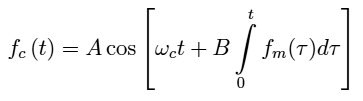
where A is the carrier-frequency amplitude, ωc is the carrier frequency, fm(t) is the modulating signal, and B is proportional to the modulation depth. This equation shows that the amplitude of the carrier never is changed, but the frequency varies according to the modulation signal. As a result, the probability density function is exactly the same as the probability density function of the carrier itself:

T his particular probability density function is the probability density function of a sinusoidal, and has a kurtosis of 1.5 (or an excess kurtosis of -1.5).
B ut there is no ‘law’ that says that the carrier has to be of a single pitch or frequency, that it has to be sinusoidal. Likewise, there is no ‘law’ that says that the carrier has to be many orders of magnitude different in frequency from the modulating signal. In FM radio it is true that the frequencies in the audio signal are many tens of thousands of times lower than the FM radio carrier frequency, but that is because of the radio broadcast use-case, which is not applicable in Eve’s musical-soundscape use-case.
S o all signals, whether super-Gaussian, Gaussian, or sub-Gaussian, are necessarily, obligatorily converted to a sub-Gaussian signal if they are frequency-modulated—and that is part of the physics that Eve’s compositions take advantage of, to achieve the effects and impact that they do. Gaussian and super-Gaussian signals do not give way to themes that are conveyed by sub-Gaussian signals; they are ‘taken over’ by the sub-Gaussians. Quasi-vivisectionist/neuroanatomist, Eve takes us apart: her pieces are fascinating lessons, revealing to us how we work, deep down inside. Different interpretation of chamber music as ‘intimacy’.
I n ‘Until It Blazes’, the latter part of the piece is overwhelmed by a high-frequency noise spectrum that, essentially, becomes an FM ‘carrier’ for the other musical signals with which it’s admixed and which it takes over. It’s not that the other signals are buried; no, the amplitudes stay the same. Rather, the admixture/modulation causes new processing by our hearing and auditory cortex—processing by which are able to detect and respond to FM acoustic signals. The musical result—and the gnostic text that inspired it—compel us to reprioritize what we believe, what we believe we know; re-think the evidence that is the basis for our knowing... This isn’t merely ‘edginess’ or gratuitous excitement. It’s politically interventional, potentially life-changing—features that are characteristic of Eve’s work. It’s an invitation to a self-styled, radically self-examining intimate community.
T he ‘gnostic’ gospels reference the Greek word ‘gnosis’, meaning ‘knowledge’. Arguably, Gnostic philosophy—finding answers to spiritual questions within oneself, without reliance on a church or priests; individuals learning to free themselves from the material world by way of meditation and enlightenment—did begin in pre-Christian times; either that, or it was a Jewish reaction to Judaism reacting to early Christianity. Some introductory comments about the apocrypha, gnostic Gospel of Thomas and the 114 ‘sayings’ it contains are here. A fine provocation for meditation, I think, on the occasion of Easter.
E ve started out as an Uptowner with a Princeton-Columbia education, but then jumped ship and began composing music her professors couldn’t countenance. Her approach to musical sources is omnivorous. She’s made collages of disco music, updated the 14th-century composer Guillaume de Machaut, made theater pieces out of Kurt Schwitters’ nonsensical ‘Ur-Sonata’, and quoted Gregorian chants along with the sounds of a couple having orgasms. One of her best pieces is ‘No Man’s Land’, a gritty poem to New York whose thoughtful text is accompanied by sampled sounds as grating as the city itself. Beglarian is an amazingly high-tech sampling artist, and much of her music—even orchestra pieces like ‘FlamingO’—uses brilliantly manipulated prerecorded noises.”
— Kyle Gann.
- Eve Beglarian website
- Beglarian E, et al. Messiah Remix. (Cantaloupe, 2004.)
- Attencio C, et al. Frequency-modulation encoding in the primary auditory cortex of the awake owl monkey. J Neurophysiol. 2007;98:2182-95.
- Beglarian E. Phil Kline's post-9/11 night walking vigil. EVBVD, 24-SEP-2001.
- Bernstein L, Trahiotis C. Revealing and quantifying temporal aspects of envelopes of high-frequency stimuli that lead to enhanced processing of interaural temporal disparities. J Acoust Soc Am. 2009;125:2690-9.
- Beiser M, Montano A. Beglarian: Almost Human. (Koch, 2007.)
- Duckworth W. Virtual Music: How the Web Got Wired for Sound. Routledge, 2005. (mentions Eve's interventional music on p. 39)
- Dunlop J, Smith D. Telecommunications Engineering. 3e. CRC, 1994.
- He N, Mills J, Dubno J. Frequency modulation (FM) detection in humans: effects of age, psychophysical method, and modulation waveform. J Acoust Soc Am. 2007;122:467-77.
- Hinkle-Turner E. Women Composers And Music Technology in the United States: Crossing the Line. Ashgate, 2006. (Eve's work cited on pp. 120, 143-8, 204, 211, 227, 251)
- Luo H, Wang Y, Poeppel D, Simon J. Concurrent encoding of frequency and amplitude modulation in human auditory cortex: encoding transition. J Neurophysiol. 2007;98:3473-85.
- Lynch R. Deep Breakfast. (Lynch, 1984.) [Tiny Geometries]
- Okamoto H, et al. Frequency-specific modulation of population-level frequency tuning in human auditory cortex. BMC Neurosci. 2009;10:1-19.
- Pienkowski M, Shaw G, Eggermont J. Wiener-Volterra characterization of neurons in primary auditory cortex using Poisson-distributed Impulse train inputs. J Neurophysiol. 2009 Mar 25.
- Remijn G, Perez E, Nakajima Y, Ito H. Frequency modulation facilitates (modal) auditory restoration of a gap. Hear Res. 2008;243:113-20.
- Summers V, Makashay M, Bernstein J, Melamed S, Leek M. Frequency modulation detection, frequency selectivity, and speech recognition in noise. J Acoust Soc Am. 2009;125:2632-8.


