Showing posts with label secrecy. Show all posts

Sunday, November 21, 2010

Private Passion Now Public: Rachel Brown and the Tip of Quantz’s Previously Unpublished ‘Iceberg’


W hat a remarkable performance Rachel Brown (baroque flute) and Terence Charlston (harpsichord) gave last Friday, in the Parry Rooms at the Royal College of Music in London!
  • Sonata in G major, No. 272 - Presto mà fiero
  • Sonata in B major, No. 267 - Larghetto
  • Sonata in A major, No. 274 - Grazioso mà vivace
  • Sonata in D major, No. 277 - Allegro assai
  • Sonata in G minor, No. 366 - Affettuoso, mà mesto; Allegro di molto, mà fiero
  • Sonata in B-flat major, No. 272 - Allegro di molto; Affettuoso; Vivace
  • Sonata in C minor, No. 276 - Cantabile
  • Sonata in F major, No. 356 - Larghetto, mà arioso; Allegro di molto
  • Sonata in G minor, No. 265 - Con affetto, mà non troppo lento
T he occasion for the performance was the launch of the publication of the first two volumes of Quantz flute sonatas that Rachel has edited. Brown’s edition of Quantz Sonatas, bringing these works to the public for the first time, is available by subscription, either to one volume or both, by emailing her at info@uppernote.com.

T his is a marketing approach similar to that used in the 18th Century. For example, Brown notes that Telemann’s Paris Quartets listed among its subscribers not only several members of the French aristocracy, such renowned players as Blavet, Guignon, Edouard, and composers, notably de Caix d'Hervelois, Charpentier, Mondonville, Fasch, Pisendel but also a ‘J.S. Bach of Leipzig’.

V olume 1 contains 6 sonatas (F major No. 272; G major No. 273; A major No. 274; B-flat major No. 275; C minor No. 276; D major No. 277) as does Vol. 2 (B minor No. 231; B minor No. 267; G minor No. 336; E-flat major No. 348; A major No. 351; F major No. 356). These are selected by Brown from the more than 300 flute sonatas that Quantz composed, almost none of which have been previously published.

Q   uantz’s book ‘On Playing the Flute’ is still one of the most-consulted books on flute technic, which makes it especially odd that virtually none of Quantz’s many compositions were actually published. Almost everything that was written by Quantz for King Frederick of Prussia remained in the court’s private possession, and then in the Stadtsbibliothek in Berlin, for more than 200 years. So I went to the library in Berlin to have a look. I would arrive in the morning when they opened at 9 a.m. and take a quarter-hour lunch and leave when they closed at 7 p.m. The librarians were wonderful; they broke almost every rule to help me—they were so delighted that someone was taking an interest in these things. It turns out that there are more than 300 Quantz concerti and about 400 sonatas, hardly any of which have been published.”
  —  Rachel Brown, remarks between Quantz sonatas, 19-NOV-2010.
T he design of these Volumes is unique in several ways. Firstly, for the sonatas that have a ‘bass’ (cello) part as well as flute and harpsichord, the flute and bass parts appear on linked staff-systems together—so that both players can continuously see what the other is doing, with the obvious advantages that this entails for fluid, mutually-responsive performance.

I   t is crucial, I think, to have the flute and the cello (bass) parts together on the page—to have the cello able to see where the dialogue with the flute is going and, from that, to be better able to choose appropriate phrasing and ornamentation.”
  —  Rachel Brown, remarks between Quantz sonatas, 19-NOV-2010.
 Quantz book
T   onguing, for Quantz, was not just simple ‘tuh’ or ‘duh’. Instead, tonguing involved a whole range of syllables and shades—tiree, tä, diddle-diddle—all sorts of articulations that could alter the sound and reveal different qualities of expression. The expressive range he covered is really quite marvelous—something that takes years to fathom, really.”
  —  Rachel Brown, remarks between Quantz sonatas, 19-NOV-2010.
R achel expressed deep thanks to Terence Charlston for his skill and devotion in preparing right-hand parts where Quantz only provided left-hand continuo. In all, Terry had to compose about 120 minutes of right-hand harpsichord score, for the multiple movements of the 12 sonatas in these two volumes.

R achel also expressed gratitude to Jackie Lee, whose Finale©/Sibelius© copyist/pre-press expertise produced the publication-ready digital files. Rachel’s specification and Jackie’s layout involve fold-out pages so as to prevent any awkward page-turns for the performers. This is a second unique/novel aspect of the design of the 2-Volume publication.

T he acoustics in the intimate, modest-size Parry Rooms on the 4th floor at RCM were ideal for the baroque flute-harpsichord duo. Filled to capacity with more than 120 people eager to hear these works, the rooms with their irregular wall and ceiling contours and the warm yellow-pine ceiling and paneling served to reflect the sound in such a way that most everyone had a good vantage point for hearing the performance. (We were grateful for Rachel's consideration in getting everybody who was in Parry 1 moved into Parry 2 just before the performance began!)

 Ceiling of Parry Room at RCM
B rown explained at length the merits of various alternate fingerings that the Quantz design affords. Her blazing 32nd notes in the bravura first movements of the pieces, though, are pretty incredible, regardless how well-engineered and forgiving a particular instrument may be. It is hard for most of us to imagine executing these fast passages on a modern Boehm design instrument with anything approaching the fluency and consistency of tone that Brown achieves on an early flute! What prodigious ability she has!

W e were similarly thrilled by Charlston’s finely-nuanced harpsichord performance. The gracefulness of his accomodation of accelerando and ritardando decisions initiated by Brown was magnificent; the ornaments Charlston applied embodied a fresh spontaneity that responded attentively to Brown’s gestures but never ‘competed’ with them. Really exciting ‘collaborative keyboard’ at its best!

O   ne of Quantz’s strengths was rhetorical ‘delivery’... all of the gestures with tonguing and breathing... He believed that every musician should play like an accomplished orator speaks: clarity and conviction should ring out from every declaration that you make as a musician. Above all else, you must be an orator.”
  —  Rachel Brown, remarks between Quantz sonatas, 19-NOV-2010.
A n especially endearing and comment-worthy aspect of the evening were Rachel’s remarks between the pieces that she and Terry played. She covered an amazing gamut of topics, ranging from instrument design, to ornamentation and historically-informed performance practice, to flute-playing technic, to composition methods, to Prussian history, to anecdotes on parent-child relationships and the plight of kids whose natures are ‘different’ than their parents would prefer. Seldom have we had so much fun as we did on Friday night. Immediately bought all of Rachel’s Quantz CDs on-offer, to take them home and get better acquainted with this previously-private-now-public Quantz passion. Judging by the qualities she displayed during the Friday night performance at RCM, Rachel must be one hell of a teacher! Bravo!

E   very day, Quantz was defending and protecting his reputation... It is interesting to read other people’s accounts of him... In his own writings, filled with quotidian bits and pieces, he will often tell you, for example, how much he paid for a thing, as though it were important to him to demonstrate or prove his shrewdness. He was orphaned at a young age and was taken under the wing of a local musician... In his teens, Quantz concentrated on oboe and violin; only later did he come to concentrate on flute. It is underappreciated how much of a musical jack-of-all-trades he was—how resilient.”
  —  Rachel Brown, remarks between Quantz sonatas, 19-NOV-2010.
H   e gave flute lessons, secretly, to Prince Frederick—before Frederick’s father, the King, died. The father’s disapproval of music, and especially of flute, was absolute; he considered it far too effeminate, inadequate as a representation of Prussian militarism, and incompatible with the important priorities that Frederick must have in his training to become King one day. There was one episode during one of Quantz’s lessons when one of Frederick’s servants reported that the father was approaching the part of the palace where the secret flute lessons room was located. Quantz and the flutes and the music and the music stands were shoved into an armoire. The father arrived and found Frederick alone, studying some book of military strategy, but, because Frederick’s hair was still done-up in the French style, he knew something was ‘up’. The father searched the area for more than an hour, but never found Quantz in the armoire. Quantz, though, subsequently referred to the incident as ‘being cooked’—because the armoire was so cramped and hot while he was confined in there.”
  —  Rachel Brown, remarks between Quantz sonatas, 19-NOV-2010.
A   t one point, Frederick tried to escape, with the help of a servant. The two did not get far. The father arrested them and subsequently had them tried for high treason. Frederick was imprisoned for a year, and his father forced the young Frederick to witness the execution of the servant.”
  —  Rachel Brown, remarks between Quantz sonatas, 19-NOV-2010.
Q   uantz did marry, you know. It was under, shall we say, ‘intriguing’ circumstances. He went to visit the widow of one of his friends who had recently died. The woman was ill; bedridden; in fact, the priest had been called to administer the last rites to her. And, with the priest there, the woman was asked if there was anything she most desired before she departed this life. And she replied that her dying wish was to be married to the great Quantz. So Quantz agreed and the priest conducted the ceremony on the spot. After which the woman sprang from her bed, said she felt very much better now, and thanked everyone for coming. This was when Quantz’s annual income was more than 2,000 talers, more than 10 times that of C.P.E. Bach...”
  —  Rachel Brown, remarks between Quantz sonatas, 19-NOV-2010.
T   his particular flute is a boxwood one that I was able to buy from Carl Hanson in Yorkshire before he retired. It is a 2-key design after Quantz—the two keys are E-flat, which is a few cents higher in pitch, and D-sharp, which is a few cents lower in pitch [than would be the case in equal-temperament]. The difference is very useful, depending on which key a piece is written in. Rudolf Tutz in Innsbruck also made me two flutes of Quantz-type design, one of ebony and one of boxwood—these woods have substantially different tone qualities, both very good. The bore of Quantz flutes is considerably larger, especially in the headjoint, compared to other baroque flutes. The sound is darker and richer in the lower register and yet they are brilliant in the upper register...”
  —  Rachel Brown, remarks between Quantz sonatas, 19-NOV-2010.
T   hese titles or designations for pieces became more and more florid, you know... this ‘Allegro di molto, mà fiero’, ‘this way, but not too much so’, and so on. In fact, as we enter the Classical period, you can tell that people were finding it to be over-the-top. Mozart, for example, entitled one of the movements in his Quartet in A major KV-298 ‘Allegro grazioso, mà non troppo presto, però non troppo adagio, così-così-con molto garbo ed espressione’, mocking the excessiveness of the practice of a generation or two earlier.”
  —  Rachel Brown, remarks between Quantz sonatas, 19-NOV-2010.
 Quantz 2-key flute, by Tutz
M   odern editorial markings can so easily obscure the composer's intentions. Unhelpful editions of baroque music are readily recognisable: if a copy of a baroque sonata designates ‘piano accompaniment’; if the left-hand keyboard part has no figured bass; if there is no separate bass part for a cellist or viol player; if there are metronome marks...”
  —  Rachel Brown, The Early Flute.


Saturday, June 20, 2009

Pre-verbal Music: Duo Stump-Linshalm’s Recording of Pierluigi Billone's 1+1=1

 Duo Stump-Linshalm
I    s it possible to approach music in silent [wordless] comprehension, without falling prey to human psychological, intuitive, irrational, spontaneous influences—i.e., those forms of comprehension engendered by words, text, speaking?”
  —  Pierluigi Billone.
P ierluigi Billone’s aleatoric work reminds me a little of Peter Eötvös’s and Ensemble Modern’s performance of Helmut Lachenmann’s ‘Schwankungen am Rand’ [Fluctuations at the edge]. Pierluigi had in fact spent some time studying with Helmut some years ago...

A    final angst-ridden attempt to strike water out of the stone of the dead monument known as [modernist] ‘music’.”
  —  Helmut Lachenmann, commenting on the aims of new music.
P lumbing the outer-limits of timbral space with each instrument. Sudden, explosive dynamics changes. Overblowing, harmonic-clipping and distortion of bass-clarinet reeds... wonderful, naturalistic colors. The harmonic palette is maybe a little like the songs of whales singing to each other, whales’ courting rituals...

T    he title of the work, ‘1+1=1’, is a quotation from an Andrey Tarkovskij film which points to the special relation between the two instruments [achieving a transcendent union by their playing together]... One drop plus another drop makes one larger drop, not two.”
  —  Petra Stump & Heinz-Peter Linshalm.
I t is impossible to know whether it is a ‘proper’ language with subjects, predicates, etc. But it has harmonic and lyrical and rhythmic features that (a) invite interest, (b) reward whatever interest and patience are sent its way, and (c) propel the interested listener to various kinds of meditation.

 Petra Stump, photo (c) Petra Stump
T    he variations that become part of instrumental technique through each individual discovery are traces—some clearer than others—of the human and cultural experiences that produced them and led to them. And they ‘vibrate’ in the act of listening—as particularity, identity, origin. They are sonic ‘layers’—living matter, with an intelligence of its own...”
  —  Pierluigi Billone.
L ooking at some of his scores, I wonder whether Billone is striving to be an archtypically ‘difficult’ composer. But electroacoustic digital material or specially-designed analog instruments or ‘found’ instruments, including rumbling and crumpling metal, play no role in this 70-minute composition. And the graphical/aleatoric score annotations are reasonably straight-forward, compared, say, to Stockhausen or Xenakis.

S onic materials and structure. Think like a whale and use what’s at hand. Reed, glottis, keys smacking against clarinet-body tone-holes, lungs. From time to time, things grind to a halt while Petra Stump and Heinz-Peter Linshalm slowly and punctuatedly smash hell out of their two bass clarinets’ keys). Alternately, there are moments where subtle, whispered tones only hint at the note that would sound were more air flowing past the expectant reed. Intertwining of pitch-bent/quarter-tone and microtonal passages by Stump and Linshalm are beautiful and wonderfully discursive, on account of the excellent recording and engineering of this disc. The beat-frequencies from the microtonal interferences between the two parts add extra depth to the music—a feature that’s accentuated by the spatial specifications that Billone designed for the piece to be performed.

T he two performers are positioned as far apart as possible (about 15 meters) while still permitting mutual acoustic influence and line-of-sight gesture. Each soul is spatially isolated... The interior of the studio is then “like the interior of a big instrument,” says Billone. No synthesizers or exotic digital sound-processing software were used in the recording/engineering of this CD. So, except for the technically and aesthetically excellent miking and mixing by Alfred Reiter at Klangforum Wien, it is almost an anti-technological work. Marine mammal-esque.

T    he flow of energy and merging of performer and instrument... One finds archaic [pre-historical, paleological] images taking form. It seems as if they were musical incantations intended to counteract the commodifiability of which the world of ‘administrated listening’ rests.”
  —  CD liner notes, ‘1+1=1’.
B esides Pierluigi Billone and the ‘1+1=1’ piece, other composers including Beat Furrer, Bernhard Gander, Bernhard Gal, Erin Gee, Christoph Herndler, Jorge Sánchez-Chiong, and Judit Varga have dedicated pieces to Stump and Linshalm. The diversity of Petra’s and Heinz-Peter’s playing and repertoire is really remarkable.

 Heinz-Peter & Petra, photo (c) Jean-François Charles
Duo Stump-Linshalm’s upcoming performances are listed here.

P etra and Heinz-Peter reside (as is poetically fitting considering the rocky etymology of their given names) in Berg 31, Götzis, Austria—in the beautiful Alps foothills south of the Bodensee, between Zurich and Innsbruck. The photo gallery on their website shows images from a number of mountainous places they have trekked. Pierluigi is currently Gastdozent für Komposition at the Musikhochschule Frankfurt, having just completed a guest professorship in Graz. (Envious, I think I would like to adjust some life-priorities to be more like Pierluigi’s or like Petra’s and Heinz-Peter’s?)


    [50-sec clip, Duo Stump-Linshalm, Pierluigi Billone, ‘1+1=1’, track2, 1.6MB MP3]


    [50-sec clip, Duo Stump-Linshalm, Pierluigi Billone, ‘1+1=1’, track8, 1.6MB MP3]

T    hey [Petra and Heinz-Peter] elicit the most unusual sounds from their instruments. These range from ethereal arabesques to enraged shrieking...”
  —  Ursula Strubinsky.
 Pierluigi Billone


Sunday, April 12, 2009

Beglarian’s Chamber Music: Magic through Risk-Sharing, Intimacy through Obligate FM

 Eve Beglarian
J    esus said, ‘I have cast fire upon the world and, see, I am guarding it until it blazes.’ ”
  —  Gospel of Thomas, v. 10, quoted by Eve Beglarian, ‘Until It Blazes’.
I    am (you are) the light that shines over all things. I am (you are) everywhere. From me (you) all came forth, and to me (you) all return. Split a piece of wood, and I am there. Lift a stone, and you will find me there. Tend a sick sheep, and you will find me there.”
  —  Gospel of Thomas, v. 77.
E    very atom belonging to me as good belongs to you.”
  —  Walt Whitman, ‘Leaves of Grass’.
L    istening for the magic, as if our lives depended on it.”
  —  Eve Beglarian, quoted in Hinkle, p. 148.
T he music and writings of Eve Beglarian are terse, capable of having radical impact for those who are amenable to attending to them.


    [50-sec clip, Eve Beglarian, ‘Until It Blazes’, Segment 1, 1.6MB MP3]


    [50-sec clip, Eve Beglarian, ‘Until It Blazes’, Segment 2, 1.6MB MP3]


    [50-sec clip, Eve Beglarian, Messiah Remix, ‘Be/Hold’, Segment 1, 1.6MB MP3]


    [50-sec clip, Eve Beglarian, Messiah Remix, ‘Be/Hold’, Segment 2, 1.6MB MP3]

E ve’s iconoclastic tendencies are endearing. Only phonies/fogies would consider them seriously threatening. And her compositional methods are wonderfully diverse—pushing envelopes that we didn’t know were there. I listen to some of the synth ‘chirps’ and tone-pips in several of her pieces...


    [50-sec clip, Ray Lynch, Deep Breakfast, ‘Tiny Geometries’, 1.6MB MP3]

E ve’s use of ambient chirps and tone-pips is not like, say, Ray Lynch’s use of them. Many communication sounds, including those of primates such as New World monkey twitter calls, contain frequency-modulated (FM) swept-spectrum signals or tone-pips. Others have rhythmic pulses that are FM swept click-trains. Complex natural sounds (e.g., vocalizations or speech) can be characterized by specific spectro-temporal patterns the components of which change in both frequency (FM) and amplitude (AM).

B ut the timing and properties of Eve’s tone-pips are measurably, statistically different from Lynch’s—Eve’s are more like natural primates and birds—and therein lies, I think, a source of the radical, profound effects that Eve’s compositions have. She is ‘wired’ into a part of our innate neurophysiology—a part that is engaged in our reflexively apprehending patterns in our surroundings, and disambiguating and prioritizing the profusion of patterns. Upon a first hearing Eve’s music confronts us with and makes us aware of details of our own inner workings that we may not have known existed; upon subsequent hearings, we revisit what we learned about those details, and reflect upon what it means and how it matters.

I t’s interesting to find what the probability density function and statistical kurtosis of a music signal are, as a means to figure out why the music works or has the effects on us that it does. In a mixture of a Gaussian signal with a sub-Gaussian signal, the Gaussian signal will be significantly attenuated or suppressed, in terms of the pulse-train intensity and auditory evoked potentials in the brain [see links below].

T he probability densities of Beglarian’s music that I’ve examined with my signal-processing set-up tend to be super-Gaussian (kurtosis > 3.0). This generally occurs because there is a substantial amount of low-amplitude time in her compositions (tracks). By concentrating the energy near zero during these times, the probability density function (PD) becomes more peaked, and therefore becomes more super-Gaussian.

 Super-Gaussian passage, Eve Beglarian, ‘Until It Blazes’
I f the raw, super-Gaussian music signals are admixed with others, they will have less ‘gain’ (in human auditory processing) than, say, a competing sub-Gaussian signal. One might want, therefore, to alter the probability density function of the music signals from super-Gaussian to sub-Gaussian. A frequency-modulated (FM) signal is always sub-Gaussian.

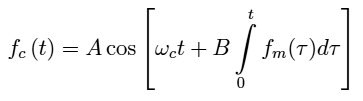
A n FM signal, fc(t), is mathematically defined by the function [see Dunlop & Smith]:

 Eq.1
where A is the carrier-frequency amplitude, ωc is the carrier frequency, fm(t) is the modulating signal, and B is proportional to the modulation depth. This equation shows that the amplitude of the carrier never is changed, but the frequency varies according to the modulation signal. As a result, the probability density function is exactly the same as the probability density function of the carrier itself:

 Eq.2
T his particular probability density function is the probability density function of a sinusoidal, and has a kurtosis of 1.5 (or an excess kurtosis of -1.5).

B ut there is no ‘law’ that says that the carrier has to be of a single pitch or frequency, that it has to be sinusoidal. Likewise, there is no ‘law’ that says that the carrier has to be many orders of magnitude different in frequency from the modulating signal. In FM radio it is true that the frequencies in the audio signal are many tens of thousands of times lower than the FM radio carrier frequency, but that is because of the radio broadcast use-case, which is not applicable in Eve’s musical-soundscape use-case.

S o all signals, whether super-Gaussian, Gaussian, or sub-Gaussian, are necessarily, obligatorily converted to a sub-Gaussian signal if they are frequency-modulated—and that is part of the physics that Eve’s compositions take advantage of, to achieve the effects and impact that they do. Gaussian and super-Gaussian signals do not give way to themes that are conveyed by sub-Gaussian signals; they are ‘taken over’ by the sub-Gaussians. Quasi-vivisectionist/neuroanatomist, Eve takes us apart: her pieces are fascinating lessons, revealing to us how we work, deep down inside. Different interpretation of chamber music as ‘intimacy’.

I n ‘Until It Blazes’, the latter part of the piece is overwhelmed by a high-frequency noise spectrum that, essentially, becomes an FM ‘carrier’ for the other musical signals with which it’s admixed and which it takes over. It’s not that the other signals are buried; no, the amplitudes stay the same. Rather, the admixture/modulation causes new processing by our hearing and auditory cortex—processing by which are able to detect and respond to FM acoustic signals. The musical result—and the gnostic text that inspired it—compel us to reprioritize what we believe, what we believe we know; re-think the evidence that is the basis for our knowing... This isn’t merely ‘edginess’ or gratuitous excitement. It’s politically interventional, potentially life-changing—features that are characteristic of Eve’s work. It’s an invitation to a self-styled, radically self-examining intimate community.

T he ‘gnostic’ gospels reference the Greek word ‘gnosis’, meaning ‘knowledge’. Arguably, Gnostic philosophy—finding answers to spiritual questions within oneself, without reliance on a church or priests; individuals learning to free themselves from the material world by way of meditation and enlightenment—did begin in pre-Christian times; either that, or it was a Jewish reaction to Judaism reacting to early Christianity. Some introductory comments about the apocrypha, gnostic Gospel of Thomas and the 114 ‘sayings’ it contains are here. A fine provocation for meditation, I think, on the occasion of Easter.

E    ve started out as an Uptowner with a Princeton-Columbia education, but then jumped ship and began composing music her professors couldn’t countenance. Her approach to musical sources is omnivorous. She’s made collages of disco music, updated the 14th-century composer Guillaume de Machaut, made theater pieces out of Kurt Schwitters’ nonsensical ‘Ur-Sonata’, and quoted Gregorian chants along with the sounds of a couple having orgasms. One of her best pieces is ‘No Man’s Land’, a gritty poem to New York whose thoughtful text is accompanied by sampled sounds as grating as the city itself. Beglarian is an amazingly high-tech sampling artist, and much of her music—even orchestra pieces like ‘FlamingO’—uses brilliantly manipulated prerecorded noises.”
  —  Kyle Gann.