Showing posts with label existential. Show all posts

Sunday, February 12, 2012

John Bischoff: Audio Combine, Modal/Bispectral Discoveries, Post-Human Futures

John Bischoff, Audio Combine
L   ocal color’ features synthetic bell-like tones, sustained tonal clusters, and computer-triggered acoustic bells struck in complementary patterns that are sometimes random, sometimes human-triggered, and combinations of both... It is enough to reference the idea of a tactus, but not enough to be [understood as] an organizing [meaning-generating/insuring] element.”
  — Audio Combine, liner notes, Ed Osborn, Brown Univ, 2011.
T he music comprising John Bischoff’s new CD ‘Audio Combine’, just released on New World Records, is beautiful, fascinating, thoroughly enjoyable. Philip Perkins’s engineering and production values are superb.

T he five tracks on the disc are diverse, representing Bischoff compositions from 2004 to mid-2011. The third track ‘Local Color’ evokes traditional chinese zhong bells, but also especially calls into question the ‘who’ of music performance [in asmuch as some of the bells are computer-triggered, randomly and deterministically, while others are played by Bischoff from his score] and other limits of performance identity [insofar as the bell modes and timbres evolve after the bell is struck—on the rim; on the bosses/nipples; on the wall; etc.—in aleatoric/random ways that the musician-computer can neither predict nor control]. Of course, all music emerges in less-than-predictable/controllable ways—just less obviously so than bells.


    [50-sec clip, John Bischoff, ‘Local Color’; (track 3), 2012, 1.4MB MP3]
T   he pieces were all recorded in live performance with minimal editing and no over-dubs. Philip Perkins recorded direct from Bischoff’s setup and also from three pairs of microphones placed at various points in the concert hall. The mix heard here switches between these four perspectives as the pieces are played. The distance and pace incorporated into the recordings from various mic positions give a clear sense of the space of the performance, and of the object-ness of the sounds. That space and our place within it become the final part of the ‘material’: when the listener has no fixed point of perspective, then the position from which the listening/understanding is done becomes one of the elements of counterpoint.”
  —  Audio Combine, liner notes, Ed Osborn, Brown Univ, 2011.
T here are a few excellent books that empirically measure the modal vibrations of bells... He & Fu, for example. And some books on bispectral analysis—mainly used today in aerospace engineering and vibration-management engineering of turbines and other structures. Useful to explore if you are a composer/performer wanting to know more about how to more reliably utilize distinctive bell harmonics in your work. Links to some of these at the bottom of this post.
Fu-He book, p. 276
[Modal Analysis, Fu & He, 2001, p. 276]

    [50-sec clip, Wang Yuanping & Hubei Chime Bells Orchestra, ‘竹枝词 (Zhu-zhi-ci) Bamboo-pole Love Poem’; (track 1), 1989, 1.5MB MP3]

T he substantial rhythmic independence of the parts in the ‘Local Color’ bell quartet is part of its distinctive Asian beauty. Because each bell projects its sound clearly, each individual bell can easily be heard over the rest of the bell ensemble, and yet the ensemble—the ‘community’ of bells—remains the primary subject. This is dissimilar from other voiced percussion like a timpani choir, performing a ‘programmatic’ role, where the effect of four or more timpani playing together is treated more as an ‘effect’ than as harmony. It is instead quartet ‘orchestration with Chinese characteristics’!

W ith computer-triggered sticking, the timing of the ring-down and the pitch-bend are the same, but the kinematic nuances of human left-hand/right-hand mallet or sticking patterns are gone. But the electromechanical linear actuators for the computer-controlled bells have their own kinematic constraints, in terms of speed of resetting for the next stroke, and so on. They have their own unique, finite kind of ‘embodiment’ just as we humans have ours, and we can hear this in these wonderful Bischoff compositions and this excellent recording of them being performed ‘live’.

A nd so the most amazing thing that we get from Bischoff’s mechatronic compositions like ‘Local Color’ is a vivid glimpse of robotic humanity and machine consciousness, revealed by the beater mechanics and linear actuators... something like an inversion of the ‘human-becoming-machine’ perspective of Ambrazevičius and Balsienė (link below): ‘machine-becoming-human’... a brilliant future of new expressive possibilities, including bionic accomodations for musicians with disabilities. Musical prosthetics? Sonnez les matines! / Din, dan, don!


J ohn Bischoff (b. 1949) is an early pioneer of live computer music. He is known for his solo constructions in real-time synthesis as well as his seminal work in computer network ensembles. Bischoff studied composition with Robert Moran, James Tenney, and Robert Ashley. He has been active in the experimental music scene in the San Francisco Bay Area for over 25 year as a composer, performer, teacher, and grassroots activist. His performances around the US include NEW MUSIC AMERICA festivals in 1981 (SF) and 1989 (NYC), Experimental Intermedia (NYC), Roulette Intermedium (NYC), and the Beyond Music Festival (LA). He has performed in Europe at the Festival d'Automne in Paris, Akademie der Künst in Berlin, Fylkingen in Stockholm, and TUBE in Munich. He was a founding member of the League of Automatic Music Composers (1978), considered to be the world's first Computer Network Band, and he co-authored an article on the League's music that appears in "Foundations of Computer Music" (MIT Press 1985). He was also a founding member of the network band The Hub with whom he performed and recorded from 1985 to 1996.
John Bischoff, Audio Combine


Wednesday, February 25, 2009

Slings and Arrows of Fortune: Benjamin Bagby’s Beowulf & Epic Chamber Music

 Benjamin Bagby performing Beowulf
H    wæt. We Gardena in gear-dagum
þeodcyninga, þrym gefrunon,
hu ða æþelingas ellen fremedon.

Literal tr.:
What! We of the Spear-Danes in old days
of the people-kings the power heard
how the princes their brave deeds did.

R. Liuzza tr.:
Listen! We have heard of the glory in bygone days
of the folk-kings of the Spear-Danes—
how those noble lords did lofty deeds.

S. Heaney tr.:
So: The Spear-Danes in days gone by
and the kings who ruled them had
    courage and greatness.
We have heard of these princes’ heroic
    campaigns.”
M edievalist Benjamin Bagby performs the epic Anglo-Saxon poem, ‘Beowulf’, in his one-man drama on Saturday evening in Kansas City. Bagby performs on an historically-reconstructed six-stringed harp, part of which comes from remnants recovered from a medieval gravesite. The poem is the oldest extant complete poem in Old English, a narrative that tells the story of the chieftain, Beowulf, who defeats the monster, Grendel, in battle. The epic/mythical qualities of it are not unlike other Northern European epics, such as the Norse Eddas (sagas) or Kalevala.

B agby hails from a Germanic clan that emigrated from Jutland to northern England in about 630, and subsequently to colonial Virginia a millennium later. In addition to his activities as founder and director of the early music ensemble Sequentia, Benjamin writes about historical performance practice and teaches at the Sorbonne and North America. In 2003, Bagby developed the program ‘Chant Wars’ with Katarina Livljanic at Harvard. Bagby was educated at Oberlin College and at the Schola Cantorum in Basel. Bagby and Glagolitic chant scholar Katarina Livljanic were recently married.

T he ‘auspiciousness’ of the narrative of Beowulf is wonderfully portrayed by Bagby—whether you see him perform ‘live’ or on the excellent 2006 DVD. Having the work performed an old, old stone cathedral with hewn timbers for beams, and minimal central heating on a cold winter’s night helps to reinforce the momentousness of the epic. Beowulf aims to convey something of import to each contemporary listener, clan-member or not. Having the scary, decrepit manuscript projected in front of us adds still more.

 Beowulf manuscript, page 1
T he Grendle ‘fight scene’, I suppose, is what gets the most attention, in almost any casual reading of the text. The mechanics of story-telling and drama: these are what English teachers tend to focus on when teaching Beowulf. The sheer exoticness of a text so old as this tends to limit the serious consideration of why it is the way it is. The ambiguities in the manuscript itself offer prodigious challenges to translators, never mind interpreters or theorists or ordinary readers/hearers.

B ut as we hear Bagby render this in performance today—in this time of widespread terrorism, regime-change and unplanned succession; amid conflicted amity, globalization and disputed sovereignty—what strikes me most is the theme of unrelenting confrontation—the necessity and inevitability of it. The human condition is perilous, no end in sight, and victories are always mixed, pyrrhic ones. Glory is the harbinger of doom. This mortal coil is in fact and above all else a coil—a chute that leads precipitously to our unbidden shuffling off it. No one gets out of here alive.

C    oil  — (n.) a spiral; tumults, troubles; a noisy disturbance, fuss, ado; the bustle and turmoil of this mortal life; (v.t.) to cull or sacrifice; to thrash; to lay in rings or spirals; to turn; to mound up; to stir.”
T    he meaning might be: ‘when we have unwound and worked off this spool of mortality’.”
  —  Schopenhauer, ‘Parerga & Paralipomena’, Volume 2, §232a.
I n Bagby’s wonderful delivery we hear vocal/musical and stylistic elements of these confrontations. Nothing sung/said is merely a formality. Not all of it is ‘consequential’. But all of it is confrontational. Hwæt! No ‘arrival’ lacks a ‘departure’. What comes in must go out; what goes up must come down. Beowulf ‘confronts’ any and all who would cling to wishful thinking or self-delusion. The end is not ‘tragic’; it just ‘is’.

W hy are there four funerals in Beowulf? Some people make a big thing about thematic repetition and the rhetoric of ‘aftermaths’. Yes, well... As a person descended from Scandinavian ancestors and as one who has read the Eddas since I was about 15, these epics and skaldic ‘lays’ and so on are just profoundly weird. At 3,182 lines length, its epic-oid length does lend to it something of the status of holy scripture—something more canonical and purposefully-structured than a clan fable.

B ut the monster slaying and fight scenes are playful—not unlike modern fantasy lit, if you ignore the extreme agèdness of the manuscript.

T he repetitions in Beowulf might be thought to be driven by the poetics or vocality of the thing. But the repeats have meta-linguistic effects, too. There is a normative fugue-like texture—which makes us notice the variations or ‘counterpoint’. These come alive in Bagby’s performance, whereas they are likely otherwise to remain mute on the printed page. You have to experience the thing ‘live’ to really ‘get it’.

T he epicness of Beowulf is conveyed by many aspects of its style—for example, the namelessness of many of the speakers. We don't know the messenger’s name; we don’t know the name of the mourning woman at the end of the poem; we don’t know the names of the retainers who ride around Beowulf’s funeral pyre. We’re not meant to know them; their names aren’t important to the story-as-epic. In fact, selective anonymity is part of what makes us know it’s an ‘epic’.

T he poet’s point of view is one recalling some much earlier time—and Bagby’s performance, a reenactment of that recall. He brings that recalled world “forward”, into the Present, just as the poet did into his own Present.

I  ask myself, ‘Why?’ Why would anybody want to do this, as a performative sort of social or collective memory? For what purposes? What good would it do?

F or the poet, this wasn’t a clannish or courtly entertainment—nor, for us, is it some minor amusement to be consumed quickly and forgotten. It has real substance—weight. It’s a timely political statement—according to John Hill. He notes that the medieval world was “institutionally more complex... church and clergy, king and court. It was socially stratified for different levels of nobility and landholdings, including slavery, and was economically organized for both mundane and prestige trade... Wessex and Mercia and other Anglo-Saxon kingdoms are in a world of sometimes-hostile arrivals and departures, of aetheling tensions and assassinations... Perhaps the narrative pulse of Beowulf ... might be taken by Anglo-Saxons as a model, for their times, of good customs, heroic/fame-enhancing behaviour, and great kingship in at least two forms: the two-generational Danish model and the Beowulfian model of sovereignty, enlarged to include broader kinship amity.”

A    rrivals, especially unanticipated ones, are electric with possibilities—with unexpected surprises ranging from the pleasant and desired, to the tense and potentially dangerous, to the terrible and unwished-for... Departures are often auspicious, full of promise and hope, although they also signify terror's monstrous flight... Each human departure involves an enlargement of possibility, with Beowulf's departure from the Danes being the most expansively promising one in the poem... In those moments, either positive or negative outcomes are possible, indeed sometimes intertwining or sometimes just lurking as potential. They inform the social action of the poem even as the many arrivals and departures create its overall and variable narrative pulse.”
  —  John Hill, p. 5.
I n comparable fashion, the globalized world of 2009, torn by conflict and economic recession as it is, is institutionally still more complex. More complex, even, than just one year ago. Traditional governance and sovereignty are seriously disrupted in several parts of the world—including, so it seems, here in the U.S. Regulatory institutions seemingly have been co-opted by the very people and organizations who they were intended to regulate, with catastrophic results.

I n other words, Beowulf is way more than a ‘creative anachronism’ or medieval ‘curio’ or museum-piece. It’s a parable for—oh, say, now.

 Risden book
K ennings’ are a significant feature in Beowulf. They’re evocative phrases that stand for everyday things. They’re not cute euphemisms/amphilogisms, nor are they comedic sarcasms. They’re not coy ways to avoid saying an ‘unlucky’ word—like ‘death’—thereby to avoid inadvertently inviting the thing-that-shall-not-be-named into your midst (as the Tlingit and other traditional peoples believe).

Y es, the kennings are alliteration- and meter-appropriate “fits” for the contexts where they occur in the text. But they’re far more than that—and it’s ‘cool’ to hear Bagby perform these gems and pour into them their real, full-blown meaning.

F or example, the skald calls the clan ‘Spear-Danes’—evoking a bellicosity that maybe Danes aren’t so famous for anymore. He calls the sea a ‘whale-road’—this evokes a liveliness and interspecies danger that we scarcely think of anymore, in the era of modern ships, and commoditized human-centric seaway-as-inanimate-resource, and GPS nav. A king is called a ‘ring-giver’ or, at other times, a ‘breaker-of-rings’—evoking not only autocratic privilege but merit-based social generosity and, alternately, unjust/capricious renunciations by those who wield power. The king as ‘guardian-of-hoards’ suggests not only personal wealth and power but a devotion to the public interest and the commonweal—far more public-centered than current or recent notions of a ‘Strong Unitary Executive’.

  • Sleep-of-the-sword—Death
  • Mighty-wanderer-of-wastelands—horror, Death (Grendel)
  • Raven-harvest—battle-field corpses
  • Battle-sweat—blood
  • War-friend—sword
  • Mind’s-worth—honor, valor
  • Horse-of-the-whale-road—ship
  • Foamy-necked-floater—ship
  • Gold-friend—retainer, loyal knight
  • Gannett’s-bath—sea
  • World-candle—sun
T here are these many fantastic kennings in Beowulf. To me, the devices seem less ‘formulaic’ or prosodical or circumlocutory than they are ‘out-of-the-box-thinking-compelling’. Benjamin Bagby confronts us and helps us to constructively absorb this deeply disturbing tale and derive new contemporary meanings from it. Beautiful performing art, yes, it is that. But, in the same spirit as J.R.R. Tolkien once argued that Beowulf is the poet’s elegy for (and warning from—) a culture long-gone, Bagby exhorts us to hope and strive in order that our own cultures survive the epic challenges that we presently face.

T    he dyers of the wolf’s fangs
squandered the Reddened Swan’s meat;
The hawk of the sword’s dew
fed on the heroes of the field—
The serpents of the Geats’ moons
fulfilled the Will of the Irons.
   ... by Egil Skallagrimsson, warrior/embedded-journalist at Brunanburh.”
  —  Jorge Luis Borges, The kenning. New Yorker, 26-JAN-1976.

 Hill book


Saturday, April 5, 2008

Ornamentation, Paradox and Temporality in Bach’s BWV 1052

 Akamus
E  very composer ... is entitled to ... [prescribe] a correct method according to his intentions, and thus to watch over the preservation of his own honor.”
  —  Abraham Birnbaum, quoted in Wolff et al., 1998 pp. 346-7.
I  n his transcriptions, Bach never proceeded in a mechanical way; rather, he strove to give the arrangement an identity of its own by subjecting the model to further development and exhausting its potential. This often involved the addition of fresh contrapuntal parts, the alteration of detail and structural modification.”
  —  Christoph Wolff.
Akademie für Alte Musik Berlin (Akamus) performs this evening in Kansas City. Among the works on the program is Bach’s D minor Concerto, BWV 1052.

There are all sorts of reasons for creating a transcription. Paying homage to the predecessor is one motive. Accomodating a particular instrumentation that happens to be available is another. Amplifying or extemporizing on historical themes is yet another. But in this piece one thing that strikes me is the focus on the personality—the personhood, the subjectivity, the existential situation—of the performers.

 J.A. Bach’s pedagogical table of ornaments, for his son, J.S.
Agogic stresses (altered durations) and ‘stolen time’ are a way to create spontaneity. The appoggiaturas and anticipations steal time from the elements that they precede. And the improvisatory character of appoggiaturas alludes to individualism and ephemerality, as Richard Hudson says in his book, ‘Stolen Time’. Even the fingers’ dwelling on notes before releasing them borrows time, steals time.

 BWV 1052 II, Badura-Skoda, p. 408
Baroque experts maintain that ornamentation was just considered an aspect of the expression of the music, left properly to the performer’s discretion. That is, in general baroque composers weren’t obsessive about notating these embellishments explicitly—on account of the common musical language, a more homogeneous performance practice than existed before or since. Is BWV 1052 different from other baroque works in this regard?

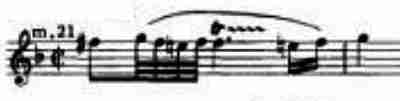
 BWV 1052 II, m. 21
Well, maybe. To me, there is in BWV 1052 a latitude for the anticipations that is especially large, and the notation provides no special clue to this. The anticipations in BWV 1052 can be played shorter than indicated or they can be played longer, without the risk of sentimentality or cliché that other pieces have. There’s a broad latitude, too, as to whether an anticipation can be slurred from the main note of the trill. There are instances where an anticipation can be both shortened and separated from the trill note by what’s called a ‘silence of anticipation’—détachè. These detachments naturally draw attention to the passage of time—what went before, what comes after, the ‘afterness’ enabled by the passage of a moment’s time. Whitespace.

 Silence of Anticipation
The effect of this latitude is to convey a sense of aloneness—as when one realizes that the constraints that have cramped one’s style have been lifted, but one now has no particular idea of what to do. You have awakened from sleep and are full of energy, but all of your friends are asleep and the shops are all closed. The ‘silences of anticipation’ carry this existential weight. Very D minor.

 BWV 1052 II, mm. 1 - 6
But the melancholy minor key doesn’t mean ‘dour’. For example, just before the final tutti, the two-bar Adagio has a solo cadenza for the keyboardist. It is an interjection of surprise and drama. Each of these things is an enactment of aesthetic imagination on a small temporal scale that draws attention to the discretionary freedom and subjectivity of the performer (and the composer, and the listeners). More than anything, BWV 1052 is a confession of unceasing surprise, insistent upon the human condition’s paradoxical and simultaneous ... desolation? fecundity? correlations discovered and then superceded/supplanted/obliterated? The stealer of time is, in turn, stolen from.

 Bach, BWV 1052, Adagio stealing time
I  n music, speeding up or slowing down does not affect the fundamental structure ... Before each cycle of a rhythm is produced, a preparatory process propagates a rate parameter down through the hierarchy [of timekeepers]. This involves specifying the interval for the timer at one layer in the hierarchy by multiplying the interval in the next higher level by the appropriate fractional constant to achieve the desired ratio between the higher and the lower layer. This multiplicative process introduces overall positive correlations.”
  —  Katinka Ridderbos, Time, p. 97.

 Hudson, Stolen Time book