J osé Bowen writes of the ‘illusion that there is such a thing as a neutral performance style’... I believe it is an illusion principally of the listener; but even then perhaps ‘illusion’ is not the right idea... If Bowen typifies the view of a scholar making a ‘forensic’ examination after the event, rather than that of a performer who, for an ulterior artistic purposes, may need to have faith in some starting point without going too far into its credibility, he is nevertheless right to imply that performers do always display an attitude towards their music.”B uilding and shaping narrative is fundamental to effective interpretation, for musicians to bring a composition to life in performance (see esp. William Rothstein, in the book edited by John Rink, link below). In regard to constructing exciting and coherent narratives, Akademie für Alte Musik Berlin is second to none. Their performance last night was warmly received by Kansas Citians.
— Jon Dunsby, in Rink, p. 227.
- G.P. Telemann - Overture (Suite) in F minor, TWV55:f1
- J.S. Bach - Brandenburg Concerto No. 5 in D major, BWV 1050
- J.S. Bach - Violin Concerto in E major, BWV 1042
- G. F. Handel - Concerto Grosso in F major, Op. 6, No. 2, HWV 32
- G.P. Telemann - Concerto in E minor for Recorder & Flute, TWV52:e1.
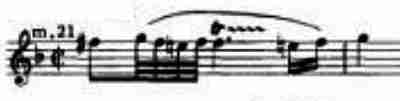
 T he Baroque slurred dotted-eighth-sixteenth ornament: this ‘punctuation’ conveys a certain tension, but it is not ‘tense’; it is instead athletic, like the taut muscles of a horse executing patterns in a dressage ring.
C onnecting the sixteenth note back to the dotted eighth with a slur has special and different meanings in Bach and Telemann and Handel. Telemann is more ‘French’ (see the excellent recent book by Steven Zohn, Baroque flutist and Assoc. Prof. Music History, Boyer College of Music & Dance, Temple Univ, link below, pp. 13ff). In the TWV 55:f1 Overture, there is an implied or interpolated ‘rest’ or suspension in the middle of the figure. By contrast, in the Akademie’s interpretations of Bach, the dotted-eighth-sixteenth slurs feel ‘pastoral’; these feel like distance is being traversed over soft earth or a hummocky pasture. In the minor keys, it feels solemn; it carries some gravitas. How wonderful to experience the diversity of German Baroque... the saturated colors and widely varying ‘feel’ and ‘sense’ that Akademie für Alte Musik Berlin impart to these pieces!
[30-sec clip, Akademie für Alte Musik Berlin, Telemann - Concerto in A minor for 2 recorders, TWV 55:a2, 1.1MB MP3]

T he musicians had already moved through several approaches to color and texture — a dark-hued French overture; a pair of light, graceful Menuets; a supple, rubato-laden Sarabande; and a pair of full-throttle fast movements — before arriving at the Plainte, a second slow movement. Suddenly, the string sound was hushed, velvety and nearly motionless. The ensemble addressed the Adagio of Bach’s Violin Concerto in E (BWV 1042) similarly, and the effect was no less surprising the second time... But for sheer inventive oddity, Handel’s Concerto Grosso in F (Op. 6, No. 2) proved the evening’s most memorable performance. Building on the gracefully modulating chord progression at the start of the work’s Andante Larghetto, the players produced a lush sound that painted Handel as an early avatar of English pastoralism.”
— Allan Kozinn, review, NY Times.
T he Akademie für Alte Musik Berlin (which loosely translates to the Berlin Academy of Early Music) features about 15 players trained in techniques employed in the 17th and 18th centuries, when the orchestra itself was still a relatively new idea. Friday’s concert confirmed that the uproar is warranted. The compelling program of music by German Baroque composers was one of the highlights of the concert season. What sets this ensemble apart from many others is the combination of technical expertise, extraordinary energy and sheer musicality... From the outset, the ensemble produced a soft but vibrant sound that was beautifully balanced. As it progressed through the nine-movement suite, the group demonstrated not only the ability to play well, but to infuse each movement with a sound and shape that was well conceived and effectively delivered. For example, the second movement contained two contrasting minuets. Not only was the instrumentation different — two recorders, lute and cello as opposed to strings — but differences in articulation also helped define each section...”
— Timothy McDonald, review, Kansas City Star.
- McDonald T. Akademie für Alte Musik Berlin review. Kansas City Star, 11-MAR-2011.
- Akademie für Alte Musik Berlin website
- Akademie für Alte Musik Berlin recordings at Harmonia Mundi
- Van Deusen M. Music manuscript notation in Bach.
- Telemann - Cto for 2 recorders, TWV 52:a2 score at IMSLP.org
- Kozinn A. Proving that early music can contain startling shifts. NY Times, 08-MAR-2011.
- Bartel D. Musica Poetica: Musical-Rhetorical Figures in German Baroque Music. Univ Nebraska, 1997.
- Bellman J. A Short Guide to Writing about Music. 2e. Longman, 2006.
- Bowen J. 'Finding the music in musicology,' in Rethinking Music. Cook N, Everist M, eds. Oxford Univ, 1999, p. 445.
- Burmeister J. Musical Poetics. Yale Univ, 1983.
- Donington R. Baroque Music: Style and Performance: A Handbook. Norton, 1982.
- Grebe K. Georg Philipp Telemann: Mit Selbstzeugnissen und Bilddokumenten. Rowohlt, 1984.
- Keller H. Phrasing and Articulation. Norton, 1973.
- Lloyd-Watts V, Bigler C. Ornamentation : A Question & Answer Manual. Alfred, 1995.
- Neumann F. Ornamentation in Baroque and Post-Baroque Music, with Special Emphasis on J.S. Bach. Princeton Univ, 1983.
- Rink J, ed. Musical Performance: A Guide to Understanding. Cambridge Univ, 2003.
- Rink J, ed. The Practice of Performance. Cambridge Univ, 2005.
- Roberts J. Handel’s borrowings from Telemann: An inventory. Göttinger Handel-Beiträge, vol. 1. Barenreiter, 1984, pp. 157-65.
- Zohn S. Music for a Mixed Taste: Style, Genre, and Meaning in Telemann's Instrumental Works. Oxford Univ, 2008.
- Steven Zohn website