H e was the solitary and lucid spectator of a multiform, instantaneous and almost intolerably precise world.”
— Jorge Luis Borges, Funes the Memorious.
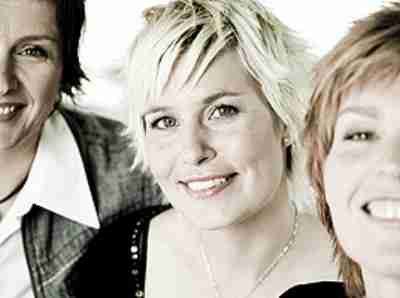
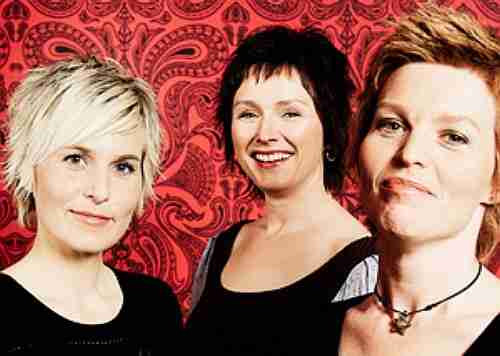
Trio Mediæval was recently broadcast on
NPR St. Paul Sunday [18-NOV-2007]. The a cappella performances of the Trio are a consummately precise blending, with perfectly tuned and controlled pitch and exquisitely matched vibrato. Trio Mediæval’s next live performances will be tomorrow (02 December) at
Cathedral of the Immaculate Conception in Kansas City, on 04 December at Weill Recital Hall at Carnegie Hall in New York City, and on 14 December at Bijloke Concertzaal in Gent.
T he voices of three women, each one distinct and yet all three closely melded. Nothing else... dark silence all around them. I think the group is breathtaking: arresting, vivid, calm but never peaceful, with every moment ready to bring a surprise.”
— Greg Sandow, The Wall Street Journal.
Y ou can’t sing a footnote.”
— Susan Hellauer [of Anonymous 4], on performing medieval music.
A harmony-led view of the music hears a sequence of vertical sonorities made up of rhythmicised pitches proceeding in a linear fashion, while a counterpoint-led view hears lines of rhythmicised pitches that proceed through changing vertical relationships. Put like that, it is not easy to see the difference. But it is in fact a dichotomy that has been perceived between these two views-or, if you prefer, an insistence on perceiving a difference between them-that lies at the heart of the century-long debate about the hearing of medieval music.”
— Daniel Leech-Wilkinson, The Modern Invention of Medieval Music, p. 158.
The first note of a phrase doesn’t get as much attention as cadential notes. But trills, morulae, tremulae, appogiaturas, and microtonal variations—especially on penultimate notes of phrases, and especially when the note is a ‘longa’ and when the interval between it and the following note is an ascending half-step—these increase the already-heightened dramatic tension. When such ornaments are performed slowly and with obvious deliberation, the tension is further increased. Rhetorically, the impact is similar to that of organum purum sung by the upper voice, with a lot of latitude with regard to timing/tempo.
I know only a tiny bit of Norwegian, and this lack of fluency substantially frees me from the literal textuality of the songs. The sounds seem timeless, in part because my linguistic deficiency decouples my comprehending process from the lyric. The sounds also seem ‘permanent’. Compared to the age of these sounds, how minuscule is the time we have to live! The songs remind us of our own mortality, and of the continuation of the world without us. How exactly do these songs ‘work’? And why do the songs’ solitariness and mesmerizing effect remind me of the fiction of Jorge Luis Borges? How medieval/post-modern is that?

- Anna Maria Friman, soprano
- Linn Andrea Fuglseth, soprano
- Torunn Østrem Ossum, soprano
- Birger Mistereggen, guest percussion and mouth harp
- Det lisle bånet (The little child)
- So ro, godt barn (Rest now, sweet child)
- Villemann og Magnhild (Villemann and Magnhild)
- Tjovane (The thieves)
- Nu solen går ned (The sun is setting)
- I mine kåte ungdomsdagar (In my reckless, youthful days)
- Gjendines bådnlåt (Gjendine’s lullaby)
- Rolandskvadet (The song of Roland)
- Solbønn (Sun-prayer)
- Eg veit i himmerik ei borg (I know a stronghold in heaven)
- Nu vilar hela jorden (All the earth now rests in peace)
- Springdans fra Vestfold (Dance from Vestfold)
- Eg aktar inkje (I don’t think much of those boys)
- Den elskte Jerusalem (Beloved Jerusalem)
- Till, Till, Tove (mountain pasture song)
- Lova Line
- Danse, ikke gråte nå (Dance, do not cry now)
- Den signede dag (Day of joy)
The nonsense-syllables (‘tralling’) add to the hypnotic, atemporal quality of the songs. This idiom involves a sequence of improvised syllables, instrumental-sounding passages, and uneven accents—and in this respect ‘tralling’ is similar to Scottish and Irish gaelic ‘mouth music’. Trio Mediæval also does a type of mountain pasture singing known as ‘laling’—an example is the cattle song ‘Till, Till, Tove’.
These contrasts in sonic texture emphasize the transitoriness and shallowness of much of our daily lives and conversations. The contrasts in texture are like Rilke’s cathedral Rose Window; are like Blake’s Tiger’s Eye with its deep fearsome symmetry. The contrasts are like blue-water sailing—water so deep it may as well be bottomless. The Trio’s textural contrasts set up a kind of ‘force-field’: the voices’ effacement of the self induces in us an alienating desire to live an imaginary life in the medieval ‘amour-propre’ sonic space that they create.

W hy mightn’t there be, somehow, a new science for each object? A Mathesis Singularis and no longer Universalis?”
— Roland Barthes, Camera Lucida.
Through these folk songs there emerges a dialectic of signs and symbols, a precursor to the modern, Wittgensteinian notion that the self is a by-product of language, the conflict between particularity and generality, the conflict between the individual and her/his expression: the concept that language and public and private narrative are what enables us to be ourselves. (Self-) consciousness is inhabited by linguistic otherness!
The fact that language is so important in our experience of ‘self’ might lead us to expect that the narrative tension between our private selves and public others must eventually resolve. In fact and paradoxically, with these songs our conventional language-based concept of identity produces the opposite effect. These songs make us seek sources of authentic individual identity beyond language.
The song ‘Gjendines bådnlåt’, for instance, betrays the extent to which the individual is shaped by society and by public discourse. The mother’s lullaby portrays the self as a collage of experiences and begs the philosophical question as to whether there is anything more to us, anything immortal. Introspection in the company of a baby too young to speak; a solitariness-together: the drive toward authenticity leads the song to seek alternatives in unisons and silence—a silence more ‘telling’ than words—in the hope of finding a form of expression for a mystical self, one that will not grow old and die.
T he songs are on fire: the Trio quests for more, ever more immediacy—until one wonders whether the escalations can possibly continue. The Trio’s quest for this supremely authentic self is manifested by a relentless search for sonic truth and timbral purity, even if that search involves, paradoxically, severing the sound/truth from the self (the three singers’ selves), from the sound’s/truth’s substrate. This is an aspect of the ur-scandinavian temperament: a violent, unremitting quest for truth and transcendence through beauty, which inadvertently ends in solipsism, often in desolate wildernesses and darkened churches. This skaldic view is my birthright. I recognize it when I hear it. I am myself Norwegian.”
— DSM.
T he voices blend and fuse in clouded silence: silence that is the infinite of space: and swiftly, silently the soul is wafted over regions of cycles of cycles of generations that have lived.”
— James Joyce, Ulysses.
From the sonorities—the interplay among the notes and the silences reverberating in the cathedral as the Trio sings—one forms new understandings. The listener’s imagination is propelled to new vistas, much in the way that James Joyce’s run-on prosody can move us. The counterpoint between the parts’ colors and rhythms and the sculpted diminuendos that collapse sounds into silences all contribute toward shaping the music into something we can understand, even without our comprehending the Norwegian words. This mental process is like reading Finnegan’s Wake without aiming to decode the English words, understanding it instead by osmosis. Joyce’s writing is not ordinary narrative prose: it is performance art, sculpted poetry, hell on wheels.
When we listen to these folk songs, silence and space play primary, essential roles enabling/compelling us to understand, dividing the cathedral into gestures and sounds, using the gestures to discover a path through sonic ambiguity. Silences provide textural contrast that confers meaning upon the text, and qualifies or reinforces the surface meanings that are present in the text.

T he silent images in the soul bring their silence to the words that are the life of the mind. They work silence into the texture of language: they keep it
supplied with silence, with the original power of silence.”
— Max Picard, Die Welt des Schweigens.
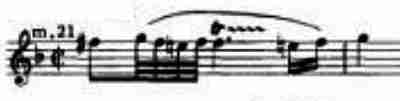
I n the realm of Western art music, silence is generally perceived not as the original power at the centre of the texture, but at the opposite extreme: its acknowledged function is to provide the conventional matting, frame, and structural delimiters to ease and define listeners’ reception of a performance... the dimming of lights, cessation of audience noise, and quiet ambience between movements. [In Mozart,] the silence lacks sound but not motion, the moment of no-sound carrying forward and raising urgent expectations of what is to come. [e.g., piano concerto in G major, K. 453, m.224].”
— Jenny Doctor, Silence, Music, Silent Music.
The first movement of Haydn’s String Quartet Op. 71 No.3, mm. 1-14 has a bar of rest with a fermata, right before the Vivace begins-and unison eighth-note rests subsequently. The silence of the four parts is a way of manipulating the listeners’ expectations of tension and release, of stasis and action. It’s a valuable compositional tool, an effective motivic device—one that arises frequently in the Trio’s arrangements.
S he told me that Ireneo was in the back room and that I should not be disturbed to find him in the dark, for he knew how to pass the dead hours without lighting the candle. I crossed the cobblestone patio, the small corridor; I came to the second patio. A great vine covered everything, so that the darkness seemed complete. Of a sudden I heard the high-pitched, mocking voice of Ireneo. The voice spoke in Latin; the voice (which came out of the obscurity) was reading, with obvious delight, a treatise or prayer or incantation. The Roman syllables resounded in the earthen patio; my suspicion made them seem undecipherable, interminable; afterwards, in the enormous dialogue of that night, I learned that they made up the first paragraph of the twenty-fourth chapter of the seventh book of the Historia Naturalis. The subject of this chapter is memory; the last words are ‘ujt nihil non iisdem verbis redderetur auditum’. Without the least change in his voice, Ireneo bade me come in. He was lying on the cot, smoking. It seems to me that I did not see his face until dawn; I seem to recall the momentary glow of the cigarette. The room smelled vaguely of dampness. I sat down, and repeated the story of the telegram and my father’s illness. I come now to the most difficult point in my narrative. For the entire story has no other point (the reader might as well know it by now) than this dialogue of almost a half-century ago. I shall not attempt to reproduce his words, now irrecoverable. I prefer truthfully to make a résumé of the many things Ireneo told me. The indirect style is remote and weak; I know that I sacrifice the effectiveness of my narrative; but let my readers imagine the nebulous sentences which filled that night. Ireneo began by enumerating, in Latin and Spanish, the cases of prodigious memory cited in the Historia Naturalis: Cyrus, king of the Persians, who could call every soldier in his armies by name; Mithridates Eupator, who administered justice in the twenty-two languages of his empire; Simonides, inventory of mnemotechny; Metrodorus, who practised the art of repeating faithfully what he heard once. With evident good faith Funes marvelled that such things should be considered marvellous. He told me that previous to the rainy afternoon when the blue-tinted horse threw him, he had been—like any Christian—blind, deaf-mute, somnambulistic, memoryless. (I tried to remind him of his precise perception of time, his memory for proper names; he paid no attention to me.) For nineteen years, he said, he had lived like a person in a dream: he looked without seeing, heard without hearing, forgot everything—almost everything. On falling from the horse, he lost consciousness; when he recovered it, the present was almost intolerable it was so rich and bright; the same was true of the most ancient and most trivial memories. A little later he realized that he was crippled. This fact scarcely interested him. He reasoned (or felt) that immobility was a minimum price to pay. And now, his perception and his memory were infallible... A circumference on a blackboard, a rectangular triangle, a rhomb—are forms which we can fully intuit; the same held true with Ireneo for the tempestuous mane of a stallion, a herd of cattle in a pass, the ever-changing flame or the innumerable ash, the many faces of a dead man during the course of a protracted wake. He could perceive I do not know how many stars in the sky. These things he told me; neither then nor at any time later did they seem doubtful. In those days neither the cinema nor the phonograph yet existed; nevertheless, it seems strange, almost incredible, that no one should have experimented on Funes. The truth is that we all live by leaving behind; no doubt we all profoundly know that we are immortal and that sooner or later every human being will do all things and know everything.”
— Jorge Luis Borges, Fune the Memorious.
Borges’ Funes the Memorious character is a person who is constitutionally unable to enter into a story. He can remember and retell anything and everything, but he cannot himself play a part in a story, even the story of his own self. In a story we are prepared to accept an updating of our understanding. And most stories are about people who resist the transformation of their perceptions or of themselves, with comic, tragic, or tragic-comic results. But Funes is unable to do this because his mental condition prevents him from engaging in the mutual fiction of singling from the Real, the core Symbolic fiction of singular reference which rides on our trust in each other—author and reader; singers and listeners—a trust which is prepared to have its granting in the mutual ‘taking-for-granted’ meet with disappointment, discouragement, repudiation.
This is very much the Fune-like ‘spell’ that Trio Mediæval casts. The central feature of our listening consists in temporarily imagining that we have a co-reference with the singers, with the songs. But none of our percepts turns out to be mutual—they could never be updated by anyone else; we recognize them as if déjà vu, and we suffer a sort of aspirational disappointment, a leaving-behind. Similarly, Funes suffers in his withdrawal from the world. In principle, Funes shouldn’t be able to speak at all—and, technically, neither can we (while the Trio’s singing persists). The relation of Borges’ narrator to Funes reveals that the mutual trust of language can and does break down. People talk [sing] past each other, and their mutual trust must acknowledge the finite risk of breakdown. It’s not only Funes who is unable to perfect a reliable, unambiguous understanding in dialogue with a fellow human being: the narrator is revealed as trapped within the same dilemma. And we’re trapped in it, too—we are exposed to unexpected sacrifices and losses, for [and of-] those we love and with whom we imagine ourselves to be fully in harmony. So before we can congratulate ourselves on the luxury of being able to forget so much (whereas Funes was condemned to remember so much), we’re reminded that what we remember may not be what our friends or family have remembered and valued: they may be like Funes, recalling something that we had vaguely sensed but didn’t actively notice, something that at that earlier time had been noticed and remembered by them. The poignant ‘anagnorisis’ in these plot-free stories [songs] turns out to be our own!
So, too, in these songs we marvel at the Fune-like precision of the Trio’s members’ memory. These songs—enchanted and enchanting—give us a glimpse of the existence of an enduring, transcendent self. And then we achieve a sudden, anagnoristic realization that we are, and can only be, something less than that self. We may be less memoriously burdened than the Fune-like Trio. But we are, oh, so much more mortal.
G ode ord skal du hogge i berg; de dårligere i snø. (Praise, write in stone; criticism, in snow.)
Av skade blir man klok—brent barn lukter vondt. (Pain wisens you young; if not wisened, burnt kids smell bad.)
Et lite, men utsøkt selskap, sa mannen—han drakk alene. (Good but small party, said s/he, drinking alone.)”
— Norwegian folksayings.
[Linn Andrea Fuglseth founded Trio Mediæval in 1997. Linn Andrea is from Sandefjord and studied at the Norwegian Academy of Music, specializing in baroque interpretation, and the Guildhall School of Music & Drama in London. She has also trained with Marit Isene, Barbro Marklund, Emma Kirkby and Mary Nichols. Linn Andrea has been soloist with the Stavanger Symphony Orchestra, The Norwegian Baroque Orchestra and Det Norske Solistkor. In addition to singing, she conducts a children’s choir in Oslo and writes arrangements of Norwegian folksongs for the Trio.
Anna Maria Friman is a PhD candidate at the University of York, where she is researching modern performance of medieval music by women. She has presented her research at international musicology conferences—including a paper entitled ‘Early Music Singing: Fact vs. Fiction’ in 2002 and another paper at the ‘Voice, Sound and Subjectivity’ conference in 2005. Anna has performed with the Gavin Bryars Ensemble, Red Byrd, Last Century Ensemble, Ciconia Ensemble, Peter Hill, NYYD Ensemble (Estonia), Latvian Radio Choir, Stuttgart Bach Choir, Det Norske Solistkor, Collegium Vocale Gent, and Ricercar Consort directed by Philippe Pierlot. Her work in the U.S. has included recording with the Girl Choristers of Washington National Cathedral. She grew up in Gothenburg, Sweden.
Torunn Østrem Ossum was originally from Namsos, Norway. She studied singing with Svein Bjørkøy at Rønningen County College in Oslo. She has wide experience as an ensemble singer and has performed with groups such as Det Norske Solistkor, Nordic Voices, Con Spirito and Grex Vocalis conducted by Carl Høgset, where she also sings as a soloist. ]

- Trio Mediæval website
- Trio Mediæval on Myspace
- Trio Mediæval at Alliance Artist Management
- Anna Maria Friman website
- Trio Mediæval. Folk Songs. (ECM, 2007.)
- Trio Mediæval. Stella Maris. (ECM, 2005.)

- Trio Mediæval. Soir, dit-elle. [Evening, says she.] (ECM, 2002.)
- Alazraki J, ed. Critical Essays on Jorge Luis Borges. Hall, 1987.
- Bailey T, Santosuosso A, eds. Music in Medieval Europe. Lund Humphries, 2006.
- Barthes R. Empire of Signs. Hill & Wang, 1983.
- Berger A. Medieval Music and the Art of Memory. Univ California, 2005.
- Berlevag Men's Choir. Cool & Crazy. (FirstRun, 2002.)
- Borges J. Funes the Memorious. 1942.
- Borges J. Labyrinths. New Directions, 2007. (Funes, The Memorious)
- Borges J. Ficciones. Duckworth, 2007.
- Howard W. Historical Figuration: Poetics, Historiography, and New Genre Studies. Literature Compass 2006; 3:1124-49.
- Klinck A, ed. An Anthology of Ancient and Medieval Woman's Song. Palgrave Macmillan, 2004.
- Leech-Wilkinson D. The Modern Invention of Medieval Music: Scholarship, Ideology, Performance. Cambridge Univ, 2002.
- Losseff N, Doctor J, eds. Silence, Music, Silent Music. Ashgate, 2007.
- McGee T. The Sound of Medieval Song: Ornamentation and Vocal Style According to the Treatises. Oxford Univ, 1998.
- McGee T, Rigg A, Klausner D, eds. Singing Early Music: The Pronunciation of European Languages in the Late Middle Ages and Renaissance. Indiana Univ, 1996.
- Prauscello L. Singing Alexandria: Music Between Practice and Textual Transmission. Brill, 2006.
- Sherman B. Inside Early Music: Conversations with Performers. Oxford, 1997.
- Smith F. Nordic Art Music: From the Middle Ages to the Third Millennium. Praeger, 2002.
- Strohm R, Blackburn B, eds. Music As Concept and Practice in the Late Middle Ages. Oxford Univ, 2001.