Showing posts with label time. Show all posts

Tuesday, January 31, 2012

Ingrid Stölzel’s Explorations of Time and Identity

Ingrid Stölzel
A   fter picking the title ‘For the Time Being,’ I realized just how often I use this expression in my daily life. When we say these words we imply that whatever state we are in or whatever action we are performing is temporary and merely a fleeting moment. In reality, of course, all states and actions are temporary, and our perception of permanence is an illusion. ‘For the Time Being’ is the newest in a series of works examining this concept of passing time.”
  — Ingrid Stölzel.
I   didn’t measure how long I was doing mouth-to-mouth breathing, but I remember thinking during the last several minutes that [the plight of this lifeless, transverse-presenting, APGAR-score-zero newborn] was hopeless. But I persisted [thinking that my doing so was, for the time being, at best ridiculous and, at worst, wrong or disrespectful of the natural fact]. And I was finally rewarded when Anna MacRae of Middle River, Victoria County, came to life.”
  — C. Lamont MacMillan, Memoirs of a Cape Breton Doctor.
I ngrid Stölzel’s new composition for flute, soprano saxophone and piano offers great beauty for the listener, plus intriguing expressive and technical challenges for each of the performers. The flute and soprano sax parts are balanced partners, while the piano undertakes an impetuous, omniscient-narratorly, cantus firmus role, with occasional upper-register tolling that explicitly marks the passage of time.

F or the Time Being’ was a commmission by the Greenbrook Ensemble in Nashville. The work that resulted from their commission is a phenomenally beautiful and poignant addition to the trio repertoire for flute, soprano sax, and piano: a 7-min fantasie, in a Walter Piston-esque, Bohuslav Martinů-esque neoclassicist modal-chromatic idiom, symbolically-charged with repetition in both rhythm and pitch, including pedal points. The work is contrapuntal, highly chromatic.

I ts initial lyrical, light and graceful lento is seeded with contemplative rubato, becoming adagio and intermittently more animated/incisive—embodying the transitoriness/impermanence suggested by Stölzel’s remark in the blockquote above. Flute and soprano sax parts are intertwined, coalescing into close harmony and then diverging again. The work embodies an intense chromatic saturation, as contrasted with more ‘open’ diatonic style. The result is subtle: acutely self-aware but never self-absorbed.

I  relistened to the Colorado State YouTube video several times (vid embedded below), capturing timings for the woodwinds. The rhythmic interplay between flute and soprano sax exhibits a fractional structure as a function of frequency that is close to a 1/f relationship, intermediate between uncorrelated ‘white’ noise and strongly-correlated Brownian noise. (An important property of 1/f timeseries structure is that it correlates logarithmically with past values. The last 3 notes, say, have equal influence on what comes next as the last 30 or the last 300.)

A nother feature of 1/f or “nearly-1/f” structure is ‘self-similarity’, which means that the smaller-scale details resemble coarser features that are higher in the hierarchy of structures that comprise the piece. Self-similarity of musical structures has fascinated composers long before fractal and multi-scale mathematics was known. For example, Bach sometimes used the same pitch contour in his fugues in the slow cantus firmus as in the fast motoric figures. So, too, with this new Ingrid Stölzel piece.

S tölzel changes meter many times in the course of the short piece. The continual shifts of meter and tempo are a most noticeable aspect of the work’s complexity, and of its perspective on personhood, self-awareness, and awareness of Time.

T he piece is constructed on a series of dyadic conflicts: episodic expansion/contraction metaphors, mainly involving the flute and soprano sax. Neither wind player can escape or circumvent these chromatic inflections, but must make believable decisions about how to use timbre/spectra to express the conflicts and their resolution. Am I azure or lavender? Was I light turquoise or dark robin’s-egg blue? Remembering/forgetting? Separating/reuniting? Living/dying?

S tölzel meditates... on the socio-historical reality of what it is to be a person, situated in Time and lacking any guarantees; on the connectedness of how we conceive of ourselves, in the context of yesterday, today, tomorrow; on our uncertainty about how much time we have (or don’t have, in the case of those of us who have a highly-uncertain and likely very-much-shortened future due to chronic, life-threatening illness). Martin Heidegger, Wilhelm Dilthey, and Paul Ricoeur are among the philosophers who explored this terrain in the 20th Century. (Links to works by other, more recent authors appear below, for your interest.)

I n other words, the trio is a delicate balance of love and horror—we create something meaningful that soon slips from our grasp; we inevitably lose our loved ones or they lose us; we cling futilely, to hopes that no longer have any reasonable basis. Life: so brutal, so unreliable. Life: the only good thing that we have, for the time being.

I   n any instant the Sacred may wipe you [out] with its finger. In any instant, the bush may burst into flames, your feet may rise, or you may see a bunch of souls in a tree. In any instant you may avail yourself of the power to love your enemies; to accept failure, slander, or the grief of loss; or to endure torture.”
  — Annie Dillard.
I ngrid Stölzel has written for ensembles such as newEar contemporary chamber ensemble, NOISE/San Diego New Music, California E.A.R. Unit, Adaskin String Trio, Erato Chamber Orchestra, Allegrésse, and Synchronia, among others. She is the winner of the 2010 NewMusic@ECU Festival Orchestra Composition Competition, the 2009 Cheryl A. Spector Prize, the 2007 UMKC Chamber Music Composition Competition and the 2006 PatsyLu Prize awarded by the International Alliance of Women in Music. Stölzel is a frequent guest composer and her music has been performed at music festivals and conferences including the 2011 Festival of New American Music, 2011 International Alliance of Women in Music Congress, 2011 New Music Festival X, IC[CM] 2010 International Conference on Contemporary Music in Spain, NACUSA 2010 National Conference, soundOn Festival of Modern Music, 30th Sacramento State Festival of New American Music, Oregon Bach Festivals, Ernest Bloch Festivals, Women in New Music Festival, Chamber Music Conference of the East, Otterbein Contemporary Music Festival, and Indiana State Contemporary Music Festival. Stölzel received her doctorate in composition at the University of Missouri Conservatory of Music and Dance in Kansas City, where she studied with James Mobberley, Chen Yi, and Zhou Long. She holds a Master of Music in composition from the Hartt School of Music in Hartford, Connecticut. Stölzel was a guest composer at the 30th Sacramento State Festival of New American Music. She has done artist residencies at the Ragdale Foundation and the Atlantic Center for the Arts in Florida.
Ingrid is a native of Germany and has lived in the U.S. for the past 20 years.

F or the Time Being’ will be performed in Kansas City in a concert by newEar Ensemble on Saturday, 11-FEB. Go, hear!
I   f the muscle can feel repugnance, there is still a false move to be made;
If the mind can imagine tomorrow, there is still a defeat to remember;
As long as the self can say ‘I,’ it is impossible not to rebel;
As long as there is an accidental virtue, there is a necessary vice:
And the garden cannot exist; the miracle cannot occur.
The garden is the only place there is, but you will not find it
Until you have looked for it everywhere and found nowhere that is not a desert.
The miracle is the only thing that happens, but to you it will not be apparent
Until all events have been studied and nothing happens that you cannot explain.
And Life is the destiny you are bound to refuse until you have consented to die.”
  — W.H. Auden, ‘For the Time Being’.

Aries Composers’ Festival at Colorado State University Center for the Arts, 07-NOV-2011.
B   eran and others comprehend musical self-similarity as a problem of engineering. In contrast, investigations that consider its cultural significance within a certain historical tradition, are very rare (e.g. Kieran 1996, Yadegari 2004). In a brief article published in 1995, Alexander Koblyakov throws a first light on this matter, making a basic statement about the study of musical self-similarity, noticing that [in principle] ‘there is a problem[atic] situation... It is necessary to include the perception (mentality) factor in a considered phenomenon of self-similarity.’ Unfortunately, most of the literature on the subject disregards this sharp observation.”   — Gabriel Pareyon, 2011.

Sunday, February 22, 2009

The Composer Vanishes: Solving the Diffusion Equation Shows that Adès’s ‘Arcadiana’ is Really a Quintet with a Fifth Un-voiced ‘Phantom’ Part

 DSM. Entropy-diffusion from composer Thos. Adès, in absentia, to and through string quartet artists performing ‘Arcadiana’, iii
B   oth form and content in Adès’s music depend upon the multivalent conjunctions that may be derived from relatively elemental forms of continuity… Analyses of ‘Arcadiana’ illustrate the paradoxical nature of postmodern musical time, in which a narrative linear interpretation may emerge from the higher-level perception of locally-concurrent periodicities and trends… Rhythmic analysis entails identifying projections of duration and pitch, as well as processes of timbre and dynamics… In some cases, these interactions are mutually reinforcing; in others, they may embody reorientation or conflict, not to mention ironic deception.”
  —  John Roeder, Music Analysis 2006; 25:121-54.
A    dès’s music merits special attention because of the consistency with which it employs elemental continuities, and because of the variety of temporalities that the composer derives from them... Continuity [is] defined as an association between two percepts, formed when the second realises a mental projection that was made as part of the first. Generally, continuity manifests itself in sequences of successive pitches, or in series of pitch percepts that are not literally successive... It may also subsist in more abstract projections and realisations of duration...”
  —  John Roeder, p. 122.
T he Jupiter String Quartet delivered a wonderful account of Thomas Adès’s String Quartet Op. 12, ‘Arcadiana’ (Venezia notturna; Das klinget so herrlich, das klinget so schön; Auf dem Wasser zu singen; Et... (tango mortale); L’embarquenment; O, Albion; Lethe) [1994] in Kansas City on Friday night in the Friends of Chamber Music 2008-2009 series—this in a program that also included Mendelssohn’s String Quartet in A minor, Op. 13, and Beethoven’s String Quartet in E minor, Op. 59, No. 2.

  • Nelson Lee and Meg Freivogel, violins
  • Liz Freivogel, viola
  • Daniel McDonough, cello
I n 2008, the Jupiter String Quartet received the prestigious Avery Fisher Career Grant, and in 2007 the Quartet won the Cleveland Quartet Award from Chamber Music America. This year is the final year in the Jupiters’ three-year residency with Lincoln Center’s ‘Chamber Music Society Two’. From 2004 to 2006, the Quartet was enrolled in the Professional String Quartet Training Program at New England Conservatory, earning Master of Music degrees in Chamber Music.

A dès wrote his first and, to date, only string quartet in 1994, under commission from Endellion Quartet in the U.K. The work is highly regarded by both performers and by theorists, and has been the subject of several important published analyses. The first several bars of the third movement (‘Auf dem Wasser zu singen’ [To be sung on the water]) are especially amenable to a kind of analysis that I think can shed light on the theme of the whole work—‘vanishing’ and mortality. That is what this post is about...

F ranz Schubert’s ‘Auf dem Wasser zu singen’ D. 774 (1823) is a setting of Friedrich Leopold Graf zu Stolberg-Stolberg’s poem, written in 1782—which Adès took as an inspiration/calibration for this third movement.

M    itten im Schimmer der spiegelnden Wellen
Gleitet, wie Schwäne, der wankende Kahn:
Ach, auf der Freude sanftschimmernden Wellen
Gleitet die Seele dahin wie der Kahn;
Denn von dem Himmel herab auf die Wellen
Tanzet das Abendrot rund um den Kahn.

Über den Wipfeln des westlichen Haines
Winket uns freundlich der rötliche Schein;
Unter den Zweigen des östlichen Haines
Säuselt der Kalmus im rötlichen Schein;
Freude des Himmels und Ruhe des Haines
Atmet die Seel im errötenden Schein.

Ach, es entschwindet mit tauigem Flügel
Mir auf den wiegenden Wellen die Zeit;
Morgen entschwinde mit schimmerndem Flügel—
Wieder wie gestern und heute die Zeit—
Bis ich auf höherem strahlendem Flügel
Selber entschwinde der wechselnden Zeit.

[Amid the glimmer of sparkling waves,
The bobbing boat glides like a swan:
Ah, the soul glides onward like the boat,
On shimmering, gleaming waves of joy;
For the sunset glow, shining down from heaven
Upon the waves, dances all ‘round the boat.

The rosy light winks at us
From above the treetops of the western wood;
Beneath the branches of the eastern wood,
The reeds whisper in the light—
In the reddening glow, the soul breathes
The joy of heaven, the peace of the grove.

Ah, alas, Time itself vanishes on dewy wings and I with It,
Into the weighty cradle of the waves.
Tomorrow, Time will fly away on glistening wings—
As it did today and yesterday and the day before—
Until I myself fly away from Time’s inconstancy
On yet loftier, more radiant wings.] ”
  —  Friedrich Leopold Graf zu Stolberg-Stolberg, ‘Auf dem Wasser zu singen’ [To be sung on the Water], 1782.
H ow does this piece work? What makes ‘Arcadiana’ ‘tick’? I look first at my rhythm metrics... These are not Fibonacci series... Ah, this quartet feels like a diffusion problem! Analytical solutions to heat- and mass-transfer problems reduce to solving partial differential equations (PDEs)—in this case, the so-called ‘heat equation’, treating the medium as a homogeneous solid under appropriate initial and boundary conditions. Hypothetically, the IC and BC can include convective and radiative interactions with the environment, but in the present example of Adès’s ‘Arcadiana’ I ignore convection and radiation possibilities.

M any analytical solutions of the heat equation refer just to the simple one-dimensional situation, with a ‘heat capacity’ c, a ‘diffusion coefficient’ k, and a ‘loss term’, φ, to account for dissipation of energy as diffusion proceeds.

 DSM. Diffusion equation with dissipation term φ
T he Endellion Quartet recording of ‘Arcadiana’ is the only one currently available. But, obviously, it is not possible to separate the four parts in the stereo channels. So I transcribed each part into Finale®, played each track individually, ripped myself MP3s from those, converted to WAV files, and began examining entropy as a function of time using FAWAV® and MATLAB®’s signal-processing toolbox.

 DSM. Wavelet-transform entropy analysis of viola part, mm. 1-4, ‘Arcadiana’, iii
T he results surprise even me. Using Crank-Nicholson finite-difference math to solve the 1-dimensional diffusion equation for propagation of entropy S(t), I find that the entropy pulse in the viola part diffuses to the cello, which appears to be sitting a “virtual 1,600 msec” away. Then the same entropy pulse appears, diffusing to the vn2 part with a smaller peak amplitude and more spread-out, consistent with a non-zero ‘dissipation’ within the expressive ‘medium’ constituted by the music. The vn2 appears to be located, according to the Crank-Nicholson solution of the diffusion equation, at a distance of about 2,100 msec from the cello. Further downstream, vn1 experiences the diffusing entropy pulse, at a virtual distance 1,200 msec away from vn2.

 Example 11a from John Roeder, ‘Co-operating continuities in the music of Thos. Adès’, Music Anal 2006; 25:121-54
A   dès often combines such elemental durational and pitch continuities within a single stream so that their realised projections are made to reinforce one another ... a series of regularly increasing and descending pitch-intervals unfolds [in ‘Arcadiana’, iii] within a sequence of regularly decreasing durations.”
  —  John Roeder, p. 126.
T   he effects of harmonic confluence may lead to a blurring of streams, and thus to a clear sense of temporal interaction, not merely co-operation. Example 11a renotates and simplifies the first eight bars of the third movement of ‘Arcadiana’ in order to foreground the two streams of activity which characterise this passage. In the pizzicato stream, the instruments alternate transpositions of the accelerating expanding-interval motive... The registral and transformational termination of the motive’s accelerating free-fall imparts a frustrated potential energy to its final interval that finds only tentative release in the contrasting tremolos of hexatonically stacked perfect fifths...”
  —  John Roeder, p. 141.

T hese results by themselves were fascinating to me. But then I got to thinking. Who is the ‘source’? The patterns account for the palpable, organically-sensible relative locations of four performers experiencing an entropy wave. But where is the entity who emitted this entropy wave? Can we use the PDE solution to impute where that ‘phantom’ source is ‘located’ with respect to the 1-D positions of the other players? (Click on the jpeg below to download the Excel spreadsheet with the C-N results in it.)

 DSM, Crank-Nicholson solution for entropy-diffusion in mm.1-4 of Thos. Adès’s ‘Arcadiana’, iii
A nd the answer is, ‘Yes’! If we take the ‘source’ of the entropy wave to be the composer in-absentia, then the diffusion equation says that that invisible, inaudible phantom is located about 3,200 msec upstream of the viola (jpeg at top of this CMT post). This piece is a quasi-quintet where the fifth player is absent!

A ctually, encouraged by the preliminary findings above today I’ve begun to do more calculations from other sections of this movement. And it appears that not only do the four string parts move around with respect to each other, as evidenced by the diffusion of entropy pulses propagating between and amongst them, so too does the phantom of Adès move, hovering at times very nearby one part and at other times watching the quartet at what is apparently a great distance.

 John Roeder, Mus Analysis 2006; 25:121-54, Example 1c, Arcadiana, iii, mm. 1-2
 John Roeder, Mus Analysis 2006; 25:121-54, Table 1
J ohn Roeder’s wonderful 2006 article in the journal Music Analysis—on coordinated continuities in Adès—is a great contribution to our understanding, illuminating a number of the features and mechanics of what Adès is doing. But I think what we have here (in entropy-diffusion evidence) is far deeper and far more symbolic (of Adès’s theme of mortality and vanishing) than Roeder and others have thus far recognized. What Adès has constructed here is nothing less than a statistical physics ‘diffusion chamber’ in which the four living performers together create an acoustic entropy field that strongly implies the existence/presence of the music’s creator. We are each familiar with the diffusion of a solute like sugar as it dissolves in a cup of tea; we are each familiar with the diffusion of heat by conduction through the cup from the hot inside to the surface that we hold in our hand. And the diffusive/dissipative effects that Adès has crafted here also strike the performer/listener as intuitively, empirically, palpably familiar. The fact that we can quantitatively model them and analyze them with pretty fancy math tools does not in any way diminish the fact that the underlying cognitive physics that Adès is using is utterly elemental, utterly organic.

A rcadiana’ is very difficult to play, yes. But when played well, the quartet evokes a physical reality that belies the technical difficulty. The very memory and spirit of the person who is absent are reanimated by the performers. We sense Adès’s presence through the implied [silent] fifth voice that is the source of the entropy waves that percolate throughout the other four parts. I find this deeply beautiful, as I hope you do as well. Thank you, Thomas! Thank you, Jupiters!

W   e are particularly fond of the ‘Arcadiana’ quartet. We wish Thomas would get busy and write more quartets.”
  — Daniel McDonough, Jupiter String Quartet, 20-FEB-2009, remark over supper.

 Jupiter String Quartet


Saturday, December 1, 2007

Trio Mediæval: A Cappella Anagnorisis

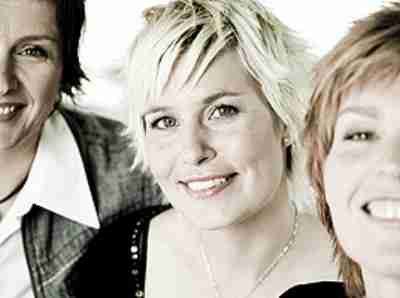
Trio Mediæval, photo by Wesenberg
H  e was the solitary and lucid spectator of a multiform, instantaneous and almost intolerably precise world.”
  —  Jorge Luis Borges, Funes the Memorious.

Trio Mediæval was recently broadcast on NPR St. Paul Sunday [18-NOV-2007]. The a cappella performances of the Trio are a consummately precise blending, with perfectly tuned and controlled pitch and exquisitely matched vibrato. Trio Mediæval’s next live performances will be tomorrow (02 December) at Cathedral of the Immaculate Conception in Kansas City, on 04 December at Weill Recital Hall at Carnegie Hall in New York City, and on 14 December at Bijloke Concertzaal in Gent.

T  he voices of three women, each one distinct and yet all three closely melded. Nothing else... dark silence all around them. I think the group is breathtaking: arresting, vivid, calm but never peaceful, with every moment ready to bring a surprise.”
  —  Greg Sandow, The Wall Street Journal.

Y  ou can’t sing a footnote.”
  —  Susan Hellauer [of Anonymous 4], on performing medieval music.

A  harmony-led view of the music hears a sequence of vertical sonorities made up of rhythmicised pitches proceeding in a linear fashion, while a counterpoint-led view hears lines of rhythmicised pitches that proceed through changing vertical relationships. Put like that, it is not easy to see the difference. But it is in fact a dichotomy that has been perceived between these two views-or, if you prefer, an insistence on perceiving a difference between them-that lies at the heart of the century-long debate about the hearing of medieval music.”
  —  Daniel Leech-Wilkinson, The Modern Invention of Medieval Music, p. 158.
The first note of a phrase doesn’t get as much attention as cadential notes. But trills, morulae, tremulae, appogiaturas, and microtonal variations—especially on penultimate notes of phrases, and especially when the note is a ‘longa’ and when the interval between it and the following note is an ascending half-step—these increase the already-heightened dramatic tension. When such ornaments are performed slowly and with obvious deliberation, the tension is further increased. Rhetorically, the impact is similar to that of organum purum sung by the upper voice, with a lot of latitude with regard to timing/tempo.

I know only a tiny bit of Norwegian, and this lack of fluency substantially frees me from the literal textuality of the songs. The sounds seem timeless, in part because my linguistic deficiency decouples my comprehending process from the lyric. The sounds also seem ‘permanent’. Compared to the age of these sounds, how minuscule is the time we have to live! The songs remind us of our own mortality, and of the continuation of the world without us. How exactly do these songs ‘work’? And why do the songs’ solitariness and mesmerizing effect remind me of the fiction of Jorge Luis Borges? How medieval/post-modern is that?

Folk Songs
  • Anna Maria Friman, soprano
  • Linn Andrea Fuglseth, soprano
  • Torunn Østrem Ossum, soprano
  • Birger Mistereggen, guest percussion and mouth harp

  • Det lisle bånet (The little child)
  • So ro, godt barn (Rest now, sweet child)
  • Villemann og Magnhild (Villemann and Magnhild)
  • Tjovane (The thieves)
  • Nu solen går ned (The sun is setting)
  • I mine kåte ungdomsdagar (In my reckless, youthful days)
  • Gjendines bådnlåt (Gjendine’s lullaby)
  • Rolandskvadet (The song of Roland)
  • Solbønn (Sun-prayer)
  • Eg veit i himmerik ei borg (I know a stronghold in heaven)
  • Nu vilar hela jorden (All the earth now rests in peace)
  • Springdans fra Vestfold (Dance from Vestfold)
  • Eg aktar inkje (I don’t think much of those boys)
  • Den elskte Jerusalem (Beloved Jerusalem)
  • Till, Till, Tove (mountain pasture song)
  • Lova Line
  • Danse, ikke gråte nå (Dance, do not cry now)
  • Den signede dag (Day of joy)

The nonsense-syllables (‘tralling’) add to the hypnotic, atemporal quality of the songs. This idiom involves a sequence of improvised syllables, instrumental-sounding passages, and uneven accents—and in this respect ‘tralling’ is similar to Scottish and Irish gaelic ‘mouth music’. Trio Mediæval also does a type of mountain pasture singing known as ‘laling’—an example is the cattle song ‘Till, Till, Tove’.

These contrasts in sonic texture emphasize the transitoriness and shallowness of much of our daily lives and conversations. The contrasts in texture are like Rilke’s cathedral Rose Window; are like Blake’s Tiger’s Eye with its deep fearsome symmetry. The contrasts are like blue-water sailing—water so deep it may as well be bottomless. The Trio’s textural contrasts set up a kind of ‘force-field’: the voices’ effacement of the self induces in us an alienating desire to live an imaginary life in the medieval ‘amour-propre’ sonic space that they create.

Trio Mediæval, photo by Mikkelsen
W  hy mightn’t there be, somehow, a new science for each object? A Mathesis Singularis and no longer Universalis?”
  —  Roland Barthes, Camera Lucida.
Through these folk songs there emerges a dialectic of signs and symbols, a precursor to the modern, Wittgensteinian notion that the self is a by-product of language, the conflict between particularity and generality, the conflict between the individual and her/his expression: the concept that language and public and private narrative are what enables us to be ourselves. (Self-) consciousness is inhabited by linguistic otherness!

The fact that language is so important in our experience of ‘self’ might lead us to expect that the narrative tension between our private selves and public others must eventually resolve. In fact and paradoxically, with these songs our conventional language-based concept of identity produces the opposite effect. These songs make us seek sources of authentic individual identity beyond language.

The song ‘Gjendines bådnlåt’, for instance, betrays the extent to which the individual is shaped by society and by public discourse. The mother’s lullaby portrays the self as a collage of experiences and begs the philosophical question as to whether there is anything more to us, anything immortal. Introspection in the company of a baby too young to speak; a solitariness-together: the drive toward authenticity leads the song to seek alternatives in unisons and silence—a silence more ‘telling’ than words—in the hope of finding a form of expression for a mystical self, one that will not grow old and die.

T  he songs are on fire: the Trio quests for more, ever more immediacy—until one wonders whether the escalations can possibly continue. The Trio’s quest for this supremely authentic self is manifested by a relentless search for sonic truth and timbral purity, even if that search involves, paradoxically, severing the sound/truth from the self (the three singers’ selves), from the sound’s/truth’s substrate. This is an aspect of the ur-scandinavian temperament: a violent, unremitting quest for truth and transcendence through beauty, which inadvertently ends in solipsism, often in desolate wildernesses and darkened churches. This skaldic view is my birthright. I recognize it when I hear it. I am myself Norwegian.”
  — DSM.

T  he voices blend and fuse in clouded silence: silence that is the infinite of space: and swiftly, silently the soul is wafted over regions of cycles of cycles of generations that have lived.”
  —  James Joyce, Ulysses.
From the sonorities—the interplay among the notes and the silences reverberating in the cathedral as the Trio sings—one forms new understandings. The listener’s imagination is propelled to new vistas, much in the way that James Joyce’s run-on prosody can move us. The counterpoint between the parts’ colors and rhythms and the sculpted diminuendos that collapse sounds into silences all contribute toward shaping the music into something we can understand, even without our comprehending the Norwegian words. This mental process is like reading Finnegan’s Wake without aiming to decode the English words, understanding it instead by osmosis. Joyce’s writing is not ordinary narrative prose: it is performance art, sculpted poetry, hell on wheels.

When we listen to these folk songs, silence and space play primary, essential roles enabling/compelling us to understand, dividing the cathedral into gestures and sounds, using the gestures to discover a path through sonic ambiguity. Silences provide textural contrast that confers meaning upon the text, and qualifies or reinforces the surface meanings that are present in the text.

Trio Mediæval, photo by Mikkelsen
T  he silent images in the soul bring their silence to the words that are the life of the mind. They work silence into the texture of language: they keep it
supplied with silence, with the original power of silence.”
  —  Max Picard, Die Welt des Schweigens.

I  n the realm of Western art music, silence is generally perceived not as the original power at the centre of the texture, but at the opposite extreme: its acknowledged function is to provide the conventional matting, frame, and structural delimiters to ease and define listeners’ reception of a performance... the dimming of lights, cessation of audience noise, and quiet ambience between movements. [In Mozart,] the silence lacks sound but not motion, the moment of no-sound carrying forward and raising urgent expectations of what is to come. [e.g., piano concerto in G major, K. 453, m.224].”
  —  Jenny Doctor, Silence, Music, Silent Music.
The first movement of Haydn’s String Quartet Op. 71 No.3, mm. 1-14 has a bar of rest with a fermata, right before the Vivace begins-and unison eighth-note rests subsequently. The silence of the four parts is a way of manipulating the listeners’ expectations of tension and release, of stasis and action. It’s a valuable compositional tool, an effective motivic device—one that arises frequently in the Trio’s arrangements.

S  he told me that Ireneo was in the back room and that I should not be disturbed to find him in the dark, for he knew how to pass the dead hours without lighting the candle. I crossed the cobblestone patio, the small corridor; I came to the second patio. A great vine covered everything, so that the darkness seemed complete. Of a sudden I heard the high-pitched, mocking voice of Ireneo. The voice spoke in Latin; the voice (which came out of the obscurity) was reading, with obvious delight, a treatise or prayer or incantation. The Roman syllables resounded in the earthen patio; my suspicion made them seem undecipherable, interminable; afterwards, in the enormous dialogue of that night, I learned that they made up the first paragraph of the twenty-fourth chapter of the seventh book of the Historia Naturalis. The subject of this chapter is memory; the last words are ‘ujt nihil non iisdem verbis redderetur auditum’. Without the least change in his voice, Ireneo bade me come in. He was lying on the cot, smoking. It seems to me that I did not see his face until dawn; I seem to recall the momentary glow of the cigarette. The room smelled vaguely of dampness. I sat down, and repeated the story of the telegram and my father’s illness. I come now to the most difficult point in my narrative. For the entire story has no other point (the reader might as well know it by now) than this dialogue of almost a half-century ago. I shall not attempt to reproduce his words, now irrecoverable. I prefer truthfully to make a résumé of the many things Ireneo told me. The indirect style is remote and weak; I know that I sacrifice the effectiveness of my narrative; but let my readers imagine the nebulous sentences which filled that night. Ireneo began by enumerating, in Latin and Spanish, the cases of prodigious memory cited in the Historia Naturalis: Cyrus, king of the Persians, who could call every soldier in his armies by name; Mithridates Eupator, who administered justice in the twenty-two languages of his empire; Simonides, inventory of mnemotechny; Metrodorus, who practised the art of repeating faithfully what he heard once. With evident good faith Funes marvelled that such things should be considered marvellous. He told me that previous to the rainy afternoon when the blue-tinted horse threw him, he had been—like any Christian—blind, deaf-mute, somnambulistic, memoryless. (I tried to remind him of his precise perception of time, his memory for proper names; he paid no attention to me.) For nineteen years, he said, he had lived like a person in a dream: he looked without seeing, heard without hearing, forgot everything—almost everything. On falling from the horse, he lost consciousness; when he recovered it, the present was almost intolerable it was so rich and bright; the same was true of the most ancient and most trivial memories. A little later he realized that he was crippled. This fact scarcely interested him. He reasoned (or felt) that immobility was a minimum price to pay. And now, his perception and his memory were infallible... A circumference on a blackboard, a rectangular triangle, a rhomb—are forms which we can fully intuit; the same held true with Ireneo for the tempestuous mane of a stallion, a herd of cattle in a pass, the ever-changing flame or the innumerable ash, the many faces of a dead man during the course of a protracted wake. He could perceive I do not know how many stars in the sky. These things he told me; neither then nor at any time later did they seem doubtful. In those days neither the cinema nor the phonograph yet existed; nevertheless, it seems strange, almost incredible, that no one should have experimented on Funes. The truth is that we all live by leaving behind; no doubt we all profoundly know that we are immortal and that sooner or later every human being will do all things and know everything.”
  —  Jorge Luis Borges, Fune the Memorious.
Borges’ Funes the Memorious character is a person who is constitutionally unable to enter into a story. He can remember and retell anything and everything, but he cannot himself play a part in a story, even the story of his own self. In a story we are prepared to accept an updating of our understanding. And most stories are about people who resist the transformation of their perceptions or of themselves, with comic, tragic, or tragic-comic results. But Funes is unable to do this because his mental condition prevents him from engaging in the mutual fiction of singling from the Real, the core Symbolic fiction of singular reference which rides on our trust in each other—author and reader; singers and listeners—a trust which is prepared to have its granting in the mutual ‘taking-for-granted’ meet with disappointment, discouragement, repudiation.

This is very much the Fune-like ‘spell’ that Trio Mediæval casts. The central feature of our listening consists in temporarily imagining that we have a co-reference with the singers, with the songs. But none of our percepts turns out to be mutual—they could never be updated by anyone else; we recognize them as if déjà vu, and we suffer a sort of aspirational disappointment, a leaving-behind. Similarly, Funes suffers in his withdrawal from the world. In principle, Funes shouldn’t be able to speak at all—and, technically, neither can we (while the Trio’s singing persists). The relation of Borges’ narrator to Funes reveals that the mutual trust of language can and does break down. People talk [sing] past each other, and their mutual trust must acknowledge the finite risk of breakdown. It’s not only Funes who is unable to perfect a reliable, unambiguous understanding in dialogue with a fellow human being: the narrator is revealed as trapped within the same dilemma. And we’re trapped in it, too—we are exposed to unexpected sacrifices and losses, for [and of-] those we love and with whom we imagine ourselves to be fully in harmony. So before we can congratulate ourselves on the luxury of being able to forget so much (whereas Funes was condemned to remember so much), we’re reminded that what we remember may not be what our friends or family have remembered and valued: they may be like Funes, recalling something that we had vaguely sensed but didn’t actively notice, something that at that earlier time had been noticed and remembered by them. The poignant ‘anagnorisis’ in these plot-free stories [songs] turns out to be our own!

So, too, in these songs we marvel at the Fune-like precision of the Trio’s members’ memory. These songs—enchanted and enchanting—give us a glimpse of the existence of an enduring, transcendent self. And then we achieve a sudden, anagnoristic realization that we are, and can only be, something less than that self. We may be less memoriously burdened than the Fune-like Trio. But we are, oh, so much more mortal.

G  ode ord skal du hogge i berg; de dårligere i snø. (Praise, write in stone; criticism, in snow.)
Av skade blir man klok—brent barn lukter vondt. (Pain wisens you young; if not wisened, burnt kids smell bad.)
Et lite, men utsøkt selskap, sa mannen—han drakk alene. (Good but small party, said s/he, drinking alone.)”
  —  Norwegian folksayings.

[Linn Andrea Fuglseth founded Trio Mediæval in 1997. Linn Andrea is from Sandefjord and studied at the Norwegian Academy of Music, specializing in baroque interpretation, and the Guildhall School of Music & Drama in London. She has also trained with Marit Isene, Barbro Marklund, Emma Kirkby and Mary Nichols. Linn Andrea has been soloist with the Stavanger Symphony Orchestra, The Norwegian Baroque Orchestra and Det Norske Solistkor. In addition to singing, she conducts a children’s choir in Oslo and writes arrangements of Norwegian folksongs for the Trio.

Anna Maria Friman is a PhD candidate at the University of York, where she is researching modern performance of medieval music by women. She has presented her research at international musicology conferences—including a paper entitled ‘Early Music Singing: Fact vs. Fiction’ in 2002 and another paper at the ‘Voice, Sound and Subjectivity’ conference in 2005. Anna has performed with the Gavin Bryars Ensemble, Red Byrd, Last Century Ensemble, Ciconia Ensemble, Peter Hill, NYYD Ensemble (Estonia), Latvian Radio Choir, Stuttgart Bach Choir, Det Norske Solistkor, Collegium Vocale Gent, and Ricercar Consort directed by Philippe Pierlot. Her work in the U.S. has included recording with the Girl Choristers of Washington National Cathedral. She grew up in Gothenburg, Sweden.

Torunn Østrem Ossum was originally from Namsos, Norway. She studied singing with Svein Bjørkøy at Rønningen County College in Oslo. She has wide experience as an ensemble singer and has performed with groups such as Det Norske Solistkor, Nordic Voices, Con Spirito and Grex Vocalis conducted by Carl Høgset, where she also sings as a soloist. ]

Smith book

Losseff book