Showing posts with label singing. Show all posts

Monday, January 16, 2012

How likely to sing after radiation therapy for head-and-neck cancer?

ASCAR
F   or oropharynx and nasopharynx cancers, it is sometimes possible to limit the dose received by the larynx according to the extent of the primary lesion. Thus, if the tumour constraints permit, the maximum dose to the larynx must be less than 63 to 66 Gy. To reduce the risk of laryngeal edema, it is recommended if possible to limit the mean non-involved larynx dose to 40 to 45 Gy [to prevent dysphonia or significant damage to vocal cords/folds].”
  —  C. Debelleix and co-workers, Centre Hospitalier Dax-Côte d'Argent, France.
T he question in this post's title has arisen several times each year over the 5 years I've been writing this blog. A relatively small percentage of the approximately 52,000 persons per year who receive a diagnosis of some form of cancer of the head and neck (U.S. SEER statistics; AHRQ HCUPnet statistics for procedures HCPCS L30318, G0251, G0339, G0340; CPT-4 77373, 77401-77435, etc.; ICD-9 92.3x) and the thousands of patients (U.S.) who receive radiation to the neck as part of a treatment regimen for a head-and-neck cancer are singers—either avid amateurs or professionals. However, the rate of inquiry by (or on behalf of) singers for whom this situation does happen is evidently not by any means ‘rare’. There have been 6 such search-strings that I have noticed in the CMT traffic logs in the past 3 weeks alone.

S o this post is meant to provide you with links to recent medical literature that you can show to your otolaryngologist/oncologist and discuss. In that regard, the typical radiation oncologist tends not to be expert in medical management of musicians; conversely, specialists in medical problems of musicians tend not to have a great deal of experience with head-and-neck cancers for which radiation therapy is routinely used. This is compounded by the fact that the situation of singers undergoing radiation to the neck is just uncommon enough that there are not many clinical trials or specific studies conducted in that population. The published studies that have some relevancy to the question are not easy for your physician to locate online or in the library either—which is why I believe providing these links will be helpful.

A  majority of the published work on this topic has to do with ‘quality-of-life’ (QoL) measurement in cancer patients treated with radiation to the neck, where one of the QoL measurements is ease of vocalization and the frequency and severity of pain or hoarseness or other forms of dysphonia or vocal abnormalities.

F or each patient, the specific cancer type and the extent of the cancer’s spread and other factors contribute to the decision-making as to whether ‘larynx-sparing’ reduced-dose, stereotactic, imagery-guided radiation therapy is a sensible approach or not. But in those cases where it is deemed to be a reasonable approach, there are specific guidelines for planning and conducting such radiotherapy.

O f course, there is no guarantee that returning to singing will be achievable, or that vocal quality or agility or range or endurance will be the same as they were prior to treatment. But to get the best chance for those outcomes, the info in the lit below should be part of your decision-making with your doctors.

I f you’re one of those who’ve been hitting the web and this blog looking for info on larynx-preserving radiotherapy and prognosis with regard to return to post-treatment singing, maybe the links below will be useful for you and your doc!

Thursday, January 29, 2009

Singing & Dry Mouth: Things You Might Not Have Tried

 Mouth
M    y mouth gets incredibly dry when I sing. Are there any new things to try out there? A gel I tried once felt greasy in my mouth, so that was the end of that. And sprays I’ve tried only last about 10 minutes.”
  —  Anonymous email to CMT.
T he short duration of action you experienced with the sprays isn’t unusual. You need to remember that any extraneous material in the mouth tends to induce reflexive/habitual motions (of tongue, etc.) to remove it and clear it out. Products that would have a longer duration of action for regular people just sitting around and not talking or singing may not last so long for you during a vocal performance. Years ago, I used to take care of cancer patients, both immediately after radiation treatment and later in palliative care, so I do know something about the strengths and limitations of the ‘artificial saliva’ products that are available.

S ubjective dry mouth sensation is known as xerostomia. But when sialometry (performed by a physician immunologist or laryngologist) objectively demonstrates a saliva flow rate of under 0.2 mL/min (resting salivation rate) and under 0.7 mL/min (stimulated salivation rate), the fancy medical terms ‘hyposialia’, ‘sialopenia’, or ‘salivary hyposecretion’ are used—basically, saliva production less than 500 mL of saliva a day, against ‘normal’ losses of saliva to (mouth-open breathing-related) evaporation and ordinary swallowing of saliva: a deficient production compared to normal losses.

L ow saliva not what the question above was about, though. The question has mostly to do with increased evaporative losses associated with large minute-wise airflow for singing, against ‘normal’ saliva flow rates that are unable to keep up with the rate of loss. In some cases, the dry mouth may be exacerbated by stage fright or allergies or medications you might be taking or a health condition that causes the mouth to be dry. But, for many singers, it’s just the mismatch between the (modest-but-normal) rate of saliva production and the (singing-accelerated) rate of saliva loss.

T he artificial saliva material may not only migrate down the throat into the esophagus, but also (in small amounts) into the larynx. So with regard to singing, please be sure to try out whatever solution you are planning to use in advance—in rehearsals long before any public performance. You don’t want to do anything radically new or un-tested on-stage.

D ry mouth is treated with liquid or gel artificial saliva solutions that are designed so that they will be retained on the mucosal surfaces for a period of some tens of minutes at least, to provide lubrication. These solutions contain bioadhesive polymers (chains that range from a few thousand Daltons molecular weight up to about 100 KDa MW), often sodium carboxymethyl cellulose (CMC). Some newer ones have an oxygenated glycerine tri-ester (TGO) active ingredient. Most of these have a rather slippery/sticky ‘mouth-feel’, but are well worth a try.

G ellan gum and alginate also both form mucoadherent gels, albeit by a different mechanism (ionic strength of moisture at physiologic mucosal surface) than the others. There are a few over-the-counter products that have these as their active ingredients.

G el-based artificial saliva products have traditionally been more effective and last longer than ‘spray’ type artificial salivas. This has been extensively studied in palliative-care patients, especially terminal cancer. But there are some mucin-mimicking artificial saliva products that have been introduced just in the last two years that have performed well in clinical trials.

P oloxamers in 2% w/v to 5% w/v solutions are liquids at room temperature but gel at body temperature, once they are applied inside the mouth.

T he polyvinylpyrrolidone polymer within an anionic polymer solution (Oasis®) enables higher concentrations of mucoadhesive polymer than older products achieve. These PVP copolymer films stay ‘stuck’ to the mouth tissues for longer, while at the same time giving improved mouth-feel due to reduced slippery/sticky mouth-feel, compared to carboxymethylcellulose (CMC)-based artificial saliva products. I have tried Oasis® and think it works very well.

 Polyoxamer F-127 N ote that the Oasis® spray does not have poloxamer in it. You can use as required, up to a maximum of 60 sprays per day. Each application of the Oasis® mouthwash lasts about 2 hours; each application of the Oasis® spray keeps your mouth feeling moist for, at most, 60 min or so. The Oasis® mouthwash would probably work better for a singer performing longer concerts. (Supposedly, Mariah Carey uses MouthKote® spray…)

T alk to your retail pharmacist. Those with training in clinical pharmacy are well prepared to advise you on the pros and cons of the various products. Some pharmacies don’t stock these products, or have a small selection since it’s a low-volume type of item, used by relatively few patients. So you may have to look for mail-order options. The hyperlinks embedded in this CMT post will give you a few options you can check out.

O r talk to your dentist. With the exception of palliative medicine physicians, oncologist physicians, ENT physicians, immunologist physicians and some gerontologists, most physicians have little experience with dry mouth and are not expert in managing it. Dentists are, in general, very knowledgeable about OTC and prescription approaches to treating dry mouth. In the U.S., artificial saliva products are regulated by FDA CDRH as Class II 510(k) dental medical devices, not as drugs.

S ome products (like Salivese®, Glandosane®, BioXtra®, and Salivix®) are only licensed for dry mouth due to radiotherapy or Sjogren’s Syndrome and require a prescription. You don’t have to have one of those ‘on-label’ conditions to get a prescription for these. A physician or dentist could legally write a prescription for you (‘off-label’). But you would have to explain to them what your performing activity entails, and why you need a powerful artificial saliva—get them to understand why other things have not been adequately effective for you and why you therefore would like to try a prescription for one of these ‘heavier-duty’ artificial saliva products.


Sunday, March 9, 2008

Tallis Scholars: Historically-Informed Alterity Causes Ecstatic Shivering and Paroxysmal Tearing

 Tallis Scholars
T   wo stanzas, and the tune is done. Silence hangs over the hall. It drifts above the seats like a balloon across the horizon. For two downbeats, even breathing is a crime. Then there’s no surviving this surprise except by applauding it away. The noisy gratitude of hands starts time up again, sending the dart to its target and my brother on to the things that will finish him.”
  —  Richard Powers, The Time of Our Singing, p. 4.
M   usical liturgical life does unquestionably contain this potential [to elicit a thrill of existential elation and fear and longing]: its legacy even now supplies much of the repertoire for secularized concert-goers; and its visual art stocks our galleries and continues to inspire... The phenomenon of ‘edge’ experience certainly links worship to universal human apprehension. It does more: it directs worship itself back to an original evocative power, a force which seems mostly to have been overtaken by the mundanity it was supposed to overcome.”
  —  Graham Hughes, Worship as Meaning, p. 276.
L   iturgical theology for late modern times must show how worship can make sense for people shaped within the modern paradigm... Worship’s recognizability lies in its coherence with other human ‘boundary’ experiences. Worship cannot be simply coextensive with generalized human experience. ‘Meaning,’ hence liturgical meaning, lies in the play on one another of similarity and difference. Characteristic of ‘edge’ experiences is that these heighten or intensify—and in this way disclose—what has always been the case. Perturbation can range in intensity from the annoyance of missing my train, to a disbelieving discovery that my job no longer exists. And elation can be either the joy of a spring morning or beaing head-over-heels in love. But this sliding scale between normalcy and the extraordinary also means that there are infinite degrees according to which I will allow the ‘alterity of the edge’ to assert itself... The sensed security can be illusory: it is possible to be hurled from assured self-determination to uttermost dread in seconds. Even should I be so fortunate in life as never to have been plunged in crisis my equanimity conceals the fact of my ‘thrownness’: that I had no say in whether and in which circumstances I would be born, nor about my eventual departure. At the borders, exposed and concealed, I am anything but in-control. And at these edges—whether of disaster or of fortune—it will not be uncommon to use language such as ‘undone’, ‘coming to pieces’, ‘at my wits’ ends’. In a word, alterity which had been kept at bay in ordinariness is now terrifyingly (or wonderfully) real.”
  —  Graham Hughes, Worship as Meaning, p. 276.
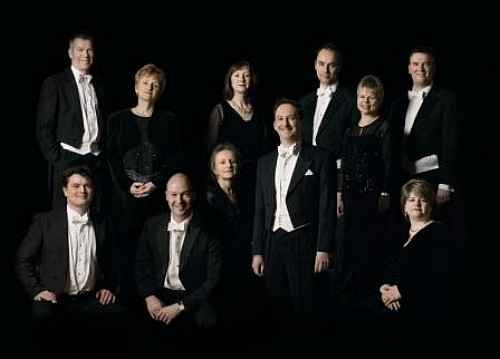
It’s usually two singers per part (SSATB), donning the surprise of flesh and emitting celestial notes here on earth. And so it was this evening in Kansas City when The Tallis Scholars performed.

Peter Phillips and colleagues presented a concert of works from Spain and Portugal, including:
  • Mendes - Asperges me
  • Cardoso - Lamentations; Magnificat
  • Lobo - Pater peccavi; Audivi vocem
  • Melgas - Ajuva nos; Domine hominem
  • Victoria - Requiem.
 Peter Phillips
The Victoria six-voice Requiem was particularly novel. Like all Requiem settings, the music is predominantly dramatic in character and intent—taking off with the introspective/hermetical Requiem æternam, ascending through the ecstatic and terrifying vision of a furious and wrathful God, and coming in for a feather-light ‘landing’ with a subdued Kyrie, singers on the brilliantly-lit altar platform at Cathedral of the Immaculate Conception, audience in the dark. The Spanish mystical brand of Catholicism communicated in this piece seems oddly premonitory of present-day self-styled liturgies.

A   fter seeing the Tallis Scholars, the Renaissance doesn’t seem remote at all.”
  —  Chicago Sun Times, August 2006.
This superb recital gave us an aerial view of religious conviction as ‘acting-out’—aspirations toward an innocence and goodness that would not only be acceptable to God but also quieting to one’s own conscience, enacted in public. The appeal that this had in Renaissance times—and that it still has today—cannot be overestimated; not just the innocence and expiation as motives, but the seductiveness and popularity of institutionalizing it as public ritual.

The counterpoint alternating with homophony is especially dramatic and evocative of other-worldliness, in support of the liturgical ‘acting-out’ of conviction and supplication.

In fact, the evocativeness is so powerful and profoundly moving that it boggles my mind: how one can sing this music without tears rolling down one’s cheeks the whole while? How can one not come undone? Rehearsing and performing it repeatedly cannot possibly immunize one against its power!

The magic of it is that music can do this at all. The terror of it lies in the fact that music is so potent, that it works so well, and that it can make us go where we don’t necessarily want to go. (That may have been the whole liturgical ‘point’ ... )

Thyrotropin-Releasing Hormone (TRH; (pyro)Glu-His-Pro-NH2 ) when suddenly released in large amounts (by the hypothalamus, into the pituitary’s hypophyseal portal system) can produce this shaking and shivering and the spine-tingling qualitative sensations that are associated with experiencing ecstatic awe. It does this by direct action of TRH on receptors in the brain. And 1-[2-hydroxyphenyl]-4[3-nitrophenyl]-1,2,3,6-tetrahydropyrimidine-2-one, an experimental drug, can do this too—it has been used as an experimental model to try to understand spine-tingling—but the drug has a peripheral site of action instead of only in the brain, so its mimicry of TRH’s action on the pituitary is not exact.

And after the TRH hits its receptors, then the multi-faceted signalling cascade begins. How does this work?! Shaking and shivering and spine-tingling sensations are elicited by a variety of stimuli. The sensations can be inhibited by central administration of drugs that act as agonists on opiate receptors, muscarinic cholinergic receptors, and alpha-adrenergic receptors. We know that from experiments with laboratory animals, plus anecdotal accounts by anesthesiologists—whose practice in the operating room and in the PACU involves administering drugs that potently affect those receptors; and whose practice also involves recovering patients as they emerge from anesthesia and those medications are washed out or metabolized away. [Bear in mind that the neurophysiology of how ‘spine-tingling’ emotional reactions happens is different from the cell biology of nerve synapses—a scientific field that recently has co-opted the phrase ‘spine-tingling’ as a colorful way of referring to spiny structural changes and variations in nerve cell synaptic membranes. See Huettner and Spires and Hyman and others (Spine-tingling excitement from glutamate receptors. Science STKE 2003; 210:53; Neurobiol Aging 2007; 28:687). Keep in mind, too, that there is a lot of appallingly incorrect disinformation/bullshit (via YahooAnswers.com and other web sources) about the physiology of spine-tingling. Needless to say, spine-tingling has not been a heavily funded area of research, insofar as it is (a) not related to an important medical problem or disease {not even Reflex Sympathetic Dystrophy (RSD) or neuropathic pain or Familial Dysautonomia} and (b) it is transient {each paroxysm unpredictably comes and goes in seconds} and would therefore be very difficult to study.] A considerable amount is known about the neurophysiology of spine-tingling in general, but not a lot is known about the neurophysiology of spine-tingly music specifically.

At any rate, for me in Saturday night’s Tallis Scholars performance there was no pharmaceutical protection from spine-tingling, no remedy in sight at all. Just a few bars into the 6-voice Requiem (Tomás Luis de Victoria, 1605) and here come the shivers—up and down the whole length of the spine, uncontrollably, continuously, my dorsomedial hypothalamus (DMH) and brainstem going wild.


You must realize I didn’t go there expecting this to happen; I did not attend this concert with the aim of being moved to tears in this way by the singing. Nor do you attend concerts with this aim, with some exceptions. And yet it does happen, this reflex, this shivering tearing neurophysiology of the ancient hind-brain of our mammalian prehistory. The rest of our Saturday had been ‘normal’, and now this—in this darkened cave of a cathedral, full of echoes and faintly redolent of Saturday 2:30 p.m. and 4:30 p.m. Masses and a funeral held here earlier in the day, for a dear 88.9 year-old someone we did not know. But we now see that we are just tiny bystanders, ceremoniously hurled into emotional depths on a cold March evening; bystanders undone by sacred music written by clever Lusitanians and Spaniards some 400 years ago. Hyperhedonic existential adventure! Acoustically-evoked hyperautonomia! Syncopal musical psychotourism! You need to read Phillips’s book, What We Really Do, to better understand their art. Better still, go to one of The Tallis Scholars’ performances and get your spine tingled yourself. Don’t understand Latin? Doesn’t matter. Deist, or atheist, or somewhere in between? Doesn’t matter. The cosmic beauty—and the shivers—induced by Tallis Scholars are universal.


 What We Really Do, Peter Phillips
T   he embellishments that the soprano sings on the way down from the top C [in Allegri’s Miserere] were not composed by Allegri but were instead improvised by generations of singers in the Sistine Chapel. These embellishments were guarded even more jealously than the written music…”
  —  Peter Phillips.

 Graham Hughes, Worship as Meaning
C   onvinced that people shape their meanings from those available to them, Graham Hughes inquires into liturgical constructions of meaning, within the larger context of late twentieth-century meaning theory. Drawing particularly upon the work of Charles Peirce, Hughes employs semiotic theory to analyze the construction, transmission and apprehension of meaning within the worship service.”
  —  Jacket blurb, Hughes book.


Thursday, January 17, 2008

Humidifying Captive Singers Breathing at High Tidal Flow rates >10 L/min

Nozzle
The reaction surprised me. My December CMT post about humidity effects on performance hall acoustics—an exotic topic and one that I addressed with some physics and a spreadsheet—has elicited quite a few emails. The post concerned the timbre and attenuation of sound as a function of distance from the stage. That is, my remarks were from the perspective of the audience and presenters and architects. But so far the comments and emails about the post have been almost entirely from singers, most of them objecting to my “Hypothetically [from an acoustics perspective], it would be wonderful to perform in very low-humidity air” remark. All of the commenters opine that relative humidity (RH) equal to 45% (the nominal target value that HVAC systems in most public buildings aim to maintain) is too low for their vocal health—their throats become dry, their vocal cords become inflamed. The commenters further say that even the higher RH range 55%-65% that I was arguing for (for acoustics reasons, not performer health reasons) in the previous CMT post is lower than they would like. [Absolute humidity (AH) is the amount of water vapor present in a gas. Relative humidity is the ratio of the absolute humidity to the maximum absolute humidity. Relative humidity is perhaps most important, as any deficit then becomes an evaporative ‘challenge’ to the tracheobronchial tree, which has to deal with the humidity gradient—100% RH deep in the alveoli in the lungs, and ambient room RH at the mouth and nostrils.]

I  agree with your comments, about preferring more humid air to sing in! I sing tenor myself! So I think, in this post let’s look at the health rationale for performance hall humidity that’s high. How high is compatible with the comfort and health of all the people in the hall, performers and audience members alike? Can architects do things to make performance halls safer and healthier for singers? Below I suggest some answers to those questions.

Human skull, view head-on through nose, showing turbinate bones
First, think about what’s different when you’re singing vs. when you’re not singing. When you’re singing, far less of the liters per minute of air that you breathe in and out goes through your nose. The nose has several functions: it warms, cleanses, and humidifies inhaled air, detects odors, and serves as a resonating chamber to modify the voice. Air enters through the external nares (nostrils) to the nasal cavity. The nasal cavity is divided by the nasal septum into right and left chambers called nasal fossae. The chamber inside the fossa is called the vestibule. The vestibule is lined with stratified squamous epithelium. The air flow over 3 pairs of structures: inferior, superior and middle nasal conchae. The conchae consist of mucous membranes supported by thin, scroll-like turbinate bones. The passage through the nasal cavity warms, moisten and filters the air.

CT scan through eyes, nose
But when you’re singing much of the air you inhale goes through your mouth, and less of the air goes through your nose than when you’re not singing. And the moist surfaces in your mouth and oropharynx have less surface area from which moisture can evaporate, compared to the moist surfaces on the conchae in your nasal passages. What’s more, the velocity of the air going past the moist surfaces in your mouth is greater and the time that the air has to pick up moisture from those surfaces is less than it would be in nose breathing. The net result is that the air reaching your vocal cords is far drier—less humid—when you are singing than it would be if you were not singing and predominantly nose-breathing. The rate of evaporation of moisture from your larynx and your lower respiratory tract is greater when you are singing than it would be at the same air flow rate in L/min by nose-breathing. This situation not only dehydrates the airway lumen, but also increases the effort required to produce sound, as Sivasankar and others have shown.


You can’t bring your shower or a rainforest to the concert hall. Or can you? Could an architect design passive humidifiers (a back-stage waterfall?; an on-stage ‘water feature’?) that would create a microenvironment capable of transferring enough moisture? No. Even if you wanted to do it, it would not be adequate. Passive transfer can’t get enough kg of water into the air, even in a small area, to cope with the losses as the air is mixed and exchanged by the HVAC system. ‘Active’ humidifiers (atomizers/nebulizers, ultrasonic foggers, steam-based systems, etc.) are needed.


On an architectural scale, the situation has a lot in common with the heat and moisture exchanger (HME) elements [for example, Tyco DAR Hygrobac, Pall BB2215, EdithFlex] that are used in intensive care unit (ICU) mechancial ventilators in hospitals. Active heat and moisture exchangers (HMEs) represent a simple and effective way to replace one of the most important upper airway functions: they retain the heat and moisture of expired air and return it to the inspired gases. As the nasal cavities normally play a very active role in this conditioning, bioengineers jokingly refer to HMEs as ‘artificial noses’. And the ability of any nose, natural or artificial, to prevent drying of secretions in the respiratory tract and drying of the respiratory mucosal surfaces depends on the delivered gas temperature and relative humidity. We look at this aspect in more detail below.

Hygroster ventilator HME
HMEs are made of cellulose or synthetic materials and have an active surface area that is about 2,000 cm2. This provides absolute humidity (AH) levels of 30 to 35 mg/L (H2O content) in the air going from the endotracheal tube into the patient’s trachea—an AH that is somewhat above the level required by the ISO-8185 and ISO-9360 standards, which specify performance guidelines for active humidifiers in medical mechanical ventilator circuits. Temperature of the air at the HME output into the ventilator breathing circuit is between 27°C and 34°C, depending on the device type and the flow rate. And, of course, the amount of moisture the air can hold is temperature-dependent: air at 20°C can only hold a maximum of 17.3 mg/L, whereas at 37 °C (normal core body temperature, 98.6°F) it can hold 43.9 mg/L. So the air at the output of a well-functioning HME is pretty close to saturated with water—a relative humidity of 80% or higher (in the upper right-hand corner [white cells] of the spreadsheet below). But as the air gets warmer in the respiratory tract of the patient, the relative humidity in that inspired air drops—to 70% or less in the trachea and mainstem bronchi. Click on this spreadsheet screenshot to download the spreadsheet and see the 4th-order statistical regression equations for the quantitative relationships between RH, temperature, and AH. What we’d be aiming for in an architectural / HVAC design is to take room air (about 20 °C) along the olive-shaded humidity “isobar” or “isopleth”(lower right-hand ellipse, arrow toward upper left-hand ellipse in the spreadsheet screenshot). The best we could possibly do is get the air to be about 35% RH when it hits your vocal cords.


Spreadsheet to Calculate Absolute Humidity as a Function of Relative Humidity and Temperature

In fact the flow-rate/moisture-transfer-effectiveness point made above about velocity and residence-time in the mouth-vs-nose breathing discussion above is also a very real issue in mechanical ventilator management and HME design. Moisture content (absolute humidity, AH) in mid-airway at 2 hours (ISO-9360) is a fuction of ventilator tidal volume, and, with typical ICU ventilator and typical HME-type humidification of ventilator circuits, we get values like these:
  • Vt = 250 mL: AH = 34.4 mg H2O/L @ 32°C
  • Vt = 500 mL: AH = 33.6 mg H2O/L @ 32°C
  • Vt = 750 mL: AH = 33.1 mg H2O/L @ 32°C
  • Vt = 1000 mL: AH = 32.9 mg H2O/L @ 32°C
Other things being equal, the greater the flow-rate through the HME per minute, the less moisture gets transferred to the air going through it—and the lower the AH in the air that gets into the respiratory tract, and the more moisture the respiratory mucosae will lose to the air.

The aim is to lose as little moisture by evaporation from the respiratory mucosal surfaces as possible—to maintain the mucociliary function of the cells in the respiratory tract that get rid of debris and micro-organisms; and to prevent injury to vocal cords, trachea, and oropharyngeal mucosa.

Nasal Anatomy
The biophysics and bioengineering principles that have been used for designing mechanical ventilators and humidification devices for very sick ICU patients might seem to be pretty remote from respiratory design considerations pertinent to healthy singers. But they are not. When you’re singing, the higher air velocity, larger tidal volumes, and less convoluted path (smaller average pathlength) and smaller surface area in the larger-caliber airway reduce moisture transfer into the inspired air, compared to breathing through your nose. Let’s say your concert performance is nearly 3 hours long, and your part has you singing nearly continuously. Physiologically speaking, that situation is actually not too different from what the air path and flow rates would be if you were intubated and on a ventilator without an HME, running on only dry room air for 3 hours. If you were on a ventilator for a 3-hour surgery, there’d surely be an HME or similar device maintaining the humidity in the air you breathe and keeping your respiratory tract moist. It takes very little time inspiring dry air to cause damage!

And look at the microscopic picture below! This shows the acute inflammation that comes with just 3 hours of breathing dry air. This is from Hirsch’s 1975 journal article, on the physiology of trachea mucus velocity and humidification in dog trachea. Obviously, you don’t get this sort of histologic data in humans, in autopsy pathology data or otherwise. The only way to get this kind of data is in experimental animal models, as Hirsch did. The amazing thing about this is how fast the onset of inflammation happens—the activation of the mast cells underneath the mucosal surface, the release of cytokines, the infiltration by polymorphonuclear leukocytes and other cells in the inflammatory response—over the course of only several hours exposure to dry air. Your subjective impressions as a singer (about your throat feeling injured or inflamed after performing in dry air) are dramatically confirmed by this microscopic photo!

Hirch 1975, Fig. 3, Photomicrograph of trachea after 3 hours of breathing dry air
This evaporative drying and inflammation process is, in fact, why proper humidification of ICU ventilators has been such a prominent topic over the past 30 years in critical care medicine. Keeping the respiratory tract from drying out is essential for preventing ventilator-acquired pneumonia (VAP) and avoiding injury to the respiratory tract. Heating and humidifying the inspired gas has for many years been an established standard of care for patients on mechanical ventilators.

Keeping the vocal cords and surrounding tissues from drying out is also important with regard to the biomechanics of phonation and musical sound production, as Verdolini and colleagues have shown.

A study by Tanner and coworkers examined whether any of several inhaled nebulized ‘mist’ products could help alleviate the effects of trans-oral breathing of dry air. The answer was, basically, ‘No.’ Whatever benefit they provide lasts only a few minutes—far too short a time to be of much help for a 2-hour performance.

So, if personal-use products won’t help, could systematically improving building designs help? Yes. Architects could design or retrofit performance halls to provide proportional zone humidity control. The humidity is sensed in each ‘zone’ and compared to a setpoint, similarly to what’s done with zone thermostats and temperature control for different temperatures in different parts of the building. If the humidity in the singers’ zone is below the preferred setpoint level, a control action is taken to add moisture in that zone. The humidity is sensed periodically or continuously. One or more hygrometer sensors in each zone and the hygrostat control circuitry enable precise and accurate control.

The hygrostat is typically a microprocessor-based device that implements a software algorithm-controlled feedback loop, and is capable of communications over a local area control network (LACN). The control sequences can expand on basic proportional humidity control and include ‘integral-derivative’ control. In this case, the integral (area under the measured humidity-time curve) is used to calculate the amount (kg) of moisture that the humidity has deviated from the setpoint. The control action is limited to avoid overshooting the setpoint and oscillations and delays in control response, as often occur with proportional control. ‘Derivative’ or ‘humidity rate-of-change’ control can be used for dynamic applications where the ambient conditions change relatively frequently and dramatically, due to local weather or other factors—very much in the same way as derivative temperature control is done. Derivative control measures the slope of the humidity trend, and it adjusts the parameters of the control algorithm to respond to the slope changes.

As one possible approach, architects could create forced-air active-convection ‘air curtains’ between zones—adding ducting to create thin, downward planar ‘jets’ of air traveling tens of centimeters per second, directed from the ceiling to the floor, to create and maintain separate zones or microenvironments—one for the stage and one for the audience? Too radical, you think? Well, air-curtaining is routinely done in industry—such active ‘air curtains’ are used in clean rooms for medical device and pharmaceuticals manufacture, for example. And they could be practical in studios, to create separate ‘zones’ (a high-humidity one for the area occupied by the singers, separated from other zones for audience or other performers). But such air curtains would not be very practical for performance hall stages with very high ceilings. And there would be tremendous problems with acoustic baffling and duct noise. The high air velocities required for effective ‘air curtaining’ are normally noisy—they are designed for industrial purposes where turbulent flow patterns and noise are not important design considerations. To design air curtains for large halls that would achieve quiet, near-laminar flow patterns and acceptable acoustics for chamber music would require huge effort and expense. It could be done—but it would be very difficult. I’m unaware of performance facilities where multi-zone humidity control has been done.

But passive-convective multi-zone humidity control is done all the time in zoos. The reptiles and other animals have the atomizers, nebulizers, ultrasonic foggers, etc., controlled by multiple hygrometer sensors to create suitable microenvironments for them. Do singers merit less attention from architects and HVAC engineers than snakes?
Lucky Reptile Digital Hygrostat How high should the humidity target level be, to be of significant help to singers? Well, normal breathing through the nose adds about 75% of the total water content before the inspired gas reaches the larynx, whereas with mouth-breathing, inspired gas is only about 25% saturated above the pharynx. Returning to our ICU ventilator analogy for guidance in suggesting an architectural design value, we know that, for respiratory tract health, the inspired gases should be delivered to the endotracheal tube or tracheostomy close to saturation at body temperature (i.e., giving a minimum RH = 75% when warmed [by passage into the airways] to 37 °C, AH = 32 mg/L). The new-generation HMEs are capable of providing 30 to 35 mg/L AH at 27 to 34 °C.

The rate of moisture loss from respiratory tract mucosa is proportional to the difference (Psat - Pa) in water vapor partial pressure at the respiratory tract mucosal surface temperature and the average ambient temperature in the airway (mixed bulk air, near the airway centerline), respectively. If the evaporation rate exceeds the moisture secretion rate by the glands lining the respiratory tract, then drying of the mucosal lining will occur. For example, in a cool room, Pa will be low enough that moisture can easily evaporate from the respiratory tract mucosa even if RH = 100%. In fact, you lose about 7 g of water per m2 of body surface area each hour via normal breathing at normal body temperature. This evaporative loss of moisture from the respiratory tract is nearly independent of ambient temperature below 30 °C (because the temperature differential is large, Pa is small, and the (Psat - Pa) differential is therefore large). There’s no way around it! Unless you’re singing in the shower or under a waterfall, you’re always losing moisture.

Even the most efficient HME also allows a net loss of heat and moisture from the respiratory tract. But an efficient HME reduces the rate of loss to a modest, sustainable figure that the body can “keep up” with, without the mucosal surfaces getting dry or injured. HMEs constructed out of hygroscopic materials outperform hydrophobic HMEs in terms of keeping the respiratory tract well-hydrated. A singer-friendly architect’s design and HVAC engineering design would be ones that deliver air to zones that singer’s perform in such that the singers’ respiratory tract mucosal glands can “keep up” with the evaporative losses without getting dry or injured.

Assessing the adequacy of humidification is difficult. Excessive humidification may cause an increase in respiratory secretions volume, and insufficient humidification may result in a decrease in secretion volume because mucus becomes encrusted in the airways and retards further secretion. In my experience, there’s never “too much” humidity when it comes to singers’ vocal comfort and health. The biggest impediments to optimizing room humidity for singers are that (a) the comfort of others and the environmental requirements for some musical instruments (e.g., strings) entail lower RH, in the 45% to 65% range, and (b) the existing HVAC systems don’t have the necessary humidifier capacity to go above this range. Ideally, though, I believe we singers would want RH in the 65% to 70% range, if one of the HVAC approaches mentioned above could fit within building budgets. Secondly, we’d prefer that the performance hall temperature be set higher than normal, maybe 23 °C or so. That way, the air at RH 65%-75% will have a higher AH, will carry more moisture, resulting in higher RH values in our vocal tracts. But first, you need to find architect/engineering firms that’re ready to think a bit “outside the box,” to begin to serve the needs of singers.

Thanks again to all of you who emailed me, for your comments and questions!


Ceiling-suspended atomizers, Copenhagen grocery


Sunday, December 2, 2007

Trio Mediæval: Dark Winters, Mythical Thinking, and the Duty to Invent

Trio Mediæval, photo by Mikkelsen
A  principle that is characteristic of both mythical and musical thought is that which is referred to as ‘calculus of combinations’. According to this principle, myth consists of distinct elements or ‘mythemes’, which the narrator of a myth—like any speaker of a language—may combine by obeying certain rules, thus creating mythical stories and utterances. The same principle can be found in folk music as well. ...Folk-melodies reshape and transform themselves everywhere. ...[Only fragments] have survived in the memory of the people. It is due to this fact that the melody includes numerous tonal irregularities.”
  —  Eero Tarasti, p.45.
Trio Mediæval’s performance yesterday (02 December) at Cathedral of the Immaculate Conception in Kansas City was exceptionally good. The weather outside the filled-to-capacity cathedral was freezing, and the audience deeply appreciated the Trio’s warmth and charm.

It isn’t often that we think of medieval singing and jazz improvisation at the same time. But, in fact, much of the charm derives from improvisational qualities of the Trio’s performance. The ‘tralling’ (mouth-singing, of rhythmic nonsense syllables); the ornamentations and microtonal shadings they applied to various figures, especially in solo passages; the antiphonal and aleatoric effects they used in several songs as they sang, dispersed in different locations within the cathedral sanctuary and, walking, converged on the central altar platform; the atmospheric effects by guest percussionist Birger Mistereggen, who simulated blustery gales, drifting snow, sea blown against a rocky shore, wind clacking icy branches together, cows in a mountain meadow, animals in the stable, etc.—all of these were delivered in an engaging, extemporaneous, dramatic manner. The improvisational effect is more evident because the Trio does not rely on sheet music during performances: the entire recital is done from memory.

If as a child you were ever thrilled by a parent or grandparent who told you bedtime stories from memory, confabulating new and exotic features on the fly, that is the spell-binding effect that you can expect from Trio Mediæval’s singing. It is a spell of clan and family, longing and belonging. Etymologically, ‘tralling’ → ‘thralling’ → ‘enthralling’ → ‘enthralled’ : the listeners who were these songs’ original target audience were induced to be ‘in thrall’ to the clan elders/chieftains/society whose songs these are. No mere artifacts, these folk songs were ancient normative generators, anchors, and enforcers of cultural identity, family identity, individual identity—the songs were a means for the continual inculcation and (re-)invention of identity, desire for community, and belonging. Ethnomusic-archy!

In fact, that inventive quality is a fundamental aspect of traditional Scandinavian skaldic poesy. The nominal sketch, characters, sequence of events, and so forth are there. The framework of the story must be respected, but the storyteller who recreates the story is obliged, aesthetically, to personalize and revivify it in the retelling. Each time the story is retold, the storyteller must extemporize and breathe fresh life into the story. Considerable dramatic license is granted for the performers to embellish and resequence, to repeat or return to subplots or vamp and emphasize some feature of a character or location, some interaction between characters that bears some special relevance to members of this audience on this night’s retelling. Trio Mediæval’s improvisations are just like that: faithful, conspiratorial, storytellerly improvisations.

Trio, Bergen 2007
After all, this historically-informed performance (HIP) practice is serious ethnomusicology, but it is not museum conservation of static texts. The music is continually evolving. The Trio focuses on individual performers and the insights gained from them about learning how to arrange and sing this traditional material, and performing such folksongs in public. The Trio’s website notes some of those who have preserved this oral tradition, from whom the Trio has derived some of their arrangements of these tunes. Although a first-rate singer or Hardanger fiddler may take up tunes (‘slattar’) from other performers past or present, it’s incumbent upon a new performer to add something of her/his own whether it be different ornamentation or varied rhythms or new ‘mouth sounds’. It would be banal to slavishly reproduce what has been done before. It would be ‘bad form’ and aesthetically false. Conservation is not sufficient for authenticity. It’s essential that skalds/singers contribute something new and diverting each time. True also of the folkmusic and stories of Finland, Iceland, and Sweden. Think of Eddas and sagas; think of Kalevala.

In this concert we were reminded that myth and music are two forms of discourse that are interrelated, as Eero Tarasti and others have written. Trio Mediæval reveals to us precisely and vividly how they are related. Bravo!

Aubert book
I  f music has its own place in all reflections on culture, it [holds this position of power] by the stakes it represents. Music is indeed never insignificant. It is simultaneously a strong and unifying means of communication and a revealer of identity within the abundance of models that characterise a society.”
  —  Laurent Aubert, Music of The Other.