T his is the best sort of virtuosity that you will hear tonight—because of its nuances, its extraordinary sensitivity and elegance!”
— Cynthia Siebert, prefatory remarks, introducing James Ehnes’s and Andrew Armstrong’s performance in Kansas City.
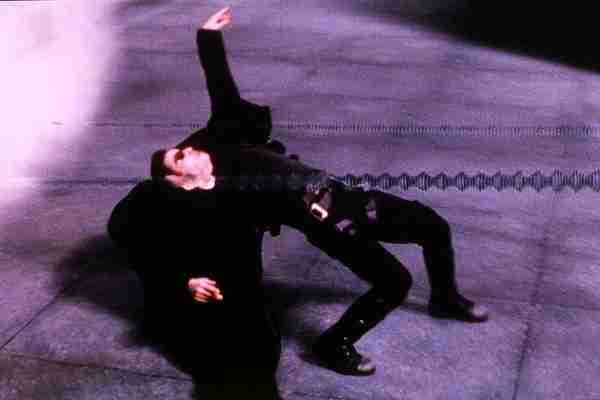
I ncredible mix of action, special effects, and story!”
— DSM, after James Ehnes’s and Andrew Armstrong’s performance in Kansas City.
I f I read one more review that says that something or someone is ‘virtuosic’—that their playing was ‘virtuosic’—my head will explode. It’s the lamest, laziest excuse for a compliment that a reviewer can write. It tells us nothing, in 300 words or less. Instead, I wanna read about whether he/she plays like Keanu Reeves fights in the original ‘The Matrix’. I wanna know details about how the fight went, note by note. I’ve got all the attention span in the world; I’ve got all night. Tell me. I wanna know whether his/her playing can save the World, and I wanna know how this can really happen. I wanna know whether this is The One. Make me believe!”
— Anonymous.
J ust in case you were hoping to make it back, they’ve reconfigured the culture so there are hardly any phone booth [portals] left. We’re gonna need guns. Lots of guns. And an endless supply of logic, humor, tenderness, disobedience, defiance, and argumentative tenacity. The surviving members of the old crew are still on board, along with some new recruits, freshly located, unplugged, and debugged. Are you with us? You’ve already made your choice. Now you have to understand WHY you made it.”
— Jacket blurb, William Irwin book, The Matrix and Philosophy.
It’s astonishing how much we expect of the Arts—especially of music. How can it possibly deliver us out of the desert-like banality that comprises so much of modern life?
And yet it can and, surprisingly often, does. It awakens us, enables us to feel how alive we and others around us are, makes us feel deeply, truly human—immersed. Nobody ‘taught’ us this, in school or in out-reach programs. We haven’t succumbed to some seductive marketing scheme to make us consume this stuff. The music doesn’t exist to separate us from our money and divert us for an hour or two. The music we’re after may at times be sensual and escapist (that is, it can be part of The Matrix, for those who prefer the Blue Pill). Or the music can at times propel us into a novel and unexpected reality—one that may or may not be pleasurable but is, regardless, inherently meaningful (that is, it can be part of the Real World, for those of us exponents who take the Red Pill). In either case, we honestly and truly resonate with it and identify deeply with it. If you don’t want to call music that succeeds in doing this ‘virtuosic’, maybe the word you’re looking for is ‘engrossing’ or ‘profound’.
T he public doesn’t need educating [about classical music]. It doesn’t need sexy marketing, or publicists, or icons [to save classical music markets]. It wants music it can enjoy or at least respect. Composers ... should have a long, hard think about why there is a far larger appetite for the music of [list of names #1] than there is for [list of names #2].”
— Christopher Pugh, Gramophone, 2008 March; 85: 8.
 T
The classical music repertoire that sells—both old and new; both live and recorded—is not all righteous, redemptive, heroic ‘Matrix-oid’ stuff of course. Sometimes what we want is serene and pacifistic, so long as it’s not namby-pamby or face-losing. We desperately want to believe in the possibility of peace, and we crave music that consoles us and dramatically restores our hope. No mean feat, that. So, if you don’t want to call music that succeeds in doing this ‘virtuosic’, maybe the word you want is ‘irenic’.

F or me the Regenlied [Song of the Rain, Brahms Sonata for Piano and Violin, Op. 78] is like a dear and true friend whom I would never forsake for anyone else. In its soft, contemplatively dreaming feeling and its wondrously consoling strength, it is one of a kind.”
— Eduard Hanslick, 19th-Century music critic.
The chamber music repertoire is rife with intimate narrative between parts. In that regard, we want desperately to be reminded that human beings can be beneficent and responsive. We want music that will remind us of friends and family who have loved us and helped us and who have worked for the public good. And, equally often, we want music that will remind us of our own good-heartedness and steadfastness—of our own radical devotedness to those we love. We want music that helps us plumb the depths of our aspirations to frenzied sacrifice for significant others: we would never forsake them, even if it costs us our lives. Most mothers feel such a love for their children—a ferocity that’s a natural correlate of childbearing and biology. Others of us have to get our other-centered ferocity in other ways. So, if you don’t want to call music that succeeds in helping us do this ‘virtuosic’, maybe the word you want is ‘altruistic’ or ‘rapt’ or just ‘berserk’ (in the Norse sense of that word).
O f course you are aware—that no one can help loving it more than anything in the world, and that one becomes addicted to it by just studying and understanding it, by listening to it as in a dream, and by becoming completely absorbed by it ... When I play the last page of the E-flat major Adagio, I always think to myself that [Brahms] can only be a thoroughly good-hearted man.”
— Elisabeth von Herzogenberg, 19th-Century singer, remarking on Brahms’s Op. 78.
- Virtuous—commendable, ethically laudable, venerable, redemptive;
- Proficient—elite level of technic and interpretation;
- Incredible, illuminating, transcendant—giftedness defying mortality and the triviality of human existence; fluency beggaring belief; super-human, exceeding known limits; god-like omniscience and omnipotence;
- Courageous—scoffing at danger; gambling and winning against terrific odds; dynamic and processual; continuously (re-)earned, not a static ‘attribute’ of character;
- Strenuous—the virtue of sweat and ‘dirty hands’; self-sacrifice to others / to humankind or to the professional guild (see Godlovitch, pp. 74-78); extraordinary exertion on behalf of public goods;
- Orthodoxastic—integrity; embodying what the field believes or idealizes; beneficience; advocacy and regulatory role in opposition to wickedness or maleficence and mediocrity.
 O
Oh, that last bullet, in the bulleted list above! Consider the plight of the arts in the U.S., and of art music in particular. The recently announced $16M cut in this year’s funding for the National Endowment for the Arts (NEA) is outrageous. “It means we must redouble our efforts to raise the arts consciousness of those who are seeking elective office in the coming year… On
VoteUsa candidates are compared on 35 important issues: foreign policy, environment, … I clicked on ‘Education’ and found 56 sub-topics; number 53 was ‘Art and Music,’ and 6 out of the original 7 major candidates had no statement at all on it, ” says Magaret Lioi, CEO of
Chamber Music America, in her editorial in this month’s issue of Chamber Music magazine (March 2008; 25(2):7). Currently the candidates “have no platform on the arts… the word ‘art’ doesn’t even appear on their websites.”
But every thinking human takes pride in seeing humankind flourish, and in knowing that the cultural legacy that has been bestowed upon us has been successfully passed on to the next generation. So ‘virtuosity’ is partly about Dawkins’s self-conserving (‘selfish’) gene:
H. sapiens appreciating that what we have been as a people will endure beyond our life on the planet as individuals. Therefore, playing and composing that (a) significantly advance the cause of the arts and (b) serve as emblems of what civilized governments’ policies should support—must surely be ‘virtuosic’ as well.
James Ehnes’s concert tonight ran the gamut from rapt, to altruistic, to irenic (in the Brahms Op. 78, Vivace ma non troppo and Adagio), to engrossing (in the LeClair Sonata in D Major, Opus 9, No. 3), to profound, to transcendent, to redemptive, to fantastical (in the Bartók Rhapsody No. 2), to berserk—beyond courageous. The playing was righteous throughout, with highly accessible, visceral, and addictive elements. Ehnes was uncanny in his technical proficiency, oracular in both ‘red pill’ (Bartók) and ‘blue pill’ (Richard Strauss Sonata in E-flat, Op. 18) phrasing: clearly capable of taking the guild of musicians and each of us as individuals yet farther. Pyrotechnical, yes; iconic, yes; prodigious, yes; and at times near-miraculous (Brahms Scherzo, Sonatensatz). Segulah (“well-choosing,” “sustaining learning,” “Samek-Gimel-Lamed,” “לּגּסּ”) ! Tenth Dan! Jinlong Golden Dragon!
Virtuosic? T’would be damning by faint praise.
But how would you know if I’m right about this? Check out Ehnes’s recordings. Attend one of his forthcoming concerts yourself. Check out the several links below—on the epistemology of ideals and on virtue ethics. You don’t have to be a card-carrying philosopher to find these things fascinating. You don’t have to be Morpheus to know virtue when you hear it.

C onfucian virtues have been predominantly a perception of what it is to be a human being and how one should behave to fulfill the meaning of Life... recorded in Analects (Lu Yu) ... operating in a continually evolving process with no permanence or limit ... even the unknown is [a type of] knowledge [concerning which one can have, or not have, virtuosic mastery]. To Confucians, learning and discovery are themselves essential virtues ... not static but requiring interaction with others.”
— Tsung-I Dow, in Tymieniecka, p. 3.
- James Ehnes website
- Ehnes and Armstrong concert, 01-MAR-2008, Friends of Chamber Music, Kansas City.
- The Matrix website (Warner Bros)
- Adams R. A Theory of Virtue: Excellence in Being for the Good. Oxford Univ, 2006.

- Card O. Ender's Game. Tor, 1993.
- Card O. Speaker for the Dead. Tor, 1994.
- Chappell T, ed. Values and Virtues: Aristotelianism in Contemporary Ethics. Oxford Univ, 2007.
- Chong C, Yuli L, eds. Conceptions of Virtue: East and West. Cavendish, 2006.
- Dzherrold D. Taking the Red Pill: Science, Philosophy and Religion in the Matrix. Ul'tra-Kul'tura, 2003.
- Fairweather A, Zagzebski L, eds. Virtue Epistemology: Essays in Epistemic Virtue and Responsibility. Oxford Univ, 2001.
- Farrelly C, Solum L, eds. Virtue Jurisprudence. Palgrave Macmillan, 2008.
- Foot P. Virtues and Vices: and Other Essays in Moral Philosophy. Oxford Univ, 2003.
- Gill C, ed. Virtue, Norms, and Objectivity: Issues in Ancient and Modern Ethics. Oxford Univ, 2005.
- Godlovitch S. Musical Performance: A Philosophical Study. Routledge, 1998.
- Grau C, ed. Philosophers Explore The Matrix. Oxford Univ, 2005.
- Howerton G. Music as one of the humanities. Mus Educ J 1962; 49: 28-30.
- Irwin W, ed. The Matrix and Philosophy: Welcome to the Desert of the Real. Open Court, 2002.
- Irwin W, ed. More Matrix and Philosophy: Revolutions and Reloaded Decoded. Open Court, 2005.
- Kupfer J. Prostitutes, Musicians, and Self-Respect: Virtues and Vices of Personal Life. Lexington, 2007.
- Lawrence M. Like a Splinter in Your Mind: The Philosophy Behind the Matrix Trilogy. Wiley, 2004.
- O’Dea J. Virtue or Virtuosity?: Explorations in the Ethics of Musical Performance. Greenwood, 2000.
- Roberts R, Wood W. Intellectual Virtues: An Essay in Regulative Epistemology. Oxford Univ, 2007.
- Simmons D. Hyperion. Spectra, 1990.
- Simmons D. The Fall of Hyperion. Spectra, 1995.
- Simmons D. Endymion. Spectra, 1996.
- Slote M. Morals from Motives. Oxford Univ, 2003.
- Sosa E. A Virtue Epistemology: Apt Belief and Reflective Knowledge. Oxford Univ, 2007.
- Statman D, ed. Virtue Ethics: A Critical Reader. Georgetown, 1997.
- Swanton C. Virtue Ethics: A Pluralistic View. Oxford Univ, 2003.
- Tymieniecka A-T, ed. Virtues and Passions in Literature: Excellence, Courage, Engagements, Wisdom, Fulfilment. Springer, 2007.
- de Wijze S. Political Morality: The Virtue of Dirty Hands. Palgrave Macmillan, 2007.
- DSM. Bronfman: Is Virtuosity ‘Necessary’? Is Sublimity ‘Measurable’? CMT blog, 08-DEC-2007.
- DSM. Bronfman and Everest: Balakirev’s and Ravel’s Virtuosic Fantasies. CMT blog, 05-DEC-2007.
- DSM. Belder: On Fingermusik and Mere Virtuosity. CMT blog, 02-SEP-2007.