Showing posts with label jazz. Show all posts

Saturday, October 9, 2010

Gene Pritsker: Beautiful Heterodoxy

 Hubble telescope, galaxy cluster CL0024+17
R    eligion...is a person’s total reaction upon life.”
  —  William James, ‘Varieties of Religious Experience’, 1902.
A   genuine first-hand religious experience like this is bound to be a heterodoxy to its witnesses, the prophet appearing as a mere lonely madman. If his doctrine prove contagious enough to spread to any others, it becomes a definite and labeled heresy. But if it then still prove contagious enough to triumph over persecution, it becomes itself an orthodoxy; and when a religion has become an orthodoxy, its day of inwardness is over.”
  —  William James, ‘Varieties of Religious Experience’, 1902.
Y ou will enjoy and be inspired by the new recording by guitarist/composer Gene Pritsker and his ensemble, SoundLiberation.
  • Gene Pritsker, electric guitar
  • Greg Baker, electric guitar
  • David Gotay, cello
  • Mat Fieldes, double-bass and electric bass
  • Joe Abba, percussion
T he original chamber opera from which this VRE Suite derives was orchestrated for narrator, tenor, soprano, mezzo soprano, baritone, 2 guitars, cello, and double-bass.


    [50-sec clip, SoundLiberation Ensemble, Gene Pritsker, Varieties of Religious Experience, ‘Everything Else Might Be a Dream’ (track 3), 2010, 1.6MB MP3]

T he Suite progresses in 8 tracks (64 min) from ‘Introduction’, a musical exposition of William James’ early views on psychology of religion, through James’ subsequent reconsiderations of his thought (‘Closer to Me than My Own Breath’, track 5), to an account of Tolstoy’s spirituality, to William James’ “conclusion” (track 8). There are myriad textures here that invite meditation. Accessible, stimulating chamber music throughout—although I do hope someday to experience the VRE opera. The theatrical gestures in here make me curious about the VRE libretto and staging. What texts did Pritsker choose, I wonder?
T   he last peculiarity of consciousness to which attention is to be drawn in this first rough description of its stream is that it is always interested more in one part of its object than in another, and welcomes and rejects, or chooses, all the while it thinks.”
  —  William James, ‘Principles of Psychology’, 1890.
M any of the published reviews of Pritsker’s work note that he challenges musical boundaries. Uh, yes he does. Exceptionally curious and inclusive rather than aggressive or confrontational, Pritsker and his collaborators explore passionate new expressions based on jazz, world rhythms, machine rhythms, lyricism, and the spirit.
W    hat interest, zest, or excitement can there be in achieving the right way, unless we are enabled to feel that the wrong way is also a possible and a natural way?”
  —  William James, ‘Dilemma of Determinism’, 1884.
T he VRE Suite is full of tasteful improvisation, sturdy melodies and voice-leading, strong ‘grooves’. Mystical it may be, but VRE Suite is far from ‘enigmatic’. It positively asserts that your cosmic, mystical experience is as genuine as my mystical experience; or as genuine as that of any organized religion.
R    eligion, therefore, as I now ask you arbitrarily to take it, shall mean for us the feelings, acts, and experiences of individual men and women in their solitude, so far as they apprehend themselves to stand in relation to whatever they may consider the divine.”
  —  William James, ‘Varieties of Religious Experience’, 1902.
 SoundLiberation, VRE CD
A ccording to theists’ Argument from Religious Experience, people have “religious experiences” — mystical or supernatural experiences, like angels or ghosts. Theists say that, because we believe other experiential claims people make — that they ate spaghetti last night, or they have a pet cat — then we should believe these claims as well. Theists say that, when skeptics insist on different, more stringent standards for assessing the veracity of claims based on religious experiences than they do for claims based on other experiences, they are prejudiced against religious claims. This prevents them from understanding and believing. William James entertained this argument in his Varieties of Religious Experience. He proposed that all normal persons do have religious experience and, since empirical experience is the final arbiter of truth, then God—as one object of religious experiences—must be accepted as factually true. A problem, though, arises in the variety of religious experiences: if there were just one true God, why is there such wide variety in religious experiences? They are mutually inconsistent, so at least some experiences must be false. There are no independent criteria we can use to separate true experiences from false experiences — not only others’, but our own. There are no independent criteria; there can be no independent criteria; all criteria rely upon the validity of some religious system, a Bible or the Koran, or some other sacred text—some of them, or all of them, must be false.
R    eligions have approved themselves; they have ministered to sundry vital needs which they found reigning. When they violated other needs too strongly, or when other faiths came which served the same needs better, the first religions were supplanted.”
  —  William James, ‘Varieties of Religious Experience’, 1902.
F or any who are unfamiliar with William James (1842-1910), I should point out that James was not a Christian. He was religious in his own way, but he was hardly a monotheist. William James published his ‘Varieties of Religious Experience’ in 1902 and, subsequently, many theists have taken bits of his writings out of context to support their arguments. But at bottom James was a Rationalist, and he did not believe in a personal God who enters history or personally responds to people’s prayers. Gene Pritsker’s VRE Suite likewise evokes a diverse range of spirituality while broadly extending respect and tolerance to all forms.
A   n act has no ethical quality whatever unless it be chosen out of several all equally possible.”
  —  William James, ‘Principles of Psychology’, 1890.
P ritsker offers a unique look at trans-textual relationships between the poetic text and musical text; between the chamber music creative tradition and new ways of crossing boundaries of genres and orchestration; between the Western canon of chamber music thought and non-traditional, jazz-derived ways of intimacy; and between the ideology of chamber for chamber’s sake and the opposite: the ideology of chamber musicians’ active ethical engagement in, and attention to, social issues.
T   he total possible consciousness may be split into parts which co-exist but may mutually ignore each other.”
  —  William James, ‘Principles of Psychology’, 1890.
C hamber operas are a good example of new “ideological,” stylistic and technological approaches to composition. They are emblematic of a transition from musical thinking that was orthodox and conservative to more heterodox, multi-layered forms.
T   he Hell to be endured hereafter, of which theology tells, is no worse than the hell we make for ourselves in this world by habitually fashioning our characters in the wrong way.”
  —  William James, ‘Principles of Psychology’, 1890.
P ritsker uses isorhythmic patterns in the first several tracks, retrogrades in ‘The Less Real of the Two’, and allusions to the rondo form in ‘William James’ Conclusion’.
G    enius, in truth, means little more than the faculty of perceiving in an unhabitual way.”
  —  William James, ‘Principles of Psychology’, 1890.
T he predominant texture in the VRE Suite is ‘pointillistic’ and tense, but not in the acoustic sense of guitars or pizzicato passages in the cello or double-bass. VRE Suite is organized through a contrapuntal juxtaposition and alternation of single notes, short gestures, and gestural ‘units’ that are based on certain ‘privileged’ pitches and intervals and chosen beat-divisions. Complex linear constructs are mostly melismas—especially exposed in the guitars, but also in the cello part.
T    he transition from tenseness, self-responsibility, and worry, to equanimity, receptivity, and peace, is the most wonderful of all those shiftings of inner equilibrium.”
  —  William James, ‘Varieties of Religious Experience’, 1902.
I t is interesting that in the first parts of the Suite the individual notes and gestures are distributed across the whole available range in each instrument, with emphasis given to irregular, “nervous” rotations of leaps and step-wise motion. A kind of self-less, anonymous, transcendent texture emerges as a result. Such an approach has a lot to do with post-serialist compositional methods, even if Pritsker would be happier to disavow this.

 X I ntegrity—a unified/unifying collective voice that is robust against the ensemble members individuality and rhythmic complexity—is assured by a technique based on manipulations of similar timbral and gestural units (motives, minimalistic ones or otherwise). The groups of repeated units establish a sonic architectural continuum and create a durable terrain governed by intervals and timbres of desire between consenting adults.
R    omeo wants Juliet as the filings want the magnet; and if no obstacles intervene he moves towards her by as straight a line as the filings. But Romeo and Juliet, if a wall be built between them, do not remain idiotically pressing their faces against its opposite sides like the magnet and the filings. Romeo soon finds a circuitous way, by scaling the wall or otherwise, of touching Juliet’s lips directly. With the filings the path is fixed; whether it reaches the end depends on accidents. With the lover it is the end which is fixed; the path may be modified indefinitely.”
  —  William James, quoted by Mortimer Adler.
B eyond the ‘Introduction’, VRE Suite becomes more and more dialectical, but in a good way. Gestures of disparate provenance react against each other, animating each other not killing each other off, bringing passages to life (?reincarnating them). The gestures (revealed by guitars, cello, and drums) alternate against a double-bass ostinato. There is much joy and comfort to be had in this...

P ritsker’s use of unusual cello-electric guitar timbres should be considered from a psychological rather than a technological point of view. “Technical” in nature, these timbres intensify the poetic metaphor or enhance the emotional power the music exerts on us, inscribing us, carving us as it goes...
W    e are spinning our own fates, good or evil, and never to be undone. Every smallest stroke of virtue or of vice leaves its never-so-little scar.”
  —  William James, ‘Principles of Psychology’, 1890.
I n James’ writing, Pritsker has found a congenial source of conceptual and artistic inspiration. William James himself embodies the contradiction of a spiritual man and rationalist. There is something of the prophet as well as a “martyr” in him, despite his wealth and Harvard credentials and social standing... He was aware of the necessity to combine intellectual effort with social intervention and his own convictions. His writings are humorous, perhaps inadvertently so. His entirely serious meanings are embedded in an “innocent”, “childish, “naïve”, “life-is-short-so-what-the-hell” surface. His psychological writings amount to an exotic kind of poetry influenced by folk literature, supernatural beauty, pain of life, and religion.
T    ake the happiest man or woman, the one most envied by the world, and in nine cases out of ten his/her inmost consciousness is one of failure. Either his/her ideals in the line of his/her achievements are pitched far higher than the achievements themselves, or else he/she has secret ideals of which the world knows nothing, and in regard to which he/she inwardly knows himself/herself to be found wanting.”
  —  William James, ‘Varieties of Religious Experience’, 1902.
T he complexity of James’ poetic texture and his multi-spectral style must appeal deeply to Pritsker. It is amazing how masterfully Pritsker explored the opportunities offered by James’ poetic vocabulary.

P ritsker’s compositions (including chamber music, chamber operas, electroacoustic and orchestral works, rock, and hip-hop) have been performed widely (Berlin Philharmonic; Adelaide Symphony; Brooklyn Philharmonic; Athens Camerata; and others). He has also collaborated with Joe Zawinul on film scoring projects.
C   reatures extremely low in the intellectual scale may have conception. All that is required is that they should recognize the same experience again. A polyp would be a conceptual thinker if a feeling of ‘Hello! Thing-um-a-bob again!’ ever flitted through its mind.”
  —  William James, ‘Principles of Psychology’, 1890.
I    believe that we stand in much the same relation to the whole of the Universe as our canine and feline pets do to the whole of human life. They inhabit our drawing rooms and libraries... They are tangent to curves of history the beginnings and ends and forms of which pass wholly beyond their ken. Just so, we are tangent to the wider life of things.”
  —  William James, ‘Pragmatism: A New Name for Some Old Ways of Thinking’, 1907.
  • Some things I am reminded of...
  • Michael Smetanin’s ‘Obsession’ for tenor saxophone, electric guitar, cello, double bass, piano, and drumkit (1995)
  • Irinel Anghel’s ‘El Enigmes II’ for electric guitar, cello (with processing), bass guitar, and tape (2001)
  • James Tenney’s ‘Septet’ for 6 electric guitars and bass guitar (1981)
  • Salvatore Macchia’s ‘Onde’ for double bass and guitar (2000)
  • Brian Ferneyhough’s ‘Trittico per G.S.’ for double bass (1989); Seven ‘Tableaux Vivants’ depicting the Angel of History as Melancholia; Stelæ for Failed Time)


Tuesday, March 16, 2010

Minneapolis Trombone Choir 37th Annual Concert: On the Emotional Lives of Once and Future Brass Players

 MTC
A    frisky spirit makes my trombone sing.”
  —  Chris Barber, trombonist.
T he thirty-seventh annual concert by the Minneapolis Trombone Choir (MTC) was an exotic and thrilling experience. The performance this past Sunday evening at Judson Church in Minneapolis featured approximately 40 trombone players, some of them alternately switching to euphonium or tuba for several of the works that comprised the evening’s program. The pieces were conducted by Jim ten Bensel, Mike Bratlie, John de Haan, Tom Huelsmann, and Stan Bann.

S everal pieces of new music were performed, including Eric Ewazen’s ‘Concertino for Bass Trombone’, conducted by John de Haan, with soloist Derek Crosier and a trombone octet consisting of Neil Baumgartner, Doug Coleman, Zach Friesen, Lauren Husting, Scott Kruse, John Metcalfe, Greg Michnay, and Brian Wistrom. The 11-minute piece begins with an atmospheric chorale section, giving way to more aggressive, virtuosic, up-tempo writing. Crosier’s cadenzas (at 7 minutes and 9 minutes) were heart-felt, luminous things. Beautiful!

 MTC Octet

J im ten Bensel, who has directed MTC for many years, is a Yamaha trombone artist with Bachelor and Master degrees in music education from the University of Minnesota. He is currently on the faculty of MacPhail Center in Minneapolis, specializing in low brass and jazz combos. As a performer, Jim has toured with Stan Kenton, Henry Mancini, Ralph Marteri, and other bands. Jim currently plays with the Barbary Coast Dixieland Band, the Bella Gala Big Band, and the George Maurer group, among others. As a classical trombonist, Jim was in 1988 awarded ‘Best Classical Brass’ by the Minnesota Music Academy Awards.

S ome 40 years ago I’d received some lessons from Jim (who was then at U of M), and, through all these years, I’ve vividly remembered his engaging teaching methods. I’ve lived away from Minnesota most of the intervening years and have been logistically unable to attend his performances, so I looked forward to Sunday’s MTC concert with much anticipation.

 Jim ten Bensel

M y anticipation was well-rewarded.

H earing a concert by Jim ten Bensel and his colleagues is a lot like having a heart-to-heart with a good friend. You alternately laugh and get misty-eyed, and, when it’s over, you feel a sort of renewed sense of what matters. Jim’s energy for putting sounds in the air is so genuine—so real—that you find yourself hoping it might linger in the air longer than is physically possible. Hoping.

I  attended this event with family members, including my parents who are in their eighties. My dad has always held low brass instruments dear, having played euphonium in high-school band when he was a kid. When I was a child, my dad used to hum/improvise a hidden baritone part whenever a piece of classical music was playing on the stereo. Often, his humming would enable me to hear a part that was actually there in the score but was too colored-over by other, brighter instruments for my inexperienced ears to notice. At other times, his humming would be revealed to be completely spurious—an extemporized harmonizing with whatever else the composer had written. The mystery of how my dad was able to fluently/synchronously impute and hum a part into a piece of music that was unfamiliar to me (and to him?) fascinated me. Was part of what convinced me that music deeply made ‘sense’, despite the fact that it was pure magic.

A t any rate, with all the years of these built-up neuroendocrine ‘triggers’, and with all of us emotionally ‘locked-and-loaded’ just so, the MTC’s inspired performance of ‘Pilgrims’ Chorus’ from Wagner’s ‘Tannhäuser’ (well, not just that one, but other works on the program as well) proved more than sufficient to raise tears in the eyes of many in the audience, particularly us once-and-future brass-players. The MTC’s powerful transgenerational evocation of what music has meant to us—to each of us, throughout our lives, separately and together—was most welcome, handkerchiefs and all.

M inisters and priests, take note: the acoustic persuasiveness of 40 low-brass players pouring their hearts out in a modest-sized church sanctuary is a spiritual force to be reckoned with, one not unlike that of the world’s great cathedral pipe organs.

T he MTC encore (Meredith Willson’s ‘76 Trombones’) was icing on the proverbial cake for the enthusiastic 150+ lovers of brass ensembles and low-brass in attendance. Bravo!

 MTC Ensemble


Tuesday, November 25, 2008

Imani Quintet: Synthetic Homelands, Statecraft & Hierarchies of Belonging

Imani Winds
S   tandpoint theory’ … asks: could you do science [, or computing, or music or other of the arts] differently if you did not ‘erase’ [disenfranchise] those people outside the [conventionally-enforced] institutional representation? ... Women in science can more sharply expose [science’s] assumptions because they are not party to the prior agreements [of the prevailing Establishment authorities]. And precisely because they are not part of the prior agreements, they may freely prioritize other agreements, including agreements about strategies for dealing with the actual world that are different from those used by institutional science [or institutional music, etc.]; strategies with a different understanding about power relations between the observer and the observed and generating different kinds of knowledge.”
  —  Lynette Hunter, Situated Textualities, p. 163.
E   verybody thinks that classical music is the music of the European canon. But when you go to children [in public schools in the U.S.] now, they don’t know what ‘classical music’ is, period.”
  —  Toyin Spellman-Diaz, Imani Winds oboist, quoted in Vivien Schweitzer NYT 14-NOV-2008.
A  nd so those kids are growing up not imagining that these musical ‘homelands’ exist. They are growing up not knowing that they ‘belong’ and have the possibility of a home within the many communities of classical music including chamber music. Community outreach programs to address that problem are tremendously important, to the kids and to each society as a whole. The Imanis are wonderful ambassadors—Secretaries of State from what, to those kids, are unknown (and what, once they discover them, are revealed to be exciting and congenial—) ‘lands’. Thank you, Imani Winds, for all of your efforts to de-mystify chamber music through your community outreach programs!”
  —  DSM.
The ‘Thanksgiving’ U.S. holiday seems to me a perfect occasion to point out the recent, festive performances and recordings of the wind quintet, Imani.

  • Valerie Coleman, flute
  • Mariam Adam, clarinet
  • Toyin Spellman-Diaz, oboe
  • Jeff Scott, French horn
  • Monica Ellis, bassoon
M embers of the Imani Winds ensemble all have graduate degrees from conservatories like the Juilliard School and the Manhattan School of Music. But, prior to their illustrious achievements in those settings and subsequently, each of them attended public schools in the U.S., and experienced the limitations that that generally entails. With that as prologue, the ensemble and its members do now perform pro bono and ‘community outreach’ work as a focus of many of their programs. Their own personal experiences in this way inform and propel their natural, generous response to the still-unmet, ever-more-unmet needs, especially for music education opportunities for underserved inner-city kids. This aspect was covered in Vivien Schweitzer’s article on the Imanis in the NYT a couple of weeks ago. It is inspiring and truly wonderful to see the Imanis ‘giving back’ in this way. Please be sure to thank them and acknowledge their efforts. (And, of course, one way of tangibly doing that is to attend their performances and buy their CDs.)

Have a listen to a couple of MP3 clips from two of their recent recordings:

    [50-sec clip, Imani Quintet, Ástor Piazzolla, ‘Fuga e Misterio’, 1.2MB MP3]

    [50-sec clip, Imani Quintet, ‘The Holly and The Ivy’ traditional carol, 1.2MB MP3]

The Piazzolla is especially characteristic, I think, of the Imanis’ chamber music ‘fusion’ interpretive approach. In his chamber compositions Piazzolla notoriously ‘borrowed’ elements of jazz (esp, its harmonies and dissonances)—plus elements of tango, baroque counterpoint, and a variety of other idioms. Essentially, he created a ethnomusicological ‘country’ or ‘territory’ in which to ground his own individualism. The Imanis make a ‘home’ out of it. In fact, they make every sonic-space they enter their ‘home’.

Piazzolla’s—and the Imanis’—style transcends all of the borrowed influences: they don’t merely ‘appropriate’ the influences or ‘reference’ them. For example, the passacaglia form with its circulating continuo line entraining/entrained-in a recursive harmonic sequence was idiomatic for 17th and 18th Century baroque music, but it’s also fundamental to jazz progressions. Another example from baroque composition idioms is the complex and often virtuosic counterpoint that epitomizes formal, collectivistic fugal gestures but which in Piazzolla/Imani Winds incarnations becomes a vehicle for individualistic discourse by each chamber artist in turn.

M ore obviously ‘democratic’ and autonomy-related are the improvisational elements. Improvisation might nominally be borrowed from jazz, but in practice it entails different tonal and rhythmic palettes that, despite how extensible and varied they are, do stay within the boundaries of the ‘homesteaded’ sonic territory.

  • Property rights;
  • Autonomy and equality;
  • Enfranchisement;
  • Social justice;
  • Decolonizing the colonized;
  • Becoming anti-colonial musical activists.
Yeah, all of that. Thankful are we, for these beautiful and interesting real worlds and virtual worlds.

Our notions of ‘belonging’ and nation-ness may have mutated in these recent years of globalization, but the issue of belonging is no less important than it ever was—and the Imani Winds sound reminds us of that fact. Thanksgiving is a holiday (in the U.S., Canada, and other places) that is associated, perhaps more than any other holiday, with concepts of nation and family and unity and equality. But it’s also an occasion for remembering and celebrating difference—for affirming the stories that we hold in common with each other, and for remembering and meditating upon the narratives that make us diverse or that, for better and worse, still separate us or colonize us. The Imanis cross genre boundaries as though they weren’t there—one big borderless E.U. as far as the performing arts are concerned.

Shall I put one of the Imani CDs on to play when my own family assembles to celebrate this Thursday? In think yes. The group or family forms a focus for our sense of belonging—and how we move our sense of attachments and identity from place to place. Members of my own family live far apart and travel abroad frequently; we don’t have opportunities to see each other very often. Our processes of ‘identification’ aren’t constant, and they surely aren’t frozen in-time as they once seemed when we were not all so far-flung. The processes are renewed and altered at times of holiday celebrations; they are contingent and fleeting, expressed in relation to our group and its customary holiday foods, and music, and other cultural genres and artifacts. We ‘transcend’ whatever our identities may have been in the past, as we create new experiences together. In a way, Imani Winds is ‘trans-national’ and ‘contingent’ as much as it is transcendent in its repertoire and interpretations. And it is so in much the same way, I think, as what I believe families do, including my own.

All of us are, in the process, avoiding artistic ‘essentialism’ and artistic ‘determinism’ or passivity—and instead actively migrating into or creating new areas. Or at least that is what listening to the Imanis makes me feel.

Their warmth and exciting virtuosity are captivating. To hear Imani Winds perform is to want to be(come) a member of their family...

Upcoming Imani Winds performances include the following:
  • 01-DEC-2008 19:00 at Borders Bookstore, 461 Park Av, New York NY
  • 02-DEC-2008 20:00 at Carnegie Hall Stern Auditorium, New York
  • 09-DEC-2008 19:00 at Borders Bookstore, 3700 Torrance Blvd, L.A.
  • 10-DEC-2008 20:00 at Walt Disney Concert Hall in Los Angeles CA
  • 12-DEC-2008 20:00 at the Performing Arts Center in South Orange NJ
Imani Woodwind Quintet


Sunday, June 1, 2008

Assistive Technologies 3: Music Is the Prosthesis

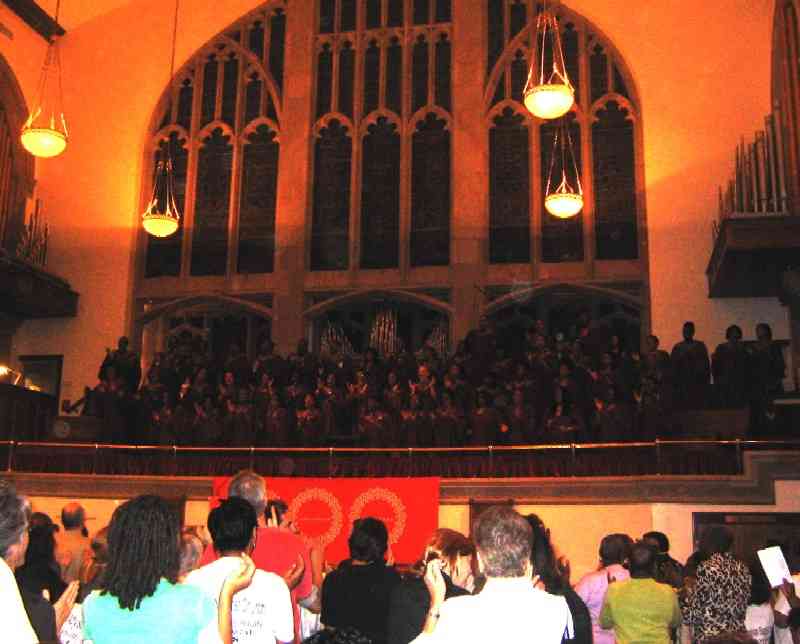
 Gospel Choir, Abyssinian Baptist Church, World Science Festival, New York, 31-MAY-2008
M  usic has a unique ability to animate us, to initiate activity for people who are stuck for one reason or another. And it has a unique ability to help us to feel community with others, to bind us together and to reveal and restore bonds that were broken. These are true for all people. But they are true also for people who have diseases, whose bodies prevent them from starting on their own. Stutterers who cannot speak can, amazingly, sing perfectly. People with viral encephalitis lethargica, about whom I wrote in my book ‘Awakenings’, are helped greatly by music. The power of drugs to help—this waxes and wanes. But the power of music never diminishes. With Parkinson’s, the music must only have a beat, a clear-cut rhythm, to get the person un-stuck. With Alzheimer’s, the music must also be familiar music, music from a time in the person’s life before the dementia. Even with advanced dementia, when powers of memory and language are lost, people will respond to music. With a song, it is possible to discover that words are still in there. Finding that out can be very reassuring, say, to a person who has been unable, for 2 years or more, to call forth words to speak. Then, once we know that the words are still there, it is our task to see whether we can elicit them at other times [when music is not there] and make them available for general use [once again]. It is the basal ganglia, the brainstem, the cerebellum, and some parts of the motor cortex; it is the mammalian old hindbrain. That is where these music-related connections are, and why the ability for music to liberate a person is impervious to diseases that destroy other parts of the brain, the intellect. Actually, I say ‘mammalian’, but every time I do someone tells me about ... cockatoos. Perhaps it is not just mammals...”
  —  Oliver Sacks, Abyssinian Baptist Church, New York, 31-MAY-2008.
There is a tendency to place too much emphasis on thought—on higher brain functions and deliberation and intellect—when we think of how we understand and respond to music. To counterbalance that tendency, neurologist-author Oliver Sacks spoke yesterday at the Abyssinian Baptist Church in Harlem, New York, in one of the events that comprise the World Science Festival. The two-hour program featured a performance of many selections of gospel music by the church's 53-member Abyssinian Baptist Choir. There was a standing-room-only sold-out crowd of more than 1,000 in attendance for the event. The World Science Festival was conceived by Columbia University physicist Brian Greene and his wife, Tracy Day, who is a broadcast journalist.

  • Over My Head (Arr., R. Jennings)
  • Woke Up This Morning (Arr., J. Bolding)
  • We’ve Come This Far by Faith (Arr., J. Bolding)
  • Lift Every Voice and Sing (Arr., R. Carter)
  • Order My Steps (G. Burleigh)
  • Total Praise (R. Smallwood)
  • That’s How the Lord Works (Arr., J. Bolding)
  • Didn’t My Lord Deliver Daniel! (Arr., J. Bolding)
  • For Every Mountain (Arr., J. Bolding)
  • This Little Light of Mine (African American Spiritual)
 Sacks book
Two CMT posts last month concerned assistive technogies, to help disabled people regain and maintain abilities to perform music, particularly in a chamber music setting. But the Abyssinian Baptist Choir concert last night and Dr. Oliver Sacks’s and Rev. Dr. Calvin Butts’s talks (and this CMT post) are reminders that music itself is an assistive technology that promotes the health of the individual and the well-being of the community/society.

Consider, too, that a dimension of the ‘intimacy’ that is definitional of chamber music idioms is that chamber music is assistive in connecting each of us with our true selves—it induces an intimacy of self-awareness, self-discovery, self-actualization. In other words, the intimacy of chamber music is not purely discursive, interpersonal intimacy. It is intra-personal as well; it is about intimate identity. Those who, through the ravages of Alzheimer’s or stroke or other conditions, have lost their memory of their own personal history or identity know this more acutely than the rest of us. The amount of the processing of musical stimuli (and the amount of the synaptic storage and processing associated with personhood and identity) that is located in lateral prefrontal regions, in motor cortex, and in the amygdala, hippocampus, and other limbic structures (ones that are only tangentially connected with intellect or volition) in the brain is suprising, as Grahn and others have recently observed in their fMRI imaging studies. The heart of the emotional brain responds innately to psychophysiological stimuli associated with realistic musical scenes and animalistic rhythms—even the mere suggestion of rhythms or songs, as Sacks says. Our true selves are (partly; substantially) down in those non-intellectual structures, too.

 Snyder book
Those who, through Parkinson’s or other diseases, have lost their ability to initiate actions that manifest their will and their personhood also know that music can assist or restore these—a major point of Oliver Sacks’s remarks. There is a physiologic immanence that is fundamental to music—the rhythm of music is the vehicle for it, more than melody or harmony. The latter are ‘added bonuses’, as Sacks put it. Gospel singing is, apart from its other notable features, inherently physical, intensely rhythmic, radically anticipative, contagious.

 Huron book
The ‘intimacy’ of gospel singing as a species of chamber music is also inherently communitarian—the solidarity and support and intimate belonging and acoustically-mediated enclosedness of the congregation; the musical rhythm-enforced inclusiveness that accepts divergence and difference ( ‘alterity’ ). At one point during last night’s performance, one of the women Abyssinian Baptist Church congregants leapt into the aisle and began shaking and shouting ecstatically. Two of the ushers stood by, but the woman did not collapse. So moved by the music, she continued her rhythmic ‘speaking-in-tongues’ shouting and shaking, at a decibel level often exceeding that of the large choir. The chamber culture and the chamber singers welcome this and recognize and assimilate it as part of the intimacy of worship in community. Sacks recommended that musical training in the schools should be a major curriculum priority, given the large social and health benefits that are known to be associated with engagement with music. In enthusiastic agreement with this remark, the crowd cheered and gave Sacks a standing ovation.

S  teven Mithen has written about this … his experience of discovering his own musicality. He was humiliated when attempting to sing as a child, and stayed away from singing for more than 30 years. Now in his forties, he decided he would take singing lessons for one year. Before he began, he got an fMRI scan of his brain. And, after singing for a year, he arranged to get another fMRI. The corpus callosum and other parts of his brain had dramatically changed in size. The changes were obvious. And it has been found in other musicians, too. We could look at fMRI scans of Albert Einstein’s brain or Brian Greene’s brain, and you could not tell the difference between the brains of mathematical physicists or cosmologists and the brains of ordinary people. But I dare say if you got an fMRI of any of the people behind me [gestures toward Abyssinian Choir members in loft] and you would say ‘This must be the brain of a musician’. It is that dramatic. Of course, it is not yet clear how much of this difference is due to genetics—music-induced structural differences in those who have already musical potential—and how much is from the musical training. But the effect is real. Engaging in music changes your brain.”
  —  Oliver Sacks, Abyssinian Baptist Church, New York, 31-MAY-2008.
The World Science Festival programs continue today with a performance by jazz singer Marilyn Maye (born in Wichita in 1930) at the Kimmel Center, with lectures by Robert Butler, David Sinclair, and Richard Weindruch entitled ‘90 Is the New 50: The Science of Longevity’ at the Eisner & Lubin Auditorium at NYU—how music may help us to live longer, in addition to helping keep our wits and our initiative and our community.

W  hat we have been studying ... is that when you pray, there’s actually a physiological change in the body. Music is very much a part of this. There are certain notes that generate in the human body a kind of peacefulness.”
  —  Rev. Dr. Calvin Butts III, pastor, Abyssinian Baptist Church, New York, 31-MAY-2008.
 Yang painting

 fMRI image of brain