Showing posts with label music therapy. Show all posts

Tuesday, May 19, 2009

One-on-One ‘Chamber Music’ with Mom: Music Therapy for Sensory-Sensitive Kids

 Kranowitz book
A    ny suggestions on how to deal with a toddler who is terrified of certain sounds? Just the mere mention of the word ‘vacuum’ has her falling on the floor, face in her hands, yelling ‘No!’ Not only is she freaked-out by the vacuum but also by certain toys, by the opening song for the ‘Barney’ TV program, the hairdryer, the blender—and also, just recently, by thunder. Any advice would be appreciated.”
  —  Anonymous#1.
I    had the same problem with my kid, starting around 2 and still somewhat an issue at 5. Not sure if being ‘overly sensitive’ is a possibility with your daughter, but my son kept getting his feelings hurt and would cry at the drop of a hat... not like throwing a fit, but instead like someone had broken his heart. A slow process waiting for this phase to pass!”
  —  Anonymous#2.
P    lease don’t make me go hear that sad, sad music again,’ my son said. He was so frightened about it that we eventually said, ‘Okay, you don’t have to go.’ After that, my husband and I took turns going to Mass vs. staying home with our son.”
  —  Laura Heneghan, quoted in Miller & Fuller, p. 15.
I  was just such a kid myself, and I still have some features of it even today as an adult. I am oversensitive to certain sounds; I cannot maintain a pace to tell a joke; I have lapses in tactfulness when I am inordinately ‘jumpy’; I over-react to certain sonic stimuli. Can’t seem to help it.

F  or example, music played very quietly—what the people who are playing it say is ‘just background music’—just makes me go ballistic. And their dismissiveness: their saying that such tiny, innocuous sounds as they are making with their soothing, nondescript, scarcely-audible ‘background music’ can’t possibly be annoying to anyone at all—‘It’s inconceivable!’—aggressively asserting that I have no legitimate basis whatever for complaint: this naturally makes me even more angry. My sonic defensiveness must be ‘all in my head’, ‘not real’, ‘invalid’—is what their denials mean. Only ‘loud’ music could possibly be objectionable—is what their refusals imply.

W  ell, in the immortal words of Mandy Patinkin to Wallace Shawn, “I do not think that word [‘inconceivable’] means what you think it means.”

I  n fact, any monotonous background sound pattern that is too quiet to be heard in detail infuriates me, drives me mad. And yet sitar music and traditional Chinese music and ‘minimalist’ compositions that have just the merest, subtlest hints of variations in notes’ attacks and releases—and which go on and on, for 30 minutes at a time or more—all of these are pleasantly, peculiarly fascinating to me. Maybe it is this way, too, for others who have SPD-type symptoms?

A  t any rate, these are the sole remaining remnants of what was, for me, undoubtedly SPD. Except that SPD did not exist as a diagnosis back when I was a kid, and nobody knew to do anything about it. Except immerse the kid in music, methodically, gradually...

I  just recently received the two SPD-related emails (2 blockquotes) above. I do intermittently browse the research literature, just out of curiosity in light of my own history and situation, to see what the current status of SPD and its clinical treatments may be—and, I thought it might be helpful to post some links (below).

T    apping tunes:
‘I’m going to tap out the rhythm of a song that you know... Listen and tell me what the song is.’ [When the child guesses correctly, sing/tap/play the song together.]
Benefits: Listening to rhythms improves auditory discrimination and aural awareness. Connecting rhythmic patterns with words promotes auditory association and memory. Using hands to tap or beat a rhythm provides tactile and proprioceptive stimuli to associate with sound and to diminish the degree to which acoustic input is 'dissociated' or frightening.”
  —  Kranowitz, OOS, p. 159.
M    atching sounds:
‘Ten identical containers, such as small opaque plastic bottles; five different kinds of small familiar objects, such as rice, paperclips, pennies, buttons, toothpicks. Shake a container and guess what's inside. Then find the other one of the other 9 containers that has the same thing in it. Shake the two containers at the same time, to be sure they match.’
Benefits: Listening to and differentiating the sounds of containers’ contents improves auditory discrimination, auditory memory, and integration of sonic expectations.”
  —  Kranowitz, OOS, p. 161.
S    cale songs:
‘Franz Joseph Haydn’s mom used to play seven tones of scale to get him up in the morning. She would play 7 notes of scale but not play the octave. Franz Joseph couldn’t stand it. He had to run downstairs and play the top ‘C’ to finish the scale. I will do that now. You cover your eyes while I play some notes, and then when I tell you, uncover your eyes and come and play the note that will finish the scale, just like little Franz Joseph and his mom Maria used to do.’
Benefits: ‘Scale songs’ reinforce rhythmic and sonic awareness. Moving while seeking to find the note that will complete the octave that mom didn't finish helps to integrate muscular/motor/vestibular systems. Pitch training makes sounds less disorienting and frightening. Pre-attentive preparatory efforts improve skills in attending to sounds and lower the threshhold for awareness of sounds.”
  —  Kranowitz, OOS, p. 162.
F  irst identified in the 1960’s by the late A. Jean Ayres (1920-1988), ‘sensory processing disorder’ (SPD) is a developmental disorder in:
  • neurological processing and cognitive organizing of sensory information;
  • assigning meaning to what is experienced;
  • acting or responding to situations in an adaptive, purposeful manner;
  • also known as Sensory Integrative Dysfunction (DSI).
S  ensory Processing Disorder does not ‘go away over time’ without therapeutic intervention. Kids don’t ‘out-grow’ it. And, in many cases, SPD doesn’t ‘go away’ even with the best available interventions and treatments. The child simply learns to cope with it, practices ways to make the symptoms less frequent and less severe, and structures her/his activities (and eventual career/profession) to take advantage of the sensory-cognitive gifts and sensory-cognitive deficits that she/he has.

T  LP listening sessions—which have been pursued with some success by a couple of the nurse-moms who I interact with at work and have known professionally for 6 to 20 years, for their own SPD kids—are typically fifteen minutes in length, done once or twice a day, five days a week, using stereo headphones that cover the ears. The efficacy of TLP, Tomatis, and other sensory-stimulation occupational therapy/music therapy programs has not been proven in clinical trials yet (see systematic-review articles and meta-analyses published by Sinha and others, for current status of scientific evidence), but neither have these therapies been shown to be ineffective.

Y  et, qualitatively and anecdotally, I do know from the two nurse-mom-friends that these therapies yielded noticeable improvements in their kids’ behaviors and level of stress.

T  he triggers of the symptoms or sensitivity leading to fright or acting-out seem to be multi-factorial and idiosyncratic: the child’s level of fatigue or stress, the time of day, the situation or social setting where the sonic stimuli occur. The interventions that can blunt or extinguish an over-sensitive episode are just as idiosyncratic.

F  or me, Sarabandes and Courantes are the best medicine—and other calming dance music, preferably Baroque… Sitting in a backyard swing on a sunny summer day and auto-stimulating my differently-abled vestibular system by twisting the swing clockwise, holding still there for a few seconds, and then reversing the swing to un-twist it, anti-clockwise... listening to Bach medium-loud, watching clouds overhead!

Note: CMT blog should not be considered as medical advice, and the remarks in these blog posts are not a substitute for professional medical advice, diagnosis, or treatment. Never delay or disregard seeking professional medical advice from your physician, pharmacist, or other qualified healthcare provider because of something you have read on CMT. You should always speak with your doctor before you start, stop, or change any prescribed part of your care plan or treatment.


Sunday, June 22, 2008

Ensemble Villancico: Källunge Codex and Sonic Rhetoric of the 17th-Century Baltic Church

 Ensemble Villancico, SEMF, Bullkyrkan, 08-JUN-2008
S  ince Martin Luther, music was increasingly understood as an investigative sonic rhetoric. For a long time, composition was dominated by the desire to convince and move the listener. From 1533, when music theorist Nicolaus Listenius introduced the concept of musica poetica, until 1606, when Johannes Burmeister published his rhetorical analysis of a motet by Orlando di Lasso, the need for ever-more forceful modes of expressing emotions grew—leading to stronger emotional contrasts and increasingly rich sonorities… Their survey of rhetorical figures in music and the effect of these on the listener reveals that composers of the period had a single major aim: to construct a composition like a speech, touching the listener’s feelings, preferably for an edifying religious purpose.”
  —  Peter van Tour, 2005.
On Sunday, 08-JUN, Peter Pontvik and members of Ensemble Villancico performed pieces from the Källunge Codex, as part of the Stockholm Early Music Festival (SEMF). The concert was held in the Bullkyrkan (Stadsmissionen) in Gamla Stan, the old-city part of Stockholm whose buildings date to medieval times and earlier.

S  veriges kanske mest kvalificerade musikfestival. (Perhaps the most superior music festival we have in Sweden).”
  —  Aftonbladet, Stockholm.
 SEMF
Ensemble Villancico, comprised of 8 singers and 4 instrumentalists, was founded in 1995 by Peter Pontvik. For the Källunge SEMF performance, the instruments were trombone and Baroque organ. The ensemble predominantly performs music from the Baroque period and is the only ensemble in Scandinavia to do so. The ensemble has won several important awards, including the Ivan Lukacic Prize at the Varazdin Baroque Festival in 2001 and the Swedish Grammis award. Pontvik has been Artistic Director of SEMF since 2002.

 Peter Pontvik
  • Jessica Bäcklund, soprano
  • Nina Åkerblom Nielsen, soprano
  • Gonca Yazan, alto
  • Dan Johansson, countertenor
  • Love Enström, tenor
  • Martin Vanberg, tenor
  • Yamandú Pontvik, baritone
  • Peter Pontvik, contertenor
  • Jens Malmkvist, bass
  • Michael Dierks, organ
  • Daniel Stighäll, trombone
The ‘Codex Kellungensis’ collection of works of the 17th Century is multi-national and includes works by Philipp Dulichius, Melchior Vulpius, Gregor Aichinger, Nicolaus Zangius, Hieronymus Praetorius, Hans Hassler, Jacob Gallus, Johann Walter, Dominique Phinot, Orlando di Lasso, and Johann Bahr.

 Källunge Codex CD
The SSAATTBB orchestration allows for a number of rhetorically and spatially evocative treatments (including antiphonal SATB-SATB double choir). The organ and/or trombone add immensely to the remarkable aesthetic effects that Ensemble Villancico achieves.

Exultate justi in Domino by Vulpius (with organ) and Duo Seraphim clamabant by Aichinger (with organ & trombone) are particularly beautiful. The latter work starts with an atmospheric duet of the two sopranos in close-harmonic chase, over an organ continuo with subsequent passages of homophony. Some of the works are dense harmonies in ‘stile antico’ (Dulichius; Vulpius). More modern compositional styles (Praetorius) are also represented in the Codex.

 Ensemble Villancico, SEMF, Bullkyrkan, 08-JUN-2008
The clarity of tone and diction and the fullness and roundness of the voices were superb. And the Bullkyrkan—an unlikely narrow, tall sanctuary on the second floor of the ancient Gamla Stan Stadsmissionen in the noisy medieval Stora Torget (big square)—was surprisingly congenial, acoustically. The echoes and reverb time from where I was sitting in the balcony were not excessive and in fact lent a 17th-Century authenticity to the performance. (It is odd that we routinely talk of period instruments for historically-informed performances and the attributes that make a particular instrument period-appropriate, but rarely speak of ‘period performance spaces’ and the acoustical attributes that make them period-appropriate or not.)

The small organ with its human diapason and reedy colors at times functions as a ‘narrator’ rhetorically. By contrast, in some dark-hued passages it blends nicely as liminal accompaniment with the singers. This organ and these arrangements for it from the Källunge Codex evoke and reinforce the 17th-Century North German / Baltic liturgical conceit, a kind of Reformation ‘hyper-responsibility’ that views humankind as challenged by what Life (Nature; God) dishes out and challenged by the frail flesh and human nature itself—the organ part tells us how and with what consequence, and the voices plead and declare the mortal parishioners’ responsible intent. Bergman’s and other Swedish films come to mind, Halldor Laxness’s books, the Eddas…

 Daniel Stighäll
Impressive, too, was Göteborg Baroque trombonist Daniel Stighäll. In some of the pieces without organ the trombone part is essentially a vocal part without words—‘toning’ vowels. Don Campbell refers to toning as the vocalization of elongated vowel sounds, and this description is entirely fitting to describe Stighäll’s rendering of his parts. When toning is done with one’s vocal cords, the sounds traditionally are those of the vowels (ah, aye, ee, oh and oo) but are not limited to them. Stighäll simply does toning with his lips and trombone—the effect is more vocal than instrumental.

 Campbell book on toning
Toning is a primordial experience—music-therapy without words but with the rhythm and constraints of breathing. It focuses the performer’s and the listeners’ attention on the mortal, physiological necessity of inspiration and expiration. It is a kinesthetic immersion in one’s corporality and fleshiness as living creature, and in one’s mortalness as an obligate breather-inner-and-outer of air.

The wordless (in-)toning allows—Compels!—our minds to end their internal chatter and enables our creative and reflective connection of mind, body, and spirit.

The trombone ‘vocal part without words’ creates an ambiance where the mind finds its own contexts for the sounds. There are no pre-formed meanings associated with the sounds and the experience tends to be non-linear, splanchnic, pre-verbal. Wordless as it is, the trombone triggers memories of ancestors and relatives who have passed away; enables us to enter into non-ordinary time, a mystical dream-time, in a way that the singers alone cannot do. This is no passively ‘received’ spirituality; this is the stuff you actively fashion under your own power.

T  he poetics of music is a mathematical science through which one creates a delightful and pure harmony on the score paper, so that this can then be recreated by singing or playing with the intention of bringing people to spiritual communion with God.”
  —  Johan Gottfried Walther, 1708.

    [50-sec clip, EnsembleVillancico, Källunge Codex, Gregor Aichinger, Duo Seraphim clamabant, SSAATTBB, organ & trombone, 1.1MB MP3]

Rhetorically, this supernatural role for the trombone is proper. The trombone was used frequently in 16th-Century Venice in canzonas, sonatas, and sacred works by Andrea Gabrieli and later by Heinrich Schütz in Germany. The Baroque trombone was used in Church music and in some other settings (opera), to represent the supernatural or the funerary from the time of Monteverdi. Perhaps this Italian and German usage was simply imported to Gotland. On the other hand, perhaps some of what we hear here has mutated to suit the characteristically Baltic mien.

In any case, Stighäll imparts a distinctly Swedish fatalism and mysticism to this sonic rhetoric. He fully inhabits his instrument, conjuring wonderfully dour and, alternately, joyful colors as a separate-but-equal baritone voice. The singers’ parts at times echo the trombone’s marcato articulations, powerfully endorsing the stature, the expressive merit, and the moral standing of the trombone’s rhetorical gestures. Choir: “You must listen to the trombone and his ideas, for what he is singing, even though it is wordless, is a sacred, ineffable truth—every bit as much as what we are singing. Indeed, we now imitate the trombone, to convince you and emphasize this point.”


    [50-sec clip, EnsembleVillancico, Källunge Codex, Philipp Dulichius, Exultate justi in Domino, SATB-SATB double choir plus trombone, 1.2MB MP3]

In 1913, Birger Anrep-Nordin found the Codex in Källunge Church in Gotland, an island in the Baltic not too far from Stockholm. The Codex Kellungensis is dated 1622 on the cover and originally contained at least 312 works for 4 to 10 parts, music for feasts of the liturgical year and indexed with the Church lectionary. The works are in Latin and German and some in a mixture of both languages. About 150 of the works were missing from the old manuscript, but the nature of those that are missing is known from one of the table-of-contents pages still extant.

 Gotland, in southern Baltic
The Codex is the work of at least 11 different scribes, only one of whose signatures actually appears in the document. The origins and arranger/transcriber credits are still somewhat controversial—a nice summary of the differing scholarly views is provided by Peter Pontvik. Possibly Johann Bahr from Silesia (1610-1670) was responsible for the Codex. He came to Gotland as a music student and eventually became cathedral organist at Visby. He is the only composer who actually lived in Gotland whose work is represented in the Codex. The Codex includes works associated with the Catholic Church and with Protestant denominations.


    [30-sec clip, EnsembleVillancico, Källunge Codex, Johann Bahr, So ziehet hin [So He moves], SSAATTBB, organ & trombone, 0.6MB MP3]

Ensemble Villancico’s Källunge recordings are available on the Sjelvar Records label.

 Tysk Kirk, Gamla Stan, Stockholm

 Gamla Stan street with Mid-sommar festive birch switches propped against shops’ doorways


Sunday, June 1, 2008

Assistive Technologies 3: Music Is the Prosthesis

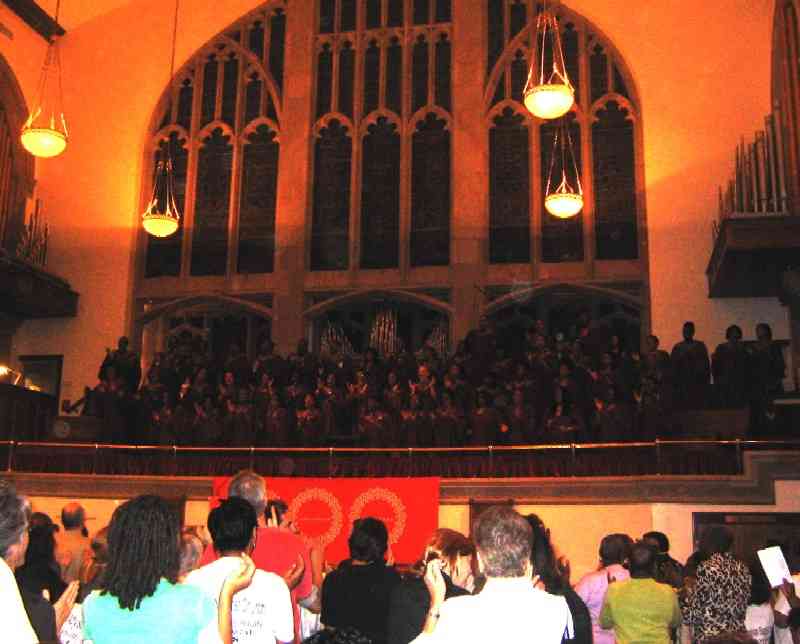
 Gospel Choir, Abyssinian Baptist Church, World Science Festival, New York, 31-MAY-2008
M  usic has a unique ability to animate us, to initiate activity for people who are stuck for one reason or another. And it has a unique ability to help us to feel community with others, to bind us together and to reveal and restore bonds that were broken. These are true for all people. But they are true also for people who have diseases, whose bodies prevent them from starting on their own. Stutterers who cannot speak can, amazingly, sing perfectly. People with viral encephalitis lethargica, about whom I wrote in my book ‘Awakenings’, are helped greatly by music. The power of drugs to help—this waxes and wanes. But the power of music never diminishes. With Parkinson’s, the music must only have a beat, a clear-cut rhythm, to get the person un-stuck. With Alzheimer’s, the music must also be familiar music, music from a time in the person’s life before the dementia. Even with advanced dementia, when powers of memory and language are lost, people will respond to music. With a song, it is possible to discover that words are still in there. Finding that out can be very reassuring, say, to a person who has been unable, for 2 years or more, to call forth words to speak. Then, once we know that the words are still there, it is our task to see whether we can elicit them at other times [when music is not there] and make them available for general use [once again]. It is the basal ganglia, the brainstem, the cerebellum, and some parts of the motor cortex; it is the mammalian old hindbrain. That is where these music-related connections are, and why the ability for music to liberate a person is impervious to diseases that destroy other parts of the brain, the intellect. Actually, I say ‘mammalian’, but every time I do someone tells me about ... cockatoos. Perhaps it is not just mammals...”
  —  Oliver Sacks, Abyssinian Baptist Church, New York, 31-MAY-2008.
There is a tendency to place too much emphasis on thought—on higher brain functions and deliberation and intellect—when we think of how we understand and respond to music. To counterbalance that tendency, neurologist-author Oliver Sacks spoke yesterday at the Abyssinian Baptist Church in Harlem, New York, in one of the events that comprise the World Science Festival. The two-hour program featured a performance of many selections of gospel music by the church's 53-member Abyssinian Baptist Choir. There was a standing-room-only sold-out crowd of more than 1,000 in attendance for the event. The World Science Festival was conceived by Columbia University physicist Brian Greene and his wife, Tracy Day, who is a broadcast journalist.

  • Over My Head (Arr., R. Jennings)
  • Woke Up This Morning (Arr., J. Bolding)
  • We’ve Come This Far by Faith (Arr., J. Bolding)
  • Lift Every Voice and Sing (Arr., R. Carter)
  • Order My Steps (G. Burleigh)
  • Total Praise (R. Smallwood)
  • That’s How the Lord Works (Arr., J. Bolding)
  • Didn’t My Lord Deliver Daniel! (Arr., J. Bolding)
  • For Every Mountain (Arr., J. Bolding)
  • This Little Light of Mine (African American Spiritual)
 Sacks book
Two CMT posts last month concerned assistive technogies, to help disabled people regain and maintain abilities to perform music, particularly in a chamber music setting. But the Abyssinian Baptist Choir concert last night and Dr. Oliver Sacks’s and Rev. Dr. Calvin Butts’s talks (and this CMT post) are reminders that music itself is an assistive technology that promotes the health of the individual and the well-being of the community/society.

Consider, too, that a dimension of the ‘intimacy’ that is definitional of chamber music idioms is that chamber music is assistive in connecting each of us with our true selves—it induces an intimacy of self-awareness, self-discovery, self-actualization. In other words, the intimacy of chamber music is not purely discursive, interpersonal intimacy. It is intra-personal as well; it is about intimate identity. Those who, through the ravages of Alzheimer’s or stroke or other conditions, have lost their memory of their own personal history or identity know this more acutely than the rest of us. The amount of the processing of musical stimuli (and the amount of the synaptic storage and processing associated with personhood and identity) that is located in lateral prefrontal regions, in motor cortex, and in the amygdala, hippocampus, and other limbic structures (ones that are only tangentially connected with intellect or volition) in the brain is suprising, as Grahn and others have recently observed in their fMRI imaging studies. The heart of the emotional brain responds innately to psychophysiological stimuli associated with realistic musical scenes and animalistic rhythms—even the mere suggestion of rhythms or songs, as Sacks says. Our true selves are (partly; substantially) down in those non-intellectual structures, too.

 Snyder book
Those who, through Parkinson’s or other diseases, have lost their ability to initiate actions that manifest their will and their personhood also know that music can assist or restore these—a major point of Oliver Sacks’s remarks. There is a physiologic immanence that is fundamental to music—the rhythm of music is the vehicle for it, more than melody or harmony. The latter are ‘added bonuses’, as Sacks put it. Gospel singing is, apart from its other notable features, inherently physical, intensely rhythmic, radically anticipative, contagious.

 Huron book
The ‘intimacy’ of gospel singing as a species of chamber music is also inherently communitarian—the solidarity and support and intimate belonging and acoustically-mediated enclosedness of the congregation; the musical rhythm-enforced inclusiveness that accepts divergence and difference ( ‘alterity’ ). At one point during last night’s performance, one of the women Abyssinian Baptist Church congregants leapt into the aisle and began shaking and shouting ecstatically. Two of the ushers stood by, but the woman did not collapse. So moved by the music, she continued her rhythmic ‘speaking-in-tongues’ shouting and shaking, at a decibel level often exceeding that of the large choir. The chamber culture and the chamber singers welcome this and recognize and assimilate it as part of the intimacy of worship in community. Sacks recommended that musical training in the schools should be a major curriculum priority, given the large social and health benefits that are known to be associated with engagement with music. In enthusiastic agreement with this remark, the crowd cheered and gave Sacks a standing ovation.

S  teven Mithen has written about this … his experience of discovering his own musicality. He was humiliated when attempting to sing as a child, and stayed away from singing for more than 30 years. Now in his forties, he decided he would take singing lessons for one year. Before he began, he got an fMRI scan of his brain. And, after singing for a year, he arranged to get another fMRI. The corpus callosum and other parts of his brain had dramatically changed in size. The changes were obvious. And it has been found in other musicians, too. We could look at fMRI scans of Albert Einstein’s brain or Brian Greene’s brain, and you could not tell the difference between the brains of mathematical physicists or cosmologists and the brains of ordinary people. But I dare say if you got an fMRI of any of the people behind me [gestures toward Abyssinian Choir members in loft] and you would say ‘This must be the brain of a musician’. It is that dramatic. Of course, it is not yet clear how much of this difference is due to genetics—music-induced structural differences in those who have already musical potential—and how much is from the musical training. But the effect is real. Engaging in music changes your brain.”
  —  Oliver Sacks, Abyssinian Baptist Church, New York, 31-MAY-2008.
The World Science Festival programs continue today with a performance by jazz singer Marilyn Maye (born in Wichita in 1930) at the Kimmel Center, with lectures by Robert Butler, David Sinclair, and Richard Weindruch entitled ‘90 Is the New 50: The Science of Longevity’ at the Eisner & Lubin Auditorium at NYU—how music may help us to live longer, in addition to helping keep our wits and our initiative and our community.

W  hat we have been studying ... is that when you pray, there’s actually a physiological change in the body. Music is very much a part of this. There are certain notes that generate in the human body a kind of peacefulness.”
  —  Rev. Dr. Calvin Butts III, pastor, Abyssinian Baptist Church, New York, 31-MAY-2008.
 Yang painting

 fMRI image of brain


Wednesday, May 28, 2008

Assistive Technologies 2: ‘Disability Arts’ and Special User Interfaces

 Mouse alternatives, for persons with disabilities
Y  ou can’t just listen to music; you have to make it.”
  —  Tod Machover, MIT, TED mp4.
T  he image of the ideal care setting today is one that nurtures physical, social, and creative activity—incorporating arts such as music, dance, and painting as beneficial agents for sustaining health... We are building care settings that are spacially generous and offer services that motivate activity, companionship, and the will to enjoy.”
  —  Elizabeth Brawley, Design Innovations for Aging and Alzheimer’s.
Disability Arts is a term that needs to be understood within the context of the whole Disability Rights Movement. It’s a matter of distributive justice and fairness, toward those who are affected by disabilities of various kinds. I recently came across the TED website, which, among its many many mp4s, has more than 300 recorded talks that have something to do with music. If you click on the image below (of cerebral palsy sufferer, Dan Ellsey, performing one of his compositions for an audience at MIT this March), you can watch a 20-min video of an example of assistive technologies to enable disabled individuals to compose and perform their music.

 Dan Ellsey performing, MAR-2008, MIT
Ellsey uses a software app called Hyperscore™, developed at MIT Media Lab. The compositions need not be electroacoustic ones like this one; however, performances by disabled persons may often utilize MIDI and waveform-sampled libraries or hyperinstruments or other means of emulating traditional acoustic analog instruments.

 Hyperscore™ user interface  Hyperscore™ rendering of harmony
This blog post is not primarily about Ellsey or MIT Media Lab, though. It is a continuation of the previous post on ‘assistive technologies’, and aims to help you fill a gap in currently available access to music-making by persons with significant motor impairments, by providing some links and information regarding some relevant products. There are many new, affordable, portable, easy-to-use devices intended to allow persons with disabilities to play music on a MIDI synthesizer or keyboard. The primary target group for these devices (and for this CMT blog post) is disabled persons who are already using computers, communication devices, and powered wheelchairs. A suitable switch interface and controller can connect large-actuator switches (like the SmartBox ones pictured at the top of this post) to any MIDI synthesizer/sequencer. Besides the software and pointing devices and so on, be sure to ‘sweat the small stuff’ as well, such as Grid-2 software-controlled switches or foot-switches to control multi-outlet powerstrips, to simplify turning equipment on and off. Usability does not just concern the software or PC UI; it concerns the user interface for the whole system or environment that the disabled person is going to use.

 SmartNAV™ user interface
Hands-free pointing devices are very helpful in mitigating musculoskeletal or motor disabilities. SmartNAV™ is one of the better ones recently introduced. SmartNAV™ is available through a number of distributors here, here, and here. The SmartNAV sits on top of your PC monitor and replaces your conventional mouse and lets you control the mouse-cursor by moving your head.

Originally designed for game control, the SmartNAV head mouse enables users to access Windows, Microsoft Office™ apps, and other programs all hands-free. You can also control Grid-2 or other software controlled switches with the SmartNAV, which is a faster alternative to a switch or direct access for some users. The SmartNAV device consists of a sophisticated infra-red camera that you place above your screen. This follows a small reflective dot so that you can move the mouse pointer by moving your head. The pointer movement can be adjusted for speed and sensitivity.

To use the SmartNAV, you simply place a small reflective dot on your forehead or glasses and position yourself so that the IR sensor on top of your monitor can detect motion of the dot. (A baseball cap is also available, incorporating a reflective dot on the peak and rear, although other kinds of hats or headbands will work equally well if you prefer not to put a dot on your forehead or eyeglasses.) The SmartNAV comes with the Sensory Software WordWall™ program. This allows you to left-click, right-click, drag, and so on, by ‘dwelling’ (resting the mouse pointer over one spot on the screen).

 SmartNAV medicare coverage
SmartNAV™ is a bit expensive (about $400 to $500, depending on the options and accessories you choose), but it’s rugged and well-designed. The new Model 4 SmartNAV has 1280x480 pixel resolution with a 41-degree field-of-view, so that it works well with hi-res monitors and the UIs of conventional software. The pointing spatial resolution and ergonomics are good enough to make using many PC apps pretty efficient. I have not yet tried it with Finale™, Sibelius™, or sequencing software, though. The dense control surfaces of those apps’ user interfaces might be a bit beyond what SmartNAV™ is suitable for. But, for simpler UIs with fewer and larger controls (like Hyperscore™), SmartNAV is fine.

 Tod Machover, MIT