Showing posts with label kinesthetic. Show all posts

Friday, March 30, 2012

Kinesthetics/Biomechanics of Instrument Design governs the music that comes out

Zankel Hall – Partch instruments
S  ome works begin their performance life in a shocking way but, with further performances, come to feel ‘more normal’. Not so with David Del Tredici’s ‘Syzygy’. It was composed in 1966, yet it retains all of its novelty and magic. It continues for me to be a source of wonder … and terror…”
  — Michael Tilson Thomas, introductory remarks, Zankel Hall, 29-MAR-2012.
A  fine program at Zankel Hall last night! Excellent New York premiére of Mason Bates’s 2011 ‘Mass Transmission’ for choir, organ, and electronica. A chamber orchestra comprised of members of San Francisco Symphony members gave a stirring account of Lou Harrison’s 1973 ‘Concerto for Organ and Percussion Orchestra’. And Del Tredici’s 1966 ‘Syzygy’ was just as disturbing as Michael Tilson Thomas promised (esp., the pyrotechnics by soprano Kiera Duffy and Nicole Cash, French horn).

B ut the highlight of the program for me was the 8-person ensemble who performed Harry Partch’s 1958 ‘Daphne of the Dunes’, using Partch’s original one-off, home-made instruments that had been shipped cross-country in two semi tractor-trailers for Carnegie Hall’s ‘American Mavericks’ programs. (Performed by Dean Drummond, harmonic cannon & spoils-of-war; Joe Bergen, harmonic cannon & chromelodeon; Charles Corey, kithara, surrogate-kithara, harmonic cannon; jeffery irving, surrogate-kithara & harmonic cannon; Jared Soldiviero, boo, spoils-of-war, kithara; Bill Ruyle, diamond marimba; Joe Fee, cloud chamber bowls; Greg Hesselink, tenor violin, gourd tree, missile-cone gongs, pre-recorded tape.)


T he spatial arrangements of the instruments’ parts give rise to a spectrum of motions that lie well under the human hand. The physical distances between the strike-positions that produce the notes; the non-monotonic relationship of the parts’ positioning to their pitches; the practical biomechanics of what it is feasible for human arms, and fingers, and feet to do; the sensitivity of the parts, namely, how much force is required to generate a particular sound intensity: all of these contribute to the sonic qualities and musical tendencies of each instrument. The geometries of each instrument are associated with patterns and playing motions and sounds that are natural or characteristic for the instrument and the music to which it contributes. This is true of all instruments, of course; but we tend to under-recognize the fact when we listen to or observe performers of ‘normal’ instruments. With Partch’s compositions, the kinesthetics and biomechanics of the user interface are in our face.

F or example, plucking vertical strings that descend down by your knees, where you have difficulty seeing the strings in the shadows—leaning forward, bending down, and plucking them while standing, perched on a tall, narrow, possibly-catastrophically-tippy bench—while the music is located on a frail, kludgy stand way up above your head—these features impart an inherent, peculiar urgency and anxiety to the playing, which on account of these reasons is very different from the sound of a harp played by a performer who is comfortably and safely seated. The emotional quality of the sound is dramatically different, despite the fact that the mechanism of sound production is substantially the same in the two instruments.

W hat an evening!—showcasing compositions that have their own internal reasons for being, mostly refusing to cater to any external audience! And, with the exception of the Mason Bates piece (commissioned by San Francisco Symphony, with support of Michele and Laurence Corash), innovating things with slim expectation of popularity or compensation within the composer’s lifetime. Price of vision.

Wednesday, January 18, 2012

Chamber Music for Dressage Freestyle (kür)

Walker article
I   want people to feel that it’s not just a kur but something like art. I hope people have a physical feeling as they hear the music—for me it is so special. I want them to be excited as they listen and watch. I think there’s a lot of emotion in it... My music before was mostly French, and this kur has some international music, but I’m also using some music by Polish composers... It’s difficult to put a name to this music, but it’s like a mix of classical with trance.”
  — Michal Rapcewicz, FEI World Cup 2009.
T his November 2011 post about the Spanish Riding School in Vienna has in 6 weeks’ time received a surprisingly large number of pageviews and outclicks.

M ost of these new visitors to CMT (and searchers who land on CMT) are equestrians, dressage riders looking for suitable music with tempi in the 140 to 160 bpm range that will suit the biomechanics of their horse and that will offer a chance to dramatically differentiate themselves from the other competitors… these are horse people who are tired to death of riding trite ‘pop’ music for their dressage tests.

B ut some of the horsey CMT visitors landing on that November lippizaner blogpost have come from TCP/IP addresses that indicate they are from Conservatories and from chamber music ensembles’ websites. Are these visitors merely musicians who in their spare time are hobbyist dressage amateurs? Or are they instead seriously looking to program new repertoire for dressage and thereby expand the market for their chamber performances and recordings? Are any of them composers, I wonder?

A nyhow, the traffic does stimulate thought! Possibly some composers would be intrigued by the prospect of writing for dressage... consider it in the same way you would composing for ballet! It is far easier to get commissioned by serious dressage riders to do some ‘miniatures’ than it is to get hired to write a ballet score. [Typically, there is a very brief leader or intro (the rider must enter the arena within 20 sec of the start of the music) to establish the mood/atmosphere and tempo and rhythmic structure of the piece—enough to cue the horse and rider. The dressage rules stipulate that the maximum length is 5 minutes of music. In many jurisdictions, there is no minimum time limit; however, most kür music is a bit longer than 3 min. Depending on the choreography, saying what you want to say in 3’30’’ or 4’20’’, say, is far more crisp, focused and dramatic (and competition-winning) than pointlessly dilating the piece to the max 4’59’’.]

A nd possibly some chamber music ensembles would be interested in recording such works... providing CDs or MP3s for dressage tests.

P ossibly ACF or other sponsors of new music would set ‘dressage to music’/‘freestyle’/‘kür’ as a subject for a future competition and call-for-compositions. Possibly one of the national dressage organizations would commission some compositions for kür.

T hink Bach WTC Bk 1, Prelude and Fugue No. 2 in C minor, BWV 847 (prelude), with a dark-angel Sviatoslav Richter-esque tempo. Nothing too delicate! Nothing too subtle! The music will be amplified, typically in a large echoic arena or open space—so you need clear orchestration with not too much polyphony or rhythmic complexity. Think confident, ebullient, full of impulsion! Think music that is emblematic of divine almighty beauty, whatever you conceive that to be! Think intimate and individualistic sound that will showcase the equine dancer! Think ‘What music would a beautiful, balletic horse love to dance to?’

Tuesday, January 3, 2012

Guided imagery in music training and performance

x
I    n order to have fast mobility and clarity on left-hand fingers, string players have to train their fingers to have these 3 elements when dropping their left-hand fingers on the fingerboard: speed; strength; and the fast release right after the drop. The 3 elements on the left-hand fingers take training to build up the strength of the muscles and the speed of the reflex of the fast release. Of course, any ‘tool’ that we gain from our technical training is ultimately to be used to create music that would touch listeners. Sometimes when musicians concentrate too much on technical elements, their music tends to be too mechanical, too careful, and lacks emotion. By contrast, when musicians concentrate on being musical, it actually helps the technical things. For example, whenever I feel my fingers stiffen in fast passages, I always find thinking something light and bubbly helps to increase my fingers’ lightness, mobility, and fast articulations. Whenever I try to sustain a long note [and yet try to musically project vitality and suspense, despite the temporary absence of pitch-change or the lack of overt dynamics changes while the note lasts], I remind myself about the struggles and tension of the music. Whenever I try to create smooth bow changes, I often picture a [calligraphy] paint brush changing its direction, instead of which muscle to move first!”  —  Jackie Lee, Heartland Music Academy, 2012.
Jackie LeeI n reply to the previous post, I received the helpful advice above.

A nother CMT reader emailed me to ask whether there was any scientific research literature that establishes the effectiveness of visual or kinesthetic imagery in music teaching, especially for soloists or chamber performers.

T here’s lots of published research on guided imagery in the neurophysiology and physical medicine and rehab literature—and in the lit for research on aging and stroke. Quite a lot in the dance and sports medicine lit. But there are not very many published controlled research studies in music performance/pedagogy lit, so far as I can tell.

I  will continue looking; please feel free to add comment below or email me if there is a reference that you like.

M eanwhile, here are some links to work that’s relevant to this.
T   he left arm functions, to a large extent, by 'walking' on the fingers. In actual walking, torso balance shifts forward, and it is caught on top of the moving legs. For the cellist's left arm, a similar balance can be felt when the upper arm shifts and must be caught by another finger or the arm will fall over... This ‘walking’ image can be strengthened by imagining that the fingerboard is a staircase... Picturing this helps you feel that your balance is aligned in the Earth's gravity, even though your fingers look angled-back in relation to the surface of the fingerboard.”   —  Jeffrey Solow, cellist, quoted in Bruser, p. 121.
I    n automatic or cyclical movements, actual and motor imagery (MI) durations are similar. When athletes imagine only the dynamic phases of movement or perform MI just before competing, however, the environmental and time constraints lead to underestimating the actual duration [and the benefits of the guided imagery are diminished, despite the speed and ease with which the imagery for brief or cyclical movements is called up]. Conversely, complex attention-demanding movements take longer to image [and so guided imagery for complex movements has impediments to its effectiveness, even if duration over/underestimation does not occur].”   —  Aymeric Guillot, 2005.
T    he bilateral frontal opercular regions [in the brain] are crucial in both preparation for and during music execution and imagining. They may have ‘mirror neuron’ properties that underlie observation or imagining of one’s own performance. The motor areas are differentially activated during the preparation and execution or imagining the sequence.”   —  Rumyana Kristeva, 2003.
Mike Mei, calligrapherD    uring execution of musical sequences in professional musicians, a higher economy of motor areas [in the brain] frees resources for increased connectivity between the finger sequences and auditory as well as somatosensory loops, which may account for the superior musical performance. Professionals also demonstrated more focused activation patterns during imagined musical performance.”   —  Martin Lotze, 2003.

Tuesday, November 22, 2011

Paul Lewis’s Performance Suggests Cardiovascular Kinesthetics as Source of Inspiration for Features in Schubert’s Late Piano Music

Paul LewisT he excellent performance last night by pianist Paul Lewis at the Mozart-Saal in the Konzerthaus in Vienna provided some new insights about acoustic effects that are idiomatic of piano that may have interested Schubert late in his composing career.

T here are many passages in the Vier Impromptus (D 935, 1827), Fantasie (D 760, 1822), and Sechs Moments musicaux (D 780, 1823-28) that have emphases with the sustain pedal applied—the Sechs Moments more than the others. The impression we receive as the sound “blooms” or blossoms in the few hundreds of milliseconds after the chord’s strings have been struck and sympathetic resonances are established in other strings and in the soundboard amounts to a tactile/haptic sense of flow—of a “systolic” pushing of blood through large blood vessels, and of the blood vessels’ elasticity, acting as a “reservoir” with network-like capacitance to absorb the flow and to subsequently dissipate it in the rete of smaller vessels beyond.

Pianoteq bloom
I t requires a piano with an efficient, high-impedance soundboard with a high Q-factor (fast decay of high overtones). You can play around with these properties with the Pianoteq software if you like. The software enables you to alter or exaggerate the “bloom”—how quickly or slowly it develops after the hammer strikes the strings; how long it takes for it to ring-down and decay while the sustain pedal is depressed.

Systolic momentsI n Lewis’s playing, we see the physical origins of the sound—besides the properties of the instrument itself, there are elements of his performance practice that contribute to his technique and the sound that it affords. For example, he places the piano bench very high—so that the top of the bench is almost even with the underside of the keyboard… Last night, it was only 2 cm lower than the surface of the flange that mounts the pedal mechanism to the underside of the Steinway Model “D”. The thighs slope downward, and this puts Lewis’s legs in an angle of slight extension—about 140° between the femur and the tibia shaft centerlines. His elbow is high as well—also in a position of slight extension.

L ewis’s pedaling technique involves, then, considerable so-called “concentric” contraction by the rectus femoris muscle of the right leg, in addition to the flexion of the ankle. The dynamics of Lewis’s right leg motions contributed substantially to the “blooming,” systolic sonic effects of the accent-sustains in these Schubert pieces.

W hy does this interest me? Because these pieces are introspective and quite emotional, and I want to think about how they came to be so. These pieces were created late in Schubert’s short life, after the consequences of his syphilis had begun to be apparent, and after his treatments with mercury compounds (one of the few modalities of “treatment” for syphilis in the 19th Century) had also begun to exert their neurotoxic side-effects.

W hile it is possible for those of us who are not musicians—who are not composers—to be oblivious to the rhythms of our bodies, to the rhythms of our life and of our mortality, it is pretty implausible that a composer, or any elite-level musician performer—would not notice. And, having noticed such things—especially abnormal things, changed or changing things, potentially life-threatening things—like the pulsatility of one’s heart that is altering day by day as it has to work harder; or palpitations of a chronic or sub-chronic abnormal heart rhythm; or the progressive dilatation of an abdominal aortic aneurysm; or the worsening of stenosis of the aortic valve in the heart, or worsening incompetence of the mitral valve—having noticed them, it is, I think, impossible for a composer not to attend to them. Impossible for those physical, kinesthetic effects not to creep into one’s music; impossible not to become a bit preoccupied or obsessed with such persistent sensory stimuli in one’s writing.

L ewis’s lucid, passionate, pulsatile playing of these late Schubert works last night—evocative as it was of preoccupations with systole, and pressure-wave run-off, and hemodynamics equations, and windkessel compliance, and vessel elastance and storage, and ventricular-arterial coupling, and how severe aortitis changes these things—caused me think of this. Life is short: compose like hell, while we can; play like hell, while we can.

Thursday, November 10, 2011

Composing-while-Dancing: EROI Festival, Organ Improvisation, and Embodiment

EROI
I   mprovising is difficult-] because our current educational system makes it so.”
  — William Porter, keynote talk, EROI 2011.
B   ecause learning it happens so very late [in the course of pedagogy and acquiring musical skills].”
  — Eastman student, quoted by William Porter, EROI 2011.
T he EROI festival this year is centered on the topic of improvisation and opened this afternoon with a stimulating, expansive meditation-cum-keynote-speech by William Porter, entitled ‘Why Is Improvisation So Difficult?’

I t was followed by a breathtaking, virtuosic “triple-header” 8:00 p.m. recital on the Craighead-Saunders organ for a packed-in audience at Christ Church across the street from Eastman School of Music:
  • Böhm – Praeludium in C; Herr Jesu Christ dich zu uns wend (Chorale Cycle with 6 verses); Hans Davidsson
  • Hindemith – Organ Sonata No. 1; William Porter
  • Schumann – Etuden in kanonischer Form für Orgel oder Pedalklavier, Op. 56; David Higgs
  • Liszt – Präludium und Fuge über den Nahmen B-A-C-H; David Higgs
U p to the mid-18th Century, improvisation was a fundamental skill in which most if not all practicing musicians were adept. Since that time, however, fewer and fewer musicians have felt fluent at improvising extemporaneously.

EROIP orter catalogued the concepts and situations that he believes lead many musicians today to find improvising difficult. He averred that because genres and idioms are today so tremendously diverse, it is difficult to teach improvisation as ‘compositional performance’ insofar as it is not humanly possible for one person to be fully fluent in what constitutes improvisation in more than a few genres/idioms. It was far easier when the prevailing idioms/use-cases/purposes of the music were few in number and the contexts for the improvisation (e.g., liturgical/sacred music) were more structured.

F oremost among the reasons why improvisation has become ‘hard,’ Porter says, is that counterpoint, voice-leading, and harmony are in recent decades taught in ‘classroom’ settings, primarily as paper-based exercises in writing, instead of as practical performance on a keyboard instrument (or any other instrument, including voice). Student musicians only rarely these days develop any ‘muscle memory’ for improvisation per se, so that the body—the fingers, the hands, the diaphragm, the whole body—knows how to execute improvisation as a sort of ‘compositional performance’. Porter exhorted the teachers in the audience to amend the curriculum to impart such kinesthetic knowledge to students, and to do it from their earliest days when they are kids, just beginners, much in the manner that would be done with dancers or other kinds of athletes.

S ome book links are gathered below, for your interest, in the spirit of Porter’s remarks about embodiment, kinesthetics, and corporality in improvisation. Especially noteworthy is Pamela Ruiter-Feenstra’s new two-volume treatise ‘Bach and the Art of Improvisation’ (link below).

W hat a fantastic EROI Festival this will be, crafting the future of organ improvisation and improvisation pedagogy!
W   e must kill the twin demons of ‘originality’/‘novelty’ and ‘imitation’: these ultimately lead to paralysis and inhibit improvisation. Instead, we must teach the student how to be compelling, how to be convincing. It is better to be ‘interesting’ than to be original. The integrity of saying something with conviction, and of being spontaneously responsive to other musicians and to the audience—is what we really mean by ‘improvisation’. We must teach them to prepare—to prepare to take advantage of the unexpected when it happens.”
  —  William Porter, keynote talk, EROI 2011.
EROI


Sunday, June 1, 2008

Assistive Technologies 3: Music Is the Prosthesis

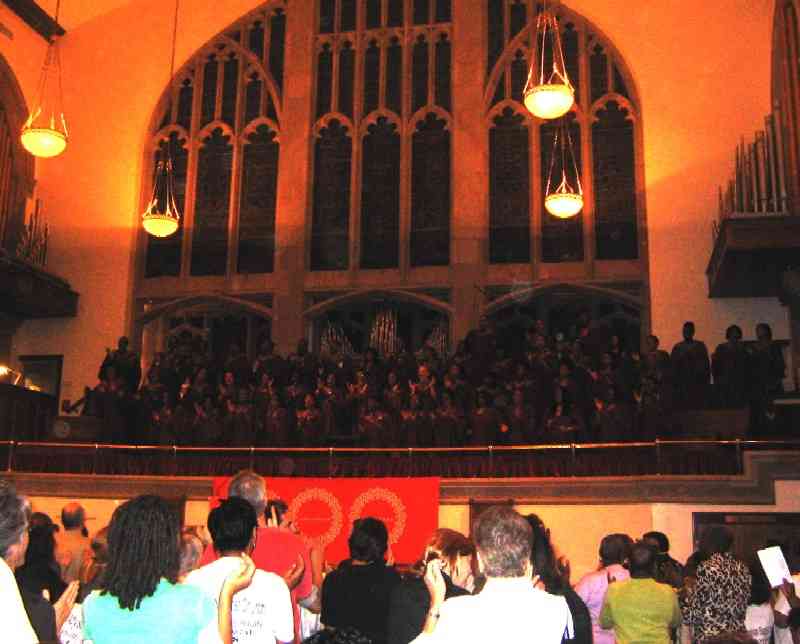
 Gospel Choir, Abyssinian Baptist Church, World Science Festival, New York, 31-MAY-2008
M  usic has a unique ability to animate us, to initiate activity for people who are stuck for one reason or another. And it has a unique ability to help us to feel community with others, to bind us together and to reveal and restore bonds that were broken. These are true for all people. But they are true also for people who have diseases, whose bodies prevent them from starting on their own. Stutterers who cannot speak can, amazingly, sing perfectly. People with viral encephalitis lethargica, about whom I wrote in my book ‘Awakenings’, are helped greatly by music. The power of drugs to help—this waxes and wanes. But the power of music never diminishes. With Parkinson’s, the music must only have a beat, a clear-cut rhythm, to get the person un-stuck. With Alzheimer’s, the music must also be familiar music, music from a time in the person’s life before the dementia. Even with advanced dementia, when powers of memory and language are lost, people will respond to music. With a song, it is possible to discover that words are still in there. Finding that out can be very reassuring, say, to a person who has been unable, for 2 years or more, to call forth words to speak. Then, once we know that the words are still there, it is our task to see whether we can elicit them at other times [when music is not there] and make them available for general use [once again]. It is the basal ganglia, the brainstem, the cerebellum, and some parts of the motor cortex; it is the mammalian old hindbrain. That is where these music-related connections are, and why the ability for music to liberate a person is impervious to diseases that destroy other parts of the brain, the intellect. Actually, I say ‘mammalian’, but every time I do someone tells me about ... cockatoos. Perhaps it is not just mammals...”
  —  Oliver Sacks, Abyssinian Baptist Church, New York, 31-MAY-2008.
There is a tendency to place too much emphasis on thought—on higher brain functions and deliberation and intellect—when we think of how we understand and respond to music. To counterbalance that tendency, neurologist-author Oliver Sacks spoke yesterday at the Abyssinian Baptist Church in Harlem, New York, in one of the events that comprise the World Science Festival. The two-hour program featured a performance of many selections of gospel music by the church's 53-member Abyssinian Baptist Choir. There was a standing-room-only sold-out crowd of more than 1,000 in attendance for the event. The World Science Festival was conceived by Columbia University physicist Brian Greene and his wife, Tracy Day, who is a broadcast journalist.

  • Over My Head (Arr., R. Jennings)
  • Woke Up This Morning (Arr., J. Bolding)
  • We’ve Come This Far by Faith (Arr., J. Bolding)
  • Lift Every Voice and Sing (Arr., R. Carter)
  • Order My Steps (G. Burleigh)
  • Total Praise (R. Smallwood)
  • That’s How the Lord Works (Arr., J. Bolding)
  • Didn’t My Lord Deliver Daniel! (Arr., J. Bolding)
  • For Every Mountain (Arr., J. Bolding)
  • This Little Light of Mine (African American Spiritual)
 Sacks book
Two CMT posts last month concerned assistive technogies, to help disabled people regain and maintain abilities to perform music, particularly in a chamber music setting. But the Abyssinian Baptist Choir concert last night and Dr. Oliver Sacks’s and Rev. Dr. Calvin Butts’s talks (and this CMT post) are reminders that music itself is an assistive technology that promotes the health of the individual and the well-being of the community/society.

Consider, too, that a dimension of the ‘intimacy’ that is definitional of chamber music idioms is that chamber music is assistive in connecting each of us with our true selves—it induces an intimacy of self-awareness, self-discovery, self-actualization. In other words, the intimacy of chamber music is not purely discursive, interpersonal intimacy. It is intra-personal as well; it is about intimate identity. Those who, through the ravages of Alzheimer’s or stroke or other conditions, have lost their memory of their own personal history or identity know this more acutely than the rest of us. The amount of the processing of musical stimuli (and the amount of the synaptic storage and processing associated with personhood and identity) that is located in lateral prefrontal regions, in motor cortex, and in the amygdala, hippocampus, and other limbic structures (ones that are only tangentially connected with intellect or volition) in the brain is suprising, as Grahn and others have recently observed in their fMRI imaging studies. The heart of the emotional brain responds innately to psychophysiological stimuli associated with realistic musical scenes and animalistic rhythms—even the mere suggestion of rhythms or songs, as Sacks says. Our true selves are (partly; substantially) down in those non-intellectual structures, too.

 Snyder book
Those who, through Parkinson’s or other diseases, have lost their ability to initiate actions that manifest their will and their personhood also know that music can assist or restore these—a major point of Oliver Sacks’s remarks. There is a physiologic immanence that is fundamental to music—the rhythm of music is the vehicle for it, more than melody or harmony. The latter are ‘added bonuses’, as Sacks put it. Gospel singing is, apart from its other notable features, inherently physical, intensely rhythmic, radically anticipative, contagious.

 Huron book
The ‘intimacy’ of gospel singing as a species of chamber music is also inherently communitarian—the solidarity and support and intimate belonging and acoustically-mediated enclosedness of the congregation; the musical rhythm-enforced inclusiveness that accepts divergence and difference ( ‘alterity’ ). At one point during last night’s performance, one of the women Abyssinian Baptist Church congregants leapt into the aisle and began shaking and shouting ecstatically. Two of the ushers stood by, but the woman did not collapse. So moved by the music, she continued her rhythmic ‘speaking-in-tongues’ shouting and shaking, at a decibel level often exceeding that of the large choir. The chamber culture and the chamber singers welcome this and recognize and assimilate it as part of the intimacy of worship in community. Sacks recommended that musical training in the schools should be a major curriculum priority, given the large social and health benefits that are known to be associated with engagement with music. In enthusiastic agreement with this remark, the crowd cheered and gave Sacks a standing ovation.

S  teven Mithen has written about this … his experience of discovering his own musicality. He was humiliated when attempting to sing as a child, and stayed away from singing for more than 30 years. Now in his forties, he decided he would take singing lessons for one year. Before he began, he got an fMRI scan of his brain. And, after singing for a year, he arranged to get another fMRI. The corpus callosum and other parts of his brain had dramatically changed in size. The changes were obvious. And it has been found in other musicians, too. We could look at fMRI scans of Albert Einstein’s brain or Brian Greene’s brain, and you could not tell the difference between the brains of mathematical physicists or cosmologists and the brains of ordinary people. But I dare say if you got an fMRI of any of the people behind me [gestures toward Abyssinian Choir members in loft] and you would say ‘This must be the brain of a musician’. It is that dramatic. Of course, it is not yet clear how much of this difference is due to genetics—music-induced structural differences in those who have already musical potential—and how much is from the musical training. But the effect is real. Engaging in music changes your brain.”
  —  Oliver Sacks, Abyssinian Baptist Church, New York, 31-MAY-2008.
The World Science Festival programs continue today with a performance by jazz singer Marilyn Maye (born in Wichita in 1930) at the Kimmel Center, with lectures by Robert Butler, David Sinclair, and Richard Weindruch entitled ‘90 Is the New 50: The Science of Longevity’ at the Eisner & Lubin Auditorium at NYU—how music may help us to live longer, in addition to helping keep our wits and our initiative and our community.

W  hat we have been studying ... is that when you pray, there’s actually a physiological change in the body. Music is very much a part of this. There are certain notes that generate in the human body a kind of peacefulness.”
  —  Rev. Dr. Calvin Butts III, pastor, Abyssinian Baptist Church, New York, 31-MAY-2008.
 Yang painting

 fMRI image of brain


Saturday, June 23, 2007

Hargis: Music to Live For, Aided and Abetted by Gestures

Ellen
CMT: Ellen Hargis is a member of the Newberry Consort and The King’s Noyse. As a soprano, she’s one of America’s preeminent early music artists, specializing in repertoire ranging from ballads to opera. She’s performed at many of the world’s leading festivals including the Adelaide Festival (Australia), Utrecht Festival (Holland), Resonanzen Festival (Vienna), Tanglewood, the New Music America Festival, Festival Vancouver, the Berkeley Festival (California), and is a frequent guest at the Boston Early Music Festival, where she’s sung title roles in Baroque operas and recently served as assistant director and Vocal and Gesture Coach for the production of the Lully opera, Psyché.


DSM: Her discography includes repertoire ranging from medieval to contemporary music. She’s recently recorded the leading role of Aeglé in Lully’s Thésée for CPO Records, released this month. Recent releases also include the premier recording of Conradi’s opera Ariadne. She’s featured on a number of Harmonia Mundi recordings including a critically acclaimed solo recital disc of music by Jacopo Peri, and in Arvo Pärt’s Berlin Mass. Ellen’s on the vocal faculty of Case Western Reserve University in Cleveland, and teaches numerous summer courses in early music, including the Longy International Baroque Institute in Cambridge, The Lute Society of America Seminars and the Vancouver Baroque Vocal Programme.

CMT: Ellen’s sense of operatic gesture is superb. Every dramatic action requires a justification, a rationale that can be apprehended by the audience, and Ellen’s Psyché direction ensured that the connection between action and justification—through appropriate visual scale of the gestures, and the reinforcement and repetition of gestures consistently by the various actors—was clear and convincing and natural.

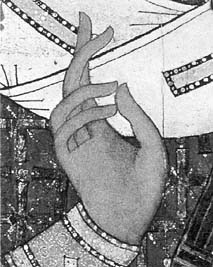
Hand Gesture, Russian Blessing
DSM: But ‘clear and natural’ doesn’t have to mean ‘tame’. The gestures of Venus, performed by Karina Gauvin, called to mind Martha Rosler’s “system of harnessed subjectivity” in her short film, Semiotics of the Kitchen (1975)—in which the artist blithely traverses a seemingly benign range of various kitchen utensils, punctuated by sudden violent actions, followed in each case by calm returns to composure.

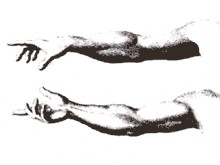
Hand Gesture
CMT: Repeat the gesture at least several times, pausing at the end of each repetition to allow the gesture's ‘radiations’ to flow through you. Walk around the stage. See yourself doing the gesture inwardly. You generate a kind of “pull” through repetition and radiation of the gesture, and awaken a sense of urgency in the character—which can be amusing or heartbreaking or other things, depending on what the gesture is and what it signifies.

DSM: Allowing your breath to release with each “pull” helps, too—it adds to the power and complexity and emotional richness/truth. The “pull” reinforces the emotional truth, makes it more vivid. Nicole Potter has a lot to say about this in her book on acting.

B  y distilling characters or scenic moments to their core gestures, you can achieve performances that are so psychologically complex that it would take reams of paper to describe them.”
  —  Nicole Potter, Movement for Actors, p. 22

Hand Gesture
CMT: When multiple players are on stage, as is usually the case in opera, special considerations arise. There are often multiple activities going on at once, which is confusing since a viewer can only really focus on one activity at a time. It’s important for actors to coordinate their activities to make the overall action on stage understandable and coherent. One way to lend coherence to multi-player action is to give it focus. If one player has the primary role in the current action, then the other characters should direct their attention to that character.

DSM: This helps the audience to see where to direct their attention, and avoids extraneous action on stage that can distract the viewer.

CMT: Giving focus doesn’t simply involve staring at other cast members, though. Each player must have an intention at all times, and display that intention. So if a player is focusing on another player and listening to what that player is saying, the first player should react to what the other player is saying or singing, and display that reaction. Action on stage involves a continual give-and-take among the players, where action leads to reaction, which entrains further action. When done right, these actions and reactions combine into a continuous flow, and that propels the drama forward—as we saw done so well in the BEMF production of Psyché!

DSM: In Psyché, I saw human beings, fully-dimensional characters. I saw suffering and joy in their eyes; I saw their lips tremble; I saw Venus’s face darkened by rage, jealousy and pain; I saw Psyché’s face brightened by love and relief. Obviously, it’s a big difference to see the opera live, at BEMF. I saw completely human people, fighting, suffering, loving and expressing all shades of human feeling, from the brightest to the darkest. Light and shadow is the leitmotiv that comes to mind.

CMT: I could hardly separate the singing from the orchestra, so harmonious was the fusion between all the elements of this production: voices, instruments, gestures, lighting … like a broad stream that just carried us away.

DSM: Ellen Hargis’ stage presence is simply phenomenal. In the various BEMF performances in which she appeared last week, what struck me most about her stage skill was the simplicity of her body language. She didn’t have to gesticulate and pace around on the stage to be expressive. She projects an aura of mobility which gives her individual gestures weight and emotional power. In her workshop at BEMF, Ellen explained the agile placement and orientation of the body—the torso, hips, arms, legs—so as to be readily and fluidly able to move to the next location on the stage, and the next.

CMT: The word ‘impressive’ is insufficient to describe Ellen’s physical presence on stage—as we saw in her performances at last week’s Boston Early Music Festival. Her beauty and smile are so striking that you can feel the audience focus on her and, at that moment, I wouldn’t have been surprised if the musicians lowered their bows and the whole audience got to their feet.

Hand Gesture
DSM: Interestingly, she isn’t the kind of singer who appeals to everyone instantly. When I first saw her I was surprised by the low tone of her soprano voice—but I soon found her singing superb and profoundly moving.

CMT: When music moves you to the extent of rendering you speechless, you utter platitudes like “This is music to die for.” In the case of Ellen Hargis, I would invert it: this is music to live for!

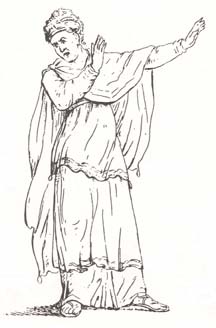
Hand Gesture, Sioux Malediction
DSM: Dr. Elena Nicoladis and her research colleagues have studied the hand gestures of bilingual children as they told the same story twice, first in one language and then the other. The researchers were surprised by what they saw. The children used gestures a lot more when telling the story in what they considered to be their stronger language. These results seem counter-intuitive. You’d imagine the children would be more inclined to use gestures to help them communicate in their weaker language. Based on these results and the results of earlier studies, Nicoladis believes there is a connection between language and memory access and gesturing.

CMT: What they believe is going on is that the very fact of moving your hands around helps you recall parts of the story—the gestures help you access memory and language so that you can tell more of the story. In other words, it’s not that the gestures are all outwardly directed, for the purpose of emphasis or persuasion or clarity of communicating what is already queued-up to be told; instead, it’s that the performative process, including gesturing, serves to “lubricate” the speaker’s memory and verbal expression centers in the brain—enabling “more” to be told, than what would otherwise have been queued-up. Benjamin Bagby says something that amounts to the same thing in the round-table discussion that’s included on his Beowulf DVD.

Initially, we thought gestures were related to meaning—that they mean things on their own. But now we believe they are more deeply related to language.”
  —  Elena Nicolaidis, Univ Alberta, 2005.

DSM: Even with a libretto to follow, there’s no question that well-devised gestures can have this same “lubricating” expressive effect in opera! This BEMF production of Psyché is ample evidence of that!

G  esture has therefore this Advantage above mere Speaking, that by this we're only understood by those of our own Language, but by Action and Gesture (I mean just and regular Action) we make our Thoughts and Passions intelligible to all Nations and Tongues.”
  — Thomas Betterton, 1710

CMT: In Russian theatre we have Otkaz (Refusal/Reversal). The ‘otkaz’ is the preparation for the action, the wind-up before the pitch. The inhale before the speech, the bent knees before the jump. Basically preparing and storing up energy needed for the intended imminent action. And we have Posyl (Sending Out, To or Away). The ‘posyl’ is the execution of the main action. It’s the path from C to B passing through the point of origin, A. Just like a ball thrown by a pitcher, the energy held in the body during the ‘otkaz’ is released and sent in the direction of the action. Because it passes through the point of origin, A, the posyl is seen by the audience as the path from A to B—containing the energy collected from the otkaz. Without such energy, the posyl has no momentum. If it’s difficult to understand an actor—if her/his lines seem unconvincing—it’s usually because she/he hasn’t prepared and gathered the energy necessary for the line. Hasn’t used the otkaz.

M  ovement is the most powerful means of expression in the creation of a theatrical production. Deprived of words, costumes, footlights, wings, auditorium, and left with only the actor and his mastery of movement, the theatre would still be theatre.”
  — Vsevolod Meyerhold, 1914

DSM: Ellen’s workshop stressed that we must always bear in mind the ‘when’ and ‘why’ of gestures, or else the ornaments will merely be ornaments—of little consequence to the energy and meaning of the performance. Indiscriminate use of gestures is a kind of incontinence—it belies a lack of understanding of when less is more. She alluded to “that landscape painter who knew how to paint cypress trees well, and who then [stupidly] painted them into every landscape everywhere.”

CMT: She also noted that the ‘accessibility’ of stage gestures does depend upon a certain amount of cultural literacy among members of the audience—a general literacy of physical/kinesthetic “grammar” that these days is faltering. So companies producing baroque operas today have the additional burden of gently informing or illustrating for audience members the 17th century gestures that are essential for their understanding and enjoyment of the performance.

DSM: There’s also the matter of timing. As Ellen emphasized in the BEMF workshop, the gesture usually precedes the action or line that it references. The gesture’s typically an ‘otkaz’-like “set up.” It may even be paradoxical or silly if it’s synchronous with the action or line.

CMT: The gesture isn’t only a “set up” for a positive verbal disclosure or declamation. Ellen points out that a gesture can also anticipate an impending ‘withholding’ of information—a secret, an emptiness, a negative whitespace. Gestures span the full range of rhetorical devices—something that was ably illustrated by the Psyché cast—aided and abetted by Ellen’s expert coaching and direction. I was glad to see that Heidi Wilson, the Wall Street Journal music critic, noted this in her review. I was glad also to see that Heidi was enthused about the notion of getting investors interested in producing this Psyché in Paris and/or New York . . .
S  eek not to know what must not be reveal’d,
Joys only flow when hate is most conceal’d ...
Let me no more with powerful charms be press’d —
I am forbid by fate to tell the rest..”
  — Indian Queen, Act III
    (opera by John Dryden and Robert Howard,
     music by Henry Purcell)


Hand Gesture