Showing posts with label hargis. Show all posts

Sunday, March 25, 2012

New Waves in Ferrara: Appealing on Many Levels, Enargeically

George de la Tour: ‘Quarreling Musicians’ (1625-1630)
S  wain argues that in Renaissance music stylized cadences—7-6 suspension cadences, with the penultimate soprano note raised a half-step, where necessary, to create a leading-tone—served to provide an easily recognizable cue to phrase endings. From this developed the V7-I cadence, a gesture whose pitch content was so distinctive that the strict rhythmic conventions of the Renaissance cadence were no longer necessary. He argues that it is no accident that the rise of genres such as the string quartet and the symphony—lacking, as they did, the solo/ripieno contrast of the Baroque concerto—coincided with a new interest in the possibilities of large-scale tonal contrast. With one kind of contrast no longer available, something new had to be found to take its place.”
  — David Temperley, commenting in 1999 on Joseph Swain’s ‘Musical Languages’.
G  esualdo proves [that] ... individual compositions, in the last analysis, count not for what they contribute to the development of a [musical] language, but how they handle their own ‘native’ language [that encompasses expressions and idioms in the broader culture, far beyond music], and it remained for a later perspective to rediscover the intrinsic value... It is a cliché to say of a great composition that it appeals on many levels, but the [inevitably] stratified nature of any musical community makes the cliché a real—almost indispensable—virtue. The health of a musical community depends on great numbers of people who simply listen with sensitivity and intelligence ... plus a few listeners who may attend to the more abstract effects of syntax as well.”
  — Joseph Swain, p. 165.
T he performance last night in Kansas City by Piffaro & King’s Noyse with Ellen Hargis entitled ‘New Waves in Ferrara: Two Bands, Fresh Sounds’ illustrated a number of 16th and 17th Century innovations. “Large-scale tonal contrasts” of the sort referred to in the quotes above and a surprising amount of chromaticism were among them.

T he King’s Noyse consists of five members (two Renaissance-design violins with the neck in-line with the box, two tenor-register violins slightly larger than a viola, and one cello-sized ‘bass violin’) plus Ellen Hargis (soprano). And Piffaro nominally has seven members, but they have on their on-stage table an arsenal of recorders of various sizes/registers, shawms (pre-cursors to oboes, ranging from tiny sopranini ones to giant basso ones), Renaissance bagpipes, sackbuts (trombones), dulcians (precursors to bassoons, in various sizes/registers), harp, lute, guitar/vihuela, percussion instruments). The instrumentation of the ensemble changes with every piece!

I n contrast to the ‘modern’, ‘individualistic’ intimacy that characterizes chamber music from the Baroque forward, the works that Piffaro-plus-King’s Noyse performed (by de Rore, Gesualdo, Luzzaschi, Agostini, and others) reveal the astonishing degree to which each individual musician had to envision and remember and anticipate the voice-leading of others’ parts as well as her/his own part. What I mean is, the kind of intimacy that is evoked in the chamber music ensemble literature from Baroque times onward entails each voice in the ensemble responding to one or more of the others on a relatively short timescale on the order of milliseconds to seconds. By contrast, the kind of intimacy evoked in the ‘New Waves in Ferrara: Two Bands, Fresh Sounds’ program embodies a kind of ‘collective’ intimacy—arising partly from the mostly-barline-less musical text, and from the musicians’ relation to that text, which entails their planning (conceptualizing in advance, and remembering) their playing on a time horizon of multiple bars, multiple phrases, or even an entire piece. The Renaissance ‘evenly-written polyphony,’ orchestrated such that each instrumental part resembles the human voice, compels a collective ‘band-like’ mentality and rhetoric—as David Douglass and Bob Wiemken said during their pre-concert lecture. [There are various writings on Renaissance poetry that characterize this sort of rhetoric as ‘enargeia’—‘to create or energize a communal actuality’ (see Norton, Plett, and Sharpling links below). I don’t notice that this term is used in the Renaissance musicology research literature, but, if it’s true that it’s not already so used, it seems to me that the musicologists might do well to adopt/adapt this expression from their literary colleagues.]

B efore attending the concert I looked at my copy of Anne Smith’s book (link below), which contains photomacrographs of original scores of Renaissance ensemble and vocal music. In some scores, 16th-Century composers corrected some notes and made the revisions in the margins or with the correction immediately following the passage as it was originally written. In other words, due to the costliness of paper the composer chose to fill-in empty spaces rather than use a new piece of paper for revision work. In other examples, the parts/voices were not notated in bar-vertical-alignment with each other—again to save paper. The rehearsal and performance consequences of this Renaissance Northern Italian notational practice in terms of performers’ reading and memory and interpretation were (and are!) monumental. And, regardless whether Piffaro/King’s Noyse/Hargis have created for themselves fair-copy transcriptions (using contemporary music software like Finale® or Sibelius®) that conform to modern practices for readability, the inherent challenges and the virtuosic complexity of the parts remain.

O f course, to deliver an emotionally-moving performance and coherent, worthy interpretation of any music requires each performer to have a vision of the whole piece in mind; requires conceiving the trajectory of the whole. Even if there are random/aleatoric/improvisatory elements, you have to have some advance plan or vision or notion of how you will execute those. The distinct or special aspect of this Renaissance music is the long scope this planning has—the autocorrelation and inter-part crosscorrelation with look-aheads/lags of multiple bars, multiple phrases, or even an entire piece. Makes our frenetic little attention-spans of today seem even tinier than usual!

M ore than that, though, these long timescale inter-relationships—and the look of the scores, and the notations’ shapes, and the composers’ revisions in the margins—seem like beautiful schematic diagrams—wiring diagrams!—that specify meditations on courtly love, loss, reminiscence, and how people related to each other (or, how the composer conceptualized those relations, conditioned by the values and morés of their patrons) in the 16th and 17th Centuries. With evocative Italian poetic lyrics (very nice English translations by Hargis and others in the program notes, by the way)— every passage unfolds an ineffable narrative, charting the process, drawing us in, revealing more and more of the human condition—what it means to be human in any Age. Emulating Walt Whitman’s famous phrase “I contain multitudes,” we consider the “you” in this Renaissance music: we imagine that, in this Renaissance music replete as it is with all of these Large-scale Mutual Awarenesses, the “you” of each performer truly contains multitudes. This is why we like serious music of all kinds, and why we love to attend concerts; at least partly why—one major reason among many.

T  he idea ... that one can understand the ratios of musical consonances [in tempered scales] without experiencing them with the senses is wrong. Nor can one know the true theory of music without being deeply versed in its practice.”
  — Letter from mathematician Giovanni Battista Benedetti to composer Cipriano de Rore, 1563.

Saturday, June 23, 2007

Hargis: Music to Live For, Aided and Abetted by Gestures

Ellen
CMT: Ellen Hargis is a member of the Newberry Consort and The King’s Noyse. As a soprano, she’s one of America’s preeminent early music artists, specializing in repertoire ranging from ballads to opera. She’s performed at many of the world’s leading festivals including the Adelaide Festival (Australia), Utrecht Festival (Holland), Resonanzen Festival (Vienna), Tanglewood, the New Music America Festival, Festival Vancouver, the Berkeley Festival (California), and is a frequent guest at the Boston Early Music Festival, where she’s sung title roles in Baroque operas and recently served as assistant director and Vocal and Gesture Coach for the production of the Lully opera, Psyché.


DSM: Her discography includes repertoire ranging from medieval to contemporary music. She’s recently recorded the leading role of Aeglé in Lully’s Thésée for CPO Records, released this month. Recent releases also include the premier recording of Conradi’s opera Ariadne. She’s featured on a number of Harmonia Mundi recordings including a critically acclaimed solo recital disc of music by Jacopo Peri, and in Arvo Pärt’s Berlin Mass. Ellen’s on the vocal faculty of Case Western Reserve University in Cleveland, and teaches numerous summer courses in early music, including the Longy International Baroque Institute in Cambridge, The Lute Society of America Seminars and the Vancouver Baroque Vocal Programme.

CMT: Ellen’s sense of operatic gesture is superb. Every dramatic action requires a justification, a rationale that can be apprehended by the audience, and Ellen’s Psyché direction ensured that the connection between action and justification—through appropriate visual scale of the gestures, and the reinforcement and repetition of gestures consistently by the various actors—was clear and convincing and natural.

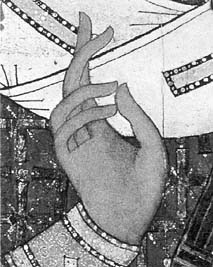
Hand Gesture, Russian Blessing
DSM: But ‘clear and natural’ doesn’t have to mean ‘tame’. The gestures of Venus, performed by Karina Gauvin, called to mind Martha Rosler’s “system of harnessed subjectivity” in her short film, Semiotics of the Kitchen (1975)—in which the artist blithely traverses a seemingly benign range of various kitchen utensils, punctuated by sudden violent actions, followed in each case by calm returns to composure.

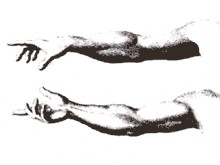
Hand Gesture
CMT: Repeat the gesture at least several times, pausing at the end of each repetition to allow the gesture's ‘radiations’ to flow through you. Walk around the stage. See yourself doing the gesture inwardly. You generate a kind of “pull” through repetition and radiation of the gesture, and awaken a sense of urgency in the character—which can be amusing or heartbreaking or other things, depending on what the gesture is and what it signifies.

DSM: Allowing your breath to release with each “pull” helps, too—it adds to the power and complexity and emotional richness/truth. The “pull” reinforces the emotional truth, makes it more vivid. Nicole Potter has a lot to say about this in her book on acting.

B  y distilling characters or scenic moments to their core gestures, you can achieve performances that are so psychologically complex that it would take reams of paper to describe them.”
  —  Nicole Potter, Movement for Actors, p. 22

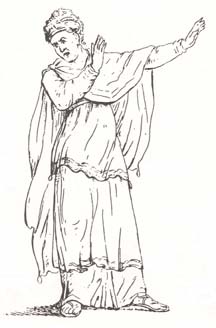
Hand Gesture
CMT: When multiple players are on stage, as is usually the case in opera, special considerations arise. There are often multiple activities going on at once, which is confusing since a viewer can only really focus on one activity at a time. It’s important for actors to coordinate their activities to make the overall action on stage understandable and coherent. One way to lend coherence to multi-player action is to give it focus. If one player has the primary role in the current action, then the other characters should direct their attention to that character.

DSM: This helps the audience to see where to direct their attention, and avoids extraneous action on stage that can distract the viewer.

CMT: Giving focus doesn’t simply involve staring at other cast members, though. Each player must have an intention at all times, and display that intention. So if a player is focusing on another player and listening to what that player is saying, the first player should react to what the other player is saying or singing, and display that reaction. Action on stage involves a continual give-and-take among the players, where action leads to reaction, which entrains further action. When done right, these actions and reactions combine into a continuous flow, and that propels the drama forward—as we saw done so well in the BEMF production of Psyché!

DSM: In Psyché, I saw human beings, fully-dimensional characters. I saw suffering and joy in their eyes; I saw their lips tremble; I saw Venus’s face darkened by rage, jealousy and pain; I saw Psyché’s face brightened by love and relief. Obviously, it’s a big difference to see the opera live, at BEMF. I saw completely human people, fighting, suffering, loving and expressing all shades of human feeling, from the brightest to the darkest. Light and shadow is the leitmotiv that comes to mind.

CMT: I could hardly separate the singing from the orchestra, so harmonious was the fusion between all the elements of this production: voices, instruments, gestures, lighting … like a broad stream that just carried us away.

DSM: Ellen Hargis’ stage presence is simply phenomenal. In the various BEMF performances in which she appeared last week, what struck me most about her stage skill was the simplicity of her body language. She didn’t have to gesticulate and pace around on the stage to be expressive. She projects an aura of mobility which gives her individual gestures weight and emotional power. In her workshop at BEMF, Ellen explained the agile placement and orientation of the body—the torso, hips, arms, legs—so as to be readily and fluidly able to move to the next location on the stage, and the next.

CMT: The word ‘impressive’ is insufficient to describe Ellen’s physical presence on stage—as we saw in her performances at last week’s Boston Early Music Festival. Her beauty and smile are so striking that you can feel the audience focus on her and, at that moment, I wouldn’t have been surprised if the musicians lowered their bows and the whole audience got to their feet.

Hand Gesture
DSM: Interestingly, she isn’t the kind of singer who appeals to everyone instantly. When I first saw her I was surprised by the low tone of her soprano voice—but I soon found her singing superb and profoundly moving.

CMT: When music moves you to the extent of rendering you speechless, you utter platitudes like “This is music to die for.” In the case of Ellen Hargis, I would invert it: this is music to live for!

Hand Gesture, Sioux Malediction
DSM: Dr. Elena Nicoladis and her research colleagues have studied the hand gestures of bilingual children as they told the same story twice, first in one language and then the other. The researchers were surprised by what they saw. The children used gestures a lot more when telling the story in what they considered to be their stronger language. These results seem counter-intuitive. You’d imagine the children would be more inclined to use gestures to help them communicate in their weaker language. Based on these results and the results of earlier studies, Nicoladis believes there is a connection between language and memory access and gesturing.

CMT: What they believe is going on is that the very fact of moving your hands around helps you recall parts of the story—the gestures help you access memory and language so that you can tell more of the story. In other words, it’s not that the gestures are all outwardly directed, for the purpose of emphasis or persuasion or clarity of communicating what is already queued-up to be told; instead, it’s that the performative process, including gesturing, serves to “lubricate” the speaker’s memory and verbal expression centers in the brain—enabling “more” to be told, than what would otherwise have been queued-up. Benjamin Bagby says something that amounts to the same thing in the round-table discussion that’s included on his Beowulf DVD.

Initially, we thought gestures were related to meaning—that they mean things on their own. But now we believe they are more deeply related to language.”
  —  Elena Nicolaidis, Univ Alberta, 2005.

DSM: Even with a libretto to follow, there’s no question that well-devised gestures can have this same “lubricating” expressive effect in opera! This BEMF production of Psyché is ample evidence of that!

G  esture has therefore this Advantage above mere Speaking, that by this we're only understood by those of our own Language, but by Action and Gesture (I mean just and regular Action) we make our Thoughts and Passions intelligible to all Nations and Tongues.”
  — Thomas Betterton, 1710

CMT: In Russian theatre we have Otkaz (Refusal/Reversal). The ‘otkaz’ is the preparation for the action, the wind-up before the pitch. The inhale before the speech, the bent knees before the jump. Basically preparing and storing up energy needed for the intended imminent action. And we have Posyl (Sending Out, To or Away). The ‘posyl’ is the execution of the main action. It’s the path from C to B passing through the point of origin, A. Just like a ball thrown by a pitcher, the energy held in the body during the ‘otkaz’ is released and sent in the direction of the action. Because it passes through the point of origin, A, the posyl is seen by the audience as the path from A to B—containing the energy collected from the otkaz. Without such energy, the posyl has no momentum. If it’s difficult to understand an actor—if her/his lines seem unconvincing—it’s usually because she/he hasn’t prepared and gathered the energy necessary for the line. Hasn’t used the otkaz.

M  ovement is the most powerful means of expression in the creation of a theatrical production. Deprived of words, costumes, footlights, wings, auditorium, and left with only the actor and his mastery of movement, the theatre would still be theatre.”
  — Vsevolod Meyerhold, 1914

DSM: Ellen’s workshop stressed that we must always bear in mind the ‘when’ and ‘why’ of gestures, or else the ornaments will merely be ornaments—of little consequence to the energy and meaning of the performance. Indiscriminate use of gestures is a kind of incontinence—it belies a lack of understanding of when less is more. She alluded to “that landscape painter who knew how to paint cypress trees well, and who then [stupidly] painted them into every landscape everywhere.”

CMT: She also noted that the ‘accessibility’ of stage gestures does depend upon a certain amount of cultural literacy among members of the audience—a general literacy of physical/kinesthetic “grammar” that these days is faltering. So companies producing baroque operas today have the additional burden of gently informing or illustrating for audience members the 17th century gestures that are essential for their understanding and enjoyment of the performance.

DSM: There’s also the matter of timing. As Ellen emphasized in the BEMF workshop, the gesture usually precedes the action or line that it references. The gesture’s typically an ‘otkaz’-like “set up.” It may even be paradoxical or silly if it’s synchronous with the action or line.

CMT: The gesture isn’t only a “set up” for a positive verbal disclosure or declamation. Ellen points out that a gesture can also anticipate an impending ‘withholding’ of information—a secret, an emptiness, a negative whitespace. Gestures span the full range of rhetorical devices—something that was ably illustrated by the Psyché cast—aided and abetted by Ellen’s expert coaching and direction. I was glad to see that Heidi Wilson, the Wall Street Journal music critic, noted this in her review. I was glad also to see that Heidi was enthused about the notion of getting investors interested in producing this Psyché in Paris and/or New York . . .
S  eek not to know what must not be reveal’d,
Joys only flow when hate is most conceal’d ...
Let me no more with powerful charms be press’d —
I am forbid by fate to tell the rest..”
  — Indian Queen, Act III
    (opera by John Dryden and Robert Howard,
     music by Henry Purcell)


Hand Gesture


Tuesday, June 12, 2007

Leçons de Ténèbres: Antiphonal Gestures in Claudin de Sermisy’s Chansons

Courtly Love
J`attends secours de ma seule pensée --
J`attends le jour, que l`on m`éconduira,
Ou que du tout la belle me dira,
‘Ami, t`amour sera récompensée.’
Mon alliance est fort bien commencée,
Mais je ne sais comment il en ira
Car, s`elle veut, ma vie périra
Quoiqu`en amour s`attend d`être avancé.
Si j`ai refus, vienne Mort insensée --
A son plaisir de mon coeur jouira.
Si j`ai merci, adonc s`éjouira
Celui qui point n`a sa Dame offensée.”
  —  Clément Marot (1497-1544)


(I wait for rescue from my thoughts alone --
I wait for the day when I will be rejected,
Or else the lovely lady will tell me,
‘Friend, your love will be rewarded.’
My relationship has started well,
But I cannot tell the outcome
Because, if she wishes, I can die
Despite my hope to win her love.
If I am refused, let death come --
She will play with my heart at her pleasure.
If I am shown mercy, he who has not
offended his lady will find joy.)

DSM: The antiphonal ‘call-and-response’ structure is a way to valorize the subject of the chanson. Le Jardin de Mélodies, the King’s Noyse performance last night at Jordan Hall in Boston opening the Boston Early Music Festival, was surely that – an enthusiastic valorization!

CMT: Your ‘antiphonal’ comment is specifically concerning the Claudin de Sermisy piece, ‘Auprès de vous’, where the strings (David Douglass [violin], Robert Mealy [viola], Shira Kammen [viola], Julie Andrijski [viola], David Morris [bass violin], Paul O’Dette [lute], Pat O’Brien [lute]) seem to call and answer to each other and overlap each other?

DSM: Yes. Rhetorically, the ‘call-and-response’ suggests that the courtly renaissance lover is subordinating his interests to those of the loved one, will not stray from the loved one to whom the chanson is sung, will remain ‘next to her’. Phrases performed by two or more semi-independent choirs interacting with one another, singing alternating musical phrases – this is essentially antiphonal, isn’t it? Or at least, historically, antiphonal psalmody was the singing or musical playing of psalms by alternating groups of performers. This Sermisy piece – these waves of sound, in the manner that Auprès de vous (‘Next to You’) creates them, strongly convey the idea that the lover is deeply affected by the loved one.

CMT: The antiphonal ‘waves’ and ‘call-and-response’, to me, signify also an element of epistemological doubt that this courtly lover has, about how requited the attachment is or will be. The piece has an antiphonal call-and-response character, but it’s essentially a soliloquy – almost as though the lover is pacing around. There’s an existential tension that accompanies these spatial acoustic displacements in this Sermisy chanson. The antiphonal effects suggest a vulnerability that the lover feels, upon realizing or fully gauging his profound dependency on the loved one. Of course, in courtly love this might all be merely for ‘show’. But in Sermisy’s score – or in the King’s Noyse’s interpretation – there is an aspect of genuine vulnerability. Very sweet. Poignant even. Lessons in darkness!

DSM: What a fine opening of BEMF this was! Wonderful!