Showing posts with label whitman. Show all posts

Sunday, March 25, 2012

New Waves in Ferrara: Appealing on Many Levels, Enargeically

George de la Tour: ‘Quarreling Musicians’ (1625-1630)
S  wain argues that in Renaissance music stylized cadences—7-6 suspension cadences, with the penultimate soprano note raised a half-step, where necessary, to create a leading-tone—served to provide an easily recognizable cue to phrase endings. From this developed the V7-I cadence, a gesture whose pitch content was so distinctive that the strict rhythmic conventions of the Renaissance cadence were no longer necessary. He argues that it is no accident that the rise of genres such as the string quartet and the symphony—lacking, as they did, the solo/ripieno contrast of the Baroque concerto—coincided with a new interest in the possibilities of large-scale tonal contrast. With one kind of contrast no longer available, something new had to be found to take its place.”
  — David Temperley, commenting in 1999 on Joseph Swain’s ‘Musical Languages’.
G  esualdo proves [that] ... individual compositions, in the last analysis, count not for what they contribute to the development of a [musical] language, but how they handle their own ‘native’ language [that encompasses expressions and idioms in the broader culture, far beyond music], and it remained for a later perspective to rediscover the intrinsic value... It is a cliché to say of a great composition that it appeals on many levels, but the [inevitably] stratified nature of any musical community makes the cliché a real—almost indispensable—virtue. The health of a musical community depends on great numbers of people who simply listen with sensitivity and intelligence ... plus a few listeners who may attend to the more abstract effects of syntax as well.”
  — Joseph Swain, p. 165.
T he performance last night in Kansas City by Piffaro & King’s Noyse with Ellen Hargis entitled ‘New Waves in Ferrara: Two Bands, Fresh Sounds’ illustrated a number of 16th and 17th Century innovations. “Large-scale tonal contrasts” of the sort referred to in the quotes above and a surprising amount of chromaticism were among them.

T he King’s Noyse consists of five members (two Renaissance-design violins with the neck in-line with the box, two tenor-register violins slightly larger than a viola, and one cello-sized ‘bass violin’) plus Ellen Hargis (soprano). And Piffaro nominally has seven members, but they have on their on-stage table an arsenal of recorders of various sizes/registers, shawms (pre-cursors to oboes, ranging from tiny sopranini ones to giant basso ones), Renaissance bagpipes, sackbuts (trombones), dulcians (precursors to bassoons, in various sizes/registers), harp, lute, guitar/vihuela, percussion instruments). The instrumentation of the ensemble changes with every piece!

I n contrast to the ‘modern’, ‘individualistic’ intimacy that characterizes chamber music from the Baroque forward, the works that Piffaro-plus-King’s Noyse performed (by de Rore, Gesualdo, Luzzaschi, Agostini, and others) reveal the astonishing degree to which each individual musician had to envision and remember and anticipate the voice-leading of others’ parts as well as her/his own part. What I mean is, the kind of intimacy that is evoked in the chamber music ensemble literature from Baroque times onward entails each voice in the ensemble responding to one or more of the others on a relatively short timescale on the order of milliseconds to seconds. By contrast, the kind of intimacy evoked in the ‘New Waves in Ferrara: Two Bands, Fresh Sounds’ program embodies a kind of ‘collective’ intimacy—arising partly from the mostly-barline-less musical text, and from the musicians’ relation to that text, which entails their planning (conceptualizing in advance, and remembering) their playing on a time horizon of multiple bars, multiple phrases, or even an entire piece. The Renaissance ‘evenly-written polyphony,’ orchestrated such that each instrumental part resembles the human voice, compels a collective ‘band-like’ mentality and rhetoric—as David Douglass and Bob Wiemken said during their pre-concert lecture. [There are various writings on Renaissance poetry that characterize this sort of rhetoric as ‘enargeia’—‘to create or energize a communal actuality’ (see Norton, Plett, and Sharpling links below). I don’t notice that this term is used in the Renaissance musicology research literature, but, if it’s true that it’s not already so used, it seems to me that the musicologists might do well to adopt/adapt this expression from their literary colleagues.]

B efore attending the concert I looked at my copy of Anne Smith’s book (link below), which contains photomacrographs of original scores of Renaissance ensemble and vocal music. In some scores, 16th-Century composers corrected some notes and made the revisions in the margins or with the correction immediately following the passage as it was originally written. In other words, due to the costliness of paper the composer chose to fill-in empty spaces rather than use a new piece of paper for revision work. In other examples, the parts/voices were not notated in bar-vertical-alignment with each other—again to save paper. The rehearsal and performance consequences of this Renaissance Northern Italian notational practice in terms of performers’ reading and memory and interpretation were (and are!) monumental. And, regardless whether Piffaro/King’s Noyse/Hargis have created for themselves fair-copy transcriptions (using contemporary music software like Finale® or Sibelius®) that conform to modern practices for readability, the inherent challenges and the virtuosic complexity of the parts remain.

O f course, to deliver an emotionally-moving performance and coherent, worthy interpretation of any music requires each performer to have a vision of the whole piece in mind; requires conceiving the trajectory of the whole. Even if there are random/aleatoric/improvisatory elements, you have to have some advance plan or vision or notion of how you will execute those. The distinct or special aspect of this Renaissance music is the long scope this planning has—the autocorrelation and inter-part crosscorrelation with look-aheads/lags of multiple bars, multiple phrases, or even an entire piece. Makes our frenetic little attention-spans of today seem even tinier than usual!

M ore than that, though, these long timescale inter-relationships—and the look of the scores, and the notations’ shapes, and the composers’ revisions in the margins—seem like beautiful schematic diagrams—wiring diagrams!—that specify meditations on courtly love, loss, reminiscence, and how people related to each other (or, how the composer conceptualized those relations, conditioned by the values and morés of their patrons) in the 16th and 17th Centuries. With evocative Italian poetic lyrics (very nice English translations by Hargis and others in the program notes, by the way)— every passage unfolds an ineffable narrative, charting the process, drawing us in, revealing more and more of the human condition—what it means to be human in any Age. Emulating Walt Whitman’s famous phrase “I contain multitudes,” we consider the “you” in this Renaissance music: we imagine that, in this Renaissance music replete as it is with all of these Large-scale Mutual Awarenesses, the “you” of each performer truly contains multitudes. This is why we like serious music of all kinds, and why we love to attend concerts; at least partly why—one major reason among many.

T  he idea ... that one can understand the ratios of musical consonances [in tempered scales] without experiencing them with the senses is wrong. Nor can one know the true theory of music without being deeply versed in its practice.”
  — Letter from mathematician Giovanni Battista Benedetti to composer Cipriano de Rore, 1563.

Friday, March 20, 2009

網絡空間: 個人空間的延展 Cyberspace: China, The Extension of Personal Space & Future of Everything

 Zhou Long
T    hinking about what we could do to share different cultures in our new society, I have been composing music seriously to achieve my goal of improving the understanding between peoples from various backgrounds. My conceptions have often come from ancient Chinese poetry. There are musical traits directly reminiscent of ancient China: sensitive melodies, expressive glissandi in various statements, and, in particular, a peculiarly Chinese undercurrent of tranquility and meditation. The cross-fertilization of color, material, and technique, and on a deeper level, cultural heritage, makes for challenging work. But there is more than this... more than reminiscence.”
  —  Zhou Long.
T he members of UMKC Wind Ensemble and Choir gave a nice performance last night at White Recital Hall (Steven Davis and Joseph Parisi conducting). The program included:

  • Chen Yi: Fanfare [premiere]
  • Zhou Long: The Future of Fire (for orchestra and choir; new transcription) [premiere]
  • Paul Rudy & Bobby Watson: Finally... (Bobby Watson, saxophone) [premiere]
  • James Mobberley: Words of Love (Rebecca Sherburn, soprano)
  • Alban Berg: Kammerkonzert (Benny Kim, violin; Robert Weirich, piano)
E ach work was admirably executed; and it was my intention to post some comments about the Berg piece, since, with 15 parts, it is the only one that’s totally consistent with the focus of CMT exclusively on ‘chamber music’. But limited time prevents me from putting up remarks about more than one piece right now, and ‘Future of Fire’ was the work that most captured my imagination.

P reviously, Zhou’s ‘Future of Fire’ was scored for orchestra and children’s choir—with the timbres and social implications that children singing to a predominantly adult audience can have. It has been performed, though, by adult choirs as well, including Chanticleer.


    [50-sec clip, Chanticleer, Zhou Long, ‘Words of the Sun’, 1.2MB MP3]


    [50-sec clip, Singapore Symphony Orchestra, Zhou Long, ‘Future of Fire’, 1.2MB MP3]

I n his new transcription, the orchestra is smaller, with textures that are more ‘chamber-like’. The 11 female voices were positioned on the left side of the stage, and the 7 men were on the right. The new transcription has the genders trading volleys—some of them lilting and lyrical, others punchy, punctate. There are no ‘extra’ notes, but there is an intense urgency ... a feeling of up-to-the-last-moment ‘indeterminacy’, about which notes the women’s parts will take next, and which notes will form the men’s parts’ response.

S o, ‘Notes Uncle’, which note? 五声阿叔, 孰徵? [wǔ-shēng-à-shú, shú-zhǐ?]

I  was reminded of the infamous YouTube video about ‘Bus Uncle’ [巴士阿叔, bā-shì-à-shú].

T he stream-of-consciousness mode that characterizes much of Zhou’s writing is present in ‘Future of Fire’, but now with a more assertive ‘mash-up’ quality and extemporaneity than it had in the children’s choir version. The volleys of disconnected gestures between the voices, the sound masses where vocal parts are doubled by instruments (women by woodwinds; men by brass)—these are clearly of Chinese origin and they are pure Zhou. But last night in the premiere of the new transcription, the atmospherics expressed (in Zhou’s abstract, modernist manner)... the future, not so much of Fire per se, but of Everything... The future of our world and our relationships with each other and with Authority.

F ire might, I think, be Zhou’s place-holder for ‘technology’ and our evolving array of social practices involving technology. In Web 2.0 social networking, what personal information may today be disclosed without the individual’s consent? 究竟在網絡這個「新世界」中,甚麼資訊是可以透露?

U nder what conditions or circumstances may it be disclosed? 在甚麼條件/情況下透露?

W hat musical expressions are strictly intimate, private, chamber-music-like, such that others have no right to mess with it or interfere with it? 又有甚麼資訊是嚴格屬於私人保有,別人無權干涉的呢?

T hese issues, to me, are what the new transcription of Zhou’s ‘Future of Fire’ assays. Truly wonderful, both in its beauty and in its political/social statement!

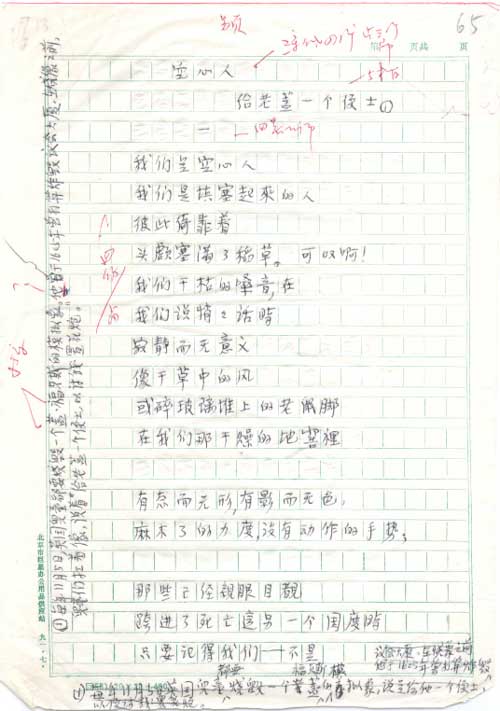
 Lucy Zhao, tr. of Walt Whitman ‘Leaves of Grass: Out of the Cradle, Endlessly Rocking’
I  , the singer of painful and joyous songs, the uniter
         of this life and the next,
Receiving all silent signs, using them all,
         but then, leaping across them at full speed,
Sing of the Past.

[Borne hither, ere all eludes me—hurriedly,
A man, yet by these tears a little boy again,
Throwing myself on the sand, confronting the waves—
I—chanter of pains and joys, uniter
         of here and hereafter,
Taking all hints to use them,
         but swiftly leaping beyond them,
A reminiscence sing.]”
  —  Lucy Zhao, tr. of Walt Whitman ‘Leaves of Grass: Out of the Cradle, Endlessly Rocking’; Peter Hessler, English back-translation from Zhao, in ‘Oracle Bones’, p. 458 ; [Whitman original].


Sunday, April 1, 2007

Goode: Whitman-esque Voyager-Prophet of the Universal ‘Want’

Richard Goode, Voyager
I  considered how best to describe to you Richard Goode’s unique accomplishment; how best to characterize that quality which makes his a distinctly American voice. And it occurred to me that he is, in many ways, the musical equivalent of Walt Whitman. Richard Goode is, among pianists, the epitome of a Whitman-like ‘voyager ego’—someone who is able to take the specifics of one individual’s feeling and experience and, through his playing, make them universal. In doing so, he transforms us . . . ”

  —  Cynthia Siebert

CMT: The human brain, according to Nussbaum, is a living record of its evolutionary history. Relatively recent cognitive developments derive from older representational functions, about which the science is all less than forty years old and of which we are hardly aware. But consideration of music performance can shed light on ancient cognitive functions that underlie modern human cognition. The biology, psychology, and philosophy of musical representation have much to tell us about what we are, and what, as a species, we have been.

DSM: It isn’t just music that offers us revelations like this. ‘Poets Thinking’, one of Helen Vendler’s books, argues that poetry is a mode of thinking that reveals not just our aesthetic values but also our psychology. Vendler is a wonderful elucidator of individual poems. Nobody writes more insightfully about a poem’s stylistic structure, and the emotional and intellectual purposes that the structure serves. And by examining the distinctive strategies of thinking in the work of such radically different poets as Pope, Whitman, Dickinson, and Yeats, Vendler makes visible aspects of style and language that other critics simply haven’t seen.

CMT: This is what Cynthia Siebert was hinting at in her introduction of Richard Goode. Music, like poetry, has often been considered an irrational genre, more expressive than logical, more meditative than given to coherent argument. And yet, in each of the four very different composers Richard Goode performed last night, he reveals a style of thinking in operation. Although they may prefer different means, he argues, all composers of any value are thinkers. He convincingly traces a trajectory from Bach’s Partitas, through late Mozart, through Brahms, to Debussy. Admittedly, Goode’s Bach is a more romantic account than is usual. But it’s a very plausible interpretation.

DSM: Whitman was writing as a poet of repetitive insistence—someone for whom thinking must be followed by rethinking. Goode shows us Brahms thinking in images, using montage in lieu of argument. He shows us Debussy as a satiric miniaturizer, remaking in verse the form of the essay. He shows us Mozart experimenting with plot to characterize life’s unfolding. The repetitions that Goode localizes in each of these composers’ works become, in his mind and hands, coherent arguments—ones that are set forth, defended, critically turned over, reiterated after deliberation and reflection. This is part of what makes Goode so ‘new’.

C   ome, said my soul, such verses
for my Body let us write, (for we are one,)
That should I after return,
Or, long, long hence, in other spheres,
There to some group of mates the chants resuming,
(Tallying Earth’s soil, trees, winds, tumultuous waves,)
Ever with pleas’d smile I may keep on,
Ever and ever yet the verses owning
 —as, first, I here and now
Signing for Soul and Body, set to them my name . . .
The untold want by life and land ne’er granted,
Now, voyager, sail thou forth to seek and find.”

  —  Walt Whitman, Leaves of Grass

CMT: It’s also, I think, what makes his playing so universal, so meaningful to each person, and fresh for each person upon repeated listenings. With his characteristic lucidity and spirit, Goode traces through these composers’ expressions to find evidence of thought in lyric; the silent stylistic measures representing changes of mind; the condensed power of poetic thinking. His work argues against the reduction of performance to well-worn and long-since elucidated themes and demonstrates, instead, that there is, ideally, in music a serious process of thinking, a deliberated style—however ancient the theme may be—and one that is powerful and original, fresh and new.

DSM: Whitman seeks the redemption of America through the reconstruction of individual subjects in conversion. Would Cynthia Siebert say that Goode seeks to redeem us by inducing ecstatic, regenerating experiences in his audiences?

CMT: Yes. That is the consequence of her opening remarks—consummate presenter that she is. She gives us not merely an introduction, but a capsulized lesson. There are the de rigeur honorifics, of course. But then she invariably gives the audience a ‘pearl,’ some unique bit of insight, a provocation, even. She cautions us that Goode is about to spin an emotional tale. You know a well-known “rule system” has been developed at the Royal Institute of Technology in Stockholm (Sundberg et al., 1983), for characterizing emotional content in music performances. The KTH model consists of a set of performance rules that predict or prescribe aspects of timing, dynamics, and articulation, based on local musical context. The rules refer to a limited class of musical situations and theoretical concepts (simple duration ratios between successive notes, ascending lines, melodic leaps, melodic and harmonic charge, phrase structure, etc.). Most of the rules operate at a low level and look only at very local contexts and affecting individual notes. But there are also rules that refer to entire phrases, much apropos of Richard Goode’s expressive playing. The rules are parameterized with a varying number of parameters. Originally, the KTH model was developed using the so-called “analysis-by-synthesis approach” that involves a professional musician directly evaluating each tentative rule brought forward by the researcher. Musician and researcher engage in constant feedback to iteratively find the best formulation and parameter settings for each rule. This method has the advantage of modeling a kind of performer–listener interaction, but it falls short by placing high demands on the evaluating expert musicians and by not permitting reliable evaluations due to the small number of judgments.

DSM: Thinking of the performance that Richard Goode just gave last night, consider just one particular rule: DURATION CONTRAST. This rule modifies the ratio between successive note durations in order to enhance and make more easily perceivable the differences in duration. Most commonly it changes the durations of a long and a short one so that the longer becomes a bit longer, and the shorter becomes shorter. As for every rule, there is a quantity control parameter (k) to be set by the analyst. This parameter is designed so as to give a fairly good result when its value is around 1. With a k value of 0, a particular rule is effectively switched off; when k is set to a negative value, the rules are inverted (in DURATION CONTRAST, it would blur the rhythmic contrasts)—which, by the way, can produce unmusical results. I can show you on my DAW synthesizer-sequencer if you like. An important aspect of the model is that it’s additive. For instance, there are several rules that influence the duration of a note, and the effects of the individual rules are added cumulatively to give the final duration. Sundberg and colleagues examined how well the KTH model can be fitted to a particular performance of a slow Mozart sonata movement (K.332, first 20 bars of the Adagio) manually, by trial and error. They focused exclusively on expressive timing of the melody (in terms of deviations from the score) and determined similarity between the performance and the model with the correlation coefficient. The PHRASE ARCH rule (shaping phrases on different structural levels) seemed to dominate the performance, although they could not find one single k parameter for these initial bars. Therefore, they tested k values for each phrase individually. Here it was mostly the PHRASE ARCH rule that got the highest correlations, as well as HARMONIC CHARGE and negative DURATION CONTRAST. The KTH model has also been used to model certain emotional colourings that might not be immediately inherent in the music structure. For example, the DURATION CONTRAST rule was found to especially distinguish between a sad and a happy performance. Some specifically selected subsets of rules and k parameter settings (“emotional rule palettes”, see Bresin & Friberg, 2000) were derived from measured performances in order to model emotional coloring of performances.

CMT: This extension to emotionality has led recently to more comprehensive computational models of expressive performances. These models include, besides the generative KTH model and the emotional models, also random variability within certain bounds, and analogies to physical motion. Recently, it was proposed to extend it with a factor of “stylistic unexpectedness” (see Juslin). To date, there is plenty of evidence that the KTH rule model is a viable representation language for describing expressive performance. To what extent it can account for the observed variations in large collections of performances of truly complex music is still an open issue. These other more recent quantitative models with more complexity and more degrees of freedom may ultimately capture more of the expressive range . . .

DSM: One of those recent models based mainly on mathematical considerations is the “Mazzola model”. The Swiss mathematician and Jazz pianist Guerino Mazzola developed his mathematical music theory and performance model beginning in the 1980s. His most recent book (Mazzola, 2002) extends over more than 1,300 pages and gives a comprehensive survey of the theoretical background as well as its computational implementation.

CMT: The Mazzola model builds on Mazzola’s mathematical music theory that includes various aspects of music theory and analysis and involves philosophical, semiotic, and aesthetic considerations as well. Every step is explained in specifically mathematical terms. He invents special terminology that is greatly different from what is commonly used in performance research, so musicologists do seem to hold it somewhat in abeyance. Engineers and mathematicians, like Bill Sethares at Wisconsin, seem to have greater receptiveness to Mazzola’s ideas . . .

DSM: The Mazzola model basically consists of an analysis part and a performance part. The analysis part involves computer-aided analysis tools for various aspects of the music structure as, e.g., meter, melody, or harmony. Each of these is implemented in particular plugins, the so-called “rubettes”, that assign particular “weights” to each note in a symbolic score. The performance part that transforms structural features into a synthesized performance is theoretically anchored in the so-called “Stemma Theory” and “Operator Theory” (a sort of additive rule-based structure-to-performance mapping). It iteratively modifies the “performance vector fields”, each of which controls a single expressive parameter of a synthesized performance. I’ve been playing around with that over the past couple of weeks on my old Ensoniq equipment . . .

CMT: What about quantification of individual style? Predictive models like the KTH or the Mazzola models generally focus on fundamental, common performance principles—that is, on those aspects that most performances have in common. Of course, there have also been attempts at measuring, quantifying, and describing stylistic performance differences. Statistical analysis can reveal a number of characteristic and distinctive phrasing behaviors, some of which could be associated (in a statistical sense) with a particular pianist. Can we do that with Goode?

DSM: Well, yes. After the concert last night, I extracted some tracks off Goode CDs that we own. We can examine visualization performance trajectories from those mp3s. Basically, the detailed performance data – beat-level tempo and dynamics curves – can be represented in an integrated way as trajectories in a two-dimensional “tempo–loudness” space that show the joint development of tempo and dynamics over time (see Langner & Goebl, 2003). This plot shows a trajectory from Richard Goode’s recording of a performance of the Mozart Rondo in A minor (K. 511) that we heard last night at the Folly Theater in Kansas City.

Goode, Mozart Rondo in A minor, Loudness-Tempo Trajectories
CMT: The line is produced by interpolating between the measured tempo and dynamics points that you captured off the CD, and smoothing the result with a moving-window Gaussian to make the trends visible. The degree of smoothing controls the amount of local variation in the plot. This is similar to Dixon’s “Performance Worm” (Dixon, 2002) that computes and visualizes performance trajectories. But the trajectory representation here also provides the basis for more detailed quantitative analysis, with data analysis (data mining) methods. So for Goode’s ‘voyager ego,’ as Cynthia Siebert called it, we should be able to map his (or other artists’ – ) expressive voyages after the fact, catalogue them, compare them.

x

Cynthia Siebert, founder of Friends of Chamber Music, explains a musical point