Showing posts with label zhou. Show all posts

Friday, March 20, 2009

網絡空間: 個人空間的延展 Cyberspace: China, The Extension of Personal Space & Future of Everything

 Zhou Long
T    hinking about what we could do to share different cultures in our new society, I have been composing music seriously to achieve my goal of improving the understanding between peoples from various backgrounds. My conceptions have often come from ancient Chinese poetry. There are musical traits directly reminiscent of ancient China: sensitive melodies, expressive glissandi in various statements, and, in particular, a peculiarly Chinese undercurrent of tranquility and meditation. The cross-fertilization of color, material, and technique, and on a deeper level, cultural heritage, makes for challenging work. But there is more than this... more than reminiscence.”
  —  Zhou Long.
T he members of UMKC Wind Ensemble and Choir gave a nice performance last night at White Recital Hall (Steven Davis and Joseph Parisi conducting). The program included:

  • Chen Yi: Fanfare [premiere]
  • Zhou Long: The Future of Fire (for orchestra and choir; new transcription) [premiere]
  • Paul Rudy & Bobby Watson: Finally... (Bobby Watson, saxophone) [premiere]
  • James Mobberley: Words of Love (Rebecca Sherburn, soprano)
  • Alban Berg: Kammerkonzert (Benny Kim, violin; Robert Weirich, piano)
E ach work was admirably executed; and it was my intention to post some comments about the Berg piece, since, with 15 parts, it is the only one that’s totally consistent with the focus of CMT exclusively on ‘chamber music’. But limited time prevents me from putting up remarks about more than one piece right now, and ‘Future of Fire’ was the work that most captured my imagination.

P reviously, Zhou’s ‘Future of Fire’ was scored for orchestra and children’s choir—with the timbres and social implications that children singing to a predominantly adult audience can have. It has been performed, though, by adult choirs as well, including Chanticleer.


    [50-sec clip, Chanticleer, Zhou Long, ‘Words of the Sun’, 1.2MB MP3]


    [50-sec clip, Singapore Symphony Orchestra, Zhou Long, ‘Future of Fire’, 1.2MB MP3]

I n his new transcription, the orchestra is smaller, with textures that are more ‘chamber-like’. The 11 female voices were positioned on the left side of the stage, and the 7 men were on the right. The new transcription has the genders trading volleys—some of them lilting and lyrical, others punchy, punctate. There are no ‘extra’ notes, but there is an intense urgency ... a feeling of up-to-the-last-moment ‘indeterminacy’, about which notes the women’s parts will take next, and which notes will form the men’s parts’ response.

S o, ‘Notes Uncle’, which note? 五声阿叔, 孰徵? [wǔ-shēng-à-shú, shú-zhǐ?]

I  was reminded of the infamous YouTube video about ‘Bus Uncle’ [巴士阿叔, bā-shì-à-shú].

T he stream-of-consciousness mode that characterizes much of Zhou’s writing is present in ‘Future of Fire’, but now with a more assertive ‘mash-up’ quality and extemporaneity than it had in the children’s choir version. The volleys of disconnected gestures between the voices, the sound masses where vocal parts are doubled by instruments (women by woodwinds; men by brass)—these are clearly of Chinese origin and they are pure Zhou. But last night in the premiere of the new transcription, the atmospherics expressed (in Zhou’s abstract, modernist manner)... the future, not so much of Fire per se, but of Everything... The future of our world and our relationships with each other and with Authority.

F ire might, I think, be Zhou’s place-holder for ‘technology’ and our evolving array of social practices involving technology. In Web 2.0 social networking, what personal information may today be disclosed without the individual’s consent? 究竟在網絡這個「新世界」中,甚麼資訊是可以透露?

U nder what conditions or circumstances may it be disclosed? 在甚麼條件/情況下透露?

W hat musical expressions are strictly intimate, private, chamber-music-like, such that others have no right to mess with it or interfere with it? 又有甚麼資訊是嚴格屬於私人保有,別人無權干涉的呢?

T hese issues, to me, are what the new transcription of Zhou’s ‘Future of Fire’ assays. Truly wonderful, both in its beauty and in its political/social statement!
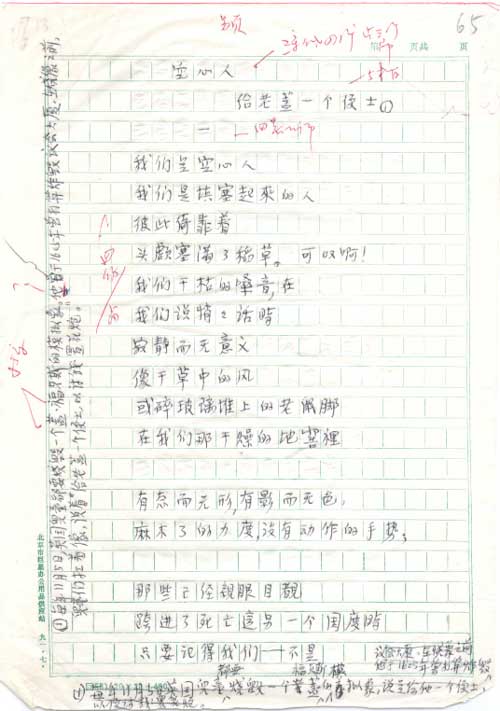
 Lucy Zhao, tr. of Walt Whitman ‘Leaves of Grass: Out of the Cradle, Endlessly Rocking’
I  , the singer of painful and joyous songs, the uniter
         of this life and the next,
Receiving all silent signs, using them all,
         but then, leaping across them at full speed,
Sing of the Past.

[Borne hither, ere all eludes me—hurriedly,
A man, yet by these tears a little boy again,
Throwing myself on the sand, confronting the waves—
I—chanter of pains and joys, uniter
         of here and hereafter,
Taking all hints to use them,
         but swiftly leaping beyond them,
A reminiscence sing.]”
  —  Lucy Zhao, tr. of Walt Whitman ‘Leaves of Grass: Out of the Cradle, Endlessly Rocking’; Peter Hessler, English back-translation from Zhao, in ‘Oracle Bones’, p. 458 ; [Whitman original].


Tuesday, August 19, 2008

Ying String Quartet: Zhou Long and Globalization of the Ineffable

Ying Quartet
T  he standard three-work structure of most quartet recitals normally limits the performance of contemporary pieces to just one quartet. In our programming of contemporary Chinese-American works, we have decided to include shorter works. This enables our audiences to sample a broader range of living Chinese-American composers in a single concert, in the same way that the style of eating Chinese food called ‘dim sum’ involves a wide variety of bite-sized delicacies.”
  —  Phillip Ying.
The CD, ‘Dim Sum’, released on Telarc by the Ying String Quartet earlier this year is a wonderful collection of new Chinese-American chamber music miniatures.

Ying Quartet, Dim Sum
The disc has twelve tracks:
  • Zhou Long: Song of the Ch'in
  • Chen Yi: Shuo
  • Bright Sheng: Silent Temple II; Silent Temple IV
  • Ge Gan-ru: Fu
  • Vivian Fung: Pizzicato for String Quartet
  • Lei Liang: Gobi Gloria
  • Chou Wen-chung: Leggeriezza; Larghetto nostalgico
  • Tan Dun: Drum and Gong; Cloudiness; Red Sona
Of these, ‘Song of the Ch'in’ is by far my favorite. Song of the Ch'in employs string quartet to emulate the seven-stringed Ch'in. As such, the four voices are immersed in a sort of intimate collectivism, a ‘post-deconstructionist’ realism, rather than conventional quartet-like inter-part dialogues. The effect is not symphonically ‘sectional’ as much as cohesive or unified; expressing ‘interior’ views of a collective voice consisting of the four individual voices that comprise the one collective ‘self’. Through its 8’30’’ length, it’s predominantly contemplative and meditative, but its middle section does have louder dynamics and a more emphatic pulse and deconstructionist parrying among the parts, still with a pervading sense of unity and interiority.

Zhou Long
Zhou Long, born in Beijing in 1953, is renowned for pioneering the fusion of idiomatic sounds and techniques of traditional Chinese music to modern Western instruments and ensembles. Dr. Zhou’s compositions span many different genres, from solo instrumental and chamber ensemble pieces, to orchestral works. His orchestrations combine traditional Chinese instruments with western instrumentation. In 2003 he received a lifetime achievement award from the American Academy of Arts and Letters. A United States citizen since 1999, Zhou Long is married to composer-violinist Chen Yi. Both are faculty members at the UMKC Conservatory.

Ch’in
The Ch'in (guqin) has naturally quiet dynamics. It has a range of about four octaves, with its lowest pitch two octaves below middle C, the same as the lowest note on the cello’s open C string. Sounds are produced by plucking open strings, stopped strings, and harmonics.

Ch’in range
Here’s the opening section:

    [50-sec clip, Ying Quartet, Zhou Long, Song of the Ch'in, 1.4MB MP3]

And another clip here, at the end of the piece:

    [50-sec clip, Ying Quartet, Zhou Long, Song of the Ch'in, 1.4MB MP3]

The gliss, pizzicato and snap pizzicato, tremolando, battuto, and other effects in the Zhou Long piece are beautiful and effective. Glisses on ch'in evoke cello effects in the low register with plenty of harmonics up in to the nether regions of the violin’s range. But here, in the Ying Quartet’s performance, violinistic technic is not some pale emulation of ch'in coloration and textures; the quartet’s execution instead conveys a consistent, unquestionable naturalness. The Yings are entirely at-home and at-ease in the material they are performing. They inhabit the pieces convincingly—they hungrily appropriate them and intently express the ‘interiority’ of the perspective they share in ensemble, from inside the work. This excellent recording must become an icon for how this can be done—an example that others can follow.

The pieces on this CD are innovative in testing the extent to which the string quartet idiom is malleable. With the long history and extensive literature that exists for it, string quartet orchestration does come with more expectations or interpretive ‘baggage’ than most other forms.

But these composers’ pieces all succeed as honest, fresh and forthright expressions, and the Yings perform them without a ‘safety net’. What I mean to say is that it is not so much an embodiment of programming bravery as a thorough-going demonstration of genuine, honest emotion. And an invitation to wonderment—honest wonderment at the world and the beauty that’s in it—this is vividly conveyed, especially in the Zhou piece. Through music, Zhou shows that the world is intelligible—not benevolent or hostile or necessarily value-laden, or conclusory, or deistic; but intelligible and meaning-ful—yet there arises the ineffable, eternal question how this could be so.

G  ifting appropriation is the positive dimension of the event, in which the thing itself always escapes [‘La chose même se dérobe toujours’], leaving in its wake, behind itself (and, hence, around us) a trail of what might constitute our environing world. This fugal movement, the flight of the thing itself, could be interpreted, in the first place, as its flight from itself (‘La chose’ flees from ‘le même’; it subtracts itself from its sameness, self-coincidence, or identity with itself) and, equally, as an instant of the thing’s self-appropriation and self-realization. More interestingly still, when it is most itself in the interior unfolding of its otherness and différance.”
  —  Michael Marder, Derrida and Différance of the Real.
This is just one piece on this beautiful CD, the Zhou Long ch'in piece. It is transcendent and accessible, and in the Yings’ hands it does these amazing, lasting, beautiful things. That’s something that any audience—even an unprepared one—can understand and enjoy and find meaningful.

Like a dim sum meal, I recommend that you savor each piece, with a gap in between. The textures and styles and meanings of these 12 tracks are widely varied, and proceeding through them pell mell would be the wrong thing to do. Any of these would make a congenial element of a chamber music concert program. I hope that more quartets choose to incorporate these into their performance repertoire.