A rchitecture and music belong together. They are practically one.”
— Frank Lloyd Wright.
A ll deep and quiet background for those assembled in the room; each and everyone a masterpiece and belonging quietly to his/her/its place, as part of the whole. As much a part as the tones of the cello of the ‘Grand Duke’ still floating down from above.”
— Bob Mosher (Wright Apprentice), writing regarding performance of Beethoven’s Op. 97 Piano Trio No. 7 in B-flat Major ‘Archduke’, in the ‘At Taliesin’ column for Madison (WI) Capital Times newspaper, 27-APR-1934.
T he Fellowship has, more than ever, been hearing great music this summer, not only in concert but in the living room at Taliesin and in the Playhouse, but also in rehearsals when the music comes up from beneath the eaves or through the vines and walls that enclose it within the spaces of Taliesin. Music makes life within those spaces more completely an enriched unity...”
— ‘At Taliesin’ newspaper column, Madison Capital Times, 23-AUG-1935, quoted in Henning, p. 155.
 T
This week I had the privilege of visiting Taliesin West in Scottsdale, Arizona. Taliesin West was established in the 1930s by architect Frank Lloyd Wright (1867-1959), as a western counterpart to the Taliesin enclave in Spring Green, Wisconsin, where his Taliesin Fellowship architecture students/apprentices worked. The Fellowship was in some ways more like a monastery for the men and women Fellows. They were free to come and go, but their daily routine was highly structured and regulated. Chamber music was a prominent part of the Fellowship’s weekly activities: many Apprentices themselves engaged in performances as amateur players, and over the years the Fellowship invited a variety of elite soloists and ensembles to perform as well. Taliesin still functions as a school of architecture, but music and other cultural events are today not regularly featured. Nonetheless, it’s fascinating to visit Taliesin and Taliesin West, for insight into how Wright designed performance spaces, for insight into how music affected Wright’s architecture and philosophy, and for insight into Wright’s curious avocation as a ‘chamber music presenter’ in Wisconsin and in Arizona in the 1930’s, 40’s, and 50’s.
Randolph Henning’s book, ‘At Taliesin,’ compiles the series of some 285 newspaper columns written by Frank Lloyd Wright and his early Taliesin Apprentices, craftsmen, and workers over a period of about four years (1934-7). I bought a copy of this book at Taliesin West. The ‘At Taliesin’ columns frequently remarked on the performances that had occurred at Taliesin and on classical music and composers/arrangers/transcribers; on the relationships between music and architecture; and on up-coming performances to be held at Taliesin and Taliesin West, to attract audience from surrounding communities. Some chamber music performances were by Wright Apprentices at Taliesin who had musical abilities, but more often were given by visiting soloists and ensembles. The ‘At Taliesin’ newspaper columns are reproduced in Henning’s book verbatim, with only a few explanatory notes added by Henning. As such, the columns provide a unique raw, historical glimpse into Frank and Olgivanna Wrights’ and their Apprentices’ views of chamber music in mid-Century.
 T
The columns entitled ‘At Taliesin’ were featured in several southern Wisconsin newspapers from 1934 through 1937, originally as a means of advertising the weekly foreign-language films that were shown at Taliesin for public-relations and fundraising. The chamber music concerts were later added to the event list—looks like probably late in 1934. The ‘At Taliesin’ newspaper columns first appeared in February 1934, shortly after the Taliesin Fellowship had been formed by Wright (in 1932). The columns grew into a format that presented a quite amazing and kaleidoscopic view of life at Taliesin. The students (Fellows) were, most of them, between ages 22 and 30; none was a journalist and none was accustomed to writing. Wright believed that all architects and designers should be able to quickly and persuasively express themselves in writing, and he induced the Taliesin Fellows to more or less rotate the duty of authoring the weekly ‘At Taliesin’ newspaper column as an on-the-job means of compelling them to develop some skill in writing. Most pieces were 300 to 500 words long; some run to 3,000 words or more. Some columns are diaristic and consist of matter-of-fact descriptions of events of the week, in which the Apprentices participated. Other columns offer critique and commentary on culture, government, economics, and other topics. Just how widely differing the perspectives and writing skills and styles of the several dozen Fellow-authors were during those years is revealed in the Henning compilation, created from clippings and microfilm of the original columns. You are able, too, to get an independent sense of some of the cult-like qualities that were featured in the
page-turner authored by Friedland and Zellman a couple of years ago, about Frank and Olgivanna Wright and their Fellows/disciples. (Have a look at the juicy reader comments at the bottom of the Amazon
page, to decide whether or not you want to delve into that.)
Apprentices/Fellows at Taliesin were expected to not only learn the principles of design, but also to build and experiment with their own buildings. Likewise, they were expected to contribute to the Taliesin community by performing manual labor such as cooking, housekeeping, and gardening; by writing/publishing and promoting Taliesin as an enterprise; and by engaging in the fine arts and performing arts, including music and theatre. The latter activities were generally part of the Fellowship’s evening rituals. Wright also welcomed a variety of other intellectual pursuits including poetry and literature and philosophy, as evidenced by his providing spaces at Taliesin and Taliesin West specifically for these activities. This holistic or ‘organic’ approach to society, design, and the arts is continued today through the
Frank Lloyd Wright Foundation and the
Frank Lloyd Wright School of Architecture, although not without some
recent difficulties. A reverence for Nature, for ancient archaeological artifacts, and for American Indian and Eastern/Oriental culture not only contributed to Wright’s architectural designs but also to ritual alternative-education practices within his Taliesin Fellowship.
 R
Rituals at Taliesin also included extemporized ‘sermonettes’ by Wright and by some of his Apprentices on Sundays. Readings included Nietzsche, a variety of poets, and essays written by Taliesin Fellowship members and visitors. (Wright had been raised a Unitarian, but Olgivanna was inclined toward Theosophy and, prior to marrying Wright, had spent time in France with Gurdjieff and his disciples.) Chamber music was sometimes part of these Sunday exercises in spirituality at Taliesin. The symbolic function of music in these rituals was, I would say, ‘sacrament-like’: mysterious, or embodying a sacred mystery that the Fellowship regarded as essential; mediating ‘grace’ for the Fellowship members or in a ‘tikkun olam’ sense, for all of humankind; a means for communing with God or entering into and participating in transcendence. Chamber music as sacred mystery, a portal to the source of meaning and value. Chamber music co-opted as ‘tool’ for cult?
M usic is Architecture at Taliesin, just as architecture is a kind of music. Music, being modern, is necessary to existence. Perhaps music as we know it is the only modern one among the arts.”
— Frank Lloyd Wright, see Henning, p. 296.
 T
The Taliesin West complex is on the State of Arizona Historic Register and the U.S. federal National Register of Historic Places, and it has also been declared a National Landmark. Taliesin in Spring Green, Wisconsin, has similar status.
 T
The Taliesin arts facilities include the Kerr Cultural Center (originally intended as a hall for chamber music), the Cabaret and Theater (1951), and the Music Pavilion (originally constructed in 1956 and rebuilt in 1964 after a fire).
Curiously, Wright called architecture “frozen music” and called music “an edifice of sound”. His incorporation of waterfalls, fountains, pools, or other moving water features into his architectural designs was intended to emulate some of the dynamic qualities in music—to “unfreeze” his architecture. He said he acquired his love of music mainly from his father, who was a music teacher and amateur musician in Richland Center, Wisconsin. Wright especially loved the music of Beethoven, and claimed to draw architectural inspiration from Beethoven’s string quartets and piano compositions.
 H
He was especially fascinated by the process of composition; by a composer’s development of and transitions between themes; by the role of ornamentation in music; and by the “necessity of ornament to the whole structure” of a composition. Wright considered that musical composition uses physical acoustics and mathematics of musical scales and harmony, which govern the structure of music horizontally (temporally) and vertically (polyphonically). He felt that architecture likewise had to insightfully use physical laws and mathematical endowments and constraints in order to succeed in terms of aesthetic expression.
Wright also considered that classical composers and especially composers of chamber music “composed from the inside outward” in a fashion resembling what he felt he himself did in designing a building. Despite Wright’s dislike for Mies van der Rohe and Bauhaus architecture, he did agree that Form follows Function. However, Function was often an aesthetic one for Wright, attracting the eye toward the architecture of Nature outside or, in music, attracting the ear toward the dynamics of relationships and processes among people.
Another parallel between an architect and a classical composer, he thought, was that each designs works that are ‘one-off’, bespoke, one-of-a-kind. Composers and architects each depend on established practices and formulas to a degree, but neither composers nor architects ought to repeat themselves or decline into cliché expressions. Each is bound by a duty to expand the scope of human experience and ought always to innovate.
 W
Wright—Mr. One-Off—had only modest interest in details of repeated performance or ‘repertoire’. Novelty and extemporaneous improvisation trumped all other cards. There is much evidence of these out-of-whack priorities at Taliesin West—features in which no attention was paid to ‘maintainability’ in the design process. For example, stone and concrete are connected to plate glass without casements or expansion joints to accommodate the different coefficients of thermal expansion of the materials—so that glass breakage is continually recurring, and replacing the glass requires re-doing the masonry to get the old glass out and put new glass in. Doors are set with steel rod pivots in thrust-bearings instead of hinges and no provision for periodic replacement of the bearings. After 60 years, the bearings have worn out. Grease has been applied to them as a temporary measure, but the grease melts in the Arizona heat and stains the carpet near the door. You would have to demolish the masonry that holds the door to get the bearings out and replace them. Welded steel decorative ‘dentillation’ ornaments around the soffits require constant repainting, on account of the rusting that arises due to the metallurgical differences between the steel substrate and the welding-rod material used to form the sheetmetal into the dentil cubes. Examples abound! The dys-aesthetics of ownership and [excessive; awkward; impractical] ongoing/recurring maintenance—and how that marred the aesthetics of the design and realization of the design—was a total blind-spot for Frank Lloyd Wright. The Dark Side of ‘Living in the Moment’ and ‘The Power of Now’; pretentions to Design, neglectful of Engineering, oblivious of the Future!
Architecturally, these mis-features are endearing—like a composer’s ‘one-off’ attempts at new ideas and techniques—never done before the current design; lessons empirically learned from the strengths and limitations that the one-off attempts reveal; and either incorporated (with improvements) into later designs or rejected and never used again. Rather than eradicating the imperfections and exalting the architect-composer as super-human, we get to see (hear) the reality, the foibles, the life as it was lived.
Wright felt that the Client needed no knowledge of architecture to enjoy and understand a building in its environment. Similarly, he felt that the Listener need not know of musical structure to enjoy and comprehend the music and be moved by it. In each case, knowledge helps enhance and deepen the understanding and the effect. But Wright felt that ‘innateness’ was something that music and architecture had in common. It’s a quality that’s essentially the same as ‘thrown-ness’ or ‘tool-ness’ in Heidegger’s philosophy.
Wright balanced tension and resolution in architecture, and he thought of this as akin to a composer’s task in creating dramatic and effective music.
 W
Wright was essentially an ‘interpretivist’ educator. He held that knowledge is socially and culturally ‘constructed’, open, fluid, context-dependent, without external reality beyond the social group. Human meanings, to Wright, were intrinsic to specific communities—professional, artistic, social, and so on. ‘Interpretivists’, he said, take the stance of empathetic participant-observers, seeking to discover the interdependencies of parts and patterns in the whole. Interpretivists are simultaneously ‘insiders’ and ‘outsiders’, critically reflective, narrative, diagnostic, probing social transactions and self-other relations.
Wright compared abstraction in music to abstraction of Nature. Several of his letters refer to abstract mimickry of a thunderstorm in Beethoven’s ‘Pastoral’. Beethoven’s revolution in music provided inspiration for Wright’s own revolutionary efforts in architecture. Just as Beethoven had overthrown early Classical construction, so Wright’s designs attempted to overthrow conventional idealistic bourgeois architecture.
By ‘overthrow idealism’ he meant the project of rejecting the assumption (of Logical Positivism) that ‘reason’ and ‘science’ can be dissociated from human and social and contextual concerns. The perversion of Reason in the 20th Century into an out-of-control capitalistic regime that alienates people from themselves and from Nature is what Wright was responding to—much the same, I suppose, as Theodor Adorno was doing, at roughly the same time.
The critical process and practice of performing chamber music at Taliesin was intended to help Apprentices to become aware of structure, including hidden constraints and compulsion, and through such awareness to be freed from that coercion. Music was basically concerned with awakening and emancipation. But it was a sort of unbridled neo-romantic concept—possibly Unitarian or Heideggerian?
I remember that Iannis Xenakis worked with Le Corbusier for 12 years (1947-59). I do not know whether Xenakis ever met Wright or visited Taliesin or Taliesin West, as Le Corbusier did. Maybe should re-read Xenakis’s books and see if he mentioned anything about this.
A typical program at Taliesin is this one, from 1936:
- Bach—Aria arranged for viola and piano;
- Tartini—Violin Sonata in G minor (with viola da gamba as figured bass; viz. Madame Blavatsky’s ‘The Ensouled Violin’ and ‘Devil’s Trill’ as these might have been regarded by theosophist Olgivanna and Frank);
- Loeillet—Piano Trio in B minor;
- Beethoven—Piano Trio No. 7 in B-flat Major, Op. 97;
- Grieg—Cello Sonata in A minor, Op. 36;
- Brahms—Trio for Horn, Violin and Piano in E-flat Major, Op. 40;
- Tchaikovsky—Piano Trio in A minor, Op. 50;
- Borodin—String Quartet No. 2 in D Major;
- Gustav Hoffman (UW Madison?)—String Quartet.
Consider
that program and what coherence (if any) it might have; what emotional impacts for disparate performers and audience members. Does it make aesthetic ‘sense’ to collide these on a single program? Baroque through 1930! What could’ve been the intent or rationale for such a program—intentions of the artists; and of the Wrights?
Performers at Taliesin during the 1930s included:
- Jane Dudley, violin (trained with Leopold Auer at Juilliard, and briefly with Jasha Heifetz);
- Rosalind Cohen (nee Paykel), violin;
- Ruth Mortonson, viola;
- Janette Wieder, cello;
- Hyman (Anton) Rovinsky, piano, viola da gamba;
- Glen Sherman, piano (professor of piano at DePauw University Conservatory from 1948-74);
- Edgar Neukrug, violin;
- Youry Bilstin, cello;
- Yen Liang, violin;
- Edgar Allen Tafel, piano.

 T
The acoustics of the Cabaret at Taliesin West are remarkably good, considering the peculiar shape of the room. The acoustics can be adjusted by raising or lowering hinged panels in apertures on one side of the Cabaret. The Cabaret seats about 50 people and has room for an ensemble of at least six or a piano quartet if the piano is not a concert grand.

 T
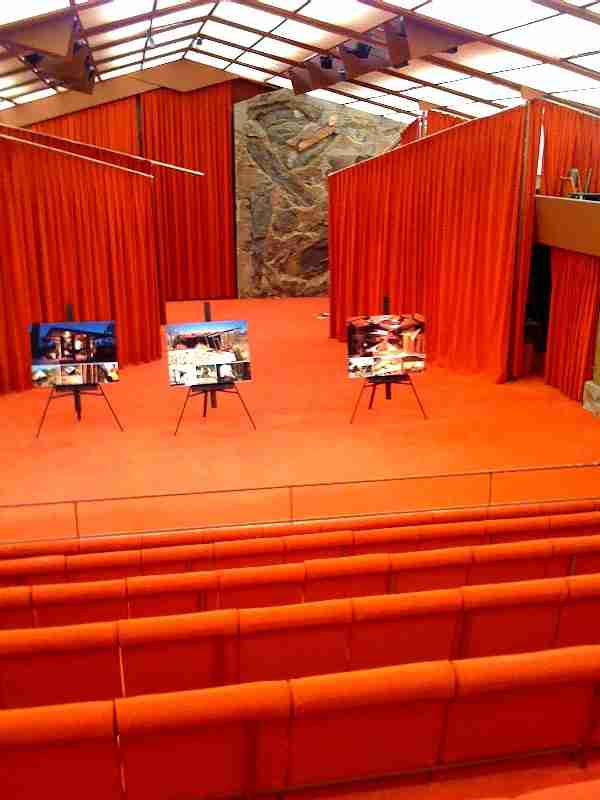
The Theatre at Taliesin West holds about 120 people. Its acoustic properties are not ideal for solo or small-ensemble chamber music performance, mostly on account of the canvas ceiling and other absorptive surfaces (velvet draping, carpeting, seating). However, for large ensembles or ensembles with brass or woodwinds the acoustics are adequate.
By all means, visit Taliesin or Taliesin West if you have a chance. Tours range from 90 minutes to 3 hours. Have a look at Henning’s book for a vivid sense of the ad hoc experimentation of Wright’s Taliesin Fellowship during those simpler times. Have a look also at Muecke’s and Zach’s new edited monograph, ‘Resonance: Essays on the Intersection of Music and Architecture’, which contains a variety of authors’ novel ideas about how music and architecture are related socially, conceptually, and processually.
T hrough my drowse float pleasant sounds: someone is playing Brahms on a distant piano; someone else is playing a melancholy tune on a flute; … Apprentice Yvonne is busy with palette and oils, and the roof-climbing goat is clip-clipping on the dormitory eaves. The good sounds of humans and animals actively happy, peaceful. …I almost said ‘monastery’. But monastery? In the sense of discipline, of communal life of subjecting individual whims and wishes to the leash of a collective ideal, a monastery, yes. But not in the sense of withdrawal from the world or of feeling lost in the welter when once outside the monastery gates. For this is a world-in-the-making with all the world’s diverse enterprise. Here one may master the secrets of corn and cookery, of Beethoven and bricks, of Gaugin and cantilevers. So Taliesin is not a relinquishing, but a ‘getting’; not a withdrawal from the world, but, in a sense more profound than that employed by dusty schoolmen, a preparation for Life.”
— Ernest Meyer, Madison Capital Times, 07-AUG-1934, in Henning, p. 305.

- Taliesin.edu
- Frank Lloyd Wright Foundation
- Barry M. Go West, Ionarts. Ionarts blog, 10-DEC-2007.
- Gila River (Pima) Nation Community website
- Allen S. Practice: Architecture, Technique and Representation. Routledge, 2000.

- Avrich P. The Modern School Movement: Anarchism and Education in the United States. AK Press, 2005. (mentions Taliesin on pp. 302, 310ff)
- Friedland R, Zellman H. The Fellowship: The Untold Story of Frank Lloyd Wright and the Taliesin Fellowship. Harper, 2006. (‘Friedland and Zellman skim over the typical historiography and gleefully delve into Wright's secrets and scandals, focusing on the cultish atmosphere, the mystical teachings and especially, the sexual indiscretions at Taliesin, his studio-commune where he commanded a near-messianic following.’ —jacket blurb)
- Gay P. Weimar Culture: Outsider as Insider. Norton, 2001.
- Guignon C, ed. The Cambridge Companion to Heidegger. 2e. Cambridge Univ, 2006.
- Harman G. Guerrilla Metaphysics: Phenomenology and the Carpentry of Things. Open Court, 2005.
- Harman G. Tool-Being: Heidegger and the Metaphysics of Objects. Open court, 2002.
- Harries K. The Ethical Function of Architecture. MIT, 1998.
- Henning R. At Taliesin: Newspaper Columns by Frank Lloyd Wright and the Taliesin Friendship, 1934-1937. Southern Illinois Univ, 1991.
- Krims A. Music and Ideology: Resisting the Aesthetic. Routledge, 1998.
- Latour B. Reassembling the Social: An Introduction to Actor-Network-Theory. Oxford Univ, 2007.
- Martin E, ed. Architecture as a Translation of Music. Princeton Univ, 1994.
- Muecke M, Zach M. Resonance: Essays on the Intersection of Music and Architecture. Lulu, 2007.
- Paddison M. Adorno, Modernism and Mass Culture. Kahn & Averill, 1996.
- Spitzer M. Music As Philosophy: Adorno And Beethoven's Late Style. Indiana Univ, 2006.
- Sturman A. Social Justice in Education. Australian Council for Educational Research, 1999. p. 103.
- Xenakis I. Music and Architecture. Pendragon (reprint), 2008.

H eidegger raised the question of the ontological status of tool and broken tool. Having initially described this difference as one between conscious perception and dark causal reality, I now state that both of these domains belong on the side of ‘as-structure’. They have nothing to do with ‘tool-being’ [the difference was partly what Wright wanted his Apprentices to confront, through participating in chamber music performances]. Whether it be Dasein listening to music or the mere collision of two silver atoms, both cases unfold within the ‘as-structure’ ... Heidegger’s tool-beings seem to withdraw from perception into the system of effects; they actually withdraw from this system as fully as they do from perception and attain a strange reality that lies outside all contexts.”
— Graham Harman, Tool-Being, p. 232.