CMT: Ellen Hargis is a member of the Newberry Consort and The King’s Noyse. As a soprano, she’s one of America’s preeminent early music artists, specializing in repertoire ranging from ballads to opera. She’s performed at many of the world’s leading festivals including the Adelaide Festival (Australia), Utrecht Festival (Holland), Resonanzen Festival (Vienna), Tanglewood, the New Music America Festival, Festival Vancouver, the Berkeley Festival (California), and is a frequent guest at the Boston Early Music Festival, where she’s sung title roles in Baroque operas and recently served as assistant director and Vocal and Gesture Coach for the production of the Lully opera, Psyché.

DSM: Her discography includes repertoire ranging from medieval to contemporary music. She’s recently recorded the leading role of Aeglé in Lully’s Thésée for CPO Records, released this month. Recent releases also include the premier recording of Conradi’s opera Ariadne. She’s featured on a number of Harmonia Mundi recordings including a critically acclaimed solo recital disc of music by Jacopo Peri, and in Arvo Pärt’s Berlin Mass. Ellen’s on the vocal faculty of Case Western Reserve University in Cleveland, and teaches numerous summer courses in early music, including the Longy International Baroque Institute in Cambridge, The Lute Society of America Seminars and the Vancouver Baroque Vocal Programme.
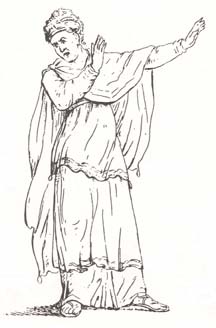
CMT: Ellen’s sense of operatic gesture is superb. Every dramatic action requires a justification, a rationale that can be apprehended by the audience, and Ellen’s Psyché direction ensured that the connection between action and justification—through appropriate visual scale of the gestures, and the reinforcement and repetition of gestures consistently by the various actors—was clear and convincing and natural.
DSM: But ‘clear and natural’ doesn’t have to mean ‘tame’. The gestures of Venus, performed by Karina Gauvin, called to mind Martha Rosler’s “system of harnessed subjectivity” in her short film, Semiotics of the Kitchen (1975)—in which the artist blithely traverses a seemingly benign range of various kitchen utensils, punctuated by sudden violent actions, followed in each case by calm returns to composure.

CMT: Repeat the gesture at least several times, pausing at the end of each repetition to allow the gesture's ‘radiations’ to flow through you. Walk around the stage. See yourself doing the gesture inwardly. You generate a kind of “pull” through repetition and radiation of the gesture, and awaken a sense of urgency in the character—which can be amusing or heartbreaking or other things, depending on what the gesture is and what it signifies.
DSM: Allowing your breath to release with each “pull” helps, too—it adds to the power and complexity and emotional richness/truth. The “pull” reinforces the emotional truth, makes it more vivid. Nicole Potter has a lot to say about this in her book on acting.
B y distilling characters or scenic moments to their core gestures, you can achieve performances that are so psychologically complex that it would take reams of paper to describe them.”
— Nicole Potter, Movement for Actors, p. 22

CMT: When multiple players are on stage, as is usually the case in opera, special considerations arise. There are often multiple activities going on at once, which is confusing since a viewer can only really focus on one activity at a time. It’s important for actors to coordinate their activities to make the overall action on stage understandable and coherent. One way to lend coherence to multi-player action is to give it focus. If one player has the primary role in the current action, then the other characters should direct their attention to that character.
DSM: This helps the audience to see where to direct their attention, and avoids extraneous action on stage that can distract the viewer.
CMT: Giving focus doesn’t simply involve staring at other cast members, though. Each player must have an intention at all times, and display that intention. So if a player is focusing on another player and listening to what that player is saying, the first player should react to what the other player is saying or singing, and display that reaction. Action on stage involves a continual give-and-take among the players, where action leads to reaction, which entrains further action. When done right, these actions and reactions combine into a continuous flow, and that propels the drama forward—as we saw done so well in the BEMF production of Psyché!
DSM: In Psyché, I saw human beings, fully-dimensional characters. I saw suffering and joy in their eyes; I saw their lips tremble; I saw Venus’s face darkened by rage, jealousy and pain; I saw Psyché’s face brightened by love and relief. Obviously, it’s a big difference to see the opera live, at BEMF. I saw completely human people, fighting, suffering, loving and expressing all shades of human feeling, from the brightest to the darkest. Light and shadow is the leitmotiv that comes to mind.
CMT: I could hardly separate the singing from the orchestra, so harmonious was the fusion between all the elements of this production: voices, instruments, gestures, lighting … like a broad stream that just carried us away.
DSM: Ellen Hargis’ stage presence is simply phenomenal. In the various BEMF performances in which she appeared last week, what struck me most about her stage skill was the simplicity of her body language. She didn’t have to gesticulate and pace around on the stage to be expressive. She projects an aura of mobility which gives her individual gestures weight and emotional power. In her workshop at BEMF, Ellen explained the agile placement and orientation of the body—the torso, hips, arms, legs—so as to be readily and fluidly able to move to the next location on the stage, and the next.
CMT: The word ‘impressive’ is insufficient to describe Ellen’s physical presence on stage—as we saw in her performances at last week’s Boston Early Music Festival. Her beauty and smile are so striking that you can feel the audience focus on her and, at that moment, I wouldn’t have been surprised if the musicians lowered their bows and the whole audience got to their feet.
DSM: Interestingly, she isn’t the kind of singer who appeals to everyone instantly. When I first saw her I was surprised by the low tone of her soprano voice—but I soon found her singing superb and profoundly moving.
CMT: When music moves you to the extent of rendering you speechless, you utter platitudes like “This is music to die for.” In the case of Ellen Hargis, I would invert it: this is music to live for!

DSM: Dr. Elena Nicoladis and her research colleagues have studied the hand gestures of bilingual children as they told the same story twice, first in one language and then the other. The researchers were surprised by what they saw. The children used gestures a lot more when telling the story in what they considered to be their stronger language. These results seem counter-intuitive. You’d imagine the children would be more inclined to use gestures to help them communicate in their weaker language. Based on these results and the results of earlier studies, Nicoladis believes there is a connection between language and memory access and gesturing.
CMT: What they believe is going on is that the very fact of moving your hands around helps you recall parts of the story—the gestures help you access memory and language so that you can tell more of the story. In other words, it’s not that the gestures are all outwardly directed, for the purpose of emphasis or persuasion or clarity of communicating what is already queued-up to be told; instead, it’s that the performative process, including gesturing, serves to “lubricate” the speaker’s memory and verbal expression centers in the brain—enabling “more” to be told, than what would otherwise have been queued-up. Benjamin Bagby says something that amounts to the same thing in the round-table discussion that’s included on his Beowulf DVD.
Initially, we thought gestures were related to meaning—that they mean things on their own. But now we believe they are more deeply related to language.”
— Elena Nicolaidis, Univ Alberta, 2005.
DSM: Even with a libretto to follow, there’s no question that well-devised gestures can have this same “lubricating” expressive effect in opera! This BEMF production of Psyché is ample evidence of that!
G esture has therefore this Advantage above mere Speaking, that by this we're only understood by those of our own Language, but by Action and Gesture (I mean just and regular Action) we make our Thoughts and Passions intelligible to all Nations and Tongues.”
— Thomas Betterton, 1710
CMT: In Russian theatre we have Otkaz (Refusal/Reversal). The ‘otkaz’ is the preparation for the action, the wind-up before the pitch. The inhale before the speech, the bent knees before the jump. Basically preparing and storing up energy needed for the intended imminent action. And we have Posyl (Sending Out, To or Away). The ‘posyl’ is the execution of the main action. It’s the path from C to B passing through the point of origin, A. Just like a ball thrown by a pitcher, the energy held in the body during the ‘otkaz’ is released and sent in the direction of the action. Because it passes through the point of origin, A, the posyl is seen by the audience as the path from A to B—containing the energy collected from the otkaz. Without such energy, the posyl has no momentum. If it’s difficult to understand an actor—if her/his lines seem unconvincing—it’s usually because she/he hasn’t prepared and gathered the energy necessary for the line. Hasn’t used the otkaz.
M ovement is the most powerful means of expression in the creation of a theatrical production. Deprived of words, costumes, footlights, wings, auditorium, and left with only the actor and his mastery of movement, the theatre would still be theatre.”
— Vsevolod Meyerhold, 1914
DSM: Ellen’s workshop stressed that we must always bear in mind the ‘when’ and ‘why’ of gestures, or else the ornaments will merely be ornaments—of little consequence to the energy and meaning of the performance. Indiscriminate use of gestures is a kind of incontinence—it belies a lack of understanding of when less is more. She alluded to “that landscape painter who knew how to paint cypress trees well, and who then [stupidly] painted them into every landscape everywhere.”
CMT: She also noted that the ‘accessibility’ of stage gestures does depend upon a certain amount of cultural literacy among members of the audience—a general literacy of physical/kinesthetic “grammar” that these days is faltering. So companies producing baroque operas today have the additional burden of gently informing or illustrating for audience members the 17th century gestures that are essential for their understanding and enjoyment of the performance.
DSM: There’s also the matter of timing. As Ellen emphasized in the BEMF workshop, the gesture usually precedes the action or line that it references. The gesture’s typically an ‘otkaz’-like “set up.” It may even be paradoxical or silly if it’s synchronous with the action or line.
CMT: The gesture isn’t only a “set up” for a positive verbal disclosure or declamation. Ellen points out that a gesture can also anticipate an impending ‘withholding’ of information—a secret, an emptiness, a negative whitespace. Gestures span the full range of rhetorical devices—something that was ably illustrated by the Psyché cast—aided and abetted by Ellen’s expert coaching and direction. I was glad to see that Heidi Wilson, the Wall Street Journal music critic, noted this in her review. I was glad also to see that Heidi was enthused about the notion of getting investors interested in producing this Psyché in Paris and/or New York . . .
S eek not to know what must not be reveal’d,
Joys only flow when hate is most conceal’d ...
Let me no more with powerful charms be press’d —
I am forbid by fate to tell the rest..”
— Indian Queen, Act III
(opera by John Dryden and Robert Howard,
music by Henry Purcell)
- Ellen Hargis’s page at California Artists’ Management
- Wilson H. Fit for a King: A Lully Opera in Period Style. WSJ, 20-JUN-2007, D7.
- Alberro A, Buchmann S, eds. Art After Conceptual Art. MIT, 2006.
- Barthes R. Empire of Signs. Hill & Wang, 1983.
- Barthes R. Image/Music/Text. Hill & Wang, 1978.
- Batson S. Truth: Personas, Needs, and Flaws in The Art of Building Actors and Creating Characters. Rugged Land, 2007.
- Bishop C, ed. Participation. MIT, 2006.
- Burrow J. Gestures and Looks in Medieval Narrative. Cambridge Univ, 2002.
- Cassell J, Sullivan J, Prevost S, Churchill E, eds. Embodied Conversational Agents. MIT, 2000.
- Davis T, Postlewait T, eds. Theatricality. Cambridge Univ, 2004.
- de Jorio A, Kendon A. Gesture in Naples and Gesture in Classical Antiquity. Indiana Univ, 2002.
- Delva J. ReadingBodyLanguage.net
- Donington R. Opera and Its Symbols: The Unity of Words, Music and Staging. Yale Univ, 1992.
- Elliott M. Singing in Style: A Guide to Vocal Performance Practices. Yale Univ, 2006.
- Goffman E. The Presentation of Self in Everyday Life. New York: Anchor, 1959.
- Gossett P. Divas and Scholars: Performing Italian Opera. Univ Chicago, 2006.
- Kelly M. Imaging Desire. MIT, 1998.
- Mallery G. Sign Language Among North American Indians Compared With That Among Other Peoples And Deaf-Mutes. USGPO, 1881.
- Elena Nicoladis at Univ Alberta.
- Ostwald D. Acting for Singers: Creating Believable Singing Characters. Oxford Univ, 2005.
- Parker R. Remaking the Song: Operatic Visions and Revisions from Handel to Berio. Univ California, 2006.
- Potter N, ed. Movement for Actors. Allworth, 2002.
- Powell J. Music and Theatre in France 1600-1680. Oxford Univ, 2000.
- Sansone C, Harackiewicz J, eds. Intrinsic and Extrinsic Motivation: The Search for Optimal Motivation and performance. Academic, 2000.
- Smart M. Mimomania: Music and Gesture in Nineteenth-Century Opera. Univ California, 2005.
- von Bismarck B, Nesbit M, Obrist H-U, Schube I. Martha Rosler: Passionate Signals. Hatje Cantz, 2005.
- Martha Rosler, Semiotics of the Kitchen (QuickTime video, 1975)
- Ian Caddy, BaroqueGestures.com
- Sign Language U.S.
- Sign Language U.S.
- Sign Language U.S.
- Sign Language U.S.
- Sign Language U.S.
- Sign Language U.K.
- Sign Language U.K.
- Sign Language Arabic (Kuwaiti)
- Sign Language Australian
- Sign Language Austrian
- Sign Language Belgian
- Sign Language Chinese
- Sign Language Croatian
- Sign Language Czech
- Sign Language Dutch
- Sign Language Estonian
- Sign Language Finnish
- Sign Language German
- Sign Language Irish
- Sign Language Latvian
- Sign Language Norwegian
- Sign Language Polish
- Sign Language Russian
- Sign Language Thai
- Sign Language