Showing posts with label haptic. Show all posts

Tuesday, November 22, 2011

Paul Lewis’s Performance Suggests Cardiovascular Kinesthetics as Source of Inspiration for Features in Schubert’s Late Piano Music

Paul LewisT he excellent performance last night by pianist Paul Lewis at the Mozart-Saal in the Konzerthaus in Vienna provided some new insights about acoustic effects that are idiomatic of piano that may have interested Schubert late in his composing career.

T here are many passages in the Vier Impromptus (D 935, 1827), Fantasie (D 760, 1822), and Sechs Moments musicaux (D 780, 1823-28) that have emphases with the sustain pedal applied—the Sechs Moments more than the others. The impression we receive as the sound “blooms” or blossoms in the few hundreds of milliseconds after the chord’s strings have been struck and sympathetic resonances are established in other strings and in the soundboard amounts to a tactile/haptic sense of flow—of a “systolic” pushing of blood through large blood vessels, and of the blood vessels’ elasticity, acting as a “reservoir” with network-like capacitance to absorb the flow and to subsequently dissipate it in the rete of smaller vessels beyond.

Pianoteq bloom
I t requires a piano with an efficient, high-impedance soundboard with a high Q-factor (fast decay of high overtones). You can play around with these properties with the Pianoteq software if you like. The software enables you to alter or exaggerate the “bloom”—how quickly or slowly it develops after the hammer strikes the strings; how long it takes for it to ring-down and decay while the sustain pedal is depressed.

Systolic momentsI n Lewis’s playing, we see the physical origins of the sound—besides the properties of the instrument itself, there are elements of his performance practice that contribute to his technique and the sound that it affords. For example, he places the piano bench very high—so that the top of the bench is almost even with the underside of the keyboard… Last night, it was only 2 cm lower than the surface of the flange that mounts the pedal mechanism to the underside of the Steinway Model “D”. The thighs slope downward, and this puts Lewis’s legs in an angle of slight extension—about 140° between the femur and the tibia shaft centerlines. His elbow is high as well—also in a position of slight extension.

L ewis’s pedaling technique involves, then, considerable so-called “concentric” contraction by the rectus femoris muscle of the right leg, in addition to the flexion of the ankle. The dynamics of Lewis’s right leg motions contributed substantially to the “blooming,” systolic sonic effects of the accent-sustains in these Schubert pieces.

W hy does this interest me? Because these pieces are introspective and quite emotional, and I want to think about how they came to be so. These pieces were created late in Schubert’s short life, after the consequences of his syphilis had begun to be apparent, and after his treatments with mercury compounds (one of the few modalities of “treatment” for syphilis in the 19th Century) had also begun to exert their neurotoxic side-effects.

W hile it is possible for those of us who are not musicians—who are not composers—to be oblivious to the rhythms of our bodies, to the rhythms of our life and of our mortality, it is pretty implausible that a composer, or any elite-level musician performer—would not notice. And, having noticed such things—especially abnormal things, changed or changing things, potentially life-threatening things—like the pulsatility of one’s heart that is altering day by day as it has to work harder; or palpitations of a chronic or sub-chronic abnormal heart rhythm; or the progressive dilatation of an abdominal aortic aneurysm; or the worsening of stenosis of the aortic valve in the heart, or worsening incompetence of the mitral valve—having noticed them, it is, I think, impossible for a composer not to attend to them. Impossible for those physical, kinesthetic effects not to creep into one’s music; impossible not to become a bit preoccupied or obsessed with such persistent sensory stimuli in one’s writing.

L ewis’s lucid, passionate, pulsatile playing of these late Schubert works last night—evocative as it was of preoccupations with systole, and pressure-wave run-off, and hemodynamics equations, and windkessel compliance, and vessel elastance and storage, and ventricular-arterial coupling, and how severe aortitis changes these things—caused me think of this. Life is short: compose like hell, while we can; play like hell, while we can.

Friday, March 12, 2010

Meditations on the Artistry of China Broadcasting Chinese Orchestra

 CBCO
C    hinese written script is made up of several thousand individual graphs. Each consists of an invariable group of strokes executed in a set order. One of the truly unique features of calligraphy that results from these apparently restrictive guidelines is that the viewer is able to mentally retrace, stroke by stroke, the exact steps by which the work was made. The viewer also is able to observe extremely subtle nuances of execution—where a stroke was made swiftly or slowly; whether the brush was put to the paper with great delicacy or force; and so on. The ability [and inducement!] to perform such mental retracing personalizes the viewing experience and generates in the viewer a strong sense of interacting or communing with the absent calligrapher [composer] ... Calligraphy clearly had this obvious social dimension, but it also had an important ‘natural’ dimension that should not be overlooked. For example, early critics and connoisseurs often likened its expressive power to elements of the natural world, comparing the movements of the brush to the force of boulders plummeting down a hillside, or to the gracefulness of fleeting patterns left on the surface of a pond by a flock of swimming geese.”
  —  Charles Lachman, Asia Society.
T here were many things for me to be inspired by while listening to the concert performed this past Monday evening at the National Arts Centre in Ottawa, Ontario. The concert—by the China Broadcasting Chinese Orchestra, conducted by Pang Ka-Pang—was a “kick-off” to both nations’ celebrating 40 years of China-Canada diplomatic relations and commercial trading.

F irst, this thought occurred to me as I listened to the 96 Chinese musicians performing: there are parallels between traditional Chinese orchestral music and certain types of traditional Chinese calligraphy!

S ome calligraphic styles involve strokes that are rapid, bold to an extreme—they are sketch-like in their spontaneity; each feature, once improvised, never to be returned-to.

B ut other Chinese calligraphy styles involve the placement of brush stroke on top of previous brush strokes—a “layer-upon-layer” effect with subsequent ink-brush strokes overlaying the ones that went before, creating extra visual, emotional ‘tension’ through the insistent, laminated repetition of a particular stroke-motion in one spot, to create part of the Chinese Hànzì character that is being written. The individual repetitions are not identical, so the effect is accumulative—a collective sonic endorsement of a single thought, one whose quality becomes now more obviously a ‘multi-faceted’ idea than we would have perceived it to be had it only been articulated once, one player to a part as one would do in most chamber music.

Immersion XI, © Clara Lieu
  • Li Huanzhi (arr. Peng Xiuwen): Ouverture du nouvel An chinois
  • Traditional (arr. Peng Xiuwen): Alors que la lune se lève
  • W.A. Mozart (arr. Peng Xiuwen): Sérénade pour cordes en G majeur
  • Tan Dun: Northwest Suite
  • Liu Tieshan & Mao Yuan (arr. Peng Xiuwen): Danse du people Yao
  • J. Strauss (arr Guang Naizhong): Pizzicato Polka, Op. 234
  • Li Huanzhi: Chant folklorique chinois - Jasmine
  • Liu Yuan: Hua Bangzi de Hebei (Cto. Pour banhu)
  • Xu Changjun: Danse du dragon

 CBCO, Jiang Kemei

O n Monday evening we heard musical examples emblematic of both: some of the works were bold, soloistic improvised “texts”; and others among them were insistent, collectivized, massively-parallelized texts, with extensive doubling and repetition.

 CBCO, parallelism


    [50-sec clip, China Broadcasting Chinese Orchestra, excerpt from Track 4, Disc B, ‘CBCO: 2005-2007 Season’, ISBN 978-7-880060280-9, Li Huanzhi, ‘Jasmine’, 1.6MB MP3]

T he ‘frisson’ generated by the massive parallelism—with whole sections of performers ‘doubling’ on the same part, with inevitable microtonal differences among them as they execute the part with fingers on strings 2 cm distant from the shaft/fingerboard—is just scintillating to listen to. But the polyphony of the composition may be quite small—only 8 or 10 parts. The sounds are being ‘crowd-sourced’ by 90+ performers: this may seem a very peculiar but nonetheless ‘chamber music-like’ idiom to a Western listener! Twelve erhus on one note, and twelve more erhus on another note, playing in thirds, two-part harmony. Reminiscent of cloud-computing on dozens of parallel distributed CPUs.

B owing mostly right down on top of the wooden resonator box, with its little deposit of rosin on top to insure that the bowhair keeps its grip on the strings. Snakeskin covering the resonator, with a tiny floating bridge and bit of felt—to minimize disturbance of strings’ motion to the positioning of the bridge and to optimize the sound production.

E ach erhu musician has two instruments, each with a different color of felt—tuned differently, suitable for rapidly switching to perform different compositions? Somewhat like a violinist who needs to play scordatura may keep two instruments at the ready, one of them alternately-tuned?

 CBCO, alternately-tuned erhus on floor

A  second insight—novel, at least for us in the audience who do not frequently have the chance to listen to Chinese music—was the varied narrative structure of the pieces that comprised the program. In several of the pieces, there were at least three “screens” or sonic tableaux where simultaneous “action” was unfolding. One of these afforded an “area” in which each performer could execute her/his part with discreetly improvisatory gestures that are broadly consistent with the score using the language employed in the score and compatible with what the other members of your section are playing. Another: an area where each performer can control the sound elements in the small-scale context of musical phrases or motifs. In yet another, a chance for the listener to collaborate with the performers to “rewrite” a quote from the composition. And finally, a space in which users can imagine and participate (as when, near the end of the last piece of the concert, Dragon Dance, conductor Pang Ka-Pang directed the audience in clapping in-time with the percussion parts). In other words and somewhat in contradiction of the conventional notion of ‘collectivistic’ section playing in unison, etc., etc., there is in reality a remarkable latitude for individual expression and structured improvisation within the Chinese music idioms.

 CBCO, Pang Ka-Pang directs audience

Five Note Scale: Gong Shang Jue Zhi Yu 
Seven Note Scale: Gong Shang Jue Bienzhi Zhi Yu Biengong
Western Scale Degrees:Do Re Mi Fi Sol La Ti 

H armonic structure and voice-leading of these pieces was fascinating as well. For example the nominally pentatonic Chinese scale can be modulated within a diatonic context. The theory may indicate 12-notes to an octave, but most of these compositions are predominantly pentatonic with diatonic/chromatic passing tones and ornaments. The solo concerto performance by banhu virtuosa, Jiang Kemei, displayed tremendous bravura improvisations, including many executed with subtle slides of the bow and manipulation of the bowhair tension with the second and third fingers. Astonishing virtuosity.

 CBCO, Jiang Kemei

W hat else? In some of the pieces, there were figures that were repeated, usually rapidly and over a prolonged interval of 10 or more seconds. But these repetitions are varied, with some musicians altering some pitches or ornaments.

I n other words, there is a powerful, ritualistic effort on the part of all, to sustain the collective impulse of all of the performers.

H ere and there, a small pause was inserted, a fraction of a second longer than in the previous repetition. Or the bows of the erhus slid downward on the strings (creating a tonal slide/gliss that was not present in the previous repetition) and ended in a percussive ‘knock’ of the bowstick against the body of the erhu. Micro-variations.
  • qupai -- different guises of a tune or figure, whose identity remains recognizable despite the changes or guises; a wide interpretive latitude of valid execution; malleability of the score; individual creativity within controlled boundaries.
O ver the years, I have seen photos of erhu and related instruments but, until now, I had not seen one played—nor had I realized that the bows have the bowhair permanently laced between the shaft (fingerboard) and the strings; I had not realized that the instrument is played by bowing with the 3rd and 4th digits pushing the bowstick ‘out’ (away from the player), so that the inner side of the bowhair is contacting the inner side of the strings to make them vibrate.

T he erhu is a 2-stringed fiddle with a 10 cm diameter cylindrical snakeskin-covered resonator box, held upright by the left hand with the resonator sitting on the player’s left thigh. The strings are about 2 cm away from the vertical shaft (which could not be called a finger board, so far away is it that the fingers never touch it).

T he fingers of the left hand stop the strings, while the right hand and arm operate the bow. By pushing the wood of the bow outward or pulling the bow hair inward with right hand fingers, the player produces sound from one of the two strings. Bowing techniques include long bow (chang gong), short bow (duan gong), tremolo (chan gong), and others. In modern erhu performance, the left hand moves to several positions. Left hand techniques, which often distinguish the special sound characteristics of erhu, include vibrato (rou yin), glissando (hua yin), appoggiatura (da yin), and others.

 Erhu bowhold

T he erhu is bowed with an underhanded bowhold. Bowing techniques include ‘la gong’ (analogous to ‘down bow’ technique used on violin family) and ‘tui gong’ (analogous to the ‘up bow’ ). Aside from the usual bowing techniques, the erhu and related instruments can also be plucked, usually using the index finger of the right hand. Left-hand techniques include hua yin (glisses) and rou xian (vibrato).

The outside (lower-pitched) string and inside (higher-pitched) string of the erhu are tuned a fifth apart, most often with D4-A4 (d1-a1) or C4-G4 (c1-g1), sometimes G3-D4 (g-d1) or A3-E4 (a-e1). Erhu has a range of three octaves D4-D7 (d1 to d4).

T hird insight: the diverse timbres of the various instruments make possible a very wide range of musical colors and textures. The sonic palette is so diverse that it demands tremendous expertise, both in terms of playing and orchestration.

S o-called ‘si-zhu’ chamber instrumentation can be executed by small ensembles—as few as 15 members but more typically 24 to 30. String ensemble orchestration is also done and consists of gaohu, erhu, zhonghu, cello and double bass. I wonder what some of the large-orchestra compositions that CBCO performed on Monday would sound like if they were performed instead by chamber-orchestra-sized ‘si-zhu’ ensembles…
  • erhu -- 2-string vertical fiddle.
  • pipa -- 4-string lute.
  • qin -- horizontal zither.
  • yangqin/zheng -- multi-bridge plucked zithers.
  • suona, guan -- double-reed with metal bell, about the size of a trumpet and with sonorities ranging between English horn and trumpet.
  • soprano sheng, alto paisheng and bass baosheng -- vertical free-reeds.
  • dizi -- flutes.
  • metal perc: ba (a flat plate of metal struck with a mallet) and luo (gongs), including yunluo (pancake-shaped bronze ‘cloudbells’ mounted in a vertical wooden panel and struck with a small beater).
  • drumhead perc: da-gu (large drum) and tang-gu.
  • wood perc: bang-zi (wood clappers) and mu-yu (wood blocks)
  • many more…

 CBCO, yunluo

P ang Ka-pang was born in 1965 in Anhui Province. He studied composition and conducting at the Shanghai Conservatory of Music and later at the Central Conservatory of Music in Beijing. In addition to leading several orchestras in Mainland China, he has conducted many other orchestras and has been a juror and guest conductor in Asia, Europe and the USA. He has conducted the Kyushu Symphony Orchestra in Japan, the Hong Kong Sinfonietta, Pusan National Symphony Orchestra, Singapore Chinese Orchestra, Vienna Mozart Orchestra, Vienna State Opera Orchestra, National Symphony of Austrian Musicians (Tonkünstler–Orchester Niederosterreich), Mozarteum Orchestra of Salzburg and the Grazer Symphonischer Orchester, among others. Since 2000, he has been invited each year to conduct the Chinese New Year Music Concert, a performance promoting Chinese music, held in Vienna’s Goldensaal Musikverein.

 Pang Ka-Pang

T he China Broadcasting Chinese Orchestra (中国广播民族乐团) is based in Beijing and represents the merger of the Chinese Film Orchestra Chinese Music Orchestra (中国电影乐团民族乐团), which was founded in 1949, and the China Broadcasting Chinese Orchestra (中国广播民族乐团), which was founded in 1953. Pang Ka-pang became chief conductor of the CBCO in 1998 and has led the CBCO in its various tours to other countries.

 CBCO

C ongratulations to CBCO on this superb, captivating performance! Thank you, too, for bringing the copies of CDs—recordings that are not otherwise available for purchase in North America!


 Layered brush strokes


Wednesday, October 24, 2007

Touching-for-Knowing: Christopher Falzone and the Cognitive Psychology of Haptic Piano

Christopher Falzone
Christopher Falzone performed Hindemith’s Sonata No. 3, Scriabin’s Etude in D-sharp minor Op. 8 No. 12, and Liszt’s Transcendental Etude No. 8 ‘Wilde Jagd’, as part of the student recital at The Curtis Institute of Music in Philadelphia on Monday evening. Falzone has received critical acclaim and numerous national and international awards for his piano performances and compositions. (In 2004, he received the prestigious Gilmore Young Artist Award. In recent years, he has appeared at the Banff Music Festival and the Ravinia Festival. Falzone is a member of the Favrile Quartet. In 2002, his ensemble, Orion Trio, received first prize in the Fischoff National Chamber Music Competition. Falzone, a native of Richmond, Virginia, presently studies at the Curtis Institute with Leon Fleisher and Claude Frank.)

Christopher’s performance on Monday night was spectacular throughout and delighted the 250 people in attendance at the recital. In particular, Liszt’s etude, ‘Wilde Jagd’, offered insights into Christopher’s physicality. This piece is arguably not as technically demanding as other of Liszt’s works, but it is nonetheless problematic for its many rhythmic challenges, triplets in the LH part, tricky leaps, and large staccato chords.

Liszt, Wilde Jagd, mm. 1 - 8
The left hand should be animated but not over-scaled. The performer’s effect may have panache but should not be preening or demonstrative. Instead, what we hope for is sensitivity alloyed with virtuosity. Falzone delivers this in abundance.

The wild hunt is mostly Presto furioso, except for the cheerful 6/8 hunt in the middle. Toward the conclusion it builds to a stormy climax, a confluence of emotional extravagance and inspiration. The hunt is a recurring theme in representational Romantic compositions and art, often associated with evocation of fright or terror as well as the excitement of the chase. Danger and the real possibility of human death is ever-present in the hunt, looming almost as much as the likelier fate of the quarry. Liszt’s ‘Mazeppa’ (Transcendental Etude No. 4) contains this idea. It is not just the eponymous ‘Jagd’.

In ‘Wilde Jagd’, Liszt is more representational than in other of his compositions. He evokes galloping horses with the persistent dotted rhythmic pattern—thundering hooves are implied by the LH part. The technical challenges of Wilde Jagd include blinding speed, prodigious power, the wide leaps, and repeated chords that demand a flexible wrist.

Liszt, Wilde Jagd, mm. 178 - 185
Falzone’s playing is massive and triumphant—thundering sheets of chords. This is epic pianism. He delivers a rhythmic precision that, olympian though it may be, still admits of flesh-and-blood. He clearly has excellent haptic memory in his fingers, his arms, his back, his entire body. This haptic memory is facilitated by intensive devotion to absorbing the music he performs.

Ultimately, music that is memorized by the mind and by the fingers is played flawlessly by heart. Yes, some pianists play from a score, or at least keep the score on the piano just in case. Falzone plays from memory—not, it seems, as a matter of performance aesthetic or requirement for this recital, but because of this wonderful, physical haptic capability that he is endowed with and has developed. He clearly keeps the notes stored in his mind—measure by measure in his mind, as any capable pianist does—but he also keeps them stored in his body, his arms, his fingers. Touching the piano is inevitable, a foregone conclusion. Magma rises under the earth’s crust; there are tremors; it erupts. Falzone is just such a Force of Nature. Not satisfied with mere sensation, touching and feeling erupt into embodied experiences that are emotional and expressive, personal and interpersonal, and mediated through Steinway technology.

A distinction can be drawn between ‘technical problems’ and ‘technical patterns’ in performance practice. The term ‘pattern’ is maybe best thought of as the sequence of fingering combinations that comprise a solution to a technical problem or challenge. For example, in Clementi’s Gradus ad Parnassum, Etude No. 85, the left hand plays a broken octave pattern with fingers 1 and 5 while fingers 2 and 3 are in a fixed position.

Clementi, Gradus, mm. 1 - 4
But Liszt’s polyphonic problems in Jagd and in other works are different. They require the performer to find some very innovative solutions/patterns and, having found them, to internalize them. When leaping, it’s preferable not to look at your hands. Maybe look at a key about one octave above the written note. Place your thumb there and press down the fifth finger; anticipate the coming chord destination when your hand is in motion, leaping. Linear jumps may be more efficient than arcs, although many accomplished pianists use big arcs successfully. If you are near enough to Falzone at one of his performances, you will see arcs, giant arcs. And probably sparks as well. Lava. Smoke. Brimstone. Exciting, impressive, beautiful!


Thursday, July 19, 2007

Shadows Over Grandeur: Bach’s Partita No. 2 in D Minor, Chaconne

Christian Tetzlaff
O  n one stave, for a small instrument, the man writes a whole world of the deepest thoughts and most powerful feelings. If I imagined that I could have created, even conceived the piece, I am quite certain that the excess of excitement and earth-shattering experience would have driven me out of my mind.”
  —  Johannes Brahms, letter to Clara Schumann.

DSM: Christian Tetzlaff’s new CD is phenomenal! And the Partita No. 2—the Chaconne—is gorgeous. Many virtuoso violinists’ gestures aim to arouse the eye as well as the ear. The use of slight detuning of the strings or oddly difficult bow techniques can draw attention to their skill. But Bach’s sonatas and partitas are not conducive to (or tolerant of) such showiness–which tends to support the argument that Bach wrote them for his own use. Tetzlaff’s interpretation of Partita No. 2 is deeply true to the spirit of this composition—this four-bar harmonic progression with sixty-four variations.

CMT: The length of the Chaconne—about 15 minutes—is interesting in itself. Profundity requires time. The artist has to have enough space to capture the audience's attention, plant some seeds, and let them grow. Tetzlaff handles this nicely. Nothing is exaggerated or played merely for ‘effect.’ It is personal and absorbing, poetical yet natural and unadorned. Tetzlaff captures all the tireless circumnavigations around this single idea, making you wonder at Bach’s rhetoric. In Partita No. 2, Tetzlaff evokes the melancholy beneath the Bach’s tribute to his first wife, Maria Barbara. There is pliancy, grandeur, musical freedom. Tetzlaff’s playing displays no desire for ‘show’ but only the desire to engage with the musical core of this piece.

DSM: Bach’s Partita No. 2 in D minor follows a ‘da chiesa’ “church sonata” pattern, in which the slow and fast movements alternate with each other. And the Chaconne is not a short story or a novella; it is a full-blown novel! A novel has enough space to support introducing and developing a number of characters. This famous Chaconne is positively monumental in its scope and scale.

CMT: The arrival of every four-bar phrase on D is a striking aspect of the Chaconne’s beauty and poignance. It’s an emphatic eternal return, as though it were a physical “law.” The impression is one of inescapability, of inevitability. There’s also the ‘monumentality’ of the sheer variety that emanates from the solo violin as the performer progresses through the 64 variations that comprise the Chaconne. The music and the soloist become an omnipotent force. The piece evokes a transcendent ‘Other’—the Divine, if you wish.

DSM: The sheer diversity of the 64 variations compels us to acknowledge the Other. The diversity is so enormous as to boggle the listener’s mind and cause the jaw to drop. Boggling not in awe at a virtuosic human performer, but in awe at the mysteries of Life, of the Universe.

CMT: All of Bach’s compositions are, in some way or other, variations on a thoroughbass. With the first statement of the four-bar theme, the harmonies first move in halves and quarters. Then they accelerate to quarters at the cadence. Then they speed up to sixteenths.

Bach, Partita No. 2, BWV 1004, Chaconne
DSM: Many of the variations occur in pairs—the second, for example, is similar to the first, but intensified. The opening eight bars comprise the theme and its first repetition, where the first three bars of the second statement are identical to the first. Then it broadens in register and introduces thirty-second-note rhythms. In terms of our cognition, Bach's 'haptic update rate' and the hypermeter of the variations’ cycling are what impart this transcendent quality to the Chaconne. Have a look at Choi and Tan paper in this month’s issue of the virtual-reality journal, Presence.

CMT: This presages the predominant dotted rhythm of the next four variations. The dotted-rhythm variations occur in pairs. The first pair is diatonic; the second pair introduces chromaticism—the descending tetrachord goes from tonic to dominant. And now this! And now this! Layer upon layer! World without end!

DSM: The texture perpetually evolves throughtout the Chaconne as well. As the velocity increases, the texture diminishes from the three- and four-voiced chords at the beginning, to single-line writing later in the piece.

CMT: As the texture becomes thinner, the chromaticism increases—the introduction of F-sharp and E-flat in the eighth statement, for example—and the registral ‘span’ increases, from the tenths in the first two statements, to about two octaves in the eighth statement and beyond.

DSM: This process—where some elements diminish while others grow—adds to the sense that the meaning intended or the theme that Bach is referencing is a commentary on life itself, on Nature, on the Cosmos.

CMT: When the next few variations featuring sixteenths evolve into an ever-expanding array of bowing patterns, wider and wider articulations, my impression is one of galaxies, of a universe that is expanding, of a supernova.

DSM: When runs of thirty-seconds first appear they are slurred (mm. 65-72), then they are separately bowed (mm. 73-76). More and more intensity. More and more and more.

CMT: The changes of mode—to the grand D major and back to D minor—are accompanied by returns to the slower rhythms that we had at the opening of the Chaconne. There is a renewal, another aspect of the eternal return.

Christian Tetzlaff
DSM: But with each rebirth we have the beginnings again of the growing speed and chromaticism and intensity. Inescapable. Inevitable. Changes of changes. Wheels within wheels.

CMT: There’s a tension—for the performer especially, but also for the listener—between the elements of articulation, tempo, affect, bowing, fingering, and other aspects of technque. The variations call upon these in different ways—increasing the importance of one or another of them and diminishing the importance of the others. This is part of the ‘novel-esque’ character of the piece. Obviously, it's also part of why the Chaconne is such a showcase for virtuosic playing.

DSM: But it would be a mistake to dwell on technique. A technically brilliant performance of the Chaconne may be emotionally empty. Instead, the tension between these demands is the source of a cast of ‘characters’ in the composition.

CMT: These are different voices, I think—not the soliloquy of a single voice. The textures of the four strings, how Bach uses the violin's four strings, are, to me, at least four different voices in this Partita.

DSM: The developments in the Chaconne are logical and yet suprising. Its inordinate novelty—novelty begetting yet more novelty—is the source of much of the piece's profundity.

CMT: There’s an inherent urgency to the Chaconne as well. Something like the remark J. Tillman made upon hearing Josh Bell play the Chaconne in the Washington D.C. subway station last January – ‘the kind of music the ship’s band was playing on the Titanic, before the iceberg.’

DSM: In other words, the Chaconne “knows” that it must end. It is anticipating the end of the universe. In the beginning there was the Big Bang. The Chaconne is showing us the approach of the Big Crunch.

CMT: Yes, this Chaconne is not sticking to the script of Church dogma in the way that Bach’s sacred music does. This Chaconne is agnostic, or even atheist in its view. We feel the finiteness of our existence on Earth and are not exhorted to believe in any life hereafter.

T o prepare for a friend’s funeral service, I had been practicing the Chaconne every day—fussing over individual phrases, searching for better ways to string them together, and wondering about the very nature of the piece—at its core an old dance form that had been around for centuries. After the many times I had heard and played the Chaconne, I had hoped it would fall relatively easily into place by now, but it appeared to be taunting me. The more I worked, the more I saw; the more I saw, the further away it drifted from my grasp. Perhaps that is in the nature of every masterpiece. But more than that, the Chaconne seemed to exude shadows over its grandeur and artful design. Exactly what was hidden there I could not say, but I would lose myself for long stretches of time exploring the work’s repeating four-bar phrases, which rose and fell and marched solemnly forward in ever-changing patterns.”
  —  Arnold Steinhardt, Violin Dreams.

F rom the grave majesty of the beginning to the thirty-second notes which rush up and down like the very demons; from the tremulous arpeggios that hang almost motionless, like veiling clouds above a dark ravine ... to the devotional beauty of the D-major section, where the evening sun sets in a peaceful valley: the spirit of the master urges the instrument to incredible utterances. At the end of the D-major section it sounds like an organ, and sometimes a whole band of violins seems to be playing. This Chaconne is a triumph of spirit over matter such as even Bach never repeated in a more brilliant manner.”
  —  Phillip Spitta.


Monday, February 12, 2007

Authenticity Re-Loaded: Music Performance as Acting

Comedy/Tragedy
T rue ihsas is possible at every performance because the munshid is a true Sufi believer. When he sings the words that describe his beliefs, the feeling always flows spontaneously from him. The munshid’s music is thus always an aesthetic expression of an authentic mystical condition. But the secular musician is more like an actor. At best, feeling may be artificially and temporarily synthesized to support expression, but even this much cannot be guaranteed since there is no special belief system available to assure the correlation of the music with feeling.”
  —  Michael Frishkopf, Tarab in the Mystic Sufi Chant, in Colors of Enchantment: Visual and Performing Arts of the Middle East, Sherifa Zuhur, ed. American Univ Cairo Press, 2001.
DSM: There was an interesting remark that Sandy Yamamoto of the Miró Quartet made the other day, about how she enters into her part—about how she prepares herself before the Miró Quartet commences performing a piece. She was, I think, basically describing a sort of ‘sense memory’ for the character of the piece—or, more precisely, a ‘sense memory’ for the character of her part.

CMT: I think the performer has a duty to enter into the mind of the composer, to “get into character” for a piece—just like an actor. While interpreting the piece, the performer imagines the feelings of the composer, and responds and reacts to the expressions of the other performers—or even the atmospherics of the audience—in the context of her/his own experiences.

DSM: In the Nineteenth Century and the Romantic period, the sense of being authentic or ‘true’ to a work was so much about being true to the composer’s emotional content, which the artist was obliged to render accurately and faithfully. In the Eighteenth Century and earlier, the notion of authenticity allowed more scope to the performer. But in every era, being true to the emotions leads performing artists to take liberties with the text—take liberties with the notation on the page. The rationale that’s offered by those who choose this approach is generally that the musical text is something that can and must be modified as part of the performer’s role in a performance, much like an actor or director suggests or requests a line change to stay more true to a character.

CMT: There was a strong reaction against this in the late Twentieth Century, of course—a trend toward “authentic-qua-textually-fastidious” performances, using period instruments that made it possible to hear the works as they might originally have been performed. I suppose that’s part of the milieu of historically correct Civil War reenactments these days, the Society for Creative Anachronism, Massively Multi-Player computer gaming, and so on. But if you have hundreds or thousands of actors as in re-enactments or Massively Multi-Player gaming, the concept of adherence to a text breaks down. Overall, you get expressive dyssynchrony, incontinence. And yet each of the players/actors is locally continent and consonant with the performances rendered in his/her area, in his/her locale. You have a confederation of artistically expressive nomads and nomadic cliques, in Deleuze’s sense.

DSM: Well, it’s an artifact of western music history that the composer’s emotional conception of the work often dominates our thinking. The western myth is:

composer’s emotions → as-composed expressions → textually literal practice performance → intended emotion elicited in audience members.

But in fact the causal chain of events is more this way:

composer’s emotions → as-composed expressions → studying score/rehearsing → emotions elicited in performer different from composer’s emotions → performer’s understanding of the work’s meaning and creative ideas for expressing those ideas through the performance → refinement of concept, including input from critics and theorists → practice performance, with adjustments to create emotionally authenticity → intended emotion elicited in audience members.

The classical musics of non-western cultures are hardly so composer-centric—Indian and Asian and Middle Eastern music, for example.

CMT: And your arrows are re-instantiated and can change substantially from performance to performance by the same performer. They can be dramatically different from performer to performer. The big mistake in western music theory and western performance practice is supposing that there is a complete, finished work that existed in the composer’s imagination and is totally and unambiguously specified by the score and its annotations. No one would make such a mistake in theatre. One true and authentic Hamlet only? Preposterous!

DSM: You have to invest yourself in the dynamic of each rehearsal. You have to understand that your fellow ensemble members need to do many preparative things before they get to the point where they are ready to get themselves into character and immerse themselves in the piece in front of them.

CMT: And how different that warming-up and tuning and other pre-preparation is for a pianist than for string players or wind instruments. How different it is even among different instruments within a family! So each performer has to keep quiet, be patient with the others, and each has to observe and understand what’s going on—has to gauge what remains for the others to finish doing before they can get their ‘game face’ fully “on”.

DSM: One thing a composer learns is that, in general, musicians aren’t too interested in why they’re doing what they’re doing. All they want to know is: What do I need to do? When do I need to do it? For many performers, if you start to try to explain the meaning or intent behind the composition, their eyes glaze over. It’s interesting that theater’s the exact opposite of this. A good actor or actress won’t do anything until they’ve understood everything. The insist on knowing about the playwright’s motivation, about his/her intended nuances and connection of the lines, about the characters psyches and personal histories, and so on. By contrast, the average musician isn’t very interested in this. The great musician, though, tries to inhabit her/his part, much like an actor would do. You don’t have to be an opera singer for this to matter. It’s equally important for instrumentalists to conceive of who the character is whose voice they play in a piece. They need to inhabit that character in performance, to deliver an authentic and compelling performance.

CMT: Are you implying that musicians also need to adopt some specific framework for their acting—like “sense memory” in method acting, for example?

I t does not matter so much what the actor thinks, but the fact that he is really thinking something that is real to him at that particular moment. The make-believe thinking that may coincide with the play is not real enough.”
  —  Lee Strasberg, ‘A Dream of Passion’

DSM: Well, yes. One of Strasberg’s reasons for personalizing the actor’s imagination in getting into character was to enhance the realism. According to Strasberg, the actor needs to include in preparation some specific objects from her/his own personal life, reacting to those familiar personal objects rather than the set or props of the play. In discussing the use of “sense memory”, he emphasized that it wasn’t enough for the actor to attend to memories in an abstract way. Only by means of a concrete sensory binding to these personal objects can the emotions be reliably evoked. It’s not enough to say, “It was really hot.” Instead, the actor must define how she/he experienced a particular heat remembered from her/his own life. By deliberately recalling a sensual memory, the actor reacts to the internal object, and that then becomes the foundation for a very realistic performance. You must “really think something that’s real.” You’ve got to hold that in your mind, as an anchor for what you do with the text. If successful, the emotionality impresses the audience by virtue of its realism—the realism is supposedly greater because those actual objects from the actor’s own life are what’ve invoked it.

CMT: But the undesirable side-effect of method acting—criticized by Joseph Chaikin and others—is that, in order to inhabit the character, the method actor involves himself with the character’s inner dilemma. “But the character,” Chaikin says, “if he were a living person, would be doing the opposite—trying to relieve himself of his unhappiness, and trying to respond to the circumstances around him.” Chaikin deplores the way that the “eyes of this actor are always secretly looking into his own head.”

DSM: By contrast, the psychological realism of early naturalism relies on imagery derived from analysis of the text itself. Necessary to drive realism into the performance, the “inner image”, according to Konstantin Stanislavsky, is text-based ‘make-believe’ rather than referencing an actual personal object. But even though this may be less intense and more detached, it still lends character and nuance to the delivery of the lines. I think more musicians are closer to Stanislavsky in their performance practice than they are to Strasberg, don’t you?

CMT: Maybe. But, either way, in order to inflect the individual parts of a speech with different emotional nuances, it’s helpful to the actor/musician to be able to shift among the inner images in a carefully planned order or sequence. How detailed you have to be depends on the motivic complexity and length of the piece. This is true regardless whether you’re a method actor or following Stanislavsky’s or some other approach. The method of blending role and personal experiences is valuable—maybe it’s inevitable.

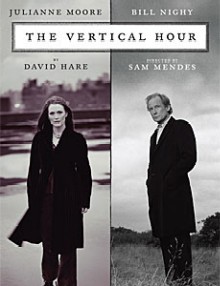
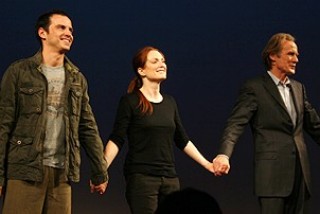
Vertical Hour, by David Hare
DSM: You can over-do this, though—this blending of personal life and role. Even Strasberg advocated other training techniques such as improvisation to “stimulate a continuous flow of response and thought within the actor,” balancing the tendency to be “looking into one’s own head.” He wasn’t a ‘method bigot’.

CMT: So the technique of adding realism by psychologically motivating the performance in personal terms—rather than a Stanislavskian, text-derived motivation—has various alternatives. One was recently recounted by Lindsay Crouse in discussing her testimony in Sidney Lumet’s ‘The Trial’. She imagined that the act of giving testimony was a confession directed at personal life and that such a confession was instrumental in enabling her to move on. The instrumentality of the confession in enabling her character to ‘move on’ in her life was the conceit that powered Lindsay’s highly authentic, realistic testimony performance.

DSM: Yes. And in Casablanca, Bogart probably ferried some of his marital problems into his role. In his film noir roles he may’ve brought some of his disillusionment with Hollywood. It’s hard to imagine how he could’ve totally ‘checked that at the door’ at any rate.

CMT: More than the infeasibility of completely compartmentalizing and distancing our concrete personal lives, it’s hard to see how an abstract entity such as a character’s ‘personality’ can be brought into the imaginative work in order to achieve the performance we want. It’s likely that concrete and highly personal objects inevitably affect our creative performance. Better to arrange it deliberately instead of allowing it to be happenstantial. The deliberate incorporation of concrete personal references helps us to manage what would otherwise be glaring contradictions—belying the fractured assumption of one coherent, simplistic personality. If we take the concept of auteur to refer to those un-simple aesthetic properties that are essential in a composition’s overall design, we’re able to acknowledge a chamber musician’s actorly contribution to the collective creative enterprise of the ensemble. But rather than taking the premise of a controlling will or one coherent composerly intellect for the work, the performers and listeners should look for what’s most valuable in the work—should look for what elements embody most of the meaning. That still leaves plenty of room for discovery and for spontaneous, dynamic interpretations. It still leaves plenty of room for nuance and surprise.

DSM: These aspects remind me of Deleuze’s writing on music vs. Adorno’s writing. Deleuze: the theorist of immanence and dynamic ‘becoming-music’ and univocality of being. Adorno: the theorist of irreducible contradictions and static plurality and structural multivocal conflict.

T o improvise is to join with the world, meld with it.”
  —  Gilles Deleuze & Felix Guattari, ‘A Thousand Plateaus’, 1987, p. 311

CMT: Very tactile, very multi-sensory, very kinesthetic—‘haptic’, to use Deleuze’s fancy word. Deleuze allows for both a haptic act of seeing and a haptic act of listening. Haptic vision is a mode of seeing that, from the artist’s easel, summons not just the eye but the ear and the touch. Haptic listening is a mode of hearing that, from the performer’s instrument, summons not just the ear but the eye and the touch. The senses aren’t alienated from each other, they’re intertwined. This inter-relation and interchangeability and cross-talk among the senses was part of what Sandy Yamamoto was implying by her comments the other night, I think. You compose the sounds; you imagine them in advance of your attacking the first note. Authentic music performance in this way becomes a wholistic composing of the senses—like an actor’s multi-sensory composite performance. No matter how many times you’ve performed the work before, you must imagine the senses again, compose the senses again.

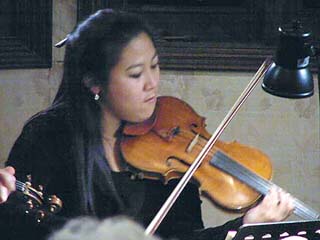
Sandy Yamamoto, inhabiting a favorite musical character

Vertical Hour, by David Hare