Showing posts with label technique. Show all posts

Wednesday, May 19, 2010

Afflicted Fingerings, Biomechanics, and Energy Budgets

 Miyoshi, Vol. 3, P. 36
B    and B-flat, vying; then C and C#: yow! … all of which as if to reveal some hidden perversity in the interval itself, to show some concealed possible corner of the second’s personality … what the Second does when he’s at home alone, when no one’s watching.”
  —  Jeremy Denk, More about Goldberg Variations, ThinkDenk blog, 11-MAY-2009.
M y hand shifts to make a gradual transition in this Bach sarabande. I never fail to be impressed by how deeply afflicted this piece is. I think of these passages as several competing storylines crossing each other... chains upon [Dutilleux-esque] chains of expressive dissonances in the French Suites.

 Bach, French Suite, No. 1 in D minor, BWV 812, mm. 7-8
W hat fingerings might be best? Bach’s Inventions No. 1 and 2 have been the focus for studies by Yuichiro Yonebayashi, Hirokazu Kameoka, and Shigeki Sagayama at the University of Tokyo (link below). They represent the positions and forms of hands and fingers as Hidden Markov Model (HMM) states and model the resulting sequence of performed notes mathematically as HMM transitions. Or, for me just now, Bach’s French Suites, BWV 812-817, Markovian fingers, compelled by what other neighboring Markovian fingers just did.

F    ingering would be no problem were it not that music notes are preceded and/or followed by other notes.”
  —  Yuichiro Yonebayashi, Hirokazu Kameoka, and Shigeki Sagayama.
O ptimal fingering is essentially a problem of finding an optimal sequence of [reasonably] smooth state-transitions, from one state of each finger to the next. But the issue is not just about ‘ease’ or ‘reliability’ or ‘evenness’, even though those are of course important. The matter has also to do with texture and emotion. In fact, a thoughtful composer who is also a pianist knows very well what biomechanical ‘cost function’ or budget for effort or attention or energy expenditure will likely prevail for performers. If the composer’s intent is to devise an especially afflicted expression, then the composer chooses a key-signature and sequences of notes specifically with the intention of beleaguering or defeating performers’ biomechanics cost functions and built-in instincts.

W    hen pianos were first invented, they were similar in size to harpsichords. Hand size was rarely a limiting factor throughout the eighteenth century because the keys were short and narrow and the repertoire usually contained intervals no larger than the octave. However, at the beginning of the nineteenth century, the piano gradually expanded in range and key size. The use of cast iron frames led to an exponential increase in string tension, resulting in heavier and deeper actions that exacerbated problems for small-handed players. Nineteenth-century concert pianos typically featured actions with 6 millimeters of travel depth, requiring 23 gm of weight for full key depression and string tension in the middle register that ranged from 12 to 15 grams. By the end of the century, string tension had risen to 80 kg in the middle register, resulting in a heavier action with 9 mm of travel depth, requiring 45 g for full key depression. Today’s Steinway grands feature even heavier actions and larger hammers: 90 kg of string tension and 10.5 mm of travel depth, requiring 50 to 60 g of key depression force.”
  —  Lora Deahl & Brenda Wristen, American Music Teacher, JUN-2003.
I  sometimes use 2-3-5 LH for triads and 1-2-3 for RH triads, leaving the thumb ready for 7ths or other contingencies. Also, my RH likes 1-3-5 or 1-2-5 when straddling black notes or for inversions or big gaps. But these produce tension in the hand—not just physical stretching but—I realize this now—brain stretching, too. Brain regions controlling the index finger and middle finger—fused under the influence of years of neuroplasticity—get anxious. They are apprehensive of more affliction that’s surely in-store.

T his Bach is undoubtedly about middle age and loss. Written in 1722 or a little earlier—two years after the sudden death of his first wife, Maria Barbara; now soon after his marriage to Anna Magdalena. Bach at 37—he hardly knew over-the-hillness first-hand, but he surely knew about loss. I realize that I am playing this differently now in my late 50s than I did 20 years ago, but I am not sure how to explain the difference in words.

I t has been more than 10 years since I played French Suites. The elapsed time is long enough to have lost any muscle memory I once had. Whole strategies and insights have vanished—and my old marked-up copy misplaced in one move or another along the way. Maybe my explanation for what is different is just that: beginning again, after some sort of catastrophe. Feels like physical therapy/rehab for someone who has suffered a stroke? You full-well know what your appendages ought to do, and you know the self-possessed sensations that you intend, but the body doesn’t cooperate—or even feel like your own self, really.

W hen working out your fingerings—even for a piece that is vexingly familiar and yet alien, like this one is for me right now—you often start at the beginning of a passage and plot your strategy forward from there. Sometimes, though, I prefer to first find the points that demand a specific finger. These points mark constraints such that you must have the requisite finger to proceed into the next phrase; such points are often the highest or lowest points in a passage. In the RH, you don’t usually want to end up with fingers 1 or 2 on the highest note (LH lowest note), nor do you want to end up on 4 or 5 on the lowest note of a RH passage (highest in the LH)—especially if the thing is going to immediately reverse direction. Once you’ve identified those constraints, you can work outward, both upstream and downstream, to plan your optimal fingerings.

I  mark each place that involves a finger substitution, a change of fingering on a repeated note, or crossings (4-over-5; 2-over-1; 3-over-1; 4-over-1; 1-under-2; 1-under-3; 1-under-4; 5-under-4). I used to do this in pencil, and sometimes I still do this. But in the last couple of years I prefer to do it with e-markups in MusicReader™ software, which I use with my AirTurn™ pedal.

I  mark more non-standard fingerings—the more afflicted the passage, the more non-standard it gets. For example, a passage may have a D minor scale in the RH, but it may continue to the octave E. One conventional fingering would cross to 1 on the high D and place 2 on the E. If it were then to return, you would have another crossing (1 - 4 on D to C) almost immediately. In this instance, a non-standard fingering such as 1-2-3-4-1-2-3-4 may be more effective. Bach as ‘rehab’; rehab as [self-] ‘discovery’...


Wednesday, February 27, 2008

En garde! : Viola da Gamba Bow Biomechanics

 Australian Viola da Gamba Society Clinic
W   ould you agree that the difference is a near-horizontal rear forearm, subsequently maintaining the connection with the shoulders? I think a more vertical forearm is a result of keeping tension in the rear-most scapula. I believe that these players are actually loading their scap’ in such a way that their elbow moves into a more ‘slotting’ position. The reason they maintain connection is because they maintain the ‘scap load’ and let the rotation take their hands/bat to the ball. In some of these drills, the vertical forearm is a checkpoint or even a ‘cue’ to get the young player to maintain some scap’ tension, which prevents disconnection and excessive external rotation of the shoulder/upper arm.”
  —  Anonymous sports medicine physician, discussing biomechanics of baseball arm motions.
Viola da gamba bowing biomechanics is quite a bit different from bowing members of the violin family. For one thing, the under-handed way of holding the bow means that the wrist and forearm have fewer (remaining) degrees of freedom and less range of motion, compared to over-handed violin bowing. And the dorsal flexion of the arm—and supination/rotation of the forearm—to hold the viola da gamba bow put more emphasis on the strength and agility of the supraspinatus. With that in mind, CMT readers who’ve asked about viola da gamba bowing and strengthening exercises may find some of the sports medicine and rehab links below useful. Especially ones that are involved in épée fencing.

 Fencing épée ‘guard’ position, Viggiani
Why? With an underhanded bow hold, much of the work is done with the forearm opening from the elbow, with little shoulder and upper arm. The elbow contributes far more with an underhanded grip than it does overhanded.

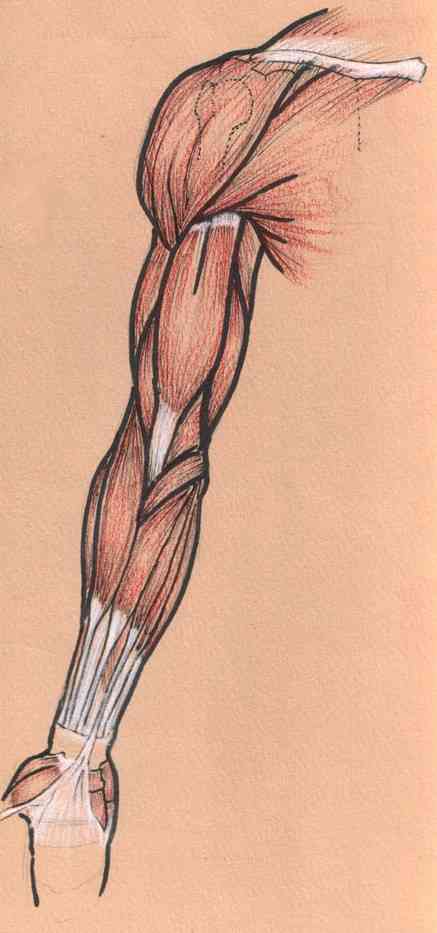
You may find that a good bit of the sports medicine literature on ‘rotator cuff’ is germane to viola da gamba bowing performance as well. (The rotator cuff is made up of four muscles: subscapularis, supraspinatus, infraspinatus and the teres minor. The rotator cuff muscles work as dynamic stabilizers of the shoulder girdle. In all, there are 30 muscles providing movement and support for the shoulder: 15 muscles move and stabilize the scapula; 9 muscles provide for glenohumeral joint motion; and 6 support the scapula on the thorax. Supraspinatus and other muscles of the ‘rotator cuff’ are just a few elements of the intricate shoulder anatomy.)

I’d say that the ‘stretch reflex’ probably does matter in viola da gamba bowing. But its importance in the ‘ballistic’ context of rapid bowing passages is probably small—see J Appl Biomechanics 1997, volume 13, fascicle 4, for example. But, for typical gamba passages with backbow-forwardbow abduction-adduction of the scapular complex happening at moderate velocities: that’s where proprioception—the stretch reflex—would be most important in control of muscles moving the bow. Rotator muscles surrounding the glenohumeral joint—the muscles involved in external rotation of the arm/elbow—probably not too important in rapid bowing. Instead, it’s the scapula that’s dominant in terms of mechanical linkage of the bow to the body. And the degree of elbow flexion—how close to horizontal the right forearm is—affects how much the ‘stretch reflex’ around the elbow can then contribute to the biomechanics of the bowing muscles’ performance.

 Dorsal flexion of arm
Gonzalez and coworkers have shown how activity of muscles that cross the ‘elbow joint complex’ (EJC) is affected by forearm position and forearm movement during elbow flexion/extension. They developed a three-dimensional musculotendinoskeletal computer model of multiple-degree-of-freedom (df) rapid (ballistic) elbow movements to study this. The model demonstrated how changes in forearm position mostly affected the flexor muscles, far more than the extensor muscles. The model also indicated that, for specific 1-df and 2-df movements, activating a muscle that is antagonistic or noncontributory to the movement can significantly reduce the movement time. The up-shot is that good muscle tone from moderate strength training likely improves viola da gamba bowing speed and accuracy.

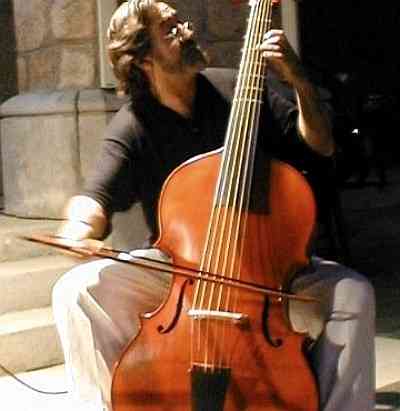
 Jordi Savall
I  f you begin with a backbow (‘roverso’), then you must be prepared also to keep the same consistent alternation of back and forward bows. Practice both ways, so that you are not caught unawares and are unable to straighten out the bowing in a fast passage. A fast run that begins off the beat must start with ‘roverso’ while a similar passage beginning on the beat would start with ‘dritto’. If you have a sequence of ‘groppetti’ [English seventeenth century theorists would call them ‘relishes’ or ‘double relishes’ –Ian Gammie] then begin the first on a forward bow, take the next on a back bow etc.”
  —  Sylvestro Ganassi, Regola Rubertina, 1542, Book I, Chapter 6 (quoted in Gammie I, Chelys 1978; 8:23-30).
T   he bow is to be held with thumb, middle and fore-finger. The thumb and middle finger hold the bow so that it does not fall, the index finger applies greater or lesser pressure on the strings as is required. [This would preclude having a finger on the hair of the bow, as was common practice in the seventeenth century, and the articulation and volume is to be controlled through the stick instead. There has been some confusion in modern times over what Ganassi meant precisely with his description of the fingers. I consider it unlikely that he meant a player to have the index finger on the hair while the thumb and middle finger hold the stick—an unusual physical contortion at the very least. Ganassi intends that the index finger should apply pressure to the strings of the viol, not to the strings or hairs of the bow. –Ian Gammie] The bow should be placed about four finger widths from the bridge—depending of course on the size of the instrument, the arm relaxed, the hand firm but not tense, so as to draw a clear and pure sound from the viol. Playing closer to the bridge will give a rougher tone, playing nearer to the finger-board will give a softer, sweeter tone.”
  —  Sylvestro Ganassi, Regola Rubertina, 1542, Book I, Chapter 6 (quoted in Gammie I, Chelys 1978; 8:23-30).
 Jordi Savall
What else? Besides external rotation and dorsal flexion of the right arm, viola da gamba playing involves a lot of inferior abduction for backbowing and inferior adduction for the forwardbow. The deltoid is an ‘obvious’ abductor of the arm, but the deltoid is not an effective abductor unless the supraspinatus muscle helps. The deltoid alone tends to press the head of the humerus up under the acromion process; but the supraspinatus has also to do considerable work in viola da gamba bowing, at least in the more energetic passages. In terms of exercises, you will want to devise a ‘balanced’ program, to strengthen all of the relevant shoulder muscles. Some of the links below are good resources to help you discover an exercise program that’s right for you, to strengthen and tone these muscles.

Most gamba players think it best to use the terms forwardbow or backbow for viola da gamba bowing, and these terms honor the predominant biomechanics of the arm in proper gamba bowing technique. Understandably, some players or teachers who play viols as well as violins may say upbow and downbow, out of habit. But those terms tend to evoke kinesthetic mental images that may distort the idea of what a proper gamba bowing technic would be.

 Ruby electric viola da gamba
There are aspects of melodic and rhythmic elements of the Baroque viola da gamba repertoire—the long, arching polyphonic lines of the ricercar; of punctuated Italian canzoni; of the dramatic madrigal style—that challenge the player’s shoulder differently than, say, classical violin repertoire. The viola da gamba requires a fluid control of the melodic and rhythmic elements. Rapid excursions to distant registers require a smooth technic that belies the intricacy of the writing. In other words, the biomechanics of virtuosic viola da gamba performance is substantially different from the biomechanics of virtuosic violin performance—not just because of the differences in elevation of the right arm, but also because of the kinematic implications of the gamba repertoire.

 Deltoid muscle  Supraspinatus muscle
In summary, unlike the violin family, the upbow is the stronger motion for viola da gamba, not the downbow. The supraspinatus is often a main source of trouble, just as it may be for baseball players, but the complexity of the shoulder anatomy makes it impossible to say, without physically examining you, whether that is the issue or the only issue in your case. The best thing is to schedule yourself a consultation with an orthopedist, a sports medicine physician, or a physical medicine physician. Or maybe a fencing instructor?

 Fencing underhanded grip

P  etites Règles qu’il faut observer dans les commencements.
  • Ne lever jamais aucun doigt sans nécessité.
  • Les Pieds sur le Plat.
  • Le Pouce suis ainsi le doigt du milieu.
  • Montrer le Poignet.
  • Ne creuser point la main.
  • Ne point faire le dos d'âne.
  • Fermer le poignet en poussant, et ne présenter le dedans.
  • Ouvrir le poignet en tirant.
  • Commencer le Poussé par le bout de l’Archet.
  • Commencer le Tiré tout proche le poignet.
  • Soutenir la Pointe de l’Archet
  • Tirer et pousser à Angles droits.
  • Ne point tendre le coude.
  • Ne point faire de Grimace.
  • Ne point souffler.


[Little Rules for Beginners
  • Never move any finger unnecessarily.
  • Keep the feet on the floor.
  • The thumb is the key.
  • Show the wrist.
  • Don’t ‘dig’ the hand.
  • Don’t do the ‘donkey-back’ (sway-back posture; lordotic spine curvature).
  • Close the wrist while pushing, and don’t present the inside.
  • Open the wrist drawing from it.
  • Begin the stroke by the tip of the bow.
  • When you begin the pull, close the wrist.
  • Support the point of the bow and pull and push at right angles.
  • Don’t extend or stretch the elbow.
  • Don’t grimace.
  • Don’t blow.]”


Wednesday, October 24, 2007

Touching-for-Knowing: Christopher Falzone and the Cognitive Psychology of Haptic Piano

Christopher Falzone
Christopher Falzone performed Hindemith’s Sonata No. 3, Scriabin’s Etude in D-sharp minor Op. 8 No. 12, and Liszt’s Transcendental Etude No. 8 ‘Wilde Jagd’, as part of the student recital at The Curtis Institute of Music in Philadelphia on Monday evening. Falzone has received critical acclaim and numerous national and international awards for his piano performances and compositions. (In 2004, he received the prestigious Gilmore Young Artist Award. In recent years, he has appeared at the Banff Music Festival and the Ravinia Festival. Falzone is a member of the Favrile Quartet. In 2002, his ensemble, Orion Trio, received first prize in the Fischoff National Chamber Music Competition. Falzone, a native of Richmond, Virginia, presently studies at the Curtis Institute with Leon Fleisher and Claude Frank.)

Christopher’s performance on Monday night was spectacular throughout and delighted the 250 people in attendance at the recital. In particular, Liszt’s etude, ‘Wilde Jagd’, offered insights into Christopher’s physicality. This piece is arguably not as technically demanding as other of Liszt’s works, but it is nonetheless problematic for its many rhythmic challenges, triplets in the LH part, tricky leaps, and large staccato chords.

Liszt, Wilde Jagd, mm. 1 - 8
The left hand should be animated but not over-scaled. The performer’s effect may have panache but should not be preening or demonstrative. Instead, what we hope for is sensitivity alloyed with virtuosity. Falzone delivers this in abundance.

The wild hunt is mostly Presto furioso, except for the cheerful 6/8 hunt in the middle. Toward the conclusion it builds to a stormy climax, a confluence of emotional extravagance and inspiration. The hunt is a recurring theme in representational Romantic compositions and art, often associated with evocation of fright or terror as well as the excitement of the chase. Danger and the real possibility of human death is ever-present in the hunt, looming almost as much as the likelier fate of the quarry. Liszt’s ‘Mazeppa’ (Transcendental Etude No. 4) contains this idea. It is not just the eponymous ‘Jagd’.

In ‘Wilde Jagd’, Liszt is more representational than in other of his compositions. He evokes galloping horses with the persistent dotted rhythmic pattern—thundering hooves are implied by the LH part. The technical challenges of Wilde Jagd include blinding speed, prodigious power, the wide leaps, and repeated chords that demand a flexible wrist.

Liszt, Wilde Jagd, mm. 178 - 185
Falzone’s playing is massive and triumphant—thundering sheets of chords. This is epic pianism. He delivers a rhythmic precision that, olympian though it may be, still admits of flesh-and-blood. He clearly has excellent haptic memory in his fingers, his arms, his back, his entire body. This haptic memory is facilitated by intensive devotion to absorbing the music he performs.

Ultimately, music that is memorized by the mind and by the fingers is played flawlessly by heart. Yes, some pianists play from a score, or at least keep the score on the piano just in case. Falzone plays from memory—not, it seems, as a matter of performance aesthetic or requirement for this recital, but because of this wonderful, physical haptic capability that he is endowed with and has developed. He clearly keeps the notes stored in his mind—measure by measure in his mind, as any capable pianist does—but he also keeps them stored in his body, his arms, his fingers. Touching the piano is inevitable, a foregone conclusion. Magma rises under the earth’s crust; there are tremors; it erupts. Falzone is just such a Force of Nature. Not satisfied with mere sensation, touching and feeling erupt into embodied experiences that are emotional and expressive, personal and interpersonal, and mediated through Steinway technology.

A distinction can be drawn between ‘technical problems’ and ‘technical patterns’ in performance practice. The term ‘pattern’ is maybe best thought of as the sequence of fingering combinations that comprise a solution to a technical problem or challenge. For example, in Clementi’s Gradus ad Parnassum, Etude No. 85, the left hand plays a broken octave pattern with fingers 1 and 5 while fingers 2 and 3 are in a fixed position.

Clementi, Gradus, mm. 1 - 4
But Liszt’s polyphonic problems in Jagd and in other works are different. They require the performer to find some very innovative solutions/patterns and, having found them, to internalize them. When leaping, it’s preferable not to look at your hands. Maybe look at a key about one octave above the written note. Place your thumb there and press down the fifth finger; anticipate the coming chord destination when your hand is in motion, leaping. Linear jumps may be more efficient than arcs, although many accomplished pianists use big arcs successfully. If you are near enough to Falzone at one of his performances, you will see arcs, giant arcs. And probably sparks as well. Lava. Smoke. Brimstone. Exciting, impressive, beautiful!


Wednesday, September 5, 2007

Mortensen: Artistic Expression and Absence of Tension

Lars Ulrik Mortensen, Fintan Damgaard photo
CMT: There is nearly as much beauty in watching Lars Ulrik Mortensen play as there is in hearing him play. The near total absence of tension in his hands and arms is impressive. Almost zero tension, even in extremely rapid and difficult passages.

DSM: He’s a phenomenally gifted artist, it’s true. I think also that careful videography and biomechanics analysis of his playing could be valuable for other performers and teachers. There’s a great deal to be gained by dissecting and understanding how he does what he does.

CMT: Beyond the ordinary pedagogical aspect, I believe too that videography and analysis of Mortensen’s technique might hold significant therapeutic value for harpsichordists who develop focal dystonia or other injuries. And not just harpsichordists—pianists as well!

W hat is the ideal in music? It is to create phrasing that arises organically from as many details as possible. The overall lines are the sum of the details; the detailed rhythm, intonation and rhythmic swing… The aim is to create the impression that the music materializes in the here and now—not because it says so in the notes, or because it is something that we are doing for our own pleasure. It is something we do to communicate, to involve the listener.”
  — Lars Ulrik Mortensen, 2007

DSM: What do you think of the notion that if you can play keyboard instrument ‘A’ well, you can probably play keyboard instrument ‘B’ well? I tend to think this is refuted by the ‘A-B’ pair ‘piano-harpsichord’.

CMT: Yes, well, many harpsichordists may have hardly the musculature to depress the piano keys, or lack the stamina to do it through an entire program.

DSM: And pianists may inadvertently tend to man-handle harpsichord keys.

CMT: In other words, the ‘the muscle memory’ you’ve spent many years acquiring in pursuing mastery of your primary instrument can’t readily be unlearned. The neural and musculoskeletal pathways are ‘set’.

DSM: In similar fashion, you don’t see highly accomplished brass players switching between brass instruments. The embouchure for each is very different from the others, and switching to another one tends to cause injury or difficulties when returning to your primary instrument.

CMT: Is it the sheer hand strength required to play the piano that’s the issue? By contrast to piano, the harpsichord’s played with the fingers only—or mostly. The only role for anatomy that’s proximal to the proximal interphalangeal joint is to position the fingers over the keys. There’s very little force exerted from the hand, arm, shoulder, or back—nothing beyond what it takes to get the key down accurately.

DSM: The piano, on the other hand, takes considerable strength to play—a large proportion of the weight of the back, shoulder, arm, hand, and fingers is projected down into the keys. The forces are considerable.

CMT: But the big difference is how you get the key down, don’t you think? How you get the piano key down determines the attack—the rate at which the hammer rises to strike the string. How you release the piano key is somewhat less critical. You don’t find people afflicted with pianists’ cramp complaining about their release. The problem is primarily with the attack.

DSM: Moreover, a pianist never really touches the string directly. The hammer mechanism is a step removed. With the harpsichord, it’s the opposite—it’s ‘pedal to the metal’ all the time. As the harpsichord key does down, your finger communicates directly with the string through the plectrum—you feel the plectrum stretch the string, you feel the string as it’s released.

CMT: And there’s a very long decay until you release the harpsichord key. With harpsichord, your release is critical—you have to maintain finger independence even more rigorously than with piano. What’s remarkable with Mortensen’s playing is not only the absence of tension in his hands but also the amazing finger independence that he has. Watch his fourth and fifth digits and you’ll see what I mean...

DSM: So with piano, the action is mainly downward, using your whole upper body—essentially ‘into’ the keyboard. And, with harpsichord, the action is mainly upward, more or less ‘out’ of the keyboard—using your finger from the tip to the proximal interphalangeal joint.

CMT: Learning how to play a keyboard instrument is a long process of training neural pathways. I wonder if there’s any difference between keyboard instruments—between piano and harpsichord, say—with regard to susceptibility to focal dystonia or other injuries.

DSM: To date, there’s really no research literature addressing that. The rarity of the cases makes the systematic study of possible statistical associations of that kind very difficult. There are, though, some recent papers in the journal MPPA that touch on it, albeit in an anecdotal way.

CMT: I wonder, too, whether—since the finger action is so different between harpsichord technique and piano technique—switching instruments might be helpful for a player who has developed a disability that is specific to one keyboard instrument. Are harpsichord and piano sufficiently different, do you think, so that the injured central and peripheral neuroanatomy involved with focal dystonia affecting the performance on one instrument would be distinct from the neuroanatomy pertinent to performance on the other instrument?

DSM: Again, there’s no published research literature concerning that possibility. Interestingly, the percentage of left-handed professional musicians isn’t significantly different from the percentage of ‘south-paws’ in the overall population, except for keyboard musicians. The percentage of ‘lefties’ among piano, organ and harpsichord players is very low—primarily because of the right-dominant literature. For a left-handed musician to play piano is comparable to writing with her/his right hand—awkward, uncomfortable. Consequently, lefties tend to play non-keyboard instruments professionally. So my hunch would be that the neuroanatomical pathways that are relevant to harpsichord playing and piano playing overlap a great deal. It would be surprising that switching instruments would offer respite from something like dystonia, unless there were a different laterality-dominance.

CMT: There is the example of Leon Fleisher and the left-handed piano literature. And Reinhard Goebel gave up being Konzertmeister of Musica Antiqua Köln in 1990 at the age 38 because of focal dystonia. He obtained a left-handed instrument, re-learned the violin left-handed, and resumed playing from the second violin desk (second-chair not because of diminished ability, but more probably to prevent collisions with the bows of the other violins). The literature was, obviously, the same as before. But the pathways were sufficiently different so that the switch was successful.

C  ould anything be more absolute than Bach’s faith in God? Well, the means that Bach employs to express his unswerving faith in God are revealed more by way of hints. If the word ‘God’ makes sense in the case of Bach; providence or meaning may be better words. His trust in authority does not give rise to the need to shout out some truth or other, but rather to suggest it. There is a very wide framework for interpretation in Bach, but he is much more challenging, because he is less blunt. He appeals much more to my temperament than the broad statements of the Romantics.”

  —  Lars Ulrik Mortensen, 2007

DSM: Mortensen is the artistic director of Concerto Copenhagen. He studied with Karen Englund and Jesper Bøje Christensen at The Royal Danish Academy of Music in Copenhagen and with Trevor Pinnock in London. From 1988 to 1990 he was a member of London Baroque, and from 1990 to 1993 he was a member of Collegium Musicum 90. He has recorded for Archiv Produktion, Harmonia Mundi, Kontrapunkt and DaCapo. His recording of Bach’s Goldberg Variations won him a Diapason d’Or. He directed the European Union Baroque Orchestra in 2003. He was professor of harpsichord and performance practice at the Hochschule für Musik und Theater in Munich from 1996 to 1999. This year he received the Léonie Sonning Music Prize, Denmark’s premier music award.

Mortensen’s instrument, by H. Klop