Showing posts with label viola da gamba. Show all posts

Sunday, June 14, 2009

Trio Hantaï and Marin Marais: Intimate Character Pieces and Politics of Melancholy

 Trio Hantaï
M    arais’s third book of ‘Pièces de Viole’ (the source of this afternoon’s work) came out in 1711 [when Marais was 55 years old], two years after he withdrew from his operatic career after the failure of his fourth opera, ‘Sémélé’. The suite in C minor from this book begins with a deeply tragic Prélude, which is followed by a vigorous Fantaisie with a brilliant and virtuosic variation or double.”
  —  Robert Mealy, Program Notes, BEMF, 2009.
T    he suites [of Marais] are more loosely organized than those by Couperin. The policy of mixing the ‘difficult’ with the ‘easy’ is discreetly expressed by Marais in his ‘Avertissement’ to Pieces de Viol (I): ‘And because simple melodies meet the tast of a lot of people, I have composed some pieces with this in mind, where chords scarcely enter. One will find others where I have used them more, and several which are entirely filled with them for those who love harmony...’ Marais differs markedly from Couperin in that he made little conscious effort to achieve anything resembling goûts réunis [conforming to prevailing/popular taste]. This is not surprising, since the music itself is so wedded to the [viol] and so bound to the tradition of virtuoso solo performance... Some of Marais’s expressive and quasi-improvisatory preludes, especially those from Book (2), seem indebted to the lute repertory in particular. The same ornaments, the same melodic turns and the same rhythms are found.”
  —  James Anthony, French Baroque Music, p. 389.
T  he Trio Hantaï performance at BEMF yesterday was especially intimate—exerting a wide range of forces on our emotions. The Jordan Hall (New England Conservatory) venue was a bit large for the trio. But, on the other hand, the acoustics of the large hall only served to accentuate the intimacy of the Trio’s playing. It felt as though they were playing in a private home, so great was the person-to-person, player-to-audience expressiveness of each of the three Hantaï brothers.

T  he Marin Marais piece especially captured my imagination—the profound sadness of it. A number of us in the audience had damp eyes—signaling an affective resonance with what we were hearing. We thought of the trials that Marais had been experiencing 300 years ago—not about three Hantai ‘talking-heads’ discoursing about Marais, but instead projecting ourselves into Marais’s actual historical, political situation.We remained intensely ‘present’, not displaced to the margins of what was represented by the Hantaïs’ playing. The signs of this affective state—these tears—were real tears of mourning, just like the ones we cry for, say, Anna Karenina, or other fictive characters.

A    n affect is never a purely psychological thing, nor a purely somatic one.”
  —  Joyce McDougall, The Many Faces of Eros, p. 157.
I  n other words, it was French Baroque stage recreated in Boston, complete with ceremonies where our passions were called into being—by the sacrifices exacted by a world that doesn’t exist anymore. Marais evoked our own [post-modern] subjectivity, from the distance of the 17th/early-18th Century. In short, I loved it.

A  t age 20, Marin Marais married Catherine d’Amicourt (on 21-SEP-1676), and they had 19 children together [?!]. He studied composition with Jean-Baptiste Lully and bass viol/da gamba with Monsieur de Sainte-Colombe. Subsequently, he wrote his five remarkable books of ‘Pièces de viole’ (1686-1725), a life’s work that covers the gamut of court preferences and personal emotions. But not a great amount of historical detail or correspondence or other evidence has been preserved, through which we might know very much about Marais’s life. The Milliot – de la Gorce biography from about 20 years ago is good so far as it goes, but it is frustrating in that it is unable to go as far as one might wish. For example, were these ‘Pièces en ut mineur’ (Prélude — Fantaisie — Allemande — Sarabande grave — Gigue — Rondeau) a personal statement or instead an oblique commentary on political developments in France in about 1711?

D    uring the so-called ‘Age of Melancholy’, many writers invoked both traditional and new conceptualizations of the disease in order to account for various types of social turbulence, ranging from discontent and factionalism to civil war. Writing about melancholy became a way to explore both the causes and preventions of political disorder, on both specific and abstract levels. Thus, at one and the same moment, a writer could write about melancholy to discuss specific and ongoing political crises and to explore more generally the principles which generate political conflicts in the first place.”
  —  Adam Kitzes, Politics of Melancholy.
T  he other music by Leclair, Rameau, Couperin, and J. S. Bach was excellent, too; I don’t mean to diminish it by commenting only on the Marais. The wit, imagination, and virtuosity of the Hantaïs’ playing were superb throughout. Jérôme, still bowing to the audience’s applause, rises and sees that Pierre and Marc have already left the stage a few seconds earlier. He shrugs to the audience, gives a comical “Well, you two are at liberty to exit, then” gesture, dangling his viol out toward the gaping stage door through which they had passed. He smiles and good-naturedly exits himself. The Hantaï brothers are masters of absolutely every Baroque gesture that exists, and not only the musical gestures!

  • Pierre Hantaï, harpsichord
  • Jérôme Hantaï, viola da gamba
  • Marc Hantaï, Baroque flute
 X


Thursday, June 11, 2009

Philippe Pierlot’s Viola da Gamba Masterclass at BEMF

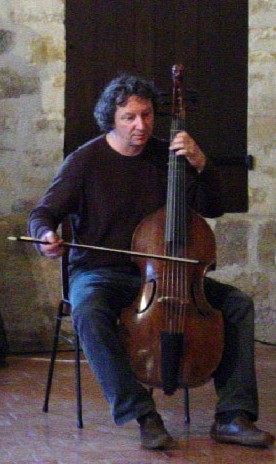
 Philippe Pierlot and Gamba T  he excellence of a teacher is revealed by his/her manner with students—and the ‘light’ that he/she sheds. Philippe Pierlot yesterday conducted a viola da gamba masterclass at BEMF that was exceptionally illuminating—not just for the three students whose performance was critiqued but also for every one of the 100 or so audience members. Philippe’s discussion of Baroque rhythms and ‘inégal’ bowing technique (interpretive emphasis, using a different percentages of bow on two consecutive notes, e.g., on upbeat and downbeat) was magical. Bravo!

Y    our middle finger is the most important, for bow control.”
R    emember that these Marais pieces are dances. This one’s pulse should be in ‘1’, not counted in 3 beats per measure. This other one must be played so that its pulse is in ‘2’, not creeping along in ‘4’.”
Y    ou must think of the phrase structure of the passage you are playing. Think of this as a sentence. Be clear about your intentions—about what you wish to say, and, of course, about what Marais was saying—before you begin.”
P    lay with your bow straight. You must bend your elbow with a fluid motion. Your bowing should be perpendicular, not to your own body, but instead perpendicular to the lady whose [carved] head is at the top of the viol’s pegbox. It is her you are playing for.”
T    hink ‘vocally’. There is no need to ‘mark’ the downbeats—they are obvious enough from the melody line. The phrase structure is enough. Understatement is what you are looking for.”
I    n Marais your releases should be gentle. Respect the ‘end’ of each note.”
K    eep the fingers of your left hand curved. Fingers that are too flat on the fingerboard will give a tone that is confused.”
M    aintain equal bow pressure on both strings in your double-stops. There are of course a few situations where equal sounding of both strings is not wanted, but this is not one of those situations.”
M    any phrase-endings in Marais and others of that period have a retiring, dwindling at the end. Not a diminuendo exactly, more like the end of a thought.”
A    nticipations (before downbeat) have great importance in Marais’s music, and they should get extra emphasis—often more than the subsequent beat. Do not discount the upbeat, the appoggiaturas. This thing is full—full of appogiaturas. They are not so much ‘ornaments’ as the essence of the piece.”
L    ay your bow on the string and push ‘up’; do not push ‘down’ or ‘into’ the string. You must send your tone up! Up to her whose head is at the top of the pegbox. Every note should be lifted ‘up’.”
Y    our bowhold wastes 5 cm. You must hold your bow back close to the frog, close to the nut. If you do not hold it there, you will have a thready tone, the balance of weight will be all wrong and you will have to press your bowhair into the string. Look! Hold it this way, back by the nut, and gravity will do everything for you. Just touch! [the bow to the string] Just let the bow fall onto the string, like so!”
P    lay closer to the bridge—about 4 cm to 6 cm from the bridge. It is a stronger, brighter sound there. And because it is louder, you will not need so much bowspeed to pronounce the notes. Less bowspeed means less arm and bow motion, and you will have plenty of bow left for some of these phrases. You will not have to retake the bow so often.”
M    arais’s notation is actually amazing—remarkably precise for Baroque—his written-out ornaments and annotated articulations, that is. He is telling us quite exactly what he wants here. In Baroque, we are normally happy just to have the notes—the music, most of the music was not much more than a ‘sketch’. But Marais gives us these over-dotting and under-dotting—all these things that are far more than just the notes.”
T    ry to keep your [lower numbered] fingers on the string [as you execute a run of notes on the same string, or a ‘jump’ on the same string]. Do not lift your fingers or ‘leap’ across distances on the string. It’s not just the aesthetics of how it looks… it is also the tone, and your preparation for the notes that are to come.”
T    he longer notes must ‘breathe’. Your bowing must give them a gentle ‘inhalation’. When you breathe in, the flow of air into your lungs begins slowly, then speeds up in the middle, and then slows down as your lungs get close to being full. Your bow must mimic this respiration.”
Y    ou have, I think, too much ‘investment’ in your attack of each note, and neglecting the arc of the overall [musical] sentence. You are too concerned that we will understand where each measure begins and ends. Think of reducing your commitment to the barline. Do not be so invested in the first beat of each measure. We need to know what the sentence is, not what the measure is.”
D    o not accent the second beat of ‘3-2’ hemiolas.”
I    f diction of a fast phrase becomes ‘confused’, bow closer to the bridge, so less bow motion is needed to pronounce each note. You can be closer than that… [about 3 cm].”
T    oo much wrist-extension is a bad temptation. It means your wrist is all the way back—extended so that it cannot be flexible or extend anymore. You want your wrist in a neutral position, so that it can be fluid. Your bow should just float there. If your wrist is in the middle of its range of motion, neutral like that, then you will not have to use so much ‘arm’ as you are doing. Your tone can then be much more expressive.”
M    ore ‘uplift’ in your bowing, please. You should bow as though you were a lute, plucking each note! The clear, ringing tone at the end of each note should be uplifted like a lute string sounds.”
P  hilippe Pierlot has taught at the Conservatoire Maastricht ands Hochschule fûr Musik Trossingen and currently teaches viola da gamba in
the Hague (Koninklijk Conservatorium) and Brussels. It is sheer fun to see him teach. His manner is intense and thoroughgoing but generous. His smile and excitement are infectious. Each little illustration of what he wants—each 2 or three bar demonstration he performs for a masterclass student—is a mini-concert in its own right, a candid snapshot of his real self. Magic.


Wednesday, February 27, 2008

En garde! : Viola da Gamba Bow Biomechanics

 Australian Viola da Gamba Society Clinic
W   ould you agree that the difference is a near-horizontal rear forearm, subsequently maintaining the connection with the shoulders? I think a more vertical forearm is a result of keeping tension in the rear-most scapula. I believe that these players are actually loading their scap’ in such a way that their elbow moves into a more ‘slotting’ position. The reason they maintain connection is because they maintain the ‘scap load’ and let the rotation take their hands/bat to the ball. In some of these drills, the vertical forearm is a checkpoint or even a ‘cue’ to get the young player to maintain some scap’ tension, which prevents disconnection and excessive external rotation of the shoulder/upper arm.”
  —  Anonymous sports medicine physician, discussing biomechanics of baseball arm motions.
Viola da gamba bowing biomechanics is quite a bit different from bowing members of the violin family. For one thing, the under-handed way of holding the bow means that the wrist and forearm have fewer (remaining) degrees of freedom and less range of motion, compared to over-handed violin bowing. And the dorsal flexion of the arm—and supination/rotation of the forearm—to hold the viola da gamba bow put more emphasis on the strength and agility of the supraspinatus. With that in mind, CMT readers who’ve asked about viola da gamba bowing and strengthening exercises may find some of the sports medicine and rehab links below useful. Especially ones that are involved in épée fencing.

 Fencing épée ‘guard’ position, Viggiani
Why? With an underhanded bow hold, much of the work is done with the forearm opening from the elbow, with little shoulder and upper arm. The elbow contributes far more with an underhanded grip than it does overhanded.

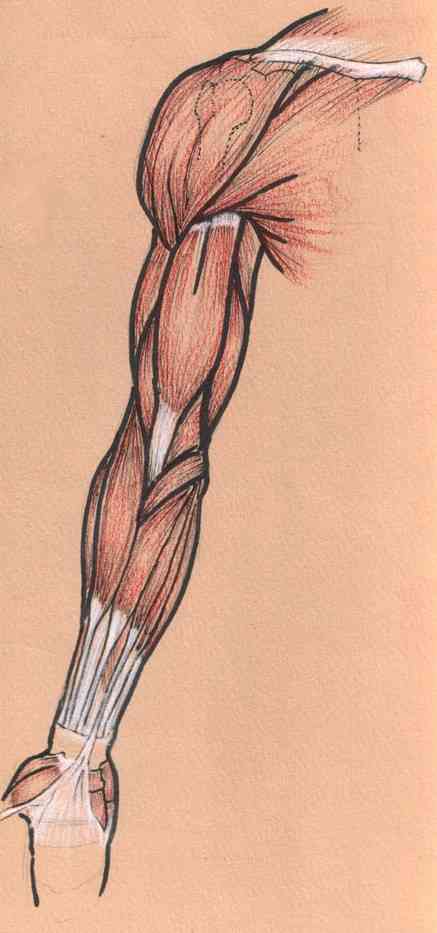
You may find that a good bit of the sports medicine literature on ‘rotator cuff’ is germane to viola da gamba bowing performance as well. (The rotator cuff is made up of four muscles: subscapularis, supraspinatus, infraspinatus and the teres minor. The rotator cuff muscles work as dynamic stabilizers of the shoulder girdle. In all, there are 30 muscles providing movement and support for the shoulder: 15 muscles move and stabilize the scapula; 9 muscles provide for glenohumeral joint motion; and 6 support the scapula on the thorax. Supraspinatus and other muscles of the ‘rotator cuff’ are just a few elements of the intricate shoulder anatomy.)

I’d say that the ‘stretch reflex’ probably does matter in viola da gamba bowing. But its importance in the ‘ballistic’ context of rapid bowing passages is probably small—see J Appl Biomechanics 1997, volume 13, fascicle 4, for example. But, for typical gamba passages with backbow-forwardbow abduction-adduction of the scapular complex happening at moderate velocities: that’s where proprioception—the stretch reflex—would be most important in control of muscles moving the bow. Rotator muscles surrounding the glenohumeral joint—the muscles involved in external rotation of the arm/elbow—probably not too important in rapid bowing. Instead, it’s the scapula that’s dominant in terms of mechanical linkage of the bow to the body. And the degree of elbow flexion—how close to horizontal the right forearm is—affects how much the ‘stretch reflex’ around the elbow can then contribute to the biomechanics of the bowing muscles’ performance.

 Dorsal flexion of arm
Gonzalez and coworkers have shown how activity of muscles that cross the ‘elbow joint complex’ (EJC) is affected by forearm position and forearm movement during elbow flexion/extension. They developed a three-dimensional musculotendinoskeletal computer model of multiple-degree-of-freedom (df) rapid (ballistic) elbow movements to study this. The model demonstrated how changes in forearm position mostly affected the flexor muscles, far more than the extensor muscles. The model also indicated that, for specific 1-df and 2-df movements, activating a muscle that is antagonistic or noncontributory to the movement can significantly reduce the movement time. The up-shot is that good muscle tone from moderate strength training likely improves viola da gamba bowing speed and accuracy.

 Jordi Savall
I  f you begin with a backbow (‘roverso’), then you must be prepared also to keep the same consistent alternation of back and forward bows. Practice both ways, so that you are not caught unawares and are unable to straighten out the bowing in a fast passage. A fast run that begins off the beat must start with ‘roverso’ while a similar passage beginning on the beat would start with ‘dritto’. If you have a sequence of ‘groppetti’ [English seventeenth century theorists would call them ‘relishes’ or ‘double relishes’ –Ian Gammie] then begin the first on a forward bow, take the next on a back bow etc.”
  —  Sylvestro Ganassi, Regola Rubertina, 1542, Book I, Chapter 6 (quoted in Gammie I, Chelys 1978; 8:23-30).
T   he bow is to be held with thumb, middle and fore-finger. The thumb and middle finger hold the bow so that it does not fall, the index finger applies greater or lesser pressure on the strings as is required. [This would preclude having a finger on the hair of the bow, as was common practice in the seventeenth century, and the articulation and volume is to be controlled through the stick instead. There has been some confusion in modern times over what Ganassi meant precisely with his description of the fingers. I consider it unlikely that he meant a player to have the index finger on the hair while the thumb and middle finger hold the stick—an unusual physical contortion at the very least. Ganassi intends that the index finger should apply pressure to the strings of the viol, not to the strings or hairs of the bow. –Ian Gammie] The bow should be placed about four finger widths from the bridge—depending of course on the size of the instrument, the arm relaxed, the hand firm but not tense, so as to draw a clear and pure sound from the viol. Playing closer to the bridge will give a rougher tone, playing nearer to the finger-board will give a softer, sweeter tone.”
  —  Sylvestro Ganassi, Regola Rubertina, 1542, Book I, Chapter 6 (quoted in Gammie I, Chelys 1978; 8:23-30).
 Jordi Savall
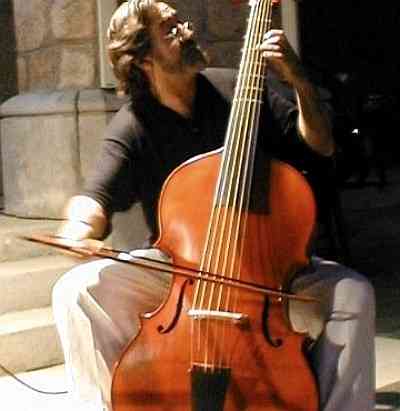
What else? Besides external rotation and dorsal flexion of the right arm, viola da gamba playing involves a lot of inferior abduction for backbowing and inferior adduction for the forwardbow. The deltoid is an ‘obvious’ abductor of the arm, but the deltoid is not an effective abductor unless the supraspinatus muscle helps. The deltoid alone tends to press the head of the humerus up under the acromion process; but the supraspinatus has also to do considerable work in viola da gamba bowing, at least in the more energetic passages. In terms of exercises, you will want to devise a ‘balanced’ program, to strengthen all of the relevant shoulder muscles. Some of the links below are good resources to help you discover an exercise program that’s right for you, to strengthen and tone these muscles.

Most gamba players think it best to use the terms forwardbow or backbow for viola da gamba bowing, and these terms honor the predominant biomechanics of the arm in proper gamba bowing technique. Understandably, some players or teachers who play viols as well as violins may say upbow and downbow, out of habit. But those terms tend to evoke kinesthetic mental images that may distort the idea of what a proper gamba bowing technic would be.

 Ruby electric viola da gamba
There are aspects of melodic and rhythmic elements of the Baroque viola da gamba repertoire—the long, arching polyphonic lines of the ricercar; of punctuated Italian canzoni; of the dramatic madrigal style—that challenge the player’s shoulder differently than, say, classical violin repertoire. The viola da gamba requires a fluid control of the melodic and rhythmic elements. Rapid excursions to distant registers require a smooth technic that belies the intricacy of the writing. In other words, the biomechanics of virtuosic viola da gamba performance is substantially different from the biomechanics of virtuosic violin performance—not just because of the differences in elevation of the right arm, but also because of the kinematic implications of the gamba repertoire.

 Deltoid muscle  Supraspinatus muscle
In summary, unlike the violin family, the upbow is the stronger motion for viola da gamba, not the downbow. The supraspinatus is often a main source of trouble, just as it may be for baseball players, but the complexity of the shoulder anatomy makes it impossible to say, without physically examining you, whether that is the issue or the only issue in your case. The best thing is to schedule yourself a consultation with an orthopedist, a sports medicine physician, or a physical medicine physician. Or maybe a fencing instructor?

 Fencing underhanded grip

P  etites Règles qu’il faut observer dans les commencements.
  • Ne lever jamais aucun doigt sans nécessité.
  • Les Pieds sur le Plat.
  • Le Pouce suis ainsi le doigt du milieu.
  • Montrer le Poignet.
  • Ne creuser point la main.
  • Ne point faire le dos d'âne.
  • Fermer le poignet en poussant, et ne présenter le dedans.
  • Ouvrir le poignet en tirant.
  • Commencer le Poussé par le bout de l’Archet.
  • Commencer le Tiré tout proche le poignet.
  • Soutenir la Pointe de l’Archet
  • Tirer et pousser à Angles droits.
  • Ne point tendre le coude.
  • Ne point faire de Grimace.
  • Ne point souffler.


[Little Rules for Beginners
  • Never move any finger unnecessarily.
  • Keep the feet on the floor.
  • The thumb is the key.
  • Show the wrist.
  • Don’t ‘dig’ the hand.
  • Don’t do the ‘donkey-back’ (sway-back posture; lordotic spine curvature).
  • Close the wrist while pushing, and don’t present the inside.
  • Open the wrist drawing from it.
  • Begin the stroke by the tip of the bow.
  • When you begin the pull, close the wrist.
  • Support the point of the bow and pull and push at right angles.
  • Don’t extend or stretch the elbow.
  • Don’t grimace.
  • Don’t blow.]”


Friday, February 22, 2008

‘Under the Hood’ of Pyramid-of-Sound: King’s Singers, Music-Minus-One

Violas da Gamba, minus bass
The King’s Singers treated the audience to a phenomenal a capella program tonight, in Kansas City’s Folly Theater. Bass Stephen Connolly’s mother died several days ago after a protracted battle with cancer, and Stephen was therefore not able to be part of this performance in the Harriman-Jewell series. As a result, Friday’s program was comprised of works specifically arranged for three, four, and five voices.

Given the intricacies of the 6-voice ensemble processes—of tuning, of balancing, of unity of sound and precision—for the works that have been arranged or commissioned specifically for The King’s Singers, it’s not surprising that last-minute substitution on a part is nearly impossible. But Stephen’s absence provided us a novel, fascinating, and thoroughly enjoyable glimpse ‘under the hood’ to better learn how some of these arrangements work—a glimpse into the orchestration of the upper parts, minus the bass.

  • The English Madrigal [Now Is the Month of Maying (Morley); Four Arms, Two Necks (Weelkes); Fair Phyllis I Saw Sitting (Farmer); Weep, O Mine Eyes (Bennet); All Creatures Now are Merry Minded (Bennet)]
  • Old Meets New in France [Revoicy venir du printemps (Le Jeune); Ah, Mon Beau Laboureur (Poulenc); Il est Bel et Bon (Passereau); Bonjour, Mon Coeur (di Lasso); Pilons l’orge (Poulenc); Au Joly Jeu (Janequin)]
  • Music of the Conquistadors [La Tricotea (Alonso); Din dirin din (Anonymous); La Bomba (Flecha)]
  • An English Romance [My Spirit Sang all Day (Finzi); I Have Loved Flowers (Finzi); Quick! We Have But a Second (Stanford); The Long Day Closes (Sullivan); Phyllis Is My Only Joy (Hobbs); The Goslings (Bridge)]
  • Arrangements in Close Harmony
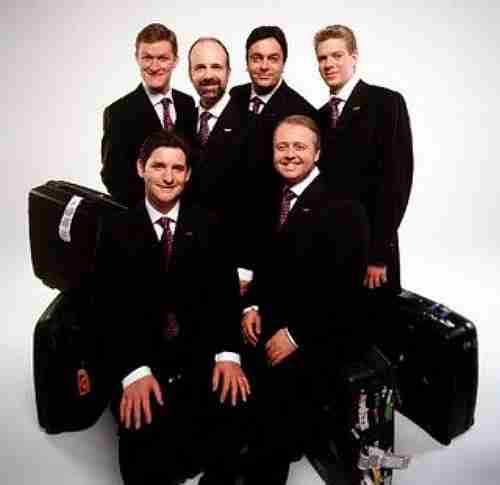
The King’s Singers is an a cappella choral ensemble, formed in 1968. The group’s name denotes King’s College in Cambridge, England. The ensemble has always been six singers, with personnel changes over the years. The current group is:

  • David Hurley (countertenor, 1990)
  • Robin Tyson (countertenor, 2001)
  • Paul Phoenix (tenor, 1997)
  • Philip Lawson (baritone, 1993)
  • Christopher Gabbitas (baritone, 2004)
  • Stephen Connolly (bass, 1987)
 King’s Singers
Most of The King’s Singers a capella concerts are divided into five groups of pieces. The first four are generally taken from the art-music repertoire (madrigals, folk songs, and recently-commissioned pieces), but the fifth group of the concert is usually a ‘close harmony’ set. Often it consists of music of The Beatles, Billy Joel, Paul Simon, Queen, George Gershwin, or Irving Berlin. Many of the pop pieces have been arranged for the group by composers like Richard Rodney Bennett, Jeremy Lubbock, and John Rutter. The King’s Singers also have initiated thematic ‘Concept Programs’, including ‘Landscape & Time’, ‘Sacred Bridges’, ‘Triumphs of Oriana’, ‘Treason & Dischord’, ‘The Voice of Weeping’, and ‘Los Impossibles’. The advantages of these programs for local presenters are considerable, in terms of marketing and diversity. The King’s Singers have commissioned pieces from Ned Rorem, György Ligeti, Libby Larsen, Daron Hagen, Francis Pott, Peter Maxwell Davies, John Tavener, John McCabe, Sally Beamish, Jackson Hill, Geoffrey Poole, Joby Talbot, Eric Whitacre and Jocelyn Pook. Several of The King’s Singers members have also arranged pieces. Philip Lawson and Bob Chilcott have been the most prolific composers in the group.

Recently, the group made an experimental recording of Thomas Tallis’ 40-part masterpiece, ‘Spem in Alium,’ with studio multi-track techniques to turn their 6 voices into 40, released on a Signum CD and Iambic Productions DVD. The group has a collection of Salvation Army songs, a CD that was released in December 2006—‘The Quiet Heart: Choral Essays, Vol. 1’. Planned releases for 2008 include a CD of Spanish Renaissance Music and a new studio CD.

In live performance the King’s Singers members have an uncanny sense of precise intonation and unity. They have also an uncanny intuition of the fullness of the sound they project, even if the performance venue is an unfamiliar one and even though in this performance they were ‘down’ one member. Considering that the group usually sings strictly a cappella with orchestrations characterized by a strong bass/baritone blend as a foundation for the other voices (orchestration that’s termed ‘Pyramid of Sound’), the absence of Connolly obviously yields a dramatically different sound. The bass part is not only a crucial harmonic foundation; it’s also a rhythmic ‘core’—an anchor that calibrates the timing of other members of the ensemble.

But with only five voices tonight, we had a unique opportunity to understand the ‘pseudo-orchestral’ writing, the contrapuntal textures, the delicacy. Had there been the full complement of six voices, I would have approached this concert experience armed with expectations grounded in my memories of the ensemble’s recordings and previous performances. Instead, I found myself listening far more open-mindedly and prejudice-free than I would otherwise have done.

King’s Singers
Well, maybe ‘pseudo-orchestral’ is the wrong term. More like idiomatic string sextet (quintet) writing, as regards the counter-melodies in the bass/baritone parts. We get an idea of ‘vastness’ through the use of compound intervals in the tenor and bari voices. The melody is often in the lower lines, and the varieties of male voice color are highlighted in the texts. The melodic contour far exceeds the initial statements by the tenor. In fact, many of the contrapuntal baroque pieces remind me of Marin Marais or other writing for viola da gamba ensembles. The gamba-like textures of these orchestrations might never have occurred to me had not Stephen been absent tonight… What a wonderful chance revelation!

These lower parts are vital for the accentual fidelity of the upper parts—regardless whether it’s six voices, or five, or four. The bass/baritone melodies become patterns that are used either as a basso ostinato or with changes, usually within a four-measure scheme. The most noticeable rhythmic feature is a dotted second-beat anacrusis—a sarabande rhythm. The texture begins simply with a tenor or lead or counter-tenor solo, and the thickest textures involve repeated passages in counter-tenor divisi. Cool!

The King’s Singers’ arrangements elegantly fit the tessitura and idiom of each voice while remaining faithful to the music itself. The word-settings are un-finicky, and the rhythms and phrase separations are, while technically challenging, very natural as-received by the audience.

The portamento effects are wonderful, especially in the ‘close harmony’ part of the program. The ambiguity of the pressure of inflected and non-inflected notes in the vertical voicings is distinctive. But these are not ‘go for the jugular’ self-referential portamentos as often happens in competition barbershop quartet singing, for example.

Assuming a unity of timbre—one tonal ‘plane’—when several intervals are combined into a chord, we get multiple intervallic relations, of which some are more important than others. The farther apart the notes of a given interval are in a chord, and the more other notes between them, the less the character of that interval imposes itself. The ‘crunch’ of M7 becomes less important if the interval becomes further separated—a M15.

In other passages we get two or three tonal ‘planes’—countertenor or tenor and everybody else—with varying degrees of ‘blend’.

What is striking in this is that, scholars though they may be, The King’s Singers’ music is music to be immediately loved, not coolly respected. The alteration of their program was done on very short notice, and this fact is correlated with the vitality and intensity of emotional expression—compared, say, to programs labored over for months or years, with progressively less edge and spontaneity. The ‘inner game’ of music is best played fast. Their technique is so light and inertia-free, we leave the concert hall with the sense that the ensemble surely must have somehow miraculously violated the Second Law of Thermodynamics. Bravo!

Totally off-topic, I notice some recent research articles showing that singing increases secretory immunoglobulin A levels (IgA) and reduces the incidence of infections, especially in wintertime (see links below). Singing also reduces the prevalence of depression, compared to instrumental musicians and compared to the general nonmusician public. The inflammatory cytokine TNF-alpha increases in professional singers during/after singing (see the paper by Grape and coworkers in Stockholm). [This is a paradoxical finding insofar as TNF-alpha is a correlate of stress, and, other things being equal, one would expect TNF-alpha in professional singers to decrease and perhaps to decrease by a greater proportion from baseline than would happen in amateur singers. There must be other neuroendocrine-cytokine cascades or feedback loops that the Swedish team didn’t measure, that would explain their counter-intuitive result.] Sing your way to a healthy immune system! You always knew singing was good for you!

T  his is the source of the feeling of solidarity and good will that comes with choral singing: people’s physiological arousals are in synchrony, at least for a brief period. In contemporary life, there are few other circumstances in which such synchrony is achieved.”
  —  Bruce Richman, 1987.
Bats in the Folly Theatre
        Hyper-Tenors Sing Out!

[ Unbeknownst to the Harriman-Jewell presenters or the Folly Theatre management, several dozen small brown bats have recently taken up residence in the upper reaches of the Folly Theatre stage fly-loft, high in the rigging. The pipistrelli became very active during The King’s Singers’ rousing performance of ‘All Creatures Now Are Merry-minded’ by John Bennet (1570-1615) early in the first half of the program. They careened through the beams of the stage lights illuminating the ensemble below and swooped joyously above the audience seated on the main-floor of the Folly.

Neither we nor the bats heretofore had any idea that The King’s Singers are such ardent environmentalists and opponents of species-ist bigotry. But with the assurance from the symbolically apropos Bennet ‘Creatures’ anthem to embolden them, the not-so-tiny Creatures continued their airborne partying throughout the Theatre for the balance of the program.

Although the Myotis lucifugi did not dive at the Singers, seldom do performers face such monumental visual and acoustic distractions as prevailed on Friday night at the Folly (except perhaps the choir at midnight Christmas Mass at Chartres Cathedral). Any complaints about the ensemble members’ intonation might be fairly chalked up to interference from the bats’ high-pitched echo-location chirps. No joke. ]


Storr book, Music & Mind