Showing posts with label orchestration. Show all posts

Saturday, May 16, 2009

Michael Giacchino: Veridical and Schematic Expectations, Fight!

 Star Trek
S    ome of the most compelling film music of the past year (2004-5) appeared not on the big screen but on the small one. Michael Giacchino’s score for the TV show ‘Lost’—the tale of several dozen plane-crash survivors marooned on a vaguely supernatural, ‘Tempest’-like island—has unsettled millions of American viewers with an eerie array of orchestral sounds: fluttery four-note figures, shivery tones produced by bowing strings near the bridge, nasty glissandos on the trombone, and, at moments of maximum tension, a low plucked note on the harp. According to convention, harps are called upon to herald angels or other vessels of goodness. Giacchino makes the instrument gaunt and deathly, much as Mahler did in the last song of ‘Das Lied von der Erde.’ In general, Giacchino has done such a bang-up job of generating menace that the scriptwriters may have a hard time satisfying the expectations that he has created. Something mighty grim will have to crawl out of that lush jungle in order to justify those twangs of terror... Music can take control of the image; it can also suggest a world separate from the image, or expose the image as a lie... Giacchino’s music for “Lost,” in its own non-Marxist way, plays this same game of estrangement. Dispatching the ghosts of Schoenberg, Xenakis, and other twentieth-century sonic terrorists into an island paradise, it touches on the universal modern suspicion that surfaces are not what they seem, that the center does not hold, that it ain’t necessarily so. When the images themselves are terrifying, music can bring about an even trickier reversal, providing ironic reassurance or genuine compassion.”
  — Alex Ross, New Yorker, 27-JUN-2005.
T    he character of motion-picture music has been determined by everyday practice. It has been an adaptation to the immediate needs of the film industry, in part to whatever musical clichés and ideas about music happened to be current. As a result, a number of empirical standards, rules of thumb, were evolved that corresponded to what motion-picture people called ‘common sense’... a kind of pseudo-tradition harking back to the intellectual milieu of Tin Pan Alley, of medicine shows and covered wagons. These rules have now been made obsolete by the technical development of cinema, as well as of autonomous [ambient] music.”
  —  Theodor Adorno & Hanns Eisler, Composing for the Films.
E  arlier this week I went to see Star Trek. The Michael Giacchino sound-track was, for me, superb—a powerful, seamless accompaniment to the action on the screen; more than an ‘amenity’.

Y  es, the scenes are held together by ‘leitmotifs’—the role that film music serves in virtually all commercial, mass-market films is one of ad hoc leitmotivic ‘glue’. The sonic clues/cues for the viewer/listener are meant to be ‘easy’, lubricious. Only in exotic art-film will you find soundtrack compositions that majorly subvert or compete with the ideas and emotions unfolding on the screen.

A  nd yet. And yet there are a number of places in this new Giacchino score where the edginess presages what is about to develop, subverting the prevailing expectations of that moment. The constantly changing scenes and sheer overload of action in Star Trek make it a little difficult to notice this. But it was the feature that most captured my imagination as we were leaving the theater and driving home. I thought I’d share a little about how I think it works here, plus a few links at the bottom that you might find useful if your own curiosity leads you to want to explore how it works.


    [30-sec clip, Michael Giacchino, ‘Star Trek, That New Car Smell’, 0.9MB MP3]

M  ost of the score is bombastic, galactic, symphonic stuff. But there are segments that engage in cross-genre ‘chamber music’ idioms. Conducted orchestra and/or software-based virtual instruments, but still ‘chamber music’. And these cross-genre moments tend to be places where subversion of our expectations happens.

  • Star Trek
  • Nailin’ the Kelvin [leitmotif & reprise]
  • Labor of Love
  • Hella Bar-Talk
  • Enterprising Young [Men]
  • Nero Sighted
  • Nice to Mind-Meld You
  • Run and Shoot Offense
  • Does It Still ‘McFly’?
  • Nero Death Experience
  • Nero Fiddles, Narada Burns
  • Back from Black
  • That New-Car Smell (clip above)
  • To Boldly Go
  • End Credits
B  eautifully done! The decision not to couple the new film’s soundtrack more closely with the original series’s music (Alexander Courage, Jerry Goldsmith, James Horner, Leonard Rosenman, Cliff Eidelman) is getting some complaints from a few reviewers. But, by contrast, the new materials Giacchino lays down should be good for the renewed Star Trek franchise. The ‘identity’ of this soundtrack is recognizable and durable. A friend with whom we saw the film on Tuesday had already seen the film the day it opened, and commented on liking the music. But then she is also a fan of ‘Lost’ and other Giacchino projects.

 Michael Giacchino
S  o there are cross-genre features in some of Giacchino’s Star Trek pieces. Not to say that other video game and film composers don’t do this; they do. But the chamber-symphonic cross-genre elements in this soundtrack are, to me, more pre-meditated and ‘go for the jugular’ than normal.

C  ross-genre techniques exploit... a schism... between two kinds of expectations—what Hallam and others call ‘schematic’ and ‘veridical’ expectations. A genre-compliant piece of music contains few or no surprises. But cross-genre pieces violate our expectations, and, to the degree that intact expectations matter emotionally or aesthetically to us, such pieces usually generate interest with each listening or each performance.

W  e are fascinated by how they “push our buttons”, even though we often can’t quite put our “finger” on why or how they do that. Fascinated... in the way that continued to preoccupy me during our drive home from the theater. Is this a synthetic, heavily-signal-processed virtual instrument, or was it processed digitized human voice—or was it a meld of the two, part-doubling and dubbed, beginning predominantly with one and dissolving into predominantly the other? Is this a chamber passage whose floor will drop out from under us, into a symphonic chasm?

H  ow does this cognitive/emotional exploit work? ‘Schematic expectations’ are automatic—culturally received and ‘generic’; things in which we have maybe considerable investment, but maybe not. Schematic expectations are built-up passively over many years. We are often quite ready to reconsider our attachment to them; we may even resent that we have them, insofar as they do not feel like they are really our own.

B  y contrast, ‘veridical expectations’ are expectations about near-term future events in the story-arc or narrative we are listening to. They are truth-statements or beliefs that we have formed by our own direct experience; they are fully “ours”. We are reluctant to abandon them because much of our own effort has been put into processing the events, musical evidence, and story-arc that have led to the beliefs and expectations that we hold at this moment. We want not to let go of them because our making sense of the situation might have to start totally from scratch if we did.

S  o if veridical and schematic expectations that we have as we listen to or play a piece of music diverge—or if they diverge for awhile and then re-converge again—then we experience powerful drama and emotional tension.

H  uron says a bit about this, as does Bharucha. Have a look at the links below if you’re interested in this.

 Michael Giacchino, photo (c) Cohen
M  ichael Giacchino, born in 1967 in New Jersey; captivated as a kid by John Williams’s classic Star Wars scores; studied composition at Juilliard; worked for Disney and then Dreamworks; enlisted by Steven Spielberg to score music for the Playstation game ‘The Lost World’, followed by ‘Medal of Honor’ and its many sequels. Video games (VG) ‘Call of Duty’ and ‘Secret Weapons over Normandy’ for which he wrote game scores were massively popular. Giacchino also scored Spielberg’s network movie, ‘Semper Fi’, the series ‘Alias’ and the movie ‘Sin’. ‘The Incredibles’ (Pixar) was a big breakthrough, or, arguably, the television series, ‘Lost’. For your interest and ambient amazement, I’ve tabulated other of Giacchino’s hypernumerous accomplishments at the bottom of this post. Live long and prosper!

 Adorno & Eisler, Composing for Films book

  • Land of the Lost (2009)
  • Partly Cloudy (2009)
  • Up (2009)
  • Fringe (19 episodes, 2008-2009)
  • Lost (92 episodes, 2004-2009)
  • Earth Days (2009)
  • Glock (2009)
  • Fracture (2008) (VG)
  • Speed Racer (2008)
  • Turning Point: Fall of Liberty (2008) (VG)
  • Medal of Honor: Airborne (2007/I) (VG)
  • Ratatouille (2007)
  • Six Degrees (13 episodes, 2006-2007)
  • Lifted (2006)
  • Alias (105 episodes, 2001-2006)
  • What About Brian (4 episodes, 2006)
  • Mission: Impossible III (2006)
  • Black (2006) (VG)
  • Lost: Revelation (2006) (TV)
  • Looking for Comedy in the Muslim World (2005)
  • The Family Stone (2005)
  • The Karateguard (2005)
  • Destination Lost (2005) (TV)
  • One Man Band (2005)
  • Sky High (2005)
  • The Muppets’ Wizard of Oz (2005) (TV)
  • Vowellet: An Essay by Sarah Vowell (2005) (V)
  • The Incredibles (2004) (VG)
  • Call of Duty: Finest Hour (2004) (VG)
  • The Incredibles (2004)
  • Call of Duty: United Offensive (2004) (VG)
  • Alias (2004) (VG)
  • Secret Weapons Over Normandy (2003) (VG)
  • Phenomenon II (2003) (TV)
  • Call of Duty (2003) (VG)
  • String of the Kite (2003)
  • Medal of Honor: Frontline (2002) (VG)
  • Redemption of the Ghost (2002)
  • Medal of Honor: Allied Assault (2002) (VG)
  • Semper Fi (2001) (TV)
  • The Trouble with Lou (2001)
  • Muppet Monster Adventure (2000) (VG)
  • Los Gringos (1999)
  • Warpath: Jurassic Park (1999) (VG)
  • My Brother the Pig (1999)
  • No Salida (1998)
  • Legal Deceit (1997)
  • The Lost World: Jurassic Park (1997) (VG)
  • Donald Duck: Maui Mallard (1995) (VG)
  • Gargoyles (1995) (VG)
  • 2008 Grammy Award for Best Score Soundtrack Album for a Motion Picture, Television or Other Visual Media (Ratatouille)
  • 2007 Film & TV Music Award for Best Score for a Short Film (Lifted)
  • 2007 StreamingSoundtracks.com Award for Composer of the Year
  • 2005 Emmy Award for Music Composition for a Series (Dramatic Underscore – Lost)
  • 2004 IFMCA Award for Score of the Year (The Incredibles)
  • 2004 IFMCA Award for Composer of the Year
  • 2004 Game Developers Choice Awards for Excellence in Audio (Call of Duty)
  • 2003 Game Developers Choice Awards for Excellence in Audio (Medal of Honor: Allied Assault)
  • 2003 Interactive Achievement Awards for Original Music Composition (Medal of Honor: Frontline)
  • 2001 Interactive Achievement Awards for Original Music Composition (Medal of Honor: Underground)


Wednesday, April 22, 2009

Orchestrating Virtuosic Saw

 Saw ad, Popular Science magazine, March, 1948
T  he visit I had to Ripon, Wisconsin, over the weekend was notable for many things—among them an excellent amateur duet, by a violin student accompanied by her father on a musical saw. Recently, composer Ken Ueno has been interested in experimenting with bowed metal bars and sheets. This fortuitous (?gratuitous) coincidence led me to get the Stanley cross-cut saw out of my basement and explore what can be done.

A  ny CMT readers who are interested in composing for musical saw should be aware that, as with any instrument, the dimensions of the material determine the pitch range that’s achievable. Almost any saw can produce musically usable sounds, but saws of 26 inches (66 cm) or longer are best. Such a length insures that the ‘sweet spot’—the lengthwise portion of the blade where a bow contacting the flat edge (not the side with the teeth) can set the blade into stable, resonant vibration—is relatively large... several centimeters long. Such a length also insures that flexing the blade in an ‘S’ shape to produce the desired pitches will not place excessive demands on the player’s left-hand strength.

 Mussehl & Westphal Musical Saw
T  he majority of commercial woodworking handsaws are tempered carbon steel with a thickness of about 0.040 inches (1 mm). Saws that are specifically made for musical purposes (see links below) may be considerably thinner than this. The thin material allows the S-shape flexion to be achieved with less muscular effort. The preparation of the saw shape and tension before commencing the bow attack can be done more easily, compared to an ordinary commercial woodworking handsaw. The resulting intonation, vibrato, and overall musicality are undoubtedly better—with less performance risk and stress for the performer. (My own views below are informed by only cursory experience with a Stanley woodworking saw, motivated by curiosity about such an exotic instrument. Please accept these comments with a ‘grain of salt’; your own mileage may vary...)


    [30-sec clip, Jim Parker, ‘Midsomer Murders Theme’, 0.9MB MP3]


    [50-sec clip, Natalia Paruz, Bach/Gounod, ‘Ave Maria’, 1.6MB MP3]

T  he majority of musical saws are capable of delivering pitches roughly in the range of a viola. Some 30-inch and larger saws are available and are labeled ‘bass’ or ‘baritone’, but most musical saws are evidently around 26 inches—‘tenor’ instruments. As such, it seems reasonable to score the saw using the alto clef—same as viola. The range in the illustration below represents safe limits for the Stanley hardware-store saw.

 Tenor saw range
I  f you decide to purchase a special ‘musical saw’, the backside edge will have been polished and prepared by the manufacturer in such a way as to be suitable to receive bow contact. I examined my Stanley crosscut saw with a magnifying glass and noted that there were some burrs along the backside edge—tiny, sharp projections that could easily damage or cut bowhairs. I removed these with a few strokes of emery cloth, followed by fine steelwool.

O  rdinary amounts of rosin on the bow seem to work just fine with the saw. My own brief experiments were with a pernambuco violin bow—too delicate, really, for the 0.040-inch Stanley blade. My suspicion is that a cello bow would offer the stiffness needed to properly articulate the notes on a saw.

H  olding the handle of the saw between the legs and jiggling the left leg to produce vibrato in the S-flexed saw is pretty easy. Flexing the blade with the left hand, however, is tricky and quite tiring unless you affix a handle through the hole near the tip of the blade—a technique referred to by saw players as a ‘cheat’. Acknowledging the deprecation of the ‘cheat’ by serious players and the visual aesthetic detractions of the ‘cheat’ for the audience, it seems to me that practical compositions for saw will limit the duration of saw passages to maybe one minute or less at a stretch. After a rest the saw player will have recovered the muscular control to proceed with a subsequent passage.

S  urely there may be some virtuosic saw players for whom extended multi-minute passages would present few problems, and for whom the arduous gauntlet-running at prodigious tessitura would afford a proof of their freakish virtuosity. But a composer who wants to score for saw because of its wonderful, peculiar, Theremin-ish timbre ought, I think, to assume that such saw virtuosi are scarce as hens’ teeth. The typical saw artist will be a normal string player who is partial to odd and exotic things, and that sort of person will not care to (a) risk over-stress or injury to their left hand and its musculature, by the weird movements required for saw flexion, or (b) engage in extended practice and rehearsal on the metallic interloper, forsaking their belovèd stringèd axe. In other words, you’ll want to write modest stuff that’s playable without too much trouble.

T  he technique of saw is similar to bowing a viola da gamba—underhanded—except for the fact that you are bowing more or less vertically. Like a viola, the saw’s size is somewhat at odds with its pitch range—too large to be comfortably played under the chin, yet smaller than would be ideal for playing between the legs. But, also like the viola, this size-pitch mismatch is probably the reason why we have such a highly distinctive, beautiful tone-color in the saw.

C  hromatic passages are pretty easy to perform. Intervals of a major or minor third or perfect fourth can be navigated with little trouble. Fifths and longer jumps seem (to me) to be exceedingly risky. Safe writing for saw would stick with melodic lines—careful attention to voice-leading and no endangerment of the gristle.

T  he top end of the saw has a quite distinct ‘nasal’ quality, which can be exploited for short, plaintive effects. The lower range has an apocalyptic, austere, dark sound. If you don’t like that, well, tough. (In fact, I feel that the weird, impending catastrophe demeanor of the saw down there is part of its psychological charm. It’s like a wise, dour octogenarian who perennially and insistently warns everyone in the room that there will inevitably be more serious trouble in the Middle East, no matter what the topic of conversation might be. This ‘wild card’ can have a wonderfully unsettling effect on the other party-goers. Just so with the musical saw...)

T  he vibrato technique is basically the same as on the violin, though you may wish to indicate on your score that the performer may vibrate somewhat slower and wider in the lower register. A cautionary notation might be useful, to instruct the performer about the effect that you are aiming for. A musical saw has—What? I am shocked!—a propensity to bring out the ‘ham’; a simple admonishment that ‘less is more’ and that you are looking for ‘subtlety that defies temptation’ should be sufficient.

P  ortamento and glissando can be readily executed on the saw—so okay to write those in your score. Obviously, trills or fingered tremolo effects are out of the question. There are no double-stops or triple-stops—at least not without severed digits or ripped trousers. Remember that the performer’s genitalia are facing the sharp teeth of the cross-cut. They (and their significant other) will long remember you if your writing is excessively ambitious.

D  o not write sixteenth notes or thirty-second notes for the poor, ‘flickted thing. Doing so will win you no friends.

A  rtificial harmonics? Well, my adventures in trying to produce them stopped when my dear spouse told me to “Cut it out!” I can only say that harmonics are in there, and that they will come out to play if you coax them. Touching the blade below the “S”, as the blade heads toward your lap can entice some spooky, scritchy, ethereal stuff out. Hard to control, though, so you may want to choose your practice environment more judiciously than I had done, so as not to tax your loved ones’ ears beyond their endurance...

E  levations of the bow—pretty much the same as the viola da gamba, except that the excursions are more vertical. Considerable bow-speed is necessary. Maybe a right-arm “break-away sleeve” for the concert performer would be a practical solution, albeit one that would promote general “hamminess”. For studio work, the player may prefer to wear a comfortable tee-shirt...

B  owed tremolo—quite effective on the saw. It has a sharp, biting effect in forte and a silken, decrepit effect in pianissimo, due to the tragic tone color of the instrument.

P  izzicati are more resonant on saw than on the violin—a feature that worked wonderfully for the daughter-father duet in the Wisconsin recital last weekend. As with harmonics, the higher pizzicati are usually best left to the violins. Unless, that is, you want the thematically desultory effect of plunked saw rubbing the violin noses in “it”—an entirely valid possibility (You choose!) but more histrionic than would suit most commissions. After all, you do not want your saw opus to end your career.

A  djectives in Italian applied to the saw must agree with it in gender (sola or sole, not solo or soli). Although it is the only instrument of the steel family in the feminine gender, it has probably the most masculine tone—Ueno’s bowed steel bar affixed to a timpani head notwithstanding.

O  ccasional short solo passages for the saw can be of telling effect for orchestral music, although recent works tend to focus on chamber ensembles. I am not sure whether this is due to the saw’s fall from grace since the 1950s—a time when there were many thousands of saw players throughout North America.

T  he solo repertory for saw is scanty—although transcriptions can be effected straightforwardly. Berlioz’s “Harold (‘The Saw’) in Italy”, for example. Or try William Walton or Walter Piston viola concerti.

L  ike the viola, the saw is easily obscured or ‘covered’ by other instruments. And saws easily cover and confuse other saws. With that in mind, you will want in general to write open harmonies. Your orchestration should assiduously avoid unisons or minor seconds in the saw section. Do not, I repeat, do not write ‘tutti’ for saw.

I  n the olden days there may have been up to eight saws in a symphony orchestra. They used to sit at the conductor’s right, upstage of the cellos, who would in this configuration be out of toothy-edged harm’s way should any slips occur amongst the saws. This was acoustically non-optimal insofar as the blades of the saws were in a particularly inefficient position for directing sound out to the audience. A large saw section is, I think it can now be agreed, extremely ill-advised. Probably it was a phenomenon of long-ago budgets and old union rules; maybe it was a consequence of the erratic sound projection next to the cellos; or maybe it was a marketing ploy by orchestras, leveraging the then-common amateur interest in playing saw as a parlour pastime. In any case, the chamber music idiom is far more reasonable for saw, and the saw is anyway properly a narrative/discursive force, not a ‘symphonic’ one. The era of the eight-saw orchestral section is thankfully now lost to living memory...

B  e aware: the striking tone-color of the instrument, while pleasantly novel at first, can soon become cloying. Therefore, a program usually should have only one work for saw, to avoid wearing out one’s ‘welcome’. You are not aiming at a ‘comeback’ for the infamous musical saw of yesteryear! You are only seeking a nice effect with some diverting novelty, which everyone will afterwards say was just fine, yes it was, and amply justified, all things considered.

Y  ou may occasionally be inclined to have saw doubling the violin(s). This will take away some of the violin’s brilliance and add weight—sometimes precisely what you want. Although unison doubling of cello by saw can be excellent, the continual doubling of the bass line an octave higher (because why? because you can’t think of anything better to do?) is a cardinal sin. The interest that can be given to inner parts can be given to the saw if you will only put your shoulder into the work. In fact, the saw player is temperamentally a lot like a good viola player and relishes exciting inner-part work as well as solos.

O  n occasion, the saw may be propelled into a range higher than it is used to—to the thrill and abject bystanderly rubber-necker excitement of all concerned. Get it down from there; talk it down carefully. Tell it how deeply loved it is, and how jumping is not the answer...

R  emember that the noble saw derives dignity from its sheer weirdness. People who choose to play the saw choose it because of its against-all-odds doggèdness and esoteric merits, and not because they are poor string players or too wicked or senile to play the violin.

T  he saw is, quite clearly, amenable to the mounting of microphones or pick-ups for sound-reinforcement—especially for ensemble work in bars or other alternative venues. (My exploring that possibility will have to wait for some future CMT post.) But, as with other chamber music, the nuanced beauty is best appreciated in live, unamplified acoustic performance. Good luck with your bowed-metal instrument project, Ken!

[Be sure and click on the 'Comments' hyperlink in the lower left-hand corner below (if comments frame is not already open), to see Natalia Paruz's remarks!]


Friday, March 6, 2009

Chugach Brass: Chamber Music for Sugpiaq (‘Real Persons’)

 Chugach Mountains, view from Anchorage, AK, in 1930/32, photo: Walter Hodge, Elmer E. Rasmuson Library, University of Alaska Fairbanks
T he Chugach Brass Ensemble delivered a wonderful performance at University of Alaska Anchorage on Thursday evening to an enthusiastic audience. About 120 people braved the cold, the thick snowfall, and the icy roads to attend.

 Chugach Brass: Sweeney, Weeda, Pierce, Epperson
  • Christopher Sweeney, trombone
  • Linn Weeda, trumpet
  • Cheryl Pierce, french horn
  • Dean Epperson, piano (guest)
T he program was widely-varied, including early music, Weeda’s arrangement of Bach’s Contrapunctus 16, a romantic piece by Debussy’s colleague Paul Dukas, and several new compositions.
  • A Philharmonic Fanfare (2003)….Eric Ewazen
  • Be My Love, A Suite of 16th Century French Chansons (2000)…. arr. Linn Weeda
         Tru, tru, tru avant il fault boire!....Jean Richafort
         Au joly boys je rencontray m’amye….Clemens (non Papa)
         Jouyssance vous donneray….Antonine Gardane
         Baises moy tant, tant….Adrian Willaert
  • Folksong (1972)….Bruce Broughton
  • Trio for Brass (1961)….Robert Sanders
  • Villanelle (1906)….Paul Dukas
  • Recreation for Trumpet, Horn, Trombone and Piano (1958)…. Pierre Gabaye
  • Contrapunctus XVI (inversus), Art of the Fugue, BWV 1080 (1745)….J.S. Bach (arr. Weeda)
  • Sonata for Trombone and Piano (1951)….George Frederick McKay
  • Fumeux fume (ca. 1380)……..Solage (arr. Weeda)
  • Trio for Brass (1996)….Anthony Plog
T he Ewazen ‘Fanfare’ is predominantly consonant triads interspersed with more dissonant harmonies (Copland-esque). The overall quality is assertive, gregarious, and extroverted—not frivolous, but intensely convivial. Very ‘brass-like’ in idiom.

W eeda’s beautiful 5-minute-long arrangement of French chansons illustrated the diversity of brass orchestration and textures. Also, a wide range in composerly ‘stance’—from the ribald ‘Tru, tru, trut’, to the tender ‘Au joly boys’ with Weeda’s mellow flugelhorn, to the exuberant horn-trombone duet ‘Jouyssance’, to the high-tessitura ‘Baises moy tant’ with Weeda’s brilliant piccolo trumpet. The brightness of the ensemble timbre is made even more dramatic by adding the piccolo trumpet on the top end. It lends a paradoxical impression of yet-wider harmonies—the as-written intervals do not have such wide spreads.

T he Broughton ‘Folksong’ was rendered with great empathy—lyrical and legato articulation without sentimental excess. Copland-esque. Sharp staccato trumpet stabs moderate the dark tones of the piano part. Weeda’s control of extended diminuendos was masterful and delicious.

O ne of the other salient musical features of this work include the frequent inclusions of slurred passages. Slurs throughout the work are used in two ways: 1) to move from one clear chord/pitch to another or 2) to move to indeterminate pitches as a gesture. In the simplest sense, slurs and legato playing provide a kinesthetic indication of fluidity within the work.

T he several Weeda arrangements showed off Weeda’s skill in orchestrating nuances that differ between the instruments. Low fifths thicken the sound.When the trumpet could otherwise be too strident, he softens the effect with the horn and trombone. Very nicely written and performed.

T hemes in much brass literature tend to maintain consistent relationships between pitches, often arranged in ascending or descending patterns. Both linear and vertical dimensions exist, of course, but can have different functions in brass works, compared to string ensemble lit. In the linear dimension, a theme is repeated, and the melodic contour varies according to the registral placements. Sometimes it is presented as an ostinato figure with a consistently repeated ascending contour and a recurring rhythmic pattern. This theme can also be combined with other elements to form a longer melodic line. Weeda handles these aspects with great skill.

T he other pieces were also new to me and interesting as a ‘casebook’ of recent writing for small chamber brass ensemble. Harmonies that are, in many places, ‘choral’ in texture.

I n the Sanders piece, the cadential formulae arise mostly from modern added-tone extensions beyond the tonic scale. Some modal intervals of fourths and fifths. By placing the “chorale material”, Sanders creates a sense of latent energy, even during the Adagio. Since we are expecting 8th note groupings in 4 (and the quarter-note pulse), the irregular feel of the rhythm in this movement gives a disruptive energy.

I n all, it was a wonderful evening—an intriguing sampling of recent chamber compositions for brass, and a fine introduction to Weeda’s abilities as an arranger. Wonderful, too, to experience such cultural diversity in the depths of winter in Anchorage.

T he ensemble takes its name from the Chugach (‘sugpiaq’) tribe that is indigenous to the Prince William sound area. Besides their roles teaching at University of Alaska Anchorage and playing with the Anchorage Symphony Orchestra, each of the performers is involved with local outreach and community music education efforts.

B esides his position as Principal Trumpet with ASO, Weeda is Music Director of the Anchorage Youth Symphony. His M.M. was from Boston University. Pierce received her M.M. from Temple University and performed French horn for 15 years in the U.S. Air Force prior to her current role in the horn section with ASO. Sweeney has M.M. and Ph.D. Mus. Ed. degrees from University of Miami and is currently Asst. Prof. of Music at UAA. Epperson was honored in 2005 as an MTNA Foundation Fellow, in recognition of distinguished service to music teaching. He has performed with Anchorage Chamber Symphony and Kenai Peninsula Orchestra.

T    he incisiveness [of the bright timbre] must be used advisedly. However, this property can be used to make a theme salient. The attack can have an equally pointed, even dissonant, effect. One sees the extent to which the problem of balance is complex and difficult...”
  —  Charles Koechlin, ‘The balance of sonorities’, in Mathews, ed., Orchestration, p.142.

T    he following five values operate through and with texts:
  • Will-to-Image: includes, at a minimum, images of past events and selves, as well as the inclination to move between several disparate worlds, what exists and what does not exist; what is real and what is not real... ;
  • Will-to-Improvise: includes not only how to invent in connection to the kairotic moment, but also how to confront failure and play within the dark spaces of the unknown, the unuttered, the ineffable;
  • Will-to-Intuit: the ability to disregard Reason, encouraging the role of emotions and feeling; the basis for inquiry and investigation; the curiosity-maker; the hunter; the willful accident;
  • Will-to-Juxtapose: the ability to contrast images and thoughts with one another, let them interact, cause them to conflict; the Bakhtininan 'centripetal force of language’; the power of metaphor;
  • Will-to-Integrate: includes synthesis, connection, parallelism, coherence; the beginning of transition to discourse; the Bakhtinian ‘centrifugal force of language’.”
  —  Joddy Murray, Non-Discursive Rhetoric, p. 140 [viz., the ‘assertiveness’ of brass players].
 ANLC map


Friday, February 22, 2008

‘Under the Hood’ of Pyramid-of-Sound: King’s Singers, Music-Minus-One

Violas da Gamba, minus bass
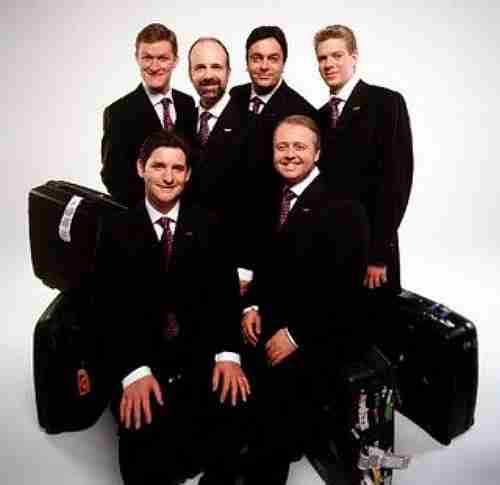
The King’s Singers treated the audience to a phenomenal a capella program tonight, in Kansas City’s Folly Theater. Bass Stephen Connolly’s mother died several days ago after a protracted battle with cancer, and Stephen was therefore not able to be part of this performance in the Harriman-Jewell series. As a result, Friday’s program was comprised of works specifically arranged for three, four, and five voices.

Given the intricacies of the 6-voice ensemble processes—of tuning, of balancing, of unity of sound and precision—for the works that have been arranged or commissioned specifically for The King’s Singers, it’s not surprising that last-minute substitution on a part is nearly impossible. But Stephen’s absence provided us a novel, fascinating, and thoroughly enjoyable glimpse ‘under the hood’ to better learn how some of these arrangements work—a glimpse into the orchestration of the upper parts, minus the bass.

  • The English Madrigal [Now Is the Month of Maying (Morley); Four Arms, Two Necks (Weelkes); Fair Phyllis I Saw Sitting (Farmer); Weep, O Mine Eyes (Bennet); All Creatures Now are Merry Minded (Bennet)]
  • Old Meets New in France [Revoicy venir du printemps (Le Jeune); Ah, Mon Beau Laboureur (Poulenc); Il est Bel et Bon (Passereau); Bonjour, Mon Coeur (di Lasso); Pilons l’orge (Poulenc); Au Joly Jeu (Janequin)]
  • Music of the Conquistadors [La Tricotea (Alonso); Din dirin din (Anonymous); La Bomba (Flecha)]
  • An English Romance [My Spirit Sang all Day (Finzi); I Have Loved Flowers (Finzi); Quick! We Have But a Second (Stanford); The Long Day Closes (Sullivan); Phyllis Is My Only Joy (Hobbs); The Goslings (Bridge)]
  • Arrangements in Close Harmony
The King’s Singers is an a cappella choral ensemble, formed in 1968. The group’s name denotes King’s College in Cambridge, England. The ensemble has always been six singers, with personnel changes over the years. The current group is:

  • David Hurley (countertenor, 1990)
  • Robin Tyson (countertenor, 2001)
  • Paul Phoenix (tenor, 1997)
  • Philip Lawson (baritone, 1993)
  • Christopher Gabbitas (baritone, 2004)
  • Stephen Connolly (bass, 1987)
 King’s Singers
Most of The King’s Singers a capella concerts are divided into five groups of pieces. The first four are generally taken from the art-music repertoire (madrigals, folk songs, and recently-commissioned pieces), but the fifth group of the concert is usually a ‘close harmony’ set. Often it consists of music of The Beatles, Billy Joel, Paul Simon, Queen, George Gershwin, or Irving Berlin. Many of the pop pieces have been arranged for the group by composers like Richard Rodney Bennett, Jeremy Lubbock, and John Rutter. The King’s Singers also have initiated thematic ‘Concept Programs’, including ‘Landscape & Time’, ‘Sacred Bridges’, ‘Triumphs of Oriana’, ‘Treason & Dischord’, ‘The Voice of Weeping’, and ‘Los Impossibles’. The advantages of these programs for local presenters are considerable, in terms of marketing and diversity. The King’s Singers have commissioned pieces from Ned Rorem, György Ligeti, Libby Larsen, Daron Hagen, Francis Pott, Peter Maxwell Davies, John Tavener, John McCabe, Sally Beamish, Jackson Hill, Geoffrey Poole, Joby Talbot, Eric Whitacre and Jocelyn Pook. Several of The King’s Singers members have also arranged pieces. Philip Lawson and Bob Chilcott have been the most prolific composers in the group.

Recently, the group made an experimental recording of Thomas Tallis’ 40-part masterpiece, ‘Spem in Alium,’ with studio multi-track techniques to turn their 6 voices into 40, released on a Signum CD and Iambic Productions DVD. The group has a collection of Salvation Army songs, a CD that was released in December 2006—‘The Quiet Heart: Choral Essays, Vol. 1’. Planned releases for 2008 include a CD of Spanish Renaissance Music and a new studio CD.

In live performance the King’s Singers members have an uncanny sense of precise intonation and unity. They have also an uncanny intuition of the fullness of the sound they project, even if the performance venue is an unfamiliar one and even though in this performance they were ‘down’ one member. Considering that the group usually sings strictly a cappella with orchestrations characterized by a strong bass/baritone blend as a foundation for the other voices (orchestration that’s termed ‘Pyramid of Sound’), the absence of Connolly obviously yields a dramatically different sound. The bass part is not only a crucial harmonic foundation; it’s also a rhythmic ‘core’—an anchor that calibrates the timing of other members of the ensemble.

But with only five voices tonight, we had a unique opportunity to understand the ‘pseudo-orchestral’ writing, the contrapuntal textures, the delicacy. Had there been the full complement of six voices, I would have approached this concert experience armed with expectations grounded in my memories of the ensemble’s recordings and previous performances. Instead, I found myself listening far more open-mindedly and prejudice-free than I would otherwise have done.

King’s Singers
Well, maybe ‘pseudo-orchestral’ is the wrong term. More like idiomatic string sextet (quintet) writing, as regards the counter-melodies in the bass/baritone parts. We get an idea of ‘vastness’ through the use of compound intervals in the tenor and bari voices. The melody is often in the lower lines, and the varieties of male voice color are highlighted in the texts. The melodic contour far exceeds the initial statements by the tenor. In fact, many of the contrapuntal baroque pieces remind me of Marin Marais or other writing for viola da gamba ensembles. The gamba-like textures of these orchestrations might never have occurred to me had not Stephen been absent tonight… What a wonderful chance revelation!

These lower parts are vital for the accentual fidelity of the upper parts—regardless whether it’s six voices, or five, or four. The bass/baritone melodies become patterns that are used either as a basso ostinato or with changes, usually within a four-measure scheme. The most noticeable rhythmic feature is a dotted second-beat anacrusis—a sarabande rhythm. The texture begins simply with a tenor or lead or counter-tenor solo, and the thickest textures involve repeated passages in counter-tenor divisi. Cool!

The King’s Singers’ arrangements elegantly fit the tessitura and idiom of each voice while remaining faithful to the music itself. The word-settings are un-finicky, and the rhythms and phrase separations are, while technically challenging, very natural as-received by the audience.

The portamento effects are wonderful, especially in the ‘close harmony’ part of the program. The ambiguity of the pressure of inflected and non-inflected notes in the vertical voicings is distinctive. But these are not ‘go for the jugular’ self-referential portamentos as often happens in competition barbershop quartet singing, for example.

Assuming a unity of timbre—one tonal ‘plane’—when several intervals are combined into a chord, we get multiple intervallic relations, of which some are more important than others. The farther apart the notes of a given interval are in a chord, and the more other notes between them, the less the character of that interval imposes itself. The ‘crunch’ of M7 becomes less important if the interval becomes further separated—a M15.

In other passages we get two or three tonal ‘planes’—countertenor or tenor and everybody else—with varying degrees of ‘blend’.

What is striking in this is that, scholars though they may be, The King’s Singers’ music is music to be immediately loved, not coolly respected. The alteration of their program was done on very short notice, and this fact is correlated with the vitality and intensity of emotional expression—compared, say, to programs labored over for months or years, with progressively less edge and spontaneity. The ‘inner game’ of music is best played fast. Their technique is so light and inertia-free, we leave the concert hall with the sense that the ensemble surely must have somehow miraculously violated the Second Law of Thermodynamics. Bravo!

Totally off-topic, I notice some recent research articles showing that singing increases secretory immunoglobulin A levels (IgA) and reduces the incidence of infections, especially in wintertime (see links below). Singing also reduces the prevalence of depression, compared to instrumental musicians and compared to the general nonmusician public. The inflammatory cytokine TNF-alpha increases in professional singers during/after singing (see the paper by Grape and coworkers in Stockholm). [This is a paradoxical finding insofar as TNF-alpha is a correlate of stress, and, other things being equal, one would expect TNF-alpha in professional singers to decrease and perhaps to decrease by a greater proportion from baseline than would happen in amateur singers. There must be other neuroendocrine-cytokine cascades or feedback loops that the Swedish team didn’t measure, that would explain their counter-intuitive result.] Sing your way to a healthy immune system! You always knew singing was good for you!

T  his is the source of the feeling of solidarity and good will that comes with choral singing: people’s physiological arousals are in synchrony, at least for a brief period. In contemporary life, there are few other circumstances in which such synchrony is achieved.”
  —  Bruce Richman, 1987.
Bats in the Folly Theatre
        Hyper-Tenors Sing Out!

[ Unbeknownst to the Harriman-Jewell presenters or the Folly Theatre management, several dozen small brown bats have recently taken up residence in the upper reaches of the Folly Theatre stage fly-loft, high in the rigging. The pipistrelli became very active during The King’s Singers’ rousing performance of ‘All Creatures Now Are Merry-minded’ by John Bennet (1570-1615) early in the first half of the program. They careened through the beams of the stage lights illuminating the ensemble below and swooped joyously above the audience seated on the main-floor of the Folly.

Neither we nor the bats heretofore had any idea that The King’s Singers are such ardent environmentalists and opponents of species-ist bigotry. But with the assurance from the symbolically apropos Bennet ‘Creatures’ anthem to embolden them, the not-so-tiny Creatures continued their airborne partying throughout the Theatre for the balance of the program.

Although the Myotis lucifugi did not dive at the Singers, seldom do performers face such monumental visual and acoustic distractions as prevailed on Friday night at the Folly (except perhaps the choir at midnight Christmas Mass at Chartres Cathedral). Any complaints about the ensemble members’ intonation might be fairly chalked up to interference from the bats’ high-pitched echo-location chirps. No joke. ]


Storr book, Music & Mind


Monday, June 18, 2007

Coherent Symphonism: Paul Leenhouts and The Royal Wind Music Recorder Ensemble

Paul Leenhouts
Presentation is the performer’s task, and to divine and interpret to a modern audience the intentions of baroque [and earlier] composers.”
  —  John Mansfield Thomson and Anthony Rowland-Jones, 1995.


  • The Gods’ Flute Heaven
  •  Royal Wind Music, Paul Leenhouts, Director
  •  Boston Early Music Festival, 17-JUN-2007, Jordan Hall, Boston
  • Sweelinck (1562-1621), Est-ce Mars*
  • Susato (1500-1561), Pavane ‘Wenn durch Leiden’*
  • Adriaensen (1550-1604), Almande Prince*
  • Brade (1560-1630), Courante XXIV
  • van Eyck (1590-1657), Amarilli mia bella
  • R. Dowland (1591-1641), Amarilli mia bella*
  • Anon., ‘When Daphne’
  • J. Dowland (1563-1626), Lachrimae Antiquae
  • Anon., ‘En m’en Revenant de Sainct Nicolas’
  • Philador (1647-1730), Bourée d’Avignone
  • van Eyck (1590-1657), Boffons
  • Mainero (1535-1582), Salterello
  • V. Schumann (1520-ca.1559), Vater unser im Himmelreich
  • Steigleder (1593-1635),Vater unser im Himmelreich*
  • Praetorius (1571-1621), Vater unser im Himmelreich*
  • Scheidt (1587-1654), Vater unser im Himmelreich*
  • Bach (1685-1750), Vater unser im Himmelreich*
  • Schuyt (1557-1616), Padovana del secondo modo
  • de Cabezón (1510-1566), Tiento I*
  • de Arauxo (1577-1663), Glosada LXVI sobre la canción de Tomás Crequilion*
  • del Encina (1468-1529), Triste España sub ventura
  • Flecha el Joven (1530-1604), Ay que bino in tierra estrana
  • Lunenberg (1981-), Recercada sobre Mille regretz
  • Desprez (1450/5-1521), Mille regretz, de vous abandonner
  • de Morales (1500-1553), Agnus Dei III de la Misa ‘Mille Regretz’
  • Weck (1495-1536), Spanyoler Tancz*
  • Flecha el Viejo (1481-1553), Ensalada
  • Praetorius (1571-1621), Spagnoletta XXVII*
  • * - arrangement & diminutions by Paul Leenhouts

DSM: Some professional recorder groups provide programs that consist predominantly of arrangements and transcriptions of works originally written for different instruments — possibly because they feel that the baroque recorder repertoire is too limited? But in the case of the Royal Wind Music, Paul Leenhout’s programming makes no such admission. Arrangments are included so as to perfect the orchestration and to better illustrate the timbral range and choral textures of the ensemble.

CMT: We have little written record of these composers’ compositional ideas or techniques, in their surviving correspondence. And relatively few sketches of their compositions have been preserved, so attempts to reconstruct their compositional thought and formal logic must rely on evidence drawn from close analyses of the works themselves. It takes great effort to discover how these composers employed compositional principles to structure their forms; it takes careful scholarship to account for specific details of individual movements as well as the relationships between the movements. But the effort is worth it, and the analyses can have a larger purpose: to fully appreciate that compositions can’t be analyzed in a meaningful manner if the analysis is divorced from the works’ historical contexts.

DSM: And part of ‘context’ is how the acoustical physics of the instruments and the available 16th and 17th century performers’ abilities constrained the writing. We can know something of the former from examining surviving historical instruments. But it’s hard to deduce the latter; hard to do history when the written record is so thin.

CMT: And, of course, social forces and biographical realities are fundamental elements of any historical situation. From their performance, one gets the sense that Leenhouts and his RWM colleagues have a deep understanding of this.

DSM: The insightfulness of their scholarship is clear from the sound that they produce. And all of their arrangements and performances rest on careful analysis. We can ask of their analyses: Does it tell us something that we didn’t know before? Is that ‘something’ a recognizable component in the piece? Does the analysis account for anomalies in the composition? Does the analysis provide a rationale or justification for what we understand and feel about the piece? Listening to this concert, the answers are emphatically “Yes!” to these questions.

CMT: Think, too, about the orchestration of these pieces. These 12 recorder voices—I would say they correspond almost literally to an organist’s 10 fingers and two feet. Beyond recorder literature-proper, RWM performs arrangements that closely reproduce some of the organ repertoire, except with more independent motion and cadential structure than one human being could execute at one time. Besides instrumental works, a recorder choir like this may also perform arrangements of vocal literature.

DSM: In the opening measures of Robert Dowland’s Amarilli mia Bella there are successive statements of a melodic motive that foreshadows and then later accompanies the arc of the piece. This motive emerges from silence, swells through the bass recorders, ascends into the tenor and alto recorders, and then sinks into the stillness from which it came. Although our first inclination is to regard these various statements as “the same”, there are actually some expressive differences among them. The change in instrumentation contrasts with the distinct timbral quality that the motive has in the opening measures. There’s a diversity in the pitches through which successive statements are given voice. And, although there’re similarities in the rhythmic figuration used for the recurring statements, there’s a latitude of duration and accentuation to all of them as well. In sectional playing, one of the most important things is to try to achieve and maintain a common tone within the section. This can be difficult due to different levels of playing skill and different acoustical qualities, especially in the tenor and bass recorders. It’s important in sectional playing to come together in agreement on how the tone should be presented in the ensemble. RWM does this consistently.

CMT: To understand this music — to make sense of the sonic textures — requires us to be able to integrate these phrases into a coherent idea and hold that idea and turn it round and round in our minds.

DSM: Yes. There’s a contemplative, meditative aspect to many of these pieces, and that’s consistent with the process of conceptual integration and round-and-round reflection that you’re alluding to. It’s partly why applauding after these pieces seems to do violence to them — applauding obliterates our zen-like state, abruptly ending the reflection. The rhythmic contour is destroyed by applause.

CMT: I think that the motives in these pieces hang together not simply because their constituent parts are connected in time but because the connections emphasize similarities to other motives. So the musical coherence that we perceive reflects the attributes of whole collections of motives. The coherence isn’t a property of any one motive in isolation. These are sentences and paragraphs. This whole 2-hour concert that Royal Wind Music performed for us was something like a book-length anthology or novella, don’t you think? And, although skill in evoking coherence does matter to the composer or arranger, our apprehending coherence in these pieces fundamentally depends upon the performers’ incarnating that coherence.

The substance of ‘symphonism’ will make itself felt in the stratification of the qualitative element of diversity and the novelty of perception within the limits of the increase of sound, but not in confirming the conditions tested earlier. Therefore, diversity in unity — the emergence of new intonations with new significations and meanings — forms the substance of symphonism.”
  —  Asaf'ev, O Simfonizme, 1921, quoted in Tarasti, Musical Signification, p. 147.


DSM: In that regard, these pieces have what I would say is an ‘orchestral’ or ‘symphonic’ texture, a mass of sound, with RWM’s individual players’ egos mostly sublimated to serve the aims of the section or the orchestra as a whole. It’s almost homophonic, but the coherence isn’t ‘coerced’. There are ‘free’ exchanges between the sections of recorders in different registers. And there are the contrapuntal lines assigned to specific voices within the sections. But these are not individualistic dialogues like the ones we find in chamber music. It feels like the expression of one unified organism. The effect is orchestral or ‘organ-like’—which I suppose is fitting, considering the shapes of the recorders and the similarities that they bear to pipe organ pipes; in terms of the means of sound production and the geometry of their air columns and apertures; and so on. The voicing and balancing of melodies and inner voices are also organ-like and contribute to the coherence of the overall effect. But RWM’s performance is organ-like in another way. The effect is unified, as though there were one consciousness behind it, just as there is one organist seated at an organ. The coherence between RWM’s members is very high. But it is a happy, enthused, ‘assenting’ sublimation by the various members. You can see it in their body language—as they play, and as they search for the proper recorder in the rack-like stands and mats on the floor in between pieces. Each one joyfully relinquishes her/his individual diversity, for the duration of the performance.

Royal Wind Music Bass Section
CMT: Symphonic, orchestral playing may sublimate individual egos and pre-judgments to a degree, yes. But, still, aren’t those egos and pre-judgments nonetheless necessary for a vibrant, meaningful, ‘whole’ performance? Gadamer, for example, once showed that our pre-judgments or prejudices are necessary and even desirable — a precondition for our understanding and communicating. New texts have to collide with meanings and ideas we already have, for new meaning to be produced. Dialogue and comprehension don’t occur if we merely suspend our ideas and passively accept another idea; they occur by a collision of ideas, our own and those expressed in the music.

DSM: Well, there’s clearly room for the individual, even in a symphony of recorders, with their sine-wave, flute-like timbres—so compliant and self-effacing as these instruments’ sounds are. The voices of the recorders in RWM are, I think, like ‘solute’ molecules that dissolve into a solvent, where the ‘solvent’ is the symphonic composite of all of the voices together. And you might say there is a ‘cratic’ entropy of acoustical mixing, much in the way that physical chemists speak of ‘cratic entropy’ of liquid and gaseous solutions. In ensemble performance, if the voices are the same ‘size’ and the interactions between them are identical, then the ‘entropy change’ for forming the ‘mixture’ (symphony) is smaller than it is if the voices are of different sizes, or have dramatically disparate energetics, or engage in dramatically different interactions. In this statistical mechanics analogy, some of the ‘particle’ differences (or lack thereof) inhere in the instruments themselves, and other of the differences (or lack thereof) are in the individual performers who play those instruments. The ‘particle’ is simply the voice that results from the ‘composite’: the player, plus the instrument, plus the text that the player executes. The tenor and bass recorders have inherently dark tones, while the alto and higher recorders are brighter, because of their geometry and acoustical physics. But the ‘player-plus-instrument-plus-text’ combinations that RWM represents have a much lower ‘cratic entropy’ than your typical ensemble . . .

CMT: That’s an interesting and novel notion—applying statistical mechanics concepts to sonic textures, treating polyphony as a physical mixing process—quantitatively accounting for musical textures in terms of ‘particle’ properties and energetics, as one would do in thermodynamics. Quite an exotic analogy. But, coming back down to earth, how can communication occur if the historical conditions separating us from these old texts are so wide as to preclude much of any common language or common base of ideas, between us and the composer? We’re talking not only of the player-particles’ submitting to a collective superego under the Leenhouts’ direction, but also of our own submission, aren’t we? Are we listeners not all sentient “particles” too—all of us endowed with somewhat different ‘sizes’, different ‘energetics’, different ‘interactions’?

DSM: I think so. And the answer emerges when we realize that our contextuality consists of more than just ‘fixed’, static, ‘horizontal’ cultural positions. There are also ‘vertical’ cultural contexts. Gadamer talks about synchronic and diachronic positions. Diachronic relationships are what we call ‘tradition’. Gadamer in fact tries hard to legitimize the concept of tradition. He says that our position in history entails our deliberate participation in evolving and creating traditions. A tradition is not merely a passive accumulation of artifacts; it’s something we cultivate actively. We produce it and further determine what it will become, regardless what it was that we’ve received. Tradition isn’t a permanent precondition that constrains us. It’s the awareness of historical conditions that influence our present understanding. Gadamer calls this the ‘wirkungsgeschichtliches Bewusstsein’, or ‘consciousness-of-being-affected-by-history.’ Gadamer sees interpretation as a single process, one that’s coextensive with understanding. It’s never achieved by subjectifying a text, but rather by ongoing societal mediation and interactions with each of us.

CMT: That sounds more mystical than sensible. How can we possibly ‘engage’ a musical text in conversation? In what sense can we ‘converse’ with a composer who’s long dead?

DSM: Well, a solution becomes plausible when we understand that ‘interaction’ in the hermeneutic sense is a bigger concept than the narrow linguistic activity we normally think of. A dialogue begins with the recognition that there’s another voice ‘out there’ (in the guise of a score or musical text). We try to reconstruct the thick ‘cultural web’ in which the text originated — to discover the questions and problems to which it served as an answer in its own time, and to discover the nuances of language and rhetoric that the text ‘pinged’ in its original community. We become receptive to new meanings by projecting ourselves against an historical ‘horizon’. None of this diminishes the role of the individual performer or listener. None of this reduces the range of textural ambiguity or timbral ambiguity that a performance may contain. What is striking about a homogeneous instrumentation such as RWM represents—what is striking about Paul Leenhouts’ conception of this music—is the very low amount of textural and timbral ambiguity in their performance. The distinctive meanings that RWM conveys are largely a consequence of their unique homogeneity in poetically rendering and coupling the motivic material in this repertoire; a consequence of their ‘cratic’ mixing of similar voices of recorders across the plurality of registers; and a consequence of the RWM members’ superb and consistent, shared vision of the historical horizon that’s pertinent to each composition. A beautiful and extraordinary kind of historical coherence is what RWM delivers! Kudos to Paul Leenhouts! Without someone of great vision, great ears, great interpretations, and great depth like his, you could have the greatest musicians on the earth and you wouldn’t achieve a great orchestral effect like this. We in the audience witness the inspired fascination that the created musical object exerts upon its creators. We experience a beauty compelling enough to cause RWM’s members to set aside their own individuality in service of this transcendent collective creation. What musicianship! What drama!

M otive is at any one time the smallest part of a piece or section of a piece that, despite change and variation, is recognizable as present throughout.”
  —  Arnold Schoenberg, The Musical Idea, in Carpenter & Neff, p. 169.


Royal Wind Music