Showing posts with label symphonic. Show all posts

Sunday, October 26, 2008

Emergence: Lisa Bielawa, MMRPGs, and Massively-Multiplayer Chamber Music

 Sweetser book
T    he 23-year-old poet [Rainer Maria Rilke] encountered a phantom self in the Cornet—Rilke’s ancestor whose life was full of wide-eyed courage, action and discovery, but cut short. Rilke’s book was written feverishly, supposedly in just one night. Perhaps Rilke, suddenly aware of his own mortality, was also already aware that—although many of us continue living into more reflective, circumspect years—in a sense all of us die young, because the innocence of our young selves cannot survive the awarenesses that are the inevitable result of prolonged engagement with a troubled world.”
  —  Lisa Bielawa, program notes, The Lay of the Love and Death [of Cornet Christoph Rilke].
A    t daybreak a horseman is there, and then a second, then four, ten. Armored-up, most of them. Then a thousand more behind them: the Army. One must separate oneself.
‘Get home in one piece, Marquis...’
‘Mary protects you, Squire.’
But they cannot bring themselves to part yet. They are friends of a sudden, like brothers. They have more to confide in each other, for they already know so much each one of the other. They linger. Awkwardly. There’s haste and hoofbeat about them. Then the Marquis takes off his right glove. He fetches out the little rose, takes a petal from it ... takes it as one would take and break the host, the communion wafer.
‘That will safeguard you. Farewell.’
Von Langenau is taken aback. He gazes long after the Frenchman. Then he shoves the ad hoc petal into his shirtpocket. It rises and falls on the waves of his breath.
Bugle-call. He rides to join his regiment, Junker does.
He smiles sadly: a woman he does not know is protecting him.

[Einmal, am Morgen, ist ein Reiter da, und dann ein zweiter, vier, zehn. Ganz in Eisen, groß. Dann tausend dahinter: Das Heer.
Man muß sich trennen.
»Kehrt glücklich heim, Herr Marquis...«
»Die Maria schützt Euch, Herr Junker.«
Und sie können nicht voneinander. Sie sind Freunde auf einmal, Brüder. Haben einander mehr zu vertrauen; denn sie wissen schon so viel Einer vom Andern. Sie zögern. Und ist Hast und Hufschlag um sie. Da streift der Marquis den großen rechten Handschuh ab. Er holt die kleine Rose hervor, nimmt ihr ein Blatt. Als ob man eine Hostie bricht.
»Das wird Euch beschirmen. Lebt wohl.«
Der von Langenau staunt. Lange schaut er dem Franzosen nach. Dann schiebt er das fremde Blatt unter den Waffenrock. Und es treibt auf und ab auf den Wellen seines Herzens.
Hornruf. Er reitet zum Heer, der Junker.
Er lächelt traurig: ihn schützt eine fremde Frau.]”
  —  Rainer-Maria Rilke, De Weise von Liebe und Tod des Cornets Christoph Rilke
You really should try to avail yourself of the opportunity to hear composer Lisa Bielawa’s new works in upcoming performances in Boston and New York (see links below). Bielawa has written a number of acclaimed chamber music compositions. She regularly writes choral and symphonic works that are also highly regarded.

Bielawa’s conceptions of chamber music and musical intimacy are admittedly broader than most. Her scoring and novel orchestrations are wondrous. Bielawa’s nominally ‘symphonic’ works, such as ‘The Trojan Women’ (2002), entails a large orchestra performing virtuosically, but sans conductor. For the world premiere of her symphonic piece ‘The Right Weather’ (2004), orchestra members were spatially dispersed in and around Zankel Hall, at Carnegie, again performing without a conductor. As such, Bielawa’s symphonic compositions involve the emergent, multi-player intimacy that is characteristic of chamber music. The pieces just happen to involve conductorless ensembles that are the size of full orchestras, playing in halls whose ambient acoustics are larger and more reverberous than is usual for chamber music venues.

 Lisa Bielawa, photo © Liz Linder
C    oncert-hall venues impose social conventions upon classical music. I love orchestras. But I have a problem with the fact that it costs $65 to hear them, and somebody is waving a stick and s/he’s in charge.”
  —  Lisa Bielawa.
Her conductorless pieces are fascinating to listen to and, I imagine, fascinating too to perform, as a member of such a peculiarly deployed ensemble. When done this way, the sense of acoustic depth can be cavernous—far larger than when the same number of performers are under the baton of a strong conductor. The communicative gestures that one uses to stay in-sync with others—or to encourage others nearby to sync-up with you—are complex and unfamiliar. And each performer’s maneuvers to recover or accommodate rhythmic and harmonic contingencies that arise are totally different from those that are routine in small ensembles. Creatively speaking, it’s like being placed in a wilderness survival situation. So much is uncertain. The inter-personal distances and vulnerability seem so great. So much, beyond what’s written on the page of music, can happen.

You become acutely aware of the extreme fragility, the tenuousness of the social fabric that defines the cooperation of the ensemble members. There are people here who, no matter how many years you’ve collaborated with them, you don’t really know very well, and who do not, when it comes down to it, know you. Nor do [some of them] care tremendously deeply about you as an individual. These things are hidden when there is a conductor…

In other words, you become acutely aware of the feral, borg-like ‘organism’ that the ensemble really is, and it is a very different kind of organism than, say, a string quartet. It is an alternate reality; there is no ‘spoon’, not really. (Not, anyhow, if you intend to bend the thing, pitting your will as a performer/ensemble-member against the psychokinetic wills of other fellow musicians.)

Lisa’s forthcoming CD, ‘The Lay of the Love and Death’, is also a meditation on the tensions between individual and collective action; between individual destiny and collective/societal destiny. It is due to be released next May by Premiere Commission Recordings, a new record label based in New York. The Lay was written for violinist Colin Jacobsen and baritone Jesse Blumberg and based on an epic poem by Rainer-Maria Rilke (‘Die Weise von Liebe und Tod des Cornets Christoph Rilke’), and was premièred at Alice Tully Hall in March 2006.

B    ielawa’s music explores the ritual and phenomenological nature of music-making and listening, employing [emergent] instrumental forces in ways that are both dramatic and intimate in their use of time and space.”
  —  Premier Commission Recordings jewel-case blurb.
Lisa Bielawa’s choice of this Rilke text leverages her degree in literature and literary criticism. Rainer-Maria Rilke’s confabulation based on the death of his ancestor in battle is a dark tale—a study in the limits of human trust; the foolishness (but inevitability) of anticipation; the spontaneity (but random happenstantiality) of genuine friendships; the innateness (but immutability) of our character and personality. It is at once an affirmation of our moral duty to live thoughtfully and responsibly among other people, and at the same time an acknowledgment that the human condition is trouble, no guarantees. Create good and beauty in the face of the void because it is the right thing to do; do not do it in expectation of any reward, in this world or in any hereafter. There is emergent quality to the text, plus the timeless ‘thrownness’ of war. There is an emergent quality to Lisa’s compositional methods that lends a distinctive openness to her writing.

Bielawa is currently composer-in-residence for the Boston Modern Orchestra Project. The present work, ‘The Trojan Women’, paints portraits of three grieving women—Hecuba, Cassandra and Andromache—who lost their husbands in the gruesome Trojan War. The three movements differ from each other in emotional content, tempi, harmonic textures, and modes of expression. But each conveys a distinc kind of mourning. Beautifully written.


    [50-sec clip, Lisa Bielawa, First Takes, ‘Trojan Women-Andromache’, 1.2MB MP3]

    [50-sec clip, Lisa Bielawa, First Takes, ‘Trojan Women-Cassandra’, 1.2MB MP3]

 Bielawa – Handful of World CD

    [50-sec clip, Lisa Bielawa, Handful of World, KafkaSongs-II, 1.2MB MP3]

    [50-sec clip, Lisa Bielawa, Handful of World, KafkaSongs-VII, 1.2MB MP3]

W    itty, dramatic and poignant by turns, [Bielawa’s ‘Handful of World’] songs offer a probing take on Kafka’s texts, and the scoring—for one performer simultaneously singing and playing the violin—makes possible all kinds of tonal resonances and multipart counterpoint. The other music ... is no less arresting or literarily astute.”
  —  San Francisco Chronicle.
Bielawa’s compositions are diverse, but they each bring character development and story-telling to the fore. And, having as I do some acquaintance with both composing and with computer game engineering, I would say that Lisa’s conductorless compositions contain some voice-leading and phrasing ‘devices’ that would be considered by game developers to be classic ‘anti-cheat mechanisms’, designed to insure continuity, preserving fairness and rationality of gameplay.

There are few, if any, opportunities for rogue or errant ensemble members to ‘hack’ the score, or ‘cheat’, or ‘grief’ other players. Would-be ‘Hackers’ spend time discovering and testing exploits to commandeer the score and exert undue influence over the musical outcomes. Would-be ‘Cheaters’ spend time using the exploits devised by others, or riding on the coattails of Hackers’ exploits. Would-be ‘Griefers’ reinforce the side-effects of others’ exploits, to alter the sociology of the game-world and to subvert the score to suit their own purposes or to advance their own perceptions of its statements or value.

  • Hack_type1: Client executable alteration (score annotations)
  • Hack_type2: Rehearsal subversion (adjusting the ensemble's understanding of the inside lore of the game)
  • Hack_type3: Part augmentation (injecting control through extra-textual embellishments)
  • Hack_type4: Denial-of-service attack (preemptiveness or recalcitrance, forcing other ensemble members to accomodate the attacker)
In a large, heterogeneous ensemble, the ‘client’ apps cannot be trusted. They are running on the Cheaters’ hardware—their minds; their performance muscle-memories—and any would-be Cheaters among the group have all of the means to reverse-engineer your score and bypass all of the markings and controls you put in place.

Despite the large number of players (high cardinality) and despite the polyphonic complexity of her writing (high dimensionality), the architecture and phrasing constructs that Lisa uses are cohesive and self-repairing. The virtual sound-worlds she creates are stable. Their beauty can be edgy—there is nothing predestined or deterministic, for individual parts or for the ensemble/society. But the worlds do not readily fall apart nor do they make us worry that they might. Cohesive, stable ‘emergence’—for the individuals and for the group.

Emergence occurs when interactions between players and objects result in consequences that are not explicit in the text and performance rules, a sort of aleatoric runtime indirection that is spontaneous and not explicitly intended by the composer-developer. Emergence requires some stochastic or random elements, but it’s not predominantly random; satisfying types of emergence are reproducible from performance to performance, and they are memorable and rehearsible. That, I think, is a distinctive feature of Lisa’s compositions… Stockhausen and others, not so much.

What else? Well, systems—and compositions—that possess the quality we would call ‘emergence’ have, I think, the following minimal features:
  • ‘Global’ phenomena emerge from ‘Local’ interactions among individual entities
  • There is [usually] no evidence of the global phenomena at the local or individual level [like much of Elliott Carter’s writing, say];
  • Global phenomena have a time-course that is different from the time-course of individual/local phenomena, and global phenomena are governed by different physics or collective forces than the ones that are exerted on individuals.
And we can recognize, I would say, at least 4 ‘levels’ of emergence. We can recognize them, and composers can bake them in.
  • First-order: When local interactions have ‘knock-on’ or chain-reaction effects and spread by contagion;
  • Second-order: When players use the score and performance environment to improvise their own expressive strategies and deliberately enable para-social interaction types that were not created or intended by the developer; the improvised strategies in turn change how various contingencies in the game play out;
  • Third-order: When new gameplay involves players’ carving new paths or creating new ‘public commons’, that are accessible to most or all players or that directly affect the overall, global character of play.
 MMRPG violins
The Lay of the Love and Death of the Cornet’ is an early Rilke work, written in Berlin in 1899. The event that precipitated its writing was the discovery of a fragment of a family heirloom document, something from a trunk or attic in the Rilke house. He had no expectation of finding any such thing, nor was he planning to write any poem having to do with his ancestral history. This item was serendipitously noticed when he was browsing among some family papers. The document concerned one young Christoph Rilke, who was killed in Hungary in 1663 in a military campaign against the Turks. This fragment of a document concerning the young man’s duties as a cornet in the army was the only historical fact that Rilke had to go on; not much else was known about this Christoph, other than the meager bits that the document fragment contained. The story, however, almost wrote itself. Rilke’s vivid imagination produced overnight this poignant, open-ended 63-page romantic invention.

In similar fashion, Bielawa’s works—including the latest Rilke one—have likewise an open-ended, improvisational feel to them, regardless how carefully orchestrated her scores are. They are natural; playable; listenable. They sound so intuitively true, so plausible that you might imagine them to have almost written themselves, like Rilke in an inspired fever. They evoke a politics of ethical engagedness, an acoustic pluralism, and an expressive ‘commons’—all precious things in an age gone amok with private property, mutual misapprehension, isolation.

Have a look at Lisa’s compositions. They are like fantastic interactive fictions or MMRPGs, each inviting you to discover a richly detailed, extensible story. Consider adding one or more of her pieces to your group’s repertoire, not just to experience the beauty that’s in them but also to extend and further develop the ways that you have at your disposal to achieve new dimensions of expressiveness amongst your ensemble’s members. Lastly but not least, do buy and enjoy her recordings, and try to catch upcoming performances. You’re sure to be emergently pleased.

G    ame developers [composers and conductors] and players [performers] speculate that it would be fantastic if we could achieve gameplay [performance] that is open and natural, where players can choose their own strategies independently, and the gameplay is limited only by each player's imagination and creativity. In recent years, games [compositions] have taken steps toward this with emergent interactions made possible by Valve Corp’s source engine and the availability of advanced game physics middleware... However, game developers [composers and conductors] realize the trade-off between emergence and design. Giving players control [means that the developers and conductors relinquish their own control].”
  —  Penny Sweetser, Emergence in Games, p. 3.

 Lisa Bielawa, photo © Azzura Primavera


Sunday, February 10, 2008

Love’s Oboe: Chamber Music Idioms within Larger Forms

 Oboe d’Amour

    [50-sec clip, Toru Takemitsu, ‘vers, l’arc-en-ciel, palma’, John Williams, Gareth Hulse & London Sinfonietta, 2.2MB MP3]

Slightly larger than the oboe, the oboe d’amour has a darker, less assertive tone—an alto timbre and personality. It’s a transposing instrument, and it sounds a minor third lower than it’s written (i.e., C is A). The oboe d’amour uses a ‘bocal’ and has this pear-shaped bell, similar to the larger English Horn.

Among contemporary works for this instrument I especially like Toru Takemitsu’s ‘Vers, l’Arc-en-Ciel, Palma’ (Verse, Rainbow, Palma/Caliper) for guitar and oboe d’amore soloists with orchestra. It’s nominally Takemitsu’s homage to the painter Joan Miró whom Takemitsu met in 1970—but it’s an interesting piece in a variety of other ways as well.

To me, it urgently begs the question of what the boundaries of chamber music are. This symphonic piece encloses or encapsulates a duet between the oboe d’amour and guitar. Here we have chamber music sounds within orchestral playing. Hulse and Williams interact beautifully, authentically.


    [50-sec clip, Toru Takemitsu, ‘vers, l’arc-en-ciel, palma’, John Williams, Gareth Hulse & London Sinfonietta, 2.2MB MP3]

 Gareth Hulse
The piece is an essay on music’s cohesive social power, capable of guarding the lovers from the outside world and facilitating their growth as individuals and as a couple. The symphonic sound masses form the walls that define the intimate space that the couple occupies. Transparent textures and clear lines make the intimacy even more striking.

Takemitsu: vers, l’arc-en-ciel, palma
Maybe this music is too tepid for Valentine’s Day? The protagonists each in turn adopt an ironic stance, distancing themselves from their shared experience. The musical dialectic prompts us to likewise take a step back to contemplate the borders and limits of emotional experience and communication. Both the writing and the performance show great sensitivity to colors and drama. On second thought, the authenticity of the ‘Thou-ness’ that’s displayed here between the guitar and the oboe d’amour makes this an entirely appropriate piece for Valentine’s. The Takemitsu composition and these two performers clearly believe in a transcendental Self – and have a sense of the interiority and trueness to self that that transcendent belief implies – and the challenge and moral duty that it poses. And authentic subjectivity is always romantic. Valentine’s it is, then.

Another wonderful oboe d’amour player is Jennifer Paull—who performs oboe d’amour works by de Caix d’Hervelois, Marais, Bach, Telemann, Stölzel, Schurmann, Graupner, Böhm, Heinichen, Lotti, Fasch, Quantz, Kuhnau, Forster, Graun, Janitch, Chelleri, and Prowo. Her ‘Volume 2’ CD has oboe d’amour works by William Blezard, Edwin Carr, Wilfred Josephs, John McCabe, John Rushby-Smith, Leonard Salzedo, and Harold Schiffman. Some links below, for your interest.

B ach’s favourite tonalities for hautboy d’amour were A minor and D minor (23 solos in each). When he began composing a piece and had to decide the tonality to put it in, surely one of the important considerations was how it would sound on the obbligato instrument ... Bach usually kept the fingered key, even when he switched sizes of the hautboy.”
  —  Bruce Haynes, p. 217.

 Jennifer Paull


Monday, June 18, 2007

Coherent Symphonism: Paul Leenhouts and The Royal Wind Music Recorder Ensemble

Paul Leenhouts
Presentation is the performer’s task, and to divine and interpret to a modern audience the intentions of baroque [and earlier] composers.”
  —  John Mansfield Thomson and Anthony Rowland-Jones, 1995.


  • The Gods’ Flute Heaven
  •  Royal Wind Music, Paul Leenhouts, Director
  •  Boston Early Music Festival, 17-JUN-2007, Jordan Hall, Boston
  • Sweelinck (1562-1621), Est-ce Mars*
  • Susato (1500-1561), Pavane ‘Wenn durch Leiden’*
  • Adriaensen (1550-1604), Almande Prince*
  • Brade (1560-1630), Courante XXIV
  • van Eyck (1590-1657), Amarilli mia bella
  • R. Dowland (1591-1641), Amarilli mia bella*
  • Anon., ‘When Daphne’
  • J. Dowland (1563-1626), Lachrimae Antiquae
  • Anon., ‘En m’en Revenant de Sainct Nicolas’
  • Philador (1647-1730), Bourée d’Avignone
  • van Eyck (1590-1657), Boffons
  • Mainero (1535-1582), Salterello
  • V. Schumann (1520-ca.1559), Vater unser im Himmelreich
  • Steigleder (1593-1635),Vater unser im Himmelreich*
  • Praetorius (1571-1621), Vater unser im Himmelreich*
  • Scheidt (1587-1654), Vater unser im Himmelreich*
  • Bach (1685-1750), Vater unser im Himmelreich*
  • Schuyt (1557-1616), Padovana del secondo modo
  • de Cabezón (1510-1566), Tiento I*
  • de Arauxo (1577-1663), Glosada LXVI sobre la canción de Tomás Crequilion*
  • del Encina (1468-1529), Triste España sub ventura
  • Flecha el Joven (1530-1604), Ay que bino in tierra estrana
  • Lunenberg (1981-), Recercada sobre Mille regretz
  • Desprez (1450/5-1521), Mille regretz, de vous abandonner
  • de Morales (1500-1553), Agnus Dei III de la Misa ‘Mille Regretz’
  • Weck (1495-1536), Spanyoler Tancz*
  • Flecha el Viejo (1481-1553), Ensalada
  • Praetorius (1571-1621), Spagnoletta XXVII*
  • * - arrangement & diminutions by Paul Leenhouts

DSM: Some professional recorder groups provide programs that consist predominantly of arrangements and transcriptions of works originally written for different instruments — possibly because they feel that the baroque recorder repertoire is too limited? But in the case of the Royal Wind Music, Paul Leenhout’s programming makes no such admission. Arrangments are included so as to perfect the orchestration and to better illustrate the timbral range and choral textures of the ensemble.

CMT: We have little written record of these composers’ compositional ideas or techniques, in their surviving correspondence. And relatively few sketches of their compositions have been preserved, so attempts to reconstruct their compositional thought and formal logic must rely on evidence drawn from close analyses of the works themselves. It takes great effort to discover how these composers employed compositional principles to structure their forms; it takes careful scholarship to account for specific details of individual movements as well as the relationships between the movements. But the effort is worth it, and the analyses can have a larger purpose: to fully appreciate that compositions can’t be analyzed in a meaningful manner if the analysis is divorced from the works’ historical contexts.

DSM: And part of ‘context’ is how the acoustical physics of the instruments and the available 16th and 17th century performers’ abilities constrained the writing. We can know something of the former from examining surviving historical instruments. But it’s hard to deduce the latter; hard to do history when the written record is so thin.

CMT: And, of course, social forces and biographical realities are fundamental elements of any historical situation. From their performance, one gets the sense that Leenhouts and his RWM colleagues have a deep understanding of this.

DSM: The insightfulness of their scholarship is clear from the sound that they produce. And all of their arrangements and performances rest on careful analysis. We can ask of their analyses: Does it tell us something that we didn’t know before? Is that ‘something’ a recognizable component in the piece? Does the analysis account for anomalies in the composition? Does the analysis provide a rationale or justification for what we understand and feel about the piece? Listening to this concert, the answers are emphatically “Yes!” to these questions.

CMT: Think, too, about the orchestration of these pieces. These 12 recorder voices—I would say they correspond almost literally to an organist’s 10 fingers and two feet. Beyond recorder literature-proper, RWM performs arrangements that closely reproduce some of the organ repertoire, except with more independent motion and cadential structure than one human being could execute at one time. Besides instrumental works, a recorder choir like this may also perform arrangements of vocal literature.

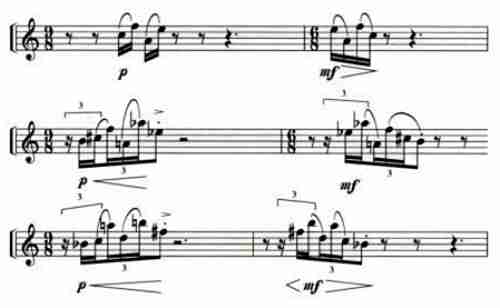
DSM: In the opening measures of Robert Dowland’s Amarilli mia Bella there are successive statements of a melodic motive that foreshadows and then later accompanies the arc of the piece. This motive emerges from silence, swells through the bass recorders, ascends into the tenor and alto recorders, and then sinks into the stillness from which it came. Although our first inclination is to regard these various statements as “the same”, there are actually some expressive differences among them. The change in instrumentation contrasts with the distinct timbral quality that the motive has in the opening measures. There’s a diversity in the pitches through which successive statements are given voice. And, although there’re similarities in the rhythmic figuration used for the recurring statements, there’s a latitude of duration and accentuation to all of them as well. In sectional playing, one of the most important things is to try to achieve and maintain a common tone within the section. This can be difficult due to different levels of playing skill and different acoustical qualities, especially in the tenor and bass recorders. It’s important in sectional playing to come together in agreement on how the tone should be presented in the ensemble. RWM does this consistently.

CMT: To understand this music — to make sense of the sonic textures — requires us to be able to integrate these phrases into a coherent idea and hold that idea and turn it round and round in our minds.

DSM: Yes. There’s a contemplative, meditative aspect to many of these pieces, and that’s consistent with the process of conceptual integration and round-and-round reflection that you’re alluding to. It’s partly why applauding after these pieces seems to do violence to them — applauding obliterates our zen-like state, abruptly ending the reflection. The rhythmic contour is destroyed by applause.

CMT: I think that the motives in these pieces hang together not simply because their constituent parts are connected in time but because the connections emphasize similarities to other motives. So the musical coherence that we perceive reflects the attributes of whole collections of motives. The coherence isn’t a property of any one motive in isolation. These are sentences and paragraphs. This whole 2-hour concert that Royal Wind Music performed for us was something like a book-length anthology or novella, don’t you think? And, although skill in evoking coherence does matter to the composer or arranger, our apprehending coherence in these pieces fundamentally depends upon the performers’ incarnating that coherence.

The substance of ‘symphonism’ will make itself felt in the stratification of the qualitative element of diversity and the novelty of perception within the limits of the increase of sound, but not in confirming the conditions tested earlier. Therefore, diversity in unity — the emergence of new intonations with new significations and meanings — forms the substance of symphonism.”
  —  Asaf'ev, O Simfonizme, 1921, quoted in Tarasti, Musical Signification, p. 147.


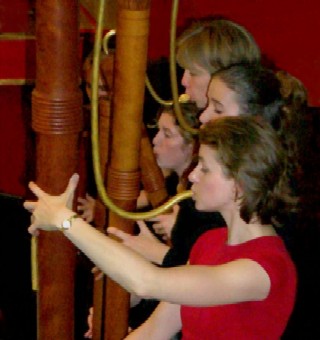
DSM: In that regard, these pieces have what I would say is an ‘orchestral’ or ‘symphonic’ texture, a mass of sound, with RWM’s individual players’ egos mostly sublimated to serve the aims of the section or the orchestra as a whole. It’s almost homophonic, but the coherence isn’t ‘coerced’. There are ‘free’ exchanges between the sections of recorders in different registers. And there are the contrapuntal lines assigned to specific voices within the sections. But these are not individualistic dialogues like the ones we find in chamber music. It feels like the expression of one unified organism. The effect is orchestral or ‘organ-like’—which I suppose is fitting, considering the shapes of the recorders and the similarities that they bear to pipe organ pipes; in terms of the means of sound production and the geometry of their air columns and apertures; and so on. The voicing and balancing of melodies and inner voices are also organ-like and contribute to the coherence of the overall effect. But RWM’s performance is organ-like in another way. The effect is unified, as though there were one consciousness behind it, just as there is one organist seated at an organ. The coherence between RWM’s members is very high. But it is a happy, enthused, ‘assenting’ sublimation by the various members. You can see it in their body language—as they play, and as they search for the proper recorder in the rack-like stands and mats on the floor in between pieces. Each one joyfully relinquishes her/his individual diversity, for the duration of the performance.

Royal Wind Music Bass Section
CMT: Symphonic, orchestral playing may sublimate individual egos and pre-judgments to a degree, yes. But, still, aren’t those egos and pre-judgments nonetheless necessary for a vibrant, meaningful, ‘whole’ performance? Gadamer, for example, once showed that our pre-judgments or prejudices are necessary and even desirable — a precondition for our understanding and communicating. New texts have to collide with meanings and ideas we already have, for new meaning to be produced. Dialogue and comprehension don’t occur if we merely suspend our ideas and passively accept another idea; they occur by a collision of ideas, our own and those expressed in the music.

DSM: Well, there’s clearly room for the individual, even in a symphony of recorders, with their sine-wave, flute-like timbres—so compliant and self-effacing as these instruments’ sounds are. The voices of the recorders in RWM are, I think, like ‘solute’ molecules that dissolve into a solvent, where the ‘solvent’ is the symphonic composite of all of the voices together. And you might say there is a ‘cratic’ entropy of acoustical mixing, much in the way that physical chemists speak of ‘cratic entropy’ of liquid and gaseous solutions. In ensemble performance, if the voices are the same ‘size’ and the interactions between them are identical, then the ‘entropy change’ for forming the ‘mixture’ (symphony) is smaller than it is if the voices are of different sizes, or have dramatically disparate energetics, or engage in dramatically different interactions. In this statistical mechanics analogy, some of the ‘particle’ differences (or lack thereof) inhere in the instruments themselves, and other of the differences (or lack thereof) are in the individual performers who play those instruments. The ‘particle’ is simply the voice that results from the ‘composite’: the player, plus the instrument, plus the text that the player executes. The tenor and bass recorders have inherently dark tones, while the alto and higher recorders are brighter, because of their geometry and acoustical physics. But the ‘player-plus-instrument-plus-text’ combinations that RWM represents have a much lower ‘cratic entropy’ than your typical ensemble . . .

CMT: That’s an interesting and novel notion—applying statistical mechanics concepts to sonic textures, treating polyphony as a physical mixing process—quantitatively accounting for musical textures in terms of ‘particle’ properties and energetics, as one would do in thermodynamics. Quite an exotic analogy. But, coming back down to earth, how can communication occur if the historical conditions separating us from these old texts are so wide as to preclude much of any common language or common base of ideas, between us and the composer? We’re talking not only of the player-particles’ submitting to a collective superego under the Leenhouts’ direction, but also of our own submission, aren’t we? Are we listeners not all sentient “particles” too—all of us endowed with somewhat different ‘sizes’, different ‘energetics’, different ‘interactions’?

DSM: I think so. And the answer emerges when we realize that our contextuality consists of more than just ‘fixed’, static, ‘horizontal’ cultural positions. There are also ‘vertical’ cultural contexts. Gadamer talks about synchronic and diachronic positions. Diachronic relationships are what we call ‘tradition’. Gadamer in fact tries hard to legitimize the concept of tradition. He says that our position in history entails our deliberate participation in evolving and creating traditions. A tradition is not merely a passive accumulation of artifacts; it’s something we cultivate actively. We produce it and further determine what it will become, regardless what it was that we’ve received. Tradition isn’t a permanent precondition that constrains us. It’s the awareness of historical conditions that influence our present understanding. Gadamer calls this the ‘wirkungsgeschichtliches Bewusstsein’, or ‘consciousness-of-being-affected-by-history.’ Gadamer sees interpretation as a single process, one that’s coextensive with understanding. It’s never achieved by subjectifying a text, but rather by ongoing societal mediation and interactions with each of us.

CMT: That sounds more mystical than sensible. How can we possibly ‘engage’ a musical text in conversation? In what sense can we ‘converse’ with a composer who’s long dead?

DSM: Well, a solution becomes plausible when we understand that ‘interaction’ in the hermeneutic sense is a bigger concept than the narrow linguistic activity we normally think of. A dialogue begins with the recognition that there’s another voice ‘out there’ (in the guise of a score or musical text). We try to reconstruct the thick ‘cultural web’ in which the text originated — to discover the questions and problems to which it served as an answer in its own time, and to discover the nuances of language and rhetoric that the text ‘pinged’ in its original community. We become receptive to new meanings by projecting ourselves against an historical ‘horizon’. None of this diminishes the role of the individual performer or listener. None of this reduces the range of textural ambiguity or timbral ambiguity that a performance may contain. What is striking about a homogeneous instrumentation such as RWM represents—what is striking about Paul Leenhouts’ conception of this music—is the very low amount of textural and timbral ambiguity in their performance. The distinctive meanings that RWM conveys are largely a consequence of their unique homogeneity in poetically rendering and coupling the motivic material in this repertoire; a consequence of their ‘cratic’ mixing of similar voices of recorders across the plurality of registers; and a consequence of the RWM members’ superb and consistent, shared vision of the historical horizon that’s pertinent to each composition. A beautiful and extraordinary kind of historical coherence is what RWM delivers! Kudos to Paul Leenhouts! Without someone of great vision, great ears, great interpretations, and great depth like his, you could have the greatest musicians on the earth and you wouldn’t achieve a great orchestral effect like this. We in the audience witness the inspired fascination that the created musical object exerts upon its creators. We experience a beauty compelling enough to cause RWM’s members to set aside their own individuality in service of this transcendent collective creation. What musicianship! What drama!

M otive is at any one time the smallest part of a piece or section of a piece that, despite change and variation, is recognizable as present throughout.”
  —  Arnold Schoenberg, The Musical Idea, in Carpenter & Neff, p. 169.


Royal Wind Music