Showing posts with label encapsulation. Show all posts

Sunday, March 22, 2009

Is Salonen’s ‘Homunculus’ Quartet a Musical Hologram?

 optical holographic set-up, (c)2007 HowStuffWorks
D    oes Salonen go further to say anything about music and holography? You’ve got the snippet from Salonen’s program notes about wanting to write a compact miniature that implies and acts like much more. And you’ve got the link at the bottom of the post, to the Michael Talbot Universe-as-Hologram thing. But is there a Salonen interview where he actually talks about holograms? Does he think that ‘Homunculus’ could be divided up into smaller bits and each bit would still embody all of the characters and textures of the whole [like a cut-up hologram would do]?”
  —  Anonymous email commenting on the previous CMT post.
I    wanted to compose a piece that would be very compact in form and duration, but still contain many different characters and textures. In other words, a little piece that behaves like a big piece... I decided to call my piece ‘Homunculus’ despite the obvious weaknesses of the spermists’ thinking, as I find the idea of a perfect little man strangely moving.”
  —  Esa-Pekka Salonen, program notes.
T he blockquote above, which I transcribed from Esa-Pekka Salonen’s program notes, is all there is, unfortunately. I haven’t thought about it a lot (yet), but I do not think that this string quartet [its compositional structure; its acoustical properties when realized in performance] is holographic. If it is holographic, then it is a hologram of (a) ‘low resolution’ in the temporal domain and (Fourier-inverse) frequency domain and (b) represented in a nonlinear medium with ‘low quantization’ dynamic range. Just my impression.

W hich draws attention to the exoticness of holograms even now, sixty-some years after holograms were discovered/invented by Dennis Gabor. The usual notion of optical holograms is that the recording medium has linear contrast formation across a very wide range—6 or more binary bits of intensity quantization or more. And the usual notion of optical holograms—oh, cut off little a corner of the hologram and illuminate it and you still get the image of the whole thing.

B ut what’s seldom expressed—or what’s seldom conveyed in popular accounts for non-physicists, anyhow—is how the hologram image from the cut-off corner differs from the image from the whole intact hologram. Yes, the little cut-off corner is itself a hologram, from which you can cut off yet another corner and once again see the ‘same’ image of the original scene. But you can’t engage in decimation of the hologram down to a minuscule, invisible ‘corner’ of film that has only one atom, say. Or digital decimation of a file that was once many megabytes in size, down till what’s left is only one binary digit—one ‘bit’, a one or a zero.

N or is a [tiny but still visible/macroscopic] holographic ‘corner’ that is 1/1000th the size of the original—one milligram of film, out of an original hologram that weighs 1 gram—capable of showing the spatial detail or contrast that the full-size original did. Over-simplified, Future-obsessed DiscoveryChannel-ified ‘lay-audience’ excuses for ‘science journalism’ has no patience for these practical facts. Instead, we get breathless, sensationalized misinformation that backhandedly suggests that Miracles happen; that Fact is Stranger than Fiction; that infinite regressions of hologram snipping do not diminish the information contained by the progressively smaller snippets. It would be so much better if the journalists and marketers and popularizers were not running the show and if instead physicists and engineers wrote or edited the copy, for longer format shows that allowed time for a bit of real-world detail...

E   very part of a hologram contains the image of the whole object. You can cut off the corner of a hologram and see the entire image through it. For every viewing angle you see the image in a different perspective, as you would a real object. Each piece of a hologram contains a particular perspective of the image, but each also includes [or contains the representation of] the entire object.”
  —  R. Nave, Hyperphysics, Georgia State University.
S o when you cut up an optical hologram, the contrast and information corresponding to larger-scale structures does go down. Information is lost. The projected image from a tiny corner does broadly resemble the original, but its resolution is lower and other structure ‘signal’ information may now be so weak as to be overwhelmed by ‘noise’. Holograms have a ‘transfer function’ and signal-to-noise ratio (S/N), just like any other system. And those are not scale independent.

A nd the same thing would happen with holographic music, notwithstanding Brian Eno’s and others’ gee-whiz comments. I do not think Salonen’s ‘Homunculus’ is holographic, in part because I do not think it has ‘extra notes’ in it. By contrast, most ‘minimalist’ and ‘ambient’ music does contain extra, dispensable notes. I do not see how Salonen’s string quartet can be shortened without the omitted elements being conspicuous for their absence. There is no way that the ‘many characters and textures’ that Salonen put in there will be preserved if we cut the piece from 12 minutes down to, say, 6 minutes or 3 minutes or 1 minute. No way.

I t would be interesting, though, to examine ‘Homunculus’ through affine transformations of tempo, which would be analogous to optically scaling holograms with changes in wavelength (the inverse of frequencies corresponding to the colors of light). You could do this in live performance—doubling the tempo, say. Or you could do it by resampling a digital recording of it—accelerating the tempo by some multiplicative factor but leaving the pitches and timbres of the strings intact. Are the expressive consequences of affine transformations of tempo similar to the consequences of reanimating an optical hologram in blue light versus red light? Do the phrases appear shorter? At the faster tempi, are the phrases’ cognitive/emotional “reach” and the strength of interactions with each other more limited in scope, compared to how they are at slower tempi?

L ikewise, are ‘polarization’ effects observed in holographic music? That is, when wavefront-aligning (polarizing) constraints are imposed on two or more voices in a piece of chamber music, then are the interference patterns manifested by the other parts also polarized? In other words, has the composer established a polarizing ‘medium’ through which all of the ‘signals’ are propagating, and does the resulting acoustic ‘image’ behave in measurable ways that are analogous to an optical ‘polarization hologram’?

I f the answer is ‘Yes’ then maybe there are other holographic features in there, too. If the answer is ‘No’, then we can add that as evidence against holographicness of ‘Homunculus’.

I s any of Ferneyhough’s writing holographic, do you think? Can we tell what is a hologram and what is not by examining the ‘text’ (score), in a way that’s analogous to how we can tell whether the image on a piece of film is holographic? How would we go about composing a piece that we intend to be a musical hologram?

 Scaling of spatial dimension when hologram is exposed to light of different frequencies/wavelengths


It’s Notes All the Way Down: Salonen’s ‘Homunculus’ Quartet

 Johannes String Quartet, photo © Lisa-Marie Mazzucco
I    have long been fascinated (and amused) by the arcane Spermists’ theory, who held the belief that the sperm was in fact a ‘little man’ (in Latin, an ‘homunculus’) that was placed inside a woman to grow into a child. This seemed to them to neatly explain many of the mysteries of conception. It was later pointed out that if the sperm was indeed an homunculus—identical in all aspects but size to an adult—then the homunculus must have sperm of its own, [and, in turn, the homunculus’s sperm are themselves micro-homunculi with their own micro-sperm, which, in turn, are nano-homunculi, and so on]. This led to a logical ‘reductio ad absurdum’—an endless chain or infinite regress of [uncountable trillions of] homunculi within homunculi! This was not considered by [reality-challenged] Spermists to be a fatal objection, however—insofar as it neatly explained how it was that, in the biblical Adam, all [future human beings] had sinned: the whole of humanity [and its misdeeds] ‘was already contained in Adam’s loins’.”
  —  Esa-Pekka Salonen, 2008.
I    wanted to compose a piece that would be very compact in form and duration, but still contain many different characters and textures. In other words, a little piece that behaves like a big piece... I decided to call my piece ‘Homunculus’ despite the obvious weaknesses of the spermists’ thinking, as I find the idea of a perfect little man strangely moving.”
  —  Esa-Pekka Salonen.
T he performance by the Guarneri String Quartet and the Johannes String Quartet together last night in Kansas City was amazing. The program included:

  • William Bolcom: Octet
  • Esa-Pekka Salonen: Homunculus (Johannes Quartet)
  • Derek Bermel: Passing Through (Guarneri Quartet)
  • Felix Mendelssohn: Octet
T imothy McDonald has a nice review in the Kansas City Star here.

 Guarneri Quartet, photo © Dorothea von Haeften
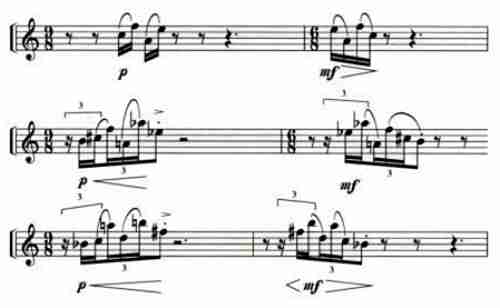
T he Salonen ‘Homunculus’ quartet has many different expressions of parallelism and simultaneity in it—which is surprising, maybe, considering that the term ‘homunculus’ is ordinarily associated with concepts of hierarchy and encapsulation of things within things.

 Homunculus
T here are rapid sixteenth-note figures and sextuplets that come in waves—liquid waves, violins spilling, viola spilling, cello spilling. The patterns evoke a sense of ‘being-as-process’, as opposed to ‘being-as-object’.

F rom the title, one might expect that Salonen had been inspired by—or is exploring—individual subjectivity: the interior experience of an individual self and the self-regard that each of us has through introspection, mapping and remembering our own history.

B ut instead Salonen’s ‘Homunculus’ suggests that a quartet is (can be) one individual-in-aggregate, or, conversely, that a single individual is (can be) a collocation of multiple selves, each of whom has its own real existence and identity.

I t’s not so much what the self ‘is’ that interests Salonen, I think, but what the self does (hears, sees, thinks, anticipates, intends, ... ) and how it does it. It’s all ‘process’. Identity has no reality except as it is enacted through acts and processes and events. ‘Homunculus’ not only asserts (abstractly) that this is so; it also defends the argument by way of quartetly examples and illustrates the cognitive and emotional range of self-as-process. ‘Homunculus’ illustrates how rapidly selfhood can be constructed/revealed—with gestures and textures that unfold over a few seconds only. Salonen’s craftsmanship here is clear, but it’s never over-worked. Organic plausibility, palpable Truth.

S ome portions of the work have ‘sectional’ writing for three parts (Vn2, Vla, Vc, say) and the fourth part (Vn1, say) is essentially autonomous, doing its own thing. Several bars/seconds elapse, and the ‘section’ has been reconstituted by a different trio (Vn1, Vn2, Vc, say) and a different one (Vla) is doing the extemporizing. The effect is vividly evocative of the ebb and flow of our normal thought-patterns—the shifting of attention amongst a variety of ideas and ‘mental sets’.

W ithin the model ‘self’ is a concept embodied in a [measurably] finite number of critical sub-units of the overall system of ‘mental sets’ that are accessible to our ordinary experiences. If there is no involvement of one or more parts of this ‘self structure’, then we feel uninvolved; our internal ‘observer’ will be felt to be not present.

S ure, the self can be ‘divided’—have a look at Jon Elster’s and others’ writings about this. But because each self exists in a set of subsystems that are totally finite, the ‘division’ can’t go on indefinitely. After a couple of hierarchical levels, ‘self’ can’t be divided further without either losing the normal sense of the word ‘self’ or division’s becoming arbitrary, unsupported by evidence from ordinary experience. There is a philosophical/aesthetic reason why Salonen wrote this for quartet and not sextet or octet or something larger. In ‘Homunculus’ we get a pretty specific statement from Salonen about how finite each of us really is...

 Esa-Pekka Salonen
S o there are in fact some neuropsychological models that still characterize how our minds work in terms of homunculus-like mappings and correspondences, but the encapsulations are finite—there is no infinite regress or vast hierarchical matryoshka-type nesting.

I n fact, self watching self watching self … is implausible on its face. Every day we are amazed at our forgetfulness and limited attention. Have a listen to ‘Homunculus’ in concert if you have the opportunity to do so. I think you’ll find Salonen saying (abstractly, musically) that we are each complex selves, but we are not arbitrarily or infinitely complex. (Salonen convinces me, and I take comfort in his having succeeded in this.)

O    ne of the ‘complex’ things about ‘complex’ music is its quality of refusing to present a straightforward object (as for instance in much minimal sculpture): it is always perceived in the act of underlining its own ongoing and provisional nature. It doesn’t present the illusion of not being an illusion—in large measure because of the continual problematization of the performance/interpretaton context.”
  —  Brian Ferneyhough, Responses to a Questionnaire on ‘Complexity’, 1990.
T o fully explain how we experience what we do in this piece (or any other), a theory of consciousness would have to address real-time self-knowledge, self-understanding, self-awareness, self-monitoring, and goal setting: our selves as we know and understand and experience them; our selves as they are seen by others and used as a basis for their recognizing us as us; our selves as the sense of values and personal history and memory that constitutes our own recognition of who we are.

B ut, our minds (selves) do quite a lot of processing that’s ‘parallel’, not hierarchical or serial. We walk and chew gum at the same time; we contemplate and monitor several ideas at once; we process the concurrent expressions in this Salonen quartet and observe our own spontaneous reactions as we do this.

F or whatever forms and depths the ‘division’ of the self plausibly may have, though, the extent of the division is limited to the finite resources that in fact constitute ‘self’ within the system of mental sets that constitute our psyche. And those finite resources change on a moment-by-moment timescale. For example, the tutti and sectional structures in this 12-minute Salonen quartet do not place demands on us that are as great as the parts of the composition where the voices diverge from each other. As the processes unfold, the evolving cognitive demands—for the performers and for us listeners—are not excessive, and the musical result is coherent, pleasurable, beautiful.

T he narrative arc is compelling, and the effort of the collected selves apprehending this Salonen quartet is richly rewarded. I’ll have to get ahold of a copy of the score, to get a more detailed sense of how Salonen’s design accomplishes so much in such a short piece.

F our, five, six, eight voices at a time are about my own cognitive limit, however—which stands in stark contrast to the recent maniacal, parallel-not-hierarchical IVF exploits of Octo Mom to explore far higher cardinalities and polyphonies in one household.


 Matryoshka nesting dolls


Sunday, February 10, 2008

Love’s Oboe: Chamber Music Idioms within Larger Forms

 Oboe d’Amour

    [50-sec clip, Toru Takemitsu, ‘vers, l’arc-en-ciel, palma’, John Williams, Gareth Hulse & London Sinfonietta, 2.2MB MP3]

Slightly larger than the oboe, the oboe d’amour has a darker, less assertive tone—an alto timbre and personality. It’s a transposing instrument, and it sounds a minor third lower than it’s written (i.e., C is A). The oboe d’amour uses a ‘bocal’ and has this pear-shaped bell, similar to the larger English Horn.

Among contemporary works for this instrument I especially like Toru Takemitsu’s ‘Vers, l’Arc-en-Ciel, Palma’ (Verse, Rainbow, Palma/Caliper) for guitar and oboe d’amore soloists with orchestra. It’s nominally Takemitsu’s homage to the painter Joan Miró whom Takemitsu met in 1970—but it’s an interesting piece in a variety of other ways as well.

To me, it urgently begs the question of what the boundaries of chamber music are. This symphonic piece encloses or encapsulates a duet between the oboe d’amour and guitar. Here we have chamber music sounds within orchestral playing. Hulse and Williams interact beautifully, authentically.


    [50-sec clip, Toru Takemitsu, ‘vers, l’arc-en-ciel, palma’, John Williams, Gareth Hulse & London Sinfonietta, 2.2MB MP3]

 Gareth Hulse
The piece is an essay on music’s cohesive social power, capable of guarding the lovers from the outside world and facilitating their growth as individuals and as a couple. The symphonic sound masses form the walls that define the intimate space that the couple occupies. Transparent textures and clear lines make the intimacy even more striking.

Takemitsu: vers, l’arc-en-ciel, palma
Maybe this music is too tepid for Valentine’s Day? The protagonists each in turn adopt an ironic stance, distancing themselves from their shared experience. The musical dialectic prompts us to likewise take a step back to contemplate the borders and limits of emotional experience and communication. Both the writing and the performance show great sensitivity to colors and drama. On second thought, the authenticity of the ‘Thou-ness’ that’s displayed here between the guitar and the oboe d’amour makes this an entirely appropriate piece for Valentine’s. The Takemitsu composition and these two performers clearly believe in a transcendental Self – and have a sense of the interiority and trueness to self that that transcendent belief implies – and the challenge and moral duty that it poses. And authentic subjectivity is always romantic. Valentine’s it is, then.

Another wonderful oboe d’amour player is Jennifer Paull—who performs oboe d’amour works by de Caix d’Hervelois, Marais, Bach, Telemann, Stölzel, Schurmann, Graupner, Böhm, Heinichen, Lotti, Fasch, Quantz, Kuhnau, Forster, Graun, Janitch, Chelleri, and Prowo. Her ‘Volume 2’ CD has oboe d’amour works by William Blezard, Edwin Carr, Wilfred Josephs, John McCabe, John Rushby-Smith, Leonard Salzedo, and Harold Schiffman. Some links below, for your interest.

B ach’s favourite tonalities for hautboy d’amour were A minor and D minor (23 solos in each). When he began composing a piece and had to decide the tonality to put it in, surely one of the important considerations was how it would sound on the obbligato instrument ... Bach usually kept the fingered key, even when he switched sizes of the hautboy.”
  —  Bruce Haynes, p. 217.

 Jennifer Paull