Showing posts with label korea. Show all posts

Sunday, March 22, 2009

It’s Notes All the Way Down: Salonen’s ‘Homunculus’ Quartet

 Johannes String Quartet, photo © Lisa-Marie Mazzucco
I    have long been fascinated (and amused) by the arcane Spermists’ theory, who held the belief that the sperm was in fact a ‘little man’ (in Latin, an ‘homunculus’) that was placed inside a woman to grow into a child. This seemed to them to neatly explain many of the mysteries of conception. It was later pointed out that if the sperm was indeed an homunculus—identical in all aspects but size to an adult—then the homunculus must have sperm of its own, [and, in turn, the homunculus’s sperm are themselves micro-homunculi with their own micro-sperm, which, in turn, are nano-homunculi, and so on]. This led to a logical ‘reductio ad absurdum’—an endless chain or infinite regress of [uncountable trillions of] homunculi within homunculi! This was not considered by [reality-challenged] Spermists to be a fatal objection, however—insofar as it neatly explained how it was that, in the biblical Adam, all [future human beings] had sinned: the whole of humanity [and its misdeeds] ‘was already contained in Adam’s loins’.”
  —  Esa-Pekka Salonen, 2008.
I    wanted to compose a piece that would be very compact in form and duration, but still contain many different characters and textures. In other words, a little piece that behaves like a big piece... I decided to call my piece ‘Homunculus’ despite the obvious weaknesses of the spermists’ thinking, as I find the idea of a perfect little man strangely moving.”
  —  Esa-Pekka Salonen.
T he performance by the Guarneri String Quartet and the Johannes String Quartet together last night in Kansas City was amazing. The program included:

  • William Bolcom: Octet
  • Esa-Pekka Salonen: Homunculus (Johannes Quartet)
  • Derek Bermel: Passing Through (Guarneri Quartet)
  • Felix Mendelssohn: Octet
T imothy McDonald has a nice review in the Kansas City Star here.

 Guarneri Quartet, photo © Dorothea von Haeften
T he Salonen ‘Homunculus’ quartet has many different expressions of parallelism and simultaneity in it—which is surprising, maybe, considering that the term ‘homunculus’ is ordinarily associated with concepts of hierarchy and encapsulation of things within things.

 Homunculus
T here are rapid sixteenth-note figures and sextuplets that come in waves—liquid waves, violins spilling, viola spilling, cello spilling. The patterns evoke a sense of ‘being-as-process’, as opposed to ‘being-as-object’.

F rom the title, one might expect that Salonen had been inspired by—or is exploring—individual subjectivity: the interior experience of an individual self and the self-regard that each of us has through introspection, mapping and remembering our own history.

B ut instead Salonen’s ‘Homunculus’ suggests that a quartet is (can be) one individual-in-aggregate, or, conversely, that a single individual is (can be) a collocation of multiple selves, each of whom has its own real existence and identity.

I t’s not so much what the self ‘is’ that interests Salonen, I think, but what the self does (hears, sees, thinks, anticipates, intends, ... ) and how it does it. It’s all ‘process’. Identity has no reality except as it is enacted through acts and processes and events. ‘Homunculus’ not only asserts (abstractly) that this is so; it also defends the argument by way of quartetly examples and illustrates the cognitive and emotional range of self-as-process. ‘Homunculus’ illustrates how rapidly selfhood can be constructed/revealed—with gestures and textures that unfold over a few seconds only. Salonen’s craftsmanship here is clear, but it’s never over-worked. Organic plausibility, palpable Truth.

S ome portions of the work have ‘sectional’ writing for three parts (Vn2, Vla, Vc, say) and the fourth part (Vn1, say) is essentially autonomous, doing its own thing. Several bars/seconds elapse, and the ‘section’ has been reconstituted by a different trio (Vn1, Vn2, Vc, say) and a different one (Vla) is doing the extemporizing. The effect is vividly evocative of the ebb and flow of our normal thought-patterns—the shifting of attention amongst a variety of ideas and ‘mental sets’.

W ithin the model ‘self’ is a concept embodied in a [measurably] finite number of critical sub-units of the overall system of ‘mental sets’ that are accessible to our ordinary experiences. If there is no involvement of one or more parts of this ‘self structure’, then we feel uninvolved; our internal ‘observer’ will be felt to be not present.

S ure, the self can be ‘divided’—have a look at Jon Elster’s and others’ writings about this. But because each self exists in a set of subsystems that are totally finite, the ‘division’ can’t go on indefinitely. After a couple of hierarchical levels, ‘self’ can’t be divided further without either losing the normal sense of the word ‘self’ or division’s becoming arbitrary, unsupported by evidence from ordinary experience. There is a philosophical/aesthetic reason why Salonen wrote this for quartet and not sextet or octet or something larger. In ‘Homunculus’ we get a pretty specific statement from Salonen about how finite each of us really is...

 Esa-Pekka Salonen
S o there are in fact some neuropsychological models that still characterize how our minds work in terms of homunculus-like mappings and correspondences, but the encapsulations are finite—there is no infinite regress or vast hierarchical matryoshka-type nesting.

I n fact, self watching self watching self … is implausible on its face. Every day we are amazed at our forgetfulness and limited attention. Have a listen to ‘Homunculus’ in concert if you have the opportunity to do so. I think you’ll find Salonen saying (abstractly, musically) that we are each complex selves, but we are not arbitrarily or infinitely complex. (Salonen convinces me, and I take comfort in his having succeeded in this.)

O    ne of the ‘complex’ things about ‘complex’ music is its quality of refusing to present a straightforward object (as for instance in much minimal sculpture): it is always perceived in the act of underlining its own ongoing and provisional nature. It doesn’t present the illusion of not being an illusion—in large measure because of the continual problematization of the performance/interpretaton context.”
  —  Brian Ferneyhough, Responses to a Questionnaire on ‘Complexity’, 1990.
T o fully explain how we experience what we do in this piece (or any other), a theory of consciousness would have to address real-time self-knowledge, self-understanding, self-awareness, self-monitoring, and goal setting: our selves as we know and understand and experience them; our selves as they are seen by others and used as a basis for their recognizing us as us; our selves as the sense of values and personal history and memory that constitutes our own recognition of who we are.

B ut, our minds (selves) do quite a lot of processing that’s ‘parallel’, not hierarchical or serial. We walk and chew gum at the same time; we contemplate and monitor several ideas at once; we process the concurrent expressions in this Salonen quartet and observe our own spontaneous reactions as we do this.

F or whatever forms and depths the ‘division’ of the self plausibly may have, though, the extent of the division is limited to the finite resources that in fact constitute ‘self’ within the system of mental sets that constitute our psyche. And those finite resources change on a moment-by-moment timescale. For example, the tutti and sectional structures in this 12-minute Salonen quartet do not place demands on us that are as great as the parts of the composition where the voices diverge from each other. As the processes unfold, the evolving cognitive demands—for the performers and for us listeners—are not excessive, and the musical result is coherent, pleasurable, beautiful.

T he narrative arc is compelling, and the effort of the collected selves apprehending this Salonen quartet is richly rewarded. I’ll have to get ahold of a copy of the score, to get a more detailed sense of how Salonen’s design accomplishes so much in such a short piece.

F our, five, six, eight voices at a time are about my own cognitive limit, however—which stands in stark contrast to the recent maniacal, parallel-not-hierarchical IVF exploits of Octo Mom to explore far higher cardinalities and polyphonies in one household.


 Matryoshka nesting dolls


Monday, February 4, 2008

Trio Con Brio: Individualism-Collectivism in Ensemble

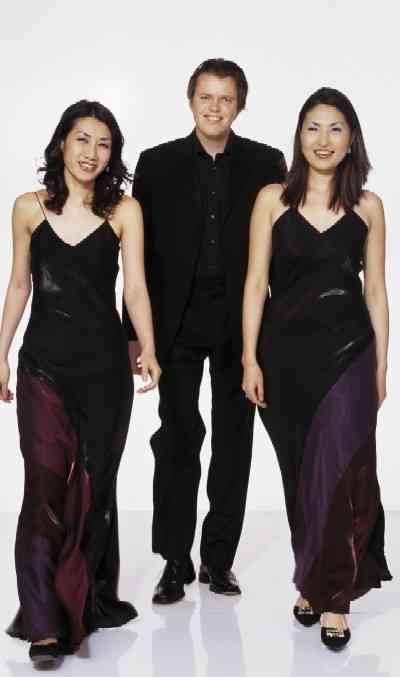
 Trio Con Brio
The performance by Trio Con Brio in Kansas City on Saturday, 02-FEB-2008, thrilled the appreciative audience. The program consisted of Beethoven’s Op. 1 No. 1, Shostakovich’s Op. 67, and the Ravel Trio, capped by an encore of the 5th movement of Dvorák’s ‘Dumky’.

    Trio Con Brio Copenhagen
  • Soo-Jin Hong, violin
  • Soo-Kyung Hong, cello
  • Jens Elvekjaer, piano
The Trio Con Brio’s integration and cohesiveness were superb—such a unity of anticipation of each other’s next steps, each other’s needs. Close your eyes. Is this the playing of three distinct musicians, or is it the happy subordination by each, to the needs of the organism that, together, they comprise? Schools of fish, flocks of birds, herds of synchronized gazelles are not so beautifully coordinated as this! Fascinating!


    [50-sec clip, Dmitri Shostakovich, Piano Trio No. 2, Op. 67, Andante, Trio Con Brio, 1.5MB MP3]

    [50-sec clip, Dmitri Shostakovich, Piano Trio No. 2, Op. 67, Andante, Trio Con Brio, 1.5MB MP3]

    [50-sec clip, Dmitri Shostakovich, Piano Trio No. 2, Op. 67, Largo, Trio Con Brio, 1.5MB MP3]

    [50-sec clip, Dmitri Shostakovich, Piano Trio No. 2, Op. 67, Largo, Trio Con Brio, 1.5MB MP3]

Throughout the performance on Saturday evening, Trio Con Brio’s dynamics and phrasing were ‘alive’. Breathing, sighing—collectively, a unified and ‘pneumatic’ interpretation that was inspired and inspiring.

This was all the more remarkable to me as I thought about what the nature of their rehearsals might be like—involving the two Hong sisters, and Jens married to Soo-Kyung Hong; involving the mixing of Danish attitudes and culture and Korean attitudes and culture. The ensemble has been together now for more than 8 years, but still—there must be moments when opinions among them diverge and disagreements between them as individuals bring friction!

And yet, apparently, such moments are amazingly few. Jens is, by nature and upbringing, a charming and modest person, despite his impressive skill as a pianist. The same is also true for Soo-Jin and Soo-Kyung, even though their charm and modesty hail from Korea, half a world away from Denmark. Each of the three is warm, optimistic, exuberant—in the playing, and in conversation after the performance. The ways that each of the three of them has for achieving this wonderful balance of collectivism and individualism may differ, but the musical result is a beautiful and deeply meaningful one. Bravo!

 Trio Con Brio
T  he Korean self is profoundly collectivist while deeply committed to individual self-assertion... I do not assume there is a code—a key value that resolves the conflict. All selves are built up from incompatible elements, and they stay that way... [The Korean self] is not so much a ‘modal’ self as an ‘ideal’ one, reflecting the ideals of Korean culture... kibun—the state of the self-in-society... Koreans are not separate individuals—at least they do not see themselves as such in the same way as Westerners—so the individualistic competition you see Koreans engage in is not really competition among individuals at all [in their view], but among families, the individual always representing more than himself or herself... an ‘amoral familism’.”
  —  C. Fred Alford, The Self Is a Conflict, Not a Continuum, p. 31.
L ee Soo-Won uses the word ‘chong’ to characterize the collective self and ‘exchange’ to characterize the individual self. ‘It is chong that enables us to overcome our own point of view in relationships and fit into the group.’ Lee does not distinguish between good (‘koun) and bad (‘miun’) chong, or between affection and attachment, including those attachments that may be destructive. Does it make any sense to say that Eunyoung has a porous ego, that she is less autonomous than one who gives up everything for love? Does it not make more sense to say that she knows her values, what she cares about, and that one cannot have all of everything one wants, and she is aware of how she would choose? Are these not the attributes of a strong self who knows that reality means choices among values? That hers is a strong group self makes no difference in this regard! Hers is still a strong self—highly individuated without being separated. Koreans are actually more self-aware than Americans because Koreans are more aware of their relationships. Self-awareness is not awareness of a ‘pristine’ self. There is no such thing. Self-awareness is awareness of the self-in-interaction with others, including others who exist only in our memories. Koreans do not have ‘Emersonian Moments’. There are other forms of self-awareness, forms that actually come much closer to what it means to be a real self in the world.”
  —  C. Fred Alford, Why Do Koreans Say ‘We’ and Instead Do ‘I’ ?, p. 55.


Trio Con Brio: How Big Is the Piano Trio Repertoire, Really?

Trio Con Brio
Like any literature, we tend to hear a small number of pieces played frequently—a variety of motives account for the popularity of a subset of the canon. Ensembles prepare what the ‘market’ wants to hear and what presenters know will please their audiences. Recording companies strongly favor what has sold in the past. And so, having never previously looked myself to see how many trios exist, after the Trio Con Brio performance I asked cellist Soo-Kyung Hong a dumb question: “How big is the repertoire for Piano Trio? I know it is tiny compared to, say, the String Quartet literature. But how small is it?”

Her answer was coy. “It is bigger than people think. But not more than about 100 Piano Trio works.”

My reaction was more shocked than maybe she expected. How could it be so small as just 100? Surely there must be many under-performed or forgotten works that she is leaving out of that number! Soo-Kyung added, “But in recent years everybody’s been very busy commissioning new things. We ourselves have commissioned a few.”

My curiosity was piqued. I spent Sunday searching on the web and came up with this list. Watch it scroll by below if you have time to kill, or you can download it as HTML file here. I come up with more than 400 piano trios. And without doubt I have missed some—I only spent an afternoon compiling this at home after all. I have not plowed through a conservatory’s library, only Google. (It was more interesting than the U.S. football game that was on television. New England defeated ... by their own defense. New York won. )

Aren’t there some of these pieces that merit more frequent performance and recording? Yes! Such a beautiful and accessible idiom! Can we continue the trend and commission yet more of these Piano Trios? Sure!


A


Karl Abel
  • Six Trios, Op. 5 (1764)

Lev Abeliovich
  • Piano Trio (1955)

Jean Absil
  • Piano Trio, Op. 7 (1931)

Samuel Adler
  • Piano Trio (1964)

Kathryn Alexander
  • Piano Trio 'AroundAbout' (2006)

Franghiz Ali-Zadeh
  • Impromptus (2004)

Charles-Valentin Alkan
  • Piano Trio in g minor, Op. 30

Jan van Amerongen
  • Piano Trio (1986)

David Amram
  • Piano Trio 'Dirge and Variations' (1962)

Iosif Andriasov
  • Trio, Op. 7

Fikret Amirov
  • To the Memory of Ghadsibekov (1953)

Volkmar Andreae
  • Piano Trio (1901)
  • Piano Trio No. 2 (1914)

Hendrik Andriessen
  • Piano Trio (1947)

Caroline Ansink
  • Piano Trio 'Skopos' (1988)

Violet Archer
  • Piano Trio No. 2 (1956)

Anton Arensky
  • Piano Trio No. 1 in d minor, Op. 32
  • Piano Trio No. 2 in f minor, Op. 73

Isabel Aretz
  • Piano Trio (1965)

Claude Arrieu
  • Piano Trio (1958)

Valery Arsumanov
  • Trio, Op. 183

Juan Artero
  • Piano Trio 'Epilogo a la auscencia' (2007)

Lera Auerbach
  • Piano Trio, Op. 28 (1992-1996)


B


Arno Babadzhanyan
  • Trio in f-sharp minor (1953)

Victor Babin
  • Piano Trio (1956)

Carl Phillipp Emmanuel Bach
  • Three Trios Op. 2

Johann Christian Bach
  • Two Trios

David Baker
  • Contrasts (1976)
  • Roots (1976)
  • Roots II (1992)

Vytautas Barkauskas
  • Modus vivendi, Op. 108 (1996)

Roland Batik
  • Four Intermezzi

Dennis Báthory-Kitsz
  • Piano Trio 'Full House Reset' (2000)

Ludwig van Beethoven
  • 3 Piano Trios, Op. 1
  • Piano Trio in B-flat, alternate version of the trio for clarinet, violoncello and piano, Op. 11
  • Piano Trio (arrangement of the second Symphony in D major, Op. 36)
  • Piano Trio (arrangement of Septet in E-flat major, Op. 20), Op. 38
  • Allegretto B-Dur WoO.39
  • Variations for Piano Trio in E-flat major, Op. 44
  • Piano Trio (arrangement of string quintet in E-flat major, Op.4), Op. 63
  • 2 Piano Trios (D major ‘Ghost’; E-flat major), Op. 70
  • Piano Trio in B-flat major ‘Archduke’, Op. 97
  • Adagio, Variationen and Rondo op.121a (Kakadu Variations)
  • Variations on Müller’s Song for Piano Trio in G major, Op. 121a
  • From ‘A Select Collection of 25 Original Irish Airs’ (WwO 152)
  • From ‘A Select Collection of 20 Original Irish Airs’ (WwO 153)

Peter Benary
  • Piano Trio (1974)

Arthur Berger
  • Piano Trio (2000)

Leonard Bernstein
  • Piano Trio (1937)

Franz Berwald
  • Four Piano Trios (1851)

Frank Beyer
  • Piano Trio 'Lichtspuren' (2008)

Evgene Birman
  • Piano Trio 'Rhapsodie' (2003)

Rainer Bischof
  • Trio Fragile, Op. 21 (1985)

Martin Bjelik
  • Piano Trio in B Major (1986)

Boris Blacher
  • Piano Trio (1973)

Ernest Bloch
  • Three Nocturnes (1924)
  • Piano Trio (1925)

Luigi Boccherini
  • Piano Trio in e minor, Op. 12

Christopher Bochmann
  • Piano Trio 'Meditation' (1970)

Joseph Bodin de Boismortier
  • Piano Trio, Op. 50 (1734)

Sergei Bortkiewicz
  • Trio, Op. 38 (1928)

Hans-Jurgen von Bose
  • Piano Trio (2002)

Susan Botti
  • Piano Trio (2008)

Lili Boulanger
  • Deux pièces en trio (1918)

Martin Boykan
  • Piano Trio No. 2 (1997)

Johannes Brahms
  • Piano Trio No. 1 in B major/minor, Op. 8 (1891)
  • Piano Trio No. 2 in C major, Op. 87
  • Piano Trio No. 3 in c minor, Op. 101
  • Piano Trio No. 4 in A major, op. post. (spurious)

Paul Brantley
  • Piano Trio 'Thomas Weaver in memoriam' (1982)

Bert Breit
  • Shibbolet Trio (1996)

Martin Bresnick
  • Trio (1988)

Frank Bridge
  • Phantasie Trio (Piano Trio No. 1) 1907
  • Piano Trio No. 2 (1929)

Benjamin Broening
  • Piano Trio (1991)

Max Bruch
  • Piano Trio in c minor, Op.5 (1857)

Paul Bruinen
  • Piano Trio 'Mano' (1990)

Ignaz Brüll
  • Trio in E-flat Major, Op. 14

Lou Bunk
  • Piano Trio (2008)

Steven Burke
  • Fury of Bloom(2001)

Alan Bush
  • Piano Trio (1947)

Ferruccio Busoni
  • Andante with Variations and Scherzo, Op. 18a (K. 184)


C


Charles Camilleri
  • Piano Trio (2005)

T. Patrick Carrabre
  • Piano Trio No. 2 'From the Dark Reaches' (2002)

Alfredo Casella
  • Siciliana e Burlesca, Op. 23-bis

Gaspar Cassadó
  • Piano Trio in C Major (1925)

Alexis de Castillon
  • Trio No.1 in B-flat Major, Op. 4

Aureliano Cattaneo
  • Piano Trio No. 2 (2007)

Cécile Chaminade
  • Trio No. 1 in g Minor, Op. 11
  • Trio No. 2 in a Minor, Op. 34

Sebastian Chang
  • Piano Trio (2004)

Eric Chasalow
  • Piano Trio 'Yes, I Really Did' (1998)

Ernest Chausson
  • Piano Trio in g minor, Op. 3

Frédéric Chopin
  • Piano Trio in g minor, Op. 8

Rebecca Clarke
  • Piano Trio (1921)

Rhona Clarke
  • Piano Trio 'Dunsandle' (1989)

Stephen Cohn
  • Piano Trio 'Anticipation of Light' (2004)

Aaron Copland
  • Vitebsk: Study on a Jewish Theme for Piano Trio (1928)
  • Prelude for piano trio

Frank Corcoran
  • Piano Trio (2007)

Richard Cornell
  • Piano Trio 'Triple Helix' (1999)

Allan Crossman
  • Piano Trio 'Icarus' (2006)

Glenn Crytzer
  • Piano Trio 'Explorations' (2006)

Carl Czerny
  • Piano Trio No. 1 in E-flat, Op. 105
  • Piano Trio No. 2 in A, Op. 166
  • Piano Trio No. 3 in E, Op. 173
  • Piano Trio No. 4 in a minor, Op. 289
  • Trois Sonatines faciles et brillantes, Op. 104
  • Deux Trios brillans, Op. 211
  • Six Grand Potpourris for piano trio, Op. 212


D


Ram Da-Oz
  • Piano Trio (1963)

Ingolg Dahl
  • Piano Trio (1962)

Richard Danielpour
  • Piano Trio 'A Child's Reliquary' (2000)

Jean-Luc Darbellay
  • Piano Trio 'Empreintes' (1996)

Mario Davidovsky
  • Piano Trio 'Chaconne' (1972)

Claude Debussy
  • Piano Trio in g minor, L. 3 (1880)

Lex van Delden
  • Piano Trio, Op. 95 (1969)
  • Piano Trio II, Op. 114 (1988)

Edison Denisov
  • Trio, Op. 39 (1971)

Tamar Diesendruck
  • Piano Trio (2001)

Albert Dietrich
  • Second Trio in A Major, Op. 14

Jan van Dijk
  • Piano Trio (1950)

Ignacy Feliks Dobrzynski
  • Grand Trio in a minor, Op. 17

Sam Dresden
  • Piano Trio (1942)

Antonín Dvorák
  • Piano Trio No. 1 in B-flat major, B. 51
  • Piano Trio No. 2 in g minor, Op. 26/B.56
  • Piano Trio No. 3 in f minor, Op. 65/B.130
  • Piano Trio No. 4 in e minor ("Dumky"), Op. 90/B. 166


E


John Eaton
  • Piano Trio (2006)

Horst Ebenhoh
  • Piano Trio (1973)

Anton Eberl
  • Piano Trio (formerly Mozart K. 291)

Klaus Egge
  • Piano Trio (1941)

Søren Nils Eichberg
  • Piano Trio (2003)

Ty Alan Emerson
  • Piano Trio (2002)

Sven Einar Englund
  • Trio (1982)

Kurt Erickson
  • Five Moments (1996)

Gabriel Erkoreka
  • Piano Trio 'Aldakiak' (2007)

Ivan Eröd
  • Trio No. 1, Op. 21 (1976)
  • Trio No. 2, Op. 42 (1982)


F


Gareth Farr
  • Piano Trio 'Ahi' (2006)

Gabriel Fauré
  • Piano Trio in d minor, Op. 120

Zdenek Fibich
  • Trio in f minor (1872)

Vivian Fine
  • Piano Trio (1980)

Michael Finnissy
  • Piano Trio 'Independence Quadrilles' (1982)

Graham Fitkin
  • Piano Trio 'Lens' (2006)

Josef Bohuslav Foerster
  • Trio No. 1 in f minor, Op. 8
  • Trio No. 2 in B-flat Major, Op. 38

Arthur Foote
  • Piano Trio No. 1 in c minor, Op. 5
  • Piano Trio No. 2 in B-flat major, Op. 65

Ron Ford
  • Piano Trio 'Brandelli' (1989)

LGeza Frid
  • Piano Trio (1947)

Philip Fried
  • Piano Trio (1984)

Joel Phillip Friedman
  • Piano Trio 'Extreme Measures' (1997)

James Friskin
  • Piano Trio (1908)

Gunnar de Frumerie
  • Trio No. 2, Op. 45 (1952)

Robert Fuchs
  • Piano Trio in C major, Op. 22
  • Piano Trio in B-flat major, Op. 72

Sandro Fuga
  • Piano Trio (1941)


G


Niels Wilhelm Gade
  • Trio, Op. 42 (1863)

Remaud Gagneux
  • Piano Trio (1976)

Hans Gál
  • Variations on an Old Viennese Heurigen Melody, Op. 9

German Galynin
  • Trio (1947)

Lucija Garuta
  • Trio in B-flat Major (1948)

Anthony Gatto
  • Piano Trio 'Bakken' (2001)

Harald Genzmer
  • Piano Trio in F Major

Fritz Geissler
  • Piano Trio (1970)

Armando Gentilucci
  • Piano Trio 'Crescendo' (1971)

Harald Genzmer
  • Piano Trio (1943)

Roberto Gerhard
  • Piano Trio (1918)

Friedrich Gernsheim
  • Piano Trio No. 1 in F Major, Op. 28
  • Trio No. 2 in B Major, Op. 37

Giorgio Federico Ghedini
  • Due Intermezzi (1915)

Mikhail Gnessin
  • Piano Trio (1947)

Benjamin Godard
  • Piano Trio No. 2 (1884)

Hugo Godron
  • Piano Trio (1948)

Alexander Goehr
  • Piano Trio (1966)

Hermann Goetz
  • Piano Trio in g minor, Op. 1

Carl Goldmark
  • Trio No.1, B-flat major, Op. 4
  • Trio No.2, E minor, Op. 33

Rubin Goldmark
  • Trio in d minor, Op. 1

Jonathan Golove
  • Bad Dreams (2001)

Gordon Goodwin
  • Piano Trio 'Swing Through Time' (2001)

Stephen Gorbos
  • Piano Trio 'Anspielen' (2006)

Mark Gould
  • Piano Trio No. 2 (2000)

Enrique Granados
  • Piano Trio, H. 140

Philip Grange
  • Piano Trio 'Homage to Chagall' (1995)

Alexander Gretchaninov
  • Piano Trio No. 1 in c minor, Op. 38 (1906)
  • Piano Trio No. 2 in G major, Op. 128 (1931)

Edvard Grieg
  • Andante con moto in c minor, BoSE 137 (1878)

Jon Jeffrey Grier
  • Piano Trio 'rondoids' (2003)

Odd Gruner-Hegge
  • Piano Trio (1923)


H


Daron Hagen
  • Piano Trio No. 1: Trio Concertante (1984)
  • Piano Trio No. 2: J’entends (1986)
  • Piano Trio No. 3 : Wayfaring Stranger (2006)
  • Piano Trio No. 4 : Angel Band (2007)

John Harbison
  • Piano Trio (2005)

Ross Harris
  • Piano Trio 'Senryu' (2007)

Roy Harris
  • Piano Trio (1934)

Tibor Harsanyl
  • Piano Trio (1926)

Franz Joseph Haydn
  • Piano Trios, H XV 1-40

Bernard Heiden
  • Piano Trio (1936)

Stephen Heller
  • Intermezzo in E Major (1842)

Robert Helps
  • Piano Trio (2004)

Mikko Heinio
  • Piano Trio (1988)

Adolf von Henselt
  • Trio in a minor, Op. 24

Hans Werner Henze
  • Adagio (1993)
  • Kammersonate (1990)

Jennifer Higdon
  • Piano Trio (1990)

Matthew Hindson
  • Piano Trio (2007)

Cheryl Frances Hoad
  • Piano Trio 'Melancholia' (2007)

Trevor Hold
  • Piano Trio (2000)

Samuel Holloway
  • Piano Trio 'Stapes' (2007)

Joel Hoffman
  • Piano Trio No. 2 'Lost Traces' (2003)

Joan Huang
  • Piano Trio 'Remembering South River Land' (2000)

Hans Huber
  • Eine Bergnovelle (after E. Zahn's "Bergvolk", Trio No. 4, Op. 120)

Johann Nepomuk Hummel
  • Piano Trio No. 1 in E-flat major, Op. 12
  • Piano Trio No. 2 in F major, Op. 22
  • Piano Trio No. 3 in G major, Op. 35
  • Piano Trio No. 4 in G major, Op. 65
  • Piano Trio No. 5 in E major, Op. 83
  • Piano Trio No. 6 in E-flat major, Op. 93
  • Piano Trio No. 7 in E-flat major, Op. 96

Miriam Hyde
  • Fantasy Trio in b minor, Op. 26 (1933)

Thomas Hyde
  • Piano Trio 'Three Dancers' (2007)

Lee Hyla
  • Piano Trio (2005)


I


Andrew Imbrie
  • Piano Trio (1946)

Vincent d'Indy
  • Piano Trio No. 2, Op. 98

Michael Ippolito
  • Piano Trio 'Double Passacaglia' (2006)

John Ireland
  • Phantasy-Trio (1906)
  • Piano Trio No. 2 in e minor (1917)
  • Piano Trio No. 3 (1938)

Miloslav Istvan
  • Piano Trio (1958)

Vera Ivanova
  • Piano Trio 'Fragments' (2002)

Charles Ives
  • Piano Trio, S. 86 (1911)


J


Adrián Jack
  • Piano Trio (1992)

Gordon Jacob
  • Piano Trio (1959)

Pierre Jalbert
  • Piano Trio (2002)

Leos Janacek
  • Piano Trio (1908) [lost]

Tadensz Jarecki
  • Piano Trio, Op. 11 (1943)

Joseph Jellinek
  • Piano Trio, Op. 10

Knud Jeppesen
  • Piano Trio (1957)

Wang Jie
  • Piano Trio 'Shadow' (2006)

Evan Johnson
  • Piano Trio 'Via Crucis' (1996)

Thomas Hewitt Jones
  • Piano Trio 'Cantus and Fugue' (2000)

John Joubert
  • Landscapes for soprano and piano trio, Op. 129

Paul Juon
  • Trio No.1 in a minor, Op. 17
  • Trio-Caprice on Selma Lagerlof’s ‘Gosta Berling’ in b minor, Op. 39 [Trio No.2]
  • Trio No. 3 in G Major, Op. 60
  • Litaniae / Tone Poem [Trio No. 4] in c-sharp minor, Op. 70
  • Legend [Trio No. 5] in d minor, Op. 83
  • Suite in C Major, Op. 89


K


Jindrich Kaan z Albestu
  • Trio No. 2 in g minor, Op. 29

Pal Kadosa
  • Piano Trio (1956)

Mauricio Kagel
  • Trio No.1 in three movements (1984)
  • Trio No. 2 in one movement (2001)

Armin Kaufmann
  • Piano Trio (1958)

Christopher Kaufman
  • Piano Trio 'Madrigal for Spring' (1997)

Hugo Kaun
  • Trio No. 1 in B-flat, Op. 32 (1896)
  • Trio No. 2 in c minor, Op. 58 (1904)

Donald Keats
  • Piano Trio 'Revisitations' (1992)

Daniel Kellogg
  • Piano Trio 'Ora Perpetuo' (2003)

Rudolf Kelterborn
  • Piano Trio 'Fantasia' (1967)

Martin Kennedy
  • Piano Trio 'Stanislas' (1996)

Harrison Kerr
  • Piano Trio (1938)

Otto Ketting
  • Piano Trio (1988)

John King
  • Piano Trio No. 1 (1977)

Leon Kirchner
  • Trio (1954)
  • Trio No. 2 (1993)

Theodor Kirchner
  • Novelletten, Op. 59

Victor Kissine
  • Piano Trio (1994)

Giselher Klebe
  • Piano Trio, Op. 22 (1955)

Richard Klein
  • Piano Trio 'Fantasia' (1974)

Peter Knell
  • Piano Trio No. 1 (1999)

Sven-Ingo Koch
  • Piano Trio (2006)

Joonas Kokkonen
  • Piano Trio (1989)

Aviya Kopelman
  • Piano Trio (2003)

Nikolai Korndorf
  • Piano Trio (1991)

Erich Korngold
  • Piano Trio (1909)

Olli Kortekangas
  • Piano Trio 'Charms' (1998)

Hans Kox
  • Piano Trio (1976)

Leopold Kozeluch
  • Piano Trio, Op. 12

Jonathan Kramer
  • Piano Trio 'Surreality Check' (1998)

Bjørn Kruse
  • Locus Scherzo for Piano Trio (2000)

Rafael Kubelik
  • Trio concertante (1988)

Toivo Kuula
  • Piano Trio (1979)


L


Osvald Lacerda
  • Piano Trio (1969)

Ezra Laderman
  • Piano Trio (1959)

Kenneth LaFave
  • Piano Trio 'American Avenues' (2006)

László Lajtha
  • Trio concertante, Op. 10 (1928)

Édouard Lalo
  • Piano Trio No. 1 in c minor, Op. 7
  • Piano Trio No. 2 in b minor (Ode on Music “Descend, ye Nine?”)
  • Piano Trio No. 3 in a minor, Op. 26

Noel Lee
  • Piano Trio (1959)

Rene Leibowitz
  • Piano Trio (1950)

Thomas Oboe Lee
  • Piano Trio No. 1 (1994, rev. 2000)

Ernst Ludwig Leitner
  • Tempus edax rerum (1994)

John Lessard
  • Piano Trio (1966)

Andrew Lewis
  • Piano Trio 'Tracking' (1990)

Peter Tod Lewis
  • Piano Trio (1960)

Lowell Liebermann
  • Piano Trio No. 1, Op. 32 (1990)
  • Piano Trio No. 2, Op. 77 (2001)

Franz Liszt
  • Rhapsodie Hongroise No. 9 - Le Carnaval de Pesth [S. 379]
  • Orpheus: Symphonic Poem
  • Piano Trio la Lugubre Gondola (1882)

Henry Charles Litolff
  • Piano Trio No. 1 in d minor, Op. 47
  • Piano Trio No. 2, Op. 56
  • Piano Trio No. 3 in c minor, Op. 100

David Little
  • Piano Trio (2003)

Heinz Martin Lonquich
  • Piano Trio II (2005)

Theo Loevendie
  • Piano Trio 'Ackermusik' (1997)

Pei Lu
  • Piano Trio 'Ballad of the Great Wall' (2005)

Withold Lutoslawski
  • Piano Trio (1980)

Gilda Lyons
  • Piano Trio 'Elements and Offertories' (2006)

Hannes Löschel
  • Frogs for Piano Trio (2000)


M


Artur Malawski
  • Trio in C-sharp (1953)

Gian Francesco Malipiero
  • Sonata a tre (1927)

Tigran Mansurian
  • Five Bagatelles (2000)

Frank Martin
  • Trio sur des mélodies polulaires irlandaises (1925)

Niels Marthinsen
  • Piano Trio (2001)

Bohuslav Martinu
  • Piano Trio No. 1 (Cinq pièces brèves), H. 193
  • Piano Trio No. 2 in d minor, H. 327
  • Piano Trio No. 3 in C major, H. 332
  • Bergerettes (5) for piano trio, H. 275

Giuseppe Martucci
  • Trio No.1 in C Major, Op.59

Charles Mason
  • Piano Trio 'Three-Legged Race' (2000)

Joseph Mayseder
  • Trio No. 4 in G Major, Op.59

Eunan McCreesh
  • Piano Trio 'The Famished Road' (1998)

John McDonald
  • Piano Trio 'Calpentyn Alternatives' (2004)

Dosia McKay
  • Danse Macabre (2007)

Paul Mealor
  • Borderlands (2004)

Ludwig Meinardus
  • Trio in a minor, Op. 40

Marc Mellits
  • Piano Trio 'Fruity Pebbles' (2004)

Fanny Mendelssohn
  • Trio in d minor, Op. 11

Felix Mendelssohn
  • Piano Trio No. 1 in d minor, Op. 49 (1839)
  • Piano Trio No. 2 in c minor, Op. 66 (1845)

Krzysztof Meyer
  • Trio, Op. 50 (1980)

Georges Migot
  • Piano Trio (1935)

Darius Milhaud
  • Piano Trio, Op. 428 (1969)

Christina Mitchell
  • Piano Trio (2001)

Ernest Moeran
  • Piano Trio in e minor (1942)
  • Piano Trio in D major (1944)

Douglas Moore
  • Piano Trio (1953)

Paul Moravec
  • Piano Trio 'Mood Swings' (1999)

Ennio Morricone
  • Distanze(1958)

Harold Morris
  • Piano Trio No. 2 (1937)

Wolfgang Amadeus Mozart
  • Piano Trio No. 1 in B-flat major, K. 254
  • Piano Trio No. 2 in G major, K. 496
  • Piano Trio No. 3 in B-flat major, K. 502
  • Piano Trio No. 4 in E major, K. 542
  • Piano Trio No. 5 in C major, K. 548
  • Piano Trio No. 6 in G major, K. 564
  • Divertimento B-flat Major, K. 254
  • Allegro d minor, K. 442/1 (1783?)
  • Andantino G Major, K. 442/2 (1783?)
  • Allegro D Major, K. 442/3 (1783?)
  • Fragment B-flat Major, K. 501a (1786)

Robert Muczynski
  • First Piano Trio, Op. 24 (1966)
  • Second Piano Trio, Op. 36 (1975)
  • Third Piano Trio, Op. 46 (1986)

Herman Mulder
  • Piano Trio, Op. 137 (1965)

Jeffrey Mumford
  • Piano Trio 'in the community of encompassing hours' (2007)

John Musto
  • Piano Trio (2005)

David Myska
  • Piano Trio 'Scorpion' (1994)


N


Bongani Ndodana
  • Piano Trio 'Ceremonies and Tongues' (1998)

Dika Newlin
  • Piano Trio (1948)

Willem Wander van Nieukerk
  • Piano Trio (2008)

Marlos Nobre
  • Piano Trio (1960)

H. H. Nordstrøm
  • Following the Wake for Piano Trio (2005)
  • Cantos al Amor (2007)

Ib Norholm
  • Piano Trio (1959)

Vítezslav Novák
  • Piano trio in g minor, Op. 1
  • Piano trio in d minor ‘Quasi una ballata’, Op. 27

Per Nørgaard
  • Piano Trio 'Spell' (1974)


O


Andrej Ocenas
  • Trio, Op. 36 (1967)


P


Christian Palmer
  • Piano Trio No. 1 in E-flat major (1866)
  • Piano Trio No. 2 in A major
  • Piano Trio No. 3 in F major
  • Piano Trio No. 5 in C major

Andrzej Panufnik
  • Piano Trio (1945 reconstructed, 1997 revised)

Arvo Pärt
  • Mozart - Adagio for piano trio

Andrián Pertout
  • Piano Trio 'Sonus dulcis' (2004)

Rudolf Petzold
  • Piano Trio, Op. 39 (1961)

Hans Pfitzner
  • Trio F Major, Op.8

John Pickard
  • Piano Trio (1990)

Gabriel Pierne
  • Piano Trio, Op. 45 (1922)

Willem Pijper
  • Piano Trio, Op. 7 (1914)

Werner Pirchner
  • Wem gehört der Mensch...? PWV 31 (1988)
  • Heimat? PWV 29a (1992)

Georg Pircmayer
  • Piano Trio 'Transition' (1956)

Felipe Pires
  • Piano Trio (1960)

Walter Piston
  • Piano Trio (1935)

Manuel Ponce
  • Piano Trio 'Romantico' (1941)

Mel Powell
  • Piano Trio (1994)


R


Sergei Rachmaninoff
  • Trio Elégiaque No.1 in g minor, Op. posth. (1892)
  • Trio Elégiaque No. 2 in d minor, Op. 9 (1893)

Joachim Raff
  • Trio No. 1 in c minor, Op. 102
  • Trio No. 2 in G major, Op. 112
  • Trio No. 3 in a minor, Op. 155
  • Trio No. 4 in D major, Op. 158

Erhard Ragwitz
  • Piano Trio (1965)

Osmo Tapio Raihala
  • Piano Trio 'Dialogues' (2003)

David Rakowski
  • Piano Trio (1985)

Maurice Ravel
  • Piano Trio in a minor (1914)

Alan Rawsthorne
  • Piano Trio (1962)

Camden Reeves
  • Piano Trio 'Starlight Squid' (2001)

Max Reger
  • Piano Trio in e minor, Op. 102 (1907)

Anton Reicha
  • Sonata in C major, Op. 47 (1804)
  • Six Trios Concertants, Op. 101 (1824)
  • Trio (1824)

Carl Reinecke
  • Piano Trio, Op. 188 (1887)

Otto Reinhold
  • Piano Trio (1915)

Franz Reizenstein
  • Piano Trio, Op. 34 (1957)

Konrad Rennert
  • Crossing the bar - Fraktur XIII (1997)

Josef Rheinberger
  • Piano Trio in d minor, Op. 34 (1862)
  • Piano Trio in A major, Op. 112 (1878)
  • Piano Trio in B-flat major, Op. 121 (1880)
  • Piano Trio in F major, Op. 191 (1898)

Josef Rheinberger
  • Piano Trio No. 3, Op. 121 (1881)

Wallingford Riegger
  • Piano Trio, Op. 1 (1919)

Ferdinand Ries
  • Piano Trio in c minor

Robert Rival
  • Piano Trio (2005)

George Rochberg
  • Piano Trio (1963)

Kurt Roger
  • Trio in E-flat major, Op. 77 (1953)

Julius Röntgen
  • Piano Trio No. 1 B-flat Major, Op. 23 (1883)
  • Piano Trio No. 2 in D major (1898)
  • Piano Trio No. 3 in g minor (1898)
  • Piano Trio No. 4 in c minor, Op. 50 (1904)

Michael Rosenzweig
  • Piano Trio (2000)

Nikolai Roslavets
  • Piano Trio No. 1 (1919)
  • Piano Trio No. 2 (1920)
  • Piano Trio No. 3 (1921)
  • Piano Trio No. 4 (1927)

Albert Roussel
  • Piano Trio in E-flat major, Op. 2

Edmund Rubbra
  • Piano Trio in One Movement, Op. 68 (1950)
  • Piano Trio No. 2, Op. 138 (1970)

Anton Rubinstein
  • Piano Trio No. 1 in F major, Op. 15 No. 1
  • Piano Trio No. 2 in g minor, Op. 15 No. 2
  • Piano Trio No. 3 in B-flat, Op. 52
  • Piano Trio No. 4 in A, Op. 85
  • Piano Trio No. 5 in c minor, Op. 108

Joseph Ryelandt
  • Piano Trio No. 1 in b minor, Op. 57 (1915)
  • Piano Trio No. 2, Op. 131 (1944)


S


Camille Saint-Saëns
  • Piano Trio No. 1 in F major, Op. 18 (1863)
  • Piano Trio No. 2 in e minor, Op. 92 (1892)
  • Le Carnaval des Animaux (1886)

Alfredo Sangiorgi
  • Tre invenzioni (1947)

Maurice Saylor
  • Piano Trio 'Terse Metamorphosis' (2004)

Philipp Scharwenka
  • Trio No.1 in c-sharp minor, Op. 100

Xavier Scharwenka
  • Trio No. 1 in f-sharp minor, Op. 1
  • Trio No. 2 in a minor, Op. 45

Martin Scherzinger
  • Piano Trio 'Across the Dancing Ground' (1997)

Karl Schiske
  • Sonatina, Op. 34 (1952)

Helmut Schmidinger
  • ... schickt sich wahrscheinlich nicht in einem so ernsten Konzert. (2003)

Tobias Schneid
  • Pianotrio No. 2 (2007)

Alfred Schnittke
  • Piano Trio (adapted in 1992 from string trio (1985))

Daniel Schnyder
  • Piano Trio (2003)

Arnold Schoenberg
  • Transfigured Night, Op. 4
  • Sonnet CCXVII by Petrarch (Op. 24/IV)

Paul Schoenfield
  • Cafe Music

Robert Schollum
  • Halbturn Evening Music, Op. 95 (1975)

Franz Schubert
  • Piano Trio #1 in B-flat major, D. 898
  • Piano Trio #2 in E-flat major, D. 929
  • Piano Trio in B-flat major ‘Sonatensatz’, D. 28
  • Piano Trio in E-flat major ‘Nocturne’ (Adagio only), D. 897
  • 16 German Dances and 2 Ecossaises, Op. 33 / D. 783

Philip Schuessler
  • Piano Trio 'One More Moment' (2000)

Clara Schumann
  • Trio in g Minor, Op. 17

Robert Schumann
  • Piano Trio No. 1 in d minor, Op. 63
  • Piano Trio No. 2 in F major, Op. 80
  • Piano Trio No. 3 in g minor, Op. 110
  • Fantasiestücke in a minor, Op. 88
  • 6 Stücke in canonischer Form, Op. 56

Joseph Schwantner
  • Piano Trio 'Autumn Canticles' (2005)

Elliott Schwartz
  • Piano Trio 'Tapestry' (1966)

Friedrich Schwarzacher
  • Trio 47/99

Kurt Schwertsik
  • Bagatellen in stark wechselnder Laune, Op. 36 (1979)

Leif Segerstam
  • Trio No. 2 'Thoughts in One Movement' (2003)

Ralph Shapey
  • Piano Trio (1953-5)

Gerald Shapiro
  • Piano Trio (1990)
  • Piano Trio 'For Martin' (1995)
  • Piano Trio No. 2 (2003)

Vache Sharafyan
  • Piano Trio No. 2 'Dream of Dreams' (2003)

Judith Shatin
  • Piano Trio 'View from Mt. Nebo' (2004)

Vissarion Shebalin
  • Trio in a minor, Op. 39 (1946)

Bright Sheng
  • Piano Trio (2001)

Michael Sheppard
  • Piano Trio (2006)

Seymour Shifrin
  • Piano Trio (1974)

Dmitri Shostakovich
  • Piano Trio No. 1 in c minor, Op. 8 (1923)
  • Piano Trio No. 2 in e minor, Op. 67 (1944)

Jean Sibelius
  • Piano Trio No. 1 in a minor (1884)
  • Allegro for Piano Trio (1886)
  • Piano Trio No. 2 in a minor ‘Havträsk’ (1886)
  • Piano Trio No. 3 in D major (1887)
  • Andantino for Piano Trio (1888)
  • Piano Trio No. 4 in C major ‘Loviisa’ (1888)

W. Siegel
  • Piano Trio 'Rapids' (2006)

Adam Silverman
  • Piano Trio 'Sturm' (2002)

Pwyll ap Siôn
  • Piano Trio (1995)

Bedrich Smetana
  • Piano Trio in g minor, Op. 15

Julia Smith
  • Piano Trio (1966)

Linda Catlin Smith
  • Piano Trio 'Ribbon' (2001)

Jose Soler
  • Piano Trio (1963)

Mauricio Sotelo
  • Piano Trio (2007)

Rick Sowash
  • Four Piano Trios (2000)

Leopold Spinner
  • Piano Trio (1955)

Benjamin Staern
  • Piano Trio (2004)

Victor Steinhardt
  • Piano Trio (1998)

Richard Strauss
  • Piano Trio No. 1 in A major, Op. 37
  • Piano Trio No. 2 in D major, Op. 53

Josef Suk
  • Piano Trio in c minor, Op. 2
  • Elegie for Piano Trio, Op. 23

Georgy Sviridov
  • Trio a minor, Op. 61

Bent Sørensen
  • Piano Trio 'Phantasmagoria' (2007)


T


Jenö Takács
  • Trio-Rhapsodie, Op. 11

Toru Takemitsu
  • Between tides (1993)

Sergei Taneyev
  • Piano Trio in D major, Op. 22

Alexandre Tansman
  • Trio No. 2 (1939)

Alexandr Tcherepnin
  • Piano Trio (1925)

Boris Tchaikovsky
  • Trio in D Major (1953)

Pyotr Ilyich Tchaikovsky
  • Piano Trio in a minor, Op. 50

Aleksandr Georgievitch Tchugaev
  • Trio (1975/79)

Sigismond Thalberg
  • Trio in A major, Op. 69

Augusta Read Thomas
  • Piano Trio 'a circle around the sun' (2000)

Antoine Tisne
  • Piano Trio (1973)

Vladimir Tošic
  • Piano Trio 'Varial' (1990)

Donald Tovey
  • Piano Trio (1910)

Joan Tower
  • Piano Trio 'For Daniel' (2008)
  • Piano Trio 'They're Off' (1997)

Arlene Seirra Truel
  • Piano Trio (1995)

Joaquín Turina
  • Piano Trio No. 1, Op. 35
  • Piano Trio No. 2 in b minor, Op. 76
  • Circulo for Piano Trio, Op. 91

Mark-Anthony Turnage
  • A Short Procession, for Piano Trio (2003)


U


Alfred Uhl
  • Piano Trio (1975)

Nicholas Underhill
  • Piano Trio (2005)

Erich Urbanner
  •  ...in Bewegung...’ Trio (1990)


V


Fartein Valen
  • Piano Trio, Op. 5 (1924)

Peteris Vasks
  • Episodi e Canto Perpetuo (1985)

David Vayo
  • Piano Trio (1998)

Octavio Vazquez
  • Piano Trio No. 1 'Guernica' (1995)

Antonio Veracini
  • Piano Trio (1973)

Sandor Veress
  • Tre quadri (1963)

Heitor Villa-Lobos
  • Piano Trio (1911)

Pancho Vladigerov
  • Trio b-flat minor, Op. 4 (1916)

Ernst Vogel
  • Piano Trio (1971)

Kevin Volans
  • Piano Trio (2003)

Robert Volkmann
  • Piano Trio, Op. 3 (1917)


W


Andrew Waggoner
  • Piano Trio (2007)

Orianna Webb
  • Piano Trio (2007)

Karl Weigl
  • Trio (1938)

Douglas Weiland
  • Trio in one movement, Op. 22
  • Pavey Ark (Trio No. 2), Op. 32

Mieczyslaw Weinberg
  • Piano Trio, Op. 24

Judith Weir
  • Piano Trio (1998)

Stefan Weisman
  • Piano Trio (1991)

Harri Wessman
  • Piano Trio No. 2 'Retorinen' (1992)

Kenny Wheeler
  • A Little Peace for Piano Trio (2002)

Gillian Whitehead
  • Piano Trio (2004)

Hermann Wichmann
  • Trio in E-flat Major, Op. 10

Ernst Widmer
  • A Ultima Flor, Op. 60 (1968)

Charles Widor
  • Piano Trio in B-flat major, Op. 19 (1875)

Benjamin Williams
  • Piano Trio (2000)

Ian Wilson
  • Piano Trio No. 3 (1996)

Christian Wolff
  • Piano Trio 'I Like to Think of Harriet Tubman' (1985)

Charles Wuorinen
  • Piano Trio (1983)


Y


Isang Yun
  • Trio (1972/75)


Z


Roger Zahab
  • Piano Trio 'Transparence' (2000)

Judith Lang Zaimont
  • Piano Trio 'Zones' (2003)

Arlene Zallman
  • Piano Trio 1999 (2000)

Frank Zappa
  • Piano Trio (1987)

Bernd Alois Zimmerman
  • Piano Trio 'Presence' (2005)

Evan Ziporyn
  • Piano Trio (2005)

Djuro Zivkovic
  • Piano Trio (2001)

Ricardo Zohn-Muldoon
  • Piano Trio 'Jacara' (2007)

Ellen Taaffe Zwilich
  • Piano Trio

Otto Zykan
  • G-kettet (1996)
  • Drei Bagatellen (1998)


    Trio Con Brio
  • Soo-Jin Hong, violin
  • Soo-Kyung Hong, cello
  • Jens Elvekjaer, piano