Showing posts with label self. Show all posts

Thursday, December 13, 2012

Beiser/Harrison/YPC: Joyous Time Loops, Just Intonation

YPC with Beiser and Harrison
T   his is the basic premise of the Transient Glory® project: that a child’s voice is a unique instrument during that fleeting time between childhood and after-childhood... and that this instrument can tackle the most challenging and uncompromising music written for them. Children leave something behind [as they grow up and leave childhood]. I don’t know what it is, but children are able to communicate in a way we adults have forgotten how to do.”
  — Francisco Núñez, YPC, 09-MAY-2011.
T   he entirety of ‘Time Loops’ is performed using ‘just intonation’ tuning, based on whole number proportions. With ‘Time Loops’ I am demonstrating the simpler and more harmonious aspects of just intonation. As a result the tunings on the CD don’t push boundaries per se, but rather they sound clearer and more direct than the normal equal-tempered scale that is used in most Western music.”
  — Michael Harrison, 23-AUG-2012.

T he new recording ‘Time Loops’ is a superb stimulus to joy and reflection. Meditation to bring peace at this or any time of year.

I n concert performances, cellist Maya Beiser plays the lead part live accompanied by pre-recorded, digitally-processed tracks forming an auto-ensemble of many sonic layers. Multi-media artist Bill Morrison created a film for ‘Time Loops’ that incorporates archival footage and CGI images that illustrate the movement of the planets, celestial mechanics mathematically conforming to the integer ratios of the music’s just intonation. Composer Michael Harrison performs the piano part with sensitivity and feeling. Even amidst the complexity and conflict of everyday life, we rediscover here the beauty and solace that are immanent in the natural world—the patterns and harmonics of a clockwork Universe whose physics was first formalized mathematically by Kepler, Galileo, Newton, and others—and rediscover that our own homo sapiens processes are as real and natural and immutable as those.

T he last and largest-scale work on the CD, ‘Hijaz,’ was composed by Harrison for Beiser and the Young People’s Chorus of New York City under the direction of Francisco Nuñez, as well as composer and percussionist Payton MacDonald on tabla and shaker. The text combines a prayer written by Harrison with spoken South Indian rhythmic syllables, which merge with the choral textures to evoke a sense of joy and unity and transcendence—deeply fitting for this holiday season.

E specially vivid and poignant are the perspectives of the school-age voices in the choir (see blockquote above). Wise beyond their years; empowered and uplifted by the music. To me, joy is mainly what music is for, and people should, through writing and performing music, feel joyous and acquire a better ability to create more joy. This CD—the compositions and performances—is first-class evidence supporting this idea. Evidence, too, of how crucially important opportunities are for kids to learn and perform music—before adulthood overtakes them as it does us all. Not a nostalgia for a childlike simplicity, but instead a meditation on clarity, on earnestness, on wonder, on the youthful drive to penetrate the truth of things, on receptiveness to joy.


    [50-sec clip, Beiser/Harrison/YPC, ‘Hijaz’; (track 8), 2012, 1.4MB MP3]
M   y intention was to invoke a sense of pilgrimage, either to a wondrous or holy place, or, metaphorically, to a sacred place within each of us. The chorus is the soul of the journeyer... The pulsing rhythms trace our footsteps, and those of our camels, as we make our way on the path of self-discovery.”
  — Michael Harrison, 23-AUG-2012.

T he recent release of ‘Time Loops’ coincided with the first productions of Maya Beiser’s ‘ELSEWHERE: A CelloOpera,’ created by Maya with director Robert Woodruff, composers Missy Mazzoli and Eve Beglarian and writer Erin Cressida Wilson. For more information, visit www.elsewherecelloopera.com.


Sunday, March 22, 2009

It’s Notes All the Way Down: Salonen’s ‘Homunculus’ Quartet

 Johannes String Quartet, photo © Lisa-Marie Mazzucco
I    have long been fascinated (and amused) by the arcane Spermists’ theory, who held the belief that the sperm was in fact a ‘little man’ (in Latin, an ‘homunculus’) that was placed inside a woman to grow into a child. This seemed to them to neatly explain many of the mysteries of conception. It was later pointed out that if the sperm was indeed an homunculus—identical in all aspects but size to an adult—then the homunculus must have sperm of its own, [and, in turn, the homunculus’s sperm are themselves micro-homunculi with their own micro-sperm, which, in turn, are nano-homunculi, and so on]. This led to a logical ‘reductio ad absurdum’—an endless chain or infinite regress of [uncountable trillions of] homunculi within homunculi! This was not considered by [reality-challenged] Spermists to be a fatal objection, however—insofar as it neatly explained how it was that, in the biblical Adam, all [future human beings] had sinned: the whole of humanity [and its misdeeds] ‘was already contained in Adam’s loins’.”
  —  Esa-Pekka Salonen, 2008.
I    wanted to compose a piece that would be very compact in form and duration, but still contain many different characters and textures. In other words, a little piece that behaves like a big piece... I decided to call my piece ‘Homunculus’ despite the obvious weaknesses of the spermists’ thinking, as I find the idea of a perfect little man strangely moving.”
  —  Esa-Pekka Salonen.
T he performance by the Guarneri String Quartet and the Johannes String Quartet together last night in Kansas City was amazing. The program included:

  • William Bolcom: Octet
  • Esa-Pekka Salonen: Homunculus (Johannes Quartet)
  • Derek Bermel: Passing Through (Guarneri Quartet)
  • Felix Mendelssohn: Octet
T imothy McDonald has a nice review in the Kansas City Star here.

 Guarneri Quartet, photo © Dorothea von Haeften
T he Salonen ‘Homunculus’ quartet has many different expressions of parallelism and simultaneity in it—which is surprising, maybe, considering that the term ‘homunculus’ is ordinarily associated with concepts of hierarchy and encapsulation of things within things.

 Homunculus
T here are rapid sixteenth-note figures and sextuplets that come in waves—liquid waves, violins spilling, viola spilling, cello spilling. The patterns evoke a sense of ‘being-as-process’, as opposed to ‘being-as-object’.

F rom the title, one might expect that Salonen had been inspired by—or is exploring—individual subjectivity: the interior experience of an individual self and the self-regard that each of us has through introspection, mapping and remembering our own history.

B ut instead Salonen’s ‘Homunculus’ suggests that a quartet is (can be) one individual-in-aggregate, or, conversely, that a single individual is (can be) a collocation of multiple selves, each of whom has its own real existence and identity.

I t’s not so much what the self ‘is’ that interests Salonen, I think, but what the self does (hears, sees, thinks, anticipates, intends, ... ) and how it does it. It’s all ‘process’. Identity has no reality except as it is enacted through acts and processes and events. ‘Homunculus’ not only asserts (abstractly) that this is so; it also defends the argument by way of quartetly examples and illustrates the cognitive and emotional range of self-as-process. ‘Homunculus’ illustrates how rapidly selfhood can be constructed/revealed—with gestures and textures that unfold over a few seconds only. Salonen’s craftsmanship here is clear, but it’s never over-worked. Organic plausibility, palpable Truth.

S ome portions of the work have ‘sectional’ writing for three parts (Vn2, Vla, Vc, say) and the fourth part (Vn1, say) is essentially autonomous, doing its own thing. Several bars/seconds elapse, and the ‘section’ has been reconstituted by a different trio (Vn1, Vn2, Vc, say) and a different one (Vla) is doing the extemporizing. The effect is vividly evocative of the ebb and flow of our normal thought-patterns—the shifting of attention amongst a variety of ideas and ‘mental sets’.

W ithin the model ‘self’ is a concept embodied in a [measurably] finite number of critical sub-units of the overall system of ‘mental sets’ that are accessible to our ordinary experiences. If there is no involvement of one or more parts of this ‘self structure’, then we feel uninvolved; our internal ‘observer’ will be felt to be not present.

S ure, the self can be ‘divided’—have a look at Jon Elster’s and others’ writings about this. But because each self exists in a set of subsystems that are totally finite, the ‘division’ can’t go on indefinitely. After a couple of hierarchical levels, ‘self’ can’t be divided further without either losing the normal sense of the word ‘self’ or division’s becoming arbitrary, unsupported by evidence from ordinary experience. There is a philosophical/aesthetic reason why Salonen wrote this for quartet and not sextet or octet or something larger. In ‘Homunculus’ we get a pretty specific statement from Salonen about how finite each of us really is...

 Esa-Pekka Salonen
S o there are in fact some neuropsychological models that still characterize how our minds work in terms of homunculus-like mappings and correspondences, but the encapsulations are finite—there is no infinite regress or vast hierarchical matryoshka-type nesting.

I n fact, self watching self watching self … is implausible on its face. Every day we are amazed at our forgetfulness and limited attention. Have a listen to ‘Homunculus’ in concert if you have the opportunity to do so. I think you’ll find Salonen saying (abstractly, musically) that we are each complex selves, but we are not arbitrarily or infinitely complex. (Salonen convinces me, and I take comfort in his having succeeded in this.)

O    ne of the ‘complex’ things about ‘complex’ music is its quality of refusing to present a straightforward object (as for instance in much minimal sculpture): it is always perceived in the act of underlining its own ongoing and provisional nature. It doesn’t present the illusion of not being an illusion—in large measure because of the continual problematization of the performance/interpretaton context.”
  —  Brian Ferneyhough, Responses to a Questionnaire on ‘Complexity’, 1990.
T o fully explain how we experience what we do in this piece (or any other), a theory of consciousness would have to address real-time self-knowledge, self-understanding, self-awareness, self-monitoring, and goal setting: our selves as we know and understand and experience them; our selves as they are seen by others and used as a basis for their recognizing us as us; our selves as the sense of values and personal history and memory that constitutes our own recognition of who we are.

B ut, our minds (selves) do quite a lot of processing that’s ‘parallel’, not hierarchical or serial. We walk and chew gum at the same time; we contemplate and monitor several ideas at once; we process the concurrent expressions in this Salonen quartet and observe our own spontaneous reactions as we do this.

F or whatever forms and depths the ‘division’ of the self plausibly may have, though, the extent of the division is limited to the finite resources that in fact constitute ‘self’ within the system of mental sets that constitute our psyche. And those finite resources change on a moment-by-moment timescale. For example, the tutti and sectional structures in this 12-minute Salonen quartet do not place demands on us that are as great as the parts of the composition where the voices diverge from each other. As the processes unfold, the evolving cognitive demands—for the performers and for us listeners—are not excessive, and the musical result is coherent, pleasurable, beautiful.

T he narrative arc is compelling, and the effort of the collected selves apprehending this Salonen quartet is richly rewarded. I’ll have to get ahold of a copy of the score, to get a more detailed sense of how Salonen’s design accomplishes so much in such a short piece.

F our, five, six, eight voices at a time are about my own cognitive limit, however—which stands in stark contrast to the recent maniacal, parallel-not-hierarchical IVF exploits of Octo Mom to explore far higher cardinalities and polyphonies in one household.


 Matryoshka nesting dolls


Wednesday, December 31, 2008

Chamber Music of Charles Ives: Authenticity Of, Necessity Of, Aberrancy Of

 Magee book
L   ong before his death in 1954, at 80, Charles Ives seemed less like the father of American music than an eccentric uncle whose antic behavior and uncensored opinions at birthdays and funerals conscript his relatives into manufacturing an endless series of apologies and disclaimers... During the past decade, the picture of Ives has metamorphosed from eccentric uncle into cagey impresario and entrepreneur, a process explained by Gayle Sherwood Magee in her aptly titled ‘Charles Ives Reconsidered’... Magee’s book is a model of contemporary musicology—sympathetically sober in its judgments and interdisciplinary in its methods… Ives may have experienced every sound he perceived and every emotion attendant upon those sounds … as music. If we imagine this differently-eared, alternatively-wired Ives, a lot of what critics have found problematic about his music and career falls away. He probably possessed an acute and unaccountable impulse to use sounds expressively. As he matured, he had to balance the need to acquire skills through musical education against the preservation of this impulse.”
  — David Schiff, review of Gayle Sherwood Magee’s Ives biography, ‘Charles Ives Reconsidered’, in The Nation 05-JAN-2009.
W   hy do I work in this way and get all upset over what just upsets other people? No one else seems to hear [the music] in the same way [that I do]. Are my ears on ‘wrong’?”
  — Charles Ives, response to violinists’ criticism of his Violin Sonata No. 1.
T he current issue of The Nation has a wonderful review by David Schiff, of the Charles Ives biography/musicological analysis by Gayle Sherwood Magee. Magee’s book is a delight. Schiff’s review is a delight as well.

 Gayle Sherwood Magee
A t its best, good criticism genuinely returns the [Foucault-ian/Adorno-ian] ‘gaze’ of the subject whose work is reviewed. Not content to merely be constructive in explaining or characterizing what the work is/was, the best criticism is deeply original in its own right. It is no way ‘derivative’ or predictable or fashionable, nor does it parasitize the reviewed work by way of using the review as an occasion to massage the egos of others.

F  ashion is fraud.”
  — CrimethInc, Recipes for Disaster.
 David Schiff
D avid Schiff’s essay is a wonderful example of excellence in criticism. He commends Gayle Sherwood Magee for her musicological scholarship and explains in detail the merits of her new book and the rationale for his judgment. These are not so much features of a distinctive authorly ‘voice’ but of an engaging authority—the friendly and well-tuned mind behind the voice.

W   hat has been lost [in journalism in recent years] is the authority of the critic - his/her strength of voice. In an age where every opinion is valid, there are no more great critics in the mould of Bernard Shaw, Tynan, and Toynbee.”
  — Mark Ryan, former Director, Institute of Ideas, London.
W   ell, only if you ignore the work of David Schiff, Arthur Danto, and quite a few others.”
  — DSM.
S chiff goes (in the last page of his essay) well beyond the idioms of ordinary ‘review’ or criticism to reflect on the problems of doing biography and biographical musicology, including the vagaries of elusive personalities—subjects who [deliberately, cagily] left fragmentary and conflictual evidence, as a means of manipulating their own legacies and public personae. He poses additional novel possibilities that might account for Ives’s unusual career(s) and compositional output—stimulated in part by David’s recollections of his own father’s idiosyncrasies. He suggests entirely new avenues for medico-musicological exploration. He does this casually, in a three-page review, with a conversational style that reads like a letter from a friend or a transcript of a conversation in your living room.

In other words, Schiff’s review starts out reading like an excellent-but-conventional piece of criticism but gradually takes on some of the qualities of a Borges short-story—with conjectures that may or may not be feasible to pursue but are nonetheless captivating in their intriguing ‘No rules! Question everything!’ possibilities.

Charles Ives, Piano Trio, ‘I. Moderato’
    [50-sec clip, Bekova Sisters, Ives, Piano Trio, ‘I. Moderato’, 1.2MB MP3]

Ives pallido ci dice di iniziare ‘ma deciso a non mollare’ ... Okay. We begin playing decisively but mezzopiano then, as instructed, and without ‘letting go’. Wow. What an amusing notation in the first bar!

Ives’s 4 violin sonatas (1908, 1910, 1913-?14, 1906-?16) and 3 piano sonatas (1905, 1909, ‘Concord’ 1915) are well-known. There are good recordings of them; the pieces are relatively often performed—more often in conservatory recitals maybe than other programs or concert series, but still... The San Francisco-based Ives Quartet and Blair String Quartet do regularly perform Ives’s string quartets, as do others. The Miró Quartet will perform Ives’s Quartet No.1 on Friday 23-JAN at Weill Recital Hall at Carnegie in NYC...

T   he Second Quartet is Ives in his early maturity, written between 1911 and 1913. The perplexing and sudden conjunctions, conflations, revelations, quotations and miasmic cuts are all firmly evident. But the somewhat tersely romanticised opening doesn’t quite prepare one for the fulminous writing to come: unceasingly powerful chromaticism. Here the quotations abound in tense, often hallucinatory rapidity... The [Blairs’] playing is involved and involving and conveys Ives’s journey from late Romanticism to modernism with conviction.”
  —  Jonathan Woolf, Musicweb International, FEB-2007.
B ut Ives’s piano trio does not receive so much attention as it deserves.

A nd if your taste runs to the exotic or experimental, then there are other pieces of Ives’s chamber music that you may like to be aware of. Ives’s throw-down Fugues in B-flat and D; his bombastic Fugue in phrygian, hypolydian and dorian modes; his contemplative Largo for violin, clarinet and piano, for example.

O r his ‘Largo for piano quintet’, subtitled ‘Law of Diminishing Returns’? Quirky finance inspiration for an insurance-man-cum-composer! What the heck does that sound like, I wonder? Go to the Yale University library and check out a copy and find out! Or go to PeerMusic Classical who publish these unusual Largos Risolutos Nos. 1 & 2.

Charles Ives, Largo ‘Law of Diminishing Returns’ for Piano Quintet, 1908-9; M.S. at Yale Univ
I   ves in his last works finally regained his undiluted, uncompromised, uncontentious, and un-ironic compositional voice—the voice of innocence that he had left behind so long ago.”
  —  Gayle Sherwood Magee, Charles Ives Reconsidered, p. 162.
S chiff exposes impolite tastes, judgments and ideas for what they are. He lets the reader infer how unjust or ill-founded our received prejudices may be. In Schiff’s elegant 3-page essay, the indeterminate nature of Truth is laid a little barer than it has ever been, barer even than Magee has done. Without doubt, bare, original Truth is more beautiful than pretty verisimilitude. It is especially beautiful and surprising to find such beauty in a short review/criticism article in a publication for a general audience. Bravo!

M agee’s efforts to debunk the medicalization/psychiatrification of Ives’s emotions are praised and synopsized in Schiff’s essay. But [‘It takes one to know one’] composer Schiff goes still further in normalizing Ives’s experimentality within the diversity of mainstream-composer personalities. To Schiff, every last one of us has his/her own unique ears and inspirations and obsessions, each her/his own skills and gifts and blind-spots. Not one of us is exactly like Ives, Schiff says, but neither was Ives any more aberrant or less aberrant in the spectrum of humanity than any of the rest of us is, lest auld acquaintance be rudely forgot.

H appy New Year! Peace!

 Differently-eared Charles Ives, engulfed by coat, (c) Naxos
D   on’t pay too much attention to the sounds, for if you do you may miss the music.”
  —  George Ives, remarking to son Charles about the proper way to conduct hymns at a revival meeting.

 Different Ear, of Anyone, of Everyone


Monday, February 4, 2008

Trio Con Brio: Individualism-Collectivism in Ensemble

 Trio Con Brio
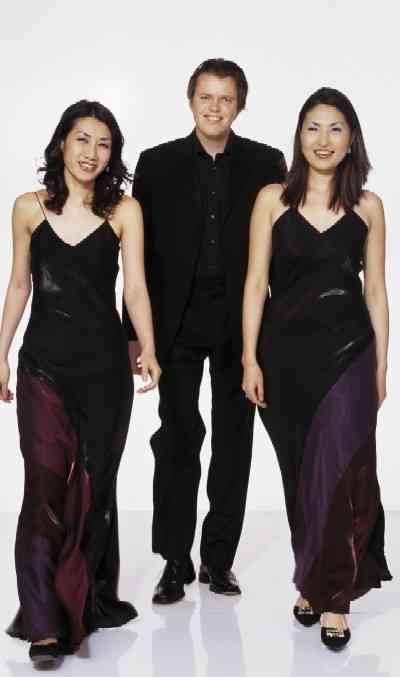
The performance by Trio Con Brio in Kansas City on Saturday, 02-FEB-2008, thrilled the appreciative audience. The program consisted of Beethoven’s Op. 1 No. 1, Shostakovich’s Op. 67, and the Ravel Trio, capped by an encore of the 5th movement of Dvorák’s ‘Dumky’.

    Trio Con Brio Copenhagen
  • Soo-Jin Hong, violin
  • Soo-Kyung Hong, cello
  • Jens Elvekjaer, piano
The Trio Con Brio’s integration and cohesiveness were superb—such a unity of anticipation of each other’s next steps, each other’s needs. Close your eyes. Is this the playing of three distinct musicians, or is it the happy subordination by each, to the needs of the organism that, together, they comprise? Schools of fish, flocks of birds, herds of synchronized gazelles are not so beautifully coordinated as this! Fascinating!


    [50-sec clip, Dmitri Shostakovich, Piano Trio No. 2, Op. 67, Andante, Trio Con Brio, 1.5MB MP3]

    [50-sec clip, Dmitri Shostakovich, Piano Trio No. 2, Op. 67, Andante, Trio Con Brio, 1.5MB MP3]

    [50-sec clip, Dmitri Shostakovich, Piano Trio No. 2, Op. 67, Largo, Trio Con Brio, 1.5MB MP3]

    [50-sec clip, Dmitri Shostakovich, Piano Trio No. 2, Op. 67, Largo, Trio Con Brio, 1.5MB MP3]

Throughout the performance on Saturday evening, Trio Con Brio’s dynamics and phrasing were ‘alive’. Breathing, sighing—collectively, a unified and ‘pneumatic’ interpretation that was inspired and inspiring.

This was all the more remarkable to me as I thought about what the nature of their rehearsals might be like—involving the two Hong sisters, and Jens married to Soo-Kyung Hong; involving the mixing of Danish attitudes and culture and Korean attitudes and culture. The ensemble has been together now for more than 8 years, but still—there must be moments when opinions among them diverge and disagreements between them as individuals bring friction!

And yet, apparently, such moments are amazingly few. Jens is, by nature and upbringing, a charming and modest person, despite his impressive skill as a pianist. The same is also true for Soo-Jin and Soo-Kyung, even though their charm and modesty hail from Korea, half a world away from Denmark. Each of the three is warm, optimistic, exuberant—in the playing, and in conversation after the performance. The ways that each of the three of them has for achieving this wonderful balance of collectivism and individualism may differ, but the musical result is a beautiful and deeply meaningful one. Bravo!

 Trio Con Brio
T  he Korean self is profoundly collectivist while deeply committed to individual self-assertion... I do not assume there is a code—a key value that resolves the conflict. All selves are built up from incompatible elements, and they stay that way... [The Korean self] is not so much a ‘modal’ self as an ‘ideal’ one, reflecting the ideals of Korean culture... kibun—the state of the self-in-society... Koreans are not separate individuals—at least they do not see themselves as such in the same way as Westerners—so the individualistic competition you see Koreans engage in is not really competition among individuals at all [in their view], but among families, the individual always representing more than himself or herself... an ‘amoral familism’.”
  —  C. Fred Alford, The Self Is a Conflict, Not a Continuum, p. 31.
L ee Soo-Won uses the word ‘chong’ to characterize the collective self and ‘exchange’ to characterize the individual self. ‘It is chong that enables us to overcome our own point of view in relationships and fit into the group.’ Lee does not distinguish between good (‘koun) and bad (‘miun’) chong, or between affection and attachment, including those attachments that may be destructive. Does it make any sense to say that Eunyoung has a porous ego, that she is less autonomous than one who gives up everything for love? Does it not make more sense to say that she knows her values, what she cares about, and that one cannot have all of everything one wants, and she is aware of how she would choose? Are these not the attributes of a strong self who knows that reality means choices among values? That hers is a strong group self makes no difference in this regard! Hers is still a strong self—highly individuated without being separated. Koreans are actually more self-aware than Americans because Koreans are more aware of their relationships. Self-awareness is not awareness of a ‘pristine’ self. There is no such thing. Self-awareness is awareness of the self-in-interaction with others, including others who exist only in our memories. Koreans do not have ‘Emersonian Moments’. There are other forms of self-awareness, forms that actually come much closer to what it means to be a real self in the world.”
  —  C. Fred Alford, Why Do Koreans Say ‘We’ and Instead Do ‘I’ ?, p. 55.


Sunday, December 16, 2007

Francis Pott Beyond the Angle of Repose: Feeling Unreal, amidst Clouds of Unknowing

Francis Pott
A nd therefore lift up thy head with a blind stirring of love; For if it begin here, it shall last without end.”
  —  Psalm 90.

he] first performance of The Cloud was attended by some who had been caught up in the tragic events of ‘07/07’ [terrorist bombing in London]. While it is mistaken to view the music as a reaction to that event, which its completion predated, such happenings offer melancholy confirmation of an enduring darkness at the heart of man, and of his capacity for acts of atrocity alongside selfless heroism. For as long as mankind continues to crucify its messengers of peace, it will fail to see the means of salvation which may always have lain in its own hands. Notwithstanding those who would decry bailing out humanity’s sinking ship through the exercise of artistic expression, the contemporary individual spared terror and suffering at first hand can neither turn away nor remain immune to words written by a surviving Polish Second War poet, Jerzy Ficowski, which resonate still as our world attempts today and tomorrow to rise above the mortal tide of its own suffering:

‘ I did not manage to save
  A single life
  I did not know how to stop
  A single bullet…
  I run
  To help where no one called
  To rescue after the event
  I want to be on time
  Even if I am too late.’

[Tr. by Keith Bosley, Krystyna Wandycz]”
  —  Francis Pott, Cloud of Unknowing, Program Notes.
D edicated ‘to Margaret Hassan and all innocent lives lost in Iraq or beyond’, Pott’s monumental, eloquent take on senseless violence and shameful hypocrisy offers a shield to the spirit against those who would destroy it. Unmissable.”
  —  Andrew Stewart, ClassicFM Magazine, SEP-2007.
O ne sometimes writes, hyperbolically, of a performance moving one to tears. But at the end of Francis Pott’s ‘The Cloud of Unknowing’, genuine tears were shed. …A heartfelt plea for reconciliation and tolerance is very much the theme of Pott’s oratorio. But the work is far from being simplistic peace propaganda. The [50-year-old] composer draws his texts from the psalms, war poets, Blake and other visionary writers, and a mystical mediaeval tract. These are arranged in such a way that mankind's instinctive tendency to lash out at enemies or perceived enemies is continually, and often ironically, contrasted with individual man’s capacity for heroism and self-sacrifice, as epitomised by the Crucifixion.”
  —  Richard Morrison, The Times, MAY-2005.
I  listened yesterday to Andrew Imbrie’s ‘Angle of Repose’, his famous choral work based on Wallace Stegner’s Pulitzer Prize-winning religious novel of the same name. And then, oddly enough, my iPod’s random shuffle served up Francis Pott’s ‘Cloud of Unknowing’.

In physics, the ‘angle of repose’ is a phrase denoting the angle or slant at which objects on an inclined plane cease to slide downward and instead come to rest and are stable at rest—the point at which the gravitational force urging them downward is offset by friction and mutual cohesion. The emphasis Imbrie places on the ‘angle’ concept in his religious choral work implies that the doxastic ‘angle of repose’ is not hospitable to growth of belief but is instead a concept of loss or curtailment or restriction. According to Imbrie, faith becomes less significant and less conventional as we move to that angle of stillness where the aporias of the human condition and immanent evil in the world stand in contrast to the notion of a beneficent God.

Some related philosophy-of-religion questions arise:
  • Can faith flourish if (through a person’s choices or through a chain of events not of the person’s choosing— ) it reaches a cognitive angle of repose? Can faith (or, for that matter, knowledge) grow if it’s tenuously positioned precisely at the angle of repose? Is there beauty and value in a windswept dwarf tree that clings to a cliff—or must we always prefer a farmer’s exclusionary concept of beauty-as-prolific-production, or an investor’s—one who values only perpetually greater and greater returns, alpha without end?
  • Conversely, is faith genuine if the minimum angle at which movement occurs is artificially increased by pouring a cement of church dogma on the surface of belief? What authenticity can faith have if you stay always in the flatland, far away from slopes and cliffs, and never venture into steep regions where the pitch of the epistemological terrain exceeds the angle of repose?
In medieval times, the text known as ‘The Cloud of Unknowing’ was meant to serve as a guide to the contemplation of God’s goodness—in a world obviously filled with suffering and evil. By contrast to the historical meditative purpose of ‘Cloud’, Francis Pott uses the text in his commission for the Vasari Singers to provide a withering critique of humanity’s heart of darkness. Pott’s ‘Cloud’ is an unrelenting 88-minute essay on a world riddled by dominionist, fundamentalist ideologies—Christian, Islamist, free-market capitalist.

Vasari Ensemble, photo by Canetty-Clarke
The libretto culminates in a brutal, ironic juxtaposition of ‘The Lord is on our side’ and Psalm 137:9——‘Blessed are they that taketh their children and dasheth the little ones against the stones’——while the tenor soloist futilely again and again tolls ‘The dead are all on the same side’, a line by the French WWI poet, René Arcos. We are way beyond any tenable religious angle of repose here. This is free-fall.

Particularly menacing in [Potts’ ‘Cloud of Unknowing’] fantastical design is ‘Is this He that was transfigured?’, an amorphous musical space that might have been filled by Arvo Pärt just as readily, or perhaps even Herbert Howells. In fact, it is the calculated exploitation of that most indispensable of musical building blocks – absolute silence – that fixes these choral and solo events together so utterly convincingly. The choir is never more stirring than in ‘In one little time may heaven be won and lost’, a chilling yet strangely conciliatory entreaty that trickles forward from an unending musical breath.”
  —  Mark Tanner, International Record Review, NOV-2007.


The original mystical/esoteric Christian text, ‘Cloud of Unknowing’, was written in the 1390s by an unknown English author, possibly Adam Easton, Cardinal of Norwich. Since God cannot be known by reasoning, the author tells the reader to dispense with any rational discourse entirely and to be submissive in a cloud of forgetting. The reader—a 24 year-old woman novitiate—is told to forget, forget, forget. Empty your mind. Blind, diffuse agape love is all that matters.

W   hat we have, then, in ‘The Cloud’ is a continuing polite bowing to the authority of traditional Augustinian sub-faculties of the mind—later to be rejected altogether by Descartes—but at the same time an entirely new sense of freedom of choice in stripping back to one key faculty of divine apprehension, in this case the [uninformed, anti-intellectual] will.”
  —  Sarah Coakley, p. 81.
There are parallels in the ‘unknowing’ quietistic memes of Zen and Zen Buddhism, of course. But those are not so adamantly opposed to or dismissive of discourse and reason as the ‘Cloud of Unknowing’. For the medieval author of ‘Cloud’, a mystical, pious, contemplative state of mind is the card that trumps all others. ‘Cloud’ exalts a pseudo-Dionysian annihilation of the self as the highest goal to which any human can aspire. It privileges solitary, anchoritic, quietistic, monkish ways—and disparages discourse. We are to give up our impious individual identities and assimilate ourselves into the Borg.

A  one-syllable workd such as ‘love’ is best. Choose one that is meaningful to you, then fix it in your mind so that it will remain there, come what may. This word will be your defense in conflict and in peace. Use it to beat upon the cloud of darkness above you and consign all distractions to the cloud of forgetting beneath you.”
  —  William Johnston, p. 56.
Have a look at Johnston’s translation. The 1390s Cloud is a zombie-like, self-mutilating cataphatism. We are told to renounce our social responsibilities for pious meditation—for neoplatonic, anti-intellectual self-absorption. (Or maybe it’s not cataphatic but instead apophatic—it doesn’t bind any specific Christian image of God; it’s imageless.) Cloud recommends that a pious will must rule the intellect. It maintains that bona fide spirituality involves the power of love only, and never the mind, never knowledge.

Francis Pott’s composition takes this medieval text and collides it with bible verses and canonical liturgical elements. The result is this stark and cautionary assessment of the role of religion in today’s world.

W   e want to believe that the culture we live in is stable and dependable, that the moral confusion and depravity we see around us are merely aberrations of settled and established moralities, deviations from the rule of social convention [but recent events and trends have made such belief untenable, except by ignoring/denying those recent facts and events and trends].”
  —  James Davison Hunter, p. 221.
Some people have difficulty thinking critically or are uncomfortable because reasoning troubles the heart. Reasoning reveals problems which may not be solvable but which nonetheless require human effort and attention to reduce them. So why not instead cleave to regimes that maintain that the process of thinking isn’t necessary? Why not instead cleave to ancient teachings that argue that thinking is forbidden by God and the prophets—teachings that ascribe unpleasant or demoralizing feelings to wrong thinking?

B efore the mountains came into being, or earth and world were created, Thou art, O God, from everlasting to everlasting.
Thou causest men to die and sayest: ‘Return, children of men.’
For a thousand years are in Thy sight as yesterday when it is past, and like a watch in the night.
Thou sweepest men to destruction. They are a dream. They are like grass which suddenly withers.
It blooms in the morning but is transformed at night. It is cut down and withers.”
  —  Psalm 90:2-6.
The adherent’s distress is reduced in proportion to the dumbing-down, the self-mutilation, the loss of identity. But what you don’t use you lose: the ability to think critically, the ability to remember the issues that pertain to the conflicts, the ability to remember who you are—these quickly atrophy. Eventually, the adherents no longer remember that they used to be able to think for themselves. According to van der Hart and colleagues, Wenninger and Ehlers, and others, such people tend to have more dissociative parts of their personality. They frequently have an ‘amnesia for their amnesia’, not recognizing that they have any impairment. They deny that any conflicts or trauma ever existed.

T o have a renewal of character is to have a renewal of a creedal order that constrains, limits, binds, obligates, and compels.... [Instead,] we want character but without effort or conviction.... We want virtue but without particular moral justifications that invariably offend.... We want decency without the authority to insist upon it.”
  —  James Davison Hunter.
Victims of trauma bring to the treatment setting an extreme level of emotional intensity and level of distress that touch, surpass and transform the empathic sensitivity of clinicians who listen to their stories. Clinicians providing care to the victims are overcome by the empathic strain. And that strain jeopardizes the effectiveness of subsequent care by blunting the clinicians’ understanding of patients’ internal psychological dynamics. This music is beautiful and cathartic for us care-givers. But it is also stressful in its own right and, therefore, to be taken in moderation. Read the package insert carefully. Use only as-directed.

I n the two months immediately after the events people’s characteristics of gratitude, kindness, hope, leadership, love, spirituality—strengths connected
through a virtue-based view—were all significantly elevated... ”
  —  C. Peterson & M. Seligman, Character strengths before and after September 11. Psych Sci 2003; 14: 381-4. (Survey of 4,817 residents of NYC in 2002)
.
[Francis Pott’s other sacred choral works, including ‘My Song is Love Unknown’, ‘Christus’, and ‘The Souls of the Righteous’, are less apocalyptic/iconoclastic than ‘Clouds’ or his oratorio ‘A Song on the End of the World’. He was previously Lecturer in Music at St Hilda’s College, Oxford, from 1992 to 2001, and since then has been Head of Music and Composition at London College of Music & Media, in Ealing, West London. In 1997, Pott won First Prize in the S. S. Prokofiev International Composing Competition in Moscow. ]

I n a final coup, Pott rudely interrupts the serenity with an anguished reminder of Christ’s cry from the cross, this time sung, harrowingly, by the soloist. But then a state of calm is reached at last as the choir sings an extended final Amen. The work ends with one last, enigmatic and hushed organ chord, which lasts for some 28 seconds and which, in the composer’s words, ‘enfolds all in its own seemingly eternal cloud of unknowing.’ I listened, enthralled, to this major addition to the choral repertoire. I can’t commend Signum highly enough for having the vision and the commercial courage to issue this recording.”
  —  John Quinn, MusicWeb International, OCT-2007.
I n character it is a work of pessimism and deep foreboding. The opening sections in particular pose a huge challenge for the choir, who are required to sing very quietly with every syllable stretched out to its fullest extent, often well beyond the point where the words become indistinguishable and we are indeed faced with a cloud of unknowing. But these clouds disperse to be replaced by visions of the Four Horsemen of the Apocalypse, intersecting with the mysticism of William Blake—potentially a powerfully heady mix, but one which I found to be perversely lacking in either menace or horror. An extended setting of Psalm 23, which the composer describes as a retreat from the noise of battle, marks a transition phase and the breakpoint between the two CDs. From here on the work settles into a quiet melancholy, a mood which sits very comfortably with Pott’s style, and a composition of significant stature emerges. Words become clear and telling, and in an atmosphere of gentle supplication the agony and the anguish of a conflict torn world are revealed.”
  —  Serena Fenwick, Musical Pointers, SEP-2007.

Simeon & Abugel book