Showing posts with label PTSD. Show all posts

Sunday, March 29, 2009

Relational Semantics: Lutosławski’s Beauty of Indeterminacy, Surprise of Proportion

 Ariadne and Miri, Leitheim, 2001
A    fter 1961 Lutosławski worked largely independently of the fashions of the European avant-garde, refining and extending a compositional technique that produced, to use Bogusław Schäffer’s phrase, ‘stylistically the most independent works of modern European music’ ... Bohdan Pociej once described Lutosławski’s mature works in terms of four tendences: (1) the constant endeavour to achieve a ‘system’, to implement it, and to find one’s own personality [and social destiny] through it; (2) the harmonic, colouristic tendency—borne of a ‘Debussyan’ fascination with pure sound, grounded in a comprehensive [Cernerian] architecture of inter-related chords; (3) the poly-chronic tendency, reflected in a constant and intense inclination to organize ‘parallel plots’ and to split the composition into many interpenetrating levels and planes—to fill the musical space with multi-directional and multi-tiered motions; and (4) the dramatic tendency expressing itself in conflict, confrontation, struggle—in the various vicissitudes of form.”
  —  Steven Stucky, p. 107.
T he new recording of Lutosławski’s works for violin and piano, by Ariadne Daskalakis and Miri Yampolsky, has captured my imagination these past several days—and it may well capture yours as well.

  • Recitative e arioso (1951)
  • Partita (1984) [commissioned by Saint Paul Chamber Orchestra and premiered by Pinchas Zucherman and Marc Neikrug in January 1985 in Minnesota]
  • Subito (1992) [his final completed composition, before his death in 1994 at age 81; written for the International Violin Competition in Indianapolis]
T hese are pieces of tremendous clarity, alignment, and focus. They are, in fact, astonishing for a sort of post-traumatic stress disorder (PTSD) sort of ‘urgent, combative hyperclarity’.


    [50-sec clip, Daskalakis & Yampolsky, Lutosławksi, ‘Recitative e arioso’, 1.6MB MP3]


    [50-sec clip, Daskalakis & Yampolsky, Lutosławksi, ‘Partita’, 1.6MB MP3]


    [50-sec clip, Daskalakis & Yampolsky, Lutosławksi, ‘Subito’, 1.6MB MP3]

L utosławski destabilizes the chromaticism in the violin part characteristic. Opposing this, the piano has vertically symmetrical chords and seems to offer respite and restore stability. Lutosławski’s early love of mathematics and the aesthetics of symmetrical are evident here—when the distances between adjacent tones in the chords are measured, one gets a numerical pattern of pitches that is invertible ... the same whether measured from the top to bottom or bottom to top.

T he developments and the transitions are beautiful, and their beauty and coherence leads us to imagine that there can be success and a happy conclusion, if only we can be sufficiently mindful and ‘good enough’. But the best and most diligent efforts can be for nought, and our grip on success can slip away. Passages that initially sound complete and self-contained turn out to be erodable or transitory ... stuff happens.

T he violin part struggles existentially. Life and its accumulated burdens take their toll, and the violin ends up (in ‘Subito’) chromatically down a half-step from where it started.

T he motoric chromaticism of the violin and the contrast provided by the piano are beautifully rendered in the Subito and the Partita.

H ear these three pieces together, one after the other on this disc. You will be impressed by Lutosławski’s skill in constructing relational algebraic expressions (Verhaltniss). Which part is the operator and which is the operand? Is the violin-piano matrix singular? Is the operation that they just played ‘commutative’?

T he size and prominence of a part are context-dependent and comparative qualities—you form an impression of them only in relation to other parts, or to the overall whole. Size and prominence are indeterminate—indefinite qualities that empower the performer/listener. They can increase or diminish without limit; there is interpretive latitude—so much latitude, in fact, that it may lead to PTSD-like anxiety, agoraphobia.

O ur judgment about the relation of parts arises both from the evidence that’s provided in a particular piece (or performance) and from custom. These make us used to specific proportions, such that wide deviations from them strike us as novel or exaggerated or contradictory. If we hear something that’s common or familiar, our expectations are already pre-conditioned and we tend to hear what we are expecting to hear. But if we hear something that’s unusual, or if a familiar pattern or relationship has a part that is relatively larger or smaller proportioned than what’s customary, then it awakens ideas about uncertainty and disparity.

A nd it’s not just the scope or extent or prominence of a part where we are awakened by relational contrasts. There can be semantic misrelations as well. Paradoxically little stimulation evokes impressions of despair, depression. Unexpectedly abundant stimulation evokes impressions of mania, agitation. The Recitative e arioso is dark, dark, dark. The year 1951 must have afforded Lutoslawski lots of dark moments to propel this piece—and Daskalakis plays as though she understands this from the inside-out. The bowing technic admits alternately of great energy [“This is how I was mistreated, and here is what I did to oppose them.”] and then of great vulnerability [“At last there was nothing more we could do, and we had to wait and see what the outcome would be.”]. The consonance of performance and writing is wonderful, an embodiment of good relations between the semantics of the composer and the gestures of the performers—Daskalakis and Yampolsky alike.

T he so-called ‘poly-agogics’ that Lutosławski uses are tastefully handled. Polyagogics are simultaneous accelerandos in one part and slight ritardandos in the other part. These microrhythms amount to a kind of polymeter—a transient complexity that confers extra tension on the piece. The Subito and the Partita have poly-agogic features, often associated with veiled or pensive, waiting, uncertain passages. I will need to get a copy of the score, to see how many of the poly-agogic rhythms are notated ones and how many of them are extemporized by Daskalakis and Yampolsky. Either way, their skill and faithfulness to what Lutosławski meant are to be commended—a fantastic Naxos CD.

A riadne is the new Dean of Strings for the Hochschule für Musik Cologne. She is also leader of the Berlin-based Ensemble Oriol and of the Manon Quartet.

 Lutosławski 1993, photo (c) Freeman


Saturday, January 26, 2008

Neurodiversity: Borromeo Quartet Brings Beethoven’s Op. 130 + Op. 133 Temperament to Life

Borromeo Quartet, photo Steiner
I n but one extraordinary passage, marked ‘beklemmt’, does the first violin break into a kind of anguished recitative whose obstreperous rhythm challenges the solemn gait of the lower instruments and threatens to rupture the music asunder. The emotion is purged, however, and the violin rejoins its companions to murmur once again the theme of the opening. Beethoven left the question of the Quartet’s finale unsettled, so that the work may be performed with either the Große Fuge of the original version or the substitute Rondo movement that he provided for it shortly before his death. This latter movement, a splendid piece of music, was written in the manner of continuous thematic expansion and development that was central to the style of his last years. With its thrusting rhythms and brief returns of its Gypsy-tinged opening theme, the movement has about it a … stubborn unwillingness to be bent into the tonic key of B-flat major.”
  —  Richard Rodda, 2005.
I ts official title is really a misnomer, for the movement incorporates an introduction, a double fugue, a slower and only mildly contrapuntal section brought about with an abrupt modulation from B-flat to G-flat, a scherzo that is soon overwhelmed by a resumption of the fiercest fugal developments, followed by a stream of afterthoughts and retrospects.”
  —  Denis Matthews.
G reat wits are sure to madness near allied—
And thin partitions do their bounds divide.”
  —  John Dryden, 1662.
W ell, if you ask writers and artists who have depression, severe depression or manic depression, what they feel is important to them about their illness and their moods in their work, what they almost always focus upon is the intensity and the range of emotional expressiveness. Learning from the pain and from the suffering, they experience the sorrow, they experience the despair of the nihilism and so forth. And on the other hand, very ecstatic and visionary states. So that’s what artists and writers focus upon. I think it’s a lot more complicated than that. I think it’s also that people with manic depressive illness who have a particular temperament live a life of almost seemingly irreconcilable differences and opposite states that they somehow, on a day to day basis, have to reconcile. So people who have very disciplined and interesting and strong and creative minds, who also have this temperament, spend their lives having to make some order out of chaos and reconcile these opposite states. I think that a lot of what we ask from artists really is to experience extreme mood states, experience the extremes of human nature and experience, and put some new meaning and redemptive value in their work.”
  —  Kay Redfield Jamison, Live from Lincoln Center.
In late 1822, Prince Nikolas Galitzin of Russia commissioned several string quartets from Beethoven. Beethoven was preoccupied with work on the Missa Solemnis, Op. 123; the Diabelli Variations, Op. 120; and the Ninth Symphony, Op. 125, and delayed delivering the B-flat quartet and Große Fugue until 1825. Galitzin was understandably annoyed by the delays. He wasn’t chopped liver.

What’s more, in this third installment on the commission Galitzin got these six movements, including the two strange slow movements and the giant, fierce 16-minute Fuge. The two fugue subjects here are not playing nicey-nicey. They’re rhetorical adversaries, struggling with each other in musical armed conflict, taking no prisoners. There are winners and there’re losers.

The unhappy public reception of Op. 130 with the Fuge attached as-written led to the substitution of the alternate finale to Op. 130, the Rondo, which turned out to be Beethoven’s last finished composition. The deal was, Beethoven would provide the substitute Rondo on condition that the withdrawn Große Fuge would be issued separately, and Beethoven would get an additional fee. Right. The fugue was published posthumously as Op. 133. Why was the final release as Op. 133 delayed until after Beethoven had died? Who was the cause of the delays, and what were their motives? And how many composers today could engage their patrons in this way? The recklessness and extravagance of it are mind-boggling! Crazy!

In December, I did a post on bipolar (manic-depressive) illness and musical creativity. The occasion of last night’s performance by the Borromeo Quartet made me wonder once more about the diversity of varieties of depression that give rise to composers’ output. Several varieties are, I think, manifested in this Beethoven Quartet. Have a look at Larkin’s nice chapter in Cooper’s book on Beethoven for some extended analysis of signs and symptoms in Beethoven’s later life and works.

The Borromeo Quartet outdid themselves in last night’s incarnation of this wonderful, emotional work. The deep perplexity of the human condition was “in there”, in their performance of Op. 130 + Op. 133. The Rondo in place of the amputated Große Fuge? Somehow, it just doesn’t seem right. It’s a shame that Beethoven suffered so that we might have this work. And it’s possible that, back in his time, nothing could’ve been done to treat his condition or mitigate his suffering. But today the question is, ought such symptoms to be under-treated, so that we might have more works like this? Ought such symptoms to be medically induced, as a form of composer performance-enhancement?

P revailing conceptions of creativity in psychology and psychiatry derive from romanticist ideas about the creative imagination—they differ considerably from notions that are central in modernism and postmodernism. Whereas romanticism views creative inspiration as a highly emotional, Dionysian, or primitive state, modernism and postmodernism emphasize processes involving hyper-selfconsciousness and alienation (hyperreflexivity). Although manic-depressive or cyclothymic tendencies seem especially suited to creativity of the romantic sort, schizoid, schizotypal, schizophreniform, and schizophrenic tendencies have more in common with the anti-romantic sensibilities of modernism and postmodernism. I criticize the book by Kay Redfield Jamison, ‘Touched With Fire: Manic-Depressive Illness and the Artistic Temperament’, for treating romantic concepts of creativity as if they defined creativity in general. I argue that Jamison’s denial or neglect of the creative potential of persons in the schizophrenia spectrum relies on certain diagnostic oversimplifications: an overly broad conception of affective illness and an excessively narrow conception of schizophrenia that ignores the creative potential of the schizophrenia spectrum.”
  —  L Sass, Creativity Research J 2000; 13: 55-74.
T  aking the new antidepressants, some of my patients said they found themselves more ‘confident’ and ‘decisive’. Is this, I wonder, a categorically ‘good’ thing? I used these claims as a jumping-off point for speculation: what if future medications had the potential to modify personality traits in people who had never experienced mood disorder? [Drugs like MK-801, for example.] If doctors were given access to such drugs, how should they prescribe them? The inquiry moved from medical ethics to social criticism: what does our culture demand of us, in the way of assertiveness? What is the price of conformity?”
  —  Peter Kramer, There’s Nothing ‘Deep’ about Depression, 2005.

    Nine Temperament Characteristics
  • Activity level refers to the amount of physical energy in the child. Does the child have to be constantly moving or do they have a relaxing approach?
  • Regularity / Rhythmicity refers to the level of predictability in a child’s biological functions such as waking, becoming tired, feeding.
  • Approach / Withdrawal refers to how the child responds to new people or environments either positive or negative. Does the child check out people or things in their environment without hesitation or do they shy away?
  • Adaptability refers to how long it takes the child to adjust to change. Does the child adjust to the changes in their environment easily or are they resistant to what is happening around them?
  • Intensity refers to the energy level of a positive or negative response. Does the child react intensely to a situation or do they respond in a calm and quiet manner?
  • Mood refers to the child’s general tendency towards a happy or unhappy demeanor.
  • Distractibility refers to the child’s tendency to be sidetracked by other things going on around them. Does the child get easily distracted by what is happening in the environment around them or can they concentrate despite the interruptions?
  • Persistence & Attention Span refers to the child’s ability to stay with a task through frustrations and length of time on the task. Can the child stay with an activity for a long period of time or do they just give up when they become frustrated?
  • Sensitivity refers to how easily a child is disturbed by changes in their environment. Does the child get bothered by external stimuli in their environment such as noises, textures, lights, etc. or do they just seem not to be bothered by them at all?

Kagan & Snidman, Long Shadow of Temperament

 Borromeo Quartet, photo Linder


Friday, January 4, 2008

Stage Fright: More Treatment Options

Battaglia 2002, Fig. 1
A fter an episode of anxiety associated with performing, I feel strange—like I’m empty and numb. It feels like I am watching everyone else, but at a distance. It’s not an ‘out-of-body experience’ or anything like that. Not light-headed or dizzy. But I do feel short of breath—my breathing is fast, and my heart-rate is still fast—even though the performance is over and the reason for the anxiety is over. It’s really weird. I just feel like there’s a ‘distance’—like the other people are real and I am somehow not real. It makes me feel so alone. It goes on for hours. Usually I have to go to sleep, and when I wake up the next day I feel completely normal. Is this some ‘after-effect’ of anxiety or what? Is this what it feels like after a seizure or something?”
  —  Anonymous.
Since my previous posts on the stage-fright topic, I’ve received several comments/questions similar to the one above.

The neurologic state associated with an episode of stage fright is not an epileptic one. But the sensations afterward can feel almost ‘inter-ictal’, with some qualities similar to what people who’ve experienced a seizure feel. And Panic Disorder and PTSD share many clinical features—such as ‘anticipatory anxiety’ and depression and ‘intrusive imagery’—imagined potential scenarios that bug you. Functional MRI and other studies of regional cerebral blood flow are beginning to show similarities, too. So the after-effects of a solo concert—feeling like you may have PTSD—aren’t really that surprising, neurologically or physiologically speaking.

Some of you who’ve sent me comments have wondered whether there are objective ways to measure the severity of the anxiety you’ve experienced. Clinically, there are a variety of scores that are used, but most of them are lengthy questionnaires, and very few of them have been designed to be self-administered. The one by Snaith and colleagues is short, intended for self-admin, and it does address ‘panic attacks’. This is different from stage-fright per se, but it nonetheless might be a helpful and relevant gauge, for those of you who’ve asked about this. Here’s a spreadsheet I’ve prepared. You can download it by clicking on this screenshot.


Spreadsheet version of Clinical Anxiety Scale (CAS) of Snaith
Panic Disorder (in the DSM-IV diagnostic nomenclature) is characterized by recurrent panic attacks—that is, periods of intense anxiety—in which 4 (or more) of the following symptoms develop abruptly and reach a peak within 10 minutes:
  • palpitations, pounding heart, or accelerated heart rate;
  • sweating;
  • trembling or shaking;
  • sensations of shortness of breath;
  • feeling of choking or dry mouth and dry throat;
  • chest pain or discomfort;
  • nausea or abdominal distress;
  • feeling dizzy, unsteady, lightheaded, or faint;
  • de-realization (feelings of unreality) or de-personalization (being detached from oneself);
  • fear of losing control;
  • fear of collapsing or dying;
  • paresthesias (numbness or tingling sensations);
  • chills or hot flashes.
Keep in mind that Panic Disorder isn’t the same as stage-fright. But some people who are susceptible to panic attacks are performing artists. Diagnostically, there’s an “overlap” between the conditions. So empirically the approach to managing stage-fright might include cognitive behavioral therapy (CBT), deep-breathing and yoga, and medications that are used in full-blown panic disorder.

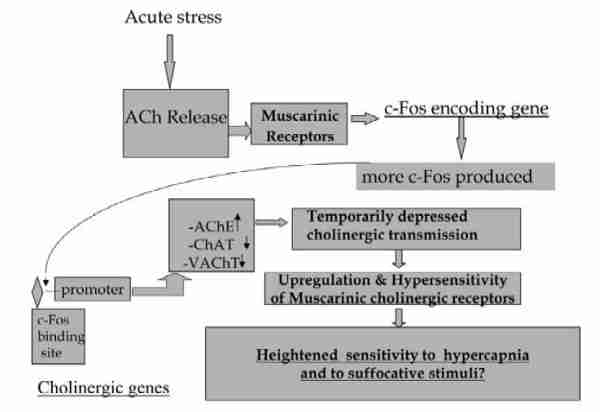
It turns out that central (brain) muscarinic cholinergic receptors are involved in our physiologic reactions to these stimuli (see the Battaglia chapter in Silman’s book for a short summary), including slight increases in CO2 in the bloodstream. The slight elevation of CO2 (hypercapnia) is what triggers the faster breathing and the racing heartbeat. And the acute stress causes an increase in the release of acetylcholine in the hippocampus in the brain (see Kaufer paper) that has a several-hours duration. Concomitantly, about 70% of people subject to panic attacks have increased sensitivity to lactate in the bloodstream, compared to healthy normals (Rosenbaum, p. 63). And that triggers faster breathing at lower blood lactic acid concentrations—at far lower levels of lactate than would cause hyperventilation in ‘normal’ unstressed people.

Also, recent research has shown that in panic attacks there’s an up-regulation of gene expression of cholinergic muscarinic receptors, cFOS, and other gene products. That up-regulation also lasts for hours—and is related to the increased sensitivity to CO2 and lactate.

In fact, since I’m not personally affected by panic attacks or stage-fright and since I don’t have any work-related reason to intensively follow the medical literature on the subject, I hadn’t previously seen the articles on anticholinergic drugs and panic attacks. But there’s actually quite a lot of new evidence for cholinergic causation of panic—accumulating evidence over the past 5 to 8 years or so. It’s not the sort of thing that your average GP would know about.

Curiously, inhibitors of the enzyme acetylcholinesterase (AChE) [for example, Alzheimer’s drugs, like donepezil (Aricept™), rivastigmine (Exelon™) and galantamine (Reminyl™); also neostigmine (Prostigmin™), pyridostigmine (Mestinon™) and other various cholinergic drugs used to treat myasthenia gravis] may induce sensations and cognitive changes that are reminiscent of post-traumatic stress disorder (PTSD), including de-personalization or feeling ‘distanced’ or unreal—very much like the symptoms described by the conservatory-student commenter above.

In other words, you can increase the number of acetylcholine receptors, or you can increase the sensitivity or binding affinity of the existing receptors, or you can increase the concentration of acetylcholine molecules available to bind to those receptors (by inhibiting AChE, the enzyme that metabolizes acetylcholine)—any of these changes can produce the same distinctive cognitive symptoms.

And, logically, you might think that doing the opposite—for example, using a drug that inhibits the binding of acetylcholine to the receptors, or a drug that enhances the activity of the AChE enzyme, or a drug that down-regulates the gene expression of the receptor or that post-transcriptionally changes the sensitivity of the receptors expressed—might offer some relief or prevent such symptoms. Yes, it’s been tried. Transdermal scopolamine and other strong anticholinergics don’t necessarily help panic attacks, though. But Battaglia’s work in Italy suggests that low doses of Akineton™ (biperiden, a weak anticholinergic drug) can help [see 2001 paper published in Arch Gen Psych ]. Anecdotal reports of the off-label use of biperiden for stage-fright also exist, although they’re not nearly as common as ones reporting the use of beta-blockers.

Of the various options, the biperiden should be relatively less likely to cause performance problems, compared to the others—compared to SSRIs, say. But, hours after the performance, brain cholinergic activity decreases below baseline. And then biperiden’s lingering activity (it has a 18 to 24-hour half-life) might be annoying—the day after your performance.

A  noradrenergic (catecholamine) mechanism of panic has been substantially repudiated in the past 15 years. Clonidine and other alpha-blockers are ineffective—that’s part of the evidence. And plasma and urine MHPG levels are not usually abnormal in the way one would expect if noradrenergic overactivity were the cause. And SSRIs are effective in panic attacks, which one would not expect if noradrenergic overactivity were the cause. In other words, the catecholamines in panic attacks seem to be the ‘effect’, not the ‘cause’. The beta-blockers mentioned in previous posts essentially address these ‘effects’, not the ‘causes’.

Serotonergic abnormalities are at least partly implicated—especially the 5-HT(1A) receptor—and this is the basis for the use of buspirone (Buspar™) or risperidone (Risperdal™) in panic disorder. GABAA / Benzodiazepine receptors (see Goddard, Gorman & Charney in Rosenbaum, pp. 57-92) have also been implicated—and that fact gives rise to another avenue of treatment/prevention possibilities.

The information on this page is not intended as medical advice and is not meant to be a substitute for individual medical judgment by a physician or other medical healthcare professional. The aim is to provide information and help in suggesting considerations for preventive care. The medications listed below should be used only after a medical examination and under the supervision of a doctor. Always consult a licensed healthcare provider for individualized advice on your health decisions.

    Medications that have been used in Panic Disorder
  • Anticonvulsants [levetiracetam (Keppra™, 500 mg bid)]
  • Serotoninergics [risperidone (Risperdal™, 4 mg qd, 5-HT(1A) and 5-HT(2) antagonist), buspirone (Buspar™, 10 mg bid, partial 5-HT(1A) agonist)]
  • SSRIs [paroxetine (Paxil™, 20 mg qd), sertraline (Zoloft™, 50 mg qd), fluoxetine (Prozac™, 20 mg qd), fluvoxamine (100 mg qd), citalopram (Celexa™, 20 mg qd), escitalopram (Lexapro™, 10 mg qd)]
  • Benzodiazepines [alprazolam (Xanax™, 1 to 4 mg qd), lorazepam (Ativan™, 2 mg qd), clonazepam (Klonopin™, 1 mg qd). ]
  • Anticholinergics [biperiden (Akineton™, 2 mg qd), possibly trihexyphenidyl (Artane™, 1 mg qd)]
Benztropine (Cogentin™, 1 mg qd) has a 36-hour half-life, far too long to be relevant to the stage-fright application. But trihexyphenidyl (Artane™, 1 mg qd) or other similar compounds should work effectively like Akineton™. The short 4-hour half-life of Artane might be an advantage. But there’s no journal literature on its use in Panic Disorder or stage fright, so far as I can tell. In any case, it would be prescribed off-label, low-dose.

Hope this helps. Let me know how things go, if you decide to pursue any of these things.

Incidentally, it’s unknown how occasional stressful events [like recitals] might mediate long-term neuronal plasticity in the brain. And it’s unknown whether repeated high-anxiety episodes of the sort experienced by some performing chamber musicians could lead to PTSD or, if they can in some cases lead to PTSD, how frequent or severe the episodes have to be to have a high probability of doing so. We won’t worry about it, since it seems not to have been examined in clinical trials or other studies. But the absence of evidence is not evidence of absence, and all that…


Sunday, December 16, 2007

Francis Pott Beyond the Angle of Repose: Feeling Unreal, amidst Clouds of Unknowing

Francis Pott
A nd therefore lift up thy head with a blind stirring of love; For if it begin here, it shall last without end.”
  —  Psalm 90.

he] first performance of The Cloud was attended by some who had been caught up in the tragic events of ‘07/07’ [terrorist bombing in London]. While it is mistaken to view the music as a reaction to that event, which its completion predated, such happenings offer melancholy confirmation of an enduring darkness at the heart of man, and of his capacity for acts of atrocity alongside selfless heroism. For as long as mankind continues to crucify its messengers of peace, it will fail to see the means of salvation which may always have lain in its own hands. Notwithstanding those who would decry bailing out humanity’s sinking ship through the exercise of artistic expression, the contemporary individual spared terror and suffering at first hand can neither turn away nor remain immune to words written by a surviving Polish Second War poet, Jerzy Ficowski, which resonate still as our world attempts today and tomorrow to rise above the mortal tide of its own suffering:

‘ I did not manage to save
  A single life
  I did not know how to stop
  A single bullet…
  I run
  To help where no one called
  To rescue after the event
  I want to be on time
  Even if I am too late.’

[Tr. by Keith Bosley, Krystyna Wandycz]”
  —  Francis Pott, Cloud of Unknowing, Program Notes.
D edicated ‘to Margaret Hassan and all innocent lives lost in Iraq or beyond’, Pott’s monumental, eloquent take on senseless violence and shameful hypocrisy offers a shield to the spirit against those who would destroy it. Unmissable.”
  —  Andrew Stewart, ClassicFM Magazine, SEP-2007.
O ne sometimes writes, hyperbolically, of a performance moving one to tears. But at the end of Francis Pott’s ‘The Cloud of Unknowing’, genuine tears were shed. …A heartfelt plea for reconciliation and tolerance is very much the theme of Pott’s oratorio. But the work is far from being simplistic peace propaganda. The [50-year-old] composer draws his texts from the psalms, war poets, Blake and other visionary writers, and a mystical mediaeval tract. These are arranged in such a way that mankind's instinctive tendency to lash out at enemies or perceived enemies is continually, and often ironically, contrasted with individual man’s capacity for heroism and self-sacrifice, as epitomised by the Crucifixion.”
  —  Richard Morrison, The Times, MAY-2005.
I  listened yesterday to Andrew Imbrie’s ‘Angle of Repose’, his famous choral work based on Wallace Stegner’s Pulitzer Prize-winning religious novel of the same name. And then, oddly enough, my iPod’s random shuffle served up Francis Pott’s ‘Cloud of Unknowing’.

In physics, the ‘angle of repose’ is a phrase denoting the angle or slant at which objects on an inclined plane cease to slide downward and instead come to rest and are stable at rest—the point at which the gravitational force urging them downward is offset by friction and mutual cohesion. The emphasis Imbrie places on the ‘angle’ concept in his religious choral work implies that the doxastic ‘angle of repose’ is not hospitable to growth of belief but is instead a concept of loss or curtailment or restriction. According to Imbrie, faith becomes less significant and less conventional as we move to that angle of stillness where the aporias of the human condition and immanent evil in the world stand in contrast to the notion of a beneficent God.

Some related philosophy-of-religion questions arise:
  • Can faith flourish if (through a person’s choices or through a chain of events not of the person’s choosing— ) it reaches a cognitive angle of repose? Can faith (or, for that matter, knowledge) grow if it’s tenuously positioned precisely at the angle of repose? Is there beauty and value in a windswept dwarf tree that clings to a cliff—or must we always prefer a farmer’s exclusionary concept of beauty-as-prolific-production, or an investor’s—one who values only perpetually greater and greater returns, alpha without end?
  • Conversely, is faith genuine if the minimum angle at which movement occurs is artificially increased by pouring a cement of church dogma on the surface of belief? What authenticity can faith have if you stay always in the flatland, far away from slopes and cliffs, and never venture into steep regions where the pitch of the epistemological terrain exceeds the angle of repose?
In medieval times, the text known as ‘The Cloud of Unknowing’ was meant to serve as a guide to the contemplation of God’s goodness—in a world obviously filled with suffering and evil. By contrast to the historical meditative purpose of ‘Cloud’, Francis Pott uses the text in his commission for the Vasari Singers to provide a withering critique of humanity’s heart of darkness. Pott’s ‘Cloud’ is an unrelenting 88-minute essay on a world riddled by dominionist, fundamentalist ideologies—Christian, Islamist, free-market capitalist.

Vasari Ensemble, photo by Canetty-Clarke
The libretto culminates in a brutal, ironic juxtaposition of ‘The Lord is on our side’ and Psalm 137:9——‘Blessed are they that taketh their children and dasheth the little ones against the stones’——while the tenor soloist futilely again and again tolls ‘The dead are all on the same side’, a line by the French WWI poet, René Arcos. We are way beyond any tenable religious angle of repose here. This is free-fall.

Particularly menacing in [Potts’ ‘Cloud of Unknowing’] fantastical design is ‘Is this He that was transfigured?’, an amorphous musical space that might have been filled by Arvo Pärt just as readily, or perhaps even Herbert Howells. In fact, it is the calculated exploitation of that most indispensable of musical building blocks – absolute silence – that fixes these choral and solo events together so utterly convincingly. The choir is never more stirring than in ‘In one little time may heaven be won and lost’, a chilling yet strangely conciliatory entreaty that trickles forward from an unending musical breath.”
  —  Mark Tanner, International Record Review, NOV-2007.


The original mystical/esoteric Christian text, ‘Cloud of Unknowing’, was written in the 1390s by an unknown English author, possibly Adam Easton, Cardinal of Norwich. Since God cannot be known by reasoning, the author tells the reader to dispense with any rational discourse entirely and to be submissive in a cloud of forgetting. The reader—a 24 year-old woman novitiate—is told to forget, forget, forget. Empty your mind. Blind, diffuse agape love is all that matters.

W   hat we have, then, in ‘The Cloud’ is a continuing polite bowing to the authority of traditional Augustinian sub-faculties of the mind—later to be rejected altogether by Descartes—but at the same time an entirely new sense of freedom of choice in stripping back to one key faculty of divine apprehension, in this case the [uninformed, anti-intellectual] will.”
  —  Sarah Coakley, p. 81.
There are parallels in the ‘unknowing’ quietistic memes of Zen and Zen Buddhism, of course. But those are not so adamantly opposed to or dismissive of discourse and reason as the ‘Cloud of Unknowing’. For the medieval author of ‘Cloud’, a mystical, pious, contemplative state of mind is the card that trumps all others. ‘Cloud’ exalts a pseudo-Dionysian annihilation of the self as the highest goal to which any human can aspire. It privileges solitary, anchoritic, quietistic, monkish ways—and disparages discourse. We are to give up our impious individual identities and assimilate ourselves into the Borg.

A  one-syllable workd such as ‘love’ is best. Choose one that is meaningful to you, then fix it in your mind so that it will remain there, come what may. This word will be your defense in conflict and in peace. Use it to beat upon the cloud of darkness above you and consign all distractions to the cloud of forgetting beneath you.”
  —  William Johnston, p. 56.
Have a look at Johnston’s translation. The 1390s Cloud is a zombie-like, self-mutilating cataphatism. We are told to renounce our social responsibilities for pious meditation—for neoplatonic, anti-intellectual self-absorption. (Or maybe it’s not cataphatic but instead apophatic—it doesn’t bind any specific Christian image of God; it’s imageless.) Cloud recommends that a pious will must rule the intellect. It maintains that bona fide spirituality involves the power of love only, and never the mind, never knowledge.

Francis Pott’s composition takes this medieval text and collides it with bible verses and canonical liturgical elements. The result is this stark and cautionary assessment of the role of religion in today’s world.

W   e want to believe that the culture we live in is stable and dependable, that the moral confusion and depravity we see around us are merely aberrations of settled and established moralities, deviations from the rule of social convention [but recent events and trends have made such belief untenable, except by ignoring/denying those recent facts and events and trends].”
  —  James Davison Hunter, p. 221.
Some people have difficulty thinking critically or are uncomfortable because reasoning troubles the heart. Reasoning reveals problems which may not be solvable but which nonetheless require human effort and attention to reduce them. So why not instead cleave to regimes that maintain that the process of thinking isn’t necessary? Why not instead cleave to ancient teachings that argue that thinking is forbidden by God and the prophets—teachings that ascribe unpleasant or demoralizing feelings to wrong thinking?

B efore the mountains came into being, or earth and world were created, Thou art, O God, from everlasting to everlasting.
Thou causest men to die and sayest: ‘Return, children of men.’
For a thousand years are in Thy sight as yesterday when it is past, and like a watch in the night.
Thou sweepest men to destruction. They are a dream. They are like grass which suddenly withers.
It blooms in the morning but is transformed at night. It is cut down and withers.”
  —  Psalm 90:2-6.
The adherent’s distress is reduced in proportion to the dumbing-down, the self-mutilation, the loss of identity. But what you don’t use you lose: the ability to think critically, the ability to remember the issues that pertain to the conflicts, the ability to remember who you are—these quickly atrophy. Eventually, the adherents no longer remember that they used to be able to think for themselves. According to van der Hart and colleagues, Wenninger and Ehlers, and others, such people tend to have more dissociative parts of their personality. They frequently have an ‘amnesia for their amnesia’, not recognizing that they have any impairment. They deny that any conflicts or trauma ever existed.

T o have a renewal of character is to have a renewal of a creedal order that constrains, limits, binds, obligates, and compels.... [Instead,] we want character but without effort or conviction.... We want virtue but without particular moral justifications that invariably offend.... We want decency without the authority to insist upon it.”
  —  James Davison Hunter.
Victims of trauma bring to the treatment setting an extreme level of emotional intensity and level of distress that touch, surpass and transform the empathic sensitivity of clinicians who listen to their stories. Clinicians providing care to the victims are overcome by the empathic strain. And that strain jeopardizes the effectiveness of subsequent care by blunting the clinicians’ understanding of patients’ internal psychological dynamics. This music is beautiful and cathartic for us care-givers. But it is also stressful in its own right and, therefore, to be taken in moderation. Read the package insert carefully. Use only as-directed.

I n the two months immediately after the events people’s characteristics of gratitude, kindness, hope, leadership, love, spirituality—strengths connected
through a virtue-based view—were all significantly elevated... ”
  —  C. Peterson & M. Seligman, Character strengths before and after September 11. Psych Sci 2003; 14: 381-4. (Survey of 4,817 residents of NYC in 2002)
.
[Francis Pott’s other sacred choral works, including ‘My Song is Love Unknown’, ‘Christus’, and ‘The Souls of the Righteous’, are less apocalyptic/iconoclastic than ‘Clouds’ or his oratorio ‘A Song on the End of the World’. He was previously Lecturer in Music at St Hilda’s College, Oxford, from 1992 to 2001, and since then has been Head of Music and Composition at London College of Music & Media, in Ealing, West London. In 1997, Pott won First Prize in the S. S. Prokofiev International Composing Competition in Moscow. ]

I n a final coup, Pott rudely interrupts the serenity with an anguished reminder of Christ’s cry from the cross, this time sung, harrowingly, by the soloist. But then a state of calm is reached at last as the choir sings an extended final Amen. The work ends with one last, enigmatic and hushed organ chord, which lasts for some 28 seconds and which, in the composer’s words, ‘enfolds all in its own seemingly eternal cloud of unknowing.’ I listened, enthralled, to this major addition to the choral repertoire. I can’t commend Signum highly enough for having the vision and the commercial courage to issue this recording.”
  —  John Quinn, MusicWeb International, OCT-2007.
I n character it is a work of pessimism and deep foreboding. The opening sections in particular pose a huge challenge for the choir, who are required to sing very quietly with every syllable stretched out to its fullest extent, often well beyond the point where the words become indistinguishable and we are indeed faced with a cloud of unknowing. But these clouds disperse to be replaced by visions of the Four Horsemen of the Apocalypse, intersecting with the mysticism of William Blake—potentially a powerfully heady mix, but one which I found to be perversely lacking in either menace or horror. An extended setting of Psalm 23, which the composer describes as a retreat from the noise of battle, marks a transition phase and the breakpoint between the two CDs. From here on the work settles into a quiet melancholy, a mood which sits very comfortably with Pott’s style, and a composition of significant stature emerges. Words become clear and telling, and in an atmosphere of gentle supplication the agony and the anguish of a conflict torn world are revealed.”
  —  Serena Fenwick, Musical Pointers, SEP-2007.

Simeon & Abugel book