Showing posts with label bipolar disorder. Show all posts

Saturday, January 26, 2008

Neurodiversity: Borromeo Quartet Brings Beethoven’s Op. 130 + Op. 133 Temperament to Life

Borromeo Quartet, photo Steiner
I n but one extraordinary passage, marked ‘beklemmt’, does the first violin break into a kind of anguished recitative whose obstreperous rhythm challenges the solemn gait of the lower instruments and threatens to rupture the music asunder. The emotion is purged, however, and the violin rejoins its companions to murmur once again the theme of the opening. Beethoven left the question of the Quartet’s finale unsettled, so that the work may be performed with either the Große Fuge of the original version or the substitute Rondo movement that he provided for it shortly before his death. This latter movement, a splendid piece of music, was written in the manner of continuous thematic expansion and development that was central to the style of his last years. With its thrusting rhythms and brief returns of its Gypsy-tinged opening theme, the movement has about it a … stubborn unwillingness to be bent into the tonic key of B-flat major.”
  —  Richard Rodda, 2005.
I ts official title is really a misnomer, for the movement incorporates an introduction, a double fugue, a slower and only mildly contrapuntal section brought about with an abrupt modulation from B-flat to G-flat, a scherzo that is soon overwhelmed by a resumption of the fiercest fugal developments, followed by a stream of afterthoughts and retrospects.”
  —  Denis Matthews.
G reat wits are sure to madness near allied—
And thin partitions do their bounds divide.”
  —  John Dryden, 1662.
W ell, if you ask writers and artists who have depression, severe depression or manic depression, what they feel is important to them about their illness and their moods in their work, what they almost always focus upon is the intensity and the range of emotional expressiveness. Learning from the pain and from the suffering, they experience the sorrow, they experience the despair of the nihilism and so forth. And on the other hand, very ecstatic and visionary states. So that’s what artists and writers focus upon. I think it’s a lot more complicated than that. I think it’s also that people with manic depressive illness who have a particular temperament live a life of almost seemingly irreconcilable differences and opposite states that they somehow, on a day to day basis, have to reconcile. So people who have very disciplined and interesting and strong and creative minds, who also have this temperament, spend their lives having to make some order out of chaos and reconcile these opposite states. I think that a lot of what we ask from artists really is to experience extreme mood states, experience the extremes of human nature and experience, and put some new meaning and redemptive value in their work.”
  —  Kay Redfield Jamison, Live from Lincoln Center.
In late 1822, Prince Nikolas Galitzin of Russia commissioned several string quartets from Beethoven. Beethoven was preoccupied with work on the Missa Solemnis, Op. 123; the Diabelli Variations, Op. 120; and the Ninth Symphony, Op. 125, and delayed delivering the B-flat quartet and Große Fugue until 1825. Galitzin was understandably annoyed by the delays. He wasn’t chopped liver.

What’s more, in this third installment on the commission Galitzin got these six movements, including the two strange slow movements and the giant, fierce 16-minute Fuge. The two fugue subjects here are not playing nicey-nicey. They’re rhetorical adversaries, struggling with each other in musical armed conflict, taking no prisoners. There are winners and there’re losers.

The unhappy public reception of Op. 130 with the Fuge attached as-written led to the substitution of the alternate finale to Op. 130, the Rondo, which turned out to be Beethoven’s last finished composition. The deal was, Beethoven would provide the substitute Rondo on condition that the withdrawn Große Fuge would be issued separately, and Beethoven would get an additional fee. Right. The fugue was published posthumously as Op. 133. Why was the final release as Op. 133 delayed until after Beethoven had died? Who was the cause of the delays, and what were their motives? And how many composers today could engage their patrons in this way? The recklessness and extravagance of it are mind-boggling! Crazy!

In December, I did a post on bipolar (manic-depressive) illness and musical creativity. The occasion of last night’s performance by the Borromeo Quartet made me wonder once more about the diversity of varieties of depression that give rise to composers’ output. Several varieties are, I think, manifested in this Beethoven Quartet. Have a look at Larkin’s nice chapter in Cooper’s book on Beethoven for some extended analysis of signs and symptoms in Beethoven’s later life and works.

The Borromeo Quartet outdid themselves in last night’s incarnation of this wonderful, emotional work. The deep perplexity of the human condition was “in there”, in their performance of Op. 130 + Op. 133. The Rondo in place of the amputated Große Fuge? Somehow, it just doesn’t seem right. It’s a shame that Beethoven suffered so that we might have this work. And it’s possible that, back in his time, nothing could’ve been done to treat his condition or mitigate his suffering. But today the question is, ought such symptoms to be under-treated, so that we might have more works like this? Ought such symptoms to be medically induced, as a form of composer performance-enhancement?

P revailing conceptions of creativity in psychology and psychiatry derive from romanticist ideas about the creative imagination—they differ considerably from notions that are central in modernism and postmodernism. Whereas romanticism views creative inspiration as a highly emotional, Dionysian, or primitive state, modernism and postmodernism emphasize processes involving hyper-selfconsciousness and alienation (hyperreflexivity). Although manic-depressive or cyclothymic tendencies seem especially suited to creativity of the romantic sort, schizoid, schizotypal, schizophreniform, and schizophrenic tendencies have more in common with the anti-romantic sensibilities of modernism and postmodernism. I criticize the book by Kay Redfield Jamison, ‘Touched With Fire: Manic-Depressive Illness and the Artistic Temperament’, for treating romantic concepts of creativity as if they defined creativity in general. I argue that Jamison’s denial or neglect of the creative potential of persons in the schizophrenia spectrum relies on certain diagnostic oversimplifications: an overly broad conception of affective illness and an excessively narrow conception of schizophrenia that ignores the creative potential of the schizophrenia spectrum.”
  —  L Sass, Creativity Research J 2000; 13: 55-74.
T  aking the new antidepressants, some of my patients said they found themselves more ‘confident’ and ‘decisive’. Is this, I wonder, a categorically ‘good’ thing? I used these claims as a jumping-off point for speculation: what if future medications had the potential to modify personality traits in people who had never experienced mood disorder? [Drugs like MK-801, for example.] If doctors were given access to such drugs, how should they prescribe them? The inquiry moved from medical ethics to social criticism: what does our culture demand of us, in the way of assertiveness? What is the price of conformity?”
  —  Peter Kramer, There’s Nothing ‘Deep’ about Depression, 2005.

    Nine Temperament Characteristics
  • Activity level refers to the amount of physical energy in the child. Does the child have to be constantly moving or do they have a relaxing approach?
  • Regularity / Rhythmicity refers to the level of predictability in a child’s biological functions such as waking, becoming tired, feeding.
  • Approach / Withdrawal refers to how the child responds to new people or environments either positive or negative. Does the child check out people or things in their environment without hesitation or do they shy away?
  • Adaptability refers to how long it takes the child to adjust to change. Does the child adjust to the changes in their environment easily or are they resistant to what is happening around them?
  • Intensity refers to the energy level of a positive or negative response. Does the child react intensely to a situation or do they respond in a calm and quiet manner?
  • Mood refers to the child’s general tendency towards a happy or unhappy demeanor.
  • Distractibility refers to the child’s tendency to be sidetracked by other things going on around them. Does the child get easily distracted by what is happening in the environment around them or can they concentrate despite the interruptions?
  • Persistence & Attention Span refers to the child’s ability to stay with a task through frustrations and length of time on the task. Can the child stay with an activity for a long period of time or do they just give up when they become frustrated?
  • Sensitivity refers to how easily a child is disturbed by changes in their environment. Does the child get bothered by external stimuli in their environment such as noises, textures, lights, etc. or do they just seem not to be bothered by them at all?

Kagan & Snidman, Long Shadow of Temperament

 Borromeo Quartet, photo Linder


Saturday, November 10, 2007

Zehetmair Quartet’s Schumann: Music as Reflective Code / Creating and Conserving Open-Source Karma

Zehetmair Quartet
The Zehetmair String Quartet delivered an invigorating performance in Kansas City tonight.

  • Mozart String Quartet in G Major, KV 156
  • Hindemith String Quartet No. 4, Op. 22
  • Schumann String Quartet No. 1 in A Minor, Op. 41

For entirely personal and idiosyncratic reasons, I found the Schumann Op. 41. No.1 quartet especially intriguing. There are passages in it that reminded me of a piece of software I had recently written, involving reflection and recursion in C# (.NET)—particularly the Quartet’s last movement, the Presto. My code is parallelized, to be run on a multi-CPU parallel multiprocessor in ‘sections’ that ‘rendezvous’ with each other to produce the final result. And so here I am, listening to the Zehetmairs, thrilled to notice sections of the Schumann quartet No. 1 with identical durations are treated as ‘privileged’—much in the manner that my software works—with the violins against the viola and ‘cello. The Zehetmairs’ orienting themselves physically on the stage as they did—in two parallel columns, with the cello directly facing the viola and the second violin directly facing the first violin—is what really ‘made’ the analogy to my code and how it works. As with so many compositions, there is a bias toward hierarchical and ‘nested’ structures in the piece. And there is the ‘repeat’—what programmers would call a loop or iteration. But there are also ‘reflection’ and ‘recursion’ in this quartet—phrases that invoke new instances of themselves, “passing in” new arguments whose values are set by what has gone before, and these invocations in turn invoke yet more instances/replicas. How cool!

Burgin, Super-Recursive Algorithms
Recursion, exemplified by calculation of N! (the factorial of a number, N) as you may remember from high-school maths, is a fundamental concept for expressing algorithms in computer science. Recursive algorithms are typically more elegant and have far more concise code than those whose flow-of-control is implemented in iterative and conditional loops. Recently K-nets and recursive structures have been receiving attention from mathematical musicologists and music theoreticians. But, as far as I’m aware, nobody up to now has looked at algorithmic recursion and reflection in Schumann’s compositions.

Zehetmair Schumann CD
How did these quartets come to be? By way of history and background, in 1842 after Clara Schumann’s return home from her tour performing in Hamburg and Copenhagen, Robert composed furiously. This probably was one of the manic episodes of his bipolar disorder. He started in April and by the end of July he’d finished the three string quartets of his Opus 41. He was 32 years old.

It’s curious that Schumann, who’d never before composed a string quartet, would explode into the idiom with three all at once. It’s even odder that these quartets turned out to be his only chamber music works without piano. And why did he never return to this project? Why did he never write more string quartets?

This Op. 41 reflects Schumann’s rapid assimilation of technique and ideas from Bach’s ‘Well Tempered Klavier’. Over the course of the previous year he’d ‘inhaled’ the quartets by the Viennese composers; grasped their mechanics; understood their architecture and flow-of-control. He’d acquired the skills to be a “hacker” in a new idiom. The Quartet No. 1 is not emblematic of ‘borrowing’ as with Brahms and others but, instead, is emblematic of ‘acumen’.

In that regard, the thematic development and counterpoint in Quartet No.1, to me, bears the hallmarks of an eager “patch” contributed to a software open-source project by a ‘newbie’ who’s acquired a reasonable fluency by quietly ‘lurking’ in the project community for some months. Some of Schumann’s writing here is clearly pianistic. His usage is ‘opportunistic’, but it is not ad hoc. His style in this Quartet is ‘modest’ yet self-assured. Schumann is applying compositional techniques and gestures that he knows ‘work’, just as any [software] developer would do. He is generalizing design-patterns from his previous [software] projects. Yes, some of the writing is maybe technically awkward for the violins, as several violinist-writers have said over the years—the Scherzo maybe more so than the Presto. And maybe this alien, pianistic quality in fact conspires to create a certain hyperkinetic/kinesthetic ‘thrill’ for the violins—and for us listeners. It’s unsettling: that’s part of its meaning and charm, and undoubtedly as Schumann intended. This is the work of an adventurous developer, not some casual bricoleur.

So what? How would this resemblance, noticed only because of my own recent work in software development, shed any new light on Schumann or on this Quartet? I think it’s worth posting here because it illuminates a dimension of Schumann and his environment that may go beyond what regular biographers might have noticed. For example, any software developer does what he/she does “in community”, with the knowledge and anticipation that other developers will see and experience the code that he/she has written. So it is between composers—especially between a newbie writing her/his first composition in a particular genre and the community of established composers in that genre. And if my suggestion (that Schumann’s phrasing and pacing and compositional structures and technical fastidiousness resemble those of a modern-day software developer) has plausibility, then we should think about the “community” whose responses Schumann was anticipating. Yes, Schumann was writing these quartets in the shadow of Haydn and Mozart and Beethoven especially. And Boccherini, Cambini, Campagnola, Viotti, and Schubert, Hoffmeister, Spohr, Burgmüller, Kraus, Kramář, Gyrowetz, Hänsel, Rejcha, and Vranický, too. But maybe these quartets’ construction reflects an implicit anticipation of the reception by Mendelssohn, Chopin, Gossec, Vaňhal, Václav Pichl and Robert Volkmann and others.

Schumann in Op. 41 seems to be trying out some of the formal procedures of Beethoven’s late quartets—but with Schumann’s own original transformations. This Quartet No. 1 is no ‘homage’ as such. In fact, as Daniel Chua has suggested, maybe Schumann’s Op. 41 was conceived in somewhat the way that Beethoven’s Op. 127 was conceived—as a means to influence musical history, rather than to reflect the musical past. These Op. 41 quartets are advancing new methods of theme construction, movement structure, and quartet orchestration. Here we have Schumann (maybe like Beethoven before him) preferring, socially, to be the musical ‘hammer’ rather than the ‘anvil’.

And so it is as well with open-source software developers. Self-styled hammers they are, never content to be anvils!

Bipolar Disorder: Intense Minds
More than anything, and knowing as we do that this was Schumann’s first string quartet, what we hear are “transgressive” gestures of a “newbie” to string quartet writing. As a software developer myself, I see evidence in Op. 41 that’s reminiscent of an intense young software developer, one who is new to a particular tool-set and new project architecture / design patterns. To me, this is Schumann bursting in upon the composerly society of quartet writing, much in the manner of a developer making her/his first contribution to an open-source collaboration, such as SourceForge.

R ule 1: Stick to your level of Karma. Open-source is not a democracy. You have heard something different? This is wrong. Always keep in mind: Open-source is not a democracy. Every developer has a certain unexpressed and inexpressable level of Karma, which allows him/her to decide (or even dictate) things and to make use of the infrastructure of the community (like their version control system, their servers, etc.). Think of Karma like your “points level” in a role-playing computer game. The more levels you’ve played and the more riddles you’ve solved, the higher your Karma level grows. But beware: your Karma may be damaged or lost, if you act improperly. If you are new to a community, your Karma level is zero by default. Always keep that in mind. What is Karma? Karma basically means the trust the community has in you. It is not possible to measure Karma or even to guess it. If you have to ask, you’ll never know.”
  —  Tobias Schlitt, 10 Golden Rules for Open-Source, 19-APR-2007

After this No. 1 fugato Andante espressivo opens in A minor, we get what sounds like a second theme in the relative major. But this turns out in fact to be a first theme: the A-minor section was just a slow introduction. The movement never returns to A minor but instead finishes in F major.

The Adagio is basically a Lied in F major, and the F major evokes further uncertainty about the quartet’s tonal center. The scherzo movement is a normal, ternary form with a contrasting Intermezzo.

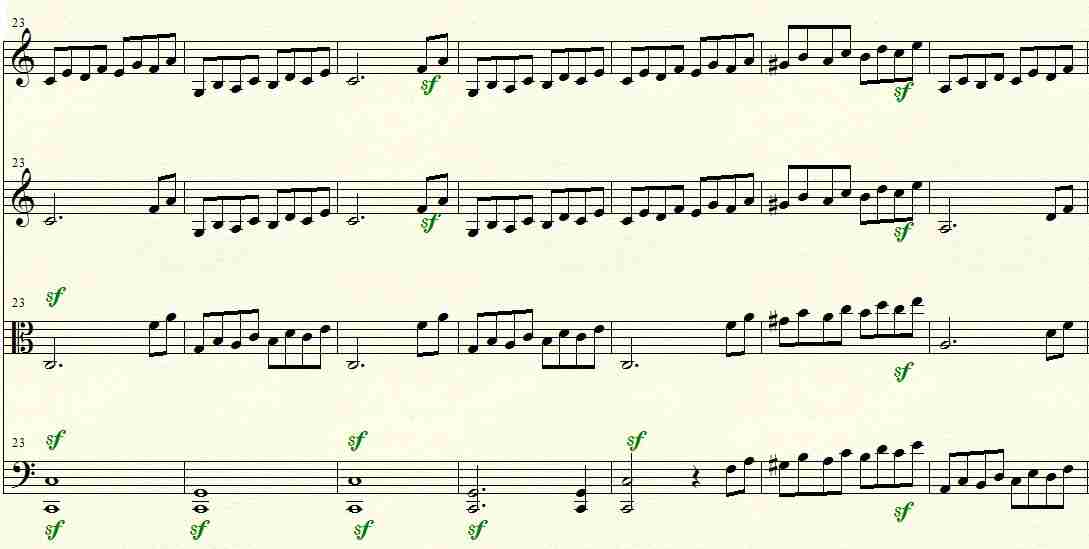
Schumann, Op. 41, No. 1, Adagio, mm 1-5
The vigorous Presto in A minor closes the quartet. This is the movement that immediately reminded me of my application in C# (.NET).

Schumann, Op. 41, No. 1, Presto, mm 1-8
Schumann iterates a rising-fifth motive. He sets up so-called Kreutzer exercise figurations (Rodolphe Kreutzer’s violin etudes, designed to strengthen the violinist’s left hand) that are not just repetitive iterations but recursive—each successive instance appears to invoke yet more instantiations of the figure, in a cascade inward. The cascades alternate between the violins and the viola and ‘cello. Programmerly recursion! Not whole phrases, but smaller-scale movements within the phrases.

Schumann, Op. 41, No. 1, Presto, mm 23-29


    [ 60-sec clip, Zehetmair Quartet, Schumann Op. 41, No 1, Presto, 2MB MP3]

Have a look at Scott Murphy’s recent article in Music Theory Online, to read a discussion of recursive regimes, Klumpenhouwer Networks, and other mathematical structure in Bartók and other classical music composers’ work. Have a look at Roger Reynolds’ book ‘Form & Method’ for more.

What about Schumann’s personality? How might that have affected what we hear in these quartets?

Provided that extensive rework doesn’t plaster over the original features, isn’t a person’s exploration of writing in a genre that is unfamiliar likeliest to reveal the inner life of that person? I suspect the answer is yes. After all, aren’t ‘first novels’ inherently first-novel-esque?

So. If we’re going to indulge in speculation about Schumann, let’s not omit his well-documented bipolar disorder. Bipolar disorder, also known as manic-depressive illness, only affects about 1% of the general population. But the prevalence rises to 30% among authors, artists, and composers—Schumann among them. Johns Hopkins professor Kay Redfield Jamison’s wonderful book ‘Touched with Fire’ looks at bipolar disorder and artists, authors, and composers. By contrast, there’s a conspicuous lack of studies of the prevalence of bipolar disorder in other creative professions, such as science, engineering, and especially software engineering.

Anybody who’s a software developer and a musician has plenty of anecdotal evidence, though. Earning a living as a software developer requires feats of memory and comprehensive recollection of protean details (of syntax of dozens or hundreds of compiler, version-control, and other software development toolsets and operating systems) that are very similar to the occupational requirements for mastery and internalization of detail such as professional musicians have. This often isn’t understood by lay persons who aren’t software engineers. But it is a commonplace, to anyone involved with software or anyone whose friends or family members are engaged in these pursuits.

It’s especially so for individuals who create open-source software—who invest hundreds of hours each year doing so, for zero financial reward. Their intellectual ‘giftedness’ is what propels them to deposit the fruits of their labors into the public domain. They do not, in general, do what they do for ulterior reasons. They are, in general, aiming to create functional, beautiful things. The process of creating, the process of innovating and moving the ‘community’ forward, are sufficient internal rewards by themselves. And, for some, their Karma, here and now, is a more reasonable concept than conventional religion.

According to Karma, performing beneficent acts brings good luck, and negative or maleficent acts result in bad luck. The consequences may arise immediately or they may be delayed. For Hindus and others, the delay can be in the present life or in the next: morally commendable acts may result in reincarnation into a higher station or class (such as a superior human or a godlike being), while bad acts result in rebirth as a human living in less desirable circumstances, or as a lower animal. Some compare the action of Karma to Western notions of sin and judgment by God or gods. Other non-deistic people understand Karma as a principle of the universe—a natural law that doesn’t require the existence or intervention of any supernatural Being.

The logical ethical consequence of the law of Karma is to behave responsibly at all times and not abuse the power that comes with virtuosity. Thomas Zehetmair and the Zehetmair Quartet are clearly creating and maintaining their good Karma. And Schumann, in his own way, may have composed these quartets—replete with fascinating recursive structures and other innovations—with the Karmic and social sensibilities that, today, are prevalent among open-source software developers as well as musicians. Just a thought.

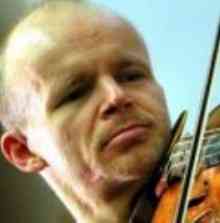
Thomas Zehetmair
[Sorry if you were hoping to find here an actual ‘review’ of the Zehetmair String Quartet’s performance in Kansas City. Suffice to say that their playing was, has been, and shall be spectacular. They are performing today (11-NOV) at the University of California @ Berkeley, and on 16-NOV in the ‘Music_at_MIT’ program in Cambridge, MA. In any case, go and hear them whenever and wherever you can! Buy their CDs and listen! Surely the depth and vibrancy of their interpretations will inspire unusual reveries/epiphanies as personally meaningful for you as the ones they stimulated in me. Possibly also of interest, besides Thomas Zehetmair’s commitment to this Quartet and to the classical violin repertoire, he dedicates a large part of his artistic activities to contemporary music. He’s given a number of first performances, such as the violin concerto written for him by Heinz Holliger and the violin concertos of James Dillon and Hans-Jürgen von Bose. His latest CD releases include the Ysaye Sonatas for solo violin, the Holliger Violin Concerto with the SWR Sinfonie-Orchester, and the Beethoven Triple Concerto with the Chamber Orchestra of Europe. Excellent, each and every one.]


A man can know no greater torment than to look forward to a lifeless future of his own planning.”
  —  Robert Schumann

V ery often what we look for in the distance is so near that we need only stretch out our hand to seize it.”
  —  Robert Schumann


Picasso, Musicians