Showing posts with label borromeo. Show all posts

Monday, October 18, 2010

Borromeo String Quartet: eBach

 BSQ
T    his program is about the greatness and the ‘open-endedness’ of Bach’s music, and about letting Bach’s music meet a new set of tools... When Bach played the organ, he was known for making beautiful and unexpected combinations of stops (the sets of pipes that make a certain sound). With this electronically-processed string quartet arrangement, we are going to bring a new set of ‘stops’ into play.”
  —  Nicholas Kitchen, @TheGardner interview with Isabella Stewart Gardner Museum staff, OCT-2010.
T he Borromeo String Quartet’s [Mai Motobuchi, viola, Yeesun Kim, cello, and Nicholas Kitchen and Kristopher Tong, violins] performance tonight at New England Conservatory’s Jordan Hall included Bartók’s String Quartet No. 6 and Beethoven’s String Quartet in E-flat Major, Op. 127.

B ut the sheer novelty of this program was embodied by ‘Bach’s Electric Chords’, Nicholas Kitchen’s string quartet arrangement of Bach’s ‘Passacaglia and Fugue in C Minor’, BWV 582, with electronic processing. Warning: If novel reworking of Bach inherently offends you, then read no further.

T he passacaglia consists of twenty variations on a theme that Bach famously co-opted from André Raison’s Premier Livre d’orgue of 1688. Many have said that the double fugue in BWV 582 is really a twenty-first variation on that theme—a variation of prodigious, surreal length.

B ach plumbed the limits of the bass melody in BWV 582, to the point where he was able abandon the melody itself from time to time and yet the beautiful mechanism does not quit or fall apart. Emulating Bach’s exploratory spirit, Kitchen pushes the discursive, contrapuntal ‘envelope’ even further. This arrangement is like a string quartet conversation that ranges from one topic to others, to the point where the thread of the conversation matters less than than the flow itself—matters less than the continuation of the self-propelled cameraderie of the celebrants. The piece becomes an expansive meditation on the joy of playing together. There are moments when it is possible to believe in the abrogation of the Second Law of Thermodynamics, energy for free, perpetual motion, and Eternal Return. The nature of bowing—as contrasted with keyboards and pedaling—also lends new dimensions to the piece, ones that likely would have pleased Bach himself.

F    enner Douglas groups French registrations into four texture-based categories: broad textures [plein jeu (principal chorus, upwards from 16'); grand jeu; fond d’orgue (all principals and flutes at 16', 8', and 4')]; contrapuntal textures [esp. reeds]; melodic textures [cornets; tierces; nazard; voix humane; etc.]; and composite textures... In the Fugue of BWV 582 easily the most interesting is the cross-beat slurring of the first countersubject [in m. 169]... If Bach had asked his [organ] pupils to phrase the countersubject across the beat, some indication of this would have been needed in the score, for it goes against the Baroque practice of placing ‘downbows’ on the ‘good’ notes.”
  — Peter Le Huray, p. 104.
 BWV 582, m. 169
T he organ offers a wide range of colors and textures, and so, of course, does the string quartet. The range can be substantially extended when mics and electronic processing are applied. To my taste, Kitchen’s orchestration makes good sense—it is empathetic, not ‘indulgent,’ and the electronic processing does not draw undue attention to itself.

T he chords themselves are intriguingly different when played by a string quartet instead of an organ. For example, the Neapolitan sixth near the conclusion of BWV 582 is not like a C-major chord transposed up a semitone but is instead a dramatic new color, in part because stringed instruments are not confined to equal temperament (12-TET). Unfretted instruments and singers are free to conform their tuning closer, say, to 18th-Century well-temperaments. Then, instead of congenial key-independent uniformity of sound as in ET, with well-temperaments each key has its own distinctive qualities, tensions, dissonances—tensions that would not be evident when playing this Passacaglia and Fugue on a modern organ.

T he tailpiece miking of each of the Borromeos’ instruments was excellent. Each quartet member’s Line6 POD® effects modeler output was routed to a powered QSC K-8® monitor positioned on the stage directly facing the audience. (In the future, I hope that a larger array of more speakers directed in a variety of directions may be possible for BSQ, or, better still, get a sound engineer and a mixing console and adjust the delays properly for the size of the hall.) The succession of effects patches in each part was switched via the foot stomp switches on the Line6 POD®s, in a pattern reminiscent of an organist changing ‘stops’. Each instrument’s soli passages involved switching to a brighter ‘reed’ patch and increasing the volume with the pedal on the right-hand side of the POD® modeler. Other organistic effects included divide-by-two and divide-by-four frequency-division patches that transformed the cello’s signal into 16' and 32' thundering contrabass pipe organ sounds. Light chorusing effects and, toward the end, increasing reverb were among other effects that Kitchen scored in this arrangement.

 BSQ
T he use of the 4 Macintosh laptops and Bili Inc. Footime® digital Page/Score Turners was interesting from another perspective as well. The profile of these is far smaller and lower than standard music stands filled with sheet music. As a result, the laptops on their stands do not present such a big acoustic obstruction between the performers and the audience members as conventional music stands. The cello and the viola are far clearer-sounding compared to normal string quartet configurations. Absolutely beautiful.

 BSQ
I n summary, we were thrilled by a superb performance and by an arrangement of BWV 582 that sheds exciting new light on an old subject.


Saturday, January 26, 2008

Neurodiversity: Borromeo Quartet Brings Beethoven’s Op. 130 + Op. 133 Temperament to Life

Borromeo Quartet, photo Steiner
I n but one extraordinary passage, marked ‘beklemmt’, does the first violin break into a kind of anguished recitative whose obstreperous rhythm challenges the solemn gait of the lower instruments and threatens to rupture the music asunder. The emotion is purged, however, and the violin rejoins its companions to murmur once again the theme of the opening. Beethoven left the question of the Quartet’s finale unsettled, so that the work may be performed with either the Große Fuge of the original version or the substitute Rondo movement that he provided for it shortly before his death. This latter movement, a splendid piece of music, was written in the manner of continuous thematic expansion and development that was central to the style of his last years. With its thrusting rhythms and brief returns of its Gypsy-tinged opening theme, the movement has about it a … stubborn unwillingness to be bent into the tonic key of B-flat major.”
  —  Richard Rodda, 2005.
I ts official title is really a misnomer, for the movement incorporates an introduction, a double fugue, a slower and only mildly contrapuntal section brought about with an abrupt modulation from B-flat to G-flat, a scherzo that is soon overwhelmed by a resumption of the fiercest fugal developments, followed by a stream of afterthoughts and retrospects.”
  —  Denis Matthews.
G reat wits are sure to madness near allied—
And thin partitions do their bounds divide.”
  —  John Dryden, 1662.
W ell, if you ask writers and artists who have depression, severe depression or manic depression, what they feel is important to them about their illness and their moods in their work, what they almost always focus upon is the intensity and the range of emotional expressiveness. Learning from the pain and from the suffering, they experience the sorrow, they experience the despair of the nihilism and so forth. And on the other hand, very ecstatic and visionary states. So that’s what artists and writers focus upon. I think it’s a lot more complicated than that. I think it’s also that people with manic depressive illness who have a particular temperament live a life of almost seemingly irreconcilable differences and opposite states that they somehow, on a day to day basis, have to reconcile. So people who have very disciplined and interesting and strong and creative minds, who also have this temperament, spend their lives having to make some order out of chaos and reconcile these opposite states. I think that a lot of what we ask from artists really is to experience extreme mood states, experience the extremes of human nature and experience, and put some new meaning and redemptive value in their work.”
  —  Kay Redfield Jamison, Live from Lincoln Center.
In late 1822, Prince Nikolas Galitzin of Russia commissioned several string quartets from Beethoven. Beethoven was preoccupied with work on the Missa Solemnis, Op. 123; the Diabelli Variations, Op. 120; and the Ninth Symphony, Op. 125, and delayed delivering the B-flat quartet and Große Fugue until 1825. Galitzin was understandably annoyed by the delays. He wasn’t chopped liver.

What’s more, in this third installment on the commission Galitzin got these six movements, including the two strange slow movements and the giant, fierce 16-minute Fuge. The two fugue subjects here are not playing nicey-nicey. They’re rhetorical adversaries, struggling with each other in musical armed conflict, taking no prisoners. There are winners and there’re losers.

The unhappy public reception of Op. 130 with the Fuge attached as-written led to the substitution of the alternate finale to Op. 130, the Rondo, which turned out to be Beethoven’s last finished composition. The deal was, Beethoven would provide the substitute Rondo on condition that the withdrawn Große Fuge would be issued separately, and Beethoven would get an additional fee. Right. The fugue was published posthumously as Op. 133. Why was the final release as Op. 133 delayed until after Beethoven had died? Who was the cause of the delays, and what were their motives? And how many composers today could engage their patrons in this way? The recklessness and extravagance of it are mind-boggling! Crazy!

In December, I did a post on bipolar (manic-depressive) illness and musical creativity. The occasion of last night’s performance by the Borromeo Quartet made me wonder once more about the diversity of varieties of depression that give rise to composers’ output. Several varieties are, I think, manifested in this Beethoven Quartet. Have a look at Larkin’s nice chapter in Cooper’s book on Beethoven for some extended analysis of signs and symptoms in Beethoven’s later life and works.

The Borromeo Quartet outdid themselves in last night’s incarnation of this wonderful, emotional work. The deep perplexity of the human condition was “in there”, in their performance of Op. 130 + Op. 133. The Rondo in place of the amputated Große Fuge? Somehow, it just doesn’t seem right. It’s a shame that Beethoven suffered so that we might have this work. And it’s possible that, back in his time, nothing could’ve been done to treat his condition or mitigate his suffering. But today the question is, ought such symptoms to be under-treated, so that we might have more works like this? Ought such symptoms to be medically induced, as a form of composer performance-enhancement?

P revailing conceptions of creativity in psychology and psychiatry derive from romanticist ideas about the creative imagination—they differ considerably from notions that are central in modernism and postmodernism. Whereas romanticism views creative inspiration as a highly emotional, Dionysian, or primitive state, modernism and postmodernism emphasize processes involving hyper-selfconsciousness and alienation (hyperreflexivity). Although manic-depressive or cyclothymic tendencies seem especially suited to creativity of the romantic sort, schizoid, schizotypal, schizophreniform, and schizophrenic tendencies have more in common with the anti-romantic sensibilities of modernism and postmodernism. I criticize the book by Kay Redfield Jamison, ‘Touched With Fire: Manic-Depressive Illness and the Artistic Temperament’, for treating romantic concepts of creativity as if they defined creativity in general. I argue that Jamison’s denial or neglect of the creative potential of persons in the schizophrenia spectrum relies on certain diagnostic oversimplifications: an overly broad conception of affective illness and an excessively narrow conception of schizophrenia that ignores the creative potential of the schizophrenia spectrum.”
  —  L Sass, Creativity Research J 2000; 13: 55-74.
T  aking the new antidepressants, some of my patients said they found themselves more ‘confident’ and ‘decisive’. Is this, I wonder, a categorically ‘good’ thing? I used these claims as a jumping-off point for speculation: what if future medications had the potential to modify personality traits in people who had never experienced mood disorder? [Drugs like MK-801, for example.] If doctors were given access to such drugs, how should they prescribe them? The inquiry moved from medical ethics to social criticism: what does our culture demand of us, in the way of assertiveness? What is the price of conformity?”
  —  Peter Kramer, There’s Nothing ‘Deep’ about Depression, 2005.

    Nine Temperament Characteristics
  • Activity level refers to the amount of physical energy in the child. Does the child have to be constantly moving or do they have a relaxing approach?
  • Regularity / Rhythmicity refers to the level of predictability in a child’s biological functions such as waking, becoming tired, feeding.
  • Approach / Withdrawal refers to how the child responds to new people or environments either positive or negative. Does the child check out people or things in their environment without hesitation or do they shy away?
  • Adaptability refers to how long it takes the child to adjust to change. Does the child adjust to the changes in their environment easily or are they resistant to what is happening around them?
  • Intensity refers to the energy level of a positive or negative response. Does the child react intensely to a situation or do they respond in a calm and quiet manner?
  • Mood refers to the child’s general tendency towards a happy or unhappy demeanor.
  • Distractibility refers to the child’s tendency to be sidetracked by other things going on around them. Does the child get easily distracted by what is happening in the environment around them or can they concentrate despite the interruptions?
  • Persistence & Attention Span refers to the child’s ability to stay with a task through frustrations and length of time on the task. Can the child stay with an activity for a long period of time or do they just give up when they become frustrated?
  • Sensitivity refers to how easily a child is disturbed by changes in their environment. Does the child get bothered by external stimuli in their environment such as noises, textures, lights, etc. or do they just seem not to be bothered by them at all?

Kagan & Snidman, Long Shadow of Temperament

 Borromeo Quartet, photo Linder


Wednesday, January 23, 2008

The Five and the One: Balance between Voices in Franck’s Piano Quintet in F minor

Borromeo Quartet, photo Steiner
A  remarkably accomplished string quartet, not simply for its high technical polish and refined tone, but more importantly for the searching musical insights it brings.”
  —  John von Rhein, Chicago Tribune, 23-AUG-2002.
T his piece was a great discovery for me. It helped me to realize that my piano playing style and my personality match well with chamber music. I believe the Franck was my finest performance during the [2001 Van Cliburn] Competition.”
  —  Stanislav Ioudenitch.
Looking forward to the Borromeo Quartet performance this Friday (25-JAN-2008) in Kansas City, I check out their program and revisit scores for the works they will play. One of them will be César Franck’s Piano Quintet in F minor, a “big”, atmospheric piece.
  • Nicholas Kitchen, Violin
  • Kristopher Tong, Violin
  • Mai Motobuchi, Viola
  • Yeesun Kim, Cello
  • Stanislav Ioudenitch, Piano (guest)
    Piano Quintet in F Minor
  • I: Molto Moderato Quasi Lento, Allegro 16:00 – 17:00
  • II: Lento, Con Molto Sentimento 10:30 – 12:00
  • III: Allegro Non Troppo, Ma Con Fucco 9:20 – 10:00

T he instrumental work was seen [in the 19th Century] as a wordless oration, and its form was viewed not so much as a harmonic or thematic plan but as an ordered succession of thoughts.”
  —  Mark Bonds, p. 53.
The piano part in this Quintet is virtuosic, magisterial, symphonic. In fact, that may be the biggest risk—the fact that the piano part is so “big”. The quartet may play beautifully and cohesively, but the pianist must fully “belong”. This is a chamber music piece. It ought not to come off as a mini ensemble piano concerto. Nobody is ‘accompaniment’. And it’s not a ‘pianist vs. quartet’ duet.

So the real unifying factor has got to be pianist Ioudenitch. Not ‘in charge’, but genuinely ‘unifying’. The opening Molto Moderato is simultaneously tender, muscular, edgy—moderato but almost anxiously hurried—with minimal good-natured geniality: urgent.

The Borromeos—known for their full tone—deliver phrasings that are abundant with feeling, and their sound production has a characteristic lyrical fullness. But, playing with Iodenitch, they are under-stated, more subdued as they merge their playing. There is a wonderfully hushed quality in this Molto Moderato.

And, true to the ma con fucco indication, the Allegro is brisk, lively and light, well-accented, almost hard-driven. Despite the fact that they do not regularly play together, the Borromeos and Ioudenitch manage to achieve what, to paraphrase David Rounds, is clearly ‘The Five and The One.’

Each movement in the Quintet evolves from a single idea, and these ideas clearly connect as a series of narrative episodes. Like a protagonist in a drama, each idea goes on its ‘journey’ through a series of contrasting psychological states hoping for resolution or fulfillment. Inter-connections and inter-movement references are beautifully rendered by the Borromeos. An extended passage, or even a single texture recalled from an earlier moment triggers our memory and builds up a multi-dimensional awareness. All this makes the work feel “Big”.

Ioudenitch’s interplay with the wonderful Borromeos is marvelous. How hard should the players try to minimize ‘inhomogeneity’ between the strings? In my view, not much. It’s routine to have a novel where each character is fully-developed and yet there are leading roles and supporting roles. And so, too, in a piece like this. It’s unreasonable to insist on absolute parity when the expressive/narrative content of the work doesn’t exhibit parity and when the composer didn’t intend it. The ‘characters’ in the 5 parts here are so disparate as to argue against attempting to enforce ‘equality’.

In other words, this is not the same inter-voice dynamic as in a Piano Trio or Piano Quartet. Obviously, the five voices have to cooperate. But the texture is more complex and could get muddy if they do not really, really cooperate and anticipate each other’s phrasing. There are thematic processes that operate on a larger scale. This is not a ‘subject/answer’ or ‘tell-and-ask’ rhetoric, as Peter Smith and others have explored in Brahms, say (Music Analysis 2001;20:193-236). There’s less predictability in individual voice-leading. There are more inter-voice constraints than in a quartet.

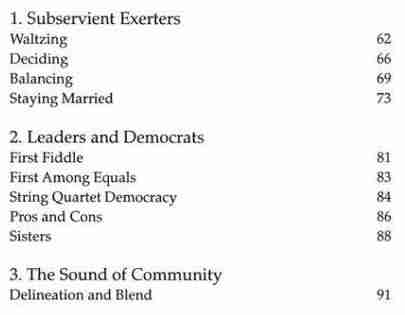
David Rounds, The Four and The One, Table of Contents
And the unfolding of the separate voices/characters is idiosyncratic—characteristic of Franck, even if not necessarily characteristic of the period or the quintet form or sonata form. We have ‘hybrid phrases’ where Franck creates ‘antecedent’ and ‘consequent’ phrases—creates the ‘consequent’ of one (sub-) phrase by transposing an initial tonic-oriented antecedent statement of a thematic idea into the dominant key. This is especially notable when the minor dominant is tonicised. In an alternative approach, Franck adjusts intervals within the repetition (consequent) so that the restatement centers on the dominant but remains within the tonic key. Material that unfolds within the tonespace of the 1-5 fifth is ‘answered’ by a repetition that falls within the 5-1 fourth. This alternative approach ‘recontextualizes’ the idea of an ‘answer’.

In fact, if Franck had used a formal ‘subject/answer’ or ‘tell-and-ask’ type of rhetoric, it would have lent a sort of ‘instability’ to the piece. It would have been somwhat of an anacrusis—an under-stressing or ambiguity of authority, before (and in between) the more forceful statements.

It’s a complex phenomenon and it involves the musical and social coordination of the group, an agreed sense of leadership, and the group members’ individual and collaborative construction of meaning through verbal discussions and shared reflections on the playing. Group identity is shaped by individual players’ self-identities and vice-versa (Rounds 1999; Stubley, 1992) and a piano quintet is no exception. We have both musical and social coordination between musicians here (Davidson & Good, 2002; Ginsborg, Chaffin, & Nicholson, 2006; Williamon & Davidson, 2002; Young & Colman, 1979).

Dahlhaus at Technische Universitat Berlin (1991, p. 255) discussed rhetorical coherence in terms of ‘architectonic form’—a balance between phrases, periods, and sets of periods—each rhetorical unit counterbalanced by one or more other metrical/rhetorical units at every level in the piece. He contrasted this with ‘logical form’ (form based soley on ‘motivic connections’) which holds a movement together ‘from within’. This Franck Quintet seems clearly ‘architectonic’ according to Dahlhaus’ definitions. Big and satisfying!

T his music is rich in atmosphere and tenderness. There are so many colors and such a wide range of emotions, it makes it hard to breathe! When all the proportions are right during the performance, it connects us with the composer’s soul. That’s an unbelievable experience for the performer and the audience.”
  —  Stanislav Ioudenitch.

Franck Piano Quintet, Molto Moderato, Piano part
Franck Piano Quintet, Molto Moderato, Violin 1 part
Franck Piano Quintet, Molto Moderato, Violin 2 part
Franck Piano Quintet, Molto Moderato, Viola part
Franck Piano Quintet, Molto Moderato, ‘Cello part


    [40-sec clip, César Franck, Piano Quintet, Molto Moderato, mm. 1-10, Schubert Ensemble, 1.1MB MP3]

    [50-sec clip, César Franck, Piano Quintet, Molto Moderato, “A”, Schubert Ensemble, 1.6MB MP3]

    [30-sec clip, César Franck, Piano Quintet, Molto Moderato, “B”, Schubert Ensemble, 0.9MB MP3]

    [50-sec clip, César Franck, Piano Quintet, Molto Moderato, “C”, Schubert Ensemble, 1.3MB MP3]


 Borromeo Quartet, photo Linder