Showing posts with label repertoire. Show all posts

Thursday, June 16, 2011

Ensemble 44: Vanity & Truth – Songs of Love by Women of the Italian Court

Ensemble 44
A   mor, non dormir più!
Su, su! svegliati omai?
Che mentre dormi tu,
dormon le gioie mie; vegliano i guai.

[Love, sleep no more—
Up, up! Will you never wake?
For while you sleep,
Sleep also my joys; awake are my troubles.]”
  — Barbara Strozzi (1619-77), ‘Amor dormiglione’, tr. Candace Magner.
E nsemble 44 (Hannah Davidson, viola da gamba; Teri Kowiak, soprano; Kathleen McDougald, harpsichord) presented a recital yesterday of art songs by Italian women composers of the Baroque period. The concert was one of the many ‘fringe’ events connected with the Boston Early Music Festival.
  • Strozzi – Amor dormiglione; La travagliata; Risolvetevi pensieri; Lagrime mie
  • Ortiz – Recercada settima (from ‘Tratado de glosas’)
  • Caccini – Se muove a giurar fede; La pastorella mia; Ch’amor sia nudo
T he texts for these songs are incisive, very passionate.
S   occorrete, luci avare,
un che muore di dolore,
con un vostro sguardo almeno!
Si può fare del guardare
carità che costi meno?.

[Help, you greedy eyes,
one who is dying of grief
with just one glance of yours!
Is there any act of charity
that costs less?]”
  — Barbara Strozzi (1619-77), ‘La travagliata’, tr. Candace Magner.
T he accessibility/universality of the sentiments expressed in these poems—timeless themes, really—plus the lyricism of the musical settings make these wonderful recital pieces, I think, for students and professionals alike.

T he acoustic intimacy of the small Steinert Hall in the Steinway Building in Boston made the experience for the several dozen attendees even more enjoyable. Such crystal clarity, for hearing the voice and the articulation of the viola da gamba and the harpsichord! The location was ideal—iconic, in fact, of how pieces like this are best presented.

E nsemble 44 has a new CD just released, entitled ‘Music of Ladies of the French and Italian Baroque’. I don’t see it yet on CDbaby website, but picked up a copy at BEMF recital… Beautiful! Here is a little clip from this disc:


    [50-sec clip, Ensemble 44, Barbara Strozzi, ‘Amor dormiglione’; 2011, 1.1MB MP3]


Friday, May 14, 2010

An Accumulation of Energies, Nameless and Named: Evening Chamber Music in Prague

 Prague Store Mesto clock
O   nce you’ve seen the signs about it [The Most-photographed Barn in America!], it becomes impossible to ‘see’ the barn,’ said Murray.
He fell silent once more. People with cameras left the elevated site, replaced at once by others.
‘We’re not here to capture an image; we’re here to maintain one. Every photograph reinforces the aura. Can you feel it, Jack? An accumulation of nameless energies...’
There was an extended silence. The man in the booth sold postcards and slides.
‘Being here is a kind of spiritual surrender. We see [and hear] only what others see [and hear]. The thousands who were here in the past; those who will come in the future. We’ve agreed to be part of a collective perception.”
  —  Don DeLillo, White Noise (1985).
A    ve Maria, gratia plena, Dominus tecum, Virgo serena.
Ave cuius conceptio,
solemni plena gaudio,
celestia, terrestria,
nova replet letitia.
Ave cuius nativitas,
nostra fuit solemnitas,
ut lucifer lux oriens
verum solem preveniens.
Ave pia humilitas,
sine viro fecunditas,
cuius annunciatio
nostra fuit salvatio.
Ave vera virginitas,
immaculata castitas,
cuius purificatio
nostra fuit purgatio.
Ave preclara omnibus
angelicis virtutibus,
cuius fuit assumptio
nostra glorificatio.
O Mater Dei, memento mei. Amen.”
W e hastily ran around the small central core of Prague—the Stare Mesto (old town) and the Hrad (castle). The evenings were dark and delicious.

W e found the astronomical clock on the Old Town Hall to be especially interesting, both symbolically and from an engineering point of view. At the top of the hour, the clock features a procession of figurines of the 12 apostles, preceded by the figure of Death (you can see him in the picture above, on the right-hand side) pulling a rope in his right hand, and inverting the hourglass that’s in His right hand. Each evening, we attended one or two concerts featuring Mozart, Vivaldi, local Czech composers—at the baroque Church of St. James, for example. The evenings had more renditions of Ave Maria than I ever knew existed.

E ach night from 8 p.m. onward you can find many—dozens?—of these chamber performances—in churches and other small halls. Very modestly-priced. Small ensembles, quartets, trios, duets, violin and piano, cello and piano, violin and piano and voice, voice and harp, violin and harp and organ/harmonium, string trio with trumpet, violin and harp and flute--anything and everything. Mostly, these are short programs less than 1 hour in length, cash admission collected at the door, with repertoire picked to appeal to a touristic audience and insure a nice extra income for the performers, many of whom are professional members of standing orchestras or chamber ensembles in and around Prague.

I nvariably, there is at least one version of Ave Maria.

F amous and familiar as it is, the most frequently performed is the version by Charles Gounod, who added melody and words to J. S. Bach’s first prelude from the Well-Tempered Clavier. Mozart’s K.554 is the one next most common version on offer. Brahms’s Op. 12.

A ntonín Dvořák’s version, the one composed in 1877. Another one, Verdi’s, for his 1887 opera Otello.

R ussian composer César Cui’s obsession: he is one of several composer ‘repeat offenders’ who have set the text at least three times: Op. 34, for 1 or 2 women’s voices with piano or harmonium (1886), and as part of two of his operas: Le Flibustier (premiered 1894) and Mateo Falcone (1907). Anton Bruckner wrote three different settings...

S ettings by Bruch, Byrd, Elgar, Verdi, Saint-Saëns, Rossini, Stravinsky, Schubert, Massenet, and Perosi as well as versions by less well-known composers, such as J.B. Tresch.

J acques Arcadelt’s setting: in reality, a 19th century arrangement by Pierre-Louis Dietsch, based on Arcadelt’s three-part madrigal, ‘Nous voyons que les hommes’.

F ranz Schubert’s ‘Ellens dritter Gesang’ (D839, Op 52. No. 6, 1825), performed with the Ave Maria prayer sung in place of the original text.

A lso, Josquin Desprez, Orlando di Lasso, and Giovanni Pierluigi da Palestrina. Nights are cool, chambered Grace, full of Marys. Collective, maintained perception—sort of like DeLillo's most-photographed barn, or like Motif #1.


Tuesday, November 11, 2008

Violence, An Unlikely Chamber Music Trope: ¿Quién es más macho?

de Zulueta book
I   was very frightened till the guns started firing. Then you felt a bit better, for some unknown reason. It was the sitting there that was the worst part ... Naked is the way to describe it ... Just waiting for the end … waiting for it.”
  —  Michael Jackson, quoting rear-gunner Jack Marshall, in The Politics of Storytelling, p. 47.
T   he definition of psychological violence as the sudden, uncontrollable disruption of affiliative bonds ... recognizes the importance of attachment relationships and their social, emotional, and cognitive manifestations. To deny the impact of trauma over human life is to deny that we matter to one another; it is a way of dissociating ourselves from human pain.”
  —  Felicity de Zulueta, From Pain to Violence, p. 185.
The previous CMT post triggered a prompt, unexpected flurry of messages about ‘violence’ as a theme in the chamber music canon. Some emailers suggested that Fauré’s ‘Piano Trio in D minor, Op. 120’ (“The last movement … the Allegro vivo!”) is emblematic of chamber music as encompassing the gamut of human emotion and expression, including uncontrollably violent feelings and expressions.

Others mentioned Edgard Varèse and André Jolivet—the ‘Density 21.5’ and ‘Cinq Incantations,’ respectively.

Another friend emailed to say, no, that Henri Dutilleux and Pierre Boulez wrote works that were more violent by far than those.

Yet another CMT reader opined that Olivier Messiaën was, if you really understood him, more profoundly and insidiously violent. (“Oh, you can play it so that the violent intentions are covered up. But if you really understand what he was up to, why then! There is no question! Hands down!”)

Maybe we need a ‘Hamilton-Browne’ taxonomy of violence in chamber music, a classification scheme to properly categorize and compare different species of this emotion when they arise.

    Two-dimensional Taxonomy of Victimization
  • Single victimization (single incident, single perpetrator)
  • Multiple victimization (single incident, multiple perpetrators)
  • Repeated victimization (multiple incidents, single perpetrator)
  • Re-victimization (multiple incidents, multiple perpetrators)
W ell, entonces, ¿quién es lo último? Here is my own nomination for the most explicit examination of violence: a piece composed by Gordon Fitzell, performed by eighth blackbird (three MP3 clips below). Gordon is a 40 year-old Canadian born in Portage la Prairie, Manitoba, with a Bachelor of Music degree from Brandon University, a masters from the University of Alberta, and a doctorate in composition and theory from the University of British Columbia, with Keith Hamel and John Roeder. He has contributed works to a number of festivals and workshops including Darmstadt Internationale Ferienkurse für Neue Music, June in Buffalo, the Yale Summer School, the Arraymusic Young Composers Workshop, and held a residency several years ago at the Banff Centre for the Arts. He is currently a professor at the University of Manitoba in Winnipeg where he teaches composition, electroacoustic music, conducts the New Music Ensemble and directs XIE (eXperimental Improv Ensemble).


    [50-sec clip, eighth blackbird, Gordon Fitzell, ‘Violence’, 1.2MB MP3]

    [50-sec clip, eighth blackbird, Gordon Fitzell, ‘Violence’, 1.2MB MP3]

    [50-sec clip, eighth blackbird, Gordon Fitzell, ‘Violence’, 1.2MB MP3]

Gordon Fitzell
I rest my case.

Seriously, do you have other ‘nominations’ you’d care to make, in this exotic category? What composers and which pieces? Under what circumstances would your ensemble undertake a thematic program, explicitly comprised of works that examine this ‘end of the spectrum’ of human emotions and deeds?

Do you think that the ‘intimacy’ of chamber music and currently-available chamber music programming such as it is today is too restrictive—that is to say, that the repertoire being performed today dwells more than it should on ‘pleasing’ sounds and ideas and emotions, and veers too far away from matters of political topicality and controversy? Do you feel that it is, marketingwise, suicidal to pursue these things? Yes, compose them, if you must; if you have them ‘in you’. Yes, record them, if you’re passionate about it and can convince a brave label to support it. But don’t even think of performing them live, not if you expect to ‘get away with it’?

Does edgier repertoire sell well and, if so, to what audience market segments in what venues and at what times of year? Is this sort of material only practical (i.e., ‘wise’, ‘safe’) for presenters to program as bonus ‘fringe’ material at festivals in the summertime—riskier even than mere ‘new music’? Is this sort of thing suitable for ACF and CMA and other organizations to commission more of?

If enough of you wish to offer comments on this, maybe I’ll gather them together into a proper ‘post’ on the subject. To those of you who emailed me, thank you very much for your comments!


Monday, October 27, 2008

Flute-Cello-Piano Trio Repertoire: Bigger than You Might Imagine

Meininger Trio, Bergisch-Gladbach/Cologne; photo © Markus Bollen
Flute-cello-piano (FCP) trios are relatively uncommon. Possibly the most frequently performed piece is Carl Maria von Weber’s Op. 63. But the FCP trio sonic palette is an interesting one, though, and the literature is more extensive than you might imagine.

For the person who emailed me asking about FCP trios, especially newer or less commonly-played ones, here is a list. I come up with more than 50. But probably I have missed some—I only spent an afternoon compiling this at home. I have not plowed through a conservatory’s library, only Google and the books listed in the links at the bottom of this post.

Beyond the ‘What to play for senior recital?’ question that led me to put up this list, there are surely other purposes and occasions where these pieces might receive more frequent performance and recording.


A


Dieter Acker
  • Trio II (1974)

William Alwyn
  • Trio for Flute, Cello, and Piano

Paul Arma
  • Divertimento II (1951)

Richard Arnell
  • Trio, Op. 64


B


Johann Christian Bach
  • Six Sonatas, Op. 2

Sven-Erik Bäck
  • Sentirè

Richard Rodney Bennett
  • Commedia (1972)


C


Muzio Clementi
  • Trio, Op. 22

George Crumb
  • Trio (‘Voice of the Whale’, [amplified and masked] Flute, Cello, and Piano)


D


Norman Dello Joio
  • Trio (1944)

Friedhelm Döhl
  • Sotto Voce (1973)

Johann Dussek
  • Grand Sonata, Op. 65


F


Elisendra Fabregas
  • Voces de mi Tierra

Louise Farrenc
  • Trio, Op. 45

Jean Françaix
  • Trio (1995)


G


Phillippe Gaubert
  • Serenade (‘Three Water Colors’, No. 3)

Adalbert Gyrowetz
  • Divertissement for piano, flute & cello in A Major, Op 50


H


Dietrich Hahne
  • Four Tunes

Franz Joseph Haydn
  • Three Trios
  • Klaviertrio No. 30

Mogens Winkel Holm
  • Transitions II (1973)

Katherine Hoover
  • Lyric Trio

Klaus Huber
  • Ascensus (1979)

Johann Nepomuk Hummel
  • Adagio, Variations & Rondo, Op. 78


J


Knud Jeppesen
  • Summer Trio (1957)


K


Elena Kats-Chernin
  • Colours of the Sea: Trio Flute, Cello & Piano

Joseph Kennedy, Jr.
  • Dialogue for Flute, Cello & Piano

Konradin Kreutzer
  • Trio Grande Sonate, Op. 28

Friedrich Kuhlau
  • Trio Concertante, Op. 119


L


John Lessard
  • Trio

Lowell Liebermann
  • Trios I & II

Otto Luening
  • Trio I

Erik Lund
  • Raccontini


M


Marcelle de Manziarly
  • Trio for Flute, Cello, and Piano

Bohuslav Martinů
  • Trio for Flute, Cello, and Piano

Karl J. Marx
  • Trio, Op. 61

Wilfred Mellers
  • Trio (1962)

Akira Myoshi
  • Sonate (1966)


N


Stefan Nicolescu
  • Triplum (1971)


P


Ignaz Pleyel
  • Sonate, Op. 16


R


Günther Raphael
  • Trio-Suite, Op. 44

Amédée Rasetti
  • Trios, Op. 13

Elizabeth Raum
  • Cinderella Suite

Scott Roller
  • Trio Set

Ned Rorem
  • Trio (1960)


S


Elliott Schwartz
  • Trio

Leland Smith
  • Trio (1947)

Harvey Sollberger
  • Divertimento (1970)

Manfred Stahnke
  • Ritus

Wolfgang Steffen
  • Trio, Op. 37


T


Hilary Tann
  • Gardens of Anna Maria Luisa de Medici

Leifur Thorarinsson
  • Trio for Flute, Cello, and Piano


W


Carl Maria von Weber
  • Trio, Op. 63

Stefan Wolpe
  • Trio (1963)

Charles Wuorinen
  • Trios I, II & III (1961)


The Jean Françaix trio is one that I had never before heard, until taking up the CMT reader-emailer’s question. Have a listen:

    [Jean Françaix, FCP Trio (1995), 8.1MB MP3 at ‘Piano-Mad’ website]

Not sure what to say about that one. It makes me feel dizzy to listen to it. How does it feel when performing it, I wonder? Does the room spin? The effect is striking...


Friday, October 10, 2008

Halloween: Spooky String Quartets, Scary Piety

Violinist, skeletonized
T    he basic purpose of story-telling ... is not just to entertain but to illuminate life. It doesn’t matter if we deal in the symbolism of supernatural beings such as vampires, zombies, ghosts, werecreatures, and unknowable cosmic entities. If horror is done right—and we have only to look at the stories withstanding the test of time to identify which ones are done right—then it provides a psychological roadmap through the trials of life.”
  —  Matthew Warner, Horror Isn’t a 4-Letter Word, p. 14.
To many, Halloween is a perfect ‘holiday’, relatively free of the social stresses that burden other celebrations during the year. And, to celebrate Halloween, it’s always good to have some appropriate atmospheric music to mark the occasion. If you and your string quartet friends are looking for something new to put you and your Halloween audiences in the spirit, you can surely do no better than Stacy Garrop’s String Quartet No. 2, ‘Demons & Angels’.


    [50-sec clip, Stacy Garrop, String Quartet No. 2 ‘Demons & Angels’, Mvt. 3, ‘Inner Demons’, 1.2MB MP3]

Music in the Loft commissioned the first two movements of ‘Demons and Angels’ for performance by the Biava Quartet on its 2004/2005 concert series. The Loft subsequently commissioned the rest of the piece, premiered by the Biava Quartet at Yale University in November 2005. The 4-movment complete work received its premiere at Music in the Loft in October, 2006.

An assemblage of unrelenting demons, unreliable angels, and gothic humanity, String Quartet No. 2 tells the story of a devout man who confidently and self-righteously thought his actions were guided by God, only to discover that he was mistaken—he has in fact heinously murdered five people. The first two movements elucidate the deluded personality of this character. The first, ‘Demonic Spirits’, addresses the darkness that’s inherent in his pious self-deception. The movement begins with a jarring chord played five times, each one representing a murder. These chords return as violent interruptions throughout the piece. This movement has two main themes: the first theme is martial/militaristic; the second theme is sinister in its arrogant impishness. The second movement, ‘Song of the Angels’, contemplates the goodness in the protagonist before his personality is transformed by delusional piety. The cello has a long solo created by blending elements of the first movement’s themes, representing how evil is spawned from good intentions that are oblivious to reality.

The third movement, ‘Inner Demons’, is a vivid account of this character as he descends into psychosis. This movement contains four themes: a tarantella, a demented waltz, a scherzo, and the Kentucky pentecostal folk hymn ‘The Wayfaring Stranger.’ Finally, the eerie hymn asserts itself above all, and we hear the man commit the five murders that opened the first movement. The piece concludes with IV. ‘Broken Spirit.’ This movement explores his realization of what he has done. The man is caught and sentenced to life in prison. With a festinating four-note motive, the man paces in his cell while his mental state alternates between psychotic violence and spasms of remorseful hope that, through contrition, he can be saved by angels.

I    am a poor Wayfaring Stranger,
A-trav’lin’ [you betcha!] through this land of woe.
And there’s no sickness, toil or danger
In that bright world to which I go.
I know dark clouds will gather ‘round me;
I know my way is [darn] rough and steep.
But beauteous fields lie just beyond me [my friends],
Where souls redeemed their vigil keep.
I want to wear a crown of glory
When I get home to that bright land;
I want to shout Salvation’s story
In concert with that blood-washed band.”
  — Appalachian Folk Hymn.
Scary jack-o-lantern
Of course, a composer’s decision to write a string quartet is fateful in its own right, linking one to the great European tradition, including veneration of glorious, deceased masters. At the outset the composer always believes in her/his own mind that the quartet-writing enterprise is a just and righteous one. Mindful of the risk of self-deception, however, Garrop dissects her corpses carefully and finds her own funereal path. ‘Demons & Angels’ is a pestilential object lesson in terror—for listeners, performers, and maybe other composers. She discovers her quartetly ‘path’ both musically and theatrically, incorporating diverse elements and exploiting the dimly-lit concert environment in suspenseful bubonic ways. Musically, Garrop’s works are distinguished by the mordant quality of their realization. The Second Quartet embodies a well-(de)composed ‘working out’ of the implications of these various morbidly-contrasting motivic ideas and Ichabodleian gestures with a traditional arch form, galloping repeated psycho-rhythms, and a cadaveric approach to thematic development. ;)

Stacy Garrop has won several orchestra competitions resulting in performances by the Civic Orchestra, Omaha Symphony, New England Philharmonic, the Women’s Philharmonic, and readings by the Minnesota Orchestra and the American Composers Orchestra. She was also selected for the Dale Warland Singers 2000-2001 New Choral Music Program. She was a finalist for the 2001 Rome Prize, and received a 2001 Barlow Endowment commission, as well as a 2002 Artists Fellowship Award from the Illinois Arts Council.

Her works have been recently performed by the Charleston Symphony Orchestra, San Francisco Chamber Singers, EARPLAY. Other performances includes ones given by the National Repertory Orchestra and the new music ensembles Third Angle and SoundsNew.

She has held fellowships/residencies at the Banff Centre for the Arts, MacDowell Colony, Millay Colony, Atlantic Center for the Arts, Yaddo, and Wellesley Composers Conference.

Garrop completed her Doctorate in Music at Indiana University in 2000; she also holds an M.A. from the University of Chicago (1995) and a B.M. from University of Michigan (1992).

Stacy is currently an Assistant Professor in Composition at the Chicago College of the Performing Arts at Roosevelt University.

Other Halloween-ish pieces you might consider include these:
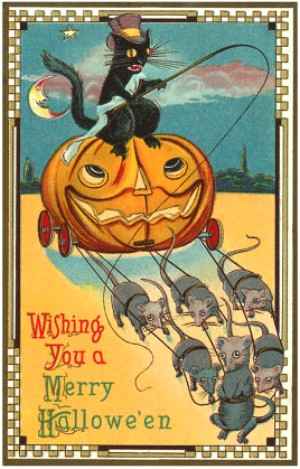
Cat pumpkin coach
Z   ig et zig et zag, la mort crie cadence
Frappant une tombe avec son talon,
La mort à minuit joue un air de danse,

Zig et zig et zag, sur son violon.
Le vent d'hiver souffle, et la nuit est sombre,
Des gémissements sortent des tilleuls ;
Les squelettes blancs vont à travers l'ombre
Courant et sautant sous leurs grands linceuls,

Zig et zig et zag, chacun se trémousse,
On entend claquer les os des danseurs,
Un couple lascif s'asseoit sur la mousse
Comme pour goûter d'anciennes douceurs.

Zig et zig et zag, la mort continue
De racler sans fin son aigre instrument.
Un voile est tombé ! La danseuse est nue!
Son danseur la serre amoureusement.
La dame est, dit-on, marquise ou baronne.
Et le vert galant un pauvre charron - Horreur!
Et voilà qu'elle s'abandonne
Comme si le rustre était un baron!

Zig et zig et zig, quelle sarabande!
Quels cercles de morts se donnant la main!

Zig et zig et zag, on voit dans la bande
Le roi gambader auprès du vilain!
Mais psit ! tout à coup on quitte la ronde,
On se pousse, on fuit, le coq a chanté
Oh! La belle nuit pour le pauvre monde!
Et vive la mort et l'égalité!

[Zig … zig … zag, Death in cadence
Striking a tomb with his heel,
Death on the stroke of midnight plays a dance-tune,

Zig … zig … zag, on his violin.
The winter wind blows, and the night is dark,
Groans are heard in the lindens;
Through the gloom, white skeletons pass,
Running and leaping in their shrouds.

Zig … zig … zag: each one is frisking,
The bones of the dancers are heard to crack—
A lustful couple sits on pillows
As if to relish a remembrance of softness that they knew in life.

Zig … zig … zag, Death continues
to scrape endlessly his sour instrument.
A shroud fell! The dancer is nude!
The dancers embrace, squeezing each other in withered love.
The lady was, says one, a marquise or baroness.
And the gallant lover was but a poor cartwright – Horror!
Look how wantonly she bonily abandons herself
As if the uncouth one was a baron!

Zig … zig … zig, which sarabande!
Circles of deaths giving each other the hand!

Zig … zig … zag, one sees in the band
The beauteous gambol with the ugly!
But psit! all of a sudden they quit the round ,
They push forward, they fly; the cock has crowed.
Oh! How exquisite is this night for the poor world!
And how lively Death and Equality!]

  —  Henri Cazalis (1840-1909), ‘Danse Macabre’.
The archetype for the Halloween spooky trope is no doubt the grotesque poem by Henri Cazalis that Saint-Saëns set for his ‘Danse Macabre’: ‘Zig et zig et zig, la Mort in cadence.’ Death, the violinist: summoning skeletons from their graves at midnight for a dance. Ghastly merriment, with interruptions. The poem’s two themes—one: osseous, clacking; the other: benighted, desolate.

If your quartet’s cellist is game, you might find Kaija Saariaho’s ‘Petals’ especially fitting as an addition to your play list. The tremendous abjection of it is deeply scary [click on the link to hear a YouTube clip of it]; very different from Danse Macabre.

It’s a challenge for composer and performers alike to achieve the grotesque without devolving into cheap pastiche. Garrop’s quartet orchestration is robust, balanced in a way that does not present excessive risks in performance. Kingston’s arrangement of the Saint-Saëns is vivid and serviceable. And Saariaho’s cello solo will leave everyone hesitant to shake the scary cellist’s hand after the performance. Bwwaah-ha-ha-ha-ha.

P   etals für Violoncello solo wurde in wenigen Tagen komponiert; eine lange, unbewußte Vorbereitung war diesem Stück jedoch vorangegangen. Das Material stammt direkt von meinem Stück Nymphea für Streichquartett und Elektronik. Der Name Petals (Blumenblätter) ist ebenfalls aus dieser Beziehung abgeleitet. Die gegensätzlichen Elemente darin sind sehr zerbrechlich, es sind farbenprächtige Passagen, die energischere Ereignisse mit klarem rhythmischen und melodischen Charakter hervorbringen. Diese scharf umrissenen Figuren werden verschiedenen Veränderungen unterworfen und versinken schließlich in einem dynamisch reduzierten, aber nicht weniger intensiven Filigranmuster. Mit der Kombination dieser beiden gegensätzlichen Ausdrucksarten wollte ich den Interpreten zu einer Ausweitung seiner körperlichen Sensibilität zwingen.
[‘Petals’ was composed in just a few days; a long, unconscious incubation preceded this, however. The material comes directly from my piece ‘Nymphea’ for string quartet and electronics. The name ‘Petals’ is derived also out of this relation—the Nymphs; the string/electronics orchestration. The moribund frailty of it all, of the petals! The opposing elements: passages that are very fragile with ambiguous character and rhythm oppose colorful passages evoking vigorous events with clear rhythmic and melodic character. These sharply outlined figures are subjected to different variations; they sink, and are dynamically reduced in the end to just one, but with still-intensive filigreed patterns. With the combination of opposing expression types, I wanted to force the performer to expand her/his sensitivity to the corporeal limits.
  —  Kaija Saariaho.
Botting book

Decrepit violin