Showing posts with label tourism. Show all posts

Friday, May 14, 2010

An Accumulation of Energies, Nameless and Named: Evening Chamber Music in Prague

 Prague Store Mesto clock
O   nce you’ve seen the signs about it [The Most-photographed Barn in America!], it becomes impossible to ‘see’ the barn,’ said Murray.
He fell silent once more. People with cameras left the elevated site, replaced at once by others.
‘We’re not here to capture an image; we’re here to maintain one. Every photograph reinforces the aura. Can you feel it, Jack? An accumulation of nameless energies...’
There was an extended silence. The man in the booth sold postcards and slides.
‘Being here is a kind of spiritual surrender. We see [and hear] only what others see [and hear]. The thousands who were here in the past; those who will come in the future. We’ve agreed to be part of a collective perception.”
  —  Don DeLillo, White Noise (1985).
A    ve Maria, gratia plena, Dominus tecum, Virgo serena.
Ave cuius conceptio,
solemni plena gaudio,
celestia, terrestria,
nova replet letitia.
Ave cuius nativitas,
nostra fuit solemnitas,
ut lucifer lux oriens
verum solem preveniens.
Ave pia humilitas,
sine viro fecunditas,
cuius annunciatio
nostra fuit salvatio.
Ave vera virginitas,
immaculata castitas,
cuius purificatio
nostra fuit purgatio.
Ave preclara omnibus
angelicis virtutibus,
cuius fuit assumptio
nostra glorificatio.
O Mater Dei, memento mei. Amen.”
W e hastily ran around the small central core of Prague—the Stare Mesto (old town) and the Hrad (castle). The evenings were dark and delicious.

W e found the astronomical clock on the Old Town Hall to be especially interesting, both symbolically and from an engineering point of view. At the top of the hour, the clock features a procession of figurines of the 12 apostles, preceded by the figure of Death (you can see him in the picture above, on the right-hand side) pulling a rope in his right hand, and inverting the hourglass that’s in His right hand. Each evening, we attended one or two concerts featuring Mozart, Vivaldi, local Czech composers—at the baroque Church of St. James, for example. The evenings had more renditions of Ave Maria than I ever knew existed.

E ach night from 8 p.m. onward you can find many—dozens?—of these chamber performances—in churches and other small halls. Very modestly-priced. Small ensembles, quartets, trios, duets, violin and piano, cello and piano, violin and piano and voice, voice and harp, violin and harp and organ/harmonium, string trio with trumpet, violin and harp and flute--anything and everything. Mostly, these are short programs less than 1 hour in length, cash admission collected at the door, with repertoire picked to appeal to a touristic audience and insure a nice extra income for the performers, many of whom are professional members of standing orchestras or chamber ensembles in and around Prague.

I nvariably, there is at least one version of Ave Maria.

F amous and familiar as it is, the most frequently performed is the version by Charles Gounod, who added melody and words to J. S. Bach’s first prelude from the Well-Tempered Clavier. Mozart’s K.554 is the one next most common version on offer. Brahms’s Op. 12.

A ntonín Dvořák’s version, the one composed in 1877. Another one, Verdi’s, for his 1887 opera Otello.

R ussian composer César Cui’s obsession: he is one of several composer ‘repeat offenders’ who have set the text at least three times: Op. 34, for 1 or 2 women’s voices with piano or harmonium (1886), and as part of two of his operas: Le Flibustier (premiered 1894) and Mateo Falcone (1907). Anton Bruckner wrote three different settings...

S ettings by Bruch, Byrd, Elgar, Verdi, Saint-Saëns, Rossini, Stravinsky, Schubert, Massenet, and Perosi as well as versions by less well-known composers, such as J.B. Tresch.

J acques Arcadelt’s setting: in reality, a 19th century arrangement by Pierre-Louis Dietsch, based on Arcadelt’s three-part madrigal, ‘Nous voyons que les hommes’.

F ranz Schubert’s ‘Ellens dritter Gesang’ (D839, Op 52. No. 6, 1825), performed with the Ave Maria prayer sung in place of the original text.

A lso, Josquin Desprez, Orlando di Lasso, and Giovanni Pierluigi da Palestrina. Nights are cool, chambered Grace, full of Marys. Collective, maintained perception—sort of like DeLillo's most-photographed barn, or like Motif #1.


Wednesday, February 6, 2008

Writing Home: Reflection Papers and Journaling to Deepen Your Music

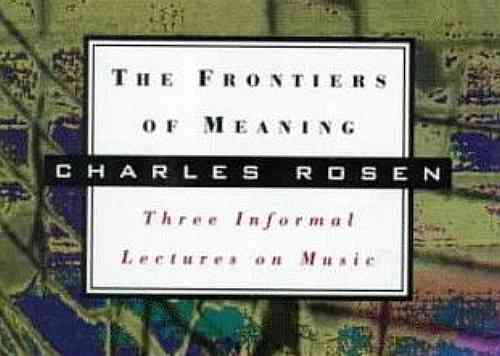
Charles Rosen, Frontiers of Meaning
N ow I’m supposed to write a paper reflecting on my playing and my learning process, which in turn are reflections of my literacy and adherence [or not] to the assignments. If I have to write this reflection paper of my reflecting on my reflections, I will ... do badness to something or someone. I have no idea what to write.”
  —  Anonymous.
If you’re in school, then chances are your assignments include writing one or more ‘reflection papers’ this semester. The task of writing an essay on your own experiences and applications and first-hand gleanings forces you to collect and distill and categorize: you critically evaluate your experiences and place them into context; the narrative form forces you to write about your own impressions and explain the context into which they fit. Quelle horreur!

Reflection papers aren’t a pedagogical punishment. Throughout your career, you can and should invest in improving your musicianship through regular journaling. This is in addition to whatever other activities you engage in for performance, composing, producing, engineering, arts marketing, artist management, presenting, teaching, listening—whatever you do musically. Writing ‘reflection papers’ is just one way for you to harvest and preserve the experiential learning that you do in those other activities. It’s a way to connect the work with the learning.

Why journal? (Why blog?) Mostly to keep yourself learning and growing, and to force yourself to clarify your thinking and revisit and retest your convictions—especially ones that may never’ve been fully thought-through in the first place. Consider it as a dimension of your training, just like practicing on your instrument(s)—it keeps your mind from getting old or rusty or atrophied. Use it or lose it!

W    hen I don’t practice for one day, my fingers know it; for two days, my friends know it; for three days, and the whole world knows it.”
  —  Ignacy Paderewski.
Journaling is about the shape and meaning we assign to our experiences. Our stories are about who we are, where we’ve come from, and where we think we’re headed and why. What you want to do is get ideas and explore ideas. You want to assemble evidence and counter-evidence, and critique the quality and strength of both.

How to go about it? I think it helps to have at least one or two examples as ‘benchmarks’ to serve as guides and reminders of the writing qualities you admire. For me, the epitome of writing that is at once erudite, elegant, and entertaining is pianist Charles Rosen. His little 1994 book ‘Frontiers of Meaning’ is, for me, iconic. Kyle Gann’s ‘Music Downtown’, emblematic of journalistic bravery. Alex Ross’s ‘The Rest Is Noise’ has a different tenor but serves to remind me of how wide our palette can be. Arnold Steinhardt’s ‘Indivisible by Four’, reminds me of grandfatherly patience and generosity in the life lived and the life written-about. You don’t have to write books as they have done. But our own writing will be better if we look frequently at how our favorite authors write.

The best book I know that specifically covers journaling and reflection papers as a practice for working artists is Buck’s. If you’re looking for practical guidance on how to go about writing a reflection paper (whether for your class assignment, or independently for your own professional growth), I recommend you pick up a copy. Check out the other books below, too.

Ultimately, critical analysis and interpretation aren’t detached acts; not value-neutral reportage. No, as a kind of psychological counterpart to Heisenberg’s Uncertainty Principle in physics, the acts of observing and journaling change the things you are observing and their relationships to each other. The personal change is the source of the value in writing reflection papers: the change enables further growth in your playing or composing or listening. Paradoxically, the infinite regress that Anonymous complained about above is actually the whole point of the exercise. Rather than ending in confusion, the process makes you figure things out; makes you figure out how you figured them out; makes you figure out how ‘figuring out’ works. A different dimension of professional practice. A different kind of rehearsal. Quelle horreur!

O  ur doubts are traitors, and make us lose the good we oft might win by fearing to attempt.”
  —  William Shakespeare.