Showing posts with label horror. Show all posts

Wednesday, November 14, 2012

Experiencing ‘Map of Rain Hitting Water’ in the aftermath of Hurricane Sandy

 Ripples
W   hen at last Justine arrives, he’s at the piano
     the hammers strike and rise
 with his fingers, and the pedal’s damp
   shifting carries through the instrument
as waves echo through the frame of a ship...
Now he thinks perhaps the music’s
More like a map of rain hitting water—
He’s moving closer to her without moving;
And how wonderful to be held from her
   at last by nothing but the song's duration—”
  — Wayne Miller, ’What Night says to the Empty Boat’, p. 73.

I ’d first listened to Mara Gibson's new 16:30 work commissioned by Mark Lowry of newEar Contemporary Music Ensemble in July. The DVD has Mark performing vibraphone, log drum, woodblock, gong, tam-tam, songbird whistle, cymbal, and miscellaneous percussion, accompanied by video imagery and film by Caitlin Horsmon. Bob Beck rendered a high level of engineering and production values achieved in this recording.

T he beauty of the chromatic intoning of vibraphone, punctuated by tolling woodblock, drum, and, less frequently, other instruments captured my interest from the first listening. The glisses and pitch-bent post-processed sounds of the vibraphone acoustically paralleled the imagery, the lateral motion of water in the foreground and in the distance; the water droplets in air, falling under gravity in parabolic arcs; the globules of water separating from a stream; the intercalating pastel cloud layers.

B ut now several months later—having just last week returned to the midwest after a period at our home on the East Coast, and having driven through some of the areas of hurricane-caused power outages and natural devastation—these textures and narrative arcs of ‘Map of Rain Hitting Water’ evoke different meanings for me. The watery surfaces now seem ominous and obscure what lies beneath.

T he reflections imply sky and sun, but these seem untrustworthy. The eddies and vortices imply structure and hidden currents, turbulence: the violence and indifference of Nature to humanity.

T he speed of the current makes abundantly clear how rapidly we will be swept away, annihilated, pointlessly. The accelerando/ritardando phrasing imparts a large-scale 2+ minute hypermeter to the piece.

N o animals or other sentient creatures are seen anywhere in Horsmon’s imagery here... bulk matter only, liquid and air. The abruptly changing frame-rate... declares a capriciousness of our frame of perception, together with Nature’s propensity to precipitous, emergent change, against which our human wishes and needs are respectively futile and irrelevant.

T here is midway through the film a montage of stop-action stills, with different transparency/saturation settings, calling into question what is motion. It brings to mind horror film sequences built up out of successions of freeze-frame stills.

T he very high-speed video of the water droplets, together with digitally-stretched contrast and/or edge-sharpening, gives heightened perception of the separateness of the individual [droplets].

W e have here a sort of ‘video-monitor-as-painter’s-canvas’ effect... a palimpsest of successive masks and over-writing of previous images and surfaces.

T he film draws our attention to the very thinness and 2-D nature of our existence in the biosphere, between the sky and the depths of water.

I n fact, most of the film is of deep water: the first 5:45 is sky; second 6:00 is water; third 4:45 is water hurled into sky—with gradual transitions between these segments.

T he piece conveys feelings of loneliness and alienation that arise from our understanding that we are alone in the universe and insignificant in its workings. Underneath the performer’s punctuated observations and soliloquy about fate and the stream of events that occupies our attention while we are alive is a certain forboding, a fear of nothingness.

T hat we are in some inescapable way alienated from Nature is an old concept, going back at least to Jean-Jacques Rousseau in the 18th Century. It is also a notion that coheres with our current environmental problems, insofar as our estrangement from Nature involves a hubris that forecloses upon developing an awareness and regard for how we depend upon Nature, in such a way that we would stop harming Nature.

R elinquishing whatever agency I have in the presence of the bulk matter around me reveals my beholdenness to the agency of other humans who are living now and who will take care of me in my dying days and who will outlive me, and the susceptibility of my remains and the residue of my life’s work to the agency of all creatures and natural processes that persist beyond my tiny lifetime.

T he harsh contrast and unblinking lens of the camera—together with the continuous, unflinching sound of the music—announce the abject hopelessness of our achieving any anonymity in the flesh, or participating in any genuine reciprocity with Nature.

S uch existential worries are absent when reciprocal trans-corporeality involves the definitely spiritual, or “more than human”, or involves an ambiguity or reversibility afforded by the hardly-human-at-all, or as-minimally-human-as-possible, as in Wilderness or Zombieness.

O ne can make some sense then of this piece’s assertion that we might be estranged from the flesh without that meaning either that such estrangement puts us really outside the flesh, or that landscapes including sky and water are themselves not fleshy. We are estranged, every bit as much as sky and water are patently fleshy.

T his is a superb composition, an excellent film, a beautiful performance, an excellent recording—sufficient to propel an evening’s meditation and beyond.

 Ripples

Thursday, November 24, 2011

Gogol’s Terminal Psychosis, No Effective Medical Palliative Care in Sight

Auerbach ©F. Reinhold
I   n the last stage of his life Gogol is increasingly consumed by a religious mania. He considers his past work a sin and burns the second part of his major novel, ‘Dead Souls’. In the end he refuses to eat. In his final hours he is visited by the fantastic figures from his own works – and they show themselves to be more reasonable than he is himself at this point. Gogol has utterly broken with his previous life and renounces it; now it is avenging itself. … This opera is not so much a biography as a poetic and satirical study of one of the greatest Russian writers, whose emotional life is as mysterious and fascinating as his idiosyncratic works... Lera Auerbach … has found her own voice, and it is full of stylistic freedom and dramatic power.”
  — Theater an der Wien opera, program notes, 2011.
T he person must, according to the DSM-IV, have at least two out of five symptoms:
  • (i) delusions, (ii) hallucinations, (iii) disorganised speech, (iv) grossly disorganized or catatonic behavior, or (v) functional incapacities or negative symptoms (such as alogia, avolition, etc)—for a substantial percentage of a one month period;
  • Plus, continuous signs of disturbance must continue for at least six months;
  • Plus, substantial social or occupational dysfunction must be evident;
  • Required exclusion criteria include substance abuse, mood disorder, and pervasive developmental disorder.
C heck, check, and check—with regard to Nikolai Gogol in the last 6 months of his life.

I f you are expecting in Lera Auerbach’s new opera a Gogolesque, cynical account of human nature, or about the ruling class (‘We are the 99%!’), or a scatology as absurdist art, you will not find it here.

N or will you learn famous Gogol’s concept of the untranslatable Russian word пошлость (‘poshlost’). [Vladimir Nabokov explained this as “posh-lust”, “not only the obviously trashy but mainly the falsely important, the falsely beautiful, the falsely clever, the falsely attractive” (Nabokov 1944, p. 70)—the falsely transcendent.] Пошлость reduces reality to a sort of cavalier mediocrity and unrepentant vulgarity—a moral and spiritual condition from which humankind cannot escape—compulsive smutiness, radical pointlessness, compulsive garish carnival, absurd superfluousness.

N o, in this fantastical new opera we get nonstop existential angst and horror—superbly manifested in Auerbach’s score and libretto, and in an exceptionally fine production by Theater an der Wien (who commissioned the work), with performances by ORF Radiosymphonieorchester, Arnold Schoenberg Chor, Grazer Kapellknaben, and Mozartknabenchor Wien… a convincing reenactment, showing the suffering Gogol, receiving no effective medical help for his end-of-life psychiatric condition.

I t is as though Gogol’s invention, пошлость, ironically haunted him during his final days. Which amounts to a lesson to us all, to be careful about what we dream, what we think, what we dwell upon. As our minds begin to fail late in life, those one-time droll ideas of ours—every hubristic preoccupation; every cynical mental posture we ever indulged—every one of them could become real in our waning days—and we may be powerless to make them stop from bothering us. Bad karma or poetic justice, hunting you down in your own lifetime! Ein Alptraum jagt den nächsten!
B   efore writing a note of ‘Gogol,’ composer Lera Auerbach immersed herself in the writer’s complete works and over twenty books written about him. It would take similar efforts to begin to understand this opera: taking us inside the fevered mind of its title character, ‘Gogol’ is less a biographical narrative set to music than a phantasmagorical, psychological investigation. Given a virtuosic staging by director Christine Mielitz, it is also an overwhelming theatrical experience.”   — Zwölftöner (Werner Kmetitsch), 17-NOV-2011.
A uerbach regularly collaborates with soloists and ensembles including Hilary Hahn, Vadim Gluzman, Leonidas Kavakos, Julian Rachlin, Philippe Quint, Gautier Capuçon, Alisa Weilerstein, David Finckel, Kim Kashkashian, Tokyo String Quartet, Borromeo Quartet, Artemis String Quartet, Vanbrugh String Quartet, Kremerata Baltica, Camerata Pacifica, and the Chamber Music Society of Lincoln Center. Auerbach was born in the city of Chelyabinsk, adjacent to Siberia. After writing her first opera when she was 12, she moved to the U.S. in 1991 where she studied piano and composition at Juilliard. Her piano studies took her to the Hochschule für Musik und Theater in Hannover. She was awarded the Hindemith Prize by the Schleswig-Holstein Musik Festival in Germany, Deutschlandfunk’s Förderpreis, selected as a Paul and Daisy Soros Fellow, and in 2007 she was selected as a member of the Young Global Leaders forum by the World Economic Forum in Davos, Switzerland.
Auerbach ©F. Reinhold
G   ogol’s ‘grotesque’ is a—] means of estranging—a comic hyperbole that unmasks the banality and inhumanity of ambient reality.”   — Susanne Fusso, p. 69.

Wednesday, October 19, 2011

Maybe You Would Like Some (bwa-ha-ha!) Halloween Chamber Music

Viviane Chassot
T   h E minor sonata... impressive for its impassioned and profoundly grave character. Its very first notes create room for dialog between rising arpeggiated octaves and sighing downward figures. This interplay combines a plebian ‘cantabile’ quality with dramatic outbursts and fermatas of great intensity... eerily piercing melody above nervously racing bass lines is an incomparably tender and profoundly human portrait hovering somewhere between hope, apprehension, and a scarcely definable longing.”
  —  Anselm Hartinger, liner notes for Viviane Chassot CD.
T   he pale F minor Adagio [of the F major sonata, Hob. XVI:23] sounds like an eccentric siciliano, with idiosyncratic bass phrasing and complicated rhythms undermining the movement’s simple, rocking motion... an unimposing but brilliant exploit. The abrupt toccata-like entry... is remarkable for its passionate quality, giving the lie to any good-natured, fatherly image one might have of Haydn.”
  — Anselm Hartinger, liner notes for Viviane Chassot CD.
E very year somebody I know asks me to suggest some scary music for them to play, for a Halloween party or other gathering of friends around this time. “Something exotic. Not Bach ‘Toccata and Fugue in D minor’ predictable.” Okay, so how about haunted accordion!


    [30-sec clip, Viviane Chassot, Joseph Haydn, Sonata in e minor, Hob. XVI:34, Presto; (track 11), 2009, 1.1MB MP3]

A h, the wistful, waning days of autumn, hours of daylight quickly shortening, your major-key moments vanquished by spooky darkness. How about a swooping, nimble waltz brought up crippled with rubatic, sesquipedalian and perhaps lethal injuries? Rapid sextuplets of flitting bats! Long fermata rests in the spooky wood; then continue on the dank path...

    [30-sec clip, Viviane Chassot, Joseph Haydn, Sonata in F major, Hob. XVI:23, Adagio; (track 5), 2009, 1.1MB MP3]

Y our languid puppy innocence cannot protect you from the danger here; it only signals your vulnerability and the juiciness of your jugular. These stretches of tranquil major are like a cinematic tight-shot, hiding the danger that’s nearby. Your lonely ambling treble can take no comfort from the lurker bass-voice. He does not escort you. Instead, he narrates your doom. Bwa-ha-ha!

T hese sonata movements become ‘character pieces’ by way of, shall we say, a “possessed” timbre and texture of which accordion is capable! E minor, the key of flight from reality and spiritual drunkenness. F minor, the key of self-torment; qualms of conscience; introversion; pensiveness; endless worry; self-reproach; wishing you’d never come. The e minor and f minor are perfect keys for Halloween, don’t you think? Far more subtle and sneaking than ... the undead d minor; the ominous g-sharp minor; the sepulchral c-sharp minor; the tragic c minor; the frenzied g minor, so obvious (see links below, esp. Steblin and Schubart).

Viviane ChassotB orn in Zürich, Chassot studied at the Hochschule der Künste in Bern with Teodoro Anzellotti. She is winner of the Kranichstein Music Prize in 2004 in Darmstadt. She is an energetic champion of new music, working with ensembles such as Contrechamps Geneva, Collegium Novum Zurich, Klangforum Wien und Ensemble modern Frankfurt. She also has in the past 10 years engaged in interdisciplinary projects with writers and dancers—for example, her 2007 collaboration with choreographer Luca Veggetti and the Cincinnati Ballet, with presentations at the Guggenheim Museum, New York. Ms. Chassot presently lives as a freelance musician in Leipzig. She has collaborated with composers such as with Beat Furrer, Michael Pelzel, Toshio Hosokawa, Roland Moser, Henri Dutilleux, Jörg Widmann, Friedrich Cerha, Arman Gushchyan, and Bernhard Lang, and she has transcribed many Baroque and early music works for the accordion. Her interpretations combine historical musical performance practice with the unusual properties of free-reed, which inevitably makes the music appear in a new [and sometimes eerie] light!


Sunday, November 9, 2008

‘Just War’ According to Dialogos: Rhetoric, Memory, Violence & Medieval Theater of Cruelty

Dialogos (left to right): Albrecht Maurer, Katarina Livljanić, Norbert Rodenkirchen
I   f the number and variety of versions—and widespread and enduring popularity—can be any criterion of greatness, the tale of Judith, it must be conceded, is one of the great stories of the world’s literature.”
  —  Edna Purdie, The Story of Judith in German and English Literature.
The staged musical production of ‘Judith’ by Katarina Livljanić and members of the ensemble Dialogos tells the biblical tale of the beautiful enchantress, Judith, who seduces and then beheads the Assyrian general Holofernes to liberate the Hebrews. The score also includes a medieval 5-string fiddle, a lirica (Croatian traditional stringed instrument, tuned in ‘archaic’ manner), and archaic flutes. The beauty and Croatian authenticity of Livljanić’s voice, the narrative and discursive power of the instrumental parts, the elegance of the staging and lighting, and the poetics of the carefully devised, historically informed Glagolitic text (and translation that is sympathetic to the needs of the audience, as opposed to Livljanić’s fellow scholars)—all of these combine to achieve a compelling artistic result, just as with ‘Vision of Tondal’ and other of Dialogos’s productions.

Character development in Livljanić’s version of ‘Judith’ is fuller than in the simplified accounts of the story that are familiar to us, and far more complex than in the synoptic artworks through which most of us are acquainted with it ... Klimt and Caravaggio and Reubens and so many others.

Holofernes, the general of the Babylonian King Nebuchadrezzar, whose decapitation by Judith is referenced in the Old Testament. Holofernes, the powerful general of King Nebuchadnezzar’s army. A number of provinces of the Second Jewish Commonwealth had withheld their assistance from Nebuchadnezzar and his government—had declined to join the coalition of the willing. So now comes Holofernes, the guy Nebuchadnezzar dispatches to give them an offer they couldn’t refuse.

The historical general did lay siege to Bethulia. The city was on the verge of surrendering but was saved by Judith, a beautiful Hebrew widow who preyed upon Holofernes’s huge vanity, deceived him, drank him under the table, sliced off his head in bed. Judith, she who then returned to Bethulia displaying the severed head, after which the Hebrews went on to beat Nebuchadnezzar’s now-generalless army. Morals: Be careful who you drink with, and be sure to drink responsibly.

Katarina Livljanić
Ensemble Dialogos
  • Katarina Livljanić (voice)
  • Albrecht Maurer (5-string fiddle)
  • Norbert Rodenkirchen (flutes)
  • Sanda Herzic (staging, scenography and costumes)
  • Marie Bellot (lighting design and direction)
Livljanić’s voice—alternately, narrator/seductress/warrior/mind/spirit—leads the listener through this biblical story of Judith, transformed here into historically-informed music theatre, instantiating characters who hail from the old biblical and Croatian Glagolitic texts to become amazingly relevant to contemporary society—both in terms of gender issues, and in terms of calling into question what is ‘justified violence’ and whether or not there is such a thing as a ‘just war’. Renaissance Glagolitic chant forms the musical structure of the performance. Accompanying Livljanić’s voice, the medieval lirica and 5-string fiddle and flutes give Marko Marulić’s Glagolitic text vivid, dramatic color.

Dialogos’s Judith is essentially ‘Eros and Thanatos’ rendered using fragments of medieval Glagolitic ‘disputationes’ that alternate with the main ‘Judith and Holofernes’ story. These interpolations are a narratorly gambit to reveal the characters’ thoughts; for example, as Holofernes’ head is severed, his thoughts ‘separate’ into a dialogue between his body and his soul. Another inner dialogue—between Judith’s mind and her soul, a sort of schizoid soliloquy—occurs as she prays for God to help her kill Holofernes.

According to Livljanić’s program notes, the ancient text of Judith survives without music, and the poetic metrical structure of the text closely corresponds to the meter of archaic Glagolitic melodies used for storytelling in medieval Dalmatia. The text refers to texts sung in the liturgical offices, and these clues enabled Livljanić to reconstruct, using Dalmatian and southern Italian musical sources, melodies plausibly correlated with indications in the original Judith text. This liturgical repertoire, sung in Croatian Church Slavonic, did function in the Latin mass, and was preserved over the centuries in manuscripts written in Glagolitic in medieval Croatia.

Livljanić performs all of the roles and uses a variety of vocal effects and a few costume changes to keep the roles distinct. Surpassing the phenomenal scholarship that goes into preparing their productions, the musicianship and historically-informed performance of the members of Dialogos ensemble are iconic.

F   rom the standpoint of the history of rhetoric, the presence of dramatic elements in discussions of torture presents a tremendous predicament for scholars, who have long been troubled by Aristotle’s casual inclusion of torture as one of the factual, ‘inartificial’, or extrinsic proofs to be discovered by orators during the inventional process... Inartificial proofs are those which ‘have not been furnished by ourselves but were already in existence, such as witnesses...’ What is so striking about the evidence ... is that, during rhetorical ‘inventio’, the ostensibly extrinsic proof that torture represents functions as an avowedly unreliable intrinsic proof. The rhetorician theorizes the inventional proof of torture as a verisimilar process that causes torture to appear to be an unshakable extrinsic proof, when in reality it is just as ‘intrinsic’, just as ‘creative’, just as fictional, just as ‘dramatic’ as other modes of rhetorical invention... Its ‘facts’ are evaluated on the basis of their potential persuasiveness as fashioned probabilities and then, in a process of reaffirmation, judged as factual on the basis of their verisimilitude. At issue, then, is less the truth of the law or the historical occurrence than the spectacular probabilities of the rhetorical presentation, which is born of materials extracted through punishment... Torture enters the scenario with its own role to play in the transformation of hypothesis into fact.”
  —  Jody Enders, Medieval Theater of Cruelty, p. 28.
Cranach the Elder Judith
Let’s do something I alluded to in the previous CMT post: illuminate this musical performance by drawing parallels between it and several works of art. Most of us know the story of Judith primarily through the famous representations of ‘Judith Slaying Holofernes’ in paintings.

The Christian church fathers embraced Judith, but went to extra trouble to ensure that the story was cast in a certain light that was favorable to the Church. When the Church hierarchy commissioned paintings and sculptures of Judith, the artists were compelled to make Judith into not so much an allegory of faith as an allegory of Christian virtue writ large—especially that prototypical virtue that most fascinates priests, chastity (as in the Cranach the Elder painting above). And then came Artemisia Gentileschi. Artemisia, without the strings of any Church commission attached. Artemisia, who had herself been raped. Artemisia Gentileschi did not make ‘nicey-nicey’.

Artemisia Gentileschi in 1620 was the first to paint a ‘feminist’ Judith. Her father Orazio had also painted Judith—a conventional Judith. Michelangelo, Botticelli and Caravaggio had painted Judith. Donatello had sculpted Judith. Gentileschi’s painting is dark, darker and more dramatic than Caravaggio’s and others’ Judiths. A theatrical spotlight is trained on the action, on the struggling limbs. The shadows on Judith’s arms force us to acknowledge the sawing, crunching, ‘why-is-this-neck-gristle-and-bone-so-tough?’ sword action she uses to get his head off. The extent of the blood splayed around the scene gives us a pretty clear idea that Gentileschci believes this was not a quick death, nor should it have been. Nor was this murder a workmanly job ineptly done. No, there is a realist’s quality of gratuitous suffering; of ‘extraordinary rendition’ as they say; of cold-blooded torture. The feminist righteous violence of Artemisia Gentileschi’s painting(s) is very close to the moral quality that Livljanić projects in the Dialogos production of Judith. Livljanić’s text has Holofernes’s dying going on and on...

Gentileschi Judith
As portrayed by Gentileschi and by Livljanić, Judith’s violence is righteous—premeditated but justified—vigorously justified ex-post facto by Judith. But not some pious, patriotic perp intent upon pleasing the patriarchs. This is cool, calculated, cathartic revenge by a woman who has been raped. ‘You, Asshole, are not f’ing getting away. You are f’ing going to die, right here, right now.’ And, naturally, heroic, cathartic righteous horror is invariably exciting. After all, ‘bloodied virtuosity’ is titillating, as American (and other—) filmmakers seem to know so well. The ‘pride goes before the fall’ tragic position of Holofernes’s arrogance and hubris just seems not to have many ‘takers’ these days. Nobody views the character and deeds of Judith as subversive and offensive anymore. Nobody thinks of Holofernes. We are all self-vindicating terrorists now. We are all Judiths or would-be Judiths if given the chance. Just not as chaste as a Church father or an Imam might prefer...

Klimt Judith
Gustav Klimt’s Judith paintings have instead a wasted, absinthe-debauched, sybaritically-bedecked golden Judith-the-Ho tucking the still-astonished dead head of Holofernes under her arm as if it were a handbag. The dramatic lighting is completely lacks the excitement and action of Gentileschi. Judith is here quiet and sated, as though she were a tiger or other predator? “Or the Hillbilly of Wasilla, Sarah Palin,” as one of the commenters in the discussion group that preceded the Kansas City Dialogos performance last night said. “What?! What are you looking at! I did not order these clothes from Neiman Marcus! No, siree! They’re goin’ back. Givin’ ‘em to charity.” Palin’s face and hair even look quite a lot like the Klimt Judith... Yikes.)

Klimt’s Judith gazes off beyond us; she has no regard for us. She appears to be daydreaming, and it is not likely that she is dreaming of murdering generals to save her people or build an actual oil pipeline. She is detached from the damage she has wrought. Klimt shows us not only Judith-the-Ho but also Judith-the-Psychopath and Judith-the-Jihadist. Klimt’s Judith ‘had’ to do what she did, just as Anthony Perkins ‘had’ to kill Janet Leigh’s character in ‘Psycho’, complete with her schizophrenic interior dialogue and ‘disputationes’.

Caravaggio Judith
By contrast, Caravaggio’s Judith is a tentative, horrified, ‘how-can-I-manage-to-finish-this?’ withdrawing, backward-staggering, agast Judith. Not a ‘psycho’ at all. And totally not ‘ho’. She stands back from Holofernes, disgusted—as much by her apprehension of her moral ‘dirtiness’ in the situation as by the physical horror of it. Whereas Gentileschi’s and Klimt’s Judiths are entirely self-assured—self-possessed with feminist and psychotic conviction, respectively; righteously unafraid—Caravaggio’s Judith comprehends that no one comes home ‘clean’. Righteous though your cause may have been, well-intentioned or not as you may have been before embarking on your project, your act has inscribed you now, marked you for life. You will never again be the same. You can never roll back the clock. The deed was morally dirty; ‘just war’ was an elusive myth, not a black-and-white certainty as you might have thought before. Livljanić manages to import some of this feeling into the Dialogos Judith performance. Various reviewers use words like ‘metamorphosis’ or ‘transformation’ or other literary expressions to describe it. Me, I don’t buy it. To me, Livljanić is a realist, one who considers that the historical Judith was—and all of us today are—complex, highly spontaneous ... concurrently ebbing and flowing with various motives and reasons and conflicts. Our confusion and messiness and internal conflicts in general don’t tend to resolve in transformative ways. We’re perpetually ‘becoming’ but we seldom transform or metamorphose. We just extemporize; we just act; we just live then with the consequences. As one of the ‘disputationes’ between Judith’s mind and her soul tells us, our abstract souls and embodied minds are old and not likely to change or suddenly become un-confused:

W   hy are you confusing me, my soul? And her soul answered: Oh, how greatly you confused my heart … I have been given to the body to live with it, and the body cheated me… The mind responded: My soul, your excuse is not good, because your body is made of earth, and you are made of wisdom… Therefore, [you must] overcome your body. The soul said: Woe to me that I hoped to receive from you a consolation, and instead I receive even bigger sadness. You know I have been living on this world for many years… I cannot overcome my body. It is older, cannot move, and cannot do any good...”
  —  ‘Disputatione’ (‘Agony’; a schizoid Glagolitic soliloquy between Judith’s ‘soul’ and her incarnate ‘mind’), ‘Judith’, text by Marko Marulić, adapted and extended by Katarina Livljanić.
W hat more can we make of this—in attempting to understand this production through parallels we can find in other works of art? Well, Livljanić’s rendering of Judith is not a ‘play’. It is instead an act of political-activist remembrance, just as Artemisia Gentileschi’s paintings are acts of protest and activist remembrance. It is an 80-minute meditation on ‘wars of choice’ and ill-conceived pre-emptive wars, as contrasted with necessary wars and ‘just’ morally-defensible wars. Livljanić’s vivid exhortations are not mere scholarly play-acting for us to ‘admire’ for their aesthetic value. No. They are powerful admonishments for us to engage in Shoah-like ‘remembering-so-as-never-to-forget’.

W   hy is it more important to remember acts of genocide than simply to learn about them? If literary works are truly the bearers of ontology, then what must be our conduct toward them?”
  —  Amy Hungerford, Holocaust of Texts.
In other words, this is not a docudrama that enables us merely to learn about an historically-explicit, militarily important act of dudicide by some hot chick in ancient Bethulia in the mavericky Second Jewish Commonwealth. No, this historically-informed artwork comes fully armed, locked-and-loaded as a bearer of political ontology: Livljanić is ballistically instructing us about what our conduct ought to be toward our ontology of justice—and about how we ought to be maintaining that ontology (and that justice) in a coherent, continent way. This is not art-as-entertainment or scholarly historiography tarted up as elite musical theater. It is beautiful and diverting, yes. But, more than that, it is art that advances specific and important political, moral, and ontological viewpoints—ones that Livljanić and her colleagues want audiences to take to heart and act upon. It is Art with an Agenda. It is a powerful essay on feminism through the ages, directly relevant to contemporary issues having to do with ‘just war’ as an abstract concept, and with specific unjust wars in-progress today, and with civil society and the problem of terrorism (terrorism that is sponsored by governments, like Nebuchadnezzar’s government or other ones in modern times; terrorism that is undertaken by groups other than the State; or terrorism that is undertaken by individuals, psychotic/psychopathic or otherwise). If you have an opportunity to attend one of Dialogos’s performances, do not miss it!

D   id an on-stage execution really take place in 1549 in the city of Tournai? According to somewhat questionable evidence about the production of Judith and Holofernes in that city, the actor playing Judith actually beheaded a convicted murderer who assumed (ever so briefly——) the role of Holofernes, just long enough to be killed during the play, to thunderous applause.”
  —  Jody Enders, Medieval Theater of Cruelty, p. 202.
Enders book

C   ahun also questions Judith’s response to the applause she receives when she emerges from Holofernes’s tent holding his head—horrified at having killed the man she loves and at their response, which she experiences at first like ‘a child whom one mistreats.’ ‘People!,’ she exclaims without much heroism, ‘What do we have in common? Who allowed you to invade my private life? To judge my acts and find them beautiful? To burden me—I who am so weak and weary, eternally hunted—with your infernal [God-sappy] glory?’ How can we know for certain, Cahun seems to be asking, what Judith’s motivations and desires were—the only person in her town willing to enter Holofernes’s tent? How can we know that Judith lost interest in sex once she was widowed, and that she became pious and chaste and shared her townspeople’s dislike and disdain for the enemy commander? Are not these assumptions based on clichés tied to sexuality? In Cahun’s telling of the Judith story, Holofernes is bestialized before he is dismembered. Judith is portrayed as ‘terrible,’ although Cahun sees her also as ‘abject’. Leiris later admiringly labels her a ‘patriot prostitute,’ but Cahun sees neither patriotism nor prostitution in Judith’s desire.”
  —  Kate Conley, From Sadistic Judith to Human Frontier, 2004.
Bellamy book


Friday, October 10, 2008

Halloween: Spooky String Quartets, Scary Piety

Violinist, skeletonized
T    he basic purpose of story-telling ... is not just to entertain but to illuminate life. It doesn’t matter if we deal in the symbolism of supernatural beings such as vampires, zombies, ghosts, werecreatures, and unknowable cosmic entities. If horror is done right—and we have only to look at the stories withstanding the test of time to identify which ones are done right—then it provides a psychological roadmap through the trials of life.”
  —  Matthew Warner, Horror Isn’t a 4-Letter Word, p. 14.
To many, Halloween is a perfect ‘holiday’, relatively free of the social stresses that burden other celebrations during the year. And, to celebrate Halloween, it’s always good to have some appropriate atmospheric music to mark the occasion. If you and your string quartet friends are looking for something new to put you and your Halloween audiences in the spirit, you can surely do no better than Stacy Garrop’s String Quartet No. 2, ‘Demons & Angels’.


    [50-sec clip, Stacy Garrop, String Quartet No. 2 ‘Demons & Angels’, Mvt. 3, ‘Inner Demons’, 1.2MB MP3]

Music in the Loft commissioned the first two movements of ‘Demons and Angels’ for performance by the Biava Quartet on its 2004/2005 concert series. The Loft subsequently commissioned the rest of the piece, premiered by the Biava Quartet at Yale University in November 2005. The 4-movment complete work received its premiere at Music in the Loft in October, 2006.

An assemblage of unrelenting demons, unreliable angels, and gothic humanity, String Quartet No. 2 tells the story of a devout man who confidently and self-righteously thought his actions were guided by God, only to discover that he was mistaken—he has in fact heinously murdered five people. The first two movements elucidate the deluded personality of this character. The first, ‘Demonic Spirits’, addresses the darkness that’s inherent in his pious self-deception. The movement begins with a jarring chord played five times, each one representing a murder. These chords return as violent interruptions throughout the piece. This movement has two main themes: the first theme is martial/militaristic; the second theme is sinister in its arrogant impishness. The second movement, ‘Song of the Angels’, contemplates the goodness in the protagonist before his personality is transformed by delusional piety. The cello has a long solo created by blending elements of the first movement’s themes, representing how evil is spawned from good intentions that are oblivious to reality.

The third movement, ‘Inner Demons’, is a vivid account of this character as he descends into psychosis. This movement contains four themes: a tarantella, a demented waltz, a scherzo, and the Kentucky pentecostal folk hymn ‘The Wayfaring Stranger.’ Finally, the eerie hymn asserts itself above all, and we hear the man commit the five murders that opened the first movement. The piece concludes with IV. ‘Broken Spirit.’ This movement explores his realization of what he has done. The man is caught and sentenced to life in prison. With a festinating four-note motive, the man paces in his cell while his mental state alternates between psychotic violence and spasms of remorseful hope that, through contrition, he can be saved by angels.

I    am a poor Wayfaring Stranger,
A-trav’lin’ [you betcha!] through this land of woe.
And there’s no sickness, toil or danger
In that bright world to which I go.
I know dark clouds will gather ‘round me;
I know my way is [darn] rough and steep.
But beauteous fields lie just beyond me [my friends],
Where souls redeemed their vigil keep.
I want to wear a crown of glory
When I get home to that bright land;
I want to shout Salvation’s story
In concert with that blood-washed band.”
  — Appalachian Folk Hymn.
Scary jack-o-lantern
Of course, a composer’s decision to write a string quartet is fateful in its own right, linking one to the great European tradition, including veneration of glorious, deceased masters. At the outset the composer always believes in her/his own mind that the quartet-writing enterprise is a just and righteous one. Mindful of the risk of self-deception, however, Garrop dissects her corpses carefully and finds her own funereal path. ‘Demons & Angels’ is a pestilential object lesson in terror—for listeners, performers, and maybe other composers. She discovers her quartetly ‘path’ both musically and theatrically, incorporating diverse elements and exploiting the dimly-lit concert environment in suspenseful bubonic ways. Musically, Garrop’s works are distinguished by the mordant quality of their realization. The Second Quartet embodies a well-(de)composed ‘working out’ of the implications of these various morbidly-contrasting motivic ideas and Ichabodleian gestures with a traditional arch form, galloping repeated psycho-rhythms, and a cadaveric approach to thematic development. ;)

Stacy Garrop has won several orchestra competitions resulting in performances by the Civic Orchestra, Omaha Symphony, New England Philharmonic, the Women’s Philharmonic, and readings by the Minnesota Orchestra and the American Composers Orchestra. She was also selected for the Dale Warland Singers 2000-2001 New Choral Music Program. She was a finalist for the 2001 Rome Prize, and received a 2001 Barlow Endowment commission, as well as a 2002 Artists Fellowship Award from the Illinois Arts Council.

Her works have been recently performed by the Charleston Symphony Orchestra, San Francisco Chamber Singers, EARPLAY. Other performances includes ones given by the National Repertory Orchestra and the new music ensembles Third Angle and SoundsNew.

She has held fellowships/residencies at the Banff Centre for the Arts, MacDowell Colony, Millay Colony, Atlantic Center for the Arts, Yaddo, and Wellesley Composers Conference.

Garrop completed her Doctorate in Music at Indiana University in 2000; she also holds an M.A. from the University of Chicago (1995) and a B.M. from University of Michigan (1992).

Stacy is currently an Assistant Professor in Composition at the Chicago College of the Performing Arts at Roosevelt University.

Other Halloween-ish pieces you might consider include these:
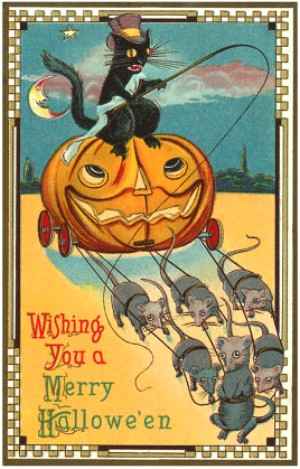
Cat pumpkin coach
Z   ig et zig et zag, la mort crie cadence
Frappant une tombe avec son talon,
La mort à minuit joue un air de danse,

Zig et zig et zag, sur son violon.
Le vent d'hiver souffle, et la nuit est sombre,
Des gémissements sortent des tilleuls ;
Les squelettes blancs vont à travers l'ombre
Courant et sautant sous leurs grands linceuls,

Zig et zig et zag, chacun se trémousse,
On entend claquer les os des danseurs,
Un couple lascif s'asseoit sur la mousse
Comme pour goûter d'anciennes douceurs.

Zig et zig et zag, la mort continue
De racler sans fin son aigre instrument.
Un voile est tombé ! La danseuse est nue!
Son danseur la serre amoureusement.
La dame est, dit-on, marquise ou baronne.
Et le vert galant un pauvre charron - Horreur!
Et voilà qu'elle s'abandonne
Comme si le rustre était un baron!

Zig et zig et zig, quelle sarabande!
Quels cercles de morts se donnant la main!

Zig et zig et zag, on voit dans la bande
Le roi gambader auprès du vilain!
Mais psit ! tout à coup on quitte la ronde,
On se pousse, on fuit, le coq a chanté
Oh! La belle nuit pour le pauvre monde!
Et vive la mort et l'égalité!

[Zig … zig … zag, Death in cadence
Striking a tomb with his heel,
Death on the stroke of midnight plays a dance-tune,

Zig … zig … zag, on his violin.
The winter wind blows, and the night is dark,
Groans are heard in the lindens;
Through the gloom, white skeletons pass,
Running and leaping in their shrouds.

Zig … zig … zag: each one is frisking,
The bones of the dancers are heard to crack—
A lustful couple sits on pillows
As if to relish a remembrance of softness that they knew in life.

Zig … zig … zag, Death continues
to scrape endlessly his sour instrument.
A shroud fell! The dancer is nude!
The dancers embrace, squeezing each other in withered love.
The lady was, says one, a marquise or baroness.
And the gallant lover was but a poor cartwright – Horror!
Look how wantonly she bonily abandons herself
As if the uncouth one was a baron!

Zig … zig … zig, which sarabande!
Circles of deaths giving each other the hand!

Zig … zig … zag, one sees in the band
The beauteous gambol with the ugly!
But psit! all of a sudden they quit the round ,
They push forward, they fly; the cock has crowed.
Oh! How exquisite is this night for the poor world!
And how lively Death and Equality!]

  —  Henri Cazalis (1840-1909), ‘Danse Macabre’.
The archetype for the Halloween spooky trope is no doubt the grotesque poem by Henri Cazalis that Saint-Saëns set for his ‘Danse Macabre’: ‘Zig et zig et zig, la Mort in cadence.’ Death, the violinist: summoning skeletons from their graves at midnight for a dance. Ghastly merriment, with interruptions. The poem’s two themes—one: osseous, clacking; the other: benighted, desolate.

If your quartet’s cellist is game, you might find Kaija Saariaho’s ‘Petals’ especially fitting as an addition to your play list. The tremendous abjection of it is deeply scary [click on the link to hear a YouTube clip of it]; very different from Danse Macabre.

It’s a challenge for composer and performers alike to achieve the grotesque without devolving into cheap pastiche. Garrop’s quartet orchestration is robust, balanced in a way that does not present excessive risks in performance. Kingston’s arrangement of the Saint-Saëns is vivid and serviceable. And Saariaho’s cello solo will leave everyone hesitant to shake the scary cellist’s hand after the performance. Bwwaah-ha-ha-ha-ha.

P   etals für Violoncello solo wurde in wenigen Tagen komponiert; eine lange, unbewußte Vorbereitung war diesem Stück jedoch vorangegangen. Das Material stammt direkt von meinem Stück Nymphea für Streichquartett und Elektronik. Der Name Petals (Blumenblätter) ist ebenfalls aus dieser Beziehung abgeleitet. Die gegensätzlichen Elemente darin sind sehr zerbrechlich, es sind farbenprächtige Passagen, die energischere Ereignisse mit klarem rhythmischen und melodischen Charakter hervorbringen. Diese scharf umrissenen Figuren werden verschiedenen Veränderungen unterworfen und versinken schließlich in einem dynamisch reduzierten, aber nicht weniger intensiven Filigranmuster. Mit der Kombination dieser beiden gegensätzlichen Ausdrucksarten wollte ich den Interpreten zu einer Ausweitung seiner körperlichen Sensibilität zwingen.
[‘Petals’ was composed in just a few days; a long, unconscious incubation preceded this, however. The material comes directly from my piece ‘Nymphea’ for string quartet and electronics. The name ‘Petals’ is derived also out of this relation—the Nymphs; the string/electronics orchestration. The moribund frailty of it all, of the petals! The opposing elements: passages that are very fragile with ambiguous character and rhythm oppose colorful passages evoking vigorous events with clear rhythmic and melodic character. These sharply outlined figures are subjected to different variations; they sink, and are dynamically reduced in the end to just one, but with still-intensive filigreed patterns. With the combination of opposing expression types, I wanted to force the performer to expand her/his sensitivity to the corporeal limits.
  —  Kaija Saariaho.
Botting book

Decrepit violin