Showing posts with label affect. Show all posts

Wednesday, October 19, 2011

Maybe You Would Like Some (bwa-ha-ha!) Halloween Chamber Music

Viviane Chassot
T   h E minor sonata... impressive for its impassioned and profoundly grave character. Its very first notes create room for dialog between rising arpeggiated octaves and sighing downward figures. This interplay combines a plebian ‘cantabile’ quality with dramatic outbursts and fermatas of great intensity... eerily piercing melody above nervously racing bass lines is an incomparably tender and profoundly human portrait hovering somewhere between hope, apprehension, and a scarcely definable longing.”
  —  Anselm Hartinger, liner notes for Viviane Chassot CD.
T   he pale F minor Adagio [of the F major sonata, Hob. XVI:23] sounds like an eccentric siciliano, with idiosyncratic bass phrasing and complicated rhythms undermining the movement’s simple, rocking motion... an unimposing but brilliant exploit. The abrupt toccata-like entry... is remarkable for its passionate quality, giving the lie to any good-natured, fatherly image one might have of Haydn.”
  — Anselm Hartinger, liner notes for Viviane Chassot CD.
E very year somebody I know asks me to suggest some scary music for them to play, for a Halloween party or other gathering of friends around this time. “Something exotic. Not Bach ‘Toccata and Fugue in D minor’ predictable.” Okay, so how about haunted accordion!


    [30-sec clip, Viviane Chassot, Joseph Haydn, Sonata in e minor, Hob. XVI:34, Presto; (track 11), 2009, 1.1MB MP3]

A h, the wistful, waning days of autumn, hours of daylight quickly shortening, your major-key moments vanquished by spooky darkness. How about a swooping, nimble waltz brought up crippled with rubatic, sesquipedalian and perhaps lethal injuries? Rapid sextuplets of flitting bats! Long fermata rests in the spooky wood; then continue on the dank path...

    [30-sec clip, Viviane Chassot, Joseph Haydn, Sonata in F major, Hob. XVI:23, Adagio; (track 5), 2009, 1.1MB MP3]

Y our languid puppy innocence cannot protect you from the danger here; it only signals your vulnerability and the juiciness of your jugular. These stretches of tranquil major are like a cinematic tight-shot, hiding the danger that’s nearby. Your lonely ambling treble can take no comfort from the lurker bass-voice. He does not escort you. Instead, he narrates your doom. Bwa-ha-ha!

T hese sonata movements become ‘character pieces’ by way of, shall we say, a “possessed” timbre and texture of which accordion is capable! E minor, the key of flight from reality and spiritual drunkenness. F minor, the key of self-torment; qualms of conscience; introversion; pensiveness; endless worry; self-reproach; wishing you’d never come. The e minor and f minor are perfect keys for Halloween, don’t you think? Far more subtle and sneaking than ... the undead d minor; the ominous g-sharp minor; the sepulchral c-sharp minor; the tragic c minor; the frenzied g minor, so obvious (see links below, esp. Steblin and Schubart).

Viviane ChassotB orn in Zürich, Chassot studied at the Hochschule der Künste in Bern with Teodoro Anzellotti. She is winner of the Kranichstein Music Prize in 2004 in Darmstadt. She is an energetic champion of new music, working with ensembles such as Contrechamps Geneva, Collegium Novum Zurich, Klangforum Wien und Ensemble modern Frankfurt. She also has in the past 10 years engaged in interdisciplinary projects with writers and dancers—for example, her 2007 collaboration with choreographer Luca Veggetti and the Cincinnati Ballet, with presentations at the Guggenheim Museum, New York. Ms. Chassot presently lives as a freelance musician in Leipzig. She has collaborated with composers such as with Beat Furrer, Michael Pelzel, Toshio Hosokawa, Roland Moser, Henri Dutilleux, Jörg Widmann, Friedrich Cerha, Arman Gushchyan, and Bernhard Lang, and she has transcribed many Baroque and early music works for the accordion. Her interpretations combine historical musical performance practice with the unusual properties of free-reed, which inevitably makes the music appear in a new [and sometimes eerie] light!


Saturday, February 3, 2007

Mozart: Affliction and Art

Mozart, Self-Absorbed
M ozart often wrote to Leopold that certain variations or sections of his pieces were so successful that they had to be encored immediately, even without waiting for the piece to end.”
  —  Emanuel Ax
DSM: Is there any evidence that Mozart understood what it is like to be old? Well, yes! Think of his Requiem in D minor, K. 626. Not just the scope of what it means to grow old, but the nuances of progressive debility and loss are in this. Mozart also comprehended coercion and conflict—consider the dark power of some of his finest masterpieces, such as the Piano Concerto No. 24 in C minor, K. 491. There is much evidence that he grasped fully the depth and despair of what it is to be human, regardless how much sweet, serene, light-hearted harmonious writing he produced.

CMT: There are no scholarly medical papers indexed in Medline that discuss any evidence that Mozart had Asperger’s Syndrome. And yet there is a considerable lore that exists suggesting that he did have this syndrome. And when I listen to Mozart it always reminds me of behaviors of someone I once knew, who has Asperger’s. The Emanuel Ax quote above is emblematic of this sense of urgency or compulsion in Asperger’s. There is a perseveration, a sort of excessive insistence, an automatism in people who are afflicted with this. It’s hard to deny that Mozart’s letters and the accounts of his behavior do have features consistent with Asperger’s. And his father was clearly protective of Wolfgang to a late age—to 1781 and beyond—as though the father thought Wolfgang would have difficulty attending to the practical necessities of daily living, difficulty staying alive. This would be typical for a parent of an Asperger’s child. Parents often first notice the symptoms of Asperger’s syndrome when their child starts preschool and begins to interact with other children. Features of Asperger’s syndrome include:

  • Unable to understand social cues and lack inborn social skills, such as being able to read others’ body language, start or maintain a conversation, and take turns talking.
  • Dislike for any changes in routines.
  • May appear to lack empathy.
  • Unable to recognize ordinary but subtle differences in speech tone, pitch, and accent that alter the meaning of others’ speech—may not understand a joke or may take a sarcastic comment literally.
  • Has a formal, readerly, stilted style of speaking. For example, the child may use the word “beckon” instead of “call,” or “returning here” instead of “coming home.”
  • Avoids eye contact.
  • Has unusual facial expressions or postures or tics.
  • Preoccupied with one or only few interests, which he or she may be very knowledgeable about.
  • Peculiarly interested in parts of a complex whole thing or in unusual activities, such as doing intricate jigsaw puzzles, designing houses, drawing highly detailed scenes, or astronomy.
  • Talks a lot, or compulsively, usually about a favorite subject. One-sided conversations are common. Internal thoughts are often expressed out loud.
  • Delayed motor development. Late in learning to use a fork or spoon, ride a bike, or catch a ball. Handwriting is often poor.
  • May have heightened sensitivity to loud noises, lights, or strong tastes or textures.

Most symptoms persist through the teen years. And while teens with Asperger’s can begin to learn those social skills they lack, communication often remains difficult. They continue to have difficulty reading others’ behavior. Asperger’s syndrome is a lifelong condition, although it tends to stabilize over time, and improvements are often seen. Adults usually achieve a progressively better understanding of their own strengths and weaknesses. They are able to learn social skills and how to read others’ social cues. And their own grasp of their situation as a mixed bag of endowments and disabilities enables most Asperger’s people to empathize with and understand the perplexity of the human condition—including loss and aging—as well as any other human can do. They just may not be able to express it as readily as others. Or the habitual patterns of expression that are their preference may prevent the expression of these other dimensions.

DSM: You know, Heaton in London has shown that children with autistic spectrum disorders like Asperger’s typically show impairments in processing ‘affective information’. But music, so rich in emotional and affective content as it is, is characteristically processed and apprehended readily by people with autism or Asperger’s. Heaton studied fourteen children with autism or Asperger syndrome and fourteen age and intelligence matched controls. They were tested for their ability to identify the affective meanings of melodies in the major and minor keys. The groups didn’t differ in their ability to ascribe the musical examples to happy and sad affective categories. So, in contrast to their performance troubles in other social and interpersonal domains, children with autistic disorders showed no deficits in processing affect in musical stimuli. In fact, in many cases people with Asperger’s or autism may have superior ability to correctly ascertain affective and transactional meanings in music, compared to ‘normal’ people.

CMT: There is an account in Harnoncourt’s book, where he examines Mozart’s letters to his father and finds evidence that Mozart had a superior sense of drama—the ghost scene in Hamlet. The ghost’s recitative needs to be shorter than the text as Shakespeare wrote it, for the recitative to have the necessary frightening effect. So here is Mozart in 1781, at age 25, opining that Shakespeare wrote the play incorrectly, correcting the great Shakespeare.

T ell me, don’t you think that the speech of the subterranean voice is too long? Consider this carefully. Picture it to yourself and remember that the voice must be terrifying—must penetrate—that the audience must believe that it really exists. Well, how can this effect be produced if the speech is so long, for in this case will not the listeners become more and more convinced that it means nothing?”
  —  W.A.Mozart,
   in Letters of Mozart and His Family,
   E. Anderson, Macmillan & Co., 1938.

DSM: And there is James McConnel’s documentary 3 years ago on BBC. He said Mozart’s fascination with wordplay and making each line in his letters rhyme, his obsession with clocks, shoe sizes and gadgets and his documented foot-tapping and twitching all suggested Tourette’s syndrome, not Asperger’s. He said the strongest clues are found in the music itself, not in the correspondence. The mixture of chaos and control in the music. Tourette’s is a constant battle between the two, having a compulsion and trying to control it, and that translates into music.

Tourette’s Tic CMT: While McConnel suggested the syndrome might have directed the nature of Mozart’s works, he never said it was the source of Mozart’s genius. While it may have affected the way in which his genius manifested itself and made him go against the grain of society, Mozart would have been a brilliant composer without Tourette’s. This has also been the directon of some of Karhausen’s analysis.


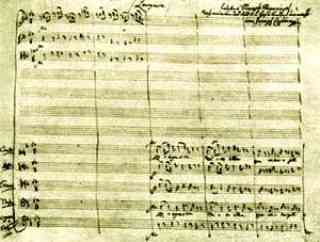
Mozart Requiem, detail of manuscript, tics


Wednesday, January 3, 2007

Ringing in the New Year: Hypermeter & Ontology of Minimalism

Morris, Peace Dove, 2007
Music is an art that exists in time. Music acquires its meaning through the interaction of all its parts. The unprepared listener is seldom aware of these interactions and may even be unable to identify the protagonists of the musical drama. He listens to music as a succession of individual moments, of greater or lesser beauty, never discovering the larger structures that give these moments meaning.”
  — Halsey Stevens

CMT: One of my favorite memories of 2006 was a simple one—a ‘minimalist’ one, really. A peaceful one—related to my New Year’s wish for peace in the coming year. I’m remembering hearing some music by Arvo Pärt, during one of my trips to New York last spring when I was doing a project for an investment banking firm. As you know, Estonian composer Arvo Pärt dispensed with ‘new’ writing many years ago, and began instead to create ‘medieval’ pieces. Beyond the scope of his original intentions, he became fascinated with bells—carillons, campaniles, all sorts of bells. Exploring the harmonic qualities of each bell, and the idiosyncrasies of individual instruments, Pärt invented a new genre of atmospheric, spiritually satisfying, minimalist chamber music. Some people consider Pärt to be something of a music therapist. Others project onto him somewhat the role of prophet or mystic.

DSM: Pärt’s minimalism encompasses a broad range of moods and ‘affects.’ … Reminds me of Naomi Cumming—her ontology of minimalism, which includes ostinato techniques.

CMT: Pärt’s seminal work, ‘Fratres,’ was the focal point of that May concert by the Jupiter Symphony Chamber Players on Monday afternoon, 15-MAY-2006, at the Good Shepherd Presbyterian Church in New York (152 West 66th Street, west of Broadway). Vadim Gluzman, a violinist who was born in the Ukraine, offered his comments on what Arvo Pärt’s music meant to him and others in the context of Soviet oppression of composers and artists. In ‘Fratres,’ the soloist intones one note from each end of his/her instrument’s range, while the rest of the orchestra adds overtones. The result is a quivering, shimmering meditation. This effect can only be fully realized in the intimacy of a church or other early-music venue.

DSM: How does Pärt’s evocation of brotherhood— ‘frères,’ ‘fratres’—work? In theories of musical subjectivity, musical syntax usually gets primary attention. And most of the time, syntax is conceived as linear, sequential structure—something that’s parsed serially, although there may be ‘look-back’ and ‘look-ahead’ and other non-serial processing that our minds perform, just as our minds do for other linguistic forms. It seems to me that linear approach is overly simplistic—it does violence to the richness of the music, and it underestimates the complexity of our cognitive processes. It’s terrible—this forcing the round peg of the music into the square hole of an expedient sequential analysis.

CMT: The experience of Pärt’s ‘Fratres’ led me to think about what kinds of subjectivities are possible when musical syntax is undermined by ostinato motivic repetition. How is it possible for Pärt to evoke such a wide range of affects when his motives are so minimal!? And, yes, I did think about Naomi Cumming, whose book is about how music constructs the “musical subject”—the ‘who’ that listeners ‘become’ while they are engaged with a piece of music. Cumming says that construction of the subject involves the interaction of three elements: timbre, gesture, and syntax. Together they convey causality and intentionality—these elements create ‘implicative expectancies’ in the listener—through voice-leading, harmonic progressions, phrase-structure ‘grammars,’ and other devices. But what happens to the musical subject when syntax is undermined by a prolonged ostinato repetition of a single motivic gesture?

DSM: One explanation for wide-ranging expressive ‘affect’ is that not all ostinati are created equal, and none of them is really ‘static’. The effect of their continuation is longitudinally additive or cumulative—a Markov building upon the nearest-neighbor or immediate predecessor. Or maybe more like a soliton wave in physics. Richard Middleton offers a useful way to distinguish among different kinds of ostinati and their effects. Discursive repetition is repetition of longer syntactical units—whole phrases or strophes. I think Middleton and the hypermeter theorists and geophysicist/seismologists would have a lot to talk about!

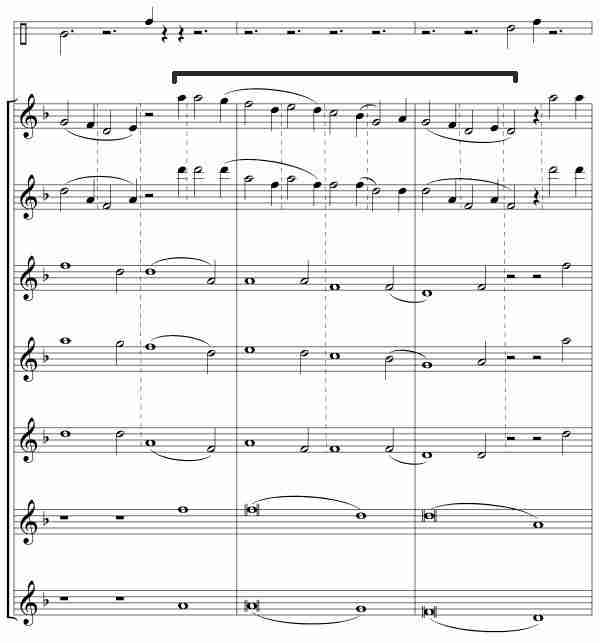
CMT: Middleton argues that a small-scale ostinato can passively achieve a degree of ‘psychic resonance’ for listeners, while larger-scale, discursive ostinato demands more of an active and ongoing emotional participation from listeners. Consider this example, from Arvo Pärt’s Arbos:

Arvo Pärt, Arbos, m. 17-19
The ostinato phrase there is expansive. In fact, the phrase marked above the staves in square brackets is a longitudinally additive construct that originates many bars before the beginning of this excerpt. The repeated phrases are embedded within a canonical structure: units at the surface are generated from a slow-moving continuo background. Pärt creates other layers of the background texture to represent family ancestors to the generations in the foreground. Pärt’s structure evokes a whole cast of musical characters: the quicker foreground figures suggest present, active, live subjects, while background figures represent ancestors.

DSM: Because ostinati can be constructed and combined in many ways, a variety of different kinds of narratives can be expressed. Several features make Pärt’s Arbos and Fratres and other works mantra-like: the harmonic consonance and the limited timbre of a single diatonic mode are what evoke in me a serene and meditative state—what you were describing in your experience of the recital at Good Shepherd Presbyterian. But the carnatic repetition is part of a hypermeter build-up of small-scale ostinato elements into much larger-scale discursive units—this is what creates this mantra-type effect. And the relationships between the various orchestral and bell layers express a complex hierarchical organization that alludes to a community of mutually interdependent subjects, a world of people at peace.

CMT: But it’s not just about people and human-centric narratives. For example, some ostinato figures evoke indifferent, mechanistic, natural, seismic, non-human processes. This situation arises in works where the means of generating the repetitive motive is actually mechanical: think of Ligeti’s ‘Poeme Symphonique for 100 Metronomes’. What distinguishes the different types of ostinato is that each evokes a different musical subject—the conceit of repetition expresses different meanings. Ostinato repetition can serve many different expressive purposes. To understand something of the affective range exhibited by repetitive music, we have to look at the interplay of these repetition types, not just one of them in isolation. You have to look at the depth and granularity of hierarchical structures involving ostinati and figure out the associations between different types of hierarchies and specific moods, ‘affects,’ and subjects.

Seismic Wave Scales

Arvo Pärt