Showing posts with label subjectivity. Show all posts

Sunday, November 7, 2010

Melvyn Tan: 19th-Century Conceptions of Self and Narrative

 Melvyn Tan, pianist
B    etween 1837 and 1840 Liszt made no fewer than 44 transcriptions of Schubert lieder.”
  —  Derek Watson, p. 45.
T    oday it is less necessary to defend the art of transcription, and arrangements are again part of the accepted repertoire. In the 20th Century the prevailing tendency to condemn them was a symptom of the age of radio, of recording, and of anti-Romanticism.”
  —  Derek Watson, p. 195.
T his was a concert of the choicest winter food, perfect for a cold, dark November London night—the sort of music that beautifully follows a meal of roasted autumn root vegetables, music that you can live off of, music to eat with a fork—the kind of savoury dish that even the most impassive of souls eye with envy when a waiter carries it by. Melvyn Tan gave us lots to contemplate, which we did with gratitude, ensconced in the warmest of red velvet Wigmore Hall seats.

T his program emphasized ‘autobiographical’ and ‘biographical’ narrative qualities, aspects that are a particular strength of Tan’s playing.
  • Schubert – 3 Klavierstücke, D.946
  • Liszt – transcriptions of Schubert: Sei mir gegrüsst, S. 558 No. 1; Auf dem Wasser zu singen, S. 558 No. 2; Du bist die Ruh, S. 558 No. 3; Liebesbotschaft, S. 560 No. 10; Ständchen (Horch, horch! die Lerch), S. 558 No. 9
  • Chopin – Piano Sonata No. 3 in B minor, Op. 58
T he Klavierstücke came in at under 10-min, 11-min, and 5-min durations, the total of them about 1 minute faster than most recent recorded versions. The 4-min, 4-min, 5-min, 3-min, and 3-min durations of the Liszt transcriptions were closer to, say, conventional tempi (of, say, Murray Perahia), but the beauty of Tan’s speed here was the sense of ‘confession’ that it conferred. The overall effect was one of an inspired storyteller, telling sagas of tremendous import with great urgency and pressure-of-speech befitting the excitement and twists and turns of the plot.

T an’s ‘matter-of-fact’ pedaling technique, especially with the prompt releases in the ‘Du bist die Ruh’, added to the strong confessional, diaristic impression of his interpretation.

P laying this entire program from memory lends even more authority to the first-person, omniscient-narratorly effects that Tan conjures up.

I   nevitably, that close and prolonged contact with another composer’s music [leaves] its mark on [one’s] own development—not least on his own Lieder.”
  —  Gerald Larner, program notes, 2010, remarking on the consequences for Liszt of years’ immersion in transcribing/arranging Schubert [consequences that have their parallel, I believe, on immersive performers like Tan].
T he seriousness and tenderness of the Chopin nocturne that Tan played as an encore touched every member of the audience… a wonderful reprise and a fine ending to a truly memorable evening!

 Melvyn Tan, pianist


Tuesday, May 6, 2008

Robert Johnson’s ‘PrairyErth’: Phobic Geographies, Non-Teleological Atmospherics

PrairyErth, watercolor ©1991, Joan Foth
T  o cherish what remains of the Earth and to foster its renewal is our only legitimate hope of survival.”
  —  Wendell Berry.

The Cincinnati Symphony Orchestra gave the premiere of Robert Johnson’s ‘PrairyErth’ last Friday night, conducted by Paavo Järvi. The program notes are here. The Cincinnati Enquirer review of the premiere is here.

Robert Johnson
  • The 7-minute tone poem is for full orchestra, but the orchestration conveys an intimacy that is characteristic of chamber music.
  • The spatial acoustic effects (antiphonal, for example of a rainstorm crossing the prairie) resemble effects achieved in fixed-media electroacoustic compositions.

Paavo Järvi
  • ‘PrairyErth’ expounds a Time to Every Purpose or, better, a Time to No Purpose At All. It documents the beauty that can be found in insignificance and the aesthetics that inheres in a lack of discernable purpose. Inadvertently or deliberately, the piece is a persuasive argument against Creationism or Intelligent Design. ‘PrairyErth’ is an essay on ‘belief-desire’ (a philosophical theory that holds that an act is purposeful insofar as the agent has a desire in combination with a belief about how to satisfy it) vs. the causality and explanatory power of intentions. It questions whether anything in Nature can ever be said to have anthropomorphic purposes underlying the tableau of natural events. According to Robert Johnson, Nature simply Is.
  • Space defines what human subjectivity can be. This is ‘atmospherics-in-where’, the ‘qualities-of-what-when’: Situatedness, context-boundness of the ‘who’.
  • Criteria of attentiveness provide the aesthetic rationale for all the changes that occur in the course of a composition. ‘PrairyErth’ captures and holds our attention, like a thunderstorm.
  • Instead of vague, vaporescent impressionism as, say, in some of Debussy, there is a freshness and inspiration in Johnson’s writing. He elevates his subject out of obscurity and creates a clarity and memorability—the writing captivates; it has impact.
  • This new composition by Johnson constitutes an intensive topographical exploration, much like the one popularized by author William Least Heat-Moon with his book ‘PrairyErth: A Deep Map’. So-called ‘deep map’ works take the form of engaged documentary, and Johnson’s follows in this tradition. There is no question of the cleverness of the music, and of the craftsmanly excellence of its construction. But I was pulled up short by its ending in just 7 minutes. No ‘deep map’ documentary should end so soon. More than this, the long-scale structures of prairie—the remnants of glaciers; the meteorological pace of prairie phenomena and ethos—deserve and require at least 20. At 7 minutes, we are just beginning to sync with the hypermeter that Johnson has set up. We feel disappointed and cheated for the piece to end at 7 minutes.
  • Like William Least Heat-Moon’s ‘PrairyErth’, Johnson’s piece evokes angst—it portrays a deep existential unease. Our hold here is tenuous, vulnerable. Possibly, we don’t really ‘belong’ here at all. Any presumption to human ‘mastery’ over this primeval landscape is delusional. It will out-last us, out-last humankind. ‘PrairyErth’ is a dream foretelling humanity’s eventual, inevitable extinction.
I  believe the common denominator of the Universe is not harmony, but chaos, hostility and murder.”
  —  Werner Herzog, ‘Grizzly Man’, 2006.
  • Like William Least Heat-Moon in ‘PrairyErth’, Johnson is here a bricoleur of consummate skill who conjures surreal events and ambiguous textures. Heat-Moon writes of a feminist rancher in the Flint Hills of Chase County, Kansas; of a farm couple swept away by a tornado; of abolitionists who perversely wanted black slaves to be free but not equal. He meditates on fence posts, Indian arrowheads and the nesting habits of pack rats. Johnson’s collage likewise has a happenstantial feel, an ambivalent tonality that Johnson half-disavows. The development of Johnson’s themes is watercolorist-reportorial, as though he were a passive observer bearing witness to the power of Nature via Joan Foth-style ‘wet-in-wet’ brush technic.
  • Nature is devoid of sympathy. The 7-minute scene has a reality far in excess of Johnson’s staged account. Sentimentalism is fatal, Johnson tells us.
T  o make a prairie it takes a clover and one bee—
One clover, and a bee,
  And reverie.
The reverie alone will do,
If bees are few.”
  —  Emily Dickinson.
Davidson book

Schueler book


Tuesday, March 13, 2007

My Lives / Writing as Resistance: Journaling Classical Music

Man Ray, Self Portrait
W  riting autobiography allows me to open up a vein of self-scrutiny, to peer through the slippery veil of what you call ‘character’—to define my own peculiar subjectivity.”
  — Patricia Foster

CMT: A writer’s always preoccupied with gathering and prioritizing the material that will be retained in what she/he is writing. If there’s a nucleus of this, it inevitably permeates the writer’s world. It’s like beach sand—it gets into everything, no matter what the Editor’s instructions are. These things become virtual necessities, inevitabilities. Necessaries.

DSM: It’s a hammer looking for a nail. It’s in the DNA. It just has to come express itself. Your peculiar fascination with Deleuze and Lacan and Derrida—I’m sure you can’t help it. Is that what you’re saying?

CMT: I’m just saying: there are latent ideas and resonances, and these conversations we have are just triggers for them. These conversations are just occasions for synthesizing the observations that are, up until the moment they emerge from our mouths, just glimmers, little scintillations. They happen regardless of whether we’re together. But I’d never remember them if we didn’t set ourselves to conversing and making these little transcripts for each other.

DSM: Well, thank you. Gratifying occasions—to capture some sparks that might kindle something bigger, in someone else who happens to see them online. Maybe something more for us, as well. The minor chore of assembling the lists of links as we do here is at least potentially useful to others. Even when we don’t necessarily receive comments on a piece, we can see the click-throughs to the Amazon and Arkiv and other links at the bottom. We have a pretty good idea of what readers are finding interesting or useful . . .

CMT: For me, the moment when I realized what my favorite conception of art was, was in December 1995, a month after Gilles Deleuze died at age 70—young. I had read his several books long before then. But it was the occasion of his dying that led me to re-visit what I knew of him and his philosophy of music. I recognized immediately that he was the embodiment of my subject. In adopting the stance that he had put forward, I could at last be dealing with the material and the priorities that were ‘necessary’ to me. And I was grateful that he had bothered to write as much as he had.

DSM: And Derrida was and is like that for me. He lived to 74 years of age, young still—died in 2004. The world has moved on quite a bit, moved on very quickly. His writing, for me, was a wonderful tapestry, a web of loyalties and enmities. He became my vehicle and my guide to what had always been waiting at the back of my mind. He didn’t especially write about music theory, yet his philosophical writing consistently served as a prism through which my own thinking about music was—and is—refracted.

CMT: Writing is always about problem-solving. Whether in fiction, biography, memoir, scholarly exposition, whatever—certain questions have to be resolved. I have never written fiction, and essays or memoir may be as close as I ever get to it. No more than a biography or a novel is memoir true-to-life. Because life is just one thing after another. The writer’s job is to find the narrative shape in unruly Life and tell the story. Not to serve the Truth, but just to serve the Story. There really is no other choice. A reporter is in service to the Fact. A eulogist is in service to the Family of the Dead. But, in general, a regular writer serves only the Story. There really are no other competing claims.

DSM: That’s a ruthless perspective! You make it sound cold or detached, commodified.

CMT: Well, no. A writer who cannot separate herself/himself from the charaters in the narrative and see them within the full spectrum of their human qualities degenerates into sentimentality. If you’re writing about music, you degenerate into uncritical promotion. Bathos does no honor to anybody, and it sure doesn’t sell papers! It surely doesn’t attract repeat visitors to a blog!

Music77, Stockholm
DSM: The right voice in which to write—the voice in which I talk to you—comes to me from my music teachers. It comes to me from Bruce Pearson, Dick Whitbeck, Herb Pilhofer, Dan Tetzlaff. None of them interested in exotic theory. But each of them tenacious about detail and nuance.

CMT: But you’re extemporizing with me on topics that can’t be informed by anything you did with those people 35 years ago! You’re not spinning memoirs in these conversations!

DSM: What is it that we learn, though, from other people? I inherited from them a tenacious, curious disposition. I absorbed their pedagogical approach and made it my own. It’s not ‘memoir’ but autobiography, what we’re doing here. The moment we put fingers to keyboard, the essential nature of Life—the random one thing after another—is displaced. No matter how ambiguous you try to make the conversation/story, no matter how many ends you leave hanging, no matter how faithfully you capture our oral detours and dead-ends—in print it’s still an objectified thing, packaged, decorated.

CMT: Everything that happens between us is not in the stories in this blog. How could it be? Memory is selective; storytelling insists on itself. Even the long, diffuse posts are only a poor simulacrum of the real deal. There’s nothing in these posts that didn’t happen. They’re edited, but they are all true.

DSM: Shades of true anyhow. Your truth; my truth. The provocation’s legitimate, so long as we don’t interfere with or libel anybody. The process we follow may be a bit chaotic, but it’s not unlike Eric Newby or other travel writers. We respond to the events, writing, performances, and recordings we encounter, such as they are—and to each other. If the ideas about music that occur to us had instead stayed in our heads or in a drawer, what value would they have? None. So, instead, we indulge ourselves here, engage in some constructive resistance, discover some new paths, reveal some of what’s necessary to our inadvertent autobiographies or travelogues, and find new friends and kindred spirits along the way. We don’t have the privilege of making a living writing about music like professional critics and reviewers and academics do. But this is a passable substitute!

CMT: In a 2005 study, the Pew Internet and American Life Project found that 11 million Americans have created blogs, and more than 25 percent of Internet users read them. The Pew Internet & American Life Project found that 44% of U.S. Internet users have contributed material to the online commons. And that was 2 years ago! Netroots infancy!


Music77, Stockholm


Wednesday, January 3, 2007

Ringing in the New Year: Hypermeter & Ontology of Minimalism

Morris, Peace Dove, 2007
Music is an art that exists in time. Music acquires its meaning through the interaction of all its parts. The unprepared listener is seldom aware of these interactions and may even be unable to identify the protagonists of the musical drama. He listens to music as a succession of individual moments, of greater or lesser beauty, never discovering the larger structures that give these moments meaning.”
  — Halsey Stevens

CMT: One of my favorite memories of 2006 was a simple one—a ‘minimalist’ one, really. A peaceful one—related to my New Year’s wish for peace in the coming year. I’m remembering hearing some music by Arvo Pärt, during one of my trips to New York last spring when I was doing a project for an investment banking firm. As you know, Estonian composer Arvo Pärt dispensed with ‘new’ writing many years ago, and began instead to create ‘medieval’ pieces. Beyond the scope of his original intentions, he became fascinated with bells—carillons, campaniles, all sorts of bells. Exploring the harmonic qualities of each bell, and the idiosyncrasies of individual instruments, Pärt invented a new genre of atmospheric, spiritually satisfying, minimalist chamber music. Some people consider Pärt to be something of a music therapist. Others project onto him somewhat the role of prophet or mystic.

DSM: Pärt’s minimalism encompasses a broad range of moods and ‘affects.’ … Reminds me of Naomi Cumming—her ontology of minimalism, which includes ostinato techniques.

CMT: Pärt’s seminal work, ‘Fratres,’ was the focal point of that May concert by the Jupiter Symphony Chamber Players on Monday afternoon, 15-MAY-2006, at the Good Shepherd Presbyterian Church in New York (152 West 66th Street, west of Broadway). Vadim Gluzman, a violinist who was born in the Ukraine, offered his comments on what Arvo Pärt’s music meant to him and others in the context of Soviet oppression of composers and artists. In ‘Fratres,’ the soloist intones one note from each end of his/her instrument’s range, while the rest of the orchestra adds overtones. The result is a quivering, shimmering meditation. This effect can only be fully realized in the intimacy of a church or other early-music venue.

DSM: How does Pärt’s evocation of brotherhood— ‘frères,’ ‘fratres’—work? In theories of musical subjectivity, musical syntax usually gets primary attention. And most of the time, syntax is conceived as linear, sequential structure—something that’s parsed serially, although there may be ‘look-back’ and ‘look-ahead’ and other non-serial processing that our minds perform, just as our minds do for other linguistic forms. It seems to me that linear approach is overly simplistic—it does violence to the richness of the music, and it underestimates the complexity of our cognitive processes. It’s terrible—this forcing the round peg of the music into the square hole of an expedient sequential analysis.

CMT: The experience of Pärt’s ‘Fratres’ led me to think about what kinds of subjectivities are possible when musical syntax is undermined by ostinato motivic repetition. How is it possible for Pärt to evoke such a wide range of affects when his motives are so minimal!? And, yes, I did think about Naomi Cumming, whose book is about how music constructs the “musical subject”—the ‘who’ that listeners ‘become’ while they are engaged with a piece of music. Cumming says that construction of the subject involves the interaction of three elements: timbre, gesture, and syntax. Together they convey causality and intentionality—these elements create ‘implicative expectancies’ in the listener—through voice-leading, harmonic progressions, phrase-structure ‘grammars,’ and other devices. But what happens to the musical subject when syntax is undermined by a prolonged ostinato repetition of a single motivic gesture?

DSM: One explanation for wide-ranging expressive ‘affect’ is that not all ostinati are created equal, and none of them is really ‘static’. The effect of their continuation is longitudinally additive or cumulative—a Markov building upon the nearest-neighbor or immediate predecessor. Or maybe more like a soliton wave in physics. Richard Middleton offers a useful way to distinguish among different kinds of ostinati and their effects. Discursive repetition is repetition of longer syntactical units—whole phrases or strophes. I think Middleton and the hypermeter theorists and geophysicist/seismologists would have a lot to talk about!

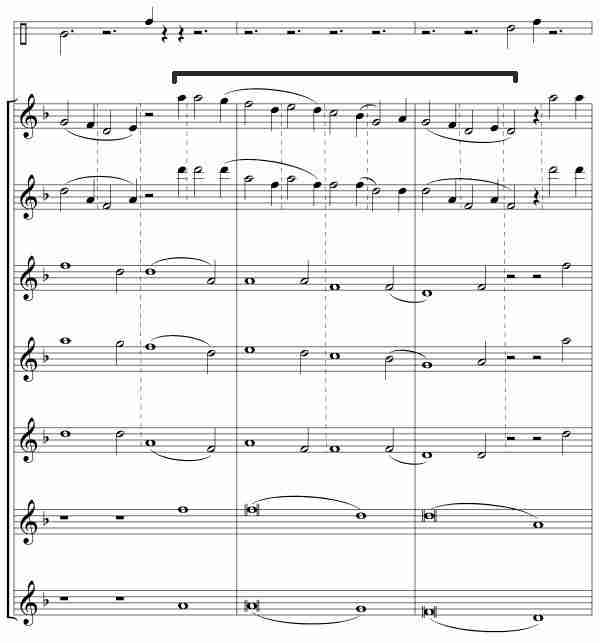
CMT: Middleton argues that a small-scale ostinato can passively achieve a degree of ‘psychic resonance’ for listeners, while larger-scale, discursive ostinato demands more of an active and ongoing emotional participation from listeners. Consider this example, from Arvo Pärt’s Arbos:

Arvo Pärt, Arbos, m. 17-19
The ostinato phrase there is expansive. In fact, the phrase marked above the staves in square brackets is a longitudinally additive construct that originates many bars before the beginning of this excerpt. The repeated phrases are embedded within a canonical structure: units at the surface are generated from a slow-moving continuo background. Pärt creates other layers of the background texture to represent family ancestors to the generations in the foreground. Pärt’s structure evokes a whole cast of musical characters: the quicker foreground figures suggest present, active, live subjects, while background figures represent ancestors.

DSM: Because ostinati can be constructed and combined in many ways, a variety of different kinds of narratives can be expressed. Several features make Pärt’s Arbos and Fratres and other works mantra-like: the harmonic consonance and the limited timbre of a single diatonic mode are what evoke in me a serene and meditative state—what you were describing in your experience of the recital at Good Shepherd Presbyterian. But the carnatic repetition is part of a hypermeter build-up of small-scale ostinato elements into much larger-scale discursive units—this is what creates this mantra-type effect. And the relationships between the various orchestral and bell layers express a complex hierarchical organization that alludes to a community of mutually interdependent subjects, a world of people at peace.

CMT: But it’s not just about people and human-centric narratives. For example, some ostinato figures evoke indifferent, mechanistic, natural, seismic, non-human processes. This situation arises in works where the means of generating the repetitive motive is actually mechanical: think of Ligeti’s ‘Poeme Symphonique for 100 Metronomes’. What distinguishes the different types of ostinato is that each evokes a different musical subject—the conceit of repetition expresses different meanings. Ostinato repetition can serve many different expressive purposes. To understand something of the affective range exhibited by repetitive music, we have to look at the interplay of these repetition types, not just one of them in isolation. You have to look at the depth and granularity of hierarchical structures involving ostinati and figure out the associations between different types of hierarchies and specific moods, ‘affects,’ and subjects.

Seismic Wave Scales

Arvo Pärt