L ocal color’ features synthetic bell-like tones, sustained tonal clusters, and computer-triggered acoustic bells struck in complementary patterns that are sometimes random, sometimes human-triggered, and combinations of both... It is enough to reference the idea of a tactus, but not enough to be [understood as] an organizing [meaning-generating/insuring] element.”T he music comprising John Bischoff’s new CD ‘Audio Combine’, just released on New World Records, is beautiful, fascinating, thoroughly enjoyable. Philip Perkins’s engineering and production values are superb.
— Audio Combine, liner notes, Ed Osborn, Brown Univ, 2011.
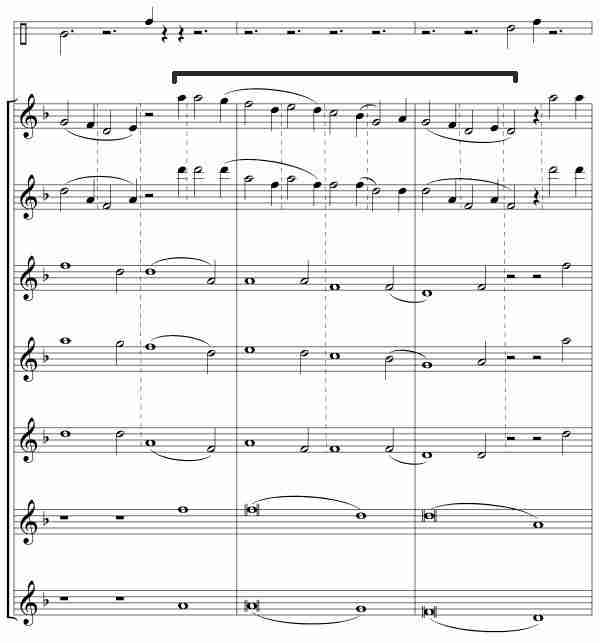
T he five tracks on the disc are diverse, representing Bischoff compositions from 2004 to mid-2011. The third track ‘Local Color’ evokes traditional chinese zhong bells, but also especially calls into question the ‘who’ of music performance [in asmuch as some of the bells are computer-triggered, randomly and deterministically, while others are played by Bischoff from his score] and other limits of performance identity [insofar as the bell modes and timbres evolve after the bell is struck—on the rim; on the bosses/nipples; on the wall; etc.—in aleatoric/random ways that the musician-computer can neither predict nor control]. Of course, all music emerges in less-than-predictable/controllable ways—just less obviously so than bells.
[50-sec clip, John Bischoff, ‘Local Color’; (track 3), 2012, 1.4MB MP3]
T he pieces were all recorded in live performance with minimal editing and no over-dubs. Philip Perkins recorded direct from Bischoff’s setup and also from three pairs of microphones placed at various points in the concert hall. The mix heard here switches between these four perspectives as the pieces are played. The distance and pace incorporated into the recordings from various mic positions give a clear sense of the space of the performance, and of the object-ness of the sounds. That space and our place within it become the final part of the ‘material’: when the listener has no fixed point of perspective, then the position from which the listening/understanding is done becomes one of the elements of counterpoint.”T here are a few excellent books that empirically measure the modal vibrations of bells... He & Fu, for example. And some books on bispectral analysis—mainly used today in aerospace engineering and vibration-management engineering of turbines and other structures. Useful to explore if you are a composer/performer wanting to know more about how to more reliably utilize distinctive bell harmonics in your work. Links to some of these at the bottom of this post.
— Audio Combine, liner notes, Ed Osborn, Brown Univ, 2011.

[Modal Analysis, Fu & He, 2001, p. 276]
[50-sec clip, Wang Yuanping & Hubei Chime Bells Orchestra, ‘竹枝词 (Zhu-zhi-ci) Bamboo-pole Love Poem’; (track 1), 1989, 1.5MB MP3]
T he substantial rhythmic independence of the parts in the ‘Local Color’ bell quartet is part of its distinctive Asian beauty. Because each bell projects its sound clearly, each individual bell can easily be heard over the rest of the bell ensemble, and yet the ensemble—the ‘community’ of bells—remains the primary subject. This is dissimilar from other voiced percussion like a timpani choir, performing a ‘programmatic’ role, where the effect of four or more timpani playing together is treated more as an ‘effect’ than as harmony. It is instead quartet ‘orchestration with Chinese characteristics’!
W ith computer-triggered sticking, the timing of the ring-down and the pitch-bend are the same, but the kinematic nuances of human left-hand/right-hand mallet or sticking patterns are gone. But the electromechanical linear actuators for the computer-controlled bells have their own kinematic constraints, in terms of speed of resetting for the next stroke, and so on. They have their own unique, finite kind of ‘embodiment’ just as we humans have ours, and we can hear this in these wonderful Bischoff compositions and this excellent recording of them being performed ‘live’.
A nd so the most amazing thing that we get from Bischoff’s mechatronic compositions like ‘Local Color’ is a vivid glimpse of robotic humanity and machine consciousness, revealed by the beater mechanics and linear actuators... something like an inversion of the ‘human-becoming-machine’ perspective of Ambrazevičius and Balsienė (link below): ‘machine-becoming-human’... a brilliant future of new expressive possibilities, including bionic accomodations for musicians with disabilities. Musical prosthetics? Sonnez les matines! / Din, dan, don!
J ohn Bischoff (b. 1949) is an early pioneer of live computer music. He is known for his solo constructions in real-time synthesis as well as his seminal work in computer network ensembles. Bischoff studied composition with Robert Moran, James Tenney, and Robert Ashley. He has been active in the experimental music scene in the San Francisco Bay Area for over 25 year as a composer, performer, teacher, and grassroots activist. His performances around the US include NEW MUSIC AMERICA festivals in 1981 (SF) and 1989 (NYC), Experimental Intermedia (NYC), Roulette Intermedium (NYC), and the Beyond Music Festival (LA). He has performed in Europe at the Festival d'Automne in Paris, Akademie der Künst in Berlin, Fylkingen in Stockholm, and TUBE in Munich. He was a founding member of the League of Automatic Music Composers (1978), considered to be the world's first Computer Network Band, and he co-authored an article on the League's music that appears in "Foundations of Computer Music" (MIT Press 1985). He was also a founding member of the network band The Hub with whom he performed and recorded from 1985 to 1996.

- John Bischoff website
- Bischoff page at Mills College, Oakland, California.
- Bischoff J. Audio Combine. (New World Records, 2012.)
- Hubei Chime Bells Orchestra; Wang Yuanping, conductor. Unique Music of Great Antiquity. (CRC, 1989)
- Ambrazevičius R, Balsienė R. Imitations of bells: Correspondence between bell acoustics and onomatopoeic texts. J Interdisc Music Stud 2010;4:1-16.
- Anderson M, Anderson S. Machine Ethics. Cambridge Univ, 2011.
- Campany R, tr. Ge Hong: To Live as Long as Heaven and Earth. Univ California, 2002.
- Choudhury A, Shah S, Thornhill N. Diagnosis of Process Nonlinearities and Valve Stiction. Springer, 2010. [bispectra]
- Clark A. Natural-Born Cyborgs: Minds, Technologies, and the Future of Human Intelligence. Oxford Univ, 2003.
- Courtney C, et al. Global crack detection using bispectral analysis. ECNDT, 2006.
- Cremer L, et al. Structure-Borne Sound: Structural Vibrations and Sound Radiation at Audio Frequencies. 3e. Springer, 2005.
- Dixon J, Cassidy E, eds. Virtual Futures: Cyberotics, Technology and Posthuman Pragmatism. Routledge, 1998.
- Epstein R, et al., eds. Parsing the Turing Test: Philosophical and Methodological Issues in the Quest for the Thinking Computer. Springer, 2008.
- Fackrell J, et al. Interpretation of bispectra of vibration signals-I. Mech Sys Signal Proc 1995;9:257-66.
- Fackrell J, et al. Interpretation of bispectra of vibration signals-II. Mech Sys Signal Proc 1995;9:267-74.
- Fahy F. Foundations of Engineering Acoustics. Academic, 2000.
- von Falkenhausen L. Suspended Music: Chime-Bells in the Culture of Bronze Age China. Univ California, 1994.
- Fu Zhi-Fang, He J. Modal Analysis. Butterworth-Heinemann, 2001.
- Gray C. Cyborg Citizen: Politics in the Posthuman Age. Routledge, 2001.
- Hammond J, White P. Analysis of non-stationary signals using time-frequency methods. J Sound & Vibr 1996;190:419-47.
- Haraway D. Simians, Cyborgs, and Women: The Reinvention of Nature. Routledge, 1990.
- Hayles N. How We Became Posthuman: Virtual Bodies in Cybernetics, Literature, and Informatics. Univ Chicago, 1999.
- Hendriks-Jansen H. Catching Ourselves in the Act: Situated Activity, Interactive Emergence, Evolution, and Human Thought. Bradford, 1996.
- Holland O, ed. Machine Consciousness. Academic, 2003.
- Jing M. A theoretical study of the vibration and acoustics of ancient Chinese bells. J Acoust Soc Am 2003;114:1622-8.
- Lin P, et al., eds. Robot Ethics: The Ethical and Social Implications of Robotics. MIT, 2011.
- Norton M, Karczub D. Fundamentals of Noise and Vibration Analysis for Engineers. 2e. Cambridge Univ, 2003.
- Perkowitz S. Digital People: From Bionic Humans to Androids. Joseph Henry, 2005.
- Randall R. Vibration-based Condition Monitoring: Industrial, Aerospace and Automotive Applications. Wiley, 2011.
- Rossing T. Science of Percussion Instruments. World Scientific, 2000.
- Schick S. The Percussionist's Art: Same Bed, Different Dreams. Univ Rochester (Eastman), 2006.
- Shen S-Y. Acoustics of ancient Chinese bells. Scientific American 1987;256:94-102.
- Solomon S. How to Write for Percussion. Solomon, 2004.
- Tavner P, et al. Condition Monitoring of Rotating Electrical Machines. 2e. IET, 2008. [bispectra]
- Timoshenko S. Vibration Problems in Engineering. 5e reprint. Wolfenden, 2007.
- Vér I, Beranek L, eds. Noise and Vibration Control Engineering: Principles and Applications. 2e. Wiley, 2005.
- Thingamajigs.org