Showing posts with label livljanic. Show all posts

Sunday, November 9, 2008

‘Just War’ According to Dialogos: Rhetoric, Memory, Violence & Medieval Theater of Cruelty

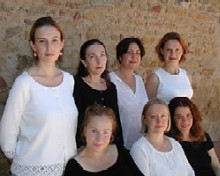
Dialogos (left to right): Albrecht Maurer, Katarina Livljanić, Norbert Rodenkirchen
I   f the number and variety of versions—and widespread and enduring popularity—can be any criterion of greatness, the tale of Judith, it must be conceded, is one of the great stories of the world’s literature.”
  —  Edna Purdie, The Story of Judith in German and English Literature.
The staged musical production of ‘Judith’ by Katarina Livljanić and members of the ensemble Dialogos tells the biblical tale of the beautiful enchantress, Judith, who seduces and then beheads the Assyrian general Holofernes to liberate the Hebrews. The score also includes a medieval 5-string fiddle, a lirica (Croatian traditional stringed instrument, tuned in ‘archaic’ manner), and archaic flutes. The beauty and Croatian authenticity of Livljanić’s voice, the narrative and discursive power of the instrumental parts, the elegance of the staging and lighting, and the poetics of the carefully devised, historically informed Glagolitic text (and translation that is sympathetic to the needs of the audience, as opposed to Livljanić’s fellow scholars)—all of these combine to achieve a compelling artistic result, just as with ‘Vision of Tondal’ and other of Dialogos’s productions.

Character development in Livljanić’s version of ‘Judith’ is fuller than in the simplified accounts of the story that are familiar to us, and far more complex than in the synoptic artworks through which most of us are acquainted with it ... Klimt and Caravaggio and Reubens and so many others.

Holofernes, the general of the Babylonian King Nebuchadrezzar, whose decapitation by Judith is referenced in the Old Testament. Holofernes, the powerful general of King Nebuchadnezzar’s army. A number of provinces of the Second Jewish Commonwealth had withheld their assistance from Nebuchadnezzar and his government—had declined to join the coalition of the willing. So now comes Holofernes, the guy Nebuchadnezzar dispatches to give them an offer they couldn’t refuse.

The historical general did lay siege to Bethulia. The city was on the verge of surrendering but was saved by Judith, a beautiful Hebrew widow who preyed upon Holofernes’s huge vanity, deceived him, drank him under the table, sliced off his head in bed. Judith, she who then returned to Bethulia displaying the severed head, after which the Hebrews went on to beat Nebuchadnezzar’s now-generalless army. Morals: Be careful who you drink with, and be sure to drink responsibly.

Katarina Livljanić
Ensemble Dialogos
  • Katarina Livljanić (voice)
  • Albrecht Maurer (5-string fiddle)
  • Norbert Rodenkirchen (flutes)
  • Sanda Herzic (staging, scenography and costumes)
  • Marie Bellot (lighting design and direction)
Livljanić’s voice—alternately, narrator/seductress/warrior/mind/spirit—leads the listener through this biblical story of Judith, transformed here into historically-informed music theatre, instantiating characters who hail from the old biblical and Croatian Glagolitic texts to become amazingly relevant to contemporary society—both in terms of gender issues, and in terms of calling into question what is ‘justified violence’ and whether or not there is such a thing as a ‘just war’. Renaissance Glagolitic chant forms the musical structure of the performance. Accompanying Livljanić’s voice, the medieval lirica and 5-string fiddle and flutes give Marko Marulić’s Glagolitic text vivid, dramatic color.

Dialogos’s Judith is essentially ‘Eros and Thanatos’ rendered using fragments of medieval Glagolitic ‘disputationes’ that alternate with the main ‘Judith and Holofernes’ story. These interpolations are a narratorly gambit to reveal the characters’ thoughts; for example, as Holofernes’ head is severed, his thoughts ‘separate’ into a dialogue between his body and his soul. Another inner dialogue—between Judith’s mind and her soul, a sort of schizoid soliloquy—occurs as she prays for God to help her kill Holofernes.

According to Livljanić’s program notes, the ancient text of Judith survives without music, and the poetic metrical structure of the text closely corresponds to the meter of archaic Glagolitic melodies used for storytelling in medieval Dalmatia. The text refers to texts sung in the liturgical offices, and these clues enabled Livljanić to reconstruct, using Dalmatian and southern Italian musical sources, melodies plausibly correlated with indications in the original Judith text. This liturgical repertoire, sung in Croatian Church Slavonic, did function in the Latin mass, and was preserved over the centuries in manuscripts written in Glagolitic in medieval Croatia.

Livljanić performs all of the roles and uses a variety of vocal effects and a few costume changes to keep the roles distinct. Surpassing the phenomenal scholarship that goes into preparing their productions, the musicianship and historically-informed performance of the members of Dialogos ensemble are iconic.

F   rom the standpoint of the history of rhetoric, the presence of dramatic elements in discussions of torture presents a tremendous predicament for scholars, who have long been troubled by Aristotle’s casual inclusion of torture as one of the factual, ‘inartificial’, or extrinsic proofs to be discovered by orators during the inventional process... Inartificial proofs are those which ‘have not been furnished by ourselves but were already in existence, such as witnesses...’ What is so striking about the evidence ... is that, during rhetorical ‘inventio’, the ostensibly extrinsic proof that torture represents functions as an avowedly unreliable intrinsic proof. The rhetorician theorizes the inventional proof of torture as a verisimilar process that causes torture to appear to be an unshakable extrinsic proof, when in reality it is just as ‘intrinsic’, just as ‘creative’, just as fictional, just as ‘dramatic’ as other modes of rhetorical invention... Its ‘facts’ are evaluated on the basis of their potential persuasiveness as fashioned probabilities and then, in a process of reaffirmation, judged as factual on the basis of their verisimilitude. At issue, then, is less the truth of the law or the historical occurrence than the spectacular probabilities of the rhetorical presentation, which is born of materials extracted through punishment... Torture enters the scenario with its own role to play in the transformation of hypothesis into fact.”
  —  Jody Enders, Medieval Theater of Cruelty, p. 28.
Cranach the Elder Judith
Let’s do something I alluded to in the previous CMT post: illuminate this musical performance by drawing parallels between it and several works of art. Most of us know the story of Judith primarily through the famous representations of ‘Judith Slaying Holofernes’ in paintings.

The Christian church fathers embraced Judith, but went to extra trouble to ensure that the story was cast in a certain light that was favorable to the Church. When the Church hierarchy commissioned paintings and sculptures of Judith, the artists were compelled to make Judith into not so much an allegory of faith as an allegory of Christian virtue writ large—especially that prototypical virtue that most fascinates priests, chastity (as in the Cranach the Elder painting above). And then came Artemisia Gentileschi. Artemisia, without the strings of any Church commission attached. Artemisia, who had herself been raped. Artemisia Gentileschi did not make ‘nicey-nicey’.

Artemisia Gentileschi in 1620 was the first to paint a ‘feminist’ Judith. Her father Orazio had also painted Judith—a conventional Judith. Michelangelo, Botticelli and Caravaggio had painted Judith. Donatello had sculpted Judith. Gentileschi’s painting is dark, darker and more dramatic than Caravaggio’s and others’ Judiths. A theatrical spotlight is trained on the action, on the struggling limbs. The shadows on Judith’s arms force us to acknowledge the sawing, crunching, ‘why-is-this-neck-gristle-and-bone-so-tough?’ sword action she uses to get his head off. The extent of the blood splayed around the scene gives us a pretty clear idea that Gentileschci believes this was not a quick death, nor should it have been. Nor was this murder a workmanly job ineptly done. No, there is a realist’s quality of gratuitous suffering; of ‘extraordinary rendition’ as they say; of cold-blooded torture. The feminist righteous violence of Artemisia Gentileschi’s painting(s) is very close to the moral quality that Livljanić projects in the Dialogos production of Judith. Livljanić’s text has Holofernes’s dying going on and on...

Gentileschi Judith
As portrayed by Gentileschi and by Livljanić, Judith’s violence is righteous—premeditated but justified—vigorously justified ex-post facto by Judith. But not some pious, patriotic perp intent upon pleasing the patriarchs. This is cool, calculated, cathartic revenge by a woman who has been raped. ‘You, Asshole, are not f’ing getting away. You are f’ing going to die, right here, right now.’ And, naturally, heroic, cathartic righteous horror is invariably exciting. After all, ‘bloodied virtuosity’ is titillating, as American (and other—) filmmakers seem to know so well. The ‘pride goes before the fall’ tragic position of Holofernes’s arrogance and hubris just seems not to have many ‘takers’ these days. Nobody views the character and deeds of Judith as subversive and offensive anymore. Nobody thinks of Holofernes. We are all self-vindicating terrorists now. We are all Judiths or would-be Judiths if given the chance. Just not as chaste as a Church father or an Imam might prefer...

Klimt Judith
Gustav Klimt’s Judith paintings have instead a wasted, absinthe-debauched, sybaritically-bedecked golden Judith-the-Ho tucking the still-astonished dead head of Holofernes under her arm as if it were a handbag. The dramatic lighting is completely lacks the excitement and action of Gentileschi. Judith is here quiet and sated, as though she were a tiger or other predator? “Or the Hillbilly of Wasilla, Sarah Palin,” as one of the commenters in the discussion group that preceded the Kansas City Dialogos performance last night said. “What?! What are you looking at! I did not order these clothes from Neiman Marcus! No, siree! They’re goin’ back. Givin’ ‘em to charity.” Palin’s face and hair even look quite a lot like the Klimt Judith... Yikes.)

Klimt’s Judith gazes off beyond us; she has no regard for us. She appears to be daydreaming, and it is not likely that she is dreaming of murdering generals to save her people or build an actual oil pipeline. She is detached from the damage she has wrought. Klimt shows us not only Judith-the-Ho but also Judith-the-Psychopath and Judith-the-Jihadist. Klimt’s Judith ‘had’ to do what she did, just as Anthony Perkins ‘had’ to kill Janet Leigh’s character in ‘Psycho’, complete with her schizophrenic interior dialogue and ‘disputationes’.

Caravaggio Judith
By contrast, Caravaggio’s Judith is a tentative, horrified, ‘how-can-I-manage-to-finish-this?’ withdrawing, backward-staggering, agast Judith. Not a ‘psycho’ at all. And totally not ‘ho’. She stands back from Holofernes, disgusted—as much by her apprehension of her moral ‘dirtiness’ in the situation as by the physical horror of it. Whereas Gentileschi’s and Klimt’s Judiths are entirely self-assured—self-possessed with feminist and psychotic conviction, respectively; righteously unafraid—Caravaggio’s Judith comprehends that no one comes home ‘clean’. Righteous though your cause may have been, well-intentioned or not as you may have been before embarking on your project, your act has inscribed you now, marked you for life. You will never again be the same. You can never roll back the clock. The deed was morally dirty; ‘just war’ was an elusive myth, not a black-and-white certainty as you might have thought before. Livljanić manages to import some of this feeling into the Dialogos Judith performance. Various reviewers use words like ‘metamorphosis’ or ‘transformation’ or other literary expressions to describe it. Me, I don’t buy it. To me, Livljanić is a realist, one who considers that the historical Judith was—and all of us today are—complex, highly spontaneous ... concurrently ebbing and flowing with various motives and reasons and conflicts. Our confusion and messiness and internal conflicts in general don’t tend to resolve in transformative ways. We’re perpetually ‘becoming’ but we seldom transform or metamorphose. We just extemporize; we just act; we just live then with the consequences. As one of the ‘disputationes’ between Judith’s mind and her soul tells us, our abstract souls and embodied minds are old and not likely to change or suddenly become un-confused:

W   hy are you confusing me, my soul? And her soul answered: Oh, how greatly you confused my heart … I have been given to the body to live with it, and the body cheated me… The mind responded: My soul, your excuse is not good, because your body is made of earth, and you are made of wisdom… Therefore, [you must] overcome your body. The soul said: Woe to me that I hoped to receive from you a consolation, and instead I receive even bigger sadness. You know I have been living on this world for many years… I cannot overcome my body. It is older, cannot move, and cannot do any good...”
  —  ‘Disputatione’ (‘Agony’; a schizoid Glagolitic soliloquy between Judith’s ‘soul’ and her incarnate ‘mind’), ‘Judith’, text by Marko Marulić, adapted and extended by Katarina Livljanić.
W hat more can we make of this—in attempting to understand this production through parallels we can find in other works of art? Well, Livljanić’s rendering of Judith is not a ‘play’. It is instead an act of political-activist remembrance, just as Artemisia Gentileschi’s paintings are acts of protest and activist remembrance. It is an 80-minute meditation on ‘wars of choice’ and ill-conceived pre-emptive wars, as contrasted with necessary wars and ‘just’ morally-defensible wars. Livljanić’s vivid exhortations are not mere scholarly play-acting for us to ‘admire’ for their aesthetic value. No. They are powerful admonishments for us to engage in Shoah-like ‘remembering-so-as-never-to-forget’.

W   hy is it more important to remember acts of genocide than simply to learn about them? If literary works are truly the bearers of ontology, then what must be our conduct toward them?”
  —  Amy Hungerford, Holocaust of Texts.
In other words, this is not a docudrama that enables us merely to learn about an historically-explicit, militarily important act of dudicide by some hot chick in ancient Bethulia in the mavericky Second Jewish Commonwealth. No, this historically-informed artwork comes fully armed, locked-and-loaded as a bearer of political ontology: Livljanić is ballistically instructing us about what our conduct ought to be toward our ontology of justice—and about how we ought to be maintaining that ontology (and that justice) in a coherent, continent way. This is not art-as-entertainment or scholarly historiography tarted up as elite musical theater. It is beautiful and diverting, yes. But, more than that, it is art that advances specific and important political, moral, and ontological viewpoints—ones that Livljanić and her colleagues want audiences to take to heart and act upon. It is Art with an Agenda. It is a powerful essay on feminism through the ages, directly relevant to contemporary issues having to do with ‘just war’ as an abstract concept, and with specific unjust wars in-progress today, and with civil society and the problem of terrorism (terrorism that is sponsored by governments, like Nebuchadnezzar’s government or other ones in modern times; terrorism that is undertaken by groups other than the State; or terrorism that is undertaken by individuals, psychotic/psychopathic or otherwise). If you have an opportunity to attend one of Dialogos’s performances, do not miss it!

D   id an on-stage execution really take place in 1549 in the city of Tournai? According to somewhat questionable evidence about the production of Judith and Holofernes in that city, the actor playing Judith actually beheaded a convicted murderer who assumed (ever so briefly——) the role of Holofernes, just long enough to be killed during the play, to thunderous applause.”
  —  Jody Enders, Medieval Theater of Cruelty, p. 202.
Enders book

C   ahun also questions Judith’s response to the applause she receives when she emerges from Holofernes’s tent holding his head—horrified at having killed the man she loves and at their response, which she experiences at first like ‘a child whom one mistreats.’ ‘People!,’ she exclaims without much heroism, ‘What do we have in common? Who allowed you to invade my private life? To judge my acts and find them beautiful? To burden me—I who am so weak and weary, eternally hunted—with your infernal [God-sappy] glory?’ How can we know for certain, Cahun seems to be asking, what Judith’s motivations and desires were—the only person in her town willing to enter Holofernes’s tent? How can we know that Judith lost interest in sex once she was widowed, and that she became pious and chaste and shared her townspeople’s dislike and disdain for the enemy commander? Are not these assumptions based on clichés tied to sexuality? In Cahun’s telling of the Judith story, Holofernes is bestialized before he is dismembered. Judith is portrayed as ‘terrible,’ although Cahun sees her also as ‘abject’. Leiris later admiringly labels her a ‘patriot prostitute,’ but Cahun sees neither patriotism nor prostitution in Judith’s desire.”
  —  Kate Conley, From Sadistic Judith to Human Frontier, 2004.
Bellamy book


Sunday, February 25, 2007

Identifying the Author(s) of Misery & Redemption: Meta-Bosnia, Misanthropy, Unnatural Lotteries, and the Almighty Blind Watchmaker

Bernard Williams, Moral Luck
Jao meni, jao meni, u zali čas rojenu!”
[Woe is me, woe is me—I was born at the wrong hour!]
  — Discourse No. 8, Vision of Tondal, tr. Katarina Livljanić, Dialogos

CMT: One thing that impressed me about last night’s Dialogos performance of the Vision of Tondal was the theology of the Glagolitic text. The moral status of Tondal’s actions was not what we would ordinarily find in Roman Catholic or Protestant traditions. The singing was truly beautiful. But, more than that, the text itself shed a glorious light on Croatian culture and medieval thought. The idea of suffering as Tondal’s (everyman's) bad luck.

DSM: There are, you know, two basic approaches to moral luck—an Aristotelian vulnerability (vulnerable to factors outside the person’s control), and the Kantian ambition to make morality immune to luck. These are not necessarily mutually incompatible. Additionally, there have been recent developments in virtue ethics and neo-Kantian ethics that add yet more approaches.

CMT: In its older forms, it’s a problem about the structure of the external world: if there is Fate, or some divine foreknowledge, or some cosmic mechanistic causality, do human beings really choose what they do and are they morally responsible for their actions? In its newer forms, it’s a problem about the structure of the internal self from which our actions emanate.

DSM: Modern scholarship has suggested that several parts of the Bible in Croat Glagolitic breviaries were initially translated from Greek but a later date were amended under the influence of the Latin Vulgate. Vajs and others believe that the Croat version of Ecclesiastes was translated from the Vulgate directly.

CMT: In fact, various translation mistakes in the Croatian texts reveal that the source for the Glagolitic translations was Latin. For example, Eccl 2:19 ‘et est quicquam tam vanum?’ [‘and is there anything so vain as this?’] is rendered as ‘i est vsacskim takoe razlicno?’ The translator misread the Latin vanum ‘vain’ for varium ‘different’ and translated it as razlicno [‘and is there anything so different/discrepant as this?’]. It diverts the meaning away from human free will and moral responsibility and redirects it to something, say, involuntarily or happenstantially matter-of-fact. Not determinism so much as just dumb luck, good or bad. This is inherent in the outlook that pervades other passages of the Croatian Bible. Evidently, the fatalistic perspective of the culture that influenced the early Croat bible translators was at odds with the Tondalian vision of moral responsibility. More recent translators have corrected the earlier mistakes and translated vanum as ispraznost. Of course, there are far greater liberties that have been taken with this text . . . The differences in wording and grammar between the texts in the Croatian Glagolitic breviaries and in the Ostrog Bible go way back.

DSM: Let me tell you a little bit of bizarre local North Shore Boston history—something that bears on theodicy and the Herzogian nature of the world. The idea of gravity specifically—or physics in general—as manifestations of the problem of evil. On Saturday, August 26, 1893, Edith Low Babson was swimming in the Annisquam River in Gloucester, Massachusetts, and drowned in the current—a tragic, needless death of an innocent child; an undeserved horrible fate that a beneficent and omnipotent God should not allow. Edith’s older brother was Roger W. Babson, who grew up to become a prominent businessman of the early 20th Century, a statistician, philanthropist, and founder of Babson College. Roger was troubled by the problem of evil in the world, by the problem of bad things that happen to good creatures—troubled by theodicy. He was deeply affected by his sister’s death, as he was again many years later, in 1947, by the death of his grandson, Michael, who also drowned. One year after his grandson’s death, Babson dedicated a significant part of his wealth to establish the Gravity Research Foundation, which thereafter awarded an annual prize for theoretical research on gravitation, a prize whose winners include the likes of Stephen Hawking. Babson explained in a pamphlet published by the Foundation in 1948, “Gravity: Our Enemy Number One”, that the goal was to “alleviate the suffering for which gravity was responsible.” It was gravity that seized them “like a dragon and brought them to the bottom,” he said. The Foundation was chartered to support research toward developing an 'insulator' against the “evil and deleterious force of gravity.” You may like to see the Foundation’s website:
  • “Gravity Aids for Weak Hearts,” Grace K. Babson;
  • “Gravity and Health,” W. Stewart Whittemore;
  • “Gravity and the Weather,” Raymond H. Wheeler;
  • “Possibility of Free Heat,” William R. Esson;
  • “Is Free Power Possible?” George M. Rideout

CMT: There are some finite deists who take the position that God is not all-good. This position is actually very rare. It seems that most finite deists would rather have a good God who is weak than a strong God who is not all-good. Usually, those who feel constrained to give up the goodness of God, just give up the idea of God altogether. Nevertheless, some feel this is the best approach to the subject. Syllogistically, the argument looks like this:
  • If God were all-powerful, he could destroy evil.
  • If God were all-good, he would destroy evil.
  • But evil has not been destroyed.
  • Therefore, God is not all-good.

G od has purposefully placed us in a situation of less than optimal advantage and subject to more suffering and destruction than any purpose can account for. We have not been given good odds for success. This does not prove that there is no God but simply that we are dealing with a God capable of harshness more extreme than some people would use...”
  —  Frederick Sontag, “Anthropodicy and the Return of God,” in Encountering Evil: Live Options in Theodicy, 2001, ed., Stephen Davis, p. 141.

DSM: One finite deist, John K. Roth, makes a strong denial of God’s goodness: “Everything hinges on the proposition that God possesses—but fails to use well enough—the power to intervene decisively at any moment to make history's course less wasteful. So, in spite and because of his sovereignty, this God is everlastingly guilty and the degrees run from gross negligence to murder...” (in Davis, Encountering Evil: Live Options In Theodicy, p. 11).

CMT: There is a another position on the problem of evil that says God Himself is the cause of evil and that He has included evil in the overall scheme of things for some specific, unfathomable purpose. Evil is in the world, we are told, because God wants it to be there. Those who take this position actually go so far as to say that evil is actually necessary for God to be able to carry out his purposes for mankind. Curiously, those who take this position usually hold to the view that God is both all-good and all-powerful. The idea is that moral perfection cannot be created ex nihilo: it must be developed. But since such growth is impossible apart from the experience of evil, it was therefore necessary for God to include evil in the world by His own design. According to this view, God designed evil to be in the world because evil is necessary for humankind’s spiritual and moral growth.

DSM: Yes, “a world in which there can be no pain or suffering would also be one in which there can be no moral choices and hence no possibility of moral growth and development” (John Hick, “An Irenaean Theodicy,” in Davis, Encountering Evil: Live Options In Theodicy, p. 46). Why? Because a morally wrong act is by definition an act that harms somebody else. But, if pain and suffering is structurally, constitutionally impossible, then no action could be morally wrong—and no person would ever face the challenge of overcoming the temptation to harm someone else. Consequently, no moral growth would occur.

CMT: So God must be omnipotent, omnipresent, and omniscient. He must be eternal, existing before time and beyond time. He must be absolutely transcendent with reference to the physical universe and yet must operate in every part of it as its sustaining cause. He must create a Vale of Tears as a proving ground for morality. And if He does not do all of these things, then everything—including the basis for Good and Evil and moral action—supposedly collapses, right? That’s what they contend, right? They contend that I can have no rational basis for morally good action unless this peculiar kind of evil-causing God exists . . .

DSM: The philosophers and theologians who take this tack are gymnasts! This is a good time to point out that humans’ capacity for pain and, in some cases, even pain itself are not evils per se. In fact, the body’s pain mechanism works as a warning system that keeps us from injuring ourselves. Therefore, our capacity for pain seems to be absolutely necessary for living in this finite world. Philip Yancey says that although it is “the gift nobody wants,” man’s capacity for pain may be “the paragon of creative genius” (Philip Yancey, Where Is God When It Hurts?, p. 21). However, there’s a big difference between humans’ capacity for pain including transient warning pains—and the horrific, prolonged agony of victims of certain diseases and human-inflicted torture.

CMT: Yes. What a desultory bit of backward logic it is! Without reward and punishment, there is no justice. Without justice, there is no judgment. Without judgment, there is no law. Without law, there is no lawgiver. Finally, if there is no lawgiver, then there is no God like the one described in the Bible. But there must be such a Lawgiver, and therefore we must have evil and punishment.

DSM: This is a weird argument that holds that punishment is remedial—that holds that the primary and divine purpose of evil and punishment is to reform a person’s character. A backward vindication of Law and the satisfaction of Justice. But is it so unreasonable to think that a good God would order His universe so as to make His subjects happy? Tondal—and other medieval and modern-day Croatians—face this challenge. At least the innocent Tondal didn’t agonize over what he might have done to deserve his suffering. He was just born at the wrong hour!

B orn at the wrong hour, forced to leave father and mother.

Who takes care of you now, who carries you around?

They suffered injustice and stayed in jails for endless terms,

Their lives trusted to a single tattered mat.

The Dead, their bones are buried in a dungeon corner.

When can your innocence be established and you be free?

Then there were the little babies—

How poignant your unformed cries must be!

Then, the ones drowned in rivers and rapids,

Those who slipped and fell from trees,

Those who died when well-ropes broke,

Those carried away in flood-waters, caught by fire.

Others met with mountain spirits and sea monsters,

Or got caught in wolves’ fangs, elephant tusks.

Some had children, but refused to raise them,

Others had abortions, others met with dire happenings.

Anyone walking on the road is likely to make a false step

And form endless queues with others on the Nei-ho bridge.

Who does not have his own distinct karma?

Where are they now whose souls and spirits have disintegrated?

Are you hiding in this bush or that clump,

Or are you hovering near brooks, amidst clouds?

Are you taking shelter under this grass-leaf or that tree

Or just wandering by this inn or that bridge?

For a time you take refuge in a temple or shrine

Or find lodging at the marketplace, near the riverbank.

Empty meadows also can provide you with places to stay

And so can a hillock, a bamboo grove, a sedge-clump.

Alive, all of you suffered one tragedy after another,

You spent days on end without food, in the biting cold,

For years exposed to the vagaries of life.

Yet now, you have to lament underground, sleep on dew,

Going into hiding every time the cocks crow

And groping your way out after sunset,

Forming dreary processions of children carried on the arms

And old people guided guided along.

Should you have knowing-power, come and listen to the Scriptures!

May you, through the Law, escape rebirth and reach the Pure Land!

May His Aureated Light save you from suffering, deliver you from darkness!

In the four seas and all the lands

May the Lord Buddha shake away our anxieties and cleanse our hatreds,

May the All-knowing and Omnipresent Buddha

Change the Wheel of Life in the three Worlds and Ten Directions!”

  —  Excerpt from ‘Summons to the Souls’, Nguyen Du (1765-1820) in A Thousand Years of Vietnamese Poetry, tr. Nguyen Ngoc, W.S. Merwin, and Burton Raffel. Random House, 1975.


Philippa Foot, Natural Goodness


Thursday, February 15, 2007

Visions of Tondal: Paroxysms of Identity

Katarina Livljanic
I am willing to grant that [transcendent experiences] feel real, but that comes back to the question: Why does anything feel real? It is because your brain creates a model of what feels real. So just as you can have sensory hallucinations, you can have hallucinations of importance. You can have hallucinations of reality, because this is the system that normally tells you what is important. Ordinarily it does so in a gentle and more lawful way, but if it goes amuck, what you get are feelings of awe, wonderment and portentousness. You can accept the subjective reality [of transcendent experiences], without going the extra step and accepting that it was real outside of the internal theater of the mind.”
  —  Barry Beyerstein PhD, Simon Fraser University, Vancouver, BC.

Dialogos
CMT: Members of the Dialogos ensemble sing with the vibrato-free purity typical of good early-music choirs. The solo work from within Dialogos is excellent. Overall, Dialogos’ Tondal is an exuberant and loving performance of intricate music, frequently in multiple overlapping lines that put the singers to the test. The variety of affects donned by the soloists and chorus is remarkable—the more so for taking place within the timbral restraint of the chant form. Dialogos performs on Saturday, 24 February, in Kansas City .

Dialogos
DSM: Yet more striking is the canticle-like intensity that Dialogos achieves. And the soloists, representing angels and Tondal’s displaced soul, singing antiphonally with the principal group! Rather than theatrical, the effect is genuinely ethereal, climaxing an evening whose serene dignity stands at variance with the violent conflict in not only medieval Croatia and bygone plague- and war-ravaged eras, but also Croatia in the 1990s.

Dialogos
CMT: What about the out-of-body experiences? Tondal’s Vision, the story of an unconscious man whose soul leaves his body, was a popular mystical tale from the 12th century. Some regard it as anticipative of Dante’s Divina Commedia. In the story of Tondal, the soul visits Hell guided by the voice of an unknown angel and gets lost on winding, narrow paths. The soul crosses dark bridges and finally returns to its body. This near-Death “out-of-body” experience seems endless to Tondal but lasts clinically only a few minutes. So we listeners are confronted by the question that Tondal constantly repeats to the angel: “For how long a time was I dead?” The Croatian collection, Vartal, written in the 16th century for a women’s Benedictine community on the Dalmatian coast, is a faithful rendering of the Tondal story.

Dialogos
DSM: There’s dissonant Glagolitic polyphony, juxtaposed with softer motives from the south of Dalmatia, Gregorian melodies and Latin polyphony from regions where Tondal’s Vision was translated and performed. Dialogos’ Tondal puts this in a new context where faces and hand movements and dance all contribute to the artistic effect. The multi-faceted, multi-lingual character of the work contributes to their evocation of floating, ethereal, detached, out-of-bodyness—very convincing.

Glagolitic Script
CMT: I think the inherently multi-lingual, inter-textual character of medieval Croatian music and sacred texts is evocative in yet another way. The inter-texuality invites us to wonder about the conventional distinctions that separate medieval, traditional and contemporary music. How arbitrary are those distinctions? Aren’t the distinctions inscribed by (and ‘inscribing’, in Foucault’s sense or Deleuze’s and Guattari’s sense) the values of major European powers? The conflict-ridden Balkan peoples are clearly not the ones who have articulated/inscribed those distinctions. The wanderings of Tondal’s soul are also the depersonalized, out-of-body wanderings of the Balkan societies. The whole region has been challenged by intrusions and it’s understandable that ego boundaries for everybody there might be a bit diffuse as a result . . .

DSM: Remember that Dalmatia (Serbo-Croatian Dalmacija) is an historic region of Croatia, extending along the Adriatic Sea, approximately from Rijeka (Fiume) to the Gulf of Kotor. Split is the provincial capital; other cities include Zadar (the historic capital), sibenik, and Dubrovnik. Except for a small coastal lowland, Dalmatia is generally mountainous, rising to the Dinaric Alps. The coast, famous for its beauty and resorts, has many bays and harbors protected by a chain of islands. The bulk of the population consists of Roman Catholic Croats; there are also Eastern Orthodox Serbs and some Italians (mainly at Zadar and nearby cities). Dalmatia was definitively subdued by Augustus (35 BCE–33 BCE) and was incorporated with part of Illyria as a Roman province. It was overrun by the Ostrogoths (5th Century), reconquered by the Byzantine Empire (6th Century), and resettled, except in the coastal cities, by the Slavs in the 7th Century. By the 10th Century it was divided between the kingdoms of Croatia (north) and Serbia (south), while Venice held several ports and islands.

Glagolitic Gospel
CMT: After several centuries of struggle, the coastal islands and most of Dalmatia, except Dubrovnik, were under Venetian control by 1420. Hungary retained the Croatian part, which in 1526 passed to the Turks but was recovered by the Treaty of Karlowitz (1699). The Treaty of Campo Formio (1797) gave Venetian Dalmatia to Austria, and the Treaty of Pressburg (1805) gave it to France. It was first attached to Napoleon's Italian kingdom but in 1809 was incorporated into the Illyrian provs. The Congress of Vienna restored it to Austria(1815). By the Treaty of London (1915) the Allies promised Dalmatia to Italy in return for Italian support in World War I. In 1918 it became part of the newly established kingdom of Serbs, Croats, and Slovenes (after 1929 Yugoslavia), but Italy continued to claim Dalmatia. The Treaty of Rapallo (1920) gave Dalmatia to Yugoslavia, except for Zadar and several islands, which subsequently passed to Italy. During World War II, Italy held most of Dalmatia, and after the war it was returned to Yugoslavia. The Italian peace treaty of 1947 gave Yugoslavia the islands that had been ceded to Italy after World War I. Following Croatia's secession from Yugoslavia in 1991, fighting broke out between Croats and Serbs. Many of the port cities in southeast Dalmatia were heavily shelled as the Serbs, backed by Yugoslavian federal forces. It is more than just the contention of cultures! One can imagine that each person (each Self!) in these regions has always had to fight and defend herself/himself!

OBE
DSM: Well, again, what about the out-of-body experience in Tondal? What about the Self that experiences itself out of its Body? You know, researchers recently have begun to explore the neurophysiology of the self and of abnormal states where the sense of self is altered, like out-of-body experiences (OBEs), using functional neuroimaging, PET scanning, and so on. There are to date only a few robust scientific investigations on OBEs, probably because they occur spontaneously, are of short duration, and happen only once or twice in a lifetime for most people. Investigation of OBEs in seizures and psychiatric disease is not much easier, given the rarity and paroxysmal nature of them. But Brugger in Zurich and Pascual-Leone at Harvard and others have recently localized the part of the brain that is most strongly implicated in out-of-body experiences. It is a set of structures in the region of the brain known as the temporoparietal junction.

Temporoparietal Junction
CMT: Transcendent hallucinations like OBEs are probably more common than generally acknowleged. While they may be a sign of pathology, they occur in 10% or more of ordinary, healthy individuals over their lifetimes. Many of these people associate their experiences with supernatural or religious meaning.

OBE
DSM: Partly, I think, this is because it is so sudden, unexpected and uncontrollable. The alteration of consciousness is so intense as to be overwhelming. It is fundamentally different, and perceived to be so, from ordinary consciousness. While the biochemistry and neurophysiology that causes it may be entirely natural and occurring within the person’s head, it’s understandable that such a profoundly unusual experience—being alienated from your own body, having perceptions that are not controllable and located at some distance from where you perceive your body to be—would lead people to ascribe to it some spiritual or transcendent significance. Dawkins and Dennett and others may find that tendency appalling. But it’s just part of our innate response—people in all cultures respond this way when they’re confronted with overwhelming, profoundly frightening altered consciousness . . .

CMT: We know that transcendent experiences may be achieved through behavioral, psychological, chemical and pathological means. Transcendent states can be triggered by either over- or under-stimulation in the brain. The CIA (and, later, researchers at the University of Michigan) developed water floatation systems to precipitate transcendent experiences through sensory deprivation. The world literature describes methods involving physical manipulations such as fasting, meditation, and breathing exercises to obtain altered states of consciousness. Rhythmic drumming and chanting—the production of the mental state is engineered so that believers affirm the spiritual message being taught. The Protestant evangelist, John Wesley, included these techniques in his manuals on how to run a revival meeting. Sadly, similar methods are even used at political rallies. The Nazis raised these manipulations to a high science with chanting, music, and psychological manipulations of fear and rhetoric at their rallies . . .

DSM: Transcendent experiences are often accompanied by feelings of awe, contentment and wonderment that last long after the experience has faded. Such an experience can fundamentally change the way the person views reality and interprets the world around them from that point forward. This is what happened to Tondal. It’s part of the Upanishads and Vedic traditions, too. Dialogos provides us a musical glimpse of that kind of awe and wonderment. I wonder whether Katarina or other members of Dialogos have themselves had an OBE first-hand. The conviction of their performance seems too great to derive from second-hand impressions or merely academic or actorly musicianship . . .

CMT: The profundity of an OBE often leads the person to believe that she/he has experienced a higher or ‘deeper’ reality. The clarity and compellingness of the experience persuades the person of the experience’s meaningfulness and convinces her/him that what was revealed is something they can rely upon and put credence in.

OBE, Howard Weingarden
DSM: Beyond that, consider that the emotions associated with transcendent and out-of-body experiences cover a spectrum ranging from blissful ecstasy to utter terror. Individuals having joyful experiences often come away from the OBE feeling they are in some way special, that they have been chosen to receive this message for a purpose. But terrifying experiences are often interpreted as a wake-up call to change one’s ways.

CMT: People report that during the OBE they felt ‘melded with the Universe,’ that they were no longer encumbered with a physical existence, or that they were nowhere or everywhere at once . . .

DSM: Of course, clinical psychiatry interprets transcendent experiences as meaningless or as signs of psychopathology and applies DSM-IV codes and dismissive labels like depersonalization, derealization and ‘loss of ego boundaries.’ That alternative perceptions that’re transient could be aesthetically pleasing or valuable in some way doesn’t seriously occur to them. They try to medicalize everything, hell-bent on eradicating or rationalizing-away anything unusual. Thomas Szasz and Gilles Deleuze and others have written extensively about this. And that pathologizing, value-loaded, medicalizing tendency is partly why healthy people tend to under-report their OBEs. It’s stigmatizing. People may think you’re crazy if you say you’ve had an OBE. Revealing to your doctor or others in gentle society that you’ve had an OBE goes nowhere good . . .

CMT: The sociologist, Nicholas Fox, wrote a useful book that explains Foucault’s and others’ post-modern [or post-structuralist] sociology of health and illness, including behavioral disorders and hallucinations. He illustrates how that differs from modernist sociology, and he reveals the politics that inheres in health talk or illness talk as sociological phenomena. You can easily generalize this to any talk of experiences that are unusual or abnormal. Fox postulates that illness is never merely or just illness, and that language is the primary field for constituting culture. While the stance that illness is never just illness doesn’t restrict the study of illness to the study of the politics of illness, it’s a productive move for Fox, one that sidesteps the dominant ideologies of illness to explore the interests served by those ideologies.

DSM: Fox locates his postmodern social theory of health at the intersection of bodies and social institutions, and opens his account with a theorizing of the Body. He draws his inspiration from Deleuze and Guattari's notion of the Body-without-Organs, a kind of pure surface on which narrative ‘inscriptional practices’ operate. In brief, Bodies are texts. And, by implication, in an out-of-body experience, if one’s self is dissociated from the Body, then there is a crisis of authorship and subjectivity. Who is the subject?

CMT: Fox moves from the Body to the institutions that organize power for the inscribing of Bodies, especially in the health/medical domains. Fox says “all organizations are mythologies constituted discursively to serve particular interests of power, and contested by other interests of power” (p. 49).

W  e may understand the organization of care as the organization of technologies of expertise, the (attempted) organization of subjectivity itself.”
  — Nicholas Fox, p. 65

DSM: Fox challenges the conventional poststructuralist assumption that a person’s ‘resistance’ comprises a positive response to repressive uses of power, patriarchy, and capitalism.

C are is power, and the possibility of resisting that power entails a refusal of care qua care, and of the very meanings which are associated with professional carers.”
  — Nicholas Fox, p. 71

CMT: Anxiety, out-of-placeness, and loss of direction, though, are hardly positive prescriptions for a new sociology, nor do they necessarily entail any specific compromise between the poles of recovering modernism (seductive, but coercive) and promoting post-postmodernism (anxiety-producing, but liberating). To turn an analysis of the past into a prescription of what we should do in the future, as Foucault did, is to perform a conceptual gymnastic double-inversion of event and theory—a maneuver that repoliticizes action. This is what happens in Tondal. So Tondal’s Vision is not merely a medieval narrative, a museum-piece of beautiful historicity. Instead, it’s a full-blown Foucauldian post-postmodern spiritual gymnastic event that challenges the ruling social order, that challenges each one of us to be responsible for our personal and spiritual identity!

DSM: Hmmm. We may wonder whether a concept such as the Person, the site of construction of a Body—of Body interiorities and the Self—would be more productive theoretically and more accurate ethnographically. But, regardless, I think it’s productive to problematize subjectivity and Body discourse—to force us to critically rethink these things. ‘The desiring machines’ of the Deleuzian Body-without-Organs are responsible for the production of ‘docile Bodies’, the concept put forward by Foucault. Yet there seems no good theoretical reason to locate desire, free will, or docility in the Body, with or without organs. Think of Alan Feldman and his Formations of Violence: it was different subjectivities that produced the docile bodies of criminals in Irish prisons, and the aggressive, resistant bodies of political prisoners—and mystics and visionaries, like Tondal or members of Dialogos or you or me.


Trogir Evangelistary